There were plenty of livestock trucks at Rosslare Port yesterday evening boarding the Stena Line Horizon – you can hear the calves bawling, already hungry and tired. Over 24 hours with no feed is not only inhumane it is illegal
There were plenty of livestock trucks at Rosslare Port yesterday evening boarding the Stena Line Horizon – you can hear the calves bawling, already hungry and tired. Over 24 hours with no feed is not only inhumane it is illegal @StenaLine@McConalogue#BanLiveExportpic.twitter.com/Xtg7Cp1flY
In the immortal words of Jim Morrison of the doors. “The time for hesitation’s through. There’s no time to wallow in the mire. We can only lose….& our love become a funeral pyre”. #BanLiveExports it’s time to act, be brave & stand up to the bad guys once & for all.
New Documents Reveal How the Animal Agriculture Industry Surveils and Punishes Critics
A respected Bay Area veterinarian endures widespread attacks following an industry “alert” about her criticisms of factory farms.
This week’s SYSTEM UPDATE on this topic — with Dr. Crystal Heath, one of the veterinarians targeted by these industry campaigns for retaliation — can be viewed on The Intercept’s YouTube channel, or on the player below.
ANIMAL AGRICULTURE INDUSTRY GROUPS defending factory farms engage in campaigns of surveillance, reputation destruction, and other forms of retaliation against industry critics and animal rights activists, documents obtained through a FOIA request from the U.S. Department of Agriculture reveal. That the USDA possesses these emails and other documents demonstrates the federal government’s knowledge of, if not participation in, these industry campaigns.
These documents detail ongoing monitoring of the social media of news outlets, including The Intercept, which report critically on factory farms. They reveal private surveillance activities aimed at animal rights groups and their members. They include discussions of how to create a climate of intimidation for activists who work against industry abuses, including by photographing the activists and publishing the photos online. And they describe a coordinated ostracization campaign that specifically targets veterinarians who criticize industry practices, out of concern that veterinarians are uniquely well-positioned to persuasively and powerfully denounce industry abuses.
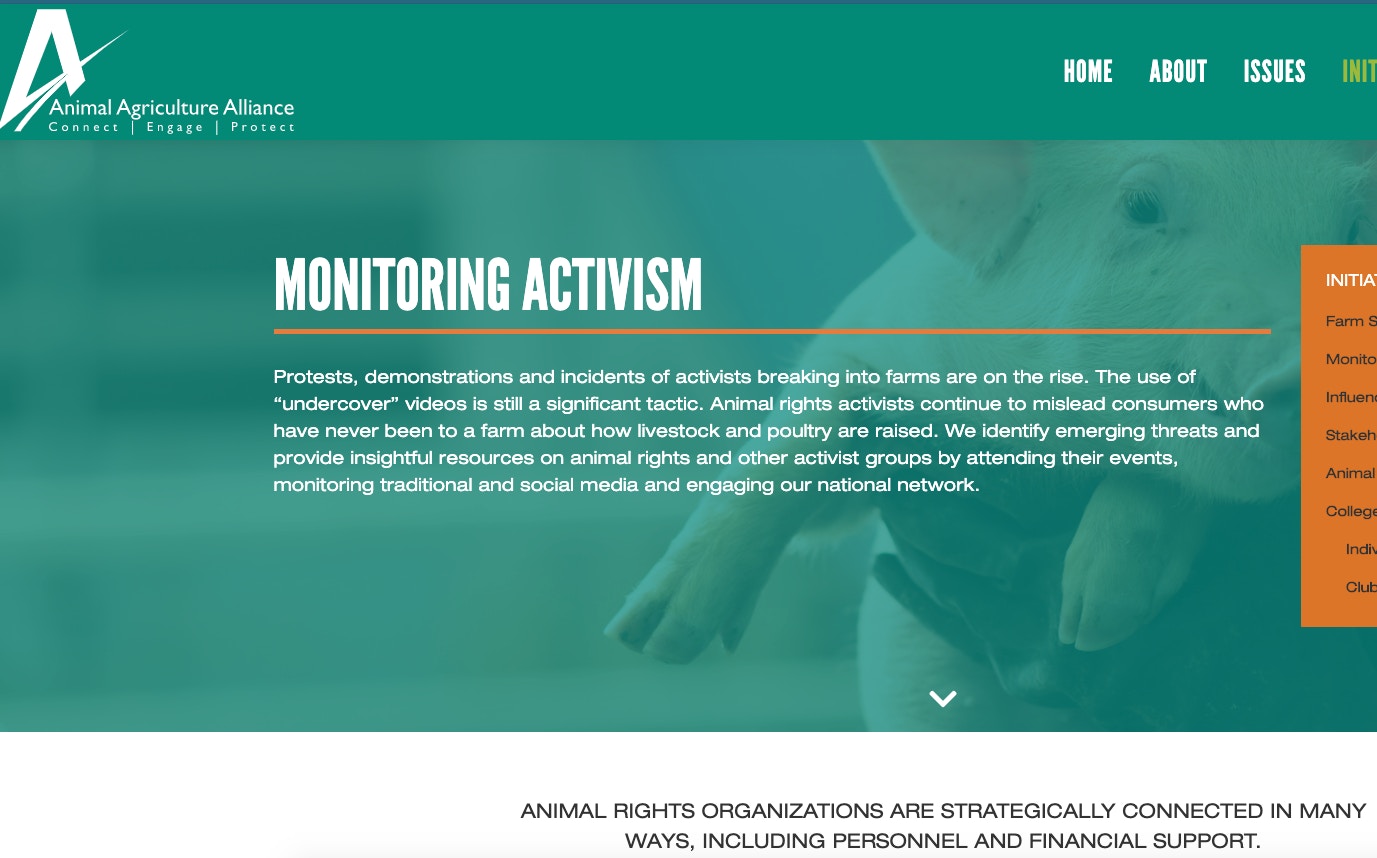
One of the industry groups central to these activities is the Animal Agriculture Alliance, which represents factory farms and other animal agriculture companies — or, as they playfully put it, they work for corporations “involved in getting food from the farm to our forks!” The group boasts that one of its prime functions is “Monitoring Activism,” by which they mean: “We identify emerging threats and provide insightful resources on animal rights and other activist groups by attending their events, monitoring traditional and social media and engaging our national network.”
Indeed, the Alliance frequently monitors and infiltrates conferences of industry critics and activists, then provides reports to their corporate members on what was discussed. As The Intercept previously noted when reporting on felony charges brought against animal rights activists with Direct Action Everywhere, or DxE, for peaceful filming and symbolic animal rescues inside one Utah farm that supplies Whole Foods and another owned by Smithfield — an action that showed how wildly at odds with reality is the bucolic branding of those farms — the Animal Agriculture Alliance issued a statement denouncing the activists for (ironically) harming their animals and urging law enforcement and “policymakers” to intervene on behalf of the industry against the activists.
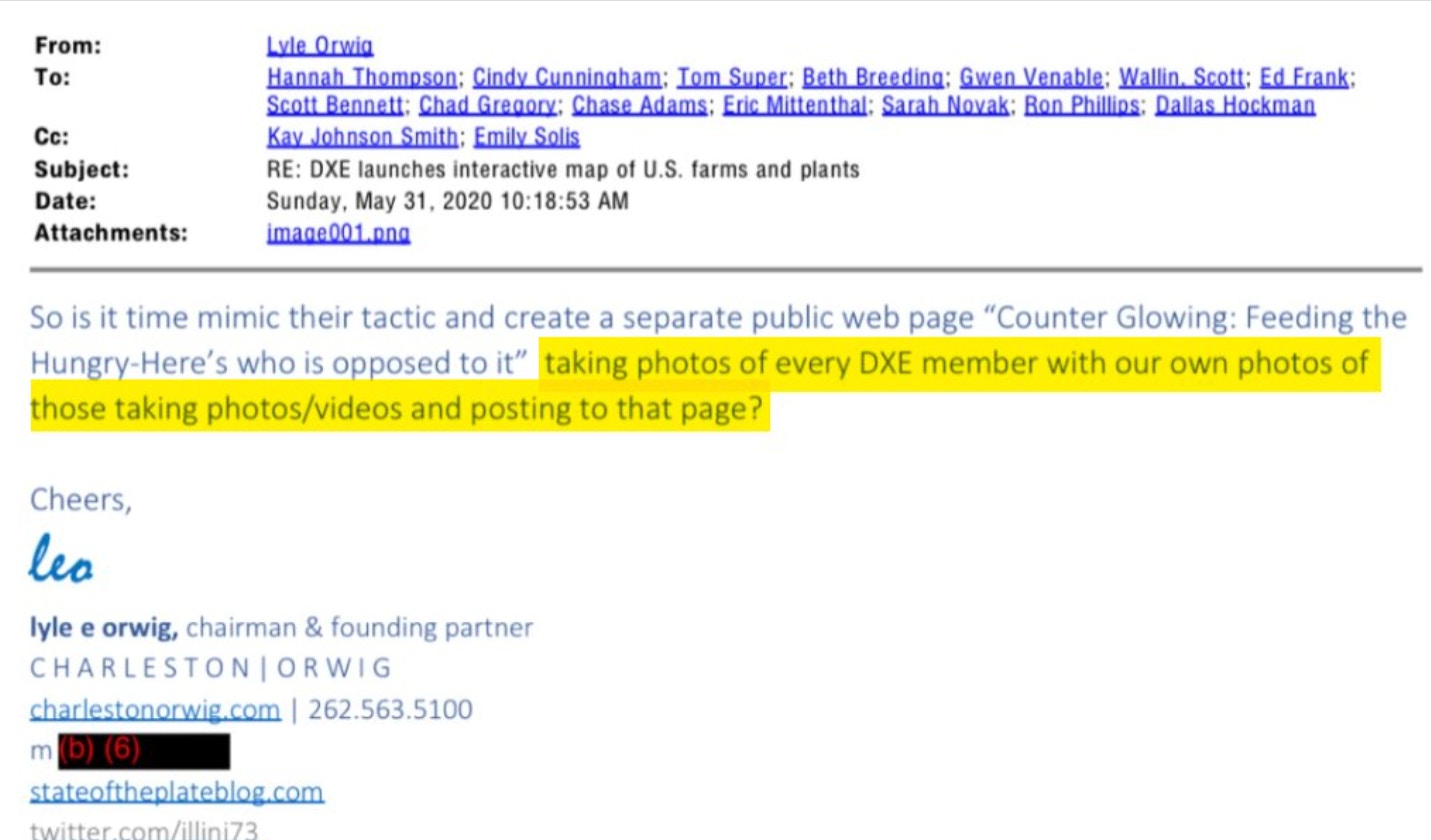
In the emails obtained by the FOIA request, the Alliance and its allies frequently encourage their members to alert the FBI and Department of Homeland Security regarding actions by activists. In response to a project by DxE to create a map tracking factory farms, Lyle Orwig — chair of the agricultural company Charleston/Orwig, Inc. and a member of the Alliance board — proposed the retaliatory step of “taking photos of every DXE [sic] member” and posting them to the internet while accusing them of being “opposed to feeding the hungry.”
ONE PERSON SINGLED OUT for retaliation in these discussions was a popular, respected Bay Area veterinarian, Dr. Crystal Heath. As a local CBS affiliate television profile of her explained, Dr. Heath is the kind of veterinarian who we all as children are taught to admire.
Rather than working for corporations or state agencies engaged in cruel animal experimentation, or for factory farms making a large salary to provide the veneer of medical justification for their barbaric, torturous practices, Dr. Heath has devoted herself to shelter medicine, working for years with the Berkeley Humane Society and other nonprofit animal rescue groups, where she “has spayed and neutered more than 20,000 animals.” The CBS broadcast report provides a full picture of the humanitarian and self-sacrificing nature of her work.
But to the Animal Agriculture Alliance and its industry allies, Dr. Heath somehow became a grave danger, an “extremist” whose name needed to be circulated within her profession as someone to be aggressively shunned. And that is exactly what they did. What prompted this targeted campaign against her was nothing more than her use of her veterinarian expertise to express criticisms of industry abuses and excesses.
In May, The Intercept reported on a gruesome mass-extermination technique being used by Iowa’s largest pork producer, Iowa Select Farms, to kill large numbers of pigs which were deemed unnecessary and in need of “depopulation” due to the pandemic. The technique, called “ventilation shutdown,” or VSD, involves cutting off the air supply in barns and turning up the heat to intense levels so that “most pigs — though not all — die after hours of suffering from a combination of being suffocated and roasted to death.” The pigs who survive this excruciating ordeal are then shot in the head in the morning by farm employees. A video report produced by The Intercept and the video documentarian Leighton Woodhouse — based on footage obtained inside an Iowa Select barn by DxE as the pigs were slowly dying — was viewed by more than 150,000 people.
Numerous veterinarians were shocked by the use of this unspeakably cruel and gratuitous mass-extermination tactic, which imposes extreme, protracted suffering on highly intelligent, socially complex, sentient animals. And it created serious problems for the industry, with McDonald’s demanding an explanation it could use publicly, and even discussions — from the National Pork Producers Council — to invent a new, more pleasant and euphemistic name for the extermination technique:
One of the veterinarians indignant about ventilation shutdown extermination programs was Dr. Heath. She was part of a group of hundreds of her veterinarian colleagues to launch a campaign urging the American Veterinarian Medical Association to withdraw its approval of the use of this technique in limited, proscribed circumstances. Though the AVMA says it was not involved in the specific use of the extermination technique by Iowa Select, its guidelines approving of VSD were, as The Intercept documented, cited as justification by the company and its allies.
Dr. Heath was quoted in one news report on the controversy as saying: “I believe the majority of AVMA members do not approve of VSD except as a ‘last resort’ depopulation method and AVMA intended VSD to be used only in extreme conditions of infectious or zoonotic disease outbreaks or natural disasters. AVMA approval has allowed pig and poultry producers to use VSD as a cost-savings procedure to cheaply destroy unprofitable or excess animals.”
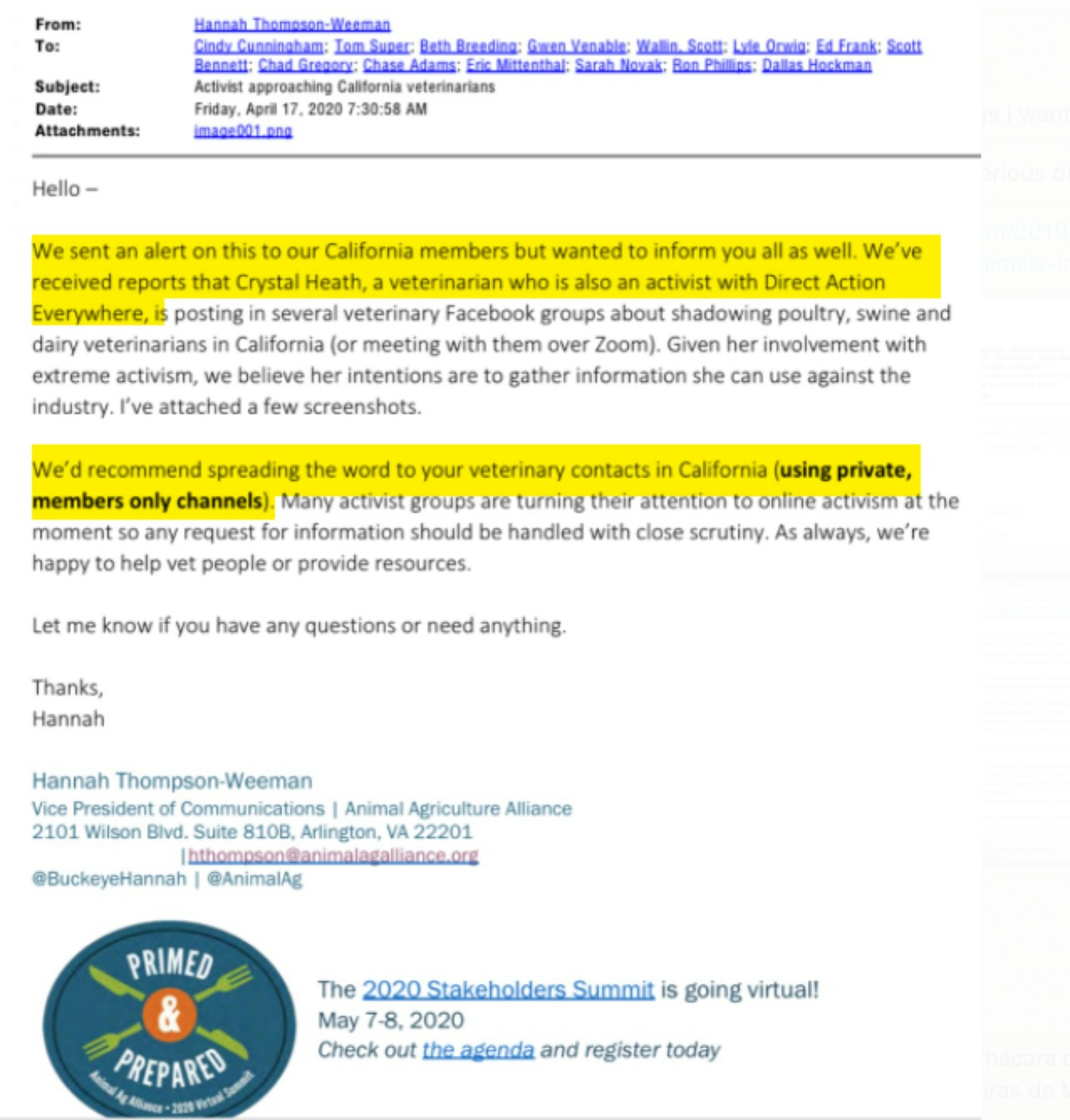
Due to her criticisms of these factory farm practices and her work with DxE in advocating industry reform, industry groups focused on her. In one email from April, a vice president of the Animal Agriculture Alliance, Hannah Thompson-Weeman, revealed that an “alert” had been sent about Dr. Heath to California members, accusing her of engaging in “extreme activism” and encouraging groups to “spread the word to your veterinarian contacts in California” — where Dr. Heath practices — “using private, members only channels.”
Following that “alert,” Dr. Heath began experiencing targeted campaigns against her online and within her profession. Though it cannot be proven that this was the result of the Alliance’s “alert,” what began happening to her for the first time in the wake of that alert tracked the language used against her by these industry groups. (The Alliance and Thompson-Weeman did not respond to The Intercept’s request for comments. Thompson-Weeman locked her Twitter account yesterday after we previewed this article and the SYSTEM UPDATE episode. The AVMA has denied that it was involved in Iowa Select’s use of VSD.)
What perhaps alerted the Alliance was one veterinarian group that accused her of being “part of an active campaign to cause as much harm as possible to our clients and ourselves,” announcing that they had alerted the Alliance about her. Veterinarian groups on Facebook posted their own warnings about her, and she was banned from some groups. Comments began appearing on her own Facebook page, purportedly from other veterinarians, accusing her of “deranged activism,” being “a liar who makes up stories,” “bastardizing our profession through every available method,” and claiming that she is “literally, by name, a topic of conversation in board rooms from Ag business to organized veterinarian medicine across the nation. Your name is literally toxic.”
What alarmed Dr. Heath most was the emergence online of anonymous flyers which contained a “BEWARE” warning at the top, along with her photo and a string of accusations, some of which were false, that claimed she harbors “an agenda that doesn’t include anything positive for our profession” and “expresses fondness” for “domestic terrorist organizations.” It warned that even allowing her access to the social media pages of veterinarians could be dangerous, and thus urged that she be blocked from all online forums, personal profiles, and social media groups.
It goes without saying that this sort of a campaign could be devastating to the career opportunities or ability to earn a livelihood of any veterinarian. Fortunately for Dr. Heath, she believes her hard-earned reputation with area clinics developed over many years will enable her to continue to work, but she believes, for very good reason, that “alerts” and campaigns of this sort would make it extremely difficult if not impossible for her to find work anywhere else. For a younger or less-established veterinarian seeing what was done to her, they would obviously think twice about speaking out or working against the factory farm industry, the obvious goal of such campaigns.
That the U.S. Department of Agriculture was in possession of the emails and other documents circulated by industry groups, and thus produced them as part of the FOIA request, indicates that, at the very least, government officials are being included in these discussions (the flyer about Dr. Heath and other social media postings regarding her were obtained by The Intercept from Dr. Heath, not by the FOIA request). What is clear is that the animal agricultural industry essentially operates their own private surveillance and “warning” networks, and uses their extensive influence within the halls of government power to aid their efforts to punish and retaliate against its critics and activists.
Dr. Heath is my guest on this week’s SYSTEM UPDATE. The episode, which can be viewed on The Intercept’s YouTube channel or on the player below, first reviews these new documents in detail obtained by the FOIA request, and I then speak to Dr. Heath about what she has endured as a result of her speaking out against this very powerful industry.
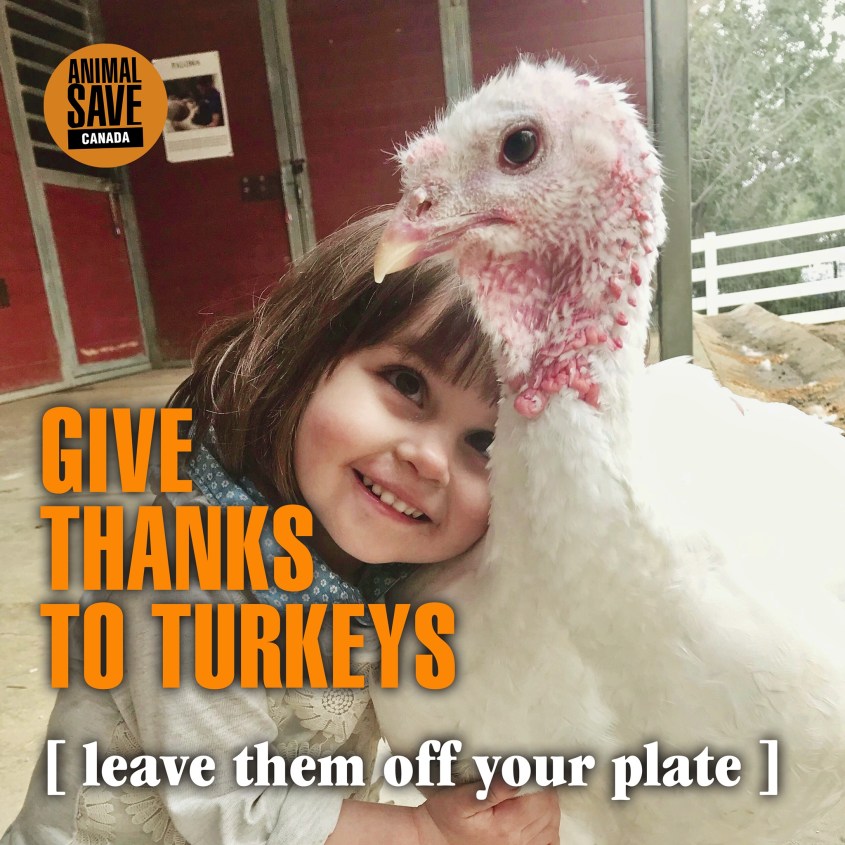
Tomorrow, on the second Monday in October is #Thanksgiving in # Canada.
Benjamin Franklin wrote that in comparison to the bald eagle, the turkey is “a much more respectable Bird, and withal a true original Native of America…He is besides, though a little vain and silly, a “Bird of Courage.”
Turkeys are intelligent and sensitive animals that are highly social. They create lasting social bonds with each other and are very affectionate; rather similar to dogs.
Turkeys are native North Americans.
European immigrants killed the abundant numbers of wild turkey written about in early historical accounts declined with colonization until they were nearly wiped out.
To this day we continue to massacre turkeys by the millions in the name of “Thanksgiving”.
Last year, 20 million turkeys were killed in Canada for their flesh that we don’t need.
Most of them were condemned to shortened lives of misery in crowded and filthy warehouses.
Give thanks to turkeys and all beings this Thanksgiving by taking them off your plate.
Animal Save Movement Canada
And I mean…What does a Thanksgiving symbolize?
Gratitude.
If this is connected with the mass murder of animals, then we remember archaic, prehistoric rituals when people wanted to thank their gods and sacrificed animals for it.
Since then, we mean that we have developed.
Therefore, such a “thank you” has nothing to do with gratitude or social culture.
It is a mass murder in the name of an outdated tradition and therefore perpetuates primitive man’s culture.
Canadians: Take a nice walk in nature that day, or play football and let the corpses of the animals out of your plate!
Your health would thank you for it, your conscience, and above all the animals.
The law requires animals in the EU to be effectively stunned before slaughter. However, exceptions are made which permit some religious communities to slaughter without pre-stunning. This applies to slaughter by the Jewish method (Shechita) or by the Muslim method (Halal).
Compassion believes there should be no exemptions, and the law should be changed to require all animals to be effectively stunned before slaughter, regardless of the slaughter method that is then used (this also applies to mis-stunning in conventional abattoirs). We also believe that all slaughterhouses should have CCTV installed in order to assist with the monitoring of slaughter and to help prevent cruelty.
Loop-holes, poor enforcement, and a lack of suitable legislations can all impact the welfare of animals at the time of slaughter.
There are a range of serious welfare concerns currently affecting vast numbers of animals across Europe.
Derogations to EU law allow animals to be slaughtered without pre-stunning for consumption by the Jewish and Muslim community. Slaughter without effective pre-stunning causes unacceptable suffering.
In the EU around 1 billion chickens a year areineffectively stunned prior to slaughter. They experience an agonising electric shock that fails to properly stun them followed by the full pain and fear of being slaughtered while fully conscious.
It is becoming increasingly common across Europe to use high concentrations of CO2 gas to make pigs unconscious prior to slaughter. CO2 gas results in a burning and then drowning-like sensation and can cause around 15-30 seconds of very severe suffering prior to the pigs losing consciousness.
Every year over 2 million animals are exported live out of the EU. They are sent to countries where they receive no legal protection at the time of slaughter. Many face agonising, drawn out slaughter.
Roughly 1 billion fish are farmed and slaughtered in the EU each year. Most are slaughtered in ways that are inhumane and illegal. EU law requires fish to be spared avoidable suffering at slaughter. The technology exists to make fish unconscious prior to slaughter, but instead the vast majority are left to suffocate or killed while fully conscious in ways that cause immense suffering.
It has become apparent that huge numbers of animals in the EU – roughly 18% of all sheep, and 27% of all goats – are not killed in official slaughter houses. This means that their slaughter goes entirely unregulated, and much of this is likely to be inhumane.
Nine out of 10 EU citizens oppose animal slaughter without stunning, poll finds
Survey comes as ‘ritual slaughter’ legal case moves through European courts and Polish government proposes restrictions
Nine out of 10 EU citizens want their governments to ban the slaughter of animals that have not been stunned, according to a poll published today.
The results of the survey, carried out for the animal welfare campaign group Eurogroup for Animals, will feed into a cross-Europe debate about so-called “ritual slaughter” – the killing of animals in line with rules of religions such as Judaism and Islam for kosher and halal meat, respectively.
Some countries, including Slovenia, Finland, Denmark and Sweden, as well as the Belgian regions of Flanders and Wallonia, have already adopted stricter rules, with no exceptions to the mandatory stunning of animals before slaughter.
In Poland, the rightwing coalition government led by the Law and Justice (PiS) party has proposed limiting the practice to the needs of religious communities within the country. That would put an end to Poland’s large halal and kosher meat exports industry.
A legal case over the compatibility of the Flemish ban on slaughtering without stunning with EU law is proceeding through the European courts. An opinion published in September by the advocate general Gerard Hogan of the Court of Justice of the EU (CJEU) rejects the ability of member states to prohibit slaughter without stunning and implement reversible stunning (which disrupts brain function for a short time). The CJEU’s final decision is due at the end of this year.
In the poll, carried out by UK-based Savanta ComRes, 89% of 23,000 EU citizens surveyed said it should be mandatory to make animals unconscious before they are slaughtered. About as many, 88%, said that animals should be made unconscious before being slaughtered even for religious practices. And 90% of respondents believed that EU countries should retain the right to introduce stricter measures to better protect animals during slaughter.
“EU citizens want animals to be properly stunned before being slaughtered and clearly want member states to be able to introduce stricter legislative measures to protect animal welfare,” said Reineke Hameleers, chief executive of Eurogroup for Animals.
New Zealand banned slaughter without stunning in 2010 and made reversible stunning mandatory. Reversible stunning, or electronarcosis, is a way of stunning animals via electric shock that makes them unconscious for a short period of time, regaining consciousness if they are not slaughtered. The meat produced is certified as halal by religious communities within New Zealand, and recognised as such by communities in Malaysia, India, the Middle East, Canada and China.
Some religious groups have voiced concerns about the proposed changes in law in Europe. Mufti Tomasz Miśkiewicz, head of the Muslim Religious Union in Poland, said: “Halal isn’t just about food, it’s also about religion. The main problem with the proposed bill is that it effectively curbs Polish Muslims’ religious freedoms. The bill proposes that ritual slaughter will be allowed if it serves the community only. But how are you going to know exactly what the needs of the community are at any given time? That’s not anything veterinary inspectorates will know.”
“The law should protect and care for everyone regardless of their nationality or religion. Democracy is about protecting one’s rights.”
Jonathan Ornstein of the Jewish Community Centre in Kraków, Poland, said that if export of kosher or halal meat was made impossible, producers might stop producing it because doing so would not make economic sense, as the economy of scale would be gone. “Without kosher meat sourced locally, we would need to buy imported meat, which would dramatically increase the cost.”
He is a vegetarian, but stressed the cultural importance of kosher meat for the Jewish community.
Agriculture Minister of Lower SaxonyBarbara Otte-Kinast tearfully informed the Lower Saxony state parliament about the catastrophic situation of pig farmers:
“I get phone calls from crying women and men on the farms who no longer know what to do. They say: I’ll kill my pigs and I’ll kill myself. “ (!!!)
The politician even had to briefly interrupt her speech.
“From many personal conversations I know that animal keepers in Lower Saxony are very desperate,” reports the Minister in an extremely emotional speech to the state parliament.
“I get phone calls from crying women and men from the courtyards who no longer know what to do.”
Overall, there could be a lack of slaughtering capacity for 120,000 pigs a week. Emergency slaughter threatens.
In order to be able to comply with pandemic plans, Lower Saxony now wants to introduce flexible working hours for companies.
According to the Minister of Agriculture, consideration is also being given to slaughtering and dismantling on Sundays and public holidays.
5200 farms in Lower Saxony are already threatened by swine fever
The penetration of African swine fever into Germany is a major economic concern for pig farmers in Lower Saxony.
The Association of Producer of Cattle and Meat set the producer price for pork anew and lowered it from 1.47 euros by 20 cents to 1.27 euros per kilogram. In the case of a fattening pig, the loss in value is around 20 euros.
Export stops for pork to non-EU countries, especially to China and Japan, are the catastrophic consequences.
Nowhere in Germany is the pig industry bigger than in Lower Saxony. According to the Ministry of Agriculture in Hanover, there are 5200 farms with 8.3 million animals.
The German pig farmers’ association puts the turnover in Lower Saxony at around 3.5 billion euros in good years.
And I mean…Germany has lost its “disease-free” status.
And the farmers complain again, they now appear as victims, they even threaten that they will kill themselves.
Only when they actually do it will their sins be forgiven. For the fact that they torture the pigs and treat them like objects until they die.
And for the brutal slaughter of the animals too, in this crime, they also share the blame.
It is not the death of the animals that is a problem for the farmers but that they do not benefit from it.
Pigs are killed very early for meat production even without an ASF outbreak.
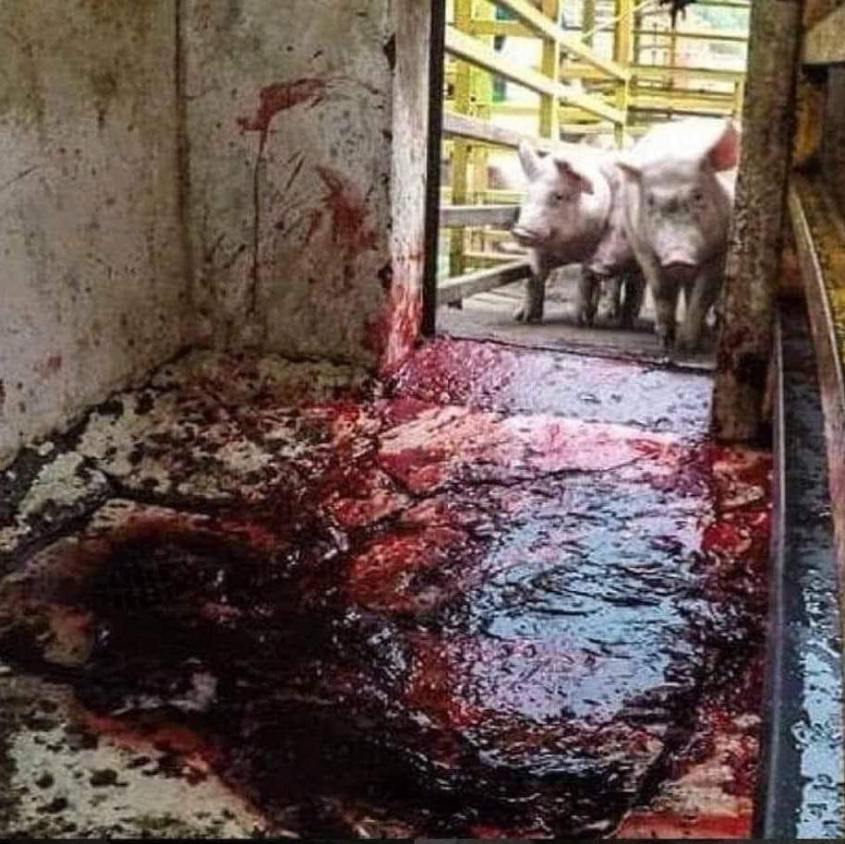
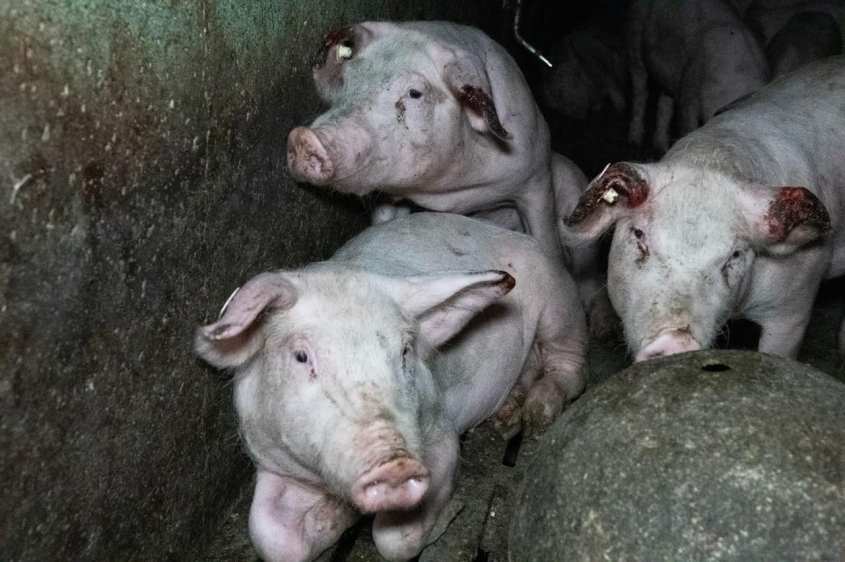
In order to produce a large amount of cheap meat for China, most animals are kept in appalling conditions: in their excrement with open, inflamed wounds, we remember the brutal videos.
The farmers should also kill themselves for this.
What the farmers fail to mention is that most pigs suffering from these common (but illegal) conditions become weak and susceptible to any virus, one of which is the highly contagious ASF.
Hypocrites, slave keepers who make money from the suffering of animals, and the lobbying of corrupt politicians!!
They finally still have time to do something sensible.
Either kill themself or produce potatoes and corn instead of animal corpses.
BBC news sheds light on UK calves exported to the Middle East
8 October 2020
Animals International
Eurogroup for Animals’ member organisations, Animal Welfare Foundation (AWF) and Animals International, gathered footage this summer, which for the first time confirmed that UK calves exported to Spain, are often shipped to the Middle East for slaughter.
With segments on Radio 4’s Farming Today, BBC 2 News, and the BBC News Channel, the BBC has released evidence gathered over the summer by Eurogroup for Animals’ members Animals International and the AWF.
Despite the UK’s claim of not exporting animals for slaughter purposes and the active campaign carried out by Compassion in World Farming (CIWF) to Ban Live Exports, the investigations carried out by Eurogroup for Animals’ members clearly show that it happens to UK animals to end up in Third Countries’ abattoirs.
Indeed, the footage shows that calves exported on long journeys from the UK (Northern Ireland) to Spain to be fattened for beef are often then exported on further journeys to the Middle East.
“We found animals with UK earring tags being slaughtered in Lebanon as well as a UK bull at the harbour in Cartagena (ES) ready to be loaded on a vessel headed for Libya”, said Gerit Weidinger, EU-Coordinator Animals International that for many years has investigated the awful conditions of the EU animals in Third Countries’ abattoirs. The footage published by BBC shows animals being thrown onto the floor and being dragged or suspended by their limbs while still conscious.
The UK currently exports some animals for breeding. Unweaned male calves are considered by-products of the dairy industry and their transport is particularly problematic because of the extremely fragile conditions of these young animals and their needs. AWF has been working on this issue for many years and restlessly reported about the animal welfare issues behind this trade. Only in 2019, the UK exported around 17,000 calves to Spain, the majority from Northern Ireland. Once reached Spain these animals are typically fattened on farms before being slaughtered or re-exported. In June this year, AWF filmed a UK calf being moved outside of its pen and left to die. “The calf was suffering from a respiratory illness, which is common after long, stressful journeys with little food or milk replacement”.
To avoid animal suffering and avoid the law being circumvented, it is key to stop any EU and UK export to non-EU countries
England – From friend Mark Glover at ‘Respect for Animals’; fighting the international fur trade.
Israel plans to BAN the fur trade
Israel says it intends to ban the buying and selling of animal furs, apart from in specially approved cases, making it the first country to do so.
Announcing plans for new regulations, environmental protection minister Gila Gamliel said the use of skin and fur for the fashion industry was “immoral”.
Several cities – in the US, and São Paulo in Brazil – have banned the sale of animal fur. The state of California passed legislation to ban fur last autumn.
At present, anyone in Israel wishing to buy or sell fur must apply for a permit, but under the new rules this will only be allowed in cases of “scientific research, education or for instruction and for religious purposes or tradition”.
“The fur industry causes the killing of hundreds of millions of animals around the world, and involves indescribable cruelty and suffering,” said Ms Gamliel.
“Utilising the skin and fur of wildlife for the fashion industry is immoral.”
Anyone found breaking the law in Israel will face a fine of up to £17,000 or a year in prison.
The announcement was praised by Blue and White MK Miki Haimovich, a known advocate for animal rights who also chairs the Knesset’s Interior and Environmental Affairs Committee.
“Wearing fur should completely disappear from the world, as in this age there is no justification for killing animals just for the sake of wearing their fur for fashion or for heating. There are excellent substitutes that do not cause suffering and murder,” Haimovich said in a statement.
Animal Outlook investigator reveals her identity and exposes the truth behind the closed doors of the dairy industry.
After a two-year career working undercover inside several factory farms, Animal Outlook investigator Erin Wing now reveals her identity, stepping out of the shadows to shine a light on the stomach-churning horrors she witnessed at her most recent — and last — investigation at Dick Van Dam Dairy, a factory farm in Southern California.
While there, Erin documented some of the most egregious cruelties she has seen in her career, along with barbaric (yet standard) dairy industry practices. She was also able to rescue a calf who now lives at a sanctuary (more on the calf rescue below).
What Erin witnessed was one of many dairy farms in its death throes with innocent cows caught in the middle of a battle between a world progressing and an industry fighting tooth and nail to keep us entrenched in the past.
This shocking footage underscores the urgency to end this inherently cruel industry once and for all. It’s time for consumers to ditch dairy, and for companies like Dean Foods to pivot to vegan products.
Animal Outlook’s undercover footage revealed:
• Cows so sick or injured they are unable to walk subjected to extremely cruel treatment by workers who sprayed them in the face with high powered water hoses; kicked, jabbed and shocked them; and closed metal gates on them.
• Workers routinely lifting these so-called “downer” cows with a tractor and dragging them with a metal device called a “hip clamp.” They lifted one suffering cow this way and dangled her almost 20 feet in the air to move her over a wall, and then dragged her backward over a cement slab.
• Sick cows left to suffer without medication, veterinary care or euthanasia. They languished for days until they died on their own, with no access to food or water while they were unable to stand.
Workers and a manager hitting cows with wooden canes and metal pipes in daily acts of extreme aggression and violence, sometimes as a form of retaliation against the animals.
• Workers and managers punching and kicking cows, and twisting their tails.
• Squalid and filthy conditions – cows forced to walk through thick feces and newborn calves unable to escape thousands of flies covering their fragile bodies.
• Shocking mortality rates of cows and calves, as well as high rates of injuries and illnesses – likely resulting from the putrid conditions and lack of care and treatment. One calf was born dead, and was pulled roughly from his or her mother. The mother cow didn’t have the benefit of pain management during this incredibly painful and rough incident.
• Cows repeatedly shocked with an electric prod as they were taken away to slaughter.
• Workers cruelly using automated gates to try to force cows to move in tightly packed spaces.
Turning hidden cameras into instruments of truth, undercover investigators are on the front lines of justice for animals — and consumers. Erin’s courage resulted in hidden camera footage that is changing the way the world sees what — and who — they’re eating. And the against-all-odds rescue of two young calves.
In more ways than one, dairy is dead on arrival. Cows must be pregnant in order to produce milk, so calves are mere byproducts to the industry. At Dick Van Dam, a slow and painful death was commonplace for calves. In one instance, a stillborn calf was pulled violently from his suffering mother. Many living calves were simply left in the hot California sun, covered in flies and slowly dying.
Meanwhile, consumers are slowly but surely realizing that the milk they drink does not come from happy cows, but relies on the broken bond between mother and child, and the violent exploitation of these individuals’ bodies. The dairy industry is dying, but not fast enough.
We also followed a truck carrying so-called “spent” cows from the factory farm to a stockyard. Later, we documented trucks going from that stockyard to American Beef Packers (ABP), the site of the former Westland/Hallmark Beef Packing plant that closed down after issuing a massive beef recall following the Humane Society of the United States’ 2008 undercover investigation, raising the question of whether this facility’s cows are ending up killed at this infamous site. ABP currently sells beef to the federal government for its National School Lunch Program.
Animal Outlook submitted investigative materials to county law enforcement agencies. Despite our overwhelming video evidence depicting dozens of apparent violations of California’s laws against animal cruelty and neglect, local law enforcement declined to recommend criminal charges. However, we are still actively pursuing justice for these animals through other means. And after reviewing the investigation, the Animal Legal Defense Fund filed a lawsuit against Dick Van Dam Dairy and the individuals caught on camera for violating state and local animal cruelty laws.
“We love our animals”
… Farmers always tell us this when another animal scandal is uncovered.
Then listen to this tiny baby goat cry out in pain as the farmer pushes a red-hot metal stick into her head.
It has nothing to do with love. In technical jargon, this is called “dehorning”.
It is done to prevent the horns from growing. Of course without anesthetics, of course without painkillers, in order to have no costs for an animal.
That is peasant love!
Their brothers and sisters crouch in the corner and witness the traumatizing process before their turn. This procedure is standard around the world.
Rock the Natur, Germany
And I mean…The reason that the farm animal lives at all is for any kind of satisfaction of human animals: if an animal is needed to eat, it is allowed to live. But if it is no longer needed, then it must not live. The slaughter comes then.
And no! humans have no right to decide that animals must be tortured and killed for their consumption.
That has always been the cornerstone of any fascist system.
So … do the carnivores claim that they don’t have to give a reason why animals are forcibly impregnated, imprisoned, deprived of their children, exploited, tortured, and killed when they are not productive? Seriously?
This is what you get from raising consumers and system servants instead of compassionate people.
At birth, every person has only positive qualities, such as love, honesty, justice, etc.
But the system does not benefit from it and breeds its members to be indifferent racists, speciesists, in a word: the system breeds us to be fascists against the “other” animals.
Mr. H. is a farmer official, local mayor, and pig farmer in the district of Rottweil, in southern Germany.
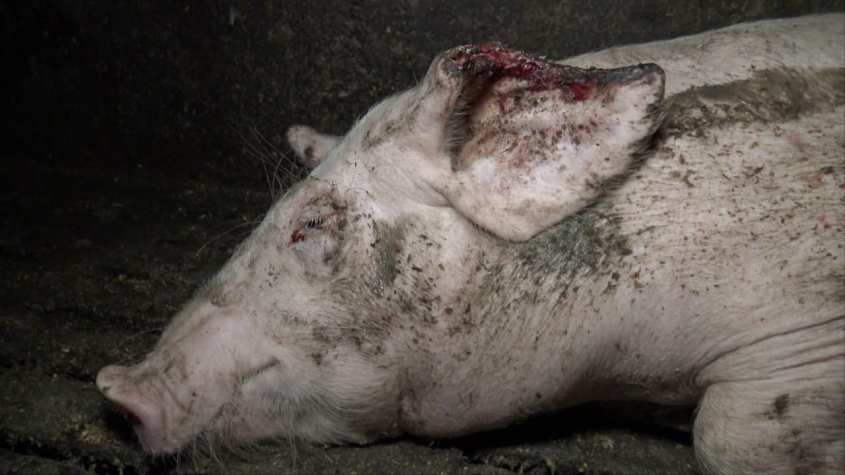
In his “animal welfare” breeding stables horrific conditions prevail: Hundreds of injured animals, many with the most severe mutilations, as well as countless sick animals – expressly not isolated.
Weak animals are eaten alive by their stressed conspecifics, carcasses are torn to pieces and the dead bodies of the pigs are piled up in the barn.
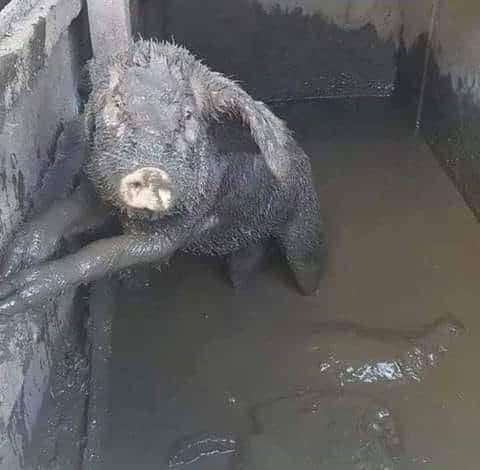
In the area of the breeding sows, animals were squeezed in cramped crates in a watery fecal broth.
In the barn, there were dying and very emaciated animals, such as piglets or a breeding sow covered in wounds, and seriously injured young pigs.
The farmer abused pigs he was captured by a hidden camera.
He carries them around on one foot, hits them, and throws the animals. The stable is filthy, full of flies and excrement.
The farmer’s lobbyist likes to appear in the media and especially to show up with prominent politicians like Agriculture Minister Hauk, Federal Agriculture Minister Klöckner, and also green politicians.
(In order to understand the extent of the animal suffering in this video, nobody needs the German language. The horror pictures, the shameful grievances speak for themselves)
And here the political site!
The scenes of pigs awakening from the stupor and brutally abused in that slaughterhouse were almost unbearable and led to the slaughterhouse being closed at the beginning of September and massive criticism of the Böblingen district.
After the publication of the documents from the above-mentioned period, it was publicly proven that Minister Peter Hauk had stopped the measures ordered by the responsible veterinary office to remedy these abuses.
Minister Peter Hauk has thus been guilty of criminally relevant aid. “He accepted animal cruelty in order to protect the slaughterhouse boss and party member Dengler,” said Mülln.
This view is also shared by the German Legal Society for Animal Welfare Law and announced in a press release on October 5th, 2020 that it had filed a criminal complaint against the Minister of Agriculture, Peter Hauk.
SOKO Animal Welfare is now also taking legal action against Minister Hauk in the Gärtringen case. “Anyone who promotes animal torment, accepts it by failing to do so, or bends right, receives criminal charges – this also applies to ministers,” confirms the SOKO investigator.
And I mean..a stable out of control! from here, of course, not made in China!
The keeping of pigs under the worst cruel conditions is legal in Germany because our society regards it as absolutely necessary because the dead bodies of these tortured animals should end up on our plates.
In an interview, the affected farmer and animal abusers described the conditions in his barn as basically okay.
When asked how it came about that the animals look like this, he replied: “Because they fought, cannibalism.”!!
And all of this in a country that describes itself as exemplary democratic and animal welfare-oriented.
With one of the best animal welfare laws in Europe, which says … “Nobody may inflict pain, suffering or harm on an animal without a reasonable reason.”
And for this reason, the suffering of animals in factory farming remains enormous and endless.
The animal abusers of the meat industry do not even need a “reasonable” reason for this, a minister finds that for everyone.
As long as the agriculture minister is elected by the meat industry in Germany, nothing will change