Category: Farm Animals

U.S: “Model” high -speed- slaughterhouse: a nightmare!


USDA inspector describes filth and mistreatment at “MODEL”
high -speed- slaughterhouse

Inspector files sworn statement in support oflLegal challenge to pig slaughter deregulation.


USA Flagge
Press release

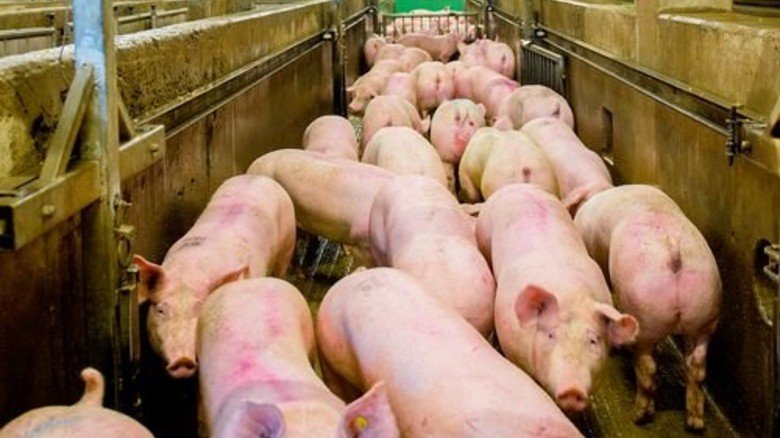
Rochester, NY: A New Trump administration rule that largely deregulates pig slaughter operations will increase fecal contamination; diseased pigs being allowed for human consumption; toenails, hair and abscesses allowed into meat; and animal mistreatment, according to a new sworn statement by a federal slaughterhouse inspector.

schweine in USAjpg

The statement was filed in federal court late last Friday, April 10, in support of a lawsuit brought by seven animal and environmental protection organizations to challenge a U.S. Department of Agriculture (USDA) rule, and comes as slaughterhouses across the country shutter due to COVID-19 outbreaks, including Smithfield Foods’ Sioux Falls, South Dakota plant that is slated to increase line speeds and reduce federal oversight under the challenged rule.

The inspector, Jill Mauer, works inside Quality Pork Processors, a large Minnesota slaughterhouse that has served as a model for the USDA’s controversial move to reduce oversight of pig slaughter nationwide.

schwein. USjpg

In December, the Animal Law Litigation Clinic at Lewis & Clark Law School filed a lawsuit challenging the rule in federal district court for the Western District of New York in Rochester.

The plaintiffs are Farm Sanctuary, Animal Equality, Animal Legal Defense Fund, Animal Outlook, Center for Biological Diversity, Mercy For Animals, and North Carolina Farmed Animal Save.

The Center for Biological Diversity and Earthrise Law Center at Lewis & Clark Law School serve as co-counsel in the case.

The USDA recently asked the court to dismiss the challenge, arguing that the rule’s harms are speculative—even though the agency itself determined that slaughterhouses responsible for 93% of pigs killed for food in the United States will take advantage of the rule, and will slaughter about 11.5 million more pigs annually.

Schweine-in-den-USA

In response, the plaintiffs on Friday fired back with a legal brief detailing why these harms are imminent. The brief was supported by a declaration from veteran USDA inspector Jill Mauer, which was obtained with the help of the whistleblower advocacy organization Government Accountability Project Food Integrity Campaign.
Mauer, who has worked under both the traditional inspection system and the deregulated system notes that under the deregulated system:

-Line speed increases consistently resulted in a greater number of hogs slaughtered daily and annually.
-Citations for fecal contamination have increased, exacerbating food safety concerns.
-Defects including toenails, hair, and abscesses are routinely allowed in meat intended for human consumption.
-Diseased pigs, including those with conditions that can trigger serious health problems in humans, have been allowed for human consumption.

schweine-stv

She has regularly observed pigs who were “driven to move faster than a normal walking speed, workers who have raised their paddles over their heads to strike the hogs, hogs vocalizing (a sign of stress) while moving, and heavy crowding of hogs.”

60361379_470564067050093_5629130201385402368_n
She has seen an increase in pig carcasses with scalding tank water in their lungs—an indication that they may have still been breathing when dropped in the tank.

The concerns set forth in her statement go beyond those that she expressed when featured on NBC late last year.
“The conditions Ms. Mauer observed are straight out of a nightmare,” says Sarah Hanneken, legal counsel for plaintiff Animal Equality. “But it isn’t a nightmare, it’s reality—a living nightmare for the animals and workers exploited at these facilities.”

60257546_884148911923358_2137264327369949184_n_002

As Delcianna Winders, who directs the Animal Law Litigation Clinic and, with her students, represents the plaintiffs, notes, “This inspector’s statement makes clear that this deregulatory rule sentences untold numbers of pigs to being beaten in an effort to keep pace with ever-increasing kill lines, and to have their throats slit and possibly even be boiled while still fully conscious. It also ensures that the number of potentially life-threatening pork products on the market will increase.”

“Ms. Mauer’s chilling observations of the increased harms to hogs and risks to human health drives home why this rule must be reversed,” said Hannah Connor, an attorney at the Center for Biological Diversity representing the plaintiffs. “Increasing slaughter line-speeds at these dangerous facilities will cause more animal suffering and pollution, degrade ecosystems, and speed the extinction crisis.”

slogan über schlachthof

Mauer’s attorney, Amanda Hitt of the Government Accountability Food Integrity campaign, added, “Jill is just the tip of the iceberg. Many more meat inspectors have reached out to my office echoing the same and more concerns about the new inspection system.”

The USDA has until April 24 to respond to this new filing.


https://animalequality.org/news/animal-equality-continues-to-push-back-on-usdas-controversial-slaughterhouse-rule/


My comment: Across the U.S., more than two-thirds of the water is contaminated with agricultural pollutants. Pig breeding in particular has skyrocketed in the past 25 years.

Female pigs are at their limit in the United States. On average, they have to give birth to 23 piglets a year. Their body can no longer withstand this. Sows mortality is increasing rapidly. It has almost doubled in the past three years!

Germany is the world’s third largest producer of pork – with 57 milion pigs in the year- after China and the USA.

As long as politics deliberately refuses to ban the production and trade of animal cruelty in factory farming, only the consumer can initiate change.

Those who boycott animal products and, instead of these, buy animal-friendly products damage the bloody business of traders and producers in the animal industry.

If no meat, milk and egg-containing products are eaten, the fewer animals are tortured (at least in the long term).
This is not even difficult, because today there is a wide range of animal-friendly and delicious plant-based products. They are now available in every supermarket.

schweine in ChinaThis picture is from 2007 and belongs to a report about a mysterious pig death in southern China:

“An unknown disease had killed hundreds of pigs at the time, the cages are indeed transport cages, probably to minimize contact”.

This is not how we, human animals, have been treated to minimize the risk of corona transmission.
Wherever in the world, animals have no rights and if epidemics like Corona break out among them, they are treated like a piece of shit.

My best regards to all, Venus

Germany: The execution of the wolves is canceled

banane rep deutschlandpg

A while ago we reported on the minister’s shameful decision in Lower Saxony, Germany.
Under great pressure from the farmer and the hunter, three wolves are to be released for shooting, one of which was a female, pregnant wolf. (https://worldanimalsvoice.com/2020/04/08/germany-wolfs-persecution/)

I received very good news today:
The North German Broadcasting (NDR) is reporting that no wolf is being shot in Lower Saxony for the time being.

wolf-

Minister Lies is thus following a “request from the Lüneburg administrative court,” it says.
The Society for the Protection of the Wolf filed a lawsuit against this exception for the execution of the three animals in Lower Saxony and filed a complaint about the shooting of protected animals.
And it worked!

wolf in Niedersachsen

https://www.nord24.de/der-norden/Vorlaeufig-keine-Toetung-von-Woelfen-in-Niedersachsen-40820.html

 
And I mean..Shortly before the decision to execute was made, the Federal Environment Ministry stated clearly and publicly: “The wolf remains strictly protected”!

Shortly afterwards and with a view of Lower Saxony came the press release that the three “problem wolves” are released for shooting.

The “exemptions” had been launched under pressure from farmers and hunters with “favorable” changes in the Federal Nature Conservation Act.

The Minister gave the argument that not just one but two wolf packs were involved in “multiple tears of (allegedly) adequately protected farm animals”.

IIt is so easy today to execute another animal if it tries to survive.
Farmers and corrupt politicians always find an excuse for this.

erscossener Wolf

The farmers will slaughter their animals anyway and get compensation for any loss.
But as long as the farmers slaughter their animals for the money, that’s meat production.
If a wolf tears up a sheep, it is a problem wolf.

At least we won the fight for the lives of these three wolves this time.
We are very happy about it!!

My best  regards to all, Venus

USA: Pig reportedly shot in the face 4 times at the slaughterhouse deserves justice – Petition.

american-flag-120402148


Pig reportedly shot in the face 4 times at the slaughterhouse deserves justice – Petition.


petition 3


Petition Link

https://forcechange.com/558825/pig-reportedly-shot-in-face-four-times-at-slaughterhouse-deserves-justice/


Target:   Martin Dooley, President of JBS USA Pork

Goal: Terminate slaughterhouse workers who allegedly shot an incapacitated pig four times in the head and face.

A pig suffered needlessly when slaughterhouse workers allegedly shot the animal four times in the head and face. The pig was already under control, per reports, and posed no threat or struggle. Demand that JBS USA Pork immediately terminate those who inflicted this apparent cruelty.

At Iowa’s Swift Pork Company’s slaughterhouse, one pig was reportedly shot four times in the head and face before being rendered unconscious. The pig sustained wounds an inch from the right eye, in the forehead, and at the base of an ear. During this time, the worker allegedly left to retrieve more bolt charges and allowed the pig to continue suffering.

This is an unacceptable way to treat an animal, even one intended for slaughter. Humane methods of slaughter are possible and those who do not follow them should not be tasked with taking innocent lives.

Sign the petition and demand that the workers responsible for this apparently inhumane treatment are terminated at once.


PETITION LETTER:

Dear Mr. Dooley,

A pig apparently endured horrific suffering and cruelty at the hands of Swift Pork Company’s workers. Per reports, the pig was shot four times in the face and head before being rendered unconscious- an inch from the right eye, twice in the forehead, and once at the base of an ear.

Pigs are extremely intelligent creatures who are said to value their lives as intensely as humans. Slaughtering them is cruel enough, but they should never be made to suffer needlessly during their transition. I demand that any worker who is proven to not utilize humane methods of slaughter be terminated at once for the benefit of these innocent animals.

Sincerely,

[Your Name Here]


Vietnam: Animals Asia: The 3 Bears Have Been Rescued and Are Now Safe In Sanctuary.

viet nam flag


Watch the arrival and unloading of the bears at the sanctuary here:

https://video-lht6-1.xx.fbcdn.net/v/t42.26565-2/10000000_534114417519184_2416350837377194261_n.mp4?_nc_cat=100&_nc_sid=985c63&efg=eyJ2ZW5jb2RlX3RhZyI6Im9lcF9zZCJ9&_nc_ohc=atVRHeVYH4MAX8Bj95_&_nc_ht=video-lht6-1.xx&oh=33956eb934bb3da4c80df7055b9996c2&oe=5EA5B0CC


You may remember that we put out an appeal recently regarding the really necessary rescue of 3 bile bears – https://worldanimalsvoice.com/2020/04/21/animals-asia-breaking-3-very-poorly-bears-are-being-rescued-can-you-support-with-a-donation-thank-you/

Very sadly, it was known that a 4th bear had very recently died at the same illegal facility.

But we have great news for the remaining bears.


From Animals Asia : 

Yesterday our amazing team saved three bears from a cruel & illegal bile farm. Sadly #Covid19 restrictions meant we couldn’t reach the farm before a fourth bear died. But today is the beginning of Alice, Bân and James’ happily ever after.


In March Animals Asia was approached by the Nam Dinh Province Forest Protection Department (FPD) to urgently rescue four moon bears who were discovered on an illegal farm. However a small rise in coronavirus cases in Vietnam led to a country-wide lockdown that  delayed our chance to rescue these bears. Tragically, during this time one of the four bears on the farm died of unknown causes while the FPD was processing the case leading us to call upon the local FPD ranger’s station to take the remaining three bears into their custody to ensure their safety.

While waiting for the lockdown to be lifted the rescue team closely monitored the coronavirus situation and fortunately there were no reported COVID19 cases in Nam Dinh province leading to restrictions being loosened. Nam Dinh was classified as medium COVID19 risk, which meant that the rescue could be carried out with restrictions, including mandatory masks and a limit on the numbers of people in the rescue team. Other precautions included having the team’s temperatures taken and foreign staff needed to bring their passports to show they had not recently been overseas.

At the crack of dawn on Tuesday our team left the Vietnam Bear Rescue Centre (VBRC) in Tam Dao and drove for three hours to meet the FPD Director in Nam Dinh city at around 8am. The FPD director sent officials to accompany the rescue team to the Giao Xuan Hai FPD ranger station which is roughly another 45km from Nam Dinh FPD in Nam Dinh city.

Our rescue team consisted of our Vietnam Director Tuan Bendixsen, Vet and Bear Team Director Heidi Quine, Senior Vet Surgeon Shaun Thomson, Vet Nurse Kat (Sarah) Donald, Bear Team Supervisor Dao Chau Tuan and Tran Thi Gai, Cao Manh Tien from our Vietnam PR team, and External Affairs Ung Toan The.

Life had been no fairy tale for these three bears, and it was clear by their symptoms of stress when we arrived that they had suffered quite some trauma while captive on the illegal bile farm and possibly in their capture. On inspection they appeared to be quite young bears, leading us to believe that they were captured from the wild and possibly witnessed the death of their mother while cubs.

As there were three bears and they had clearly not lived the fairy tale lifestyle of their storybook counterparts, it was decided to give them meaningful names from fairy tales. The bear in the leftmost cage was named James after James and the Giant Peach who overcame cruelty to find friendship and security. The bear held in the middle cage was given the name Bân after Princess Ban from the Vietnamese fairy tale about the clumsy daughter of the King of heaven whose warmth of love and care extends to everyone on unexpectedly cold days. Last but not least in the rightmost cage was the calmest bear Alice, whose time in a nightmarish Wonderland was coming to an end.

It took some time to persuade the bears to enter our transport cages. Alice was enticed by some sweet honey offered on a long spoon, but for James and Bân, it was the desperate desire for a drink of cool, fresh water that finally brought them in. This could indicate that when they were on the farm their access to water was limited, which could explain why it was the key motivator in helping them choose to enter our transport cages.

Once they were safely stowed on our transport truck it was just over four hours drive before they arrived at their forever home at Vietnam Bear Rescue Centre, where they will begin a vital 45 day period of quarantine, and for the first time receive a properly balanced diet and enrichment to stimulate their minds after years behind the bars of a barren cage.

Most of us have been in quarantine, isolation and lockdown for several weeks now. It’s not been pleasant, has it? Now imagine living this way for years while having an unnecessary and dangerous medical procedure forced on you. That’s precisely what’s happened to these poor bears. They have been robbed of so much of their lives.

Their grim story is over now and with your help we can give James, Bân and Alice the happily ever after they dearly deserve.

Please donate and help us change their lives forever. The only cure is kindness.

#ThreeBearsRescue


https://help.animalsasia.org/page/59360/donate/1?ea.tracking.id=threebearsrescue_social


https://www.animalsasia.org/uk/media/news/news-archive/their-happily-ever-after-begins-now-threebearsrescue.html

profession: butcher

This video comes from a pig farm in the USA and was shot by the organization Toronto Pig save.

 
The pictures could come from anywhere, the violence and sadism of workers in animal farms and slaughterhouses is (almost) the same everywhere.

The question arises, how is it possible that a normal person becomes a cold sadist and torturer?

schlachter_kvasilev-s-700x400

The subject of “psychology of the perpetrators of violence” had been occupying psychologists in the previous century, but the – often senseless – violence of the slaughtered workers deserves a special look.
First of all, it has to be said that many workers in the meat factories in the USA are illegal immigrants from Latin America and Asia who receive little or no training.

In Germany, slaughterhouse workers mostly come from Eastern Europe and are not employed on a regular basis.
The percentage of the core workforce in German slaughterhouses is only 10%, which is why Belgium submitted an official complaint about social dumping to the EU Commission in April 2013.

Certainly some slaughterhouse workers are already -by entering the industry-, people who are socio-sociopaths, that is: people who are antisocial and “conscience-free” in the clinical sense, and who often enjoy making others suffer.

schlachter mit kuh

In any case, this activity is mostly practiced through “learning by doing”, which means that one looks how the others do it and also does it that way.

Given the brutality of the slaughter process and (as can be seen in the video) the brutal handling of defenseless animals, it is easy to think that people whose work is killing animals are sadists or mentally disturbed.

There are many explanations as to why someone chooses this job.
The socio-political one who says that they are normal people, but have no professional training and do this to feed their family and themselves. Marxist ideology even classified them as victims of the system.

The other explanation is that they are predisposed  people, who are prone to violence and abuse of others – people or animals.

And there is also a third explanation that sees slaughterers and farm workers as the product of “group dynamics”.

Schwein unter Stiefel des Schlachters_n

It says that the extremely irrational and violent behavior arises as an obligation to adapt and to obey in a violent environment, that of other colleagues. Anyone who rejects violence against animals as immoral and inhumane practice is ridiculed by the group as a weakling, and excluded from the group’s collective gatherings in the beer garden.

According to the third aspect, a slaughterer’s room for maneuver is limited to a predetermined aggressiveness, relentlessness, which the group shows and demands.

And so at some point, the same people who originally rejected violence and felt uncomfortable, get used to participating in this violence themselves.

And they don’t feel anything anymore.

Schlachter mit Kuh Kopf_n

And the more they become desensitized, the more psychological stress increases because most people endure violence to a certain point.

The contact and use of violence has profound effects on the psyche, as has been found in war veterans.
You become increasingly violent, both towards animals and humans, and often develop addictive behavior.

A slaughterhouse worker said: I often had the idea of ​​hanging the foreman upside down on the belt and stabbing him.
Because I wasn’t allowed to do that, I left out the pressure and frustration of working at the animals …
Most of the stabbers have been arrested for assault. Many have alcohol problems, they have to drink, otherwise they cannot cope with killing live, wriggling animals all day.
Some will abuse their women at some point because they “cannot get rid of these feelings”.

(Quotes from the book by Melany Joy: “Why We Love Dogs, Eat Pigs, and Wear Cows”).

Finally, one wonders, what kind of a criminal industry is it that tolerates an extremely violent, aggressive and anti-social human potential and generates it in the real sense.

anonymous nazi spruch

My best regards to all, Venus

Factory farming: The Silicon Valley of viruses

Pandemics like the present are a consequence of our dealings with animals and the environment. If we do not change this, the next catastrophe will not be long in coming.

coronavirus,3d render

Imagine that while your country is practicing social distancing, tens of thousands of citizens are crowded together in gyms in a neighboring country.
Imagine that this neighboring country is also carrying out genetic and pharmaceutical interventions that help its citizens maintain productivity under such adverse conditions, but with the unfortunate side effect of destroying your immune system.
To finally accomplish this dystopian vision: Imagine that your neighbors had reduced the number of doctors tenfold at the same time.

Such measures would radically increase the number of deaths not only in your neighboring country, but also for you. Pathogens do not respect national borders. They are neither Spanish nor Chinese.

Pathogens also do not respect the boundaries between different species. Flu and corona viruses move fluently between human and animal populations, just as they move fluently between nations.
There is no separate animal and human health in pandemics – just as there is no Korean and French health.

Social Distancing only works if everyone practices it – including animals.

We actually know that

The meat we eat today comes mainly from genetically homogeneous, immunocompromised and permanently medicated animals, tens of which are housed in buildings or stacked cages – no matter how the meat is labeled in the end.
We know that.

And most of us would very much wish it was different. But there are many things in the world that we want – but unfortunately they are different.

Massentierhaltung_
But for most of us, the future of livestock farming is pretty low on their priority list, especially in the current situation. It is understandable that we are most concerned with ourself in such a situation.
The problem is that we are not particularly good egotists.

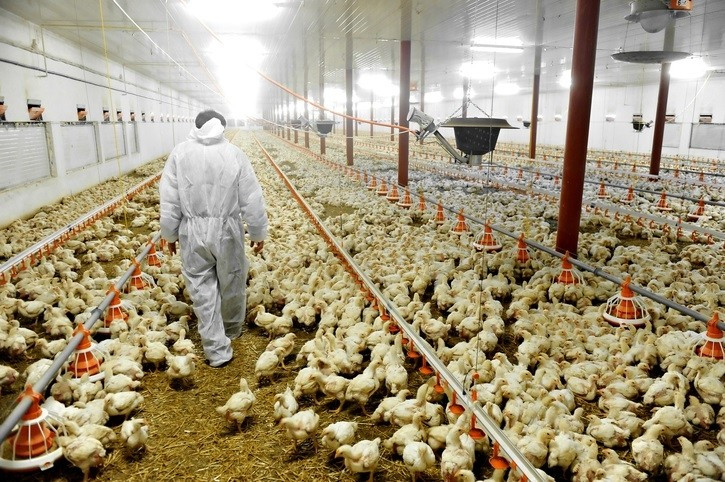
We do not yet know the entire history of the development of Covid-19, the strain of the coronavirus that threatens us today. But given the recent threat from influenza viruses such as H1N1 (swine flu) or H5N1 (avian flu) and pandemic viruses, there is no doubt that these viruses have emerged in large chicken and pig farms.

Genetic analysis has shown that critical components of H1N1 have emerged from a virus that circulates in North American pigs.
But it is the commercial poultry farms that appear to be the Silicon Valley of viral development.

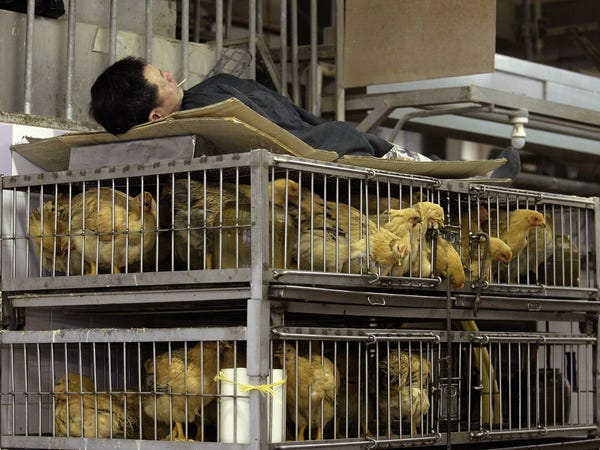
mastanlage Hühner

Of 16 strains of novel influenza viruses currently classified by the Centers for Disease Control and Prevention (CDC – an agency of the United States Department of Health) as “particularly worrying”, including H5N1, 11 are from H5 or H7 viruses.

In 2018, a group of scientists analyzed the 39 antigen shifts, also known as “conversion events,” which we know have played a key role in creating these particularly dangerous strains. Their results demonstrate that “all but two of these events have been reported in commercial poultry production plants.”

hühner im Müllpg

The abbreviation CDC stands for an authority in the USA, whose name is actually Centers for Disease Control and Prevention.

We are dropping prevention from the acronym because it already sounds innocent enough. But we also tend to dismiss serious discussions about prevention in favor of reactive strategies.

This is understandable – especially in the middle of a pandemic – but in a dangerous way irresponsible.

We are concerned with the production of face masks, but apparently we do not care about the companies that cause pandemics. The world is on fire and we are always reaching out for new extinguishers while the petrol soaks the tinder at our feet.

masken wegen Coronavirus

To reduce the risk of a pandemic for ourselves, our focus must be on animal health.

When it turned out that a number of people had become infected with the virus after visiting a wet market in Wuhan, where the virus was probably transmitted to humans by bats via an intermediate host, China closed 19,000 wildlife farms and banned wild meat from wet markets.

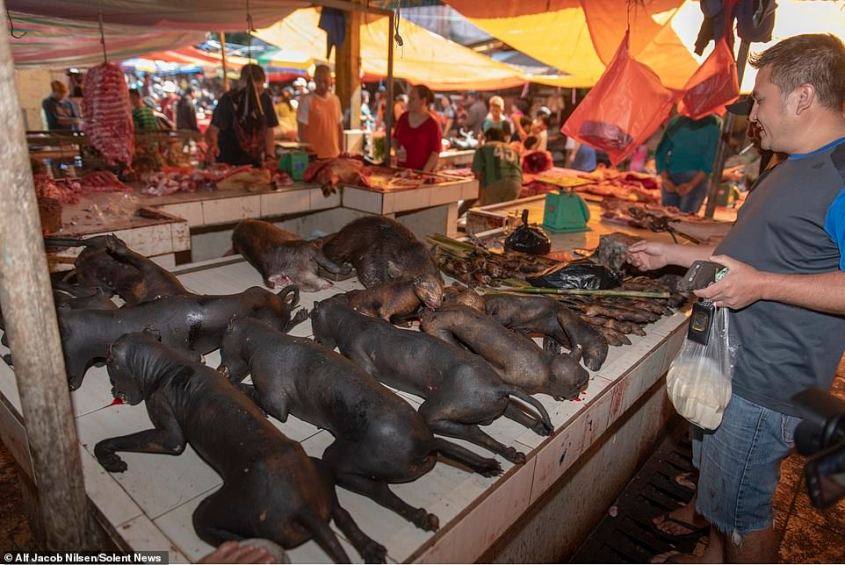
wild markt Chinapg

In the case of farm animals, however, the lack of public understanding has enabled unscrupulous corporations to steer politics in exactly the wrong direction.

Across the world, corporations have managed to implement policies that use public funds to promote industrial agriculture. A study suggests that the public is providing $ 1 million a minute in global agricultural subsidies, mostly used to support and expand the current broken model.

The same $ 1 million a minute that fosters industrial agriculture also increases the risk of pandemics.

anonymous you can look away

The consequences of a mortality rate of one to two percent are omnipresent: half of the world lives under house arrest, one generation faces economic bankruptcy.
Are we able to imagine the impact of a 60 percent death rate?

Try to imagine that half of the people you knew who had the flu last year would now die. If you have children, how many of them had the flu in the last year? Force yourself to imagine these things, and then ask yourself: How much would it be worth sacrificing now to avoid that?

All of this leads to the most important question: What can we do?

The link between factory farming and increasing pandemic risk has been scientifically well documented, but the political will to contain this risk has been lacking in the past.
Now is the time to let this will arise.

It is very important that we talk about it, share our concerns with our friends, explain these problems to our children, think together about how we should eat differently.

Fleischfressende und ein Veganer

Changing one of the most powerful industrial complexes in the world – factory farming – cannot be easy, but at this moment, with what is at stake, it may be possible for the first time in our lives.

https://www.freitag.de/autoren/the-guardian/das-silicon-valley-der-viren


And I mean…I read this article in the “Friday” newspaper and think it is very good. A very complex topic is presented in simple words.

I only disagree with the author on one point: “But for most of us, the future of animal husbandry is pretty low on their list of priorities, especially in the current situation. It is understandable that in such a situation we are most concerned about ourselves take care of yourself.”
We put the misery of animals and the dangers that come from factory farming, not only since yesterday at the end of the list of our interests.
We always did this on principle, and most don’t associate the pandemic with meat consumption.
Because they don’t want to see the reality, they deny it.
The meat eaters believe that this is a temporary problem, so they don’t worry about how to solve it.
And none of them thinks questioning a system that creates pandemics and dangers through factory farming.
Because this system thinks for them.

We can only protect ourselves against viruses and epidemics if this system no longer exists – the animal production system.

My best regards to all, Venus

England: Exposing the Pig Business – USA and Poland. And Legal Threats If Broadcasted !

gemalt-england-flagge-5d


A factory farm near Wieckowice in Poland, owned by US pork giant Smithfield Foods, the biggest pig factory farming corporation in the world, has been infected with African Swine Fever. The Guardian reported on 8th April 2020 that over 10,000 piglets on the farm would be culled.

I went to Wieckowice to film my (2009) Channel 4 documentary Pig Business where I met local residents and workers suffering from respiratory, neural and intestinal diseases because of toxic emissions from this very same pig factory that has closed today. I climbed factory farm perimeter fences to film suffering pigs and interviewed Smithfield Foods’ US lawyer and local directors, EU bankers and EU bureaucrats to hear their excuses for their destruction of rural culture, health and economies.

Meanwhile on 16 April 2020, 700+ workers at a Smithfield Foods processing plant in South Dakota, were tested positive for COVID-19, representing 55% of all confirmed cases in the state.

In this uncensored version of the 2009 film Pig Business you will hear pork processing workers describing their cramped, dangerous and unsanitary conditions in Smithfield’s slaughter and packing plant at Tar Heel, North Carolina. Though most of the meat is now sent to China and the workers have union representation, most of the workers are undocumented migrants whose rights are undermined. So it is not surprising that during this pandemic Tar Heel is still open and slaughtering 34,000 pigs per day.

In 2009, the censored version of Pig Business was broadcast by Channel 4. We have now posted the uncensored film that includes footage of local doctors, workers and of Robert F Kennedy Jr that had to be taken out of the Channel 4 broadcast version because of threats of defamation from Smithfield Foods.

The competitive imperative for livestock farms to ‘get big or get out of the industry’ is threatening the health of people, animals and ecosystems around the world. What hope of curbing the possible vector of viruses in the UK if pig and poultry factory farms continue to grow ever bigger?

The launch of the Pig Business, The Full Tail – an uncensored version of Pig Business (2009) comes as US pork giant Smithfield Foods – featured in the documentary – slaughters 10,000 pigs stricken with African Swine Fever in a factory farm in Poland, and closes its packing facility in South Dakota where 700+ workers tested positive for COVID-19. Where Smithfield Foods sowed bad karma of cruel treatment of pigs and sick workers and neighbours, so they now reap the consequences.

When I first heard about the outbreak of COVID-19, one emotion I didn’t feel was surprise.

No measures were taken to prevent the root cause of swine flu, mad cow disease and avian flu, and so it was only a matter of time before some new and deadly disease spread from animals to humans. This time it is COVID-19. Many scientists are again suggesting that the pig and poultry industries could be the vectors of the disease in its passage from bats to humans. So, instead of our governments only investing in cures and vaccines, we urgently need to prevent the outbreaks of zoonotic diseases by ending factory farming.

My film Pig Business, exposes the true costs of the corporate takeover of the pig industry focusing on US pig giant Smithfield Foods’ invasion of Poland. It was broadcast on Channel 4 in 2009, during the global pandemic H1N1 (swine flu) that killed approximately 253,000 people worldwide, though some sources report much higher.

Smithfield Foods’ takeover of pig farming and processing in Poland has come home to haunt it. They were in the headlines earlier this month when African Swine Fever struck their factory pig farm in Wieckowice, Poland, 93 miles from the German border, and all 10,000 piglets had to be slaughtered.


A week later, Smithfield was in the news again when their packing plant in S. Dakota was closed due to a staggering 700+ confirmed COVID-19 cases among Smithfield employees and people associated with them. Smithfield-related infections account for 55% of the caseload in the state.


My film tells the story of neighbours living near the US-based (and now Chinese owned), Smithfield Foods, the world’s biggest pork producer, that had expanded into Poland in the late 1990’s thanks to a favourable loan from the European Bank for Reconstruction and Development.

Imported pork began flooding the Polish, European and UK markets undermining local smaller scale farms. Smithfield Foods pork is only cheaper because they are raised in cruel overcrowded and unhealthy conditions with hundreds of thousands of tons of waste polluting the surrounding countryside.


Pigs are raised in unhealthy, stressful conditions that cause such suffering to the animals that they have to be given prophylactic antibiotics to keep them alive. The sheds become a breeding ground for antibiotic resistant diseases that form part of the toxic brew, including ammonia, hydrogen sulphide from biodegrading faeces, that threatens the health of both workers and neighbours with respiratory, neural and intestinal diseases.


To compete with this global race to the bottom, EU and UK pig farms are still expanding and externalising their true costs, or facing bankruptcy.

When the BBC World rejected the film, Pig Business for fear of litigation, Channel 4 agreed to air it. But when Smithfield got wind of it in 2008, they instructed a London lawyer to threaten Channel 4 with a libel action if they dared go ahead with the broadcast. Channel 4 hired a specialist libel lawyer to alter the film to ensure it was protected from the very corporate-friendly libel laws that prevailed in the UK at the time. In 2013 the law was changed so that now a profit-making entity must prove serious financial loss before it can sue for damages.

Though Channel 4 did broadcast the film, Smithfield’s threats to sue them resulted in scores of important testimonials being removed.

I am now publishing the Pig Business ‘The Full Tail – uncensored version’ film that contains those powerful extracts as they are as relevant today as they were back in 2009. The arrival of African Swine Fever in their farm in Poland and the rates of COVID-19 in their processing house proves that their dangerous businesses practices have not changed despite the suffering and diseases that locals have complained about for decades.

Below are some of the statements that have returned into the Director’s cut.

  1. Polish Minister for Agriculture; ‘Often they try to keep the inspectors out of the farms altogether. The owners use various legal loopholes and tricks……to stop vets entering the farms’

Why was this removed? In a libel court in the UK we would have to prove that this happened repeatedly and on specific farms on specific dates’


Smithfield former farm worker; ‘The doctor asked where I worked before… and I said on the pig farm… He said I simply breathed all those fumes and my lungs couldn’t cope. He said my lungs had shrunk day by day. I’ve damaged my lungs and there was no cure.’

‘When there was an inspection, we were told to remove all the treatment charts and when they’d gone we hung them up again. If the inspectors should ask us questions we were instructed to say we were only cleaners…and that the vet was doing all the treatment not us.’

Why was this removed? No workers were allowed to be used in the film


Smithfield former farm worker ‘Most people are sick but hide it for fear of losing their jobs. They come from local villages. The problem is the microclimate… which contains concentrated… hydrogen, sulphate, nitrogen… and other poisonous substances.’

‘…because of the large amount of pigs, we found many sick pigs during our routine rounds, so we would give medicines all the time”

Why was this removed? No workers were allowed to be in the film. Smithfield might argue that we cannot prove specific cases with medical records, although 25%-30% of factory pig farm workers suffer permanent lung damage.


Neighbour of the Wiekowice pig factory; ‘The gasses from the farm have been tested. A certified company called Atma conducted the research. This was paid for by the county mayor. The results showed the pollution was up to 30 times above the recommended guidelines’.

Why was this removed? They had to be able to prove that these gasses are emitted every day.
Each day’s test cost £1,100 so the local mayor could only afford one test


Robert F Kennedy Jr: ‘They can’t raise hogs with this kind of cruelty unless they give them lots of antibiotics, sub-therapeutic antibiotics. The United States dept of agriculture just made a study that said that every one of these facilities puts out 1 billion antibiotic-resistant bacteria every day that crosses the property line and threatens the health of people who live down-wind of those facilities and the herds of animals that live down-wind of those facilities’.

‘They can’t produce a pork chop cheaper than a family farmer without breaking the law.’

Why was this removed? Can’t use Robert Kennedy unless he is speaking in the senate


With global trade, pig farming has to compete with global ‘vertically integrated’ giants like Smithfield Foods that own both pig production and processing to reap the profit from the entire system. Their monopoly enables them to push down the prices of pork and so bankrupt independent pig producers and their contract farmers and externalise their true polluting costs onto the broader community. Local diseases are now proving to be global. The power is in our hands. We can prevent these diseases by only buying meat from local small scale family farms where animals are treated as sentient beings not industrial raw materials.


The good karma of only eating meat with a high welfare label will reap the reward of less animal-to -human diseases. The health of our animals is integral to our own survival. Look for the high welfare labels RSPCA Assured, Free Range or best of all, Organic or go direct to your farmer via farmers market, websites like Big Barn or your local box delivery scheme to find high welfare. Please sign and share our petition asking the government not to sign a trade deal with the US that allows imports of pork raised in conditions that are illegal in the UK.


Best wishes,

Tracy Worcester, Director


From the multiplication table of “animal production”

antibiotika cloprostenolpng

Research activists often find medicines in plants in the animal industry, here the active ingredient cloprostenol. This artificial hormone is routinely used to initiate, accelerate and synchronize births in pig breeding. The goal: more profitability.

schweine kasten mit ferkel-PETA-D

If all the mother pigs in a group give birth as quickly and simultaneously as possible, the associated working time for the operator is also reduced.

ontarioabattoir_jmcarthur_schweine-schlachtung2011-9964-768x

This saves effort and thus costs.

And: the sows can be inseminated more quickly after birth, which means more pregnancy cycles per year, so more born piglets overall.

ferkel einsamo

The routine use of cloprostenol is also promoted by the increasing size of the mast systems.

Piglets in increasingly large batches of uniform age and weight are in demand there – which is only feasible through simultaneous mass births in pig breeding.

holocaust anonymous o
ARIWA – Animal Rights Watch e.V.


And I mean...Eating meat is normal, natural and necessary is the propaganda of the media, which is controlled by the system.

150 billion animals are slaughtered each year for human consumption!!
The calculation is simple: the more animals killed per minute, the more money is released.

In fact, it is estimated that more than 500 million animals die in the U.S. meat industry before they reach the slaughterhouse, many of them die from illness that is exclusively attributable to factory farming.

This all,  is factored into production costs.

The meat eaters assume that the meat that ends up on their plate does not make them sick or kill them.
Indeed, and it is no longer a secret, the meat receives a large amount of antibiotics, toxic pesticides and hormones that are known to be carcinogenic. That makes the meat a poison.

No wonder thus we have shit in our flesh.

And it’s no wonder that the corona will continue to eliminate some human animals who see meat as their “free choice”.

anonymous you can look away

My best regards to all, Venus

Animals Asia – Breaking – 3 Very Poorly Bears Are Being Rescued. Can You Support With A Donation ? – Thank You.

AA April20

Dear Mark,

Forgive me for getting straight to the point but we’ve received an urgent call about three bears in terrible trouble.

We were first alerted two weeks ago and dropped everything to prepare for the rescue as quickly as we could. I know what you’re thinking… Why are they still waiting? Travel restrictions had just been put in place due to the coronavirus which meant it wasn’t permitted or safe to go ahead. During this initial call, we made the difficult discovery that there had been four bears, but sadly one of them passed away just a week before we were contacted.

With the travel restrictions now lifted and fearing for the safety of the remaining three bears, our incredible rescue team have once again dropped everything and are racing to bring them home to sanctuary. But we need your help.

These are extraordinary times. And with more empty bear bellies to fill, more medicines to purchase, and facing months of high costs because of the coronavirus, we need your help now more than ever to bring these bears home.

We currently know very little about the three bears. But their lives have certainly been no fairytale. They were discovered trapped in tiny, depressing metal cages side by side. We dread to think how long they’ve been like this…
Despite limited information, we can be almost certain that they’ll have serious health issues and need special ongoing care and treatment for the rest of their lives. Which we hope could be another 15 years or more.

Please, will you help these sweet bears on the road to recovery and beyond by setting up a monthly donation?


Help to bring them home with a donation:

https://help.animalsasia.org/page/59361/donate/1?ea.tracking.id=aprilrescue20_rgedm1_en&supporter.country=GB

 
It’ll take our team around four hours to reach the site in Nam Dinh Province and we hope to arrive on Tuesday morning (Vietnam time). I promise to keep you updated on their progress and to bring you more information soon. For live updates, and to see your kindness in action, please be sure to follow us on Facebook, Twitter and Instagram

As always, thank you from the bottom of my heart for being there for Asia’s animals when they need you most. Please stay safe during this difficult and challenging time.

With bear hugs of gratitude and of hope,

Jill-Robinson-thumb

Jill Robinson MBE, Dr med vet hc, Hon LLD
Founder and CEO, Animals Asia

PS This is only the beginning.

By setting up a monthly gift today, you can help us ensure they live the lives they truly deserve.

PPS Big bear hugs of thanks for your continued support. Without you, Animals Asia wouldn’t be where we are today. And so many of Asia’s abused animals would never have been found and brought to safety. You should feel proud of the incredible difference you make.


Asia’s biggest food companies silent on the welfare of farm animals.

China


Asia’s biggest food companies silent on the welfare of farm animals


Even as a pandemic threatens food supply chains, most firms, including China’s top pig and poultry producer, have shed no light on how they are managing risks and opportunities linked to farm animal welfare.


https://www.eco-business.com/news/asias-biggest-food-companies-silent-on-the-welfare-of-farm-animals/


Major food companies in Asia must improve the welfare of farm animals that they produce, supply or use, an annual benchmark of 150 of the world’s largest food companies has shown.

Out of 17 Asian companies in the benchmark, 15 emerged in the bottom tier for being virtually silent on how they are managing the risks and opportunities associated with farm animal welfare.

The 15 Asian companies—which made up half of the bottom tier—included China’s top pig and poultry producer Wens Foodstuff, feed and meat manufacturer and distributor New Hope Liuhe, retailer China Resources Vanguard and Japanese food producers Meiji Holdings and Maruha Nichiro.

The Business Benchmark on Farm Animal Welfare (BBFAW) 2019, released earlier this month, comes at a time when the Covid-19 pandemic is highlighting the fragility of global food supply chains and the need to do more to stop the spread of diseases from animals to humans.

“In a world where farm animal welfare is an increasingly important driver of both business value and investment risk, maintaining and improving animal welfare standards must be a focus,” said Dr Rory Sullivan, co-author of the 2019 report and chief executive of Chronos Sustainability, which serves as the BBFAW’s secretariat.

Pig production is big business for Asian companies, but there is also a focus on poultry and seafood.

Companies should begin by publishing commitments to improve farm animal welfare throughout their business operations, state how they will implement these commitments, and report on their performance, said Nicky Amos, managing director of Chronos Sustainability and executive director of BBFAW.

The BBFAW expects corporate policies on issues such as the avoidance of genetic engineering or cloning, avoidance of growth-promoting substances, and reduction or avoidance of the routine use of antibiotics. Companies should also declare their policies on pre-slaughter stunning for all animals, limiting long-distance live transportation and the provision of effective enrichment for farm animals (such as outlets to perform their natural behaviour), she said.

Hens in tiny cages, gestating pigs in crates

Two primary concerns for consumers, scientists and animal welfare organisations are the use of cages for hens reared to lay eggs, and crates for gestating pigs, the Humane Society International (HSI) told Eco-Business.

Producers as well as many food and food service companies worldwide have pledged cage-free systems for laying hens and group housing for sows, which are the higher welfare alternatives, the HSI said.

These alternatives allow the animals to perform some of their natural behaviour. For chickens, this means nesting, dustbathing, perching and foraging. For sows, this means more opportunity for movement, social interactions and to root (an exploratory behaviour where the pig uses its snout to nudge into something repeatedly).

In China, however… the majority of (egg-laying hens) are confined to cages so small that they cannot even fully stretch their wings, and each animal has less space that a letter-size sheet of paper or an iPad on which to spend their entire life,” said the HSI. Hens in cages are so severely restricted that they suffer from physical abnormalities due to lack of exercise, and the same happens to sows kept in crates.

“Beyond that, chickens raised for meat need more space and better conditions,” it said. China produces more pigs and chickens (raised for eggs or meat) than any other country.

In China… the majority of (egg-laying) hens are confined to cages so small that they cannot even fully stretch their wings, and each animal has less space than a letter-size sheet of paper or on iPad on which to spend their entire life.

Humane Society International

Researcher Michelle Sinclair of the University of Queenslands’ Centre for Animal Welfare and Ethics in Australia has interviewed members of Asia’s livestock industry and said many farms in China are making an effort to address animal welfare.

In research conducted in China, her team asked farmers and slaughter workers what they saw as the most important welfare issues. The top issue cited was the absence of adequate pre-slaughter stunning, which essentially renders an animal unconscious before the slaughter, until death. Quality of transportation was second, and the experience and attitude of workers was third.

Animal welfare issues that farmers and slaughter workers ranked as important also included avoiding stress from heat and cold, sufficient water and feed that was of adequate quality.

Practical solutions exist, such as the formation of prescriptive and locally relevant industry standards, clearly presenting the business benefits of better animal welfare, and building a body of local research, Sinclair and Professor Clive Phillips noted in a research paper last year.

Role of investors and avoiding ‘greenwash’


15 of the 17 Asian companies in the Business Benchmark on Farm Animal Welfare 2019 were in the bottom tier. Image: Eco-Business

Investors have an important role to play and need to be more active, said the BBFAW and HSI.

Investors should expect companies to be transparent about their business and improve their practices, said HSI. “Further, investors should encourage and incentivise producers and food businesses to create time-bound plans to fully implement animal welfare commitments.”

Challenges faced by the livestock industry include developing knowledge on what the issues are, and how to address them. Many countries do not have prescriptive laws or standards to follow, and the industry has to ensure profitability even as it improves animal welfare, said Sinclair.

Consumers can also make an effort to support companies that have animal welfare policies, and adhere to them. “Obviously they can also eat less meat (of higher quality), substituting for vegetables and other health foods where they can,” said Sinclair.

The HSI said it is important that retailers understand the differences between products, so they can provide customers with options that actually support animal welfare. Producers are able to “greenwash” their practices in a number of ways, such as by making claims that are general—“we treat our animals well, because a healthy animal makes a great product”—or labelling products as certified by an animal welfare scheme which has no significant requirements beyond the law, it noted.

The challenges can be overcome through collaboration among companies, researchers, governments, industry groups and animal advocacy organisations, said Sinclair. “In my view, there is a lot more to lose, and bigger challenges to come, if we don’t improve animal welfare globally. We see a major health and environment crisis semi-regularly and a lot of the time, these disruptions and risks can be tied to a lack of consideration of the animals we farm and share our world with.”

Thai, Chinese companies are best Asian performers

Companies in Asia that have made progress include Japanese retail giant Aeon, said Amos. Aeon recently changed products under its own brand to cage-free eggs, starting locally before expanding sales to all its locations worldwide by end-2022.

The two best-performing Asian companies in the latest benchmark⁠⁠—which was supported by BBFAW’s two founding partners, animal welfare organisations Compassion in World Farming and World Animal Protection⁠—were Thailand’s Charoen Phokphand Foods and China’s WH Group. Both companies placed in the fourth of six tiers, which means they published some information on animal welfare commitments, but did not have robust processes to ensure they are effectively implemented.

WH Group, one of the largest pork producers in the world, provided a general overview of its approach to farm animal welfare, and described the management structure for its sustainability policy that includes animal care, said Amos. Its Smithfield subsidiary, however, has a comprehensive approach and provides a detailed account of its performance. In addition, all of Smithfield’s pregnant sows are put in group-housing.

Meanwhile, Charoen Phokphand has published a farm animal welfare policy that Amos said includes partial commitments on key issues, such as the avoidance of close confinement and requirement of pre-slaughter stunning. It has also set animal welfare targets and reported its progress.

According to HSI, Charoen Phokphand has started cage-free egg production in Thailand. Multinational corporations Sodexo, Tesco and Carrefour have also introduced animal welfare programmes, such as committing to use or sell exclusively cage-free eggs, in some Asian countries.

The six companies in the top tier of the 2019 benchmark were Switzerland’s Coop Group and Migros, and United Kingdom’s Cranswick, Waitrose, Noble Foods and Marks and Spencer.

https://www.eco-business.com/news/asias-biggest-food-companies-silent-on-the-welfare-of-farm-animals/