Meat producer Cranswick’s shares have plummeted after UK supermarkets suspended supplies after alleged supplies against pigs.
Covert footage appeared this last weekend from the Animal Justice Project – AJP – showed workers at Northmoor Farm in Lincolnshire, abusing piglets by holding them by their back legs as they were smashed into the floor.
Other videos showed the botched killing of a sow, leaving the animal screaming and writhing in pain. A sow was also shown being beaten with metal bars.
PHOTO – AJP
A worker who failed to kill a sow using a bolt gun reportedly said to an undercover investigator ‘Don’t let nobody see you doing like what we did’.
Supermarket chains Asda, Morrisons, Sainsbury and Tesco have now suspended Northmoor Farm as a supplier of meat; shares at the London Sock Exchange fell around 7.5% 0n Monday. It made £2.6 Billion in revenue in 2024, with around 24% coming from its fresh pork sector.
Cranswick owns Northmoor Farm; with around 6,000 pigs being processed there. Cranswick as a whole SLAUGHTERS AND PROCESSES IN EXCESS OF 34,000 PER WEEK; yes you read it right, 34,000 deaths PER WEEK. On their website they claim that animal welfare is at the heart of their business.
Images on their website show pigs and piglets in green fields with wide open spaces. The AJP has now filed a complaint to national agency TRADING STANDARDS as a result of its excellent investigation.
A spokesperson for Cranswick said that the animals they rear is of the utmost importance and that they were extremely disappointed to see the unacceptable lapse in welfare standards shown at Northmoor Farm. Evidently, as soon as they saw the footage from the farm, the working team were suspended and an ‘urgent and thorough investigation’ commenced. They have also suspended the farm from supplying any pig meat until the investigation is completed.
AJP founder Claire Palmer said they were demanding immediate enforcement of the ban on blunt force trauma; in addition to the prosecution of Cranswick. She continued that there must be a public enquiry into pig farming practices and regulatory failures.
AJP is calling for a legislative phase out of pig farming in favour of a food system that no longer depends on animal suffering.
We at WAV fully support what Claire says, and the work undertaken by AJP to expose this abuse.
Ottawa eyeing new ways to ban export of horses for slaughter in Japan
Published Feb 13, 2025 at 11:00am
Ottawa is eyeing fresh ways to ban the export of live horses to Japan for slaughter to produce an expensive sashimi delicacy, after the proroguing of Parliament last month halted a bill sponsored by a Liberal MP that would have outlawed the practice.
The Liberal government is considering introducing regulations blocking the exports so it can keep a 2021 election promise before Canadians return to the polls this year.
An estimated 50,000 horses, many of which are large draft horses, have been exported since 2013, with some journeys exceeding the permitted limit of 28 hours.
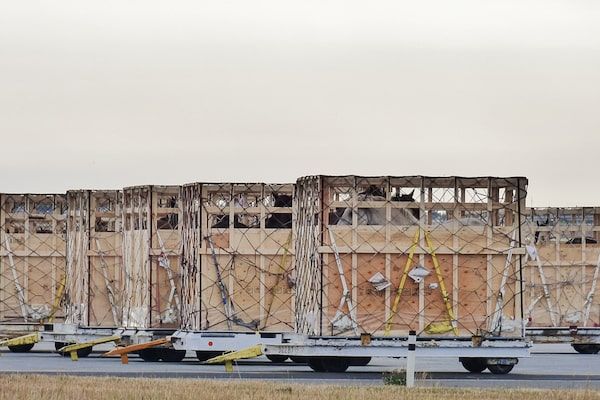
In 2022 and 2023, 2,500 live horses a year were flown from Edmonton, Calgary and Winnipeg to Japan for slaughter for their meat, including to produce basashi, an expensive sashimi delicacy.
Animal-welfare groups and several Canadian celebrities, including singer-songwriters Bryan Adams and Jann Arden and classical guitarist Liona Boyd, have been applying pressure on Canada to follow the lead of other countries, including the United States, and ban the export of live horses.
“It breaks my heart that thousands of horses endure extreme suffering in terrifying transports every year, only to die in a senseless slaughter. Horses are not commodities; they are loyal companions,” Ms. Boyd said in a statement.
“As a lifelong horse lover, I can’t stand by while they endure such cruelty. I’m urging the government to honor its promise – Canadians have spoken, and we beseech an end to this suffering now.”
In December, 2021, Prime Minister Justin Trudeau issued a mandate to the then-agriculture minister to ban the export of live horses, to honour the Liberals’election pledge.
But a private member’s bill banning the export of live horses, supported by the government, was held up in the Senate for months last year, and had not passed the stages required to become law when Parliament was prorogued.
Bill C-355, sponsored by Liberal MP Tim Louis, was sharply criticized by Don Plett, leader of the Conservatives in the Senate, and the Tories are unlikely to support it when Parliament returns, destroying its chances of becoming law before the election this year.
Agriculture Minister Lawrence MacAulay is now looking at other ways to enforce a ban, including by issuing regulations that would not require a vote or debates by the Commons and Senate.
In 2023, Ottawa introduced regulations to ban the import of elephant ivory and rhino horn, including by trophy hunters.
“The Government remains committed to ending the export of live horses by air for slaughter,” Mr. MacAulay’s spokesperson, Annie Cullinan, said in a statement, noting the commitment set out in the minister’s mandate letter and the government’s support of Mr. Louis’s initiative.
“We believe that a legislative change would be the most efficient and concrete way to end this practice, however, given that Parliament is currently prorogued, we are exploring other options.”
Animal-welfare groups have been urging the government to implement a ban before the next election, warning that the Liberals could face accusations of failing to keep their promises.
Kaitlyn Mitchell, director of legal advocacy at Animal Justice, said that “the vast majority of Canadians –across political lines – want a ban, and the government explicitly promised to deliver it.”
“Minister MacAulay has the power to act, whether by introducing regulations now or through a bill when Parliament returns,” she said. “This is a chance to follow through on a commitment that matters to many voters and for the Liberals to show before the next election that they can be trusted to keep their promises.”
But Mr. Plett warned against a ban, and shutting down the export trade in horses for meat.
“When our entire nation is on edge due to the U.S. President’s attack on our export markets, it would be outrageous for this government to pile on by shutting down a premium agricultural export market. This is a time to stand behind our farmers, not be caving in to animal rights extremists,” he said.
A Japanese animal-welfare organization, Life Investigation Agency, last year obtained official government reports of shipments of horses from Canada, including pregnant mares, in crates.
The records, acquired through Japan’s freedom of information laws, showed that some horses had difficulty standing and fell during flight. Some suffered injuries such as a fractured leg, or died on board or in quarantine after arriving in Japan. Several experienced heat stroke, dehydration and physical compression on the journey, with one horse subjected to accidental suffocation.
On one flight from Edmonton in January last year, 85 horses were flown in crates to Kagoshima, and four horses fell within their crates during the flight. A mare was severely injured from the fall and died. Upon arrival in Japan, the three other horses were found collapsed in their crates, and were suffering shortness of breath. Two had injuries so severe they died shortly after arrival.
The Canadian Food Inspection Agency, which monitors the transports and inspects the animals in Canada to ensure welfare standards are adhered to, called the reports troubling when they came to light last year and said it was looking into them.
The Federal election campaign is over – and for sheep, the outcome could not be more significant.
With the re-election of the Albanese government in the 2025 Federal Election, one of the most important animal welfare reforms in our nation’s history is now secure: the legislated phase-out of live sheep export by sea.
Thanks to the incredible efforts of supporters who helped amplify this issue – through donations, by fuelling our ad blitz in battleground seats, and via direct engagement with candidates – a candidate who backs the phase-out was elected in nearly every seat we campaigned in. This is a powerful reminder that while animals cannot vote, caring Australians will do so on their behalf.
We are so grateful to everyone who donated to our billboards declaring Australian sheep have suffered enough, and to the hundreds of our supporters who helped lobby candidates in battleground seats.
The Coalition ran on a platform of keeping this unpopular trade alive. The landslide outcome – especially in Western Australia where the live export lobby campaigned fiercely against the ban – can only be seen as a definitive rejection of policies that promote animal cruelty. This moment solidifies the turning of the tide.
There are other policies that the Albanese government committed to, which will ensure animals are a key priority for the new parliament, including:
Full implementation of the national Animal Welfare Strategy to improve standards and review outdated systems that entrench suffering for pigs, chickens and other farmed animals.
Inclusion of animal welfare protections in international trade agreements.
Expansion of the trophy hunting import ban to cover more protected species.
We are eager to work with the re-elected government – and the overwhelmingly animal-friendly crossbench – to ensure these and other much-needed reforms for animals are realised.
We are so grateful to our friends at the Australian Alliance for Animals and Stop Live Exports for uniting with us to ensure as many people as possible understood what was at stake for animals this election. While in many ways, the ‘real’ work starts now, we could not have a stronger foundation upon which to build the reforms that animals need and deserve.
the day no animal is forced onto a live export ship. But today, we celebrate one of the most significant animal welfare reforms ever achieved globally.
Today, we celebrate a victory for compassion thanks to our supporters and everyone who kept animals front of mind at the ballot box.
We can now count down to 1 May 2028 with certainty – knowing from that day onwards not a single Australian sheep will set foot on a live export ship. While of course we wish this end date was much sooner, we also recognise the need to consider all who may be affected by this historic decision.
As the trade winds down, fewer Australian sheep will suffer at its hands. Since our very first investigation, the number of sheep exported live by sea each year has dropped by the millions – from 6 million annually, to less than 500,000.
Now, we can safely say that within three years, this number will be zero.
Animal farming rips apart the sacred bond between mother and baby; there’s nothing “humane” about it. Mother hens, cows, goats, turkeys, pigs, and sheep all care for their young and are fiercely protective of them, each in their own way. In animal farming, the mother’s desire and ability to protect and nurture her babies is robbed from her.
Mother birds exploited in the food industry—whether hens, turkeys, ducks, or geese—along with their babies, are all killed. In the wild, they stay in the nest to incubate their eggs, keeping them warm, and rarely leaving. Once hatched, the mother guides her chicks to food, alerts them of threats, and shields them from harm with her wings.
Whether in “free-range” or “cage-free” warehouses—marketing lies to keep consumers buying—or in cages, male chicks in the egg industry are killed because they don’t produce eggs, often by maceration. Their mothers are slaughtered too, while still young. Sexual violation, forcible impregnation, and the stealing of babies are done to virtually all female farmed animals, including birds, pigs, cows, goats, and sheep.
In nature, before giving birth, mother pigs also build nests to create a safe environment for their piglets and will often defend them aggressively. Yet pregnant mother pigs in animal farming are confined to tiny metal cages—called gestation or farrowing crates—barely larger than their bodies, often forcing them to lie in their own waste. After months of this torture, her piglets are taken from her shortly after birth. Then she’s forcibly impregnated again.
Cows, just like human mothers, carry their babies for nine months. When they give birth, they will lick and nuzzle their calves clean, stimulating circulation and bonding. The calves receive essential colostrum from their mother’s milk which helps strengthen their fragile immune systems.
But in the dairy industry, baby cows, goats, and sheep are taken from their mothers within a day or two so that humans can steal, consume, and profit from their milk. From the searing pain of branding and disbudding (burning off tender horns without painkillers) to the heartbreak of mother-baby separation, mothers are left physically wounded, exhausted, and grief-stricken.
Female calves are kept alone in tiny hutches for months, often in extreme weather, only to be forced into the same cycle—sometimes before they’re a year old. Male calves, deemed worthless because they don’t produce milk, are slaughtered.
It’s common to see mothers chasing after their stolen babies, left bellowing in desperation and anguish, often for days. This cruelty repeats until she collapses or stops producing enough milk for the ranchers. Then she’s frequently beaten or shocked to force her onto a truck to the slaughterhouse. Many animals are slaughtered, even skinned alive, while still conscious.
All this torment and killing repeats endlessly for unnecessary products we’re better off without. Better treatment or painless death doesn’t make exploitation ethical. We have no right to their bodies. Using and killing mothers, babies, or any animal for culture, taste, profit, or convenience is the opposite of compassion; no animal farming is “humane.”
We must speak up for all mothers and their babies—including those who are the most ignored, oppressed, and killed on the planet. Every one of them was once someone’s baby, and every mother loved them. Neither these babies nor their mothers deserved what was done to them.
In the dairy and egg industries, all male babies and their mothers are killed. Many people don’t realize that most animals slaughtered for food products are infants. Yet, Congress and the United States Department of Agriculture continue funneling billions in taxpayer dollars to support animal agribusiness. Demand that the U.S. government redirect subsidies away from this industry of cruelty and mass slaughter of mothers and their babies.
In the United States alone, over 2 million sheep are slaughtered annually, with the vast majority being lambs—babies. This number spikes during Easter, and the average age at slaughter is 6-8 month
Male calves in the dairy industry have little to no value to dairy farmers, as they don’t produce milk, and so they are killed. They’re either shot shortly after birth or sold to veal “farms,” where they’re confined alone in tiny crates for up to 16 weeks—essentially tortured—to prevent muscle development and keep their flesh tender. Some are used for “breeding” or eventually slaughtered to be turned into meat products.
Male baby goats, called “kids,”, and male lambs are also slaughtered in the goat and sheep milk industries. So are all their mothers. Male baby chicks in the egg industry are killed immediately after hatching, most often either tossed like garbage into giant blenders, shredded alive, or suffocated.
Though animal farming uses sanitized terms like “artificial insemination” and “breeding,” the young females are tightly restrained, and in dairy, the device used on female cows is often referred to as a “rape rack.” Forcible impregnation is done manually with a catheter, pipette, or, in the dairy industry, an entire arm—an extremely stressful and often painful experience. Farmers collect sperm from bulls, male goats, and male sheep through manual stimulation or using an electroejaculator.
Pregnant mother pigs are caged in “farrowing crates,” often so small they can’t turn around for months on end. After her newborn piglets are taken away, the mother is forcibly impregnated again, trapped in an unrelenting cycle of solitary confinement and suffering. Though pigs can live up to 20 years, they are killed at just six months old. Like all farmed animals, they’re trucked without food or water for several days—often in extreme cold or heat—to the slaughterhouse, where they suffer even more in a terrifying death.
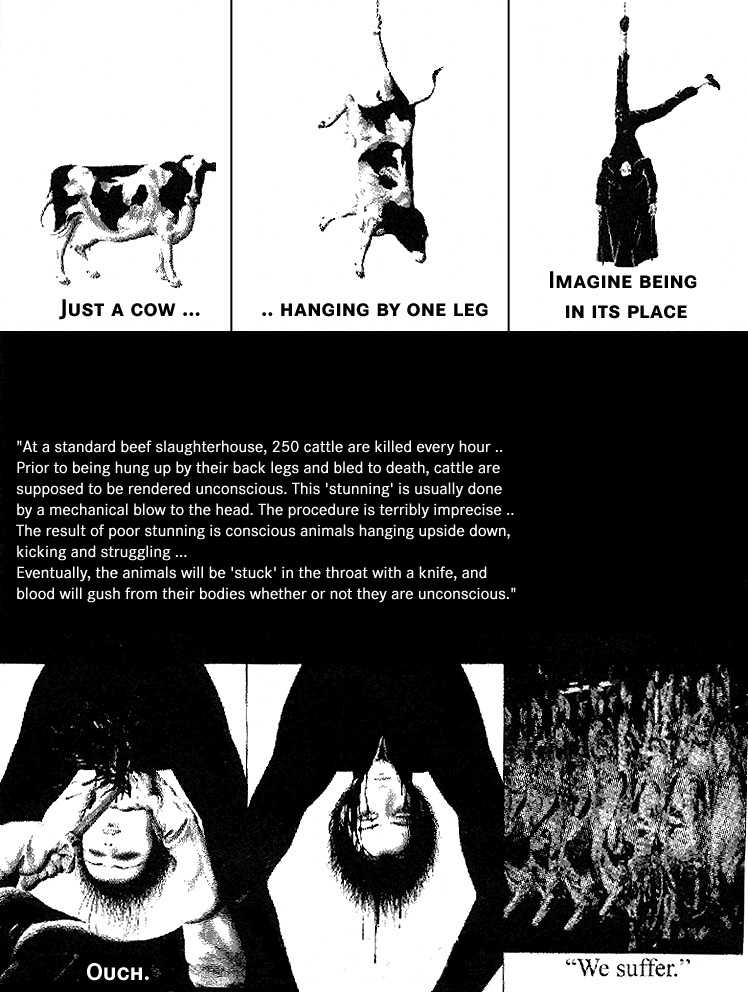
Animal agribusiness claims that “stunning” makes animals insensible to pain, but its actual purpose is to immobilize them so they can’t fight back. The most common method to “stun” pigs is in CO₂ gas chambers, where they feel everything, often screaming in agony and desperately fighting to escape. The industry calls this “controlled atmosphere stunning” and deems it “humane.” Many animals are still conscious while being slaughtered.
When mother cows can no longer produce enough milk to be profitable, they are slaughtered at around five years old. Their natural lifespan is up to 25 years.
Mother hens in the egg industry and mother turkeys in the poultry industry are killed at 1-2 years old. Their natural lifespans are up to ten years. Regardless, even if they were allowed longer lives before being forced into slaughterhouses, using and killing animals for unnecessary products—for tradition, taste, habit, or profit—is the epitome of unjust, cruel, and violent.
Despite evidence linking animal products to increased risks of heart disease, cancer, diabetes, and Alzheimer’s, the United States Department of Agriculture (USDA) continues to promote them in its dietary guidelines, while research shows that eliminating animal products can reduce these disease risks. Yet, in March 2025, the USDA allocated an additional $10 billion to bolster animal agribusiness. Where is government cost-cutting when it’s truly needed?
It’s time to end speciesism and for those in charge of our food system to stop the monstrous torment and killing of sensitive, feeling, defenseless animals. Call on Congress and the USDA to stop funding the horrors of animal agribusiness and redirect subsidies to support a slaughter-free, plant-based food system.
WAV is based in Kent, England; as well as having Diana in Germany.
Kent is known as the ‘gateway to Europe’ due to its location. It is a short hop over [or under] the English Channel to start your euro journey from France. Kent is a very historic county with masses of beautiful buildings and locations to visit. It is located directly South East of ‘Ol London town’ but the reality is once you get there, for example, down into the Weald; https://en.wikipedia.org/wiki/Weald which still has 23% of its area covered by woodland; the world here is utterly different to the madness mayhem that is London. And to think central London borders with Kent and is a mere 23 miles away !
KWT have a unique opportunity to create a wildlife rich landscape; where missing species can be resored to former farmland.
In the borough of Tunbridge Wells lies over 205 ACRES of land where hedgerows have eroded and the woodland edges are disappearing. Bordering Furnace Farm, an existing KWT reserve, Hoathly Farm has been intensively farmed for decades and no longer yields the returns needed to be viable without flooding the land with pollutants.
KWT HAVE UNTIL THE 24TH MAY 2025 TO SECURE THIS LAND AND RESTORE IT TO A BEAUTIFUL HAVEN FORE WILDLIFE AND WALKERS.
Can you help with a donation; no matter the size ?
An animal rights group is taking its case to the people with a new billboard depicting an activist who is facing prison for removing chickens from a Petaluma poultry farm.
The billboard on Highway 101 in Petaluma depicts activist Zoe Rosenberg who is accused of taking chickens from the farm. She could face up to five years in prison.
The billboard shows an illustration of Zoe with the words ‘Should she go to prison for rescuing a chicken ?’.
Zoe is charged with felony conspiracy and 4 misdemeanors stemming from an early morning protest outside Petaluma Poultry in June 2023. Zoe is accused of removing four 4 chickens from company vehicles.
Zoe is a member of Direct Action Everywhere (DAE) who paid for the billboard.
Bill Mattos, President of the California Poultry Federation described the incident as a ‘terrorist act’ – ‘you don’t break into a high quality poultry facility with the best biosecurity and humane conditions in California’ he said.
Members of DAE say they have a right to take action for animals in distress, and they have protested at many poultry farms.
Zoe’s trial, after being delayed, is now scheduled to begin on September 15th.
We at WAV naturally wish Zoe every success with her case; which is certainly NOT a case of terrorism, but rather one of compassion !
We have some really good news to share with you this Sunday.
Remember back in March this year we did a post re terrible abuses at a ritual slaughterhouse in Arley, Warwickshire – which showed terrible scenes of sheep suffering abuses before their throats were cut – here is our link at the time:
Well as investigations have been on going for the last few months by the Food Standards Agency (FSA) we have been restricted from further publishing; but now, today we can confirm that as a result of the investigation and abuses at Arley, which included staff playing Wolf noises to sheep, severe hadling as can be seen in this link https://www.independent.co.uk/news/uk/home-news/slaughterhouse-abattoir-sheep-meat-halal-warwickshire-b2705241.html ; and sheep still being alive FOUR MINUTES after their throats were cut, we can say with great pleasure that the entire facility has been shut down by the FSA and had its license revoked.
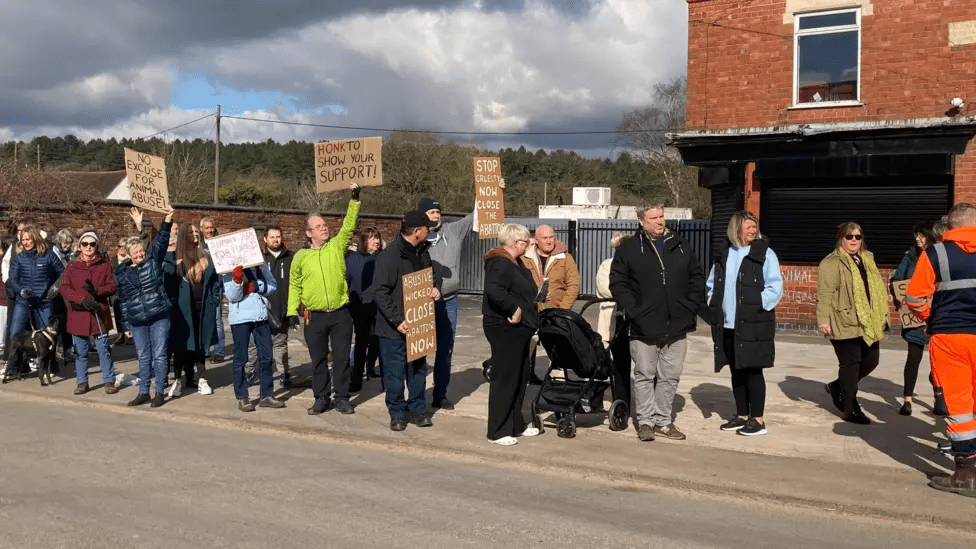
A lot of action in the way of demonstrations was undertaken by local people regarding this hell hole for animals; and we congratulate them on a very worthwhile victory !
Above – Local residents campaign for the slaughterhouse to be closed.
In its report on findings, the FSA said that it lacked confidence in the abattoirs ability (shown above) to deliver ‘consistant compliance’.
We have always said, and will continue to say, that there is NO PLACE IN THE UK WHERE RITUAL SLAUGHTER SHOULD BE UNDERTAKEN.