Category: Farm Animals

USA: NJ Animal Rights Group To Protest The Gassing Of Geese At Teterboro Airport.

Further News – Protest:

https://www.msn.com/en-us/travel/news/stop-gassing-geese-at-major-nj-airport-animal-group-says-protest-planned/ar-BB1nglTC?ocid=BingNewsSearch

 A New Jersey-based animal rights organization is taking action, and urging others to follow suit, against the lethal way that Teterboro Airport mitigates its local Canada geese population.

According to the Animal Protection League of New Jersey (APLNJ), Teterboro Airport has been working with the U.S. Department of Agriculture’s Wildlife Services program to gas Canada geese as well as other bird species and mammals for decades.

Read the full article at:

https://www.msn.com/en-us/news/us/nj-animal-rights-group-to-protest-the-gassing-of-geese-at-teterboro-airport/ar-BB1nfdbk?ocid=BingNewsSearch

EU: What ARE Member States Doing To Help Broiler Chickens Across The EU?

29 May 2024

Billions of broiler chickens across the EU are bred to be fast-growing, which puts their bodies under enormous strain. In our new white paper, we call on policy-makers to phase out these breeds and, instead, prioritise slower-growing breeds in EU legislation. Several Member States are already showing support for this kind of shift.

It is impossible for fast-growing broiler chickens to live a good life, in which they are comfortable, healthy, and exposed to a variety of positive experiences. To improve the welfare of the birds in this sector, it is critical that EU policy-makers legislate on a significant, EU-wide transition: in which fast-growing broiler chickens are phased out, and only slower-growing, higher welfare breeds are permitted to be farmed. 

In our new white paper, Paving the way for higher welfare broiler breeds in the EU: From market initiatives to legislation, we lay out three legislative routes policy-makers could take to foster such a change. We also lay out the European Chicken Commitment as the basis for this legislation, and explore what individual Member States have been doing to improve broiler welfare, both nationally and in supporting the phase-out of fast-growing breeds at EU level. 

The Netherlands

The Netherlands has already made a lot of notable progress towards producing only higher welfare breeds. The “Chicken of Tomorrow” was introduced between 2014 – 2015, an initiative that ensured slower-growing broilers were prioritised in its food systems. Now, the market for fresh chicken meat in the Netherlands consists of 100% higher welfare, slower-growing broilers. 

This sector shake-up was largely catalysed by interest from Dutch consumers in animal welfare, as well as related issues such as public health and sustainability. Various studies showed Dutch consumers are willing to pay more for improved animal welfare standards, incentivising retailers to rethink their production practices. 

Further pressure was added by NGOs that shone a light on the awful experiences of fast-growing broilers, for instance the Plofkip campaign by our member Wakker Dier. This caused a public outcry, which persuaded the two biggest retailers in the Netherlands, Jumbo and Albert Heijn, to launch their own higher welfare standards for broilers. They were soon followed by all the other supermarket chains.

Denmark

The Danish government and key Danish political parties have agreed to phase out the state procurement of fast-growing chickens, as well as promised to back a ban on the farming of fast-growing broilers at EU level. 

Sweden

New criteria developed by the Swedish National Agency for Public Procurement include standards for higher welfare chicken breeds, in line with European Chicken Commitment. There are also two propositions in the Swedish Parliament to ban fast-growing breeds nationwide (proposition number 18 and proposition number 29).

Norway

The Animal Ethics Council has recommended fast-growing breeds are banned in Norway. As of May 2024, the Norwegian government has been working on recommendations to give to Parliament, and the Norwegian animal protection law will likely be revised in the near future.

The organic movement and labelling schemes across Europe are also having an impact on broiler chicken welfare

Alongside these progressive steps by governments and retailers across Member States, several labelling schemes and initiatives are also playing a role in changing the fates of Europe’s broilers. 

Chiefly, the European Chicken Commitment, also known as the Better Chicken Commitment, is incentivising corporations to commit to higher welfare standards for broiler chickens. Hundreds of companies have signed up to these commitments, demonstrating that higher welfare standards and market competitiveness are compatible. Further, as a science-based welfare policy, approved and supported by animal welfare organisations all over the world, the standards laid out in the commitment make an excellent foundation for future legislation on broilers at EU level.  

Organic legislators and organisations have also been showing support for slower-growing broilers across Europe. Organic bodies in Finland, Poland, Spain, and Austria  have all recommended specific broiler breeds that can be used in organic farming, pointing to the clear connection between slower growth and higher welfare.

Specific labels at national level have contributed to this growing emphasis on slower-growing broilers, too. In Germany, Deutscher Tierschutzbund has laid out a mandatory requirement within both the basic and premium levels of its animal welfare certification label Für Mehr Tierschutz, for extensive to medium-extensive breeding lines with slower growth.

Similarly Krav, an organic labelling scheme in Sweden, has set a growth rate limit for slower-growing breeds with an ambition to make this limit even stricter by 2032.

Shaping a new future for broiler chickens in the EU

As the EU gears up to revise the full animal welfare legislation, several Member States are already setting an example for the kind of major changes needed to truly put welfare at the heart of the broiler chicken sector. The wellbeing of the birds in this industry will be defined largely by the action policy-makers now take to legislate on slower-growing breeds. Without such policies in place, these sentient beings will only continue to suffer.

EU: Animal Welfare Should Be A Priority For Next Commission, Member States Say.

Eid Slaughter of exported British sheep – Paris. Very fortunately, the UK live export ban prevents this EU abuse witnessed in the past.

27 May 2024

Animal welfare should be at the core of the European Commission’s next legislative agenda, and priority should be given to publishing the long-due animal welfare legislation, a number of Member States highlighted in the AGRIFISH council meeting today.

The information note was submitted by Slovenia, Bulgaria, France, Portugal and Sweden.

The delegations noted the work that has been done so far on animal welfare, in particular the publication of the transport regulation proposal, and the regulation on the welfare of cats and dogs, currently being discussed by the working parties in the Council. 

WAV Comment – ‘Discuss’ is all they can ever do – we never see results !

On the regulation on cats and dogs, the delegation stressed the need of public-facing awareness campaigns, to enable consumers to make informed choices and recognise unregistered establishments and illegal pet trade operations, particularly with the increase in online trade. They noted the need for the European Commission to support Member States in these efforts.

The delegation called on the European Commission to come forward with the revised proposal to protect animals at farm level and at the time of killing: the Kept Animals and Slaughter Regulations, respectively. 

These proposals were promised to be published by the end of last year, however they have yet to see the light of day.  This call was reinforced by a number of member states during the session, specifically Luxemburg, Denmark and Netherlands, with the latter highlighting that animal welfare is critical for sustainable food production, public health and consumers’ trust.

On the European Citizens Initiatives, “End the Cage Age” and “Fur Free Europe”, the delegation emphasised that it expected further work on the EC’s side a proper assessment of the economic and social impacts of any proposed legislation in this area. 

On transport, Luxembourg called for immediate work on the legislative proposal, while it called for a ban on exports to non-EU countries, saying this should be replaced by meat and carcasses.

The revised animal welfare legislation should be a priority for the next Commission. Citizens have asked for better protection of animals, and it is high time it was delivered. In the run-up to the European elections, it is great to see Member States speak up. Over 700 candidate MEPs have so far taken a pledge for the animals, and we hope that the next legislature will bring the changes that are long overdue.

Stephanie Ghislain, Political Affairs Manager, Eurogroup for Animals.

Fortunately, the UK did the right thing. The UK has gone it alone and banned live animal exports; and the EU ? – ask them again in another five years !!

Austria: 14 Animal Rights Activists Arrested In Front Of The Ministry.

On Thursday, 14 animal rights activists were arrested in front of the Ministry of Agriculture in Vienna. According to their own statement, they had held out there for seven hours to speak to Minister Norbert Totschnig (ÖVP). Their request: an end to the fully slatted floor.

The 20 animal rights activists came to the Ministry of Agriculture on Thursday as a “delegation of pigs”, according to a press release from the VGT Association Against Animal Factories. When they were not received by Minister Norbert Totschnig (ÖVP), they waited in the entrance area and some of them chained themselves with bicycle locks around their necks.

On Thursday, 20 animal rights activists gathered in front of the Ministry of Agriculture to demand an end to fully slatted floors. (Image: VGT.at)

VGT chairman Martin Balluch posted several photos of the action. “Even if the minister has once again buried his head in the sand, the problem will not go away. A ban on full slatted floors is necessary,” he wrote on Platform X. The interests of the animals must be taken into account, according to a statement.

14 activists in police custody
According to the VGT members, they held out in front of the Ministry of Agriculture in Vienna for a whole seven hours. The police then cut the activists loose and arrested 14 out of a total of 20. They were taken into police custody.

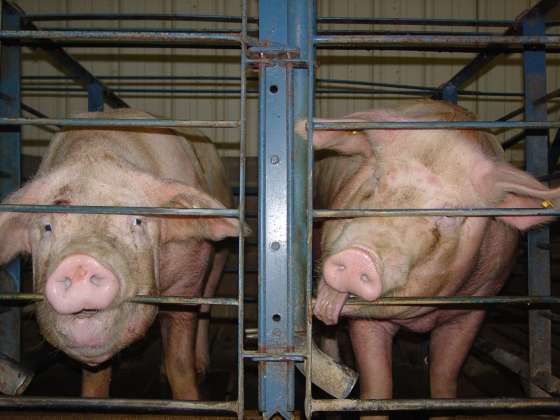
Fully slatted floors are usually concrete floors with slits through which the animals’ manure and urine fall into the slurry pit below. Straw is not used. According to Statistics Austria, around 70 percent of pigs in Austria are kept on fully slatted floors (as of 2020). The law stipulates, for example, a certain width for the slats and a minimum distance between them.

See more pictures at https://www.krone.at/3388281

Mark

EU: Are EU Companies Paying Due Diligence To Animal Welfare?

24 May 2024

New EU rules will introduce requirements for large companies to address the environmental and human rights impacts of their operations and value chains. While animal welfare is not included in the obligations, the text recognises that companies should contribute to protecting ecosystems and the well-being of animals.

Following a two-year process, the Council gave the final approval to the legislative proposal today. The European Parliament already approved the file on 24 April.

As the legislation applies to large companies (with over 1,000 employees and a turnover of more than 450 million euros), several types of companies involved in animal-based food production will be subject to the Directive. For example, large producers of animal-based products and feed would be required to integrate due diligence policies across the company. 

For instance, they should identify actual or potential adverse impacts to human rights or to the environment arising from their production, prevent them, or bring them to an end should they occur. Potential impacts could include the expansion of livestock production into forests or pollution coming from a farm’s operations.

Moreover, the Directive acknowledges the One Health approach, as recognised by the World Health Organization, underlining the link between the health of humans, domestic and wild animals, and the wider environment. It also includes the Convention on International Trade in Endangered Species of Wild Fauna and Flora (CITES) among the list of international environmental instruments to be complied with.

Above – Foie Gras Force Feeding – and Death As A Result

Eurogroup for Animals calls on the EU Member States to incorporate animal welfare when transposing the legislation into national law. Building on the progress for animals in the OECD Guidelines for Multinational Enterprises on Responsible Business Conduct and the EU’s Corporate Sustainability Reporting Directive, Member States must go further by setting stricter due diligence requirements for animal welfare.

NO ! – They are NOT Paying Due Diligence To Animal Welfare?

Regards Mark

UK: United Kingdom Bans Live Animal Export.

21 May 2024

CIWF

The Animal Welfare (Livestock Exports) Act, which has now been enshrined in law, means that farm animals can no longer be exported from Great Britain for slaughter or fattening.

The passing of this legislation marks over five decades of campaigning against the cruel live export trade, which sees animals make gruelling journeys by road and sea, often only to be slaughtered at the end of the voyage. 

During such journeys animals suffer from overcrowding, exhaustion, dehydration and stress.

The bill was first raised in 2017 by the Conservative party, promoted as a benefit of Brexit since EU trade rules prevent member states from banning live exports to other countries in the union.

The ban has been celebrated by campaigners such as Compassion in World Farming as a landmark victory.

For decades, farmed animals have endured these senseless and arduous exports to the continent – but no longer! I am phenomenally proud of our supporters whose dedication and persistence have helped secure this hard-fought victory.

Philip Lymbery, President, Eurogroup for Animals

The news follows Australia’s recent announcement of a phase out of live export of sheep. 

Pressure is mounting on the European Commission to follow suit and finally bring an end to the export of live animals from EU ports. 

Petition: Australia Is Finally Banning Live Sheep Exports. The UK Has Now Introduced A Ban. The European Union Must Follow Suit!


Petition Link:


petition: Australia is Finally Banning Live Sheep Exports. The European Union Must Follow Suit! (thepetitionsite.com)

In rare positive news about the live animal trade, Australia finally announced its plan to end its live sheep export trade by 2028, due to the serious animal welfare issues involved. Now, the European Union (EU) must follow suit.

As the world’s largest livestock exporter, the EU has a responsibility to lead by example and put an end to the cruel and perilous journeys that animals endure.

Sign the petition to demand the European Union Commission ban live sheep exports!

Animal welfare organizations have long criticized the live export trade for its cruelty. The heartbreaking reality is that animals in the live export trade suffer unimaginable conditions on long sea voyages during trade, leading to avoidable injury, sickness, and death.

Countries like Germany have already begun to acknowledge these horrors by restricting or ending their involvement in live exports, but the EU remains the largest live sheep exporter in the world. Now, it is time for the entire EU to step up and protect these vulnerable creatures.

As we move towards more humane and ethical practices, ending live exports is a crucial step. The proposed ban not only aligns with global moves to protect animal welfare but also addresses public health and ethical concerns.

European leaders must not delay in making this vital change. By banning live sheep exports, the EU can prevent further animal suffering and demonstrate its commitment to compassion and innovation in agriculture.

Sign the petition to join us in calling on the European Union Commission to enact a full ban on live sheep exports.

Regards Mark

Following photos – WAV / SAV contacts.

We expose live sheep being shipped from Serbia to Israel


https://serbiananimalsvoice.com/2015/09/21/england-sav-now-write-to-eu-commissioner-hahn-regarding-serbia-israeli-live-animal-transport/

https://serbiananimalsvoice.com/2015/10/20/serbia-it-now-appears-the-sheep-exported-live-to-israel-were-from-serbia-despite-the-threats/

Survey Reveals Majority of Citizens in EU Bullfighting Countries (Spain, France and Portugal) Are Against the Tradition.

WAV Archive Photos

17 May 2024

CAS

A survey conducted by CAS International shows that the majority of Spanish, French and Portuguese citizens are against bullfighting, and think the harmful tradition sees too much suffering to bulls.

Spain, France and Portugal are the only European countries that still allow bullfighting, including different patronal festivities with bulls and cows. 

7500 citizens were polled by Ipsos I&O Public on behalf of CAS International. Key finding included:

77% agreed that bullfighting causes too much suffering to bulls;

65% agreed that children under 18 should be prohibited from attending bullfights;

Only one in every five persons thought that bullfighting is a valuable tradition that should have a place in society;

58% favour a complete ban on bullfighting. 

It is clear that more and more people are becoming aware of the violence inflicted on bulls and people do not accept this anymore.

Maite van Gerwen, Director, CAS International

The European Union leaves the protection of animals that are used in cultural, traditional and religious events at the discretion of Member States. However, 74% of respondents agreed that the European Union should act to protect the welfare of animals in cultural traditions, and 67% did not agree with the use of national or EU subsidies to support bullfighting.

There are clear signs that interest in bullfighting is in a decline. In the past 20 years, the number of bullfights in France has decreased by 40%, and by 63% since 2007 in Spain. In Portugal, 166 bullfights were held in 2023, the lowest number ever recorded in the country.

Regards Mark

UK: Queen Pledges Not To Buy Any More Fur.

Queen Camilla pledges not to buy any more fur in latest Palace move away from animal products – after foie gras banned, holy oil for anointing the King was ‘cruelty-free’ and Coronation roll produced on paper for the first time.

Getty Images

Queen Camilla has pledged not to buy any more fur products in the latest move by Buckingham Palace to not use animal products. 

The Palace sent a letter with ‘the Queen’s warmest wishes’ to the People for Ethical Treatment of Animals (Peta) which vowed Camilla ‘will not procure any new fur garments’.

The animal-rights group toasted the news with a glass of the finest claret and its managing director Ingrid Newkirk said: ‘It’s right and proper for the British monarchy to reflect British values by recognising that fur has no place in our society.’

Continue reading at:

Queen Camilla pledges not to buy any more fur in latest Palace move away from animal products – after foie gras banned, holy oil for anointing the King was ‘cruelty-free’ and Coronation roll produced on paper for the first time | Daily Mail Online

China Cat Torture Actions:

China: Cat Torture – London Protest May 21st 2024. Piccadilly Circus – Chinatown, Then On To Chinese Embassy. – World Animals Voice

China: Cat Torture – X STORM – Wednesday 22nd May 2024. – World Animals Voice

UK: More Live Export Ban Info.

The Conservative Animal Welfare Foundation is delighted the Animal Welfare (Livestock Exports) Bill has passed its Third Reading in the House of Lords

 <https://mcusercontent.com/39260baecf6044e1f26ef4f9d/images/50104a3a-7d55-85c3-2f37-f849393cf768.png>       

Animal Welfare (Livestock Exports) Bill passes through Parliament!

 <https://mcusercontent.com/39260baecf6044e1f26ef4f9d/images/4c363c29-8ef7-562a-cb4e-c611c447304c.png>      

London, 14th May 2024

Today (14th May) The Conservative Animal Welfare Foundation (CAWF) is delighted the Animal Welfare (Livestock Exports) Bill has passed its Third Reading in the House of Lords.

This follows the Bill passing its Report Stage on 8th May in the House of Lords and Committee Stage on 14th March, having already passed all of its stages in the House of Commons.

The Bill has now completed all of its stages and will soon receive Royal Assent to become law and ban live exports for slaughter and fattening.

Throughout its passage in the House of Commons and the House of Lords, the Bill has attracted support across parties. During the Third Reading in the House of Commons, Minister Mark Spencer said that ending live exports for fattening and slaughter “is close to the hearts of many in this House”. Several Conservative MPs spoke in support of the Bill, including Patron and former Secretary of State for Defra Theresa Villiers MP, Patron Henry Smith MP, former Secretary of State for Defra Dr Therese Coffey MP, and Sir Mike Penning MP.

The Animal Welfare (Livestock Exports) Bill will ban the export of cattle, sheep, goats, pigs and horses for slaughter and fattening from Great Britain, stopping unnecessary stress, exhaustion and injury caused by exporting live animals. You can read more about the Bill here <https://conservativeanimalwelfarefoundation.us12.list-manage.com/track/click?u=39260baecf6044e1f26ef4f9d&id=bf0910abaa&e=57f5095601>

.The commitment to end live exports for fattening and slaughter honours a popular Conservative Party Manifesto commitment and delivers an important component of Defra’s Action Plan for Animal Welfare. Since the founding of Conservative Animal Welfare Foundation in 2016, ending live exports for fattening and slaughter has been a core campaign. Historically Great Britain has exported large numbers of sheep and calves abroad to France and as far afield as Spain. Overcrowding means that some cannot lie down at all, while those who do may be injured or trampled to death. They can be in transit for days, suffering extremes of temperature and often without sufficient food, water or rest.

Animals may end up in countries with far poorer welfare standards than our own, enduring practices which are illegal in the UK such as veal crates. Calves placed into the Dutch white veal pen systems, where they are unable to perform natural behaviour, are barely able to turn around.

Conservative Animal Welfare Foundation would like to thank the Prime Minister Rishi Sunak MP, Secretary of State for Defra Steve Barclay MP, and the Defra team for their continued support for this critical measure which will spare many animals the suffering they endure on long journeys overseas.

Lorraine Platt, Co-Founder of Conservative Animal Welfare Foundation, commented: “We are delighted the Animal Welfare (Livestock Exports) Bill passed its Third Reading in the House of Lords. With the Bill now awaiting Royal Assent, today we have made history in passing legislation to finally put an end to the cruel live export trade for fattening and slaughter.”

“This Bill –which delivers a key Manifesto commitment, as well as an important component of Defra’s Action Plan for Animal Welfare– has enjoyed the strong support of MPs and Peers across the political spectrum.”

“We are grateful to Minister Lord Douglas-Miller for leading the Bill in the Lords, and Secretary of State Steve Barclay for leading the Bill in the Commons, as well as to the wider Defra team for their hard work on this important subject.”

.CLIFFS LIT UP IN CELEBRATION OF LIVE EXPORT BAN

https://www.ciwf.org.uk/

About the Conservative Animal Welfare Foundation (CAWF) The Conservative Animal Welfare Foundation was established in 2016 to raise awareness on the lives of billions of animals reared on intensive farms around the world and how this impact upon animal welfare, the environment and public health. We want to highlight the action people can take to help advance farm animal welfare.

Animal welfare is an increasing concern amongst the public, who frequently look to Government to take the lead in both maintaining and improving standards.

The Conservative Animal Welfare Foundation believes it is highly important that the welfare of farm animals is placed at the forefront of the Governments plan for food and farming along with its focus on productivity, competitiveness, and technology.


CLIFFS LIT UP IN CELEBRATION OF LIVE EXPORT BAN

https://www.ciwf.org.uk/news/2024/05/cliffs-lit-up-in-celebration-of-live-export-ban

Regards Mark

Remembering Jill and many others in this campaign.