Over 10,000 animals are abandoned each year in Croatia.
It’s not only a problem for domestic animals like dogs and cats, but also farmed animals.
An amendment of the country’s Penal Code has now made abandoning an animal a criminal offence punishable by up to 2 years in prison, as well as increasing penalties for causing unnecessary pain or suffering, killing or abusing animals.
Amendments to the Croatian Penal Code came into effect on 2 April, bringing with them the long-awaited positive changes in animal protection.
Under the new legislation, individuals who abandon any animal they are responsible for will face imprisonment for up to one year. If the abandonment results in the death of an animal or involves the abandonment of multiple animals, the perpetrator could be sentenced to up to two years in prison.
This significant victory for animal welfare is the culmination of extensive efforts by Animal Friends Croatia, which initiated a petition in 2021 urging for animal abandonment to be treated as a criminal offence. Notably, 80% of the population supported this campaign.
Animal abandonment can now be directly reported to the police or municipal prosecutor’s office, rather than to veterinary inspectors. This streamlined process aims to expedite responses and facilitate the prosecution of offenders. It also serves as a deterrent against animal abandonment, as individuals are now aware that they risk imprisonment and may take the long-term care of animals into consideration before acquiring one.
The penalties for causing unnecessary pain or suffering to animals, and for killing or severely abusing animals, have been increased from a maximum of one year to two years. In cases where these offences are committed for financial gain, perpetrators may now face imprisonment for up to three years instead of two.
Another new measure allows courts to impose restrictions on individuals who have committed animal-related offences if there is a risk of reoffending; a ban on owning or acquiring animals for a period of one to five years.
Animal Friends Croatia is now urging citizens with information about law violations to promptly report any instances of animal abandonment and abuse to the police.
Regards Mark
Excellent, and we congratulate our friends at Animal Friends Croatia for getting this fantastic result.
We have experienced similar issues in the past in Serbia – another Balkans nation.
Octopus farm must be stopped, say campaigners, as new documents reveal plans were reckless and threatened environment, wildlife and public health
8 April 2024
CIWF
Press Release
Campaigners are calling on a seafood company to scrap plans to build the world’s first octopus farm in Spain as new documents reveal that – as well as ignoring animal cruelty concerns – it failed to consider the significant threats the farm would pose to wildlife, the environment and public health.
Environment report was insufficient & exposes ‘hypocrisy’ of Nueva Pescanova’s sustainability claims
NGOs Eurogroup for Animals, Compassion in World Farming and AnimaNaturalis are urging company Nueva Pescanova to immediately stop the project on the grounds that, as well as causing cruelty to octopuses, the farm contradicts its own corporate sustainability claims. Among the concerns is that the farm could threaten dolphins and turtles near the site, and its discharges could add to local water pollution and CO2 emissions. The probability of these impacts was considered to be ‘significantly high’ by the Canary Islands Government.
The company’s website claims that it is committed to ‘maintaining biodiversity’, ‘protecting the ecosystem’ and ‘promoting the circular economy’. Yet its own environmental report for the farm at the Port of Las Palmas, Gran Canaria, was considered insufficient by the Canary Islands Government due to concerns that the plans could:
threaten local wildlife, including protected cetaceans (dolphins and porpoises) and vulnerable sea turtles, through noise and water pollution due to its close proximity to a Marine Protected Area (MPA).
pose a public health risk by using nearby seawater which is not of a high enough quality to be used for human food production.
cause pollution including CO2 emissions, odour concerns, and discharges that could significantly contribute to the already highly contaminated harbour waters.
threaten a protected species of algae – cystoseira – which is present in the surroundings.
involve highly unsustainable practices such as the use of wild fish as feed and high energy consumption of the facility.
Speaking on behalf of the team of Legal Natura legal experts who examined the documents, lawyer, Maria Angeles López Lax, said: “Nueva Pescanova’s environmental report was inadequate, lacking basic information to allow the Government to assess the impact of the farm on the environment and public health. It’s up to the company to prove that the farm would not impact on protected species or risk public health before permission can be granted, yet the company has failed to address even the most basic of these concerns.”
Octopuses are unique, intelligent, naturally solitary creatures who are not suited to the overcrowded conditions that are typical of factory farms. This would increase aggression and can ultimately lead to cannibalism. They are also carnivorous, meaning they need to be fed wild fish in captivity, an unsustainable practice that would put extra pressure on already overexploited fish populations.
Compassion in World Farming launched its report Octopus Farming: A Recipe for Disaster in 2021 revealing scientific evidence that octopus farming would be both cruel and environmentally damaging. A year ago, Compassion and Eurogroup for Animals launched Uncovering the Horrific Reality of Octopus Farming – its joint response to Nueva Pescanova’s plans to farm around one million of these intelligent, unique animals in an aquatic factory farm annually.
On World Octopus Day last year (8 October), 75 NGOs, experts and public figures, led by Compassion and Eurogroup for Animals, wrote to the Canary Islands Government urging it to reject the plans. Thousands of supporters also took action, urging the President of the community to stop the octopus farm.
It is unjustifiable to introduce this new type of factory farming, as climate scientists warn of the urgent need to change our food systems and evolve our diets to become more sustainable. We deserve better than continued environmental devastation to fill corporate pockets, and these incredible animals deserve better than lives diminished to confinement and suffering.
Keri Tietge, Aquatic Animals Policy Officer, Eurogroup for Animals
Not only would this octopus farm cause cruelty to these naturally solitary and intelligent animals and be environmentally unsustainable, it’s also hypocritical for Nueva Pescanova to push plans that contradict their own corporate sustainability claims.
Dr Elena Lara, a marine biologist and Senior Research Manager, Compassion in World Farming,
Our society should be in a moment of progress towards a more empathetic and compassionate treatment of animals. If this aberration continues, despite the rejection of the scientific community and a large part of society, we will be facing a serious rupture of these values.
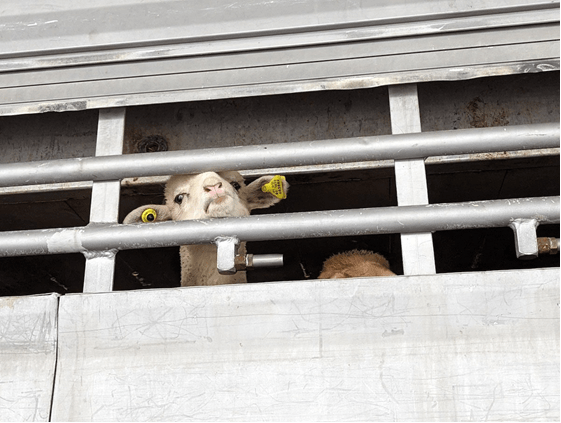
Farm Animals Programme Officer, Susanna Blattner, was recently invited by our member Essere Animali to follow trucks transporting lambs across Italy. The purpose of the investigation was to monitor any legal violations to the animals, intervening where possible, and to record firsthand the experiences of these lambs to show where the current Transport Regulation is falling dramatically short of protecting their welfare. This is her account of her experience.
As a veterinarian with experience in slaughterhouses, I thought I was ready for this experience. I arrived on the day of the investigation prepared; I reviewed European regulations until I could cite the most common breach articles from memory. I studied Italian regulations, legislative decrees, previous investigations, watched hours of videos, and talked to several colleagues to prepare myself as best as I could.
Unfortunately, it wasn’t enough. Theory doesn’t prepare you for certain things, and from this experience, I return even angrier and sadder but with a greater awareness of the importance of my role in Brussels.
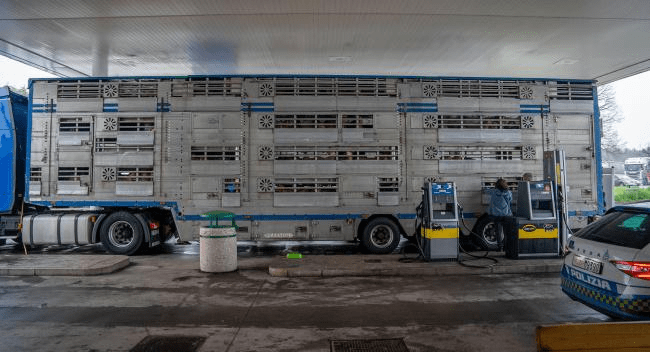
The days were organised like this: wake up at 4am, head to a service station in Friuli, near the border with Slovenia, and wait in the car until a truck containing lambs arrived (sometimes they stopped at the service station) to follow and monitor it. In case of obvious irregularities, call the police and report any problems.
I expected long hours of waiting, but instead, the trucks kept coming. Sometimes I could even hear the lambs bleating from tens of metres away, and every truck spotted with a Hungarian or Romanian licence plate was a blow to the heart.
Their bleating was persistent. I still have it in my ears.
The times when the trucks stopped at a service station and I had the opportunity to inspect them were devastating. The trucks were overcrowded, the lambs touching the upper shelf with their heads, unable to drink. When I stroked them, they searched for me insistently, as if they understood that I was there for them.
Essere Animali
Their bleating was persistent; I still have it in my ears. One morning, we followed a truck from Friuli to Emilia Romagna – four hours of pursuit during which even on the highway, with the windows closed, I could hear their lament.
One of the things that struck me the most was my complete helplessness. I met police officers with big hearts who, when I explained that I was a veterinarian, listened to me and called Italian colleagues to try to do something for the welfare of those poor animals and penalise the people who had allowed such cruelties. I met veterinarians who worked with heart, and above all professionalism, ready to meticulously inspect every truck and penalise every minor infringement, with tearful eyes. But I also encountered police officers who accused me of wasting their time for “such a thing”, and veterinarians who laughed in my face because I wasn’t in touch with reality and it made no sense to fine a truck for “so little.” The “so little” were more than 800 lambs on a truck without adequate safety measures and devices for drinking.
A stronger Transport Regulation will be the key to changing the sad state of live animal transport.
However, what troubled me the most was the impossibility of protecting the animals being transported due to endless bureaucratic loopholes: the grey areas of the current transport law, that allow transporters to do things without considering animal welfare at all, the inability of law enforcement to impose adequate penalties, and so on.
But there was something that gave me a glimmer of hope – the people I met during this experience.
The petrol station attendant who, while we waited at the service station for the arrival of the veterinarians, brought us a bowl to give water to the lambs.
The clerk who, when he realised what we were doing, showed us videos of other atrocities done to animals that he had managed to film.
The travellers who, when they arrived at the service stations, came to ask us what was happening to the animals, and upon our explanation, realised the cruelty of this practice.
The television journalist who was with me all day to film the events, and at the end said to me, “But how can I still eat these little animals now?”
It was a strong, bittersweet experience, one that would be very challenging to repeat due to the physical and emotional fatigue it incurred, but one I will never forget either. I am now even more motivated to work hard, and fight to protect the millions of animals transported every year.
It’s critical the European Commission takes its revision to the Transport Regulation seriously, creating species-specific rules across the sector that robustly protect the welfare of all animals involved.
Agriculture minister Jim Fairlie said if it was implemented Scotland would be “leading the way in improving the welfare of animals”.
The use of battery cages for birds was banned in the UK in 2012.
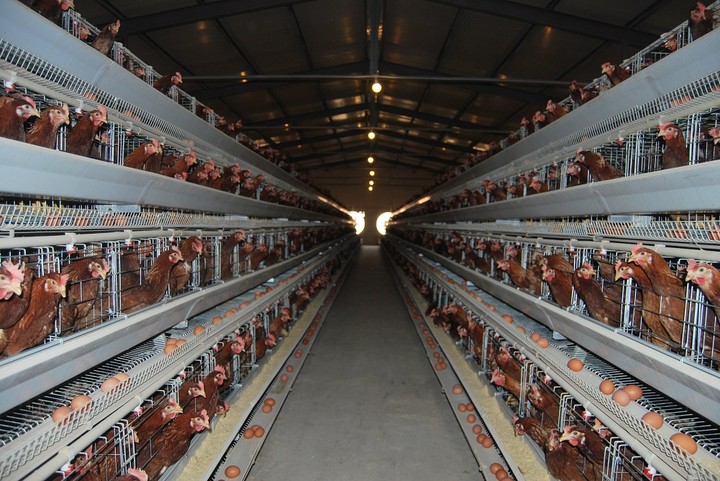
But there are still more than 1.1m chickens in Scotland kept in “enriched cages”, which provide birds with more room to nest, roost and scratch than the smaller battery cages.
A survey in 2020 found that almost nine out of 10 people (88%) in the UK believed that using cages in farming was cruel.
And more than three quarters (77%) supported a complete ban on their use.
The Scottish government’s preference is for a ban on the installation of new cages from 2033, followed by a complete ban on keeping birds in enriched cages from 2034.
Ministers believe this option “most effectively balances improvements in bird welfare and ensures sustainability for the laying hen sector”.
But the consultation also seeks views on banning the use of enriched cages from 2030.
And it proposes a non-regulatory option, which would see shops and caterers commit to stop selling and using eggs from birds kept in enriched cages by 2034.
‘Significant progress’
Mr Fairlie said the Scottish government’s most recent programme for government had included commitments “to improve the welfare of laying hens to ensure their confinement does not negatively impact their normal behaviours”.
He added: “Significant progress has already been made in recognising the importance of animal welfare – both in government policies and the demand from the public in the choice they make when shopping.
“If implemented, the ban would be another example of Scotland leading the way in improving the welfare of animals by being the first UK nation to ban the practice.”
The minister said the European Union had put forward legislation to prohibit using cages for all farmed livestock, with Luxembourg and Austria already banning them and others phasing them out.
And he said the Scottish government would also call for evidence, in due course, on the use of cages in the gamebird, quail egg and meat sectors.
Mark Borthwick, World Animal Protection policy manager, welcomed the news and said: “We’re pleased to see Scotland leading the way in consulting on the ban of cages for laying hens which are still in use in the UK.
“Enriched cages for laying hens will be banned in other countries including in Germany in 2025, in Czechia by 2027 and in Slovakia by 2030.
“France has banned the installation of any new cages. The UK is behind, and the other nations are slipping behind even further.
“It is time to end the use of cages which restrict animals’ natural behaviours and cause great suffering.”
‘Leading the way’ ? – 10 YEARS TOO LATE ! – Regards Mark
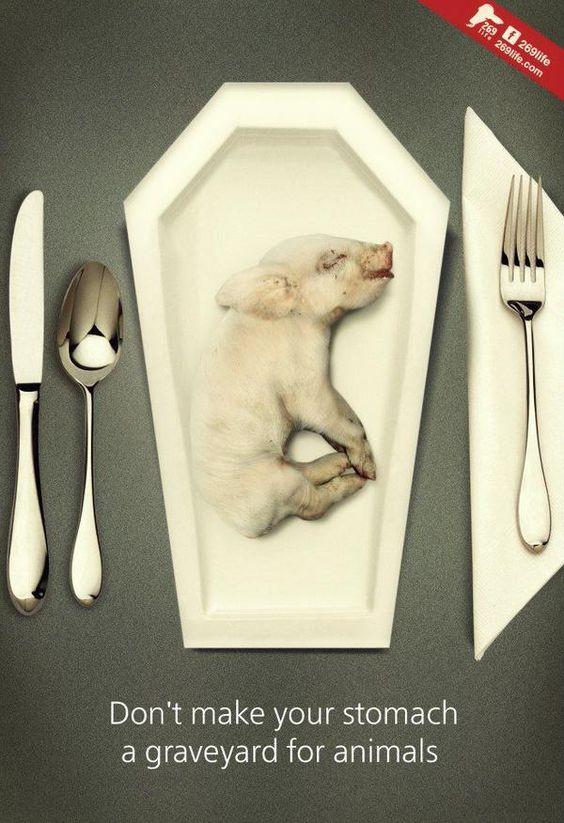
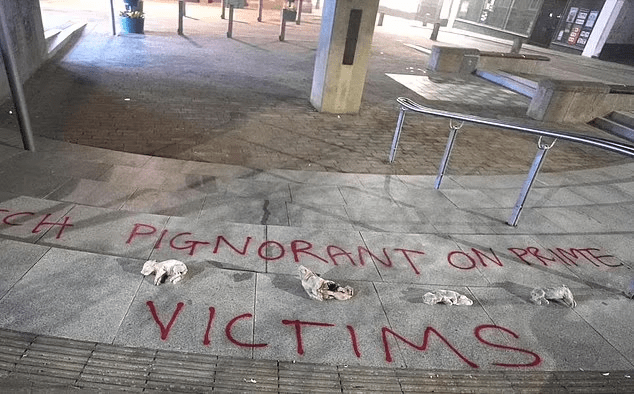
Am just sending out news links about this today as there is a lot going on – basically, activists got into slaughterhouse re pig killing; and dead baby piglets are left outside a town hall as a result – with the words ‘Pignorant on crime’ sprayed onto the pavement. All to highlight the cruel and suffering endured by pigs.
The courts and prison system are in chaos here – with everything taking far too long to send REAL criminals through the system – but if you do animal rights, you get charged within hours and it all moves on quickly – how strange !
Info – The Port of East London is located at the mouth of the Buffalo River in the Eastern Cape of South Africa. It serves as the only remaining river port in the country. The port has excellent rail and road connections to regions such as the Free State, Gauteng, and KwaZulu-Natal. Additionally, it acts as a vital gateway connecting Africa to the global market
Animal rights groups will greet the Al Mawashi vessel when it docks at East London harbour today and document “animal exploitation”.
In East London, Ban Animal Trading South Africa will document the export and in Cape Town the Coalition to Stop Live Animal Export South Africa will protest at 123 Hertzog Boulevard on the Foreshore.
The Kuwaiti importer of livestock is expected to load live animals and transport the cargo to the Middle East.
Labelled as the “death ship”, the 44-year- old vessel is expected to be anchored at the harbour at about 8am, according to a ship tracking website.
National Council of SPCA (NSPCA) executive director Marcelle Meredith said their inspector and veterinarian travelled to the feedlot in the Eastern Cape, owned by a farming company, in preparation for the arrival of the vessel.
About 60 000 sheep, 1500 cattle and 200 goats will be loaded onto the vessel and taken to Kuwait and Saudi Arabia.
“They inspected the animals at the feedlot and again serious welfare concerns were identified.
On March 18 a warning was issued for shade and water to be provided for the animals and for injured animals to receive appropriate treatment. Since March 26 seven NSPCA inspectors, the veterinarian and two inspectors from King William’s Town SPCA have been at the feedlot to inspect the animals being held in preparation for loading,” said Meredith.
According to the NSPCA, their understanding was the owner of the farming company was managing the shipment for Al Mawashi to whom he rented the feedlot for the export.
Meredith said on Wednesday the inspectors encountered escalating hostility during a lawful inspection, conducted with a warrant as the company owner allegedly displayed aggressive, discourteous behaviour and demanded the inspectors leave the premises.
“The NSPCA had to request assistance from police. The NSPCA has five prosecution cases against Al Mawashi and (the owner of the farming company). The NSPCA has encountered ongoing animal abuse at this feed lot. During the June 2023 shipment, inspectors thwarted attempts to load sick, pregnant, lame, heavily horned and unshorn sheep. Inspectors further intervened when rams had their horns severed using an angle grinder causing a bloodbath and resulting in 131 rams being confiscated and the arrest of the then feedlot manager.
As a result, the NSPCA met the Eastern Cape Department of Rural Development and Agrarian Reform. The department agreed guidelines for the export of animals by sea would be stringently followed for future shipments,” said Meredith.
Al Mawashi declined to comment.
Cape Times
Regards Mark
An animal abusing rust bucket that should have gone to the sea bed decades ago !
Sonoma County voters will be asked this November if they want to restrict the size of animal farms.
The county clerk and registrar of voters approved the measure for the ballot last Wednesday after animal rights and environmental activists gathered more than enough signatures to meet the required 19,746.
The petition drive was led by the group Coalition to End Factory Farming, who want to end large-scale concentrated animal feeding operations, or CAFOs, in Sonoma County.
The initiative calls for a three-year phase-out of one classification of animal farms — large CAFO. It does not affect farms classified by the U.S Environmental Protection Agency as medium CAFO or smaller.
According to Coalition spokesperson Samantha Faye in a statement released Monday, the ordinance could affect two dozen sites that classify as Large CAFOs, which she said are only about 2.4% of animal farms in the county.
“Across these two dozen facilities, there are approximately 2.9 million animals confined,” she said. “These facilities disproportionately affect animals, our water, our air quality, our public health, and the sustainability of agriculture in Sonoma County.”
The group uses the EPA definition of CAFO, which differs depending on an animal’s species, their quantities and the way the farm handles animal waste. For example, a duck farm is classified as a “large CAFO” if it confines 5,000 ducks and uses a liquid manure handling system that washes their waste into a holding pond or lagoon on site. If it disposes of manure some other way, it doesn’t become a large CAFO until it has 30,000 ducks.
The potential ordinance would state that CAFOs disproportionately affect low-income and disadvantaged communities, and that the county intends to provide a retraining and employment assistance program for workers at CAFOs to facilitate the transition to safer forms of work.
“We are against the very vague language in the proposed ballot initiative put forth by the Coalition to End Factory Farming, and the group behind them, Direct Action Everywhere,” said Jennifer Reichardt of Sonoma County Poultry, Liberty Ducks in an email. “This will not save family farms. The goal of this initiative is to put farms out of business.”
Reichardt said that if the measure is passed, residents in the Bay Area will have to pay a higher price for meat, dairy, and eggs, because they will need to be imported.
“If it is passed, it will increase greenhouse emissions from trucking in products from further away, increase the cost of food, and shut down local, often multi-generational, businesses. It will put hundreds of employees out of work, and force the import of other meat, dairy, and eggs from outside the county and state,” Reichardt said.
Sonoma is one of four California counties where the highly pathogenic avian flu was detected among commercial flocks last year, prompting the board of supervisors to declare a local state of emergency in December 2023.
The Coalition to End Factory Farming includes animal rights groups, small farm advocates, and Direct Action Everywhere, an organization that, among other things, wants to make legal the right of people to enter places such as factory farms to remove animals they say are in distress. Their activism includes trespassing to obtain video footage inside farms and rescuing animals.
Their co-founder, San Francisco attorney Wayne Hsiung, was arrested in November and sentenced in Sonoma County to 90 days in jail and two years of probation last year for felony trespassing at chicken and duck farms in 2018 and 2019.
At a press conference Monday, Cassie King of Direct Action Everywhere said they watch farms from public property or may use satellite imagery to decide to enter a facility. For example, they may see if birds never go outside in a facility that’s supposedly free range.
“Sometimes they find animals who are on the brink of death, who are clearly ill or injured and can’t get themselves up, can’t get themselves to food and water,” she said. “If they leave them behind, they will surely die, either die slowly from starvation or dehydration. In many cases, facility employees will come and kill the individuals who are too sick or weak to feed themselves to survive.”
Italian fashion company Moncler Group – which owns Moncler and Stone Island – is tied to horrific duck slaughter.
The brand is connected to duck farms and abattoirs in Vietnam that have been exposed by PETA. As seen in the footage, workers mercilessly stab ducks, slit their throats, and cut their feet off while they’re still alive.
Ducks and geese feel fear and pain, just as humans do. They’re happiest with their families and don’t want to spend their life imprisoned on a filthy farm.
A growing number of clothing companies now use entirely animal-free fabrics to create top-notch fashion, and many companies – including Napapijri and ASOS – have ditched feathers. Moncler Group must do the same.
Please use PETA’s new action alert to urge Moncler Group to spare birds suffering and a painful death by banning down.
As has been customary for some years now, a few days before Easter, our investigative team returned to the motorways on the border between Italy and Slovenia to monitor trucks loaded with lambs arriving from Eastern Europe, heading to slaughterhouses in Tuscany, Lazio and Puglia.
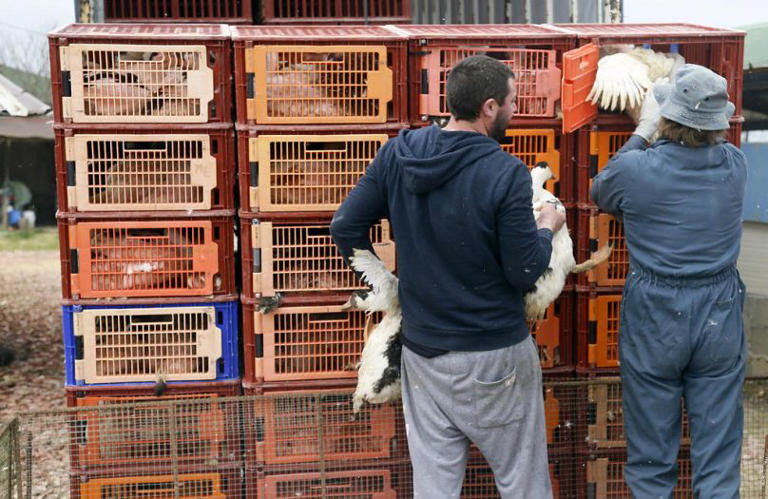
On the monitored vehicles, coming from Hungary, Romania, Slovakia and Poland, several problems and violations of the rules were once again found: overcrowding, presence of unweaned animals on vehicles not suitable to feed them and transported for a longer period than that required by the regulations, ventilation and watering systems not working, inadequate or unreachable drinking bottles for all lambs, insufficient space above the animals’ heads to be able to travel in a natural position.
And all this for long and exhausting journeys, which can last up to 30 hours.
This activity was carried out in collaboration with Animals’ Angels, Enpa and the Animal Welfare Foundation.
Of the 20 trucks targeted by the associations, 8 were checked by the police and 4 received fines of thousands of euros.
Already on the first day, a truck was fined €6,500 due to malfunctioning ventilation and drinking system and document irregularities. The situation was such that the truck was not fit to continue its journey.
OUR REQUESTS
The revision of Council Regulation (EC) No 1/2005 of 22 December 2004 “on the protection of animals during transport and related operations” is a unique opportunity for the European Commission and the EU co-legislators to ensure greater and better protection of animals and to take action on the most serious issues in order to spare animals avoidable suffering.
That is why we ask:
an immediate ban on the export of live farmed animals to third countries;
limiting travel times for the transport of live animals to a maximum of eight hours and 4 hours for poultry and rabbits (which must be transported in specific containers);
the prohibition of the transport of animals: • unweaned; • in an advanced state of pregnancy (who have exceeded 40% of the gestation state); • at the end of their productive life;
the prohibition of the transport of live animals if the expected outside temperatures are below 5°C or above 25°C, subject to clear definition of the following parameters: • specific species – and categories – conditions for the suitability of animals for transport; • minimum and maximum outdoor temperatures; • availability of space; • availability and method of administration of food and water;
to limit intra-EU maritime transport as much as possible and to allow it only where it is strictly necessary, with the suitability of the vessels approved by an EU Authority that verifies compliance with strict technical and mandatory requirements;
to develop a clear definition of ‘journey time’, which is to be understood as the time that elapses from the ‘start of the journey’ to the ‘end of the journey’, including the loading and unloading of animals. In the case of sea transport, the “journey time” includes the time that the animals spend along the road journey from the farm to the port and from the port to the “final destination”, as well as the time that the animals spend on the boats and during embarkation and disembarkation operations;
the reduction and replacement of the transport of live animals with that of meat and carcasses, and seeds and embryos, as also recommended by FVE, OIE, and EFSA.
We also call for stricter enforcement of EU legislation, which must also be accompanied by more controls and inspections and strict penalties for infringements.
Inside another truck there was a lamb unable to stand on its legs, which was entrusted to the associations. The lamb is now under the care of a veterinarian. Again, the truck was not fit to continue its journey.
In December 2023, the European Commission published a proposal to revise the legislation on the transport of live animals. The European elections in June are a unique opportunity to continue the work: it is crucial that the new Parliament and the new Commission commit to better regulation and controls.
It is equally important that the Ministry of Health in Italy is ready to give precise indications that make controls more efficient throughout the country and that our government works with other member states to improve legislation at European level.
And this umpteenth investigation, with the sanctions that have arisen and the great media attention it is generating, is one more tool to make the problem visible and bring it once again to the tables of the institutions!
Ps: this transport monitoring activity has once again brought to light a very serious situation for animals. A serious reform of this practice by the EU is urgently needed. Ask yourself:
Despite a clear commitment from the European Commission in 2021 to deliver proposals to ban caged animal farming by the end of 2023, it has failed to deliver on its promise.
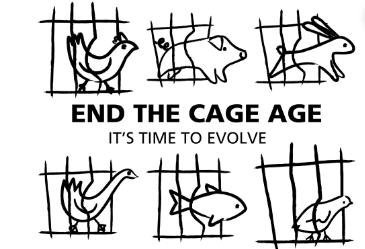
As a result, last week, the End the Cage Age Citizens’ Committee — a group of seven EU citizens who started the ECI — launched a ground-breaking legal action against the European Commission for failing to act.
Funded by Compassion in World Farming, this historic case could result in the Commission being compelled by the court to set out a clear timescale for the legislation.
It is the first legal action to hold the Commission to account over its failure to act on an ECI — an important test case for both animal welfare and democracy.
Despite overwhelming support, animals continue to suffer
Back in 2021, Compassion in World Farming, along with millions of European citizens, celebrated the news of the European Commission’s clear commitment.
It followed the first ever successful European Citizens’ Initiative (ECI) to ‘End the Cage Age’, which was signed by an overwhelming 1.4 million EU citizens and supported by a coalition of 170 NGOs led by Compassion.
ECIs were introduced with the specific purpose of giving citizens more influence over EU decision making and the tool is described by the European Commission as “a way for you and other Europeans to take an active part in EU policy-making”.
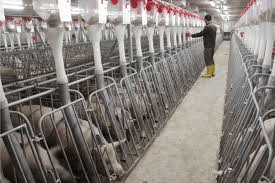
Pregnant sows are forced to nurse their piglets in crates so small they can’t even turn around; chickens can’t spread their wings, and along with countless rabbits and quail will spend all their lives in barren cages.
In October last year, the European Commission’s own Eurobarometer survey revealed that an overwhelming nine out of ten, or 89% of EU citizens — around 400 million people — believe animals should not be farmed in individual cages.
The Commission’s own scientific advisers, the European Food Safety Authority, have also backed the phasing out of cages on welfare grounds for pigs, dairy calves, laying hens, ducks, quail and rabbits.
Meanwhile, more than 300 million pigs, hens, rabbits, ducks, quail and geese continue to suffer confinement and misery in cages across the EU each year.
Pregnant sows are forced to nurse their piglets in crates so small they can’t even turn around; chickens can’t spread their wings, and along with countless rabbits and quail will spend all their lives in barren cages.
Ducks and geese are caged for force-feeding to produce foie gras.
How did the ban get derailed?
In September, we hoped to hear European Commission President Ursula von der Leyen set out the plans to deliver the ban in her State of the Union speech.
Instead, what we heard were words that echoed the letter she received from the farming federation Copa Cogeca. It seems she caved into pressure from the agriculture lobby to put the ban on hold.
Together with my colleagues in End the Cage Age Citizens’ Committee, we have made repeated requests to meet with the president on behalf of the millions of EU citizens who support the cages ban, without success.
The cages ban — part of the Commission’s excellent Farm to Fork strategy to meet climate and nature obligations — also has the chance to provide wider environmental and socio-economic benefits.
Yet, last October, an investigation from Lighthouse Reports revealed that “an increasingly assertive meat industry helped derail a historic democratic demand to improve animal welfare standards in the EU”.
We simply cannot allow the powerful farming lobby to have preferential access to decision-makers to influence them to backtrack on promises they have made to citizens.
This is particularly unjust when those citizens have followed the very process designed to give them more influence over EU decision-making. As a result of this injustice, both animal welfare and democracy are now at stake.
There is simply no justification for any further delay. All the appropriate preparation, assessments and consultations have already been carried out by Commission officials and the proposals make strong provision for financial support to help farmers transition to cage-free systems during a phase-out.
This measure is backed by the animal welfare movement who believe public subsidies should be redirected to reward farmers for transitioning to high welfare and nature-positive systems that benefit society.
Pursuing legal action is not a choice we have taken lightly, but we cannot allow the European Commission to break its promises to citizens, making a mockery of democracy in the process.
The cages ban — part of the Commission’s excellent Farm to Fork strategy to meet climate and nature obligations — also has the chance to provide wider environmental and socio-economic benefits.
A report from the Institute for European Environmental Policy found that the ban would have greater sustainability benefits.
In addition, it concluded that the current discrepancy between legislation in member states was leading to uneven market conditions across the EU, and that a level playing field should be created.
Democracy is not to be mocked
Pursuing legal action is not a choice we have taken lightly, but we cannot allow the European Commission to break its promises to citizens, making a mockery of democracy in the process.
Most importantly, we cannot stand by silently while millions of animals continue to suffer in cages. Caving into the big agriculture lobby and continuing to use taxpayer funds to prop up this damaging sector is not helping citizens, or the majority of small-to-medium-scale farmers.
The hope is that this ground-breaking legal action — launched on behalf of millions of supportive EU citizens as well as the voiceless 300 million animals still suffering every day in cages — will speed up the ban and ensure that every cage is an empty cage.
We will not rest until we end the Cage Age.
Olga Kikou is Head of Compassion in World Farming EU, the leading farm animal welfare organisation dedicated to ending factory farming and achieving humane and sustainable food production.























 World Animals Voice