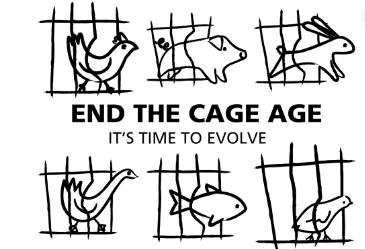
The European Ombudsman has opened an inquiry into the European Commission’s (EC) failure to publish a legislative proposal to phase-out and ultimately ban cages for farm animals, in line with its official answer to the End the Cage Age European Citizens’ Initiative (ECI).
Eurogroup for Animals and numerous other animal protection organisations wrote to the European Commission in October after it unexpectedly backtracked on the commitment to bring forward legislation banning cages in 2023, and did not provide any clarity on when it would be published.
In June 2021, the EC promised that by the end of 2023, it would put forward a legislative proposal to phase out and finally prohibit the use of cages, a commitment which it re-stated and reinforced on numerous occasions. The EC had generated considerable legitimate expectation among citizens that legislation would be forthcoming, creating a case of maladministration.
The complaint raises the issue of the EC undermining the rules that govern ECIs and the very credibility of the democratic participatory process they represent. In the run up to the European elections in June of this year, this is a particularly poor signal to send to citizens.
The European Ombudsman has now asked the EC to send an official reply to Eurogroup for Animals and all the other complainants by the end of January.
The opening of the inquiry of the European Ombudsman sends a clear signal that the democratic tool of the ECI should not be undermined. Citizens are using the tools at their disposal to make their voice heard on issues that matter. We expect the European Commission to follow through on its commitment, and we continue asking for a timeline indicating when the promised proposals will be published.
The Belgian Presidency does not plan to address the proposal for animal transport in its term according to the programme of legislative files that will be worked on. The presidency of the Council is responsible for setting the agenda and facilitating dialogue between the Council and other EU institutions. It is now Belgium’s turn to take on the role until June of this year.
In December the European Commission published a proposal for the transport of live animals, but the proposed text failed to recommend actions that can make significant improvements for animal welfare, ignoring several EFSA opinions. Most strikingly, it still allows for animals to be transported live to non-EU countries, despite the ever growing concerns on the consequences of such journeys.
It was hoped that the Council could work on the topic and strengthen the proposal. However, with the Belgian Presidency deciding to kick the can down the road, the EU will not be in a position to adopt new welfare standards for the transport of live animals any time soon. The programme only mentions the drafting of a progress report on animal transport, and will only be worked on “if there is time”, which according to news reports, is highly unlikely.
At the beginning of its term in 2019, this Commission under President Ursula von der Leyen committed to improving the lives of farmed animals by coming forward with a number of proposals, of which transport is just one.
It was expected that this whole package could come into force and start improving the lives of millions of animals across the EU as soon as 2027. So far the Commission has only brought forward the proposal on transport, which could now be further delayed, and a proposed regulation on cats and dogs which the Council is expected to adopt a general approach on.
Photo – Mark (WAV) – A Dutch Horse Transporter heads out of Dover UK.
The Animal Welfare (Livestock Exports) Bill will have its Committee of the Whole House and Remaining Stages in the House of Commons on Monday 15th January.
This means if the Bill passes (WAV Comment – Sure it will as it has full Cross Party Support) it will be ready to enter the House of Lords to complete its passage.
This important Bill will ban the export of cattle, sheep, goats, pigs and horses for slaughter and fattening from Great Britain, stopping unnecessary stress, exhaustion and injury caused by exporting live animals. In doing so, it will deliver a key Conservative Manifesto commitment and part of Defra’s Action Plan for Animal Welfare.
During live export animals may end up in countries with far poorer welfare standards than our own, enduring practices which are illegal in the UK such as veal crates. Calves placed into the Dutch white veal pen systems, where they are unable to perform natural behaviour, are barely able to turn around.
UK ACTION – We are asking our supporters to contact their local MP and ask them to attend these important final stages of the Bill in the House of Commons. To make this easier for you, we have drafted a template below which you can copy and paste.
We hope you will join us in the mission to end live exports for fattening and slaughter.
With warmest wishes,
Email to: your MP
Dear (name of MP),
I am contacting you to ask you to support the Animal Welfare (Livestock Exports) Bill which will enter its final stages in the House of Commons on Monday 15th January. Ending live exports for fattening and slaughter was included in the Conservative Manifesto and Defra’s Action Plan for Animal Welfare.
With a General Election this year, I am keen to ensure this important Bill becomes law as soon as possible. I therefore ask you to attend and vote in favour of the Bill during its final stages on Monday, to prevent the cruelty of live exports from continuing in the future.
Historically the UK has exported thousands of sheep and calves abroad to France and as far afield as Spain. Overcrowding means that some cannot lie down at all, while those who do may be injured or trampled to death. They can be in transit for days, suffering extremes of temperature and often without sufficient food, water or rest. Please help to end live exports for fattening and slaughter for good.
Our respect and congratulations go out to ‘Korean Dogs’ and to ‘Korean Animal Rights’ (KARA) and also ‘HSI’ for their tenacity in fighting this issue. As we know with live exports (UK); it can take a long time to achieve victory – rewards don’t get delivered on a plate; they have to be fought for sometimes over many years. But as here, good wins over evil !
I can hear some people saying ”yes, but a 3 year phase out period ?” – 3 years too long as far as I am personally concerned; but now we have a completion date, something which has eluded campaigners for so long. Also, as in the BBC report, ne dog farmer, Joo Yeong-bong, told the BBC the industry was in despair. Great ! – personally I think and hope that very quickly the industry will realise it is now heading towards history books and will quickly take the government money on offer, stop the dog farming, and move to basic traditional farming or something else. I personally think this is the most wonderful news for all the South Korean (and other international) campaigners who have battled for so many years. Thanks also must go to the current South Korean President Yoon Suk Yeol and First Lady Kim Keon Hee who are both are known animal lovers, having 6 dogs themselves. First Lady Kim has called for the practice of eating dogs to end. Now we are witnessing it happen !
Once again, congratulation to ‘Korean Dogs’, ‘KARA’ and ‘HSI’; EVERYONE ! for all their long work and providing the evidence of suffering.
Regards Mark
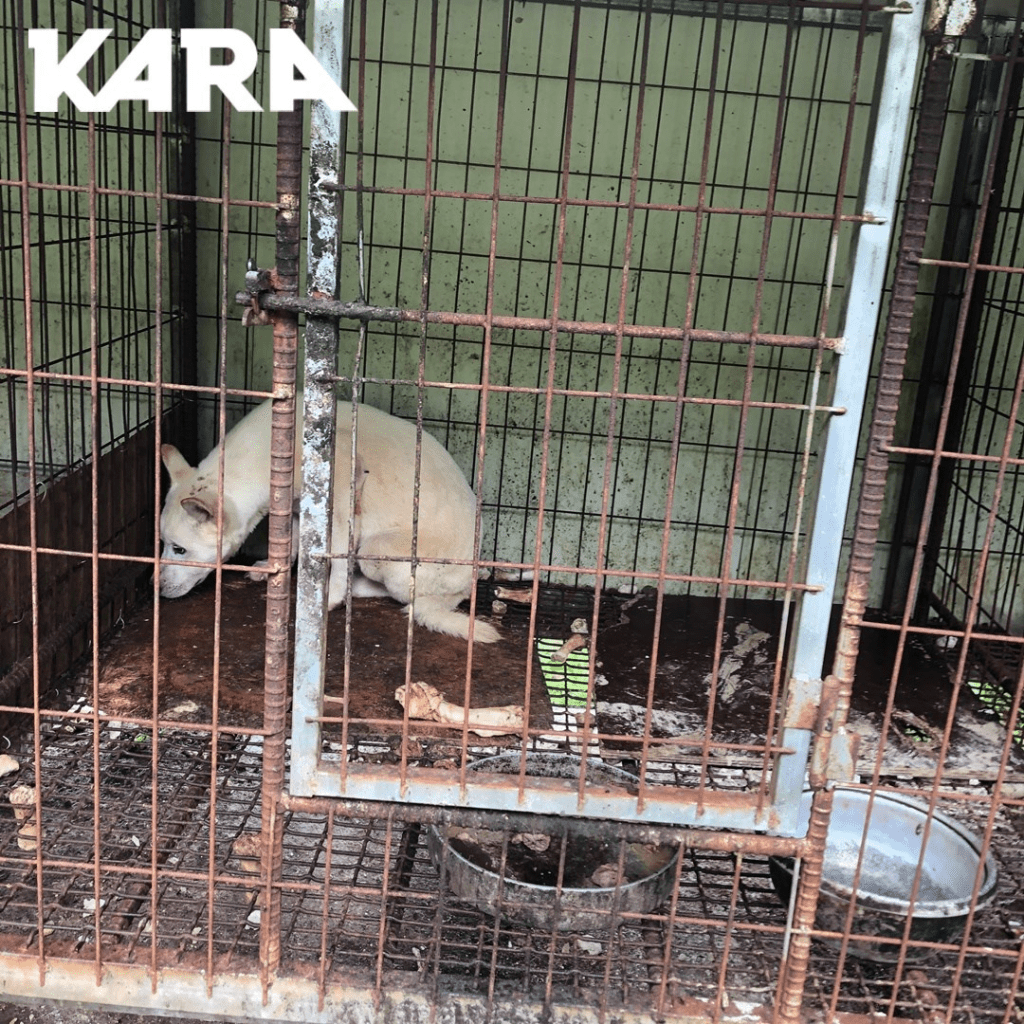
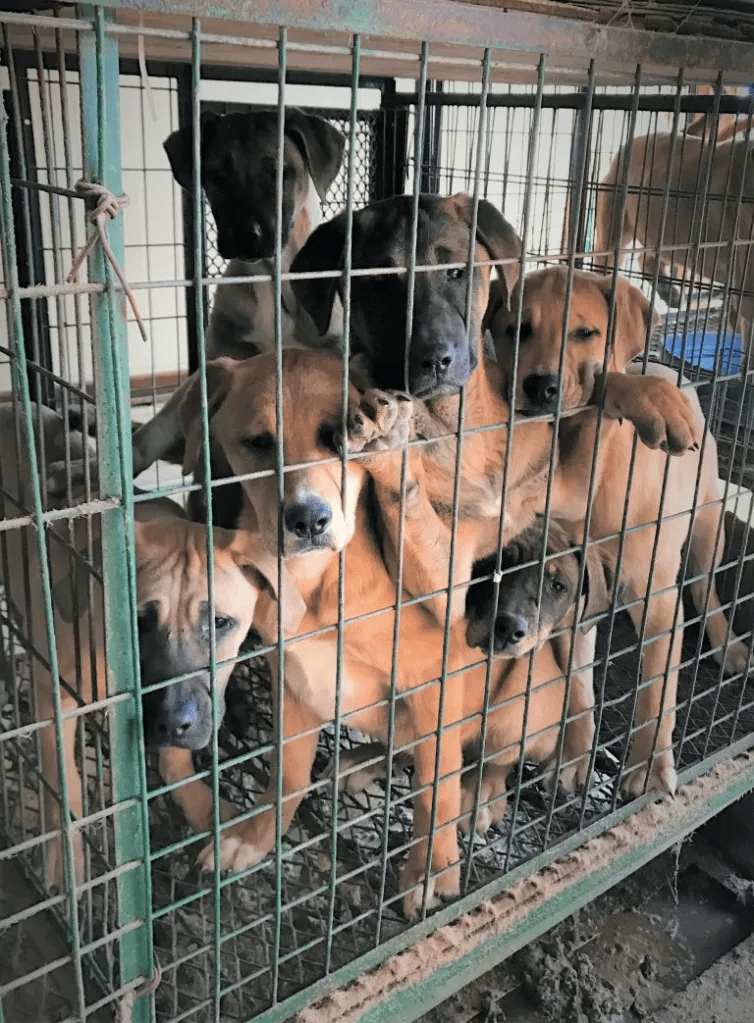
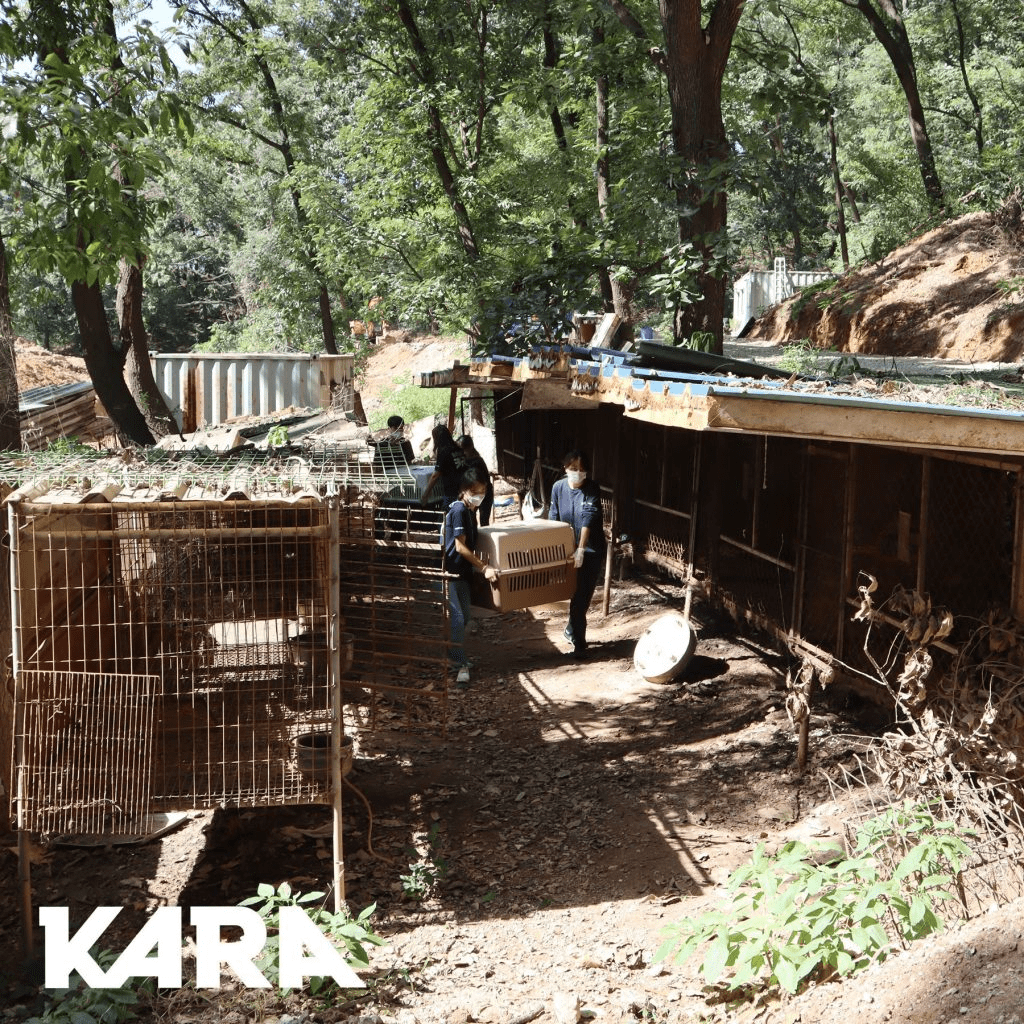
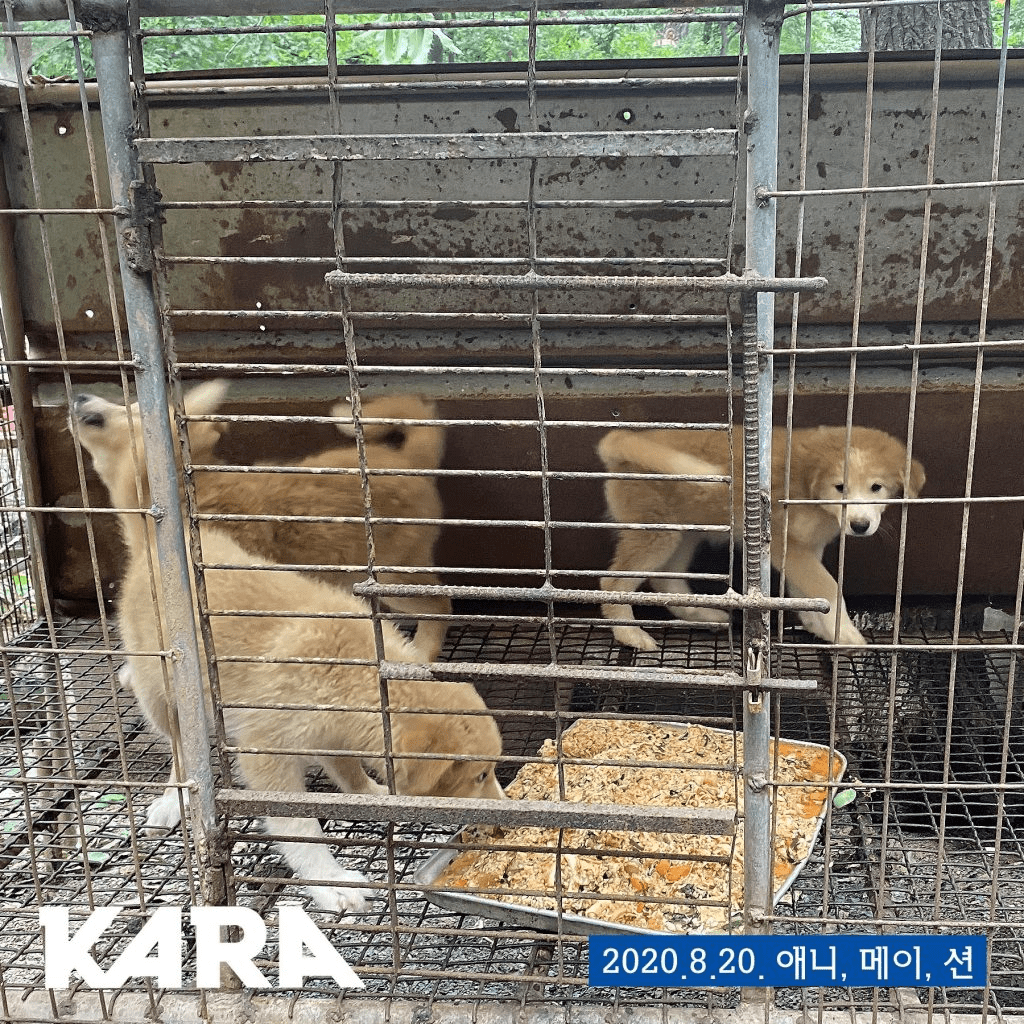
The ‘Korean Dogs’ action header and photos provided by KARA of dog meat farms suffering:
The slaughter and sale of dogs for their meat is to become illegal in South Korea after MPs backed a new law.
The legislation, set to come into force by 2027, aims to end the centuries-old practice of humans eating dog meat.
Dog meat stew, called “boshintang”, is considered a delicacy among some older South Koreans, but the meat has fallen out of favour with diners and is no longer popular with young people.
Farmers and restaurant owners have three years to find alternative sources of employment and income before the legislation comes into force.
According to government statistics, South Korea had around 1,600 dog meat restaurants and 1,150 dog farms in 2023, all of which will now have to submit a plan to phase out their businesses to their local authorities.
Animal rights groups, which have long been pushing for the ban, praised the outcome of Tuesday’s vote.
Jung Ah Chae, the executive director of the Humane Society in Korea, said she was surprised to see the ban in her lifetime. “While my heart breaks for all the millions of dogs for whom this change has come too late, I am overjoyed that South Korea can now close this miserable chapter in our history and embrace a dog friendly future,” she said.
One dog farmer, Joo Yeong-bong, told the BBC the industry was in despair.
Maverick Tasmanian MP John Tucker has threatened to “bring the government down” if it does not support his demands for mandatory CCTV in abattoirs and a cessation of AFL projects until the Macquarie Point stadium passes parliament.
Camille Labchuk’s journey toward veganism began at 12 and was motivated by a desire to distance herself from the cruelty associated with dairy and egg production. Photo by Abdul Matin Sarfraz for Canada’s National Observer
Defending animal rights means never eating your clients
Growing up on Prince Edward Island, Camille Labchuk lived with a coterie of domestic animals, including cats, hamsters, rabbits, and ducks. But at age nine, she became aware of the darker side of human-animal relationships. Television footage of the commercial seal kill near her home profoundly impacted her, sparking a lifelong commitment to animal welfare.
“I couldn’t believe that people were clubbing baby seals over the head and then skinning them for their fur,” said Labchuk. “My experience with animals until that day had mostly been that people were kind and loving toward their companion animals. That was when I first … realized that sometimes animals suffered at our hands.”
WAV Comment – I have seen quite a bit of animal suffering over the years, and this is basically downright disgusting !
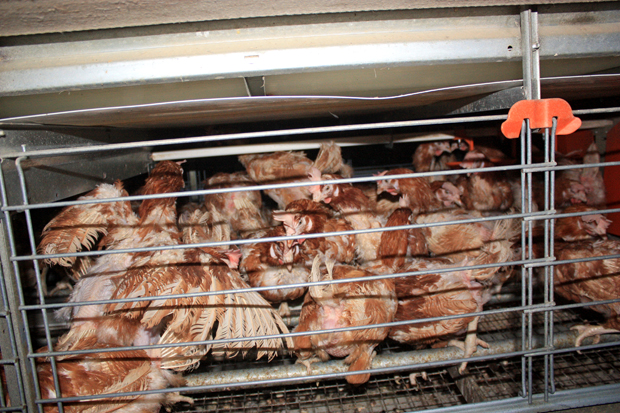
This is Italy 2023 and does nothing more than justify why the EU Commission needs to wake up now and get things such as this stored into the history books. Open the cages now and set them free !
Investigative work is dangerous and expensive. Please give anything you can to support the work of Essere Animali;
Thank you – Mark
Mark, I did, I heard the rabbits’ “screams”. Even though their suffering is actually silent, it came to me intensely, loudly and clearly.
I saw this terrible suffering of rabbits locked in cages for the first time two years ago, when I participated in a survey in 7 different farms. And then again last March, when – you may remember – we placed cameras with the aim of shooting a 24-hour live broadcast and documenting the life of these animals in cages.
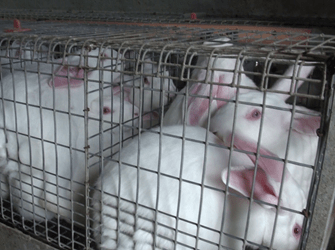
Can you imagine what it must be like to live in a cage a little bigger than your body, which doesn’t allow you to stand up and move freely? This is everyday life for a rabbit who is born and lives on a farm and does not know what it means to jump outdoors on a lawn as his instinct would push him to do.
I chose to show you the rabbit above that I met during my last investigation, because I was struck by its exhausted gaze, devoid of light and for the total absence of vital stimuli that it communicated to me. And like him, unfortunately, there are millions of them on Italian farms.
You only see him, but there are also 6-7 rabbits living in those cages. And they suffer, even if they don’t scream and we often suffer,
Help me to put an end to the silent screams of rabbits in cages.
Carrying out investigations is always very difficult and risky. But it’s a risk worth taking. The videos and images we have collected, in fact, have helped to strengthen the End the Cage Age campaign, for the abolition of cages in Europe.
These images show harrowing situations. Caged rabbits live in the space of a printer’s sheet, are stressed and apathetic because they have to repress their nature, and become aggressive, hurting themselves or their mates. They are also often sick: stress, in fact, compromises their immune system, so much so that I have seen many with malformations, dermatitis and other obvious pathologies. In addition, the cages are made of wire mesh that causes wounds due to continuous rubbing. And the most chilling thing is that dead rabbits are sometimes left for days next to live ones.
In the video below you will find a brief summary of a survey we carried out.
It contains strong images, but they are necessary to get an idea of the real condition of a rabbit in a cage
Investigations like these are very demanding from a physical and psychological point of view, but also expensive from an economic point of view , because they require days and days of work, travel, food, accommodation, fuel, cameras, suits and appropriate clothing and much more.
Until January 6, we will collect the necessary resources for the 2024 investigations. Many of our supporters have taken up our appeal but we have not yet reached the goal. Today you too can do something very important!
Millions of animals suffer in factory farms. Our investigations, the most broadcast in Italy, allow us to denounce it.
Well folks, personally for me it has taken what ? – around 40+ years of campaigning to get to where we are now – read on below.
To be honest, the last four years or so have been a roller coaster of ‘yes it will be banned’ followed by ‘no it will not be banned’ statements. A few years back I did the official government consultation on the issue of live animal exports; and expectations were high as with past campaigning on this issue, I knew that almost all of the British people were against the trade, and at the time, in PM Boris Johnson, we had a PM who would push the legislation for a ban through Parliament.
Thins have changed now as we no longer have Boris at the helm and we have seen Bills such as the ‘animal kept Bill’ which would have banned the export trade, scrapped by the current government at the last minute.
But anyway, what fantastic news today, with the implementation of the ‘Animal Welfare (Livestock Exports) Bill 2023-24’ which will make it an offence to export from or through Great Britain live livestock for slaughter outside the British Islands, we have reason to celebrate as we now join up with campaigner friends in New Zealand; the only other nation that has officially banned the export of live animals.
As explained below, it is only through Brexit and getting free from the shackles of the EU that the UK has been able to do this. We as a nation have taken back control and are reverting to making law for our own citizens; without the dreg of EU legislation hanging over us.
I would suggest that you look at the following which gives a basic overview on the legislation and some of the basic reasons whilst it has gotten to the situation it has currently arrived at.
So where do we go now ? – Europe, to be basic. I / we have campaigned in Europe for decades on the issue of live animal transport. With the issue of caged animals and the need to set them free through the citizens initiative, the EU Commission is under huge pressure to act for the welfare of animals. The UK export ban issue is another thing that can be thrown at them as a reason why they need to act and act now. Thousands and thousands of live animals are trucked across every day; and they should not be; just as live EU animals should not be exported outside of the EU to meet the gruesome deaths that await them.
We have plenty to go on, and so the work continues. To ‘win’ after 40+ years of campaigning does not really seem true – we had a glass of wine lunchtime to celebrate what in reality is a massive victory; but also to remember all those who fought so hard for the cause here in UK but who are no longer with us. So this is for them, the Mike Tucker,
the Carla Lane, wonderful Barb
Below – Dover – Barb gives a hug to my dog ‘Golda’.
… and so many others who fought but have not seen this campaign get to where it is now – a ban on the export of slaughter and further fattening animals from the UK.
“John often used to hitch a ride in my car which I had taken to the Netherlands as part of the job. We shared many hours on the road; laughing, talking and generally trying to have a good time in work that we both knew the live animal export business caused immense suffering to – innocent, sentient beings”.
The Animal Welfare (Livestock Exports) Bill 2023-24 will make it an offence to export from or through Great Britain live livestock for slaughter outside the British Islands. It was introduced to the House of Commons on 4 December and the second reading was undertaken as scheduled for 18 December 2023.
The Animal Welfare (Livestock Exports) Bill 2023-24 was introduced to the House of Commons on 4 December 2023 as a bill to make provision to prohibit the live export of certain livestock, such as cattle, sheep and pigs, from Great Britain for slaughter. Second reading is scheduled for 18 December 2023.
The government has said that the UK’s departure from the EU gives it the freedom to implement such a ban. The Conservative Manifesto for the 2017 and 2019 General Elections included commitments to control the live exports of livestock.
Live animals have long been exported to EU countries from the UK for breeding, fattening, and slaughter. There have been long running campaigns, including the RSPCA’s Stop Live Exports campaign, to end such exports. This reflects concerns that animals transported to Europe suffer from unnecessarily long journeys, experiencing stress, exhaustion, thirst and rough handling.
Although, for practical reasons, the last exports for fattening or slaughter were in December 2020, the Bill will ban them permanently. It will make it an offence to send, transport, organise transport (or attempt to send, transport or organise transport) for livestock for export from or through Great Britain for fattening and slaughter outside the British Islands. The ban applies to a range of livestock including cattle, horses, sheep, goats, pigs and wild boar, but not poultry. Live exports, including of racehorses, will still be permitted for breeding, competitions and races.
The provisions do not apply to Northern Ireland and journeys within the island of Ireland are not covered. However, they do apply to journeys transiting through Great Britain to a destination outside the British Islands, for example to those that begin in Northern Ireland or EU Member States such as the Republic of Ireland, transit through Great Britain and are destined for a country or territory outside the British Islands.
The ban on exports may need to be defended against World Trade Organisation rules which require countries to apply non-discriminatory rules (so-called ‘most favoured nation’ rules) to trade. Case precedents indicate that exceptions under WTO rules may apply to ethical and animal welfare provisions, however this issue is not clear cut. Challenges can only be bought by other signatory countries. There has been no indication as to whether other countries may wish to challenge the government over the Bill’s measures.