Today, the European Parliament took a stand on the future of aquaculture in Europe by adopting MEP Clara Aguilera’s report on “Striving for a sustainable and competitive EU aquaculture: the way forward”. The Parliament has for the first time given animal welfare a prominent place in its position on European aquaculture, calling for important steps to improve the situation for fish, but missed the opportunity to take action against some of the worst welfare conditions and unsustainable systems.
Eurogroup for Animals supports the report that was voted on in the Plenary. We highly welcome the MEPs’ call for an EU Animal Welfare Reference Centre for fish, which is critical for the implementation of legislation on fish welfare to be proposed next year. Eurogroup further acknowledges other important progress as the report recognises the importance of applying evidence-based standards and interventions to improve fish welfare during keeping, transport and slaughter, and the fact that good animal welfare is the best preventive step to ensure health and welfare and reduce use of medication.
The Parliament also positively called for animal welfare to be improved in aquaculture and be included in the Common Fisheries Policy, as well as for more efforts on the sustainability of feed, including using a low trophic index to identify sustainable alternatives. However, despite these positive aspects, the report still contains some serious shortcomings. Indeed, the statement that “various recommendations on animal welfare do not apply to the fisheries and aquaculture sectors because of their nature”, being included without referring to any particular recommendations is in contradiction with a number of other European Parliament positions and the work done by the European Food Safety Authority and the European Commission, since consensus was reached that fish are sentient beings.
Just like in mega-stalls on land, animals in fish farms are cooped up in too small a space. (…) animals in fish farms are kept in such a way that they cannot exhibit their natural behaviour and their lives are one big suffering. As in land-based mega-stalls, cramming large numbers of animals together in fish farms leads to environmental pollution, disease and excessive antibiotic use.
MEP Anja Hazekamp
MEP Caroline Roose confirmed that “Aquaculture is not sustainable (…) when animals are crammed in by the hundreds, without any density limit, and are forced to behave in ways that are contrary to their nature”.
This vote was an opportunity to call for the transition to low-trophic species to be a priority, including the prohibition of introducing new carnivorous species, such as octopus, into industrial farming systems.
Octopus are unanimously described as sentient, sensitive and intelligent animals by science and current EU law only protects their welfare in laboratory settings. The opening of the “first-ever octopus farm” constitutes a “disaster for animal welfare and an environmental disaster, scientists warn”, said Anja Hazekamp.
With this report the European Parliament has demonstrated much needed progress on fish welfare in aquaculture – which is to be applauded – however the Parliament clearly fell short on addressing some fundamental problems with welfare and sustainability in aquaculture.
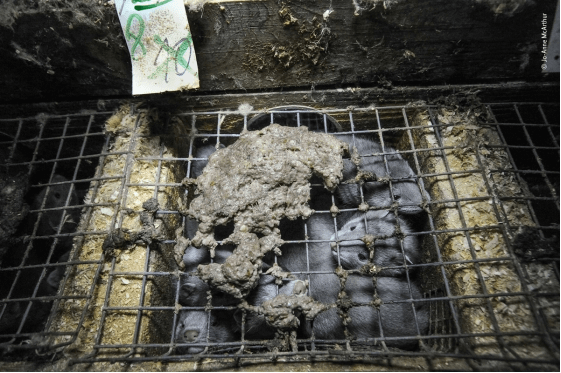
Life and Death in Fur Farming. Ten, now eight, mink kits in a nest box on a Swedish fur farm. These American mink kits fight for space and to reach their food. A sign indicates two have died. Though the legal cage size is now larger and a two-storey box a requirement for adult mink, with no more than two adults per cage, injuries still occur. Sweden, 2010. Jo-Anne McArthur / Djurrattsalliansen / We Animals Media
I think it’s striking that these images factually demonstrating abject animal suffering in the “fur industry” look exactly like the reality of abject suffering of animals in the “animal agriculture food industry” while, in the USA, the fur industry council degenerates like to boast that their victims on fur farms are executed onsite …
(via anal electrocution, for example, where humans physically restrain terrified creatures and insert rods into their anuses to electrocute them – while, interestingly, when humans get colonoscopies, for example, requiring anal insertion of instruments to capture colon images by people who must be educated, trained and certified to do so, which, by the way, is to prevent death versus causing it, humans actually get sedation)
… and therefore don’t require the horrors inherent in slaughter transportation. Imagine bragging that your death industry is marginally “better” than another death industry while ignoring the entire violent D-E-A-T-H requirement of innocent victims in both. If horrific transport is bad, actual violent killing is WORSE.
I wouldn’t expect anything other than deception and manipulation and abuse from the FAM folks in either, though. SL
This week we’ve got big news on our progress with getting animal stories in the media. Jo-Anne McArthur has been awarded Highly Commended in Wildlife Photographer of the Year for her image Life and Death in Fur Farming.
The image is one of 14 Highly Commended images announced on September 1 as a preview of this year’s competition, which attracted entries from photographers of all ages and experience levels from 93 countries. Jo-Anne is awarded in the category of Photojournalism.
Jo-Anne shares some words about the story behind this image and her hopes for its impact:
The first time I visited fur farms was in 2009. It was a shock to see the decrepit, putrid, mass incarceration of so many animals in so many sheds and tiny cages, offering me yet another of the many moments of disbelief that I experience in my career. I have since photographed fur farming extensively, especially in my home country of Canada, and it is with urgency that I wish for this unnecessary industry to end. I am so happy that we are seeing bans on fur farming in many countries, including those who have traditionally supported a large fur industry.
To say that I’m thrilled that WPY has awarded this mink farming image in their competition is an understatement, because the reason I do this investigative work is so that people can look, consider, discuss, critique, care, change. WPY offers this image of ten, now eight, mink kits and their mother in a cramped nesting box for the world to view. Many people do not know that animals are industrially farmed for their fur. They are unaware of the conditions. They are unaware that these animals are killed by gassing and anal electrocution, or that they are kept in tiny cages by the millions, globally, each year, so that we can wear fur trim, have fur pompoms on our hats, or a poof of fur on a child’s trinket.
I feel passionately about taking photos of fur farming so that the images can help campaigners and policy makers end this industry, and continue to raise awareness amongst the unknowing public. Images are a strong and crucial part of the puzzle when it comes to creating a kinder world for animals.
Mink farming is an industry where, traditionally, the welfare of these semi‑aquatic, naturally solitary mammals has not been a priority unless it affects the fur. But in 2020, mink farming came under the spotlight when it became clear that not only could mink catch the Covid-19 virus, but that the virus could mutate in mink and be transmitted back to humans. In response, Denmark – then the largest mink-fur producer after China – shut down its industry, killing all 17 million animals, and in the Netherlands and Spain, hundreds of thousands were killed. But in Sweden, after a temporary ban on breeding, the government allowed its 20 or so farms to reopen in 2022.
Djurrattsalliansen, the non-profit organization Jo-Anne was working with when she took this photograph, has played a significant role in fur farm investigations in Sweden, which have helped to bring the number of farms down significantly.
Take PETA’s Cruelty-Free Shopping Guide along with you next time you head to the store! The handy guide will help you find humane products at a glance. Order a FREE copyHERE
Searching for Cruelty-Free Cosmetics, Personal-Care Products, Vegan Products, or more?
Want to do more than go vegan? Help others to do so! Click below for nominal, or no, fees to vegan literature that you can use to convince others that veganism is the only compassionate route to being an animal friend:
“The greatness of a nation and its moral progress can be judged by the way its animals are treated.” – Mahatma Gandhi
“Animals don’t hate, and we’re supposed to be better than them.” – Elvis Presley
“Let us remember that animals are not mere resources for human consumption. They are splendid beings in their own right, who have evolved alongside us as co-inheritors of all the beauty and abundance of life on this planet.” – Marc Bekoff
“Animals are more than ever a test of our character, of mankind’s capacity for empathy and for decent, honorable conduct and faithful stewardship. We are called to treat them with kindness, not because they have rights or power or some claim to equality, but in a sense because they don’t; because they all stand unequal and powerless before us.” – Matthew Scully
“Lots of people talk to animals…Not very many listen though…that’s the problem.” – A.A. Milne
“If having a soul means being able to feel love and loyalty and gratitude, then animals are better off than a lot of humans.” – James Herriot
“Because we have viewed other animals through the myopic lens of our self-importance, we have misperceived who and what they are. Because we have repeated our ignorance, one to the other, we have mistaken it for knowledge.” – Tom Regan
“True human goodness, in all its purity and freedom, can come to the fore only when its recipient has no power. Mankind’s true moral test, its fundamental test (which is deeply buried from view), consists of its attitude towards those who are at its mercy: animals.” – Milan Kundera
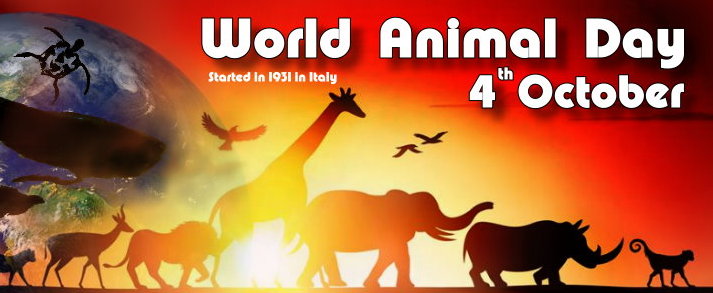
Today, October 4th, is World Animals Day.
World Animal Day is an international day of action for animal rights and welfare celebrated annually on October 4, the feast day of Francis of Assisi, the patron saint of animals.
The mission of World Animal Day is “to raise the status of animals in order to improve welfare standards around the globe.
WAD is an annual event.
The MISSION OF WORLD ANIMAL DAY To raise the status of animals in order to improve welfare standards around the globe. Building the celebration of World Animal Day unites the animal welfare movement, mobilising it into a global force to make the world a better place for all animals. It’s celebrated in different ways in every country, irrespective of nationality, religion, faith or political ideology. Through increased awareness and education we can create a world where animals are always recognised as sentient beings and full regard is always paid to their welfare.
WAV Comment – you have to remember here that here we are talking about ANTI Foie Gras ban and anti fur ban Rees Mogg; who now has one of his chums, and a major Conservative Party donor; appointed as a senior minister by Liz Truss at the Department for International Trade (DIT).
Despite all our years of work and evidence gathering by dozens of welfare groups; I predict that I will get a response from the DIT telling that, in accordance with the Truss wishes, animal welfare will not be considered in future trade deals; or if it is (?), I will be fed yukspeak on ‘they do care about it’, but not enough to actually include the issue in future deals.
As promised recently, as soon as I get a reply from the DIT, I will be publishing and adding comment.
Who knows, the reply may be from the new Truss appointed Dominic Johnson. Lets hope so – but as he probably does not give a toss about animal welfare, just like his mate Rees Mogg, I am not holding my breath.
With all this, no wonder the Tories have reached rock bottom in opinion polls and fingers crossed, Truss will soon be ousted and we the people of the UK will get what they need, a General Election.
The City business partner of Jacob Rees-Mogg has been handed a peerage and job as a senior minister by Liz Truss’s government in a move likely to trigger accusations of cronyism.
Dominic Johnson, a financier who co-founded Somerset Capital Management with Rees-Mogg, was appointed as a minister in the Cabinet Office and the Department for International Trade.
The announcement was slipped out on the government’s website, which said he had been appointed as of Sunday.
“Dominic Johnson CBE was appointed a minister of state jointly in the Department for International Trade and the Cabinet Office on 2 October 2022,” the statement said.
The appointment is likely to be controversial at a time when Truss, her chancellor, Kwasi Kwarteng, and Rees-Mogg face questions about being too close to the City, after the mini-budget handed substantial tax cuts to financiers and the wealthy.
Johnson is a substantial party donor who has given more than £250,000 and was vice-chairman of the Conservative party between 2016 and 2019. He replaces Gerry Grimstone, the former chairman of Barclays and Standard Life, in his role as trade minister, encouraging inward investment.
Somerset Capital Management is reported to be up for sale, with two of its founding partners now in senior government roles. Johnson recently said he was stepping down as chief executive of Somerset Capital Management.
Rees-Mogg still holds a substantial stake in the investment firm, despite the potential conflict of interest with his role as business secretary.
Above – no, cannot be true, wow !!
Regards Mark
Further reading on this:
Jacob Rees-Mogg is caught up in a cronyism row after the partner in his investment firm was suddenly handed a peerage and made a government minister.
MP’s look of disbelief as Jacob Rees-Mogg claims ‘Putin funds anti-fracking campaigns’
Jacob Rees-Mogg has been defending the Government’s decision to allow fracking for shale gas to go ahead in England.
Shocked Labour MP Cat Smith appeared stunned as Jacob Rees-Mogg told her some anti-fracking campaigns may have been funded by Vladimir Putin. The exchange came as Mr Rees-Mogg, who was recently appointed as Liz Truss’ Business Secretary, defended the decision to allow fracking to go ahead on the grounds of energy security.
WAV Comment – it is political chaos here; Liz Truss the new (but probably not for long) Prime Minster has taken many actions to oppose both the Conservative manifesto – which should outline the Party aims; with regards animal welfare and environmental issues. We have reported on a lot of this over the past few weeks, and you can see our posts by scrolling back down through the site.
I say political chaos as the Conservatives are currently in government. Labour are n opposition. Due to the actions of Truss since she took the helm of the Conservatives just a few weeks ago; the Conservatives are being led (by Labour) by a massive 33%+ in opinion polls. Everything currently looks as if Labour will form the government at the next election.
We (WAV) are not associated with any UK political party; but we are a voice for improvements in animal welfare and the environment. These are just 2 issues where Truss has kicked us, long time and evidence providing campaigners, with a good boot in the teeth. So now she is starting to witness pay back time.
Here are a couple of articles which outline the current differences between the parties:
Liz Truss (Conservative) ‘to scrap proposed bans on fur and foie gras imports’
Liz Truss is set to scrap proposed bans on importing fur and foie gras to the UK, according to a Tory insider, sparking outrage from animal lovers.
Foie Gras production Banned in the UK, but still imported !!
The new prime minister will also reportedly ditch a ban on live animal exports in her first weeks in office.
The decisions will be a massive blow to campaigners who have spent decades lobbying for the reforms to spare animals from suffering.
Production of both fur and foie gras is considered so cruel that they are already banned in the UK.
All four measures were promised in the party’s animal-welfare action plan, announced last year to wide acclaim.
And curbs on live exports were promised in the Conservatives’ election manifesto, together with an end to hunting trophy imports.
But a senior Conservative told Politico: “Banning things seems very socialist. Informing people is the way to go.”
In February this year, right-wing cabinet members including Jacob Rees-Mogg intervened to block the Animals Abroad Bill, which contained the curbs on fur, foie gras, hunting trophies, and adverts for foreign theme parks that cause animal suffering.
The Kept Animals Bill, which banned live exports and keeping primates as pets and tackled puppy smuggling, could also be dropped. It had been due to be debated on Monday, which became the day of the Queen’s funeral, and no new date has been given.
A ban on cruel exports of live animals for slaughter and fattening had been hailed as a benefit of Brexit.
It would be a huge let-down, not only for those who work for these campaigns daily but also for millions of animals
Lorraine Platt
The government says it is still looking at the fur and foie gras bans, but the source said the measures would not go ahead under Ms Truss, who appointed Mr Rees-Mogg as business secretary and promoted Mark Spencer, understood to have been another of those blocking the Animals Abroad Bill.
However, MP Scott Mann, who has spoken out in favour of a ban on live exports, has been promoted to environment minister.
Last week, Ms Truss sacked Zac Goldsmith as animal-welfare minister after he introduced reforms including an ivory sales ban and higher jail terms for cruelty. He also wanted to crack down on religious slaughter without stunning.
“A lot of his causes were very worthy, but you can be worthy when you’re the son of a billionaire,” the MP said in a bizarre comment. Lord Goldsmith’s father was financier James Goldsmith.
Lorraine Platt, co-founder of the Conservative Animal Welfare Foundation, told The Independent she was bitterly disappointed by news the bans would be dropped.
“It would be a huge let-down, not only for those who work for these campaigns daily but also for the millions of animals involved,” she said.
“Banning live exports and hunting trophies were manifesto commitments, and some people vote on manifesto commitments at elections.”
She said the foundation had often heard reports the measures could be scrapped or watered down.
Sir Roger Gale, patron of the foundation, condemned the “let them choose” argument as “a little spurious” and perverse when the UK has bans on producing fur and foie gras.
He told Times Radio he was concerned about the direction of travel of animal welfare under the new government, and millions of votes including in red-wall seats would be lost to the Tories if they reneged on animal welfare.
Foie gras production involves force-feeding ducks and geese with pipes pushed into their throats to fatten their livers.
Fur farms have been exposed as leaving animals suffering infected, bloody wounds, spreading disease and literally driving animals mad from confinement.
Claire Bass, executive director of Humane Society International/UK, said it was surprising and perplexing that senior Conservatives wanted to row back on the popular measures in last year’s animal welfare action plan.
“Animals matter to voters, and people will not be content with oft-recycled rhetoric about being a ‘world leader in animal welfare’ if it’s not accompanied by meaningful action,” she said.
“Banning fur imports is not un-Conservative, it’s simply the right thing to do in line with the British public’s moral compass.”
Under Boris Johnson, the government said it wanted to consider compulsory animal-welfare labelling on food and promised to consult on proposals next year.
The Department for Environment, Food and Rural Affairs (Defra) ran a 12-week consultation last year on new labelling standards for produce now that EU regulations no longer apply.
Ministers had at one stage said they would press ahead with the hunting trophy imports ban, but that pledge appears also to have been dropped.
Instead, they are backing a private members’ bill by backbencher Henry Smith that bans hunting trophy imports – body parts of wild animals killed by paying hunters. Mr Smith has called such hunting barbaric.
On foie gras, Defra said it was considering any further steps that could be taken, “building on the opportunities presented” by Brexit, and was still gathering information.
“The government has made clear that the production of force-fed foie gras raises serious welfare concerns,” a spokesman added.
On fur, the department said: “We are continuing to build our evidence base on the fur sector, which will be used to inform any future action on the fur trade.”
It also said the Kept Animals Bill would continue its passage through Parliament.
The Independent has also asked the office of the new Defra secretary, Ranil Jayawardena, to confirm whether the proposals will go ahead.
… and then on the other hand we have this from Labour; currently 33%+ leading in the opinion polls.
Labour will ban foie gras and hunting trophies imports if it takes power, environment boss Jim McMahon pledges
Labour would ban imports of foie gras and hunting trophies “very early” after winning power, Shadow Environment Secretary Jim McMahon has said.
Animal welfare campaigners were outraged earlier this month when Liz Truss junked a Conservative commitment to outlaw the controversial pâté.
Nature and farming groups are also dismayed that the new administration has paused post-Brexit subsidies that incentivised agriculture without saying what will replace them.
Speaking to i at the Labour Party conference in Liverpool, Mr McMahon could hardly contain his glee at the furious backlash to a threatened rolling-back of environmental protections. He says the Tories are taking their rural heartlands for granted – and will suffer the electoral consequences.
But he acknowledged that he will come under immediate pressure to make good on a host of long-standing promises cherished by Labour supporters to improve animal welfare, of which import bans on foie gras and hunting trophies are the most high-profile.
i revealed last year that Jacob Rees-Mogg, now the Business Secretary, was leading efforts to shelve the proposed ban on foie gras and last week it emerged that it had been scrapped entirely.
To produce foie gras – which translates as “fatty liver” – male ducks and geese are force fed grain and fat three or four times a day in a process known as “gavage.” The forced feeding causes the birds’ livers to swell to up to 10 times their normal size.
Asked when a Labour government would bring in the bans, Mr McMahon said: “There will be a lot to do in that first Queen’s Speech but there will be an expectation on Labour to set our stall on animal welfare very early that I am working hard to achieve.”
He added that he was exploring whether the bans could be implemented without passing new laws to free up Commons time for other high-priority legislation, saying: “It’s about the art of the possible.”
Mr McMahon said the bans are the “easier stuff” and added: “The question for us and the current Government is how do you marry higher animal welfare standards with new international trade deals.”
Ms Truss, when she was International Trade Secretary, won a Cabinet battle to force through a new trade deal with Australia despite worries it exposed British farmers to competition from producers with lower standards. Mr McMahon said the party was considering banning any future such deals and would double down on efforts to make the UK a world leader in ethical and green food.
He said he was astonished that the new Environment Secretary, Ranil Jayawardena, paused plans for post-Brexit farm subsidies, the Environment Land Management Scheme, without saying what comes next – leaving the National Farmers Union and green groups united in fury.
“I know Ranil reasonably well,” Mr McMahon said. “I’m staggered that he’s been missing in action. He should have been on the phone to the big groups like the NFU and Wildlife Trust. It’s just a matter of respect. Even if the intention isn’t to throw it all out but to pause, reflect and rebuild there’s going to be a breakdown in trust.”
The former Oldham council leader admitted his current job was not necessarily an obvious fit: “The only greenery I saw as a kid were the weeds growing through the cracks in the pavement.”
Unsurprisingly for a politician he showered praise on farmers and fishermen as “grafters” who are the best of British – but also said he wants to make townies care more about the county by bringing it into urban areas.
“Of course I am going to fight for the shires and coastal communities who have some of the most beautiful parts of the country on their doorstep,” Mr McMahon said. “But you can’t just pitch up in somewhere like Oldham and say, ‘It’s your responsibility to tackle the climate change emergency,’ when what’s their own environment like? It’s grey and it’s depressing and there’s no access to safe green spaces. There’s a huge opportunity there for Labour to fill in the gap.”
Everyone makes promises if it means them getting elected. We read of what will be done in party manifesto’s; only then to be treated as we are now by the Conservatives – how things change !
Whatever happens and regardless of all the promises and manifesto statements, we will continue to hold ALL those in politics to account for both the animals and the environment. Recent events have shown us that in reality, you never believe a bloody word; as they all come up with excuses (after they have been elected) for not doing this and not doing that.
British politics is currently having one of its biggest changes for decades – and for the animals who have been betrayed by the Tories, we say ‘bring it on’. We want and demand progressive change after all these years of campaigning and evidence providing; often at great risk to some individuals.
We fought hard to get the foie gras and fur ban issues to the top of the pile; the government is attempting to wipe the issues off the board overnight. That is why we have a wry smirk on our faces as we now see truss and the Conservatives who betrayed us attempting, but failing, to clamber out of the deep filth pit that she and they have put themselves into.
An interesting time; but we will fight for the animals whatever;
The Danish Minister for Food, Rasmus Prehn, has decided to ban the production of cage eggs in Denmark, beginning in 2023.
The final goodbye to Danish cage eggs is applauded by Animal Protection Denmark. It is a victory for activist consumers, the retail sector, and Animal Protection Denmark – and millions of caged hens.
We are thrilled to finally see an end date for the production of cage eggs in Denmark – and an end to the horrific living conditions of the hens laying the eggs. It raises the bar for basic animal welfare in the Danish poultry sector.
Britta Riis, CEO of Animal Protection Denmark
The ban will be introduced with a transition period of 12 years for the remaining 7 farmers still producing cage eggs. Animal Protection Denmark would have liked the transition to have been faster but acknowledges that major changes in food production can take time.
It has been almost 10 years since we ramped up our campaigning against cage eggs. Many consumers joined us in turning their backs on cage eggs, and retailers took them off their shelves. In the end, these movements led to the final goodbye to cage egg production, and we owe the Danish people and the Danish retail sector a debt of gratitude for leading this change.
CEO of Animal Protection Denmark
The ban on cage eggs comes after the political party Enhedslisten put forward a motion in 2020 to phase out the last remaining producers of egg-laying cage hens by the end of 2022. The Government did not support the motion on the grounds that the suggested phase-out period was too short, but the Minister for Food acknowledged the horrendous living conditions of caged egg-laying hens and supported the general move towards a ban. And the politicians are aligned with public sentiment: Three out of four Danes think that cage eggs should be banned according to a new survey conducted by Epinion on behalf of Animal Protection Denmark.
Even though Danish consumers and retailers have turned their backs on cage eggs, 7 Danish farmers still have around 550.000 hens sitting in cages around the country. A lot of Danes are unknowingly served caged eggs in food served in cantinas, kindergartens, and ready meals, and some of Denmark’s biggest municipalities continue to buy vast quantities of cage eggs. This use of eggs is not labelled, making it impossible for consumers to opt out. Animal Protection Denmark urges everyone to support the Danish people’s clear opposition to cage eggs.
During the 12-year phase-out an estimated 6 million hens may have to endure life in a cage. This should not happen. The Danish people should not be fed this many hidden cage eggs, and to this end, private and public buyers must step up and take responsibility.
CEO of Animal Protection Denmark
Several of Denmark’s neighbouring countries, such as Germany, Austria, and the Netherlands have already imposed bans on keeping caged hens. While the animal welfare bar in Denmark is raised by the ban, there is still a long way to go until all farmed animals get to live good lives in accordance with their needs, Animal Protection Denmark points out.
Paul Wesley, the vegan actor known for starring in The Vampire Diaries, discussed animal rights on the Plant Based News (PBN) podcast.
He spoke to PBN co-founder Robbie Lockie about a range of issues, including factory farming, the challenges of being a vegan actor, and the truth about dog food.
The two also discussed cultivated meat, with Wesley describing it as “the future.” He said that vegans “have a responsibility” to support the industry.
I just learned about World Day for Farmed Animals, coming up on October 2nd (Gandhi’s birth date). It has been around since 1983 and is meant to memorialize the billions of animals abused and killed for food each year.
Mahatma Gandhi, (1869–1948) “To my mind, the life of a lamb is no less precious than that of a human being. I should be unwilling to take the life of a lamb for the sake of the human body. I hold that, the more helpless a creature, the more entitled it is to protection by man from the cruelty of man“.
Like many, I always considered farm animals only as a source of food. But, after recently watching the documentary Speciesism, I realized that farm animals are much like our family pets, deserving of love and respect.
I’ve learned that farm animals get neither on today’s factory farms. Male baby chicks are ground up alive or suffocated in garbage bags. Hens are crowded in small wire cages that tear out their feathers. Breeding pigs spend their lives pregnant in metal cages. Calves are snatched from their mothers upon birth, so we can drink their milk.
The cruelty of factory farming drove me to replace animal products in my diet with plant-based meat and dairy items. I have since learned that my cruelty-free diet is also great for my health and for the health of our planet.
Making hay: Farm animals could get constitutional rights in Switzerland
Washington Examiner
Voters in Switzerland are set to decide whether to ban factory farming and modify laws to grant animals the constitutional right “not to be intensively farmed.”
Under a new proposal that will be considered by Swiss voters over the weekend, the country would be required to implement laws that lower animal stocking rates and limit the importation of intensively farmed meat. The proposal has received mixed support, with national polling showing that 52% of voters oppose the ban, while 47% support it.
Proponents argue a ban would protect the environment by reducing farms’ reliance on soya-based animal feed that has been linked to widespread deforestation. Animal rights groups have also championed the proposal, pushing for more humane conditions in the facilities where animals are held.
“You can keep 27,000 chickens in one barn, and their room to move is about the size of an A4 sheet of paper,” said Silvano Lieger, managing director of Sentience Politics, an animal rights group that proposed the ban in 2018. “Pigs are kept in barns, too, up to 1,500 per farm, with 10 pigs sharing the space of an average parking spot. It is not possible to treat animals in a dignified way in those conditions.”
However, opponents have argued the ban would negatively affect the domestic production of meat and would fail to prevent the cheap importation of intensively farmed animals. Others have argued Swiss law already enforces strict welfare laws.
About 80% of Swiss meat is produced domestically, according to ProViande, the Swiss interbranch organization for the meat industry. However, some industry workers say the rate of importation would increase drastically if the ban is implemented.
I need to draw your attention to what statements (in my view) contradict each other:
Quote from the DIT
“the government has made it clear in its manifesto that in all our trade negotiations, we will not compromise on our high environmental protection, animal welfare and food standards”.
Or
Liz Truss has refused to enshrine animal welfare in trade deals;
Wanting to know what is right or wrong relating to government policy; I have now been sent a reply from my own MP stating that on my behalf, he has now written to the Department for International Trade (DIT) asking for ‘policy statements’ to be given and if ‘anything has changed’ – ie a very recent conversion to the Liz Truss view. Or, do the commitments expressed in their original (DIT) letter ‘remain intact’. ? – yes, that’s what I want to know !
So; a little progress of sorts but I am still not being given the final government approach now of dealing with international free trade agreements (FTA). I now wait to be forwarded the response from the DIT to see, as I originally asked, who is right, and who is wrong.
I will publish their (DIT) response when it is provided to me. In the meantime, I sit twiddling my thumbs and other bits waiting to get ‘a government policy statement’. Depending on how this is worded (change or no change) will then set the agenda for future actions by WAV on the issue.
Once I have had a response about this, I have further questions lined up regarding several things – the live transport of live animals from the UK being one. Here again, Truss appears to be changing the goalposts and giving the AR movement a good kick in the teeth for the years of campaigning it has taken to get this stopped. Read here the great article from Jane who really sums up the situation and attitudes:
The government had a consultation on banning live animal exports and it was clear from the results that the majority of people wanted the trade banned:
We are used to long drawn out campaigns, and we are used to false promises and being shit on by governments on a host of issues relating to animal welfare and the environment. Our movement has tenacity on its side; the government changes and relies on the votes of citizens to remain in power, or not !
I am a big badger fan, so badger culling will be another issue being prepared for future letters.
Personally, I have battled the disgusting live export trade for 35+ years; done undercover trails especially relating to British horses going into Europe for meat, and I sure as hell am not going to stop now. There are too many animals in this sordid trade that require us to be a voice for them. So we will, however long it takes.
Regards Mark
“In the past, Mark worked with television comedy scriptwriter Carla Lane for many years; and had the position of being the investigator for her animal charity (Animaline) throughout the years of the horse export investigations. Through undercover investigation work, port monitoring, visits to UK horse markets, and trails into Europe, it was shown that British horses were being exported from the UK whilst being declared as ‘going for riding’ to Europe. In reality, the animals were being exported to Europe for their meat. What was declared on the export licenses was a complete and utter lie to get around the complexities of exporting sentient animals for one thing when they were actually going to their deaths !
After all the investigative work was completed and documented, which involved a lot of work, Carla and Mark teamed up in London one day and made formal presentations to the UK Government Ministry – DEFRA (previously MAFF) about all the investigation work”.
Wonderful Carla
35+ years of live export tenacity – I do know a little about live exports and hopefully can argue in defence of those who cannot speak.








 World Animals Voice
