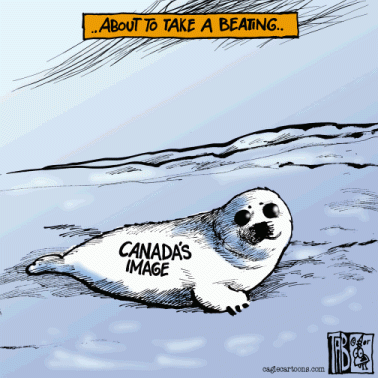
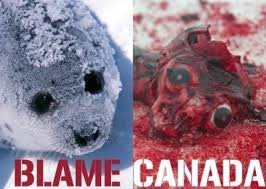
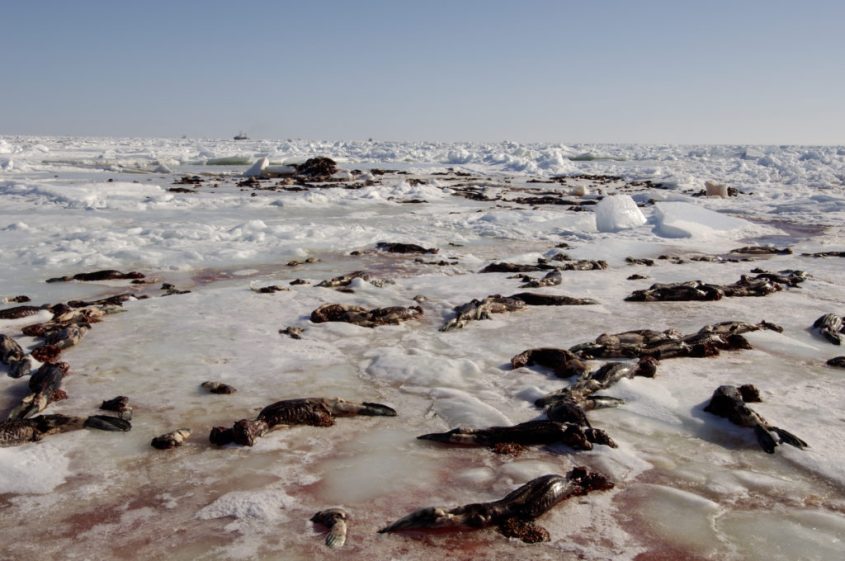
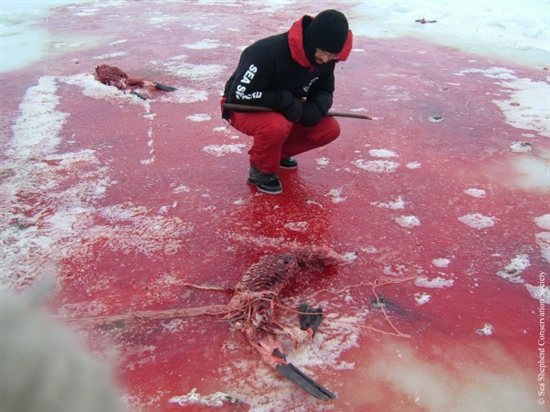
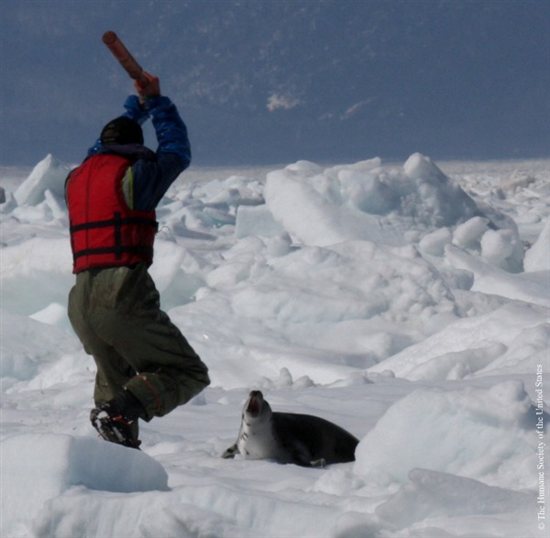
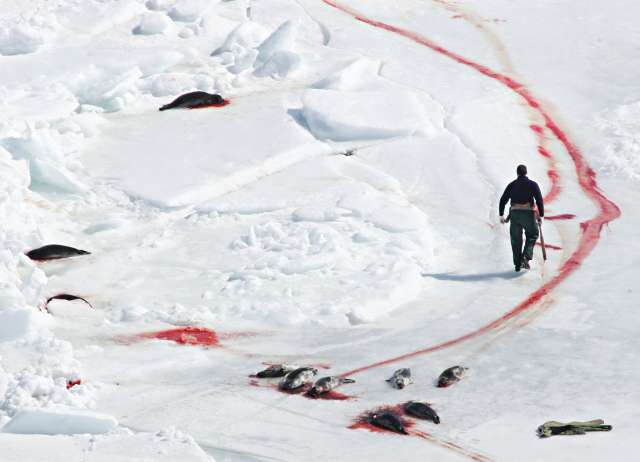
This is the time of year once again when Canadians will start smashing in the heads of young seal pups.
Does Canada not realise that it is hated the world over for allowing this hunt to take place each year ?
Why does the World hate me ? – says the animal abuser
Why does the World hate me ? – says the animal abuser
Below are a few facts and links which we hope will give you more information on what is going on. Like all hunters, the Canadian government is supporting those which murder seals – ‘they take our fish’ – OUR fish ?? – or do they mean beings of the sea which are taken as a food source by other animals of the sea ?
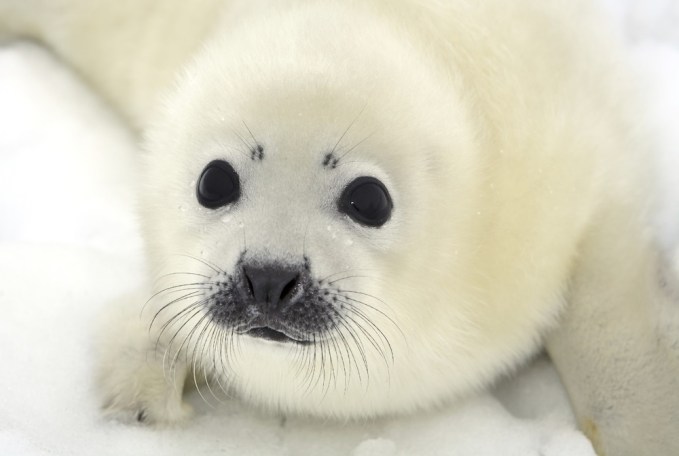
It is illegal in Canada to hunt newborn harp seals (whitecoats) and young hooded seals (bluebacks). When the seal pups begin to molt their downy white fur at the age of 12–14 days, they are called “ragged-jacket” and can be commercially hunted.
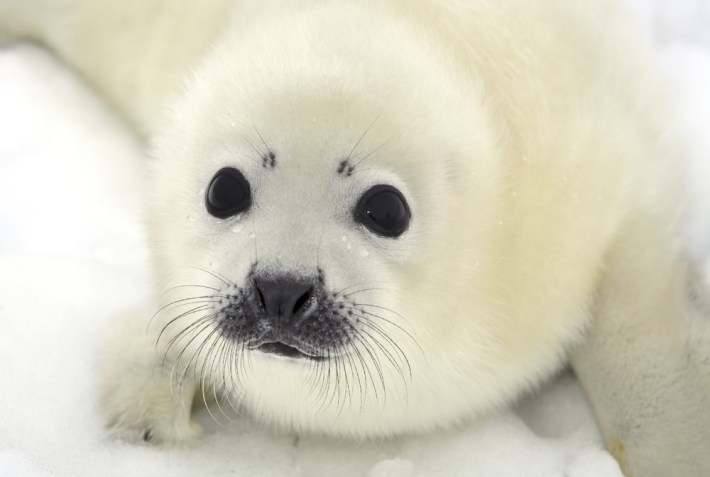
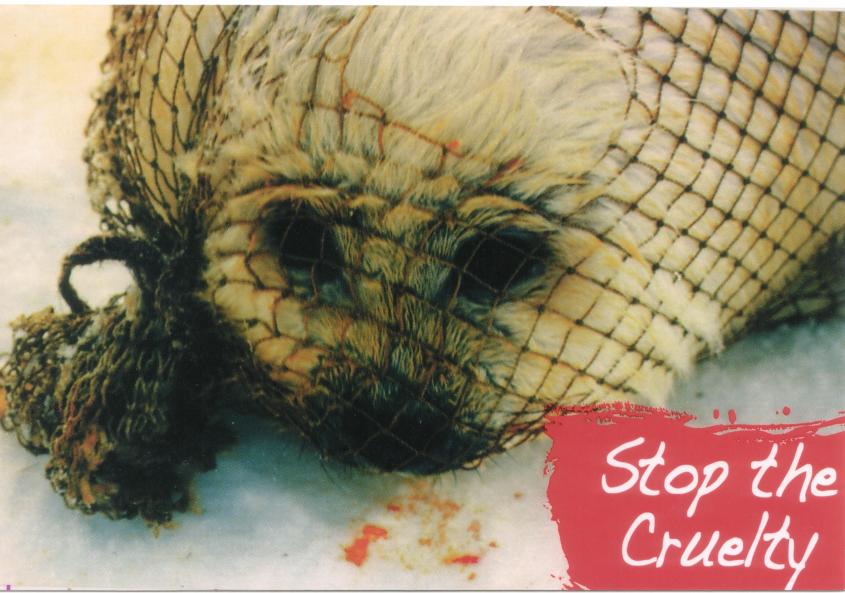
Hunters in Canada target harp seal pups because of their soft fur. But law prohibits hunters from killing pups that have yet to grow out of their white coat, like this baby’s. Harp seals aren’t endangered, but melting ice because of climate change is killing pups.
In recent years, hundreds of thousands of seals have been killed annually in the commercial seal hunt. More than one million seals have been slaughtered in the past five years alone. These kill levels are among the highest witnessed in Canada in half a century.
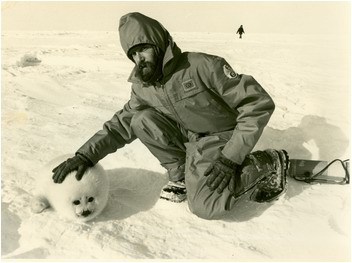
In March of 1976, he and Paul Watson (now Sea Shepherd) stood on the heaving ice floes off the coast of Labrador as a large sealing ship bore down on them.
As the vessel bore down on them and the ice cracked and split beneath their feet, I (Paul) said to Bob,
“when it splits, I’ll jump to the left and you to the right.”
Bob looked straight ahead and calmly said, “I’m not going anywhere.”
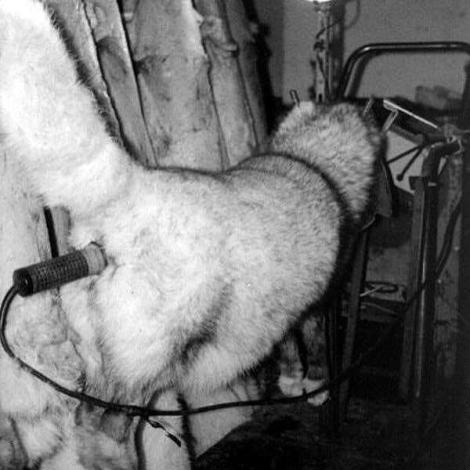
A recent article in the Independent revealed that a UK retailer is selling a coat made from killing and skinning 100 hamsters and we all often see hats with real fox fur pompoms and coats with collars made with coyote fur. All of these animals, slaughtered cruelly for fashion.
As the law stands, imports of fur are legal. The law must change. The import and sale of fur is allowed even though the main ways fur is obtained, including fur farming, are banned in Britain.
Killing animals just for their fur is cruel and barbaric, and we must stop funding it by banning imports of real fur immediately.
Fur import bans have been successfully implemented elsewhere. There is a EU-wide ban on the import of domestic cat and dog fur and California is considering a ban on the sale of real fur.
The UK should take a lead and become the first country in the world to ban fur imports.
That’s why we’ve teamed up with change.org to launch this petition as part of our new Fur-Free UK campaign.
Using the hashtag #FFUK , we’re telling the fur trade what we really think about their barbaric industry.
Please sign our petition to help end this senseless cruelty to animals.
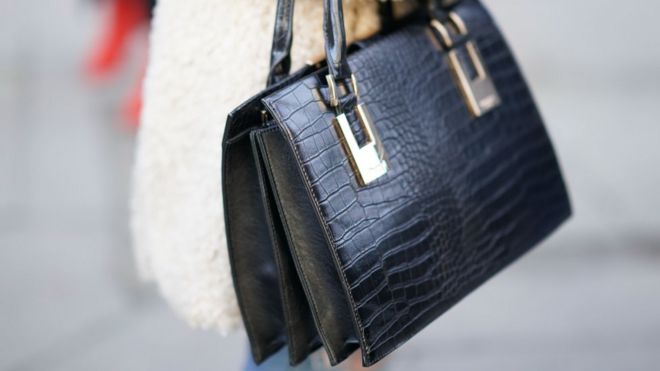
Selfridges has said it will ban the sale of exotic animal skins such as alligator, crocodile and python.
From February 2020, the luxury London department store will only sell leather from agricultural livestock.
The Humane Society International said the move was the “natural next step for a responsible retailer” and would save “countless” crocodiles and snakes.
People for the Ethical Treatment of Animals (Peta) has urged rival stores, such as Harvey Nichols, to follow suit.
Yvonne Taylor, director of corporate projects at Peta, told BBC News: “Hats off to Selfridges – which had already banned fur, angora, and foie gras after persuasive talks with Peta – for now ending the sale of wild animals’ ‘exotic’ skins.”
The industry is not only “heartless”, but “extremely wasteful”, Peta claims, saying it can take the skins of four crocodiles to make a single bag.
The BBC understands that the ban will mainly affect sales of very high end, expensive accessories, particularly shoes and handbags.
The move follows an announcement from designer Victoria Beckham that she would stop using exotic skins in her designs from her autumn/winter 2019 collection onwards.
Beckham joins Vivienne Westwood, Diane von Furstenberg and Chanel in the ban – alongside high street brands such as Topshop, H&M and Adidas.
The company’s head of fashion, Bruno Pavlovksy, said it had become harder to source such skins ethically.
Meanwhile, British designer Stella McCartney’s “vegetarian brand” has never used leather, skin, fur or feathers.
The brand uses leather alternatives such as recycled polyester instead of Brazilian calf leather – which it claims has a high environmental impact.
Selfridges, which banned the sale of fur in 2005, said banning exotic skins was part of a “long-standing commitment to place ethics and sustainability at the heart of commercial decisions”.
Selfridges’ buying director Sebastian Manes said the brand was fixed on being at “the very forefront of future thinking retail”.
He added: “For us, that’s a future where luxury is defined by craftsmanship and material innovation.”
In 2015, the store removed single-use plastic water bottles from sale and made its signature yellow paper bags from recycled coffee cups.
Since the beginning of this year, all clothes bags have been made with used plastic bottles.
In the charity sector, the British Heart Foundation will not accept real fur or fur-trimmed items, or anything made from ivory.
Oxfam told the BBC it does not sell products made from crocodile or alligator skin, angora wool or fur.
It also checks legal regulations for items made of snakeskin, tortoiseshell and coral, and will only sell ivory if it can be proven that the product was made before 1947.
Peta’s Ms Tayor said conscientious and informed consumers “absolutely reject the exotic skins trade, which invariably torments and kills crocodiles, snakes, lizards, and other sentient, beautiful animals in appalling ways for fashion”.
She added: “Peta urges other department stores, like Harvey Nichols, and brands such as Louis Vuitton to follow Selfridges’ business-savvy example.”
A spokesperson for Harvey Nichols told the BBC: “Harvey Nichols requires any brand that uses fur or exotic skins to adhere to the Animal Sourcing Principles as set out by the Responsible Luxury Initiative (ReLi)”.
The ReLi claims to have set “high level principles” for the sourcing of leather, fur and exotic skins, but Peta maintains that there are “few laws” to protect reptiles from abuse.
According to Peta the illegal trade in exotic skins is “rampant” – with an estimated US $1bn worth of python skins imported into Europe illegally each year.
The group also claims that many of the millions of reptiles whose skins are exported from Southeast Asia each year belong to endangered species, whose numbers in the wild are “drastically dwindling”.
Department store John Lewis told the BBC that it does not sell any products with exotic animal skins.
In a proposal that could spell disaster for America’s fragile gray wolf populations, the Department of the Interior has announced plans to delist the majestic animals from the Endangered Species Act (ESA).
If approved, wolves would be managed state by state, putting them in danger and at the mercy of trophy hunters.
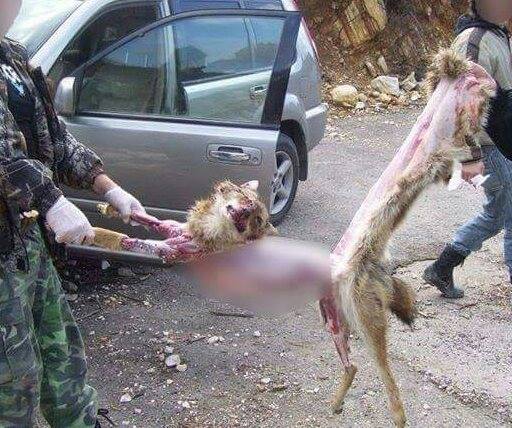
In the Great Lakes region, gray wolves were delisted from 2011 to 2014. During those few years, nearly 1,500 wolves were murdered, often in horrific ways: mutilated in cable-neck snares and steel-jawed leg-hold traps, or hunted and ripped apart by hounds.
In Idaho and Montana, where wolves are not protected, more than 3,200 have been slaughtered in the last eight years.
Gray wolves have been protected by the ESA for more than 40 years. During that time, their numbers have increased to an estimated 5,600. But environmentalists and animal advocates state they are still at great risk, and removing their protections would be disastrous.
Hunting not only impacts the total numbers of wolves but also the structure of each pack and genetic diversity of the species.
Stripping protections from one of the United State’s most iconic species would be a national tragedy, and is nothing more than a free pass for hunters.
Sign the petition urging the U.S. Fish and Wildlife Service to keep wolves on the endangered species list, preventing the wholesale slaughter of these iconic animals.
Press Release from our animal friends at GAIA in Belgium.
Flemish Parliament approves ban on fur farming and force feeding
Thursday, March 14, 2019 — Brussels, 14 March 2019–
“It’s a great day for hundreds of thousands of minks who suffer each year in Flanders and are gassed for their fur. Flanders will also end the cruel practice of foie gras production.”
Global Action in the Interest of Animals (GAIA) applauds yesterdays unanimous decision by the Flemish parliament to ban fur farming and force feeding for fois gras production. The members of the Flemish parliament unanimously agreed the decision proposed earlier by the Flemish government on the initiative of Flemish animal welfare minister Ben Weyts (N-VA). GAIA president Michel Vandenbosch, who was involved 30 years ago in founding the very first anti-fur association in Belgium ‘Comité Anti Fourrure’, witnessed this reward after more than a quarter of a century of actions and campaigning against the suffering and abuse of hundreds of thousands of minks and ducks. Michel Vandenbosch: “Yesterdays agreement to forbid the practice in Flanders follows bans in Wallonia (in 2015) and the Brussels Region (in 2017) and means that the entire country will be free of fur farming by 2023 at the latest. Moreover, by banning force feeding, Flanders also joins the European top when it comes to animal welfare.”
By 1 December 2023 at the latest, the last of the 17 remaining fur farms and the only company in Flanders still to force feed ducks for the production of foie gras will have disappeared. The companies concerned will receive degressive compensation from the Flemish government. The sooner they stop, the higher the compensation will be. The government is to provide a total of 10 million euros for this purpose.
No support for fur
Wallonia and Brussels already banned mink farming in their regions back in 2015 and 2017 respectively. In Flanders there are still 17 active mink farms holding an annual combined total of around 200,000 minks (mothers and young) in captivity. The animals live for 7 to 8 months in a tiny cage before being gassed and ending up as a garment or accessory in the shops. These are wild animals and display highly neurotic behaviour in captivity (incessantly jumping up and down, self-mutilation, etc.). “It pays to persist. Breeding and killing animals for their fur alone is completely outdated”, stresses GAIA president Michel Vandenbosch. “A great majority of the Flemish people shares this opinion.”
The fact there is no social support for fur production is repeatedly demonstrated in surveys. The last survey, conducted by Ipsos in 2015 on behalf of GAIA, showed that 85% of the Flemish people agreed to the ban on the breeding and killing of animals for fur.
Jean-Claude Van Damme and Pamela Anderson
GAIA stepped up its fight against mink farming in Flanders over the years with numerous campaigns. In 2011, the organisation teamed up with Jean-Claude Van Damme to launch the campaign ‘The Victims’. At the end of December 2017, none other than Pamela Anderson wrote a letter to the Flemish minister Ben Weyts calling him to take urgent action on the ban.
So far a ban has been enforced in eleven other European countries: the United Kingdom, Austria, the Netherlands, Norway, Croatia, Slovenia, the Republic of Bosnia and Herzegovina, Serbia, the Republic of Macedonia, the Czech Republic and Luxembourg. Big fashion labels like Gucci, Armani, Hugo Boss, etc. are also excluding fur from their collections. The list keeps growing. “Fashion and ethics go increasingly hand in hand. We are delighted that Flanders will now contribute to a fur-free world”, says Vandenbosch.
Ban on force feeding
The ban on force feeding calls a halt to a cruel form of animal abuse in Flanders which remained in only one West-Flemish company. The Brussels Region already enforced a ban on force feeding for the production of foie gras in 2017. Resistance to force feeding is also growing across Europe: 12 European countries have already launched a formal ban or interpret the law for the protection of animals in such a way as to condemn the practice. Only 5 EU countries are still producing foie gras (France, Spain, Bulgaria, Hungary, Belgium). “We are committed to continue our campaigning in Wallonia, where 9 producers continue the use of force-feeding methods.”
The organization FOUR PAWSwarns of “unprecedented scandal“:
Vytenis Andriukaitis acts completely alone!
Vienna: FOUR PAWS sounds the alarm: At present, a single-handed approach by EU Commissioner for Animal Welfare Vytenis Andriukaitis is causing a stir in Europe’s animal welfare scene.
Andriukaitis wants to consolidate fur farming practically.
With a so-called “animal welfare reference center”, the standards for the attitude of mink, raccoon dog, fox, etc. should be laid down. Therefore FOUR PAWS, together with the umbrella organization of European animal welfare organizations Eurogroup for Animals, is launching a petition to prevent this plan.
According to the Commissioner, an animal welfare reference center should officially provide technical assistance to EU countries in their animal welfare inspections (!!). The EU’s intention is also to establish standards and good practice examples in animal welfare. However, this would mean the same regulation of keeping conditions in wildlife as in other species – an absolute no-go for animal rights activists.
“Wildlife is, as the name implies, nature and never captive,” says Heli Dungler, founder and president of FOUR PAWS. “In addition, animal welfare and fur farming are mutually exclusive.
“There is no ethically or animal friendly produced fur. “
The life of fur animals is hellish, but the European Commission wants its second EU Reference Centre for Animal Welfare, which covers poultry and rabbits, to also focus on fur animals – an absurdity!! No amount of welfare can improve the lives of wild animals forced into conditions that are the antithesis of their natural needs and environment, and 8 out of 28 Member States have already gone fur free.
The role of EU Commissioner Andriukaitis is extremely dubious in this case. “The Commissioner responsible for animal welfare is vehemently, almost rabbid, against any criticism from animal welfare organizations. He simply denies the animal welfare organizations the dialogue.It’s unclear what drives him here, “says Dungler.
“It seems he wants to pull this project absolutely, which is against any animal welfare idea”!
While more and more EU member states recognize the spirit of the time and prohibit fur farming, the EU Commissioner goes exactly in the other direction.
The irony:Almost a year ago, EU Commissioner Andriukaitiswas guest and speaker at the 1st International Animal Welfare Summit organized by FOUR PAWS in Vienna. At that time he said verbatim:
“Animal welfare is a very important part of my responsibility and indeed one of my personal priorities as Commissioner for Health and Food Safety. We should not take our foot off the pedal, not slow down our animal welfare activities. There are still many issues that need to be resolved and we need to continue to proactively make EU animal welfare policies a reality. “
A number of Member States, such as Austria, Belgium, the Netherlands, Luxembourg, Slovenia, the Czech Republic, Croatia and the United Kingdom have banned the keeping of fur animals by law.
There are no longer any fur farms there, or this practice will expire after a transitional period. Similar arrangements have been announced for Poland, Ireland, Lithuania and Estonia, or are under consideration.
In Denmark the keeping of foxes on fur farms is prohibited. In Austria, the last fur farm closed its doors in 1998.
Other EU Member States,notably Germany,Italy and Sweden, have adopted stricter animal husbandry requirements which are likely to lead to a short-term outbreak of this practice. A closure of the last German mink farm is expected by mid-2022 at the latest.
My comment: The Dachau’s fur farms in all countries are worse than anyone can imagine from the outside.
Buyers have to see what happens in fur farms. If we are honest, without consumers there are no such crematoriums anymore.
Consumers, however, are kept away from the shocking reality of fur farms by the media and advertising, so that their buying decisions are not compromised.
On the other hand, on such corrupt politicians, says Andriukaitis, the fur mafia sets now new hope that the bloody business will be resumed. And this new form of fur farming restoration is called in the “Moral vocabulary” of Andriukaitis with the code name “Reference Center for Animal Welfare”!
“Moral” they do not know … the MEP`s… “Empathy” is missing by them completely … Corruption is the norm in circles of the EU!
Live animal exports has always really been ‘my thing’ – I did undercover investigations into British horses being exported to Europe for slaughter; when the export license data said that they were being exported for ‘riding’.
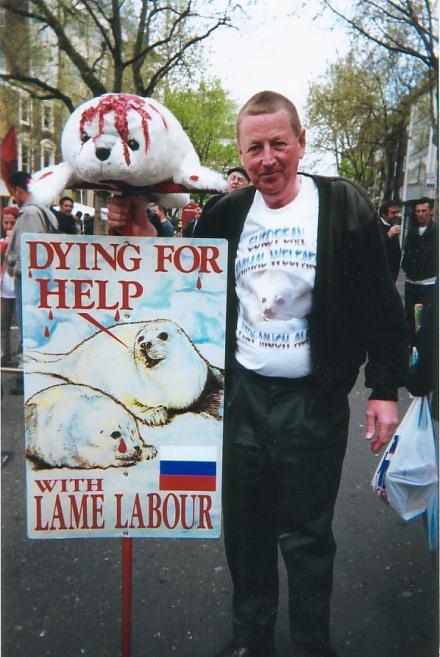
For many years whilst doing export work I also worked with a good friend of mine; Robert; founder of ‘European Animal Welfare’. I helped Bob with his campaign for the baby Russian seal pups who were being slaughtered for thei skins back in the 90’s and more.
Top Man ! – Robert
After many years of campaigning; we got the job done – Russia stopped seal hunting !
We took the campaign to many places; Bob even dressed up as Father Christmas one year to get into the Russian Embassy in London to make his point.
Please visit the following and scroll down to read a lot more on the Russian seal pup campaign:
Here is some of my memories about a trip to Brussels, Belgium; the EU; to try and be a voice for the baby seals. Enjoy !
Regards Mark.
Above – Whitecoat Seal Pup – is that not worth saving ?
(Me) Dressed up as a Russian sealer; with Mark Watts MEP and the brilliant Robert – and ‘that Egg’ – outside Downing Street, London.
———————————————
And so thanks to the Metropolitan police, things went a bit pear shaped and to a point, our presentation of the petition at the door of number 10 was dealt a blow that made it rather, or drastically less effective than it should have been. Regardless of their attempts to cause us problems, plastic bag after plastic bag of petition cards against a Russian seal pup cull, and more importantly, 10,000 signatures calling on the British government to act, were delivered unceremoniously to the door of number 10. One good thing which had been planned by us anyway, and which did happen as a result of events at Downing Street, was that the giant Easter egg was afterwards taken to one of the nearby London hospitals where it was handed over to one of the children’s wards to be used as I think, a big storage container for their toys on the ward to go into. There were no quibbles at the hospital regarding special security activities and the egg was simply accepted for what it was, which was a gift for the sick children in the hospital ward. At least we had no problems there. Who are the real children in this case, you have to ask ! – those in Downing St. or the sick youngsters at the hospital ? – I say the former.
Thinking ahead, we also had plans for action in Europe. Surely things will go better there – wont they ?
The issue of Russian seal pup skins being imported into the EU had been a major problem for many years. We had been to London in an attempt to get PM John Major and the British government to raise the issues of Russian seal pup killing at every opportunity. He utterly failed big time. As there was very little progress here it was now time to take up the other stage of our campaign; that being to take our issues to Europe; next stop Brussels !
Cut to October 1997. – I have taken something like a very welcome three days holiday from work and have driven down to Ramsgate harbour in Kent where I am meeting up with Robert and the others to head to Brussels, Belgium, and the European Union offices. We are all going over to Belgium by a single minibus which has been chartered especially for the trip. At Ramsgate I park my car in the long-term car park and hang around the short time until Robert and the others arrive in the minibus. There are seven of us making this trip, all friends and supporters of Robert’s efforts for the Russian seal pups. I climb on board the minibus and we go through the normal procedures in order to catch a ferry to Ostende that evening. Despite being a large vehicle, the minibus is fairly well kitted out with all the gear there we are taking with us to Brussels; things including stands, display boards, flags, the life sized seals from London and a complete Russian tundra display, which is made up of white fleece type sheeting and dustbin sack after dustbin sack full to the brim with white polystyrene chips which will be shaped on the display to represent the snowfall.
In his very supportive role, Mark Watts MEP has again offered his help, support and services during our trip to Brussels. From what I can recall the ferry which took us to Ostende was at the time, a new catamaran type vessel; and we left Ramsgate at about 6 PM in the evening. Being made by one of the new ferries operating the service, the crossing to Ostende was fairly quick, considering that the journey usually takes approximately 4 hours by normal (older type) vessel. Once at Ostende harbour, we had no problems in clearing both customs and passport control. As anyone who is a regular to Europe will know, Ostende to Brussels is literally a simple journey of between one and two hours down the A10 and E40 motorways, almost a straight line heading in a south easterly direction.
And so by just taking our time and not rushing anything at all, we were in Brussels around about 10 PM that same evening. As we had a meeting within the EU the following morning, we just drove around for a short time that night to make sure that we were familiar with our route to the European Parliament buildings ready for the following morning. It has to be remembered that everything being done on this trip was funded solely by Robert and the rest of the crew who were supporting him. As such, we were not in any position to be able to afford good hotel rooms in central Brussels for the night; instead, for us, it was going to be a case of undergoing ‘economy measures’. Once we were happy with the route to be taken to the European Parliament buildings the following morning, we took the minibus down into what we first envisaged to be a side street, but one which turned out to be one which was still fairly busy even at 11 o’clock in the evening. From memory, the road forming this street was divided by a central tree-lined, grassed area; one side of the road heading off in one direction whilst the other side of the central reservation was for traffic going in the opposite direction. On both parts of the roads there were shops, bars and cafes. Have you ever tried sleeping in a minibus with six other adults ? – If not, then I would very much suggest that you had been doing the right thing throughout your life; or have had a lucky escape ! To say that it is a ‘challenge’ would very much be an understatement, and this scenario was something that we were all going to have to endure that night during our stay parked up in a very busy side street in Brussels. All the doors were opened on the bus, and the multitude of arms and legs of all the occupants sprawled out in just about every direction found on any compass; and as always in such situations, there was a degree of almost continual talking and giggling.
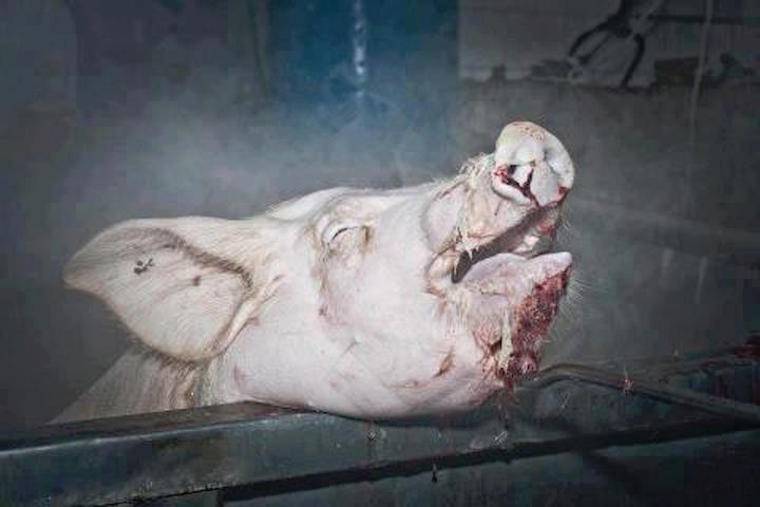
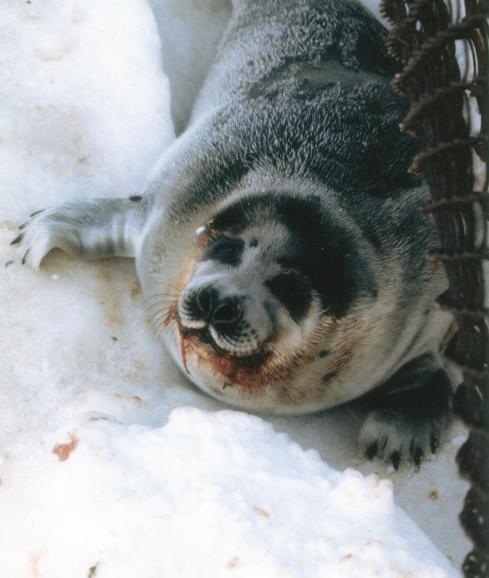
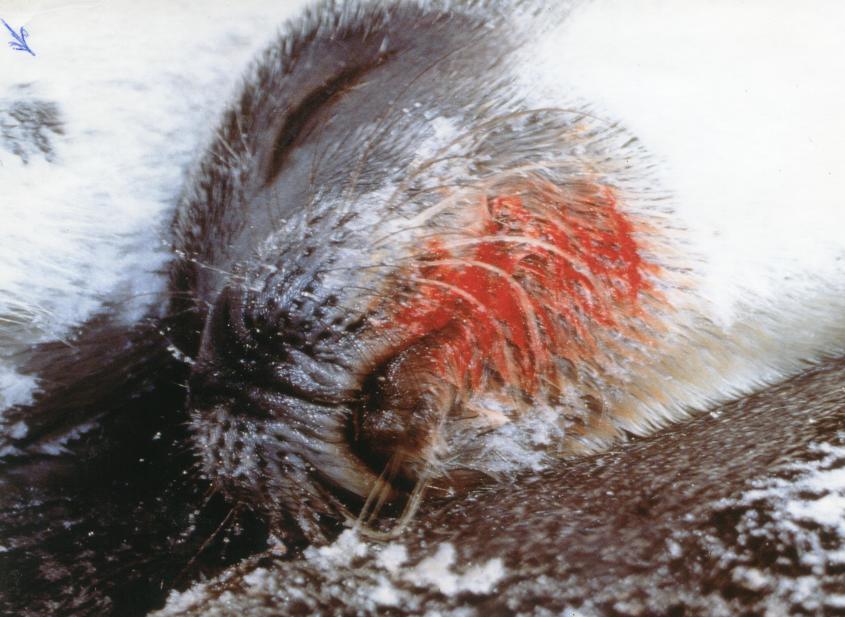
Bleeding from the mouth is a sure sign of stress in young seal pups
As luxury in the form of adequate sleeping quarters was not a paramount issue in the minibus, we all attempted to grab some shut eye during the time leading up to, and around midnight. I think it fair to say that virtually nobody in the crew was able to get any sleep at all seeing the conditions we were in within the minibus; and so there was a unanimous decision made around witching hour that it might be better for all of us to bail out of the bus and ‘sleep rough’, by trying to get our heads down on the grass under the trees that formed part of the central reservation between the roads. Don’t ask me how we got them or where they even came from, some of the shops I guess, but all I can recall is that we ended up with a hefty amount of large, empty cardboard boxes under the trees. Fortunately, the weather for many days before had been dry and warm, so it was a case of just selecting your cardboard box, finding somewhere to lay it, crawling in and attempting to get some sleep !. I recall looking across out of my box at Robert; this brilliant seal campaigner guy who was scheduled to meet up with an EU Commissioner the following morning, and seeing him prising himself snugly into a large cardboard box on a side road in Brussels which had become his bed for the night. He looked your typical street dosser type guy. Me being me, my wicked sense of humour crept in and I was in two minds to get out of my box and go round to all the crew; dropping a pound coin into their hands and whispering “here love, go and get yourself a cup of tea”, or something similar. I restrained !
By about 3 am I think I had probably had about ten minutes sleep, if that, during the last two or three hours. Taxis and vans making early deliveries to the city centre and all the shops in the road were blasting up and down on each side of us; and, it was just the very last place you could, or would choose to get your head down for anything which even resembled a good sleep. I got talking to Audrey, one of the crew, at around 3 am; and we decided that there was little enjoyment to be had where we were, so it was a case of walking the streets for a while. We crawled out of our boxes, dusted ourselves down and set off in the direction of ….. anywhere. We had a good walk round for a few hours, whilst witnessing the night sights and ‘offers’ of downtown Brussels and making friends with the many cats who appeared out of the darkness and came over to us for a bit of attention. They got it; at least they had a good night. I was a bit annoyed that I did not have anything to give them to eat; and I hope that they forgave me for not dishing up bowlfuls of food. Audrey and I discussed anything that decided to rear its head; from “dust to the state of the nation” (Stranglers – ‘Giants’ album) ..
Topics include dust to the state of the nation
.. and the time passed by quite quickly; it had turned 6 am before we even realised. I have this real thing about nice teeth; and to me, a beautiful set of teeth on a girl are just as important as the size of any of her bits or the length of her legs. Well I am probably exaggerating when I say that, but I do consider oral hygiene a very important thing. So by 6 am I was rather keen for two things; a good strong cup of hundred mile coffee and then after that, a good session with the toothbrush ! All the crew had escaped from their cardboard boxes by the time we returned from our walking tour of the Brussels streets, and together we headed off with one thing in mind; that being to find an early morning café where we could get something to drink and eat; followed by (in my case anyway) a good teeth cleaning session. We were lucky and found this place just along the road; and I think the guy who owned the place had thought that all his birthdays had come at once, with all these crazy Brits turning up on his door at 6-30 am and ready to drink all the coffee that he had and eat anything that could be eaten within his café. All I can recall is after having something good to eat and drink, descending these stairs in the café; and going into a room and having a wash and very welcome and essential teeth clean. Afterwards I wandered back upstairs to meet up with all the crew. One by one, each person went down and had a wash and personal hygiene experience; and by 8 am or 8-30’ish, we were all tanked up with coffee and croissants; ready to go and in a dishevelled sort of way, meet up with the pristine hierarchy from the EU.
It was not perfect as is often the case under such circumstances; none of us had a fresh suit or anything formal to change into; I my case, we had either walked the streets of Brussels the night before, or been encased in a reject cardboard box dosing under a few trees on a busy roadway for a few hours. Whatever, we were all rather deprived of sleep; but as the saying goes; ‘shit happens’ !- I guess that was a night of shit for me.
Robert went to a box shoved into a section at the rear of the minibus, and suddenly produced a whole bunch of fresh, new white T shirts for us all to wear. They were great, and each had “European Animal Welfare – Very Much Alive” written across the chest, complete with an excellent picture of a baby whitecoat Russian seal pup. It was a very welcome addition to, and diversion from the clothes which we had worn whilst travelling from Ramsgate. We all looked the part now, and were ready to do action at the Brussels HQ of the European Union !
We wormed our way through the busy Brussels morning rush-hour by way of the route we had taken and planned the night before to the EU headquarters. I recall driving into the so-called public car park, and thinking to myself that we would probably have made faster progress if we had been provided with an Apollo moon buggy rather than a large van we had; such were the amount of potholes and ‘varying undulating terrain’ that formed this wasteland which had obviously passed EU regulations by putting ticks in bxes under the heading of ‘adequate car parking facilities’.
It did not take that long for all of us to unpack the van of all its display equipment and then to manhandle the gear across to the main reception area at the entrance to the EU Parliament building. As it was early morning, we had arranged to do a live link up with BBC Radio Kent, our home county station, but as always where the media are involved with anything relating to animal welfare issues, the actual events are very much often overplayed and given as totally different portrayal to those who listen or read. Rather than describe our planned meeting with the EU Commissioner to discuss the situation regarding the import of seal pup skins from Russia, as organised by Mr Mark Watts MEP; BBC Radio Kent broadcast to its listeners that Animal Rights activists from Kent had stormed and taken over the EU Parliament !. This was obviously not quite reality. Also, why are we always called ‘animal rights’ when in fact we are dealing with animal welfare issues ? – I can only suggest that the term ‘rights activist’ immediately conjures up a harder image to the press and media who wish to make a stronger story. Readers / listeners no doubt are lured into the view of the whole place as being taken over by balaclava clad terrorists armed with a multitude of coloured spray cans; smashing and spraying our way through corridors, turning over tables and chairs and basically, causing fear and havoc amongst all the employees at the EU. Actually, we were people who worked and who had simply gone to the EU parliament for a day to express our concerns as EU citizens about the killing and import of Russian seal pup skins into the EU !
Here we are in Brussels (at the EU) – post pistols up the nose and all that. Mark (WAV) standing at back (in baseball cap) to right of ‘Ruthless’ banner. Robert at front holding ‘Shame’ banner.
We ended up managing to get through to BBC Radio Kent and explain that the situation was rather different in reality to that which they were portraying to their listeners. Our visit had been arranged by Mr. Watts MEP; and the nearest we got to any table was going to be one in the restaurant or, at the meeting with the Commissioner. I hoped they would both remain on all their legs at both venues; and as for spray cans, they were in my garage at home; to be used on car repairs !
To further what can be described as ‘glitches’ in our day; we had as a group the pleasure of experiencing at first hand the activities of the Belgian police. From what I gathered that morning, the large paved area directly in front of the entrance doors to the EU Parliament comes under the classification of being ‘EU territory’ rather than ‘Belgian’ territory. As such, the Belgian police, whilst being in existence for security reasons, do not have specific Belgian authority with regard their policing of this area. Maybe it was just me, I don’t think so, but the message had not quite gotten through to one senior Belgian police officer who was patrolling around the main doors of the Parliament entrance.
Chances are that he had not been fully briefed / informed that we were attending on that day and that we had been given permission by the EU Eurogroup for Animals to set up a media display outside at the entrance to the Parliament. Not knowing this situation, we casually walked across with all of our display directly into the entrance area, where we proceeded to start unpacking and constructing our Russian seal pup display. Witnessing this, our Belgian police officer friend did a very good portrayal of the space shuttle – he kind of went into orbit with all burners blazing !!.
All I can remember for the next few minutes was having pistols pointed at us by the Belgian police, lots of shouting and a great deal of pandemonium by many people. Fortunately for us, Mr Mark Watts MEP arrived on the scene, had a quiet discussion with Robert and then made his way over to explain and calm down the situation with the Belgian police. I can remember thinking to myself what I would have to tell my family back home if things had carried on as they initially were for those first few minutes with the Belgian police. My mum would probably have asked if I had a nice day in Brussels, to which I would’ve responded something along the lines of being shot in the legs or head by a Belgian police officer ! – Apart from that, the day would have been really good; look at the bullet removed from my head; now that’s a souvenir !
Once all the preliminary misunderstandings had calmed down and been put right by various EU parties who appeared on the scene, we continued to set up our display at the entrance to the Parliament building portraying Russian seal pup hunting. By this time we had gathered the attention of a lot of people going into the building, as well as certain representatives from various EU press who stopped, took some photos and asked a few questions about our aims and campaign. In the end it turned out to be a very positive morning. Mr Michael Elliott from the AW Eurogroup arrived and joined up with us and with Mr Watts MEP to have some photographs taken.
Mark Watts had kindly organised for us to have some lunch with him in the main restaurant area within the Parliament, and so before retiring for this, we dismantled a display and took it back to the van.
I will try and dig out a few photos of this campaign and post them onto this page when I can – Mark.
Help us stop mink eyelashes being falsely advertised as ‘cruelty-free’
If you see real mink fur eyelashes on sale described as ‘cruelty-free’ or ‘humane’ in store or online, then please let us know.
We have registered complaints with the Advertising Standards Agency about a number of online eyelash sellers over the false description of their real mink fur eyelashes as ‘cruelty free’.
Here is an example of the type of false advertising being used: “Our mink lashes are made from 100% natural and individually selected mink fur hairs that have been harvested by gently brushing live animals from Russia. We would like to stress that no animals are ever harmed in this process. Our mink lashes are completely cruelty free.”
We have managed to get this particular case removed, but there are still many others out there.
Let’s be clear, there is no assurance able to be given about the standards of the conditions in which the mink are kept, records of veterinary inspections or, importantly, the method of restraint when harvesting the furs that have supposedly been ‘gently brushed’ from live animals. There is no national or international certification available that objectively denotes the production of real mink fur eyelashes as cruelty free.
E mail Respect at: info@respectforanimals.org
Title your e mail – Mink Eyelash Hotline
‘Morally bankrupt’ fur trade in financial crisis
Saga Furs, one of the most prominent bodies of the global fur trade, has recently recorded a ‘clearly negative’ operating result. According to Saga Furs latest financial statement, the company’s total sales fell by 28% on the previous year, as the price level of mink and fox skins fell by 24% and 20%respectively. World mink production is also estimated to have fallen by 20% in 2018.
Comparing the most recent financial statistics with those five years ago, Respect for Animals can reveal the extent of Saga’s problems. In the period between November 2012 to October 2013, the operating profit before taxes was 26.7 million Euros. In the period between November 2017 and October 2018 the company lost 1.7 million Euros.
In a candid revelation, the company has been forced to admit that the fur industry ‘faces image problems in the western market’.
However, parts of the financial report will sicken those who care more about animals than financial statistics. The number of pelts sold during the 12 months between November 2017 and October 2018 was over 9.3 million.
Mark Glover said: “These figures provethat the anti-fur campaign has this multi-billion dollar industry on the run. But there is no room for complacency. Tens of millions of animals are still being killed each year to meet the demands of this dreadful trade. We still have much to do.”
Confirming the financial woes of the fur trade, Kopenhagen Furs, the world’s largest fur auction house and owned by Danish fur breeders, has just ended its first auction of 2019, recording an average price of 160 Danish Kroner (£19). This suggests a serious economic outlook for the fur industry, given that skin must sell for around 300 Kroner (£35) for a fur breeder to break even.
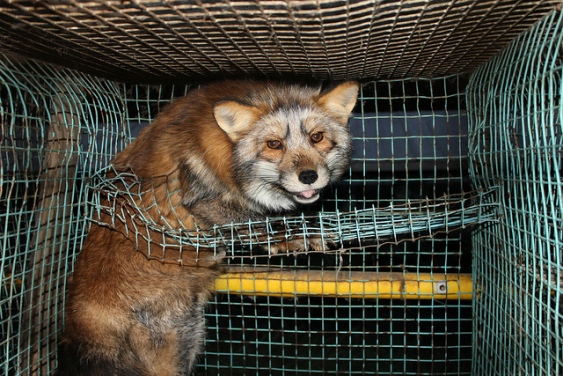
Good news comes from China, where 174 white foxes were freed from a fur farm thanks to the courage and support of the activists.
The hides market is losing more and more importance: veterinarians and those who consider it old-fashioned to wear coats, bags and gloves made of cages and reared animals cruelly slaughtered for their own fur sigh with relief!
The release of these animals was made possible thanks to the efforts of BoHe, a Chinese activist who also deals with 2,700 dogs rescued from the meat market, and Karen Gifford, an American activist. Thanks to the donations of hundreds of other people, the two women were able to save the white foxes from the breeding plant.
The farm said it was in competition for lack of revenue: after closure, the foxes would be sold to other farms or simply killed. The two women took advantage of the stalemate and were able to bring the foxes away.
Because the foxes were not raised in the wild, but only in a cage, they could not be released directly into the wild. For this reason, the activists took them to a Buddhist sanctuary in Mudanjiang Prefecture
The monks of the reserve did not hesitate when they heard of the foxes looking for shelter: they completely cleared their green spaces for the foxes. Here the foxes can return to their wild state.
After the euphoria to finally see the animals free and in their natural habitat, the two women started a new appeal: now we have to secure food for the foxes, so we need more donations.
The sanctuary is a temporary facility and will house the foxes until suitable shelter is built for them.
A gesture of courage on the part of the activists and the humanity of the monks and of all people who supported the mission with what they could give.
My comment: Hardly a fashion accessory is probably covered with such clichés as the fur. A fur coat is expensive. Who wears it, shows that he has the necessary change to buy it. Fur has always been one of the ultimate status symbols in the fashion industry.
China is currently the leading fur supplier, with 15 million martens dying there each year alone under unimaginably cruel conditions. Even dogs and cats have to give their lives for fur production there.
We’ve talked about it many times, and our goal is to make this cruel fur mafia public all over the world, to show what’s really going on.
We’ve had some modest successes so far, but the main goal is to show that fur production in China is a highly professional exploitation of animals, which works very good because the European and German clothing industries have a business pact for fur, leather and applications with China and all of these items are imported unchecked and despite prohibition, throughout Europe.
The more praiseworthy is the action of these animal rights activists who set an example for their country. Thus, the hope arises that the animal rights groups in Asia will soon create a foundation there …




































 World Animals Voice