Category: General News

EU: Why do fast-growing broiler chicken breeds need to be phased out?

Why do fast-growing broiler chicken breeds need to be phased out?

18 September 2023

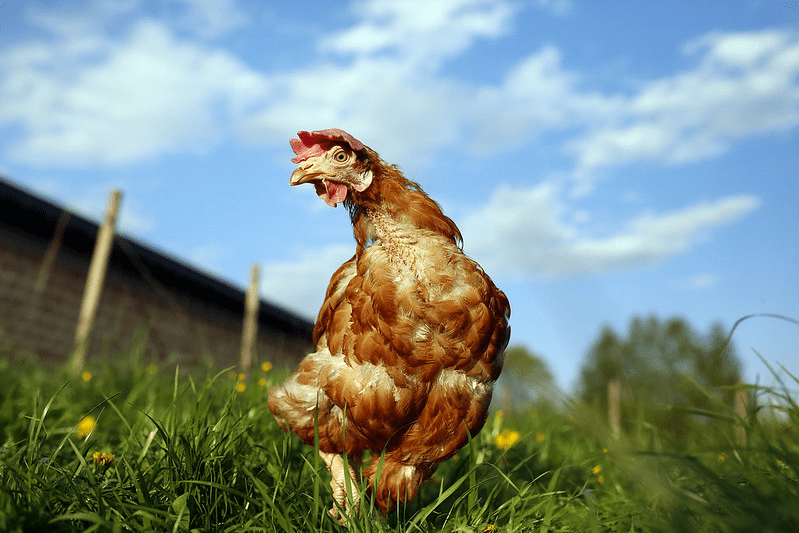
Photo – Act 4 Farmed Animals.

95% of the broiler chickens currently reared on factory farms are fast-growing, selectively bred to reach slaughter weight in just five to six weeks. Their growth rate has a huge impact on their health and welfare. Here’s why the EU must ban fast-growing broiler breeds as soon as possible.

Sickness. Exhaustion. Starvation. Broiler chickens commonly face all of these problems on factory farms, as the way in which they are bred results in a string of health issues that have a major impact on their physical, mental, and emotional wellbeing. From the immense pressure their rapid growth puts on their bodies to the crowded conditions they are housed in, it’s clear fast-growing broiler breeds must be banned in the EU’s anticipated update to the animal welfare laws. 

The European Commission is currently working on revising the animal welfare legislation for the first time in decades.

Learn more about the policies we are asking them to consider for all kept species, including broiler chickens, here.

What are the biggest health problems experienced by fast-growing broiler chickens?

Industrially farmed broiler chickens commonly experience:

Lameness: the skeletal systems and leg muscles of fast-growing broiler birds cannot keep up with their rapid growth and weight gain. They therefore have muscles far too heavy for their fragile bones, leading to gait problems and considerable pain. Up to 58.8% of broiler chickens reportedly suffer from lameness;

Lesions: due to their excessive weight, fast-growing broilers spend more time sitting than their slower-growing counterparts. It is common for them to develop lesions on their bodies that can become infected due to the poor hygiene standards in place on most factory farms. Contact dermatitis is also frequent in these systems, with up to 58% of industrially-farmed broiler birds reportedly suffering from lesions;

Heart failure: their unnatural growth rate puts immense pressure on the cardiovascular system, meaning countless birds die before slaughter.

What other factors make it impossible for fast-growing broiler chickens to lead comfortable lives?

Fast-growing broiler chickens are chronically hungry, which results in them experiencing near constant mental and physical distress.

They also generate a lot of body heat due to their high metabolic rates. With typical broiler houses containing thousands of birds, these spaces quickly become inhospitable, with chickens overheating. The consequences can be fatal.

To make matters worse, broiler houses are not cleared of litter until the birds have been taken to the slaughterhouse. This means that chickens have to live in their own faeces for weeks, and often end up suffering from respiratory problems, eye abnormalities and other health issues resulting from high levels of ammonia and other noxious gases.

Due to their sheer size and subsequent health problems, broiler chickens cannot engage with their environments and peers comfortably. Evidence shows that broilers are curious birds that want to explore and play, but breeding in a way that causes them to be chronically unhealthy, while also being crushed into huge flocks, means these birds don’t have the energy nor the means to express their natural behaviours. 

Here’s what a day in the life of a typical factory farmed broiler chicken looks like.

The European Commission must ban the breeding of fast-growing broiler chickens 

Fast-growing broiler breeds must be prohibited in the updated animal welfare legislation, and only slower-growing breeds should be permitted in Europe’s farming systems. These animals deserve a healthy life filled with positive experiences, which is only possible for birds of breeds with slower growth rates.

Regards Mark

Finland: Great News – Citizens’ initiative to ban fur farming in Finland breaks records.

Citizens’ initiative to ban fur farming in Finland breaks records

13 September 2023

Susiryhmä

Having collected the required 50,000 signatures in just 24 hours, a Finnish citizens’ initiative calling for a national phase out of fur farming will now go to Parliament for debate.

Turkistarhaus historiaan (consign fur farming to history) calls for a law to ban fur farming in Finland within a reasonable transition period, in addition to rolling out a support system for fur farmers to ensure a fair transition for all.

Finnish citizens’ initiatives have 6 months in which to gather the required level of support.

After breaking records by acquiring the required 50,000 signatures in only one day, over 100,000 names have now been added. Signatures are collected on the Ministry of Justice’s website.

The organisers highlighted the suffering of animals such as mink and foxes, the economically unprofitable industry and public health risks as reasons why fur farming must be brought to an end. 

The demand for a ban will be debated in the Finnish parliament after validation of the signatures.

The success of the initiative is another clear indication that European citizens want to see an end to fur farming, as proven by the European Citizens’ Initiative Fur Free Europe which gathered over 1.5 million validated signatures. 

Visit the initiative’s website to learn more, add your support if you are a Finnish citizen, or donate.

Regards Mark

Italy: Mass pig culling continues in Italy amid African swine fever crisis.

Mass pig culling continues in Italy amid African swine fever crisis

14 September 2023

Essere Animali

Essere Animali documented serious biosecurity and animal welfare shortcomings in the management of pig culling.

First detected in Italy in January 2022, African swine fever (ASF) is a highly contagious viral disease that affects domestic and wild pigs. Whilst posing no threat to humans, mass culls have been taking place in an attempt to limit the spread of the disease amongst farmed pigs to reduce losses for farmers. 

New footage obtained by Essere Animali in the province of Pavia shows inadequately culled animals subjected to slow and painful deaths, and serious deficiencies in hygiene and biosecurity that may lead to further spread of the virus on farms.

The footage shows:

Serious deficiencies in the facility and in the biosecurity procedures

Inadequate management of culling with severe additional suffering for the animals

The lack of animal welfare training of the workers involved

At least 5 pigs abandoned on the ground in the pen leading to the killing containers in an acute distressed condition with symptoms potentially attributable to ASF

Video footage

🔴 IMMAGINI STRAZIANTI Abbiamo filmato con un drone l’abbattimento dei maiali in un allevamento del pavese colpito dalla peste suina… | Instagram

The organisation also claims that improper implementation of biosecurity measures by the nation’s health authorities have resulted in the inability to control the spread of the disease, resulting in emergency mass culls that are a disaster for animal welfare.

We think it is essential to show images that show that, in the face of all the failings of the health authorities and our institutions, in a period of time in which public money has been spent on inadequate measures and biosecurity has not been sufficiently stringent, it is the tens of thousands of pigs that will be slaughtered in these days, amidst atrocious suffering and in the absence of adequate stunning, who will pay the highest price.

Simone Montuschi, President, Essere Animali

Regards Mark

Italy: They had already shot Amarena, perhaps several times, – Autopsy Report.

Past post – Italy: Hunter Kills Popular Bear ‘Out of Fear’ Despite Being Attraction With Locals and Tourists; and We Thought They (Hunters) Were Fearless Men !! – Cubs Missing But Many Searching To Rescue. Lets Hope for Positive News. – World Animals Voice

From Di in Germany:

06 Settembre 2023 – 17:01:34

di Martina Colabianchi

They had already shot Amarena, perhaps several times, but with one substantial difference: it was small hunting pellets that hit the mother bear, symbol of Abruzzo, and not a 12 gauge bullet that killed her.

This is what emerged yesterday during the autopsy at the Zooprophylactic Institute of Teramo. The ball was first identified in the morning during x-rays at the university’s Veterinary Clinic and then extracted from Amarena’s carcass during the cadaveric examination in the afternoon, which ended almost at midnight.

The “warning” shots which essentially serve to scare and ward off the bear are a fairly common occurrence in park lands: the bear Stefano who was killed in Molise in 2013 already had the same wounds, i.e. a combination of warnings and a subsequent fatal shooting.

The autopsy discovery changes the narrative of the event, because now everything is in the hands of the ballistics expert Paride Minervini, whose report will be decisive in defining what happened. As judicial circles make clear, the reconstruction of the exact dynamics of the shot is crucial to define the responsibilities of the only suspect, Andrea Leombruni, for which it is essential to establish the timing, the choice of the weapon and the bullet, the distance, the trajectory and closing the house gate to block the bear.

The autopsy confirms, however, that it was a slow death, due to the blow which, having entered the lung from the side near the shoulder, irreparably compressed all the internal organs causing inevitable internal bleeding. A slow death to which Amarena would not have surrendered but against which she would have fought, trying several times to get up from the ground, in vain.

————————————————————————————————-

Avevano già sparato ad Amarena, più volte forse, ma con una sostanziale differenza: a colpire la mamma orsa simbolo d’Abruzzo erano stati dei pallini piccoli da caccia, e non un proiettile calibro 12 che l’ha uccisa.

È quanto è emerso, ieri, durante l’autopsia all’Istituto Zooprofilattico di Teramo. La palla è stata prima individuata, in mattinata, durante le lastre alla Clinica Veterinaria dell’università e poi estratta dalla carcassa di Amarena durante la ricognizione cadaverica nel pomeriggio, terminata quasi a mezzanotte.

Gli spari di “avvertimento” che servono, in sostanza, per spaventare e allontanare l’orso, sono un fatto abbastanza comune nelle terre dei parchi: già l’orso Stefano che fu ucciso in Molise nel 2013 presentava le stesse ferite, ossia un connubio di avvertimenti e una successiva fucilata mortale.

La scoperta autoptica cambia la narrazione dell’evento, perché ora è tutto nelle mani del perito balistico Paride Minervini, la cui relazione sarà decisiva per definire l’accaduto. Come fanno capire gli ambienti giudiziari, la ricostruzione della esatta dinamica dello sparo è cruciale per definire le responsabilità dell’unico indagato, Andrea Leombruni, per cui risulta fondamentale stabilire la tempistica, la scelta dell’arma e del proiettile, la distanza, la traiettoria e la chiusura del cancello di casa per bloccare l’orsa.

L’autopsia conferma, comunque, che si sia trattato di una morte lenta, dovuta al colpo che, entrato nel polmone dal fianco vicino alla spalla, le ha compresso irrimediabilmente tutti gli organi interni provocando un’inevitabile emorragia interna. Morte lenta a cui Amarena non si sarebbe arresa ma contro cui avrebbe lottato, tentando più volte di alzarsi da terra, inutilmente.

Regards Mark

England: Past Actions.

About Us. | Serbian Animals Voice (SAV)

We did well with ‘basic’ SAV over the years, exposing and covering many animal abuse issues throughout Serbia.

You can see a bit of our work by visiting https://serbiananimalsvoice.com/category/serbia-central-serbia-capital-belgrade-and-serbiavojvodina-capital-novi-sad/  –  but the best way is probably to just track through the monthly ‘Archives’ which you can see on the left side of the Home page.

Warning – there are lots of graphic photos and descriptions in these articles.

My policy has always been never to dress something up to be ‘nicer’ than what it is – so what you get and see here is the reality of the situation in Serbia, warts and all.  I think (or know from experience) that animal welfare is often an issue that slowly grinds you down over the years when you are involved with cruelty on a daily basis – but the animals need us; so we carry on.

At the end of 2018 we worked hard with Mark (Glover) and the crew at ‘Respect for Animals’ http://www.respectforanimals.org/ here in England to get a national fur ban in Serbia – http://www.respectforanimals.org/serbian-fur-farming-ban-comes-into-force/ – it eventually happened – something we all saw as a positive result. 

Thousands of Chinchillas were to be saved ! – Job Done !

Regards Mark

Enjoy a fast trip through Wales !

Get down and dirty !

Poland: Nightmare for animals at the largest egg producer in the European Union.

Nightmare for animals at the largest egg producer in the European Union

12 September 2023

Otwarte Klatki

Press Release

An investigation released today has revealed large-scale inhumane conditions at the largest egg producer in the European Union.

A documented investigation by Anima International at Fermy Drobiu Woźniak, in Poland, has revealed serious welfare issues and irregularities, including injured and sick hens left without treatment and dying in cages. Almost one million hens in cages and tens of thousands in barns are reared on this farm. The company exports to 60 countries in Europe, Asia and Africa, with exports accounting for 70% of its production.

Two activists who were employed at the farm over the summer described how on a daily basis, dead hens were discovered in advanced stages of decomposition, at times obstructing conveyor belts and allowing eggs to come into contact with deceased animals. The hens live in a huge confinement, leading to multiple cases of aggression and acts of cannibalism. Despite the fact that cages were enriched, per European Union regulations, the conditions at the farm fell short of the requirements. 

Click ‘Watch on YouTube’ to view – M

Hens in industrial farming lay more than 300 eggs a year. Such intensive production and high levels of exploitation result in some animals dying of exhaustion. Others go to slaughter after just 18 months or so, as their bodies are unable to sustain intense production. Under the right conditions, they could live up to 10 years.

Bogna Wiltowska, Director of Investigations and Interventions, Anima International Poland (Otwarte Klatki)

Anima International has started a petition to urge the producer to phase out cage farming by 2027, thereby setting a benchmark for the industry at large.

A supplier who keeps the largest number of hens in the entire European Union should also be the leader in terms of welfare standards. Fermy Drobiu Woźniak’s decision to phase out cage farming would affect several million hens per year.

Paweł Rawicki, President, Anima International Poland (Otwarte Klatki)

In the upcoming months, the European Commission is expected to reveal its proposals for a revised animal welfare legislation, including a reply to the European Citizens’ Initiative to End the Cage Age.

This investigation shows the horrific realities faced by animals in Europe and definitely does not bode well to an EU that claims that it is a leader in animal welfare. The European Commission now has a once-in-a-lifetime opportunity to introduce a ban on cages, and to see through the democratic process in which 1.4 million EU citizens asked for transition to cage-free systems.

Reineke Hameleers, CEO, Eurogroup for Animals.

Notes

Investigation website

Regards Mark