Category: General News

Because we are the perpetrators


annie Mc Arthur Foto Schweino

The face of an individual that has lost all hope.
Mistreated by those who were supposed to care for them—and now headed to their death.
How and why are we doing this to others when there is absolutely no need for it?

Jo-Anne McArthur / We Animals

The answer: Because we are the perpetrators.
Because we only recognize rights for our species.
This is the right of the stronger that allows us to become perpetrators.
Humans have rights, animals have no rights.
No animal in this world has rights, nowhere.

There are many moral reasons to give the other species the right to life, freedom, happiness.
Every human being gets these rights at birth, the species gives the rights to itself.
And that favors the winner, that gives his privilege over other species.

That’s the answer to the question.

My best regards, Venus

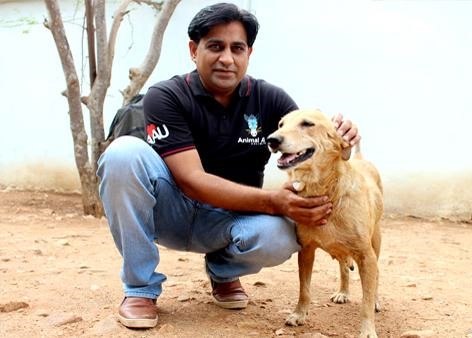
India: More Brilliant Work From the Crew at Animal Aid Unlimited -22/6/19.

INDA0001


We humans have a tough time describing the personalities of animals. But each of us can probably say that every animal we’ve ever known, from a dog to a donkey, from the cow in the field to the chipmunk on our windowsill, has a personality we can feel, though we may lack the words to express it. That’s why the ability to share their stories through videos has been such a godsend for animals–enabling animals who may be on the other side of the world to reveal themselves as the unique, silly, wise, grand, naughty and indescribably sweet characters they are. 

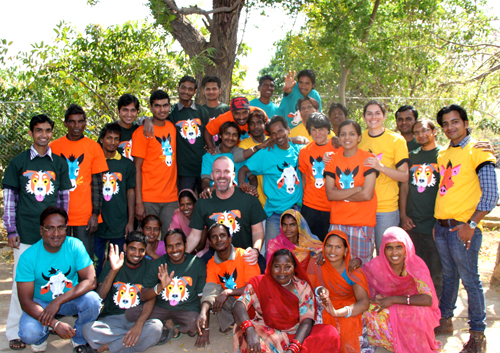
Thank you. We are delighted to let you “meet” a few more of the precious personalities who are alive today because of your support.

udi

animal aid unlimited india


Sweetest puppy looked like a balloon from severe subcutaneous emphysema


This sweetheart’s tail was almost the only thing she could move as her body filled with air. But she seemed to use her wagging tail to ask for help. And she desperately needed it. Her entire body was swelling up from head to toe as air escaped out of her lungs after a probable perforation following a trauma. We could see the outside wound, but not what was happening inside to cause this balloon effect. At Animal Aid’s hospital our medical team diagnosed her with a rare condition called subcutaneous emphysema. We treated her with antibiotics and compression bandages, and within a few days she felt so much better that she has to show you herself! Meet beautiful Puff today!  


Please donate, for big help to small ones. 


A piece of string almost cost Jitu his legs 


The string was knotted tightly around two of his legs, and this handsome young dog was in an extremely life-threatening situation. We don’t have any information about how this happened but sadly we do suspect it may have been done to him intentionally. The blood supply had been dangerously reduced and the swelling in his legs caused by constricted veins threatened to make his legs necrotic (dead). If a few more days had passed like this, gorgeous Jitu would have likely died a very painful death.

But a caring little boy found this suffering street dog, and told his father, who called Animal Aid to the rescue. Jitu’s suffering must have gone on for several days before he collapsed in agony. But thanks to you, we saved him. Meet sweet Jitu today. 


Please donate, because rescue gives animals back their lives.


Babies in the house, jump! jump!

These dream team kids (baby goats) came into the world a couple of days ago. Their mother had such severe mastitis (infected udder) that she cannot feed her babies so we are bottle feeding them and even when her infection has cleared she is unlikely to produce milk for them. As you might imagine, these tiny little twin brothers came out of the shoot silly, naughty, and 100 percent adorable. We’ve named them Marlon and Darlin’. 


Please donate for babies whose mothers are ill.


Celebrate the Caregivers: Dr Vaibhav 

DR VAIL

When Dr Vaibhav Harsola speaks, he is careful, gentle, thorough and efficient–just like his surgeries. Whether a routine spay or a complicated wound repair; an eye removal or an amputation, Dr Vaibhav is an expert at saving lives through his outstanding surgical skills.

Dr Vaibhav also brings a great range of administrative skills and is our liaison with government officials for animal issues in Udaipur. We join many animals in our gratitude that we have Vaibhav’s talent on board.


USA: Arizona Game & Fish Commission Adopts Rule to Ban Wildlife Killing Contests.

-usa-us-flagge-

FOR IMMEDIATE RELEASE – June 21, 2019

proj coyote media release

Contacts:
Betsy Klein, I AM WOLF NATION, (714) 478-0353, b@planb.foundation
Matt Francis, Project Coyote, (435) 659-9635, mfrancis@projectcoyote.org
Katie Stennes, Project Coyote, (240) 328-5369, kstennes@projectcoyote.org
Lain Kahlstrom, Animal Wellness Action, (480) 565-0655, lkahlstrom@outlook.com

Arizona Game & Fish Commission Adopts Rule to Ban
Wildlife Killing Contests

Commissioner Vows to Revisit Rule if Contests are Held Despite the Ban

Phoenix, AZ – Today the Arizona Game and Fish Commission (AZGF) voted unanimously (4 to 0) to ban wildlife killing contests (WKCs) for predatory and furbearing species in Arizona. For months a coalition comprised of concerned citizens and wildlife conservation organizations has worked tirelessly to ban WKCs statewide. Wildlife killing contests are barbaric events wherein participants compete to kill the greatest number, the largest, or even the youngest of the target wildlife species for “entertainment” and prizes. Hundreds of coyotes, bobcats, cougars, foxes and other species are killed in these events every year in Arizona.

In 2018 and 2019, Dewey-Humboldt, Flagstaff, Coconino County and Yavapai County passed resolutions condemning the events (Tucson and Pima passed similar resolutions in recent years). New Mexico and Vermont banned coyote killing contests in 2019 and 2018, respectively. California passed a wildlife killing contest regulation in 2014. Recently the Washington Post highlighted the Santa Slay Coyote Tournament, which takes place annually in Yavapai County, noting the national public outcry against these contests.

“We commend the Commission for adopting a rule to crack down on wildlife killing contests for predatory and furbearing species including coyotes and foxes,” said Matt Francis, Arizona State Representative for Project Coyote. “While we have concerns that potential loopholes may allow these contests to continue, we were pleased to hear that Commissioner Davis is committed to amending the rule if necessary to prevent participants from evading the ban. We all want the same thing: to end the cruel and ecologically destructive killing of the public’s wildlife for no good reason.”

“I believe Commissioner Davis said it best when he said it is the responsibility of the Commission to ensure their rules uphold the highest ethical principles, and they prohibit the take and use of wildlife for economic and illegitimate purposes,” stated I AM Wolf Nation Executive Director Betsy Klein. “As stewards of all wildlife, we owe this to present and future generations. While the rule leaves room for these atrocities to continue, it is a step in the right direction and we are thankful to the Commission for proposing such a rule in the first place.”

The coalition has been working to close loopholes in the rule that may allow WKC participants and organizers to continue their contests so long as participants don’t officially “register or record entry” or “pay a fee.” The rule as passed today also leaves animals such as prairie dogs and rabbits unprotected.

Today Commissioner Davis noted that he believed 99 percent of hunters would abide by the new rule.  
 
Over 70 conservation scientists have signed a statement condemning WKCs on ecological and ethical grounds (see a factsheet here explaining why indiscriminately killing coyotes is counterproductive).

The Arizona Game and Fish Department (AZGFD) itself recognizes that killing coyotes does not reduce their numbers, stating on their website: “Removing coyotes from one area generally results in other coyotes moving in from surrounding areas and breeding faster.” There is no way to know the effect that wildlife killing contests have on coyote populations in Arizona because AZGFD does not monitor the contests or track the number of coyotes killed in these events.

The coalition is hopeful that today’s action by the Game and Fish Commission put an end to the scientifically and ethically indefensible practice of wildlife killing contests in Arizona.

***

Footage of today’s Commission meeting is available here.

Read an Op Ed in today’s Arizona Daily Star by Dan Flores, author and Project Coyote Ambassador, and David Parsons, retired wildlife biologist for the U.S. Fish and Wildlife Service and Project Coyote Science Advisory Board Member condemning wildlife killing contests.

Project Coyote, a national nonprofit organization headquartered in Northern California, is a North American coalition of wildlife educators, scientists, ranchers, and community leaders promoting coexistence between people and wildlife, and compassionate conservation through education, science, and advocacy. For more information, visit ProjectCoyote.org

Project Coyote is a fiscally sponsored project of Earth Island Institute, which has received a Four Star rating from Charity Navigator.


Judi Dench and Others Speak Out Against China’s Yulin Dog Meat Festival. A 1.5 Million Signature Petition Submitted To Chinese Embassy In London This Week.

UKjpg


Judi Dench Speaks Out Against China’s Yulin Dog Meat Festival: ‘I Cannot Imagine the Suffering’


Image result for dame judi dench

Dame Judi Dench’s strong statement against the Yulin Dog Meat Festival was include in a petition to end the festival

On June 21, China’s Yulin Dog Meat Festival will begin again. The event, started in 2009, was created to help boost flagging dog meat sales in the country.

During the festival, and in the days leading up to the event, thousands of dogs and cats are painfully slaughtered for consumption, even though Yulin had no history of mass dog slaughter and consumption before the festival was created, according to Humane Society International.

Interest in the consumption of dog meat continues to wane around the world, but the festival, and its cruel practices, still continue.

“The dog meat trade in China is first and foremost about crime and cruelty. The Yulin festival is one small but distressing example of an unspeakably cruel trade run by dog thieves and sellers who routinely steal pets in broad daylight using poison darts and rope nooses, defy public health and safety laws, and cause horrendous suffering, all for a meat that most people in China don’t consume,” Claire Bass, executive director of Humane Society International, said in a statement.

Understandably, the festival, which commences each year on the summer solstice, has caught the attention of numerous animal-loving celebrities, who have spoken out and fought against it. Ricky Gervais, Lisa Vanderpump and Simon Cowell, who has donated thousands to shut down the dog meat trade, are just a few of the celebrities working to bring this festival to an end.

RELATED: Activists Save 62 Filthy Dogs from Slaughter Days Ahead of China’s Yulin Dog Meat Festival

Another star who recently joined the cause is Dame Judi Dench. The actress sent a message of support to go along with a recent petition created to stop the Yulin Dog Meat Festival.

“It fills me with sadness to think that the Yulin Dog Meat Festival is just around the corner again. So I wanted to send this message as a symbol of my solidarity with all the thousands of people in China against the dog meat trade, who love their dogs and cats just as much as we do, but who go through the awful heart ache of having them stolen by dog thieves. I cannot imagine the suffering of those poor dogs, and I hope very much that one day soon this cruel trade will end,” Dench said in her statement.

The petition — which was created by Humane Society International and Care2 — its 1.5 million signatures and Dench’s message were delivered to the Chinese Embassy in London on Thursday. The bill was escorted to the embassy by several of the petition’s human supporters and four dogs that were rescued from past Yulin Dog Meat Festivals.


https://people.com/pets/judi-dench-speaks-out-against-yulin-dog-meat-festival/?utm_campaign=social-button-sharing&utm_medium=social&utm_source=twitter.com

EU: Food Safety PR – 21/6/19 – Fight against food fraud: joint action on organic products.

EU- Flagge

Food Safety

Fight against food fraud: joint action on organic products

Today, Europol/INTERPOL published the results of the OPSON VIII operation to which the EU Food Fraud Network contributed in order to detect fraudulent actions in the organic sector. Justice, police, customs and food experts have been mobilised to investigate and to ensure the success of this operation for which 16 Member States volunteered to participate. The action focused on complex international supply chains and aimed to identify their vulnerable points It also investigated suspicions of fraud, targeted false certification, concentrated on food and feed in significant quantities, mostly imported, destined for redistribution under EU organic label. Though no health issues were identified, the action led to a number of administrative and criminal proceedings and the seizing of products. The Commission took the lead of the action on organic products by providing to the participants intelligence elaborated on in depth analysis of available data, supporting the national actions (e.g. statistics risk based operators, countries or control bodies) conducted by the participating countries and coordinating investigations with Europol and INTERPOL.

For more information, see EU coordinated actions


“We have to make people think”- Ingrid Newkirk for the 70th birthday


Newkirk mit Affepg

She is friendly and polite – which is probably enhanced by her British accent. But if need be, it’s hard as steel. Ingrid never shies away from finding clear words or making a statement – whether she’s going to undress, light a car, take Anna Wintour’s office, or get jailed.

Ingrid has taken off countless times to protest against fur, leather, meat, etc. And even now, at 70, there is no reason for her to stop.

Ingrid-E-Newkirk-Billboard

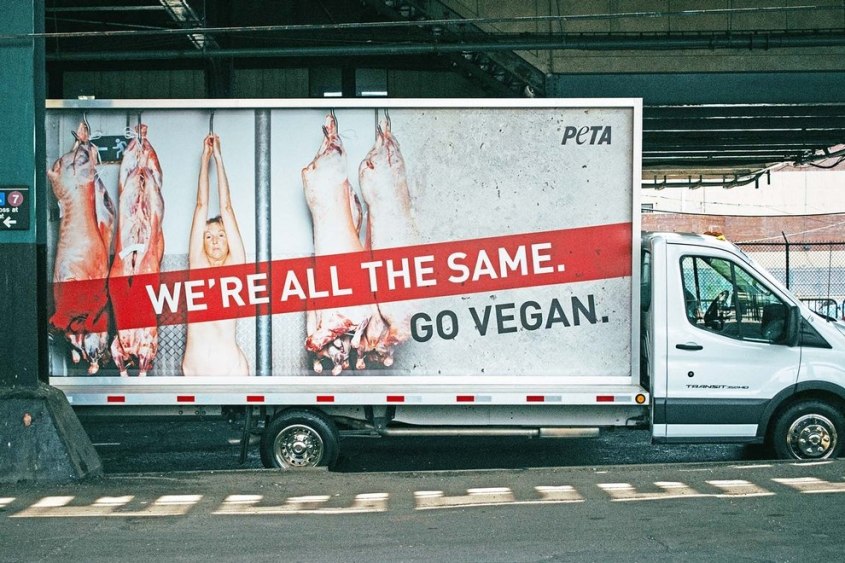
For an ad motif, she hung herself on a butcher’s hook at a market in London next to the bodies of pigs to show how similar humans and other animals are.

“It was very cold,” recalls Ingrid. “And it was almost impossible to hang on this hook. Your whole body weight hangs on your hands. I just undressed, grabbed the hook and hung there. I knew that there would be people who found the motive offensive. Animals are just like us in terms of their bodies and their feelings. We need to get people to think about it. I was wondering if we should not bring in the cries of pigs (in the slaughterhouse), but that would have been too much. “

Ingris-E-Newkirk-mit streunepg

For today’s standards that may not sound very revolutionary.
But in the 1970s castration clinics and adoption programs in animal shelters were still unknown territory.
As the first female director of a shelter in Washington, D.C. Ingrid pushed through a law that provided public funds for castration and veterinary care.
She stopped selling animals to laboratories and set up an adoption program for homeless animals at “her” shelter. She was voted Washington Person of the Year for her commitment.

1Aktion-General-Motors-Crash-Test-mit-lebenden-Tieren-01-c-PETA-USA

General Motors (GM) was the last remaining automaker to use primates, pigs, dogs, ferrets, mice and rats for accident testing. The company refused to introduce human testing methods in collaboration with PETA USA, such as computer-controlled models.

In one action, a crowd gathered after Ingrid set a donated car on fire.
The same thing she did at two more exhibitions. After 18 months of unremitting publicity against animal cruelty at GM, the company stopped all animal accident testing. Thus, the cruel practice was abolished worldwide.

-Ingrid-E-Newkirk-Pennsylvania-c-PETA-USA

Pennsylvania held a pigeon shooting that captured 5,000 birds, put them in tiny cages for days without food and water, then released them – sick, weakened and disoriented.
Afterwards, the participants were able to shoot at the animals.

Birds that were wounded but not immediately dead fell to the ground, and the children of the participants kicked them dead or turned their necks over.
In 1992, around 2,000 animal rights activists protested against this event.
Ingrid led 40 of them into the field to stop the pigeons from shooting.
They seized cages in which birds were still sitting and also collected the injured animals. When the group was arrested, they decided not to pay a fine but to go to jail. Because that would cost the city a lot of money, and the event would be with all the necessary security and the following prison housing – so the hope – in the long term too expensive.
For us the 1992 pigeon shooting cost the taxpayer $ 300,000 – the event was soon discontinued.

In the summer of 1981, Ingrid and another PETA-USA founder decided to uncover the unimaginable animal suffering that takes place behind locked laboratory doors.
It was the first eyewitness investigation of the animal rights movement.

Affe im Labor-02-c-PETA-USA

Ingrid’s colleague hired worked as an undercover at the Institute for Behavioral Research – a government-funded laboratory in Silver Spring, Maryland. There monkeys were cut through the spinal nerves to make their limbs partly unusable. With electric shocks, food deprivation, and other cruel methods, the animals were forced to try everything they could to reuse the disabled limbs.

An expert witness went to the lab at night.
Ingrid was hiding in a cardboard box in the parking lot, looking out from there to report by radio should anyone approach the lab.
When the photos and videos of the monkeys finally went public, it triggered a storm of indignation.
The investigation brought PETA USA, the topic of animal rights and the horror behind animal testing on the television screens and front pages of the United States.

Ingrid-E-Newkirk-4-c-PETA-USA

The investigation was groundbreaking. For the first time, an experimentalist was arrested and convicted of animal cruelty. For the first time abused animals were confiscated from a laboratory. And for the first time, the US Supreme Court has won a victory for animals abused in animal experiments.

-Ingrid-E-Newkirk-Indien-PETA-USA

In Mumbai Ingrid was stretched in front of a horse-drawn carriage – including teeth – and pulled before the eyes of the passers-by and their team through the relentless heat.
Because the same happens to many horses. Thanks to PETA’s campaigns, Mumbai, like many other cities worldwide, has banned horse-drawn carriages.

anna wintour vogue pgAnna wintour-Vogue Editor

In order to persuade Anna Wintour (the Vogue- Magazine editor) to finally distance herself from fur, PETA had repeatedly delivered delicious vegan cakes – but unfortunately without success.

That’s why Ingrid, another PETA member and Kate Pierson of the B-52’s, stormed the magazine’s New York office, past all the security guards, to protest that Vogue still supports fur.
Anna Wintour fled and barricaded herself in a back room. So Ingrid took over the reception and answered the phone with the words: “We closed today because of animal cruelty.”

Even after her death, Ingrid wants to ensure that the subject animal rights comes to the front pages.
Her will states that various parts of her body should be used to denounce animal suffering.

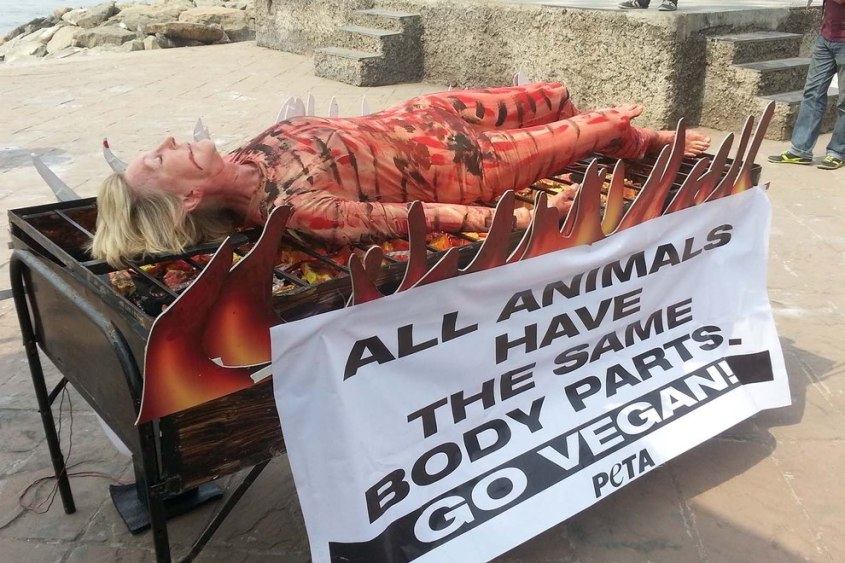
Ingrid-Newkirk-BBQ-India_2014_c-PETA

Their meat is to be grilled, for example, at a “human barbecue”.
Her skin is turned into a wallet and other leather products.

Her legs should be disassembled and make human umbrella stands or other articles.
Ingrid wants to make it clear that we all have the same body parts and nobody wants to die for a steak or a shoe.

Elefanten Füße als Tischjpg
Her lizard tattoo will be removed to make the first “exotic leather” accessory that the wearer has agreed to.
One of her eyes is sent to the US Environmental Protection Agency to remind her that PETA USA will keep a close eye on her until the agency stops her useless animal experiments.
Ingrid’s liver is publicly displayed in France as a protest against the compulsory feeding of geese and ducks for foie gras.

“We have to make people think,” explains Ingrid.

“Because most of us have learned not to think about what’s going on with pigs, chickens, monkeys, rats, bears and horses, and not to worry about their suffering.
Our job is to focus people’s attention and make them think. It is not our goal to make us popular.

https://www.peta.de/ingrid-newkirk-70-jahre

My comment: It does not matter who suffers. We must alleviate the suffering itself.
For that, we need effective activism, courage, and aggressive methods to spread the animal’s suffering to the media and society. Just as Ingrid Newkirk does!
Our fight should never stop.
And we are sure that Ingrid Newkirk will not stop fighting at the age of 70.
We wish that and we hope so.

My best regards to all, Venus

Update – Two very special Belugas have arrived at their new sanctuary home…


Following on from our recent post that Little Grey and Little White had set off on their journey to a new sea sanctuary; we can now give you an update that they have arrived safely at their destination – so that is brilliant news !

Our recent post:

https://worldanimalsvoice.com/2019/06/19/little-grey-and-little-white-have-now-begun-their-journey-to-their-new-sea-sanctuary/

News From the Whale and Dolphin Conservation Society:

Two very special belugas have arrived at their new sanctuary home…

Yesterday, Little White and Little Grey arrived safely in Iceland! 

If you’ve been following this story, you’ll know that we have been working with the SEA LIFE Trust to create the world’s first ocean sanctuary for whales.

We realised a long time ago that it is no use calling for an end to captivity unless there is somewhere for captive whales and dolphins to go. After years of planning and mind-boggling logistical challenges, the first two whales have arrived at their new sanctuary home. They will be monitored by our experts in a quarantine area to make sure they are fully fit after their long journey before being released into the sea.

beluga jet full livery

How do you fly two Belugas to their new sanctuary home?

beluga transport graphic WDC

Your support made all this possible. Now we need your help to continue looking after Little Grey, Little White, and many others still held in captivity. Please donate today so we can continue our vital work. 

Donate to help the new sanctuary by clicking on the following link:

https://uk.whales.org/support/support-the-worlds-first-beluga-sanctuary/?don=referrer_fixed&ref=EM-BELU-19-06-00-DON&utm_medium=email&utm_campaign=June%20ENL&utm_content=June%20ENL+CID_823b6fba353adcf63345d797ccbb4adb&utm_source=Campaign%20Monitor%20WDC&utm_term=DONATE%20NOW

Java: Central Java regent commits to shutting down dog meat trade.

The 21st June will see the start of another Yulin dog meat ‘festival’ in China. Most of us are very familiar with the extreme cruelties involved with this; and we will focus more over the coming days.

In the meantime; there is better news from Java about the dog meat trade there:


Central Java regent commits to shutting down dog meat trade, is hailed as a hero by animal rights activists

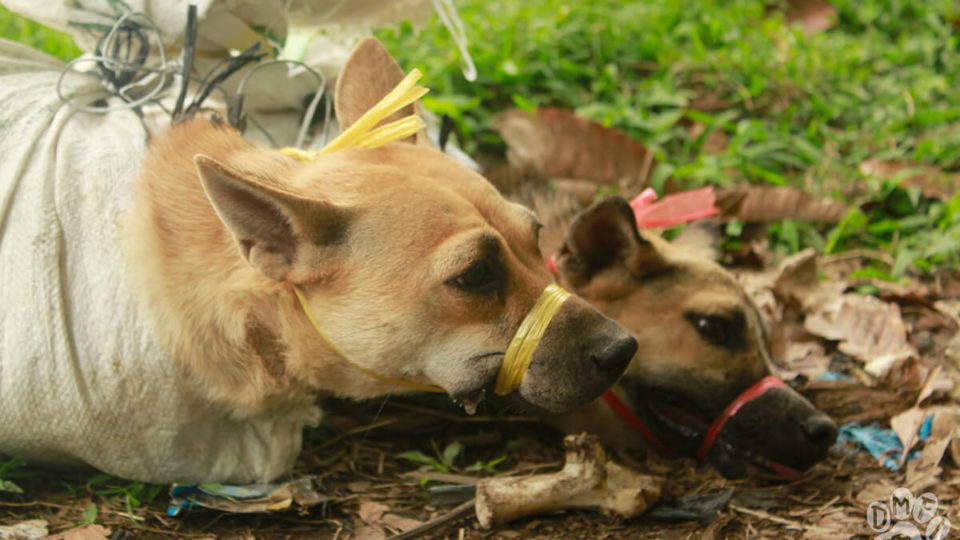
Two dogs tied up as part of Indonesia’s dog meat trade. Photo: Dog Meat Free Indonesia

Two dogs tied up as part of Indonesia’s dog meat trade. Photo: Dog Meat Free Indonesia


Though it is not eaten widely throughout Indonesia, dog meat is popular in certain regions and demand for it fuels an industry that animal rights activists have denounced as not just cruel but also a threat to public health. Last year, activists scored a victory in getting officials from multiple government agencies to agree to work towards banning the trade.

Despite that success, the national government has yet to issue a blanket ban on dog meat, leading activists to focus on persuading regional governments to take the initiative. Yesterday, the Dog Meat Free Indonesia Coalition (DMFI) announced they scored another win with a commitment from Juliyatmono, the head of Central Java’s Karanganyar regency, to shut down all of the dog meat stalls in his jurisdiction.

According to a statement accompanying the above video, DMFI met with Juliyatmono on Monday to talk about the dog meat trade. The regent said he shares their concerns and has agreed to take “some bold steps to start immediately, including the closure of the Regency’s 21 dog meat stalls!”

After calling upon other senior government officials to follow Juliyatmono’s example, the post ends with an expression of gratitude to Regent Juilyatmono: “You are a hero!!”

Speaking to Detik, Juliyatmono confirmed his plans to close all of the dog meat stalls in his regency, citing health concerns as a justification.

“To prevent various diseases caused by dog ​​meat, we will immediately close all dog stalls in Karanganyar,” Juliyatmono said, adding that the shut down would save about 2,000 dogs per month.

DFMI has had mixed success in lobbying other regional governments. They reported having “a disappointing meeting with the Surakarta City Government” in April, but in March they were able to get promises of action from representatives of the governor of North Sulawesi as well as the office of the mayor of Tomohon – the city home to the infamous “Tomohon Extreme Market” – which pledged a 12-month action plan that would result in the end of all sales of dogs and cats within a year.

In August, DFMI — which includes NGOs such as the Jakarta Animal Aid Network (JAAN), Animal Friends Jogja, Change for Animals Foundation and Humane Society International — made their case at the National Coordination of Animal Welfare meeting, organized by the Indonesia’s Ministry of Agriculture and attended by representatives of livestock and animal health agencies, the Indonesian Veterinary Medicine Association and related NGOs from across Indonesia.

During the meeting, DMFI coalition showed a video of their investigations into the dog meat trade and held a group meeting session to discuss it afterwards. Similar videos showing some of the most shocking and cruel aspects of the dog meat trade have helped given momentum to activists seeking a ban in recent years.

Part of DMFI’s argument was based not just on the cruelty of the dog meat trade but also its potential health dangers to humans. Just days earlier, the coalition had issued a public warning that millions of tourists to Indonesia could be at risk of rabies due to the dog meat trade.

Their arguments were apparently quite convincing. In a video from the meeting, Indonesia’s director of veterinary public health referred to the way dogs in the trade were treated as “torture”.

According to a press release by JAAN, at the end of the meeting’s closing session, all participants agreed to issue a ban on the trade of dog and cat meat in Indonesia, as well as prohibit the issuance of veterinary certificates for meat from either animal.  Additionally, the results of the national coordination meeting would be used as the basis for a recommendation to the Ministry of Agriculture to formulate a regulation regarding the ban on the dog meat trade in Indonesia.

However, such a national regulation has yet to pass. So, for now, animal activists will have to keep pushing at the local and regional level to shut down the dog meat trade piece-by-piece.

DMFI has been lobbying the government heavily since the start of 2018. In January of that year, they sent a letter to President Joko Widodo calling for immediate action and the letter was signed by more than 90 Indonesian and international celebrities including Cameron Diaz, Chelsea Islan, Jane Goodall, Sophia Latjuba, Simon Cowell and Ellen DeGeneres. The coalition also has a global petition signed by more than 930,000 people all over the world.

As a Muslim-majority nation, the vast majority of Indonesians do not eat dog (it is considered haram or forbidden in Islam) but it is popular in among certain people in some parts of the country including Sulawesi, the capital Jakarta and the popular tourist island of Bali. Coconuts took a look into the dangers facing Bali’s native dogs, including the island’s illicit dog meat trade, as part of our Coconut’s TV on iFlix series.

https://coconuts.co/jakarta/news/central-java-regent-commits-to-shutting-down-dog-meat-trade-is-hailed-as-a-hero-by-animal-rights-activists/


Thanks EU – When It Comes To Pesticides, We Will Mark Our Own Homework.

GREECE/

We expressed our concerns about the way things were going with the EU and big pharma lobbyists back in March; here is the ink:

https://worldanimalsvoice.com/2019/03/08/eu-have-the-lobbyists-for-bayer-monsanto-convinced-the-eu-to-ignore-the-concerns-of-the-eu-citizen/

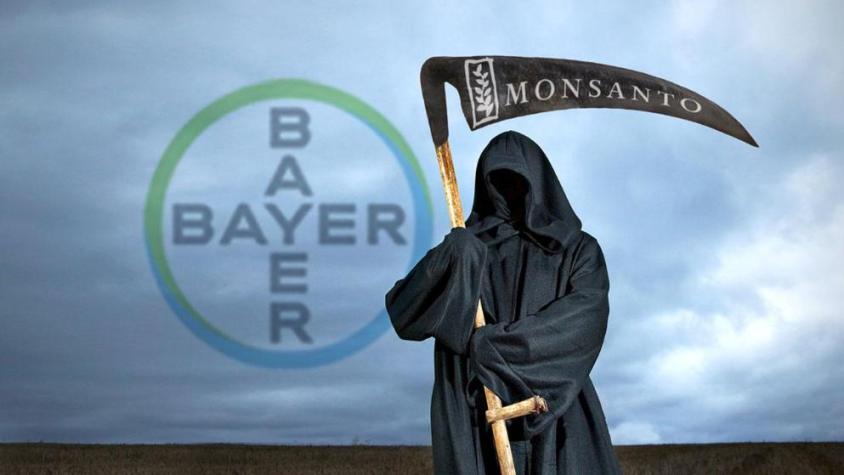
Well as the following article suggests, big pharma has now got its foot in the door and its lobbyists are now working to play down the effect that pesticides can have in relation to human health. It has been shown that such pesticides are killing off the bees kept within the EU, but it does not really appear to matter much in the corridors of Brussels. The lobbyists appear to be getting their way, in direct opposition from the European citizen. The shape of things to come ? – regardless of what damage your products may incur on people, the people who make decisions have been sorted out by the lobbyists to work in their favour – and regulations may be watered down as a result to ensure that big industry continues to make profits for shareholders; products continue to be sold in the shops; and if you fall ill as a result of using them; then tough; we have doctored the legislation so that we will not be taken to court. In other words; just as we want it !

Be1


Source:

https://www.independentsciencenews.org/health/eu-threatens-to-legalise-human-harm-from-pesticides/


By Hans Muilerman and Jonathan Latham, PhD

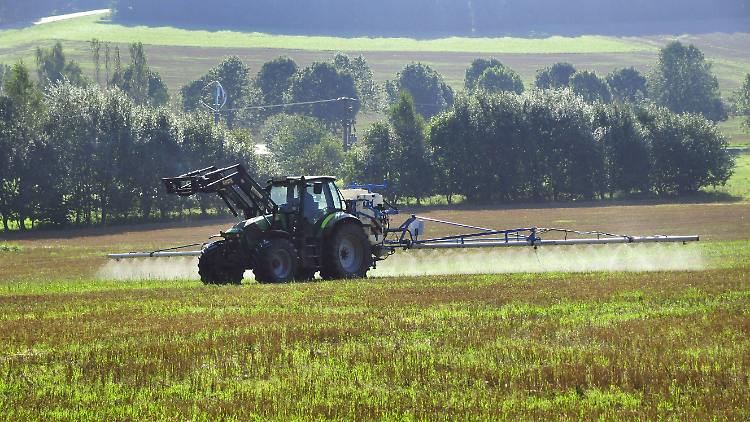
Current EU regulations forbid human exposure to pesticides that are classified as mutagenic, carcinogenic, reprotoxic (toxic for reproduction), persistent or capable of disrupting endocrine systems. By virtue of these and other protective measures EU regulations are considered the gold standard in public protection.

However, experts who are closely linked to industry (or are part of anti-regulation pressure groups) have taken control of the EU’s new Science Advice Mechanism (SAM). These experts have contributed to a report commissioned to reevaluate the EU’s authorisation of pesticides. The report, called “EU authorisation processes of Plant Protection Products”, and published in late 2018, recommends dramatically weakening the EU regulatory system. Especially notable is the adoption of many ideas previously proposed by the chemical industry. For example, the EU currently deems the acceptable level of public exposure to mutagenic pesticides (those that damage DNA) to be zero. The new report recommends scrapping this standard of protection.

The history of the new SAM report is that it was requested by EU Health Commissioner Vytenis Andriukaitis. Its purpose was to determine how to act in cases of so-called ‘diverging views’; that is, when media and public interest groups get involved. The request follows a series of major controversies over EU regulatory decision-making. One such controversy was over the herbicide Glyphosate. A “European Citizens Initiative” delivered more than a million signatures to the EU Commission asking for a ban on Glyphosate. Several cities banned Glyphosate. Even a dairy company banned the use of Glyphosate by their farmers.

With this pressure from all over Europe, the EU Commission had difficulty reaching a decision since many EU member states (Bulgaria, Denmark, Czech Republic, Estonia, Ireland, Spain, Cyprus, Latvia, Lithuania, Hungary, the Netherlands, Poland, Romania, Slovakia, Finland and the U.K) opposed a ban. Ultimately, a very unusual 5-years extension for glyphosate was agreed but soon the discussion will start again.

Issues with neonicotinoids have also pushed the EU Commission into a corner. Neonicotinoid insecticides are linked by much research to ‘bee colony collapse’ and, according to the International Union for the Conservation of Nature “represent a worldwide threat to biodiversity, ecosystems and ecosystem services” (Goulson, 2013; IUCN 2017). This again placed the EU Commission in the crossfire since many EU member states and their ministries of agriculture wished to keep neonicotionids on the market. Waves of scientific publications and media attention about dying bees and empty beehives forced the EU Commission to finally ban them. Nevertheless, Poland, Romania, Hungary, and Lithuania still resist the ban by using derogations.
gegen Monsanto pg

A third big controversy has been endocrine disruption. Public concern about hormone-mimicking chemicals forced politicians in 2009 to address endocrine disruption concerns in the regulations and ban endocrine disrupting pesticides. An enormous lobbying effort from industry, the US chamber of commerce, EU Directorate General (DG) Enterprise, and EU DG Growth, tried to stop the implementation of the new rules, especially during the TTIP trade negotiations with the US. EU DG Environment was isolated and in the end DG SANTE (health) was found willing to do the dirty work of undermining the rules. Again, waves of bad publicity from the public and scientists harmed the credibility of the EU Commission. This debate too is far from over.

Conflicted science advice

The SAM report is important since it will soon be used by the EU Commission as an input for its ‘REFIT’ programme to evaluate pesticide regulation. This is a programme that the chemical industry sees as a major opportunity for a regulatory roll-back.

Some of the experts invited to help SAM and listed on the SAM website, however, are not independent. Instead, they have strong links to the International Life Sciences Institute (ILSI). ILSI is a worldwide network, a federation of non-profits funded by many industries, including the pesticide industry, and which provides expertise in regulatory issues.

ILSI global includes over 400 company members and ILSI Europe includes 88.

Among them are every pesticide multinational.

Sourcewatch writes of ILSI that: “The interests of food, pharmaceutical, tobacco, energy, and other industries have become even more entwined. They have learned to cooperate (rather than blaming each other for the cancer epidemic) and they now form coalitions to fight health and environmental regulations.

“It is notable that [ILSI members] generally employ the same lawyers, lobbyists and PR companies, and use essentially the same tactics”.
wiese sprüher jpg

ILSI has a negligible public profile, and claims not to be a lobby group, but is very active behind the scenes in obtaining seats for ILSI-associated scientists on regulatory panels such as that of the EU Food Safety Authority (EFSA) and international organisations like WHO, the World Health Organisation, the Food and Agriculture Organisation (FAO) of the UN, and the International Programme on Chemical Safety (IPCS) of the WHO. Experts generally do not disclose their links to ILSI and pretend to be independent academic scientists.

A recent example of ILSI members successfully getting seats on an EFSA-panel concerned the risk assessment idea of a Threshold of Toxicological Concern (TTC). This idea assumes chemicals are safe at low doses without (expensive) testing. It has been an important goal of the chemical industry to establish TTCs in European and other jurisdictions.

PAN Europe has analysed the process of developing guideline for the TTC at the European Food safety Authority EFSA. We discovered that the chair of the EFSA working group was Sue Barlow, who worked for ILSI and the cigarette industry. She had volunteered to be chair of the EFSA working group. From this position she installed an ILSI network. This EFSA working group then more-or-less copy-pasted the ILSI proposal, making it into an EFSA opinion.

ILSI has been imposing its ideas on many other current EU risk assessment methods too, intending to weaken protections and ease access of pesticides to the market. Thus a PAN Europe survey showed that out of 12 EU pesticide risk assessment methods analysed, 8 were designed and promoted by ILSI. Industry is being allowed, under the radar, to “write its own rules”.

eu-flagge-zerrissen-pg


The conflicted scientists

In the case of the SAM, a prime example of these conflicts is UK professor Alan Boobis who is listed on the SAM website as a contributor to the SAM report. Alan Boobis has been active in ILSI  for decades. Until January 2018 he was the chair of its Board of Trustees. Due to his conflicts of interest Boobis was disbarred from a new expert panel convened by EFSA in 2012.

French professor Dominique Parent-Massin is mentioned alongside Boobis as working on the SAM report. Prof. Parent-Massin has previously worked with ILSI member, Ajinomoto – the world’s biggest Aspartame producer.

Also listed on the SAM website is Joergen Schlundt, former Director of the Danish National Food Institute. Schlundt is also a former ILSI board member .

All three are listed on the SAM-website as contributors to the report, or as providers of evidence through another report written by a new network called Science Advice for Policy by European Academies (SAPEA), or as being part of a ‘sounding board’ and fact-checking process. Despite these counter-indications the SAM website states that “The Commission found that none of the interests declared constituted a conflict of interest.”

Another expert used by the SAM is German professor Daniel Dietrich, editor-in-chief of the journal Chemico-Biological Interactions. With a group of editors of journals of pharmacology and toxicology he has been very vocal in trying to stop the regulation and banning of endocrine disrupting pesticides (in EU Regulation 1107/2009). Dietrich published editorials in several scientific journals that triggered highly critical responses from other scientists, such as members of the ‘Endocrine Society’. Ties between the Dietrich group of authors and industry were exposed by Le Monde journalist Stéphane Horel who found 17 out of the 18 experts of Mr. Dietrich’s group have past or current ties to industry. The Dietrich group has been prolific, publishing articles like ‘Endocrine disruption: Fact or urban legend?’ that disputes the health risks of endocrine disruption (Nohynek et al., 2013). Even after former EU science advisor Anne Glover achieved a consensus between opposing groups that toxicological thresholds below which chemicals are safe (see TTC above) were unproven, Dietrich and his group (along with Alan Boobis) still claimed their opponents used “pseudoscience” (Dietrich et al., 2016). Dietrich also opposed the EU ban of bee-harming neonicotinoids, and both Dietrich and Boobis criticized the IARC-report asserting the genotoxicity of Glyphosate.

Conflicts in EU science advice

The EU has mechanisms to prevent conflicts of interest from derailing its scientific decisions. The SAM website currently presents ‘Declarations of Interest’ (DoI) for its members including for Boobis, Parent-Massin, Dietrich, and Schlundt. But one might wonder if procedures to report conflicts of interest are functioning. DoI’s were not available online when the SAM-report was published (in June 2018). One was even not signed until considerably after publication, in August 2018.

The efforts of ILSI have so far been effective. Several of its campaigning targets are included in an important “SAPEA evidence review report“. SAPEA (Science Advice for Policy by European Academies) is a new body set up by European science academies. This evidence review is intended to feed into the SAM report and featured many of the conflicted scientists above. SAPEA’s report promotes many industry objectives, such as the use of ‘historical control data’. The great importance of this is that, since many potential historical controls exist, their use makes it much easier to ascribe toxic effects observed in animal testing as being simply noise and therefore irrelevant.

Another industry goal is to promote inexpensive (in vitro) ‘mode-of-action assessment’ in preference to expensive adverse outcome testing. A third is to drop the obligation for chronic mouse testing.

The aims of PAN Europe and the Endocrine Society, on the other hand, are: 1) to recognise the reality of ‘low dose effects’ which are currently not tested at all for pesticides; 2) the recognition that chemicals may cause non-linear toxicity responses over a wide range of doses. These are called ‘non-monotonic dose-effect responses’ (whereas regulators presently acknowledge only linear dose-response curves of toxicity and even dismiss effects entirely if they are not linear); 3) mandatory testing for endocrine disruption; 4) to dispute the current regulatory assumption that chemicals have safe thresholds. All are missing from the SAPEA report.

In a further blow to precaution, the SAM report proposes to change EU rules by exchanging the acceptable level of citizen protection from “do not have any harmful effects on humans” for an undefined level, that of “acceptable risk”. This is the change of regulation that would make human harm legal, since it would stop the EU’s much-detested-by-industry ‘hazard approach’ that aims to avoid any exposure of humans to classified (mutagenic, carcinogenic, reprotoxic (toxic for reproduction), persistent and endocrine disrupting) pesticides.

SAM proposes that the EU should re-examine this ‘hazard approach’, which has been under attack by industry for many years; and so it seems that SAM might prove to be the instrument by which industry finally achieves successes for which they have campaigned so long.

The EU has shown itself sensitive to public pressure. What is now needed is for that pressure to be redoubled.

References

Goulson, D. (2013) An overview of the environmental risks posed by neonicotinoid insecticides. Journal of Applied Ecology 50: 977–987.
Nohynek, G.J., C. J. Borgert, D. Dietrich, and K. K. Rozmand (2013) Endocrine disruption: Fact or urban legend?, Toxicology Letters 223 295– 305.
Dietrich et al., (2016) Allowing pseudoscience into EU risk assessment processes is eroding public trust in science experts and in science as a whole: The bigger picture. Chemico-Biological Interactions 257 (2016) 1-3.
Dietrich et al., (2013) Open letter to the European commission: scientifically unfounded precaution drives European commission’s recommendations on EDC regulation, while defying common sense, well‑established science, and risk assessment principles. Arch Toxicol (2013) 87:1739–1741.

Hans Muilerman works at PAN Europe and is based in Brussels.

If this article was useful to you please consider sharing it with your networks.