The Federal election campaign is over – and for sheep, the outcome could not be more significant.
With the re-election of the Albanese government in the 2025 Federal Election, one of the most important animal welfare reforms in our nation’s history is now secure: the legislated phase-out of live sheep export by sea.
Thanks to the incredible efforts of supporters who helped amplify this issue – through donations, by fuelling our ad blitz in battleground seats, and via direct engagement with candidates – a candidate who backs the phase-out was elected in nearly every seat we campaigned in. This is a powerful reminder that while animals cannot vote, caring Australians will do so on their behalf.
We are so grateful to everyone who donated to our billboards declaring Australian sheep have suffered enough, and to the hundreds of our supporters who helped lobby candidates in battleground seats.
The Coalition ran on a platform of keeping this unpopular trade alive. The landslide outcome – especially in Western Australia where the live export lobby campaigned fiercely against the ban – can only be seen as a definitive rejection of policies that promote animal cruelty. This moment solidifies the turning of the tide.
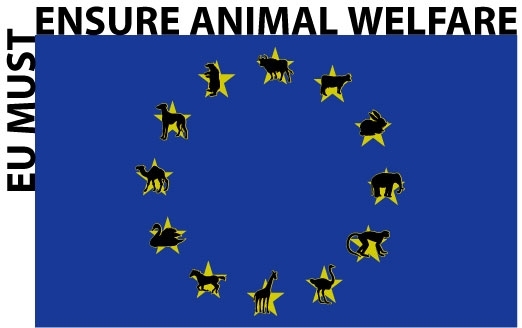
There are other policies that the Albanese government committed to, which will ensure animals are a key priority for the new parliament, including:
Full implementation of the national Animal Welfare Strategy to improve standards and review outdated systems that entrench suffering for pigs, chickens and other farmed animals.
Inclusion of animal welfare protections in international trade agreements.
Expansion of the trophy hunting import ban to cover more protected species.
We are eager to work with the re-elected government – and the overwhelmingly animal-friendly crossbench – to ensure these and other much-needed reforms for animals are realised.
We are so grateful to our friends at the Australian Alliance for Animals and Stop Live Exports for uniting with us to ensure as many people as possible understood what was at stake for animals this election. While in many ways, the ‘real’ work starts now, we could not have a stronger foundation upon which to build the reforms that animals need and deserve.
the day no animal is forced onto a live export ship. But today, we celebrate one of the most significant animal welfare reforms ever achieved globally.
Today, we celebrate a victory for compassion thanks to our supporters and everyone who kept animals front of mind at the ballot box.
We can now count down to 1 May 2028 with certainty – knowing from that day onwards not a single Australian sheep will set foot on a live export ship. While of course we wish this end date was much sooner, we also recognise the need to consider all who may be affected by this historic decision.
As the trade winds down, fewer Australian sheep will suffer at its hands. Since our very first investigation, the number of sheep exported live by sea each year has dropped by the millions – from 6 million annually, to less than 500,000.
Now, we can safely say that within three years, this number will be zero.
Animal farming rips apart the sacred bond between mother and baby; there’s nothing “humane” about it. Mother hens, cows, goats, turkeys, pigs, and sheep all care for their young and are fiercely protective of them, each in their own way. In animal farming, the mother’s desire and ability to protect and nurture her babies is robbed from her.
Mother birds exploited in the food industry—whether hens, turkeys, ducks, or geese—along with their babies, are all killed. In the wild, they stay in the nest to incubate their eggs, keeping them warm, and rarely leaving. Once hatched, the mother guides her chicks to food, alerts them of threats, and shields them from harm with her wings.
Whether in “free-range” or “cage-free” warehouses—marketing lies to keep consumers buying—or in cages, male chicks in the egg industry are killed because they don’t produce eggs, often by maceration. Their mothers are slaughtered too, while still young. Sexual violation, forcible impregnation, and the stealing of babies are done to virtually all female farmed animals, including birds, pigs, cows, goats, and sheep.
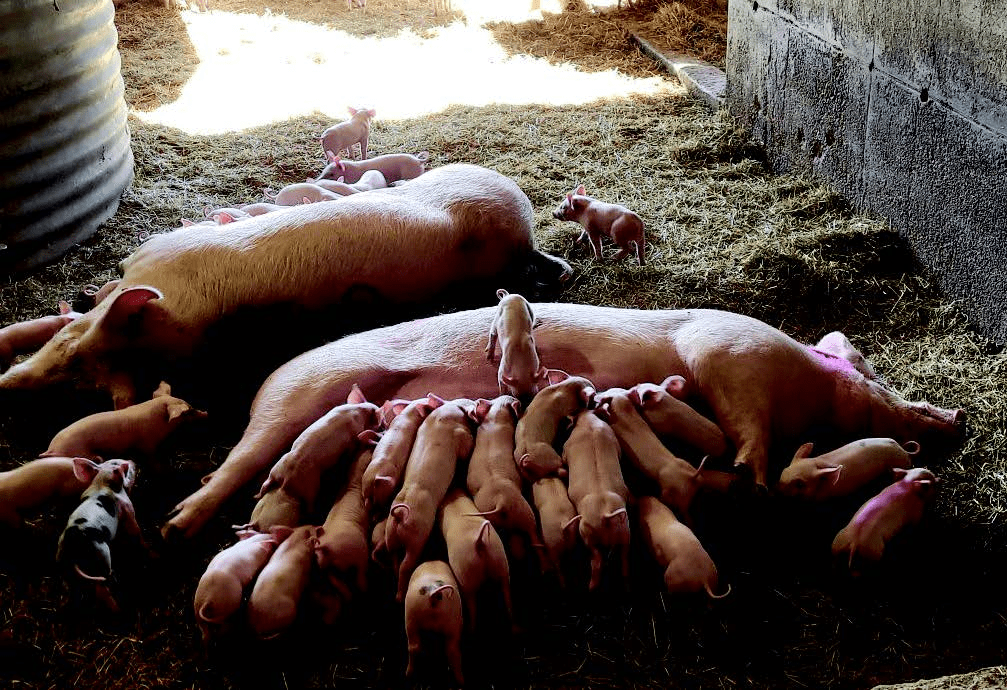
In nature, before giving birth, mother pigs also build nests to create a safe environment for their piglets and will often defend them aggressively. Yet pregnant mother pigs in animal farming are confined to tiny metal cages—called gestation or farrowing crates—barely larger than their bodies, often forcing them to lie in their own waste. After months of this torture, her piglets are taken from her shortly after birth. Then she’s forcibly impregnated again.
Cows, just like human mothers, carry their babies for nine months. When they give birth, they will lick and nuzzle their calves clean, stimulating circulation and bonding. The calves receive essential colostrum from their mother’s milk which helps strengthen their fragile immune systems.
But in the dairy industry, baby cows, goats, and sheep are taken from their mothers within a day or two so that humans can steal, consume, and profit from their milk. From the searing pain of branding and disbudding (burning off tender horns without painkillers) to the heartbreak of mother-baby separation, mothers are left physically wounded, exhausted, and grief-stricken.
Female calves are kept alone in tiny hutches for months, often in extreme weather, only to be forced into the same cycle—sometimes before they’re a year old. Male calves, deemed worthless because they don’t produce milk, are slaughtered.
It’s common to see mothers chasing after their stolen babies, left bellowing in desperation and anguish, often for days. This cruelty repeats until she collapses or stops producing enough milk for the ranchers. Then she’s frequently beaten or shocked to force her onto a truck to the slaughterhouse. Many animals are slaughtered, even skinned alive, while still conscious.
All this torment and killing repeats endlessly for unnecessary products we’re better off without. Better treatment or painless death doesn’t make exploitation ethical. We have no right to their bodies. Using and killing mothers, babies, or any animal for culture, taste, profit, or convenience is the opposite of compassion; no animal farming is “humane.”
We must speak up for all mothers and their babies—including those who are the most ignored, oppressed, and killed on the planet. Every one of them was once someone’s baby, and every mother loved them. Neither these babies nor their mothers deserved what was done to them.
In the dairy and egg industries, all male babies and their mothers are killed. Many people don’t realize that most animals slaughtered for food products are infants. Yet, Congress and the United States Department of Agriculture continue funneling billions in taxpayer dollars to support animal agribusiness. Demand that the U.S. government redirect subsidies away from this industry of cruelty and mass slaughter of mothers and their babies.
In the United States alone, over 2 million sheep are slaughtered annually, with the vast majority being lambs—babies. This number spikes during Easter, and the average age at slaughter is 6-8 month
Male calves in the dairy industry have little to no value to dairy farmers, as they don’t produce milk, and so they are killed. They’re either shot shortly after birth or sold to veal “farms,” where they’re confined alone in tiny crates for up to 16 weeks—essentially tortured—to prevent muscle development and keep their flesh tender. Some are used for “breeding” or eventually slaughtered to be turned into meat products.
Male baby goats, called “kids,”, and male lambs are also slaughtered in the goat and sheep milk industries. So are all their mothers. Male baby chicks in the egg industry are killed immediately after hatching, most often either tossed like garbage into giant blenders, shredded alive, or suffocated.
Though animal farming uses sanitized terms like “artificial insemination” and “breeding,” the young females are tightly restrained, and in dairy, the device used on female cows is often referred to as a “rape rack.” Forcible impregnation is done manually with a catheter, pipette, or, in the dairy industry, an entire arm—an extremely stressful and often painful experience. Farmers collect sperm from bulls, male goats, and male sheep through manual stimulation or using an electroejaculator.
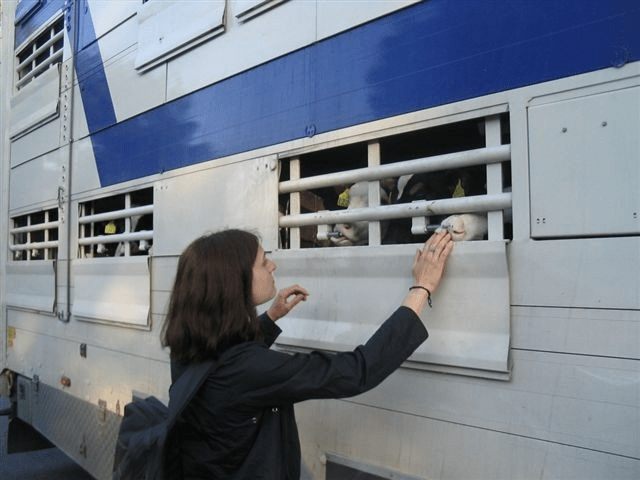
Pregnant mother pigs are caged in “farrowing crates,” often so small they can’t turn around for months on end. After her newborn piglets are taken away, the mother is forcibly impregnated again, trapped in an unrelenting cycle of solitary confinement and suffering. Though pigs can live up to 20 years, they are killed at just six months old. Like all farmed animals, they’re trucked without food or water for several days—often in extreme cold or heat—to the slaughterhouse, where they suffer even more in a terrifying death.
Animal agribusiness claims that “stunning” makes animals insensible to pain, but its actual purpose is to immobilize them so they can’t fight back. The most common method to “stun” pigs is in CO₂ gas chambers, where they feel everything, often screaming in agony and desperately fighting to escape. The industry calls this “controlled atmosphere stunning” and deems it “humane.” Many animals are still conscious while being slaughtered.
When mother cows can no longer produce enough milk to be profitable, they are slaughtered at around five years old. Their natural lifespan is up to 25 years.
Mother hens in the egg industry and mother turkeys in the poultry industry are killed at 1-2 years old. Their natural lifespans are up to ten years. Regardless, even if they were allowed longer lives before being forced into slaughterhouses, using and killing animals for unnecessary products—for tradition, taste, habit, or profit—is the epitome of unjust, cruel, and violent.
Despite evidence linking animal products to increased risks of heart disease, cancer, diabetes, and Alzheimer’s, the United States Department of Agriculture (USDA) continues to promote them in its dietary guidelines, while research shows that eliminating animal products can reduce these disease risks. Yet, in March 2025, the USDA allocated an additional $10 billion to bolster animal agribusiness. Where is government cost-cutting when it’s truly needed?
It’s time to end speciesism and for those in charge of our food system to stop the monstrous torment and killing of sensitive, feeling, defenseless animals. Call on Congress and the USDA to stop funding the horrors of animal agribusiness and redirect subsidies to support a slaughter-free, plant-based food system.
Chris Packham; known to all of us in the UK for his environmental knowledge and especially as a television wildlife campaigner; narrates a video for ‘Animal Aid’, of which he is a Patron, called ‘Killing Our Countryside’.
The film reveals the damage done to the British countryside and wildlife by the shooting industry’s mass release of tens of millions of pheasants and partridges for shooting ever year.
The film, and accompanying campaign, make the argument for a ban on the production and release of birds for shooting.
The film also reveals what many people have not seen; the method of raising these birds which are bred to die – simple as that !
Please write to/call the above contacts. They full well know what they are doing, and the social media backlash directed at them has been blocked (by them) on FB.
VICTORY: San Antonio agrees to stop hiding comments on government-run animal shelter’s Facebook page
From a report done after a site visit in 2022 – there were numerous issues even then:
Dog euthanasia area
Pre-euthanasia holding kennels.
The incinerator is situated next to a series of euthanasia holding kennels. Though I did not get to observe the entire euthanasia process, what I observed and learned from numerous staff members is that the dogs are driven in a Kubota or walked on a catch pole to the euthanasia holding kennels and once all are gathered for euthanasia, they are walked through the door into the euthanasia area where they are euthanised and then disposed of in the incinerator. I heard from multiple staff members that the dogs express anxiety and fear behaviours once in the pre-euthanasia kennels due to the smell of death from the euthanasia room that is just a few feet from the kennels.
Euthanasia room and process.
The euthanasia room itself was clean, though it did smell like dead bodies, likely from the cooler where some bodies are stored. The dogs are lifted onto a metal table and euthanized. When I asked a euthanasia supervisor why they are lifted up onto a table rather than the staff getting on the floor with them, he stated it’s hard for the staff to bend over that much so it’s easier on their bodies to euthanise them on the table. The table was steel with nothing on top of it.
.. for the mass murder of animals, basically worldwide, has become fashionable, and implies to uneducated readers that you’re actually doing the poor creatures a favour. That may be so, in VERY few cases, like Mark said with Turkey, “Dogs that are in pain, terminally ill or pose a heath risk would be euthanised“, but it is certainly not applicable to the young, and/or healthy. Done away with because they are considered surplus, unwanted etc.
Next thing we’ll hear is that animals are no longer slaughtered, but “euthanised”. Let’s be clear here: if you kill a human, even with the best intention in the world (terminally ill, extreme suffering, etc.) and call it “Euthanasia” – you are a murderer. End of.
Language is so important. Racism/Speciesim/the subjugation of women – it all started with the language. And when it comes to animals, the abuse (of language) clearly knows no bounds. But we’ll cover that in a separate post. Soon.
At a court trial in Northern England, which we have been following, like many other international environmentalists; two men have now now been found guilty of the felling of an iconic tree located along ‘Hadrians Wall’ https://en.wikipedia.org/wiki/Hadrian’s_Wall – the northern most frontier of the ancient Roman Empire.
The two environmental thugs, Daniel Graham – 39 years of age, and Adam Carruthers aged 32 years, both from Cumbria in Northern England; have been convicted in a trial at Newcastle Crown Court on two counts of criminal damage – and the two have been remanded in custody ‘for their own protection’ until they are sentenced on 15th July 2025.
The pair even filmed themselves on a mobile phone destroying this beautiful, iconic landmark – so the evidence was pretty clear for the jury, who reached a unanimous verdict after a short deliberation.
Mrs. Justice Lambert leading the trial informed the pair to be prepared for ‘lengthy’ custodial sentences.
The iconic tree, which had survived the harshness of life on the wall; and yes it can be very bleak there; for over 150 years, was destroyed by the pair within a matter of seconds.
Despite this mindless destruction, the base of the tree still exist and is being monitored and nurtured by specialists. The legacy is to grow 49 new trees from the remaining section of the tree.
This will be the positive shared with a global audience who were devastated by events.
Tokyo politician released photographs from inside an ‘euthanasia centre’
Images show the procedure is anything but humane as dogs are gassed
Lawmaker hopes to highlight Japan’s stray policy and encourage debate
Published: 16:53 BST, 25 November 2015 | Updated: 21:41 BST, 25 November 2015
The streets of Tokyo may be free of prowling dogs since its zero-stray policy came into effect but the laws come at a heavy price as one politician has revealed.
Ayaka Shiomura, a lawmaker in the Tokyo Metropolitan Assembly, recently went to visit an euthanasia centre in Japan and shown that the ‘dream box’ used to euthanise the country’s strays are anything but humane.
The excruciating procedure involves putting strays into a gas chamber where they are slowly suffocated with carbon dioxide and the whole process can last as long as 15 minutes, reported People’s Daily Online.
Ayaka Shiomura went to visit an unnamed facility, thought to be in Tokyo where the lawmaker is based, and posted about her experience on her website last month.
Euthanasia facilities like it are part of a zero-stray policy, which stipulates that all unclaimed cats and dogs must be euthanised in a set period of time according to Rocket News 24.
Shiomura explained in her introduction that any animals brought to the facility remains at the shelter for anywhere between three to seven days, depending on local policy.
After that time, if the animal is unclaimed, it will be disposed of.
During Shiomura’s visit, 10 dogs were to be euthanised. Of those, some were thought to be pets as they still had collars on.
The dogs were kept in a cage, which has a back door leading straight into the ‘dream box’ – a romantic name that had little to do with the stark reality of the gas chamber.
The staff at the facility never have to touch the animals as they generally wander in on their own accord.
Once inside, the chamber is locked down and a button is pressed to disperse carbon dioxide into the chamber.
Elisa Allen, Associate Director at PETA, told MailOnline: ‘Death by carbon dioxide or carbon monoxide can be extremely distressing and painful.
‘Cats often slam themselves against their cages, desperately trying to escape. Dogs howl, cry and claw at the metal walls of the chambers while they’re slowly poisoned.’
The cramped gas chamber is equipped with a glass window, which allows the operator to check the procedure is complete.
Through this window, Shiomura captured the final moments of the dogs’ gruesome death through suffocation.
Shiomura described that the dogs were ‘trembling’ before the procedure but this soon became ‘panting’ and eventually ‘collapsing’.
The chamber is gassed for 15 minutes to ensure the dogs are completely dead.
Finally, their remains are dumped into an incinerator to be disposed of.
According to news site TouTiao, Shiomura debated over whether to publish the post but felt that she needed to highlight the issue of animal culling.
She explained that in Japan, there’s around 170,000 stray dogs and cats that are euthanised in this way but the procedure is far from kind.
Shiomura hopes that more people in Japan would consider the consequences of buying a pet before making the purchase.
There are more humane ways to euthanise animals.
Elisa Allen informed MailOnline: ‘Animal shelters around the world condemn the use of such gases, choosing instead euthanasia (‘mercy killing’) by intravenous injection of sodium pentobarbital in the case of dogs, cats and animals of similar size, sometimes using other humane methods for smaller or larger animals.
‘When properly performed by caring, well-trained people – one who holds and comforts the animal and another who carefully injects the solution intravenously – euthanasia provides a painless, peaceful release.’
WAV is based in Kent, England; as well as having Diana in Germany.
Kent is known as the ‘gateway to Europe’ due to its location. It is a short hop over [or under] the English Channel to start your euro journey from France. Kent is a very historic county with masses of beautiful buildings and locations to visit. It is located directly South East of ‘Ol London town’ but the reality is once you get there, for example, down into the Weald; https://en.wikipedia.org/wiki/Weald which still has 23% of its area covered by woodland; the world here is utterly different to the madness mayhem that is London. And to think central London borders with Kent and is a mere 23 miles away !
KWT have a unique opportunity to create a wildlife rich landscape; where missing species can be resored to former farmland.
In the borough of Tunbridge Wells lies over 205 ACRES of land where hedgerows have eroded and the woodland edges are disappearing. Bordering Furnace Farm, an existing KWT reserve, Hoathly Farm has been intensively farmed for decades and no longer yields the returns needed to be viable without flooding the land with pollutants.
KWT HAVE UNTIL THE 24TH MAY 2025 TO SECURE THIS LAND AND RESTORE IT TO A BEAUTIFUL HAVEN FORE WILDLIFE AND WALKERS.
Can you help with a donation; no matter the size ?