
The referenced incident in 2023 in Italian:
https://www.parcoabruzzo.it/dettaglio.php?id=74362

Medieval Displays of Cruelty in Tuscany
The referenced incident in 2023 in Italian:
https://www.parcoabruzzo.it/dettaglio.php?id=74362
Medieval Displays of Cruelty in Tuscany
.. well worth a visit … even if you’re not living in the US.


Recent Article of Interest:

https://aldf.org/article/state-animal-protection-laws-ranked-oregon-is-1-north-dakota-50/
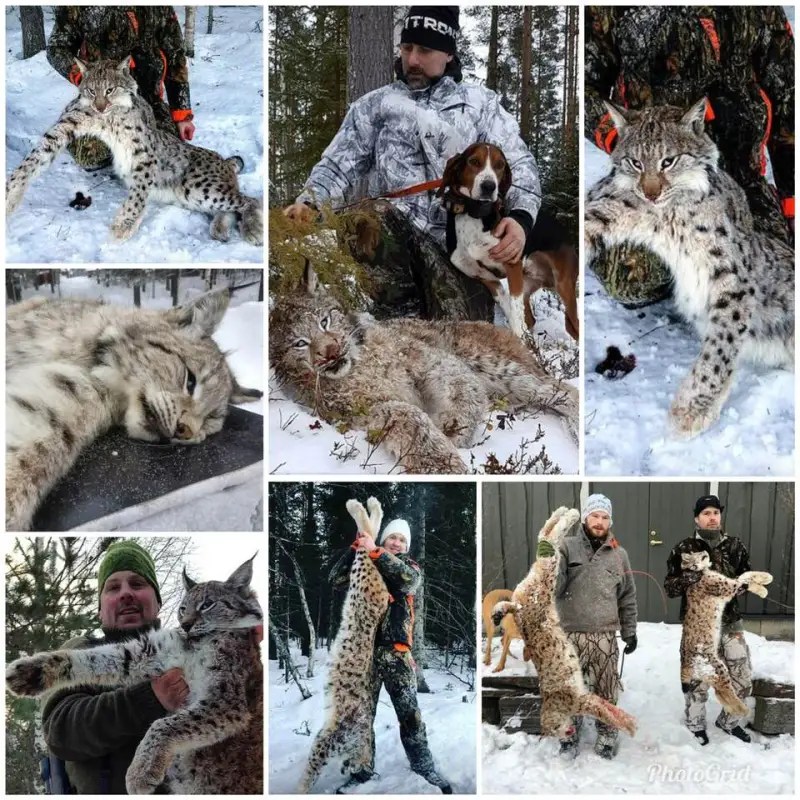
So, after already, this year, killing scores of Wolves, Sweden now takes aim at the country’s Lynxes.
This is what it looks like … it’s about “the excitement“, say the hunters. (comment Ed: let not me catch you do it, boys“)
Several Articles on the Issue:
https://swedenherald.com/article/over-80-lynxes-to-be-shot-the-hunt-begins-now
https://www.thepetitionsite.com/829/862/336/

Donald Trump Jr. has once again shown his reckless disregard for wildlife. This time, he has allegedly killed a protected bird in Italy’s Venice lagoon.
A video from his own hunting trip reportedly shows him (https://www.theguardian.com/world/2025/feb/04/donald-trump-jr-accused-of-killing-protected-bird-in-venice-lagoon) posing with the lifeless body of the rare ruddy shelduck bird, clearly flouting Italian and EU laws that criminally prohibit its killing.
We must not allow this flagrant act of wildlife destruction to go unanswered. Sign the petition to demand justice for Italy’s protected wildlife!
The ruddy shelduck is safeguarded under the EU Birds Directive and Italian law. That’s precisely because its population is at risk due to habitat destruction and climate change.
Yet Trump Jr., an avid trophy hunter, treated its death as nothing more than a spectacle. This was not a mistake – this was a crime. Hunting in Italy is strictly regulated, and if Trump Jr. illegally killed this protected species, he must face legal consequences just like anyone else.
No one is above the law – not even the son of a U.S. president. If Italy fails to act, it sends a dangerous message that wealthy foreigners can violate conservation laws with impunity. Italian authorities have already been urged to investigate, and we must amplify that demand.
We call on the Italian government to hold Donald Trump Jr. fully accountable under Italian law! Help us by signing the petition now!
REGARDS MARK
https://www.bbc.co.uk/news/articles/crezlw4y152o
“Italian” tomato purees sold by several UK supermarkets appear to contain tomatoes grown and picked in China using forced labour, the BBC has found.
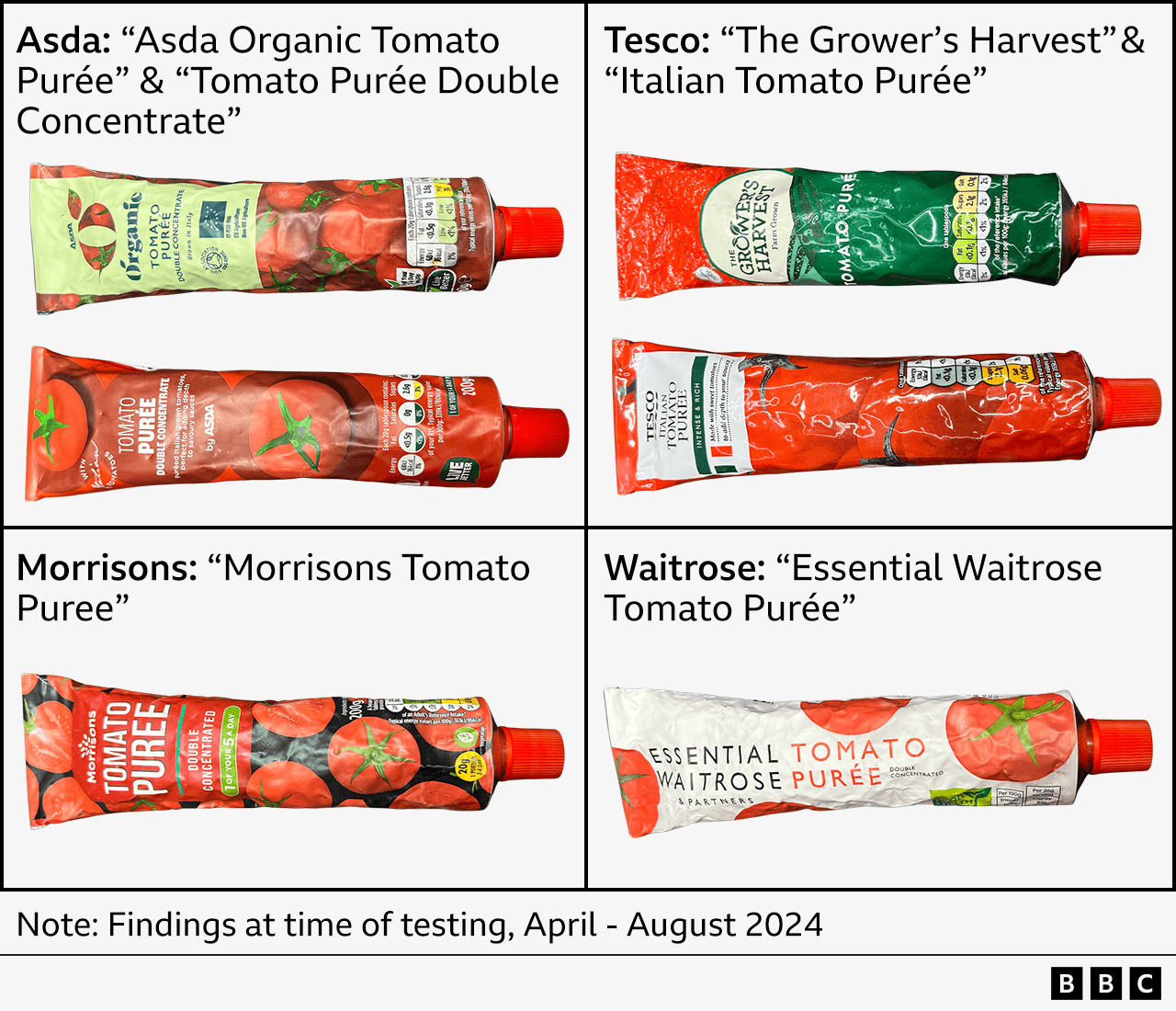
Some have “Italian” in their name such as Tesco’s “Italian Tomato Purée”. Others have “Italian” in their description, such as Asda’s double concentrate which says it contains “Puréed Italian grown tomatoes” – and Waitrose’s “Essential Tomato Purée”, describing itself as “Italian tomato puree”.
A total of 17 products, most of them own-brands sold in UK and German retailers, are likely to contain Chinese tomatoes – testing commissioned by the BBC World Service shows.
Most Chinese tomatoes come from the Xinjiang region, where their production is linked to forced labour by Uyghur and other largely Muslim minorities. The UN accuses the Chinese state – which views these minorities as a security risk – of torture and abuse. China denies it forces people to work in the tomato industry and says workers’ rights are protected by law. It says the UN report is based on “disinformation and lies”.
All the supermarkets whose products we tested dispute our findings.
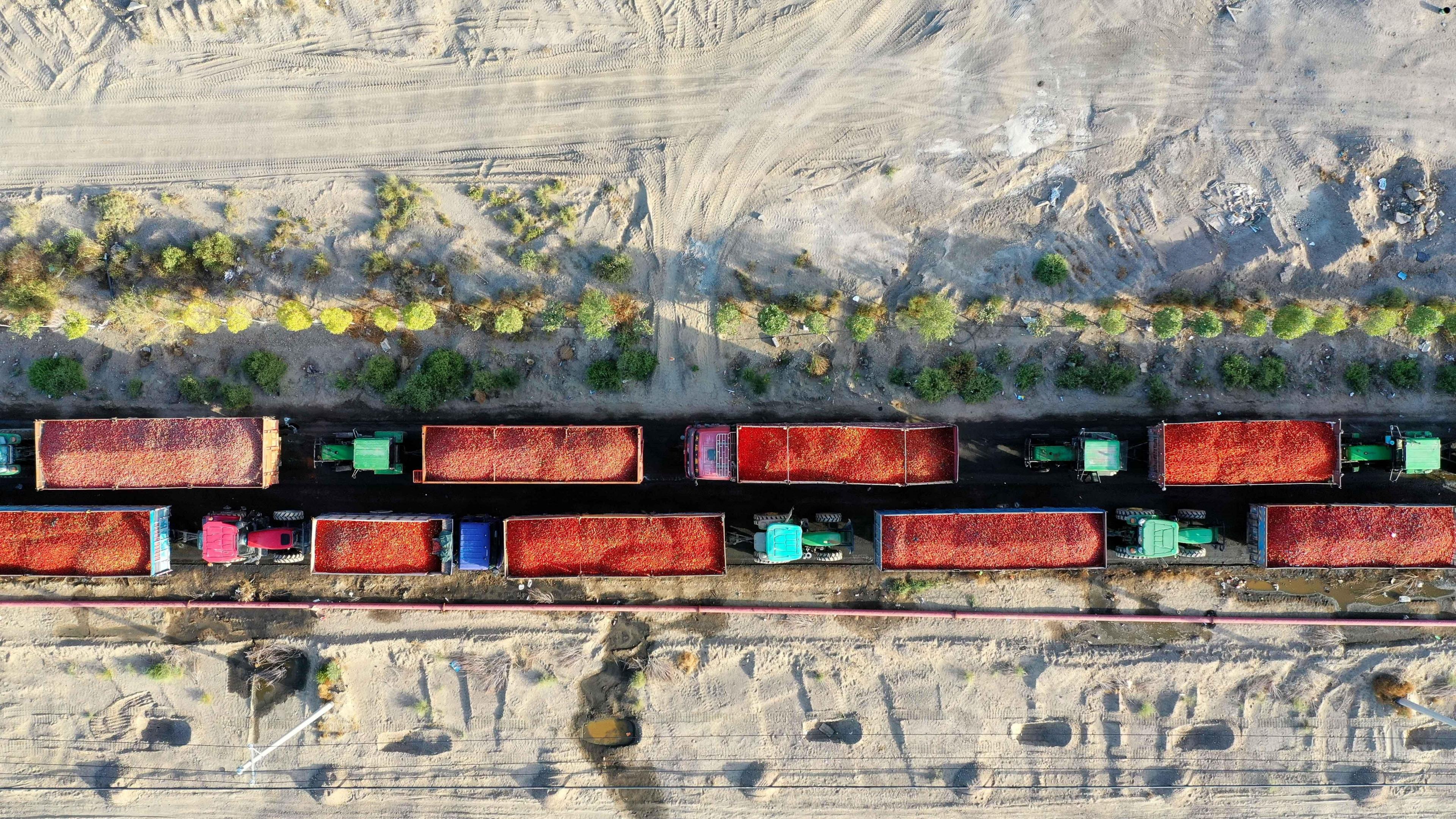
China grows about a third of the world’s tomatoes. The north-western region of Xinjiang has the perfect climate for growing the fruit.
It is also where China began a programme of mass detentions in 2017. Human rights groups allege more than a million Uyghurs have been detained in hundreds of facilities, which China has termed “re-education camps”.
The BBC has spoken to 14 people who say they endured or witnessed forced labour in Xinjiang’s tomato fields over the past 16 years. “[The prison authorities] told us the tomatoes would be exported overseas,” Ahmed (not his real name) said, adding that if the workers did not meet the quotas – as much as 650kg a day – they would be shocked with electric prods.
Mamutjan, a Uyghur teacher who was imprisoned in 2015 for an irregularity in his travel documentation, says he was beaten for failing to meet the high tomato quotas expected of him.
“In a dark prison cell, there were chains hanging from the ceiling. They hung me up there and said ‘Why can’t you finish the job?’ They beat my buttocks really hard, hit me in the ribs. I still have marks.”
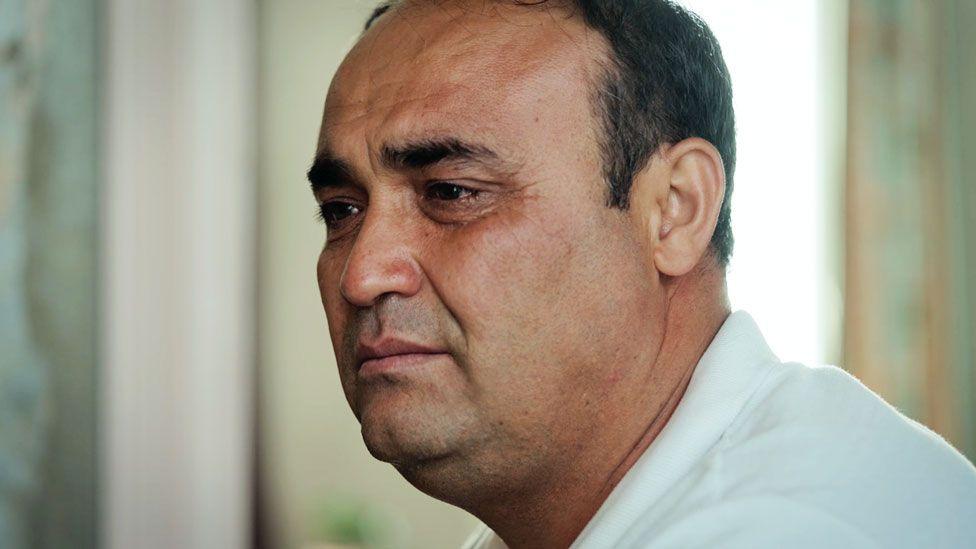
It is hard to verify these accounts, but they are consistent, and echo evidence in a 2022 UN report, external which reported torture and forced labour in detention centres in Xinjiang.
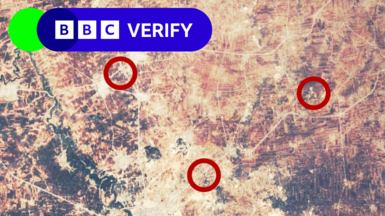
By piecing together shipping data from around the world, the BBC discovered how most Xinjiang tomatoes are transported into Europe – by train through Kazakhstan, Azerbaijan and into Georgia, from where they are shipped onwards to Italy.
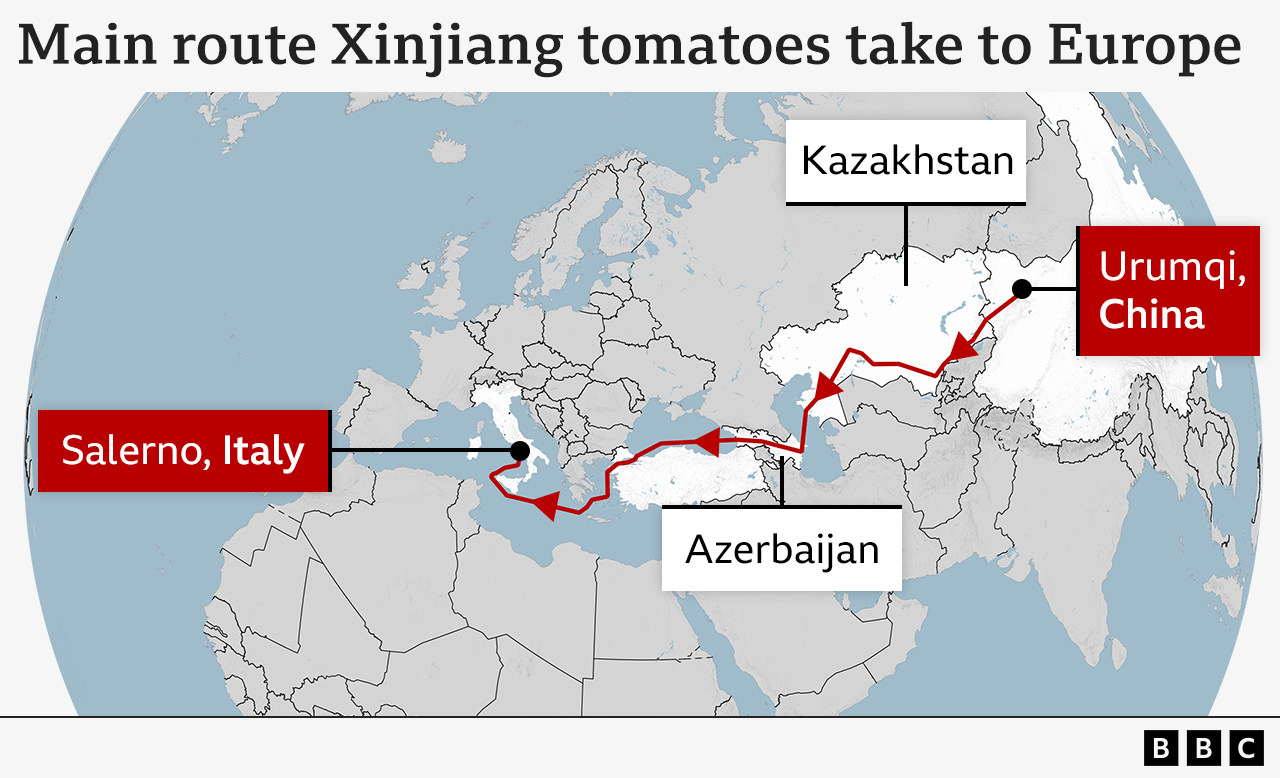
One company name repeatedly appeared as a recipient in the data. This was Antonio Petti, part of a group of major tomato-processing firms in Italy. It received more than 36 million kg of tomato paste from the company Xinjiang Guannong and its subsidiaries between 2020 and 2023, the data showed.
The Petti group produces tomato goods under its own name, but also supplies others to supermarkets across Europe who sell them as their own branded products.
Our investigation tested 64 different tomato purees sold in the UK, Germany and the US – comparing them in a lab to samples from China and Italy. They included top Italian brands and supermarket own-brands, and many were produced by Petti.
We asked Source Certain, a world-renowned origin verification firm based in Australia, to investigate whether the origin claims on the purees’ labels were accurate. The company began by building what its CEO Cameron Scadding calls a “fingerprint” which is unique to a country of origin – analysing the trace elements which the tomatoes absorb from local water and rocks.
“The first objective for us was to establish what the underlying trace element profile would look like for China, and [what] a likely profile would look like for Italy. We found they were very distinct,” he said.
Source Certain then compared those country profiles with the 64 tomato purees we wanted to test – the majority of which claimed to contain Italian tomatoes or gave the impression they did – and a few which did not make any origin claim.
The lab results suggested many of these products did indeed contain Italian tomatoes – including all those sold in the US, top Italian brands including Mutti and Napolina, and some German and UK supermarket own-brands, including those sold by Sainsbury’s and Marks & Spencer.
But 17 appeared to contain Chinese tomatoes, 10 of which are made by Petti – the Italian company we found listed repeatedly in international shipping records.
Of those 10 made by Petti, these were for sale in UK supermarkets at the time of testing from April-August 2024:
These were for sale in German supermarkets, during our testing period:
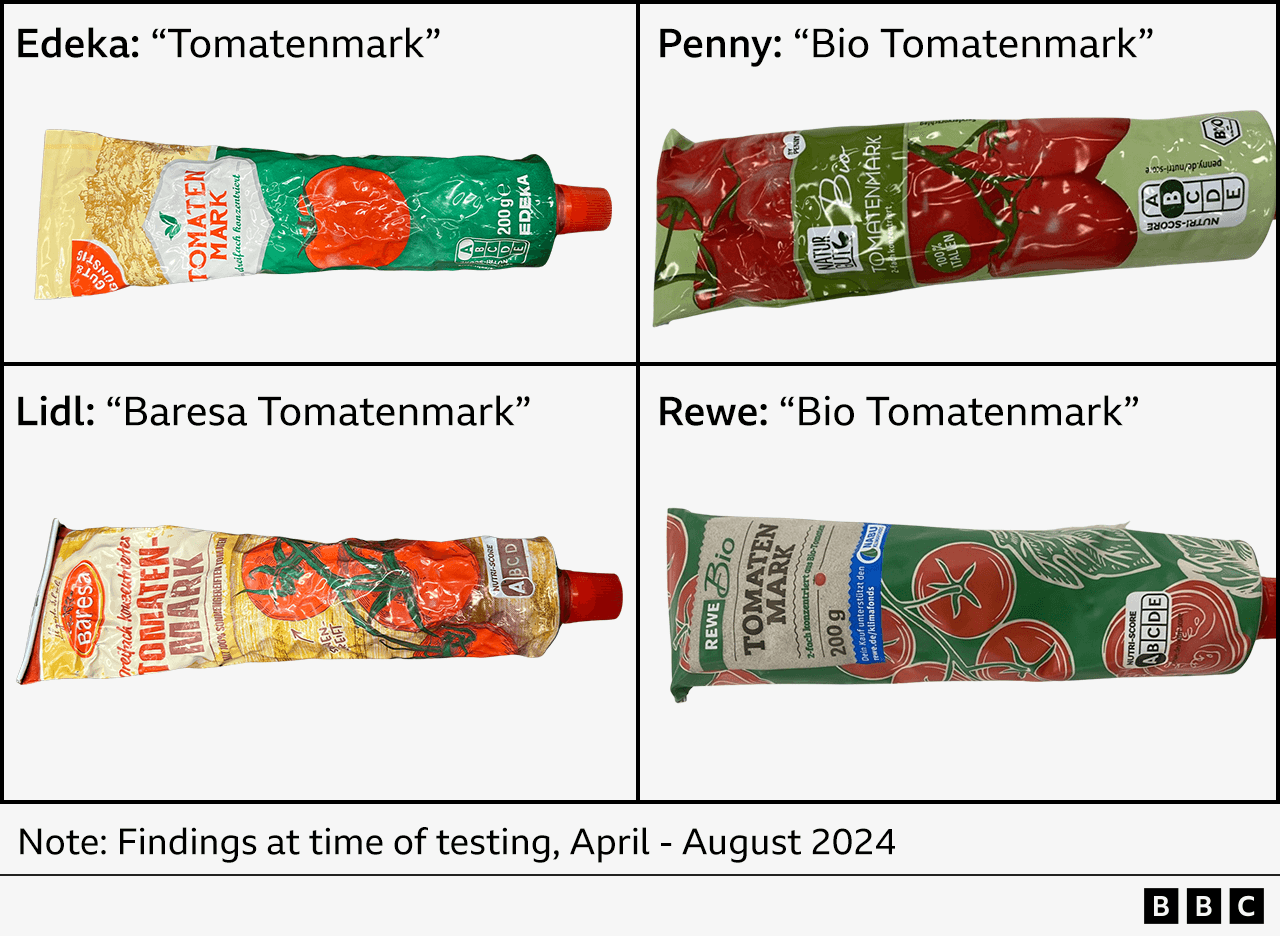
In response, all the supermarkets said they took these allegations very seriously and have carried out internal investigations which found no evidence of Chinese tomatoes. Many have also disputed the testing methodology used by our experts. Tesco suspended supply and Rewe immediately withdrew the products. Waitrose, Morrisons, Edeka and Rewe said they had run their own tests, and that the results contradicted ours and did not show the presence of Chinese tomatoes in the products.
But one major retailer has admitted to using Chinese tomatoes. Lidl told us they were in another version of its Baresa Tomatenmark – made by the Italian supplier Giaguaro – sold in Germany last year “for a short time” because of supply problems and that they are investigating this. Giaguaro said all its suppliers respected workers’ rights and it is currently not using Chinese tomatoes in Lidl products. The BBC understands the tomatoes were supplied by the Xinjiang company Cofco Tunhe, which the US sanctioned in December last year for forced labour.
In 2021, one of the Petti group’s factories was raided by the Italian military police on suspicion of fraud – it was reported by the Italian press that Chinese and other foreign tomatoes were passed off as Italian.
But a year after the raid, the case was settled out of court. Petti denied the allegations about Chinese tomatoes and the issue was dropped.
As part of our investigation into Petti, a BBC undercover reporter posed as a businessman wanting to place a large order with the firm. Invited to tour a company factory in Tuscany by Pasquale Petti, the General Manager of Italian Food, part of the Petti group, our reporter asked him if Petti used Chinese tomatoes.
“Yes… In Europe no-one wants Chinese tomatoes. But if for you it’s OK, we will find a way to produce the best price possible, even using Chinese tomatoes,” he said.
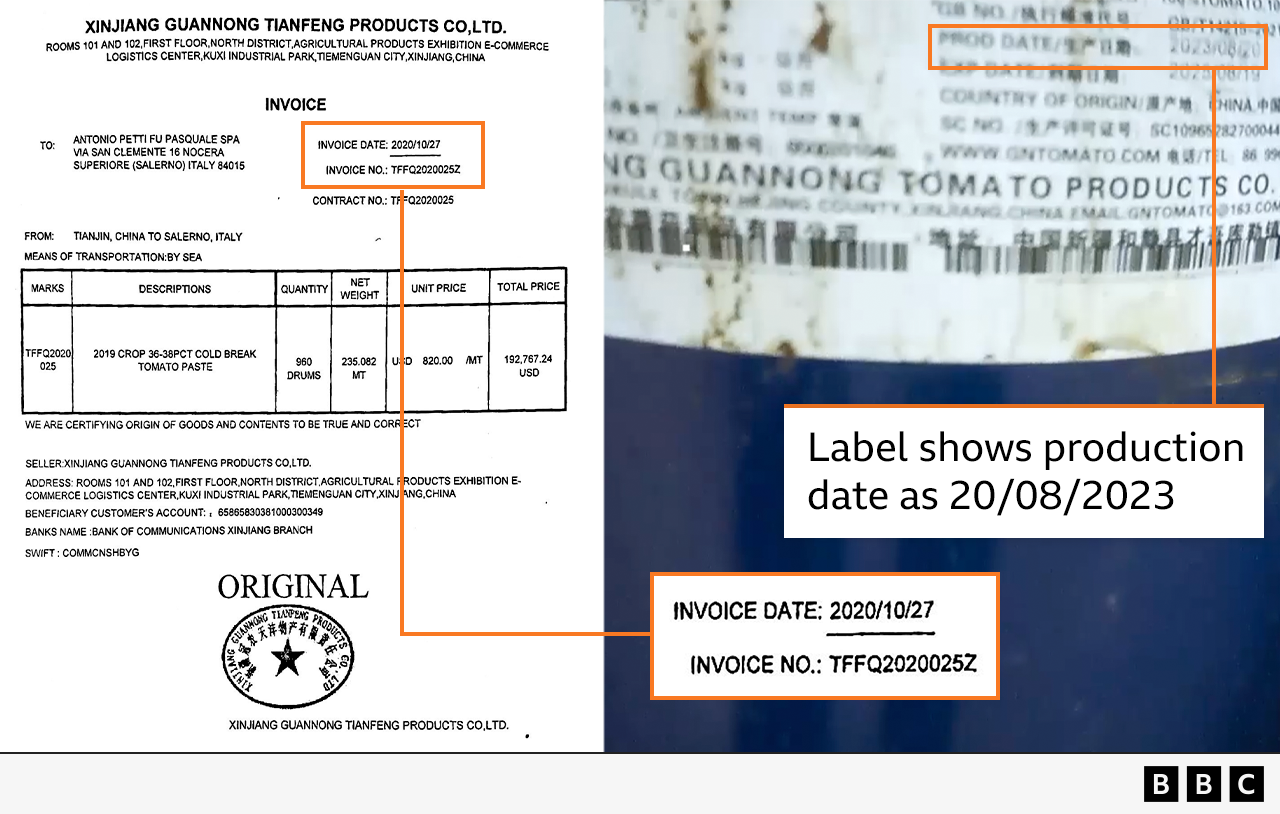
The reporter’s undercover camera also captured a crucial detail – a dozen blue barrels of tomato paste lined up inside the factory. A label visible on one of them read: “Xinjiang Guannong Tomato Products Co Ltd, prod date 2023-08-20.”
In its response to our investigation, the Petti group told us it had not bought from Xinjiang Guannong since that company was sanctioned by the US for using forced labour in 2020, but did say that it had regularly purchased tomato paste from a Chinese company called Bazhou Red Fruit.
This firm “did not engage in forced labour”, Petti told us. However our investigation has found that Bazhou Red Fruit shares a phone number with Xinjiang Guannong, and other evidence, including shipping data analysis, suggests that Bazhou is its shell company.
Petti added that: “In future we will not import tomato products from China and will enhance our monitoring of suppliers to ensure compliance with human and workers’ rights.”
While the US has introduced strict legislation to ban all Xinjiang exports, Europe and the UK take a softer approach, allowing companies simply to self-regulate to ensure forced labour is not used in supply chains.
This is now set to change in the EU, which has committed to stronger laws, says Chloe Cranston, from the NGO Anti-Slavery International. But she warns this will make it even more likely that the UK will become “a dumping ground” for forced labour products.
Panorama: What’s on Your Supermarket Shelves? The Dark Side of the Tomato Trade
Tomatoes are a store cupboard staple for many of us, but can we trust what we’re eating? The BBC investigates what’s in the tomato purees we buy to make pizzas, pasta sauces and much more besides.
Watch on iPlayerListen on Sounds
Watch now on iPlayer or on BBC One at 20:00 on Monday 2 December (22:40 in Northern Ireland, 23:10 in Wales)
Outside the UK, watch the Eye Investigations documentary Blood on the Shelves on YouTube, external
“The UK Modern Slavery Act, sadly, is utterly not fit for purpose,” she says.
A spokesperson for the UK Department for Business and Trade told us: “We are clear that no company in the UK should have forced labour in its supply chain… We keep our approach to how the UK can best tackle forced labour and environmental harms in supply chains under continual review and work internationally to enhance global labour standards.”
The issue was brought up in the UK Parliament on Monday, where the Parliamentary Under-Secretary of State for Environment, Food and Rural Affairs (Defra) said it was “extremely concerning”.
Baroness Hayman of Ullock told the House of Lords that the department was “looking at labelling as a way to better inform consumers”.
Dario Dongo, journalist and food lawyer, says the findings expose a wider problem – “the true cost of food”.
“So when we see [a] low price we have to question ourselves. What is behind that? What is the true cost of this product? Who is paying for that?”

NOT REALLY ITALIAN THEN
China – YES WE COULD DO WITHOUT IT !
He realised the only thing I couldn’t say no to was giving all the money away to animal rights organisations. The irony is the only way to get me on tour is to make sure I don’t make a penny from it.
Moby’s passion for animal rights is no secret as the star has even brand himself with his beliefs through tattoos.
His boldest are two arm tattoos which he debuted in 2019 and read ‘Animal Rights’, one word on each arm in thick black ink.

Regards Mark
Metro – London

27 September 2024
Four Paws


All across Europe, billions of animals endure unimaginable suffering every day, as current EU laws continue to fall short in providing them the protection they desperately need. NGOs Eurogroup for Animals and FOUR PAWS have teamed up to host the photo exhibition Silent Suffering which will expose the pain and distress endured by farmed, companion, wild, and aquatic animals.
The invite-only event will take place on 1 October at the Royal Library of Belgium in Brussels, bringing together MEPs and representatives of animal protection organisations from across Europe.
The photos, put forward by Eurogroup for Animals’ member and partner organisations are spread across nine categories: cage farming, transport, broiler chickens, aquatics, fur farming, animals in science, large carnivores, pets, and trade.
Why this exhibition matters now
As the European Commission prepares to enter a new term, FOUR PAWS and Eurogroup for Animals call for animal welfare to be a priority, and for a revision of the outdated animal welfare legislation to be put forward without further delay.
Regards Mark
Regards Mark
Photo – East Kent Sabs.

The bearskin hats worn by soldiers outside Buckingham Palace now cost more than £2,000 each, new figures show.
Animal rights activists trying to get real fur out of the bearskin caps worn by King’s Guards took aim at the cost of the ceremonial garb.
The price of the caps soared 30% in a year to more than £2,000 pounds apiece for the hats made of black bear fur, the Ministry of Defense said in response to a freedom of information request by People for the Ethical Treatment of Animals (PETA).
Peta anger over soaring cost of bearskin caps worn by King’s Guard outside Buckingham Palace

Regards Mark
 World Animals Voice