Extreme violence and neglect uncovered on a UK dairy farm
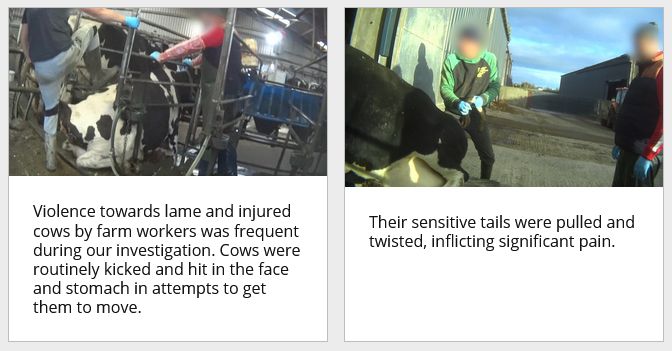
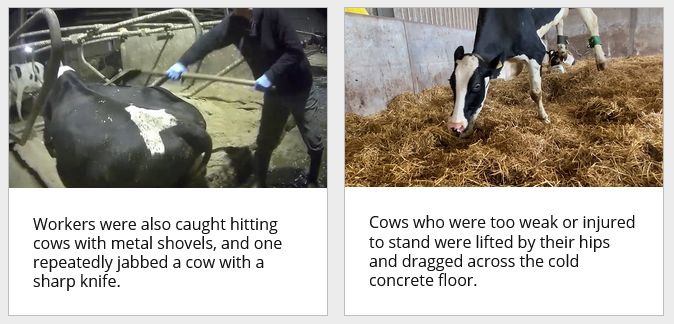
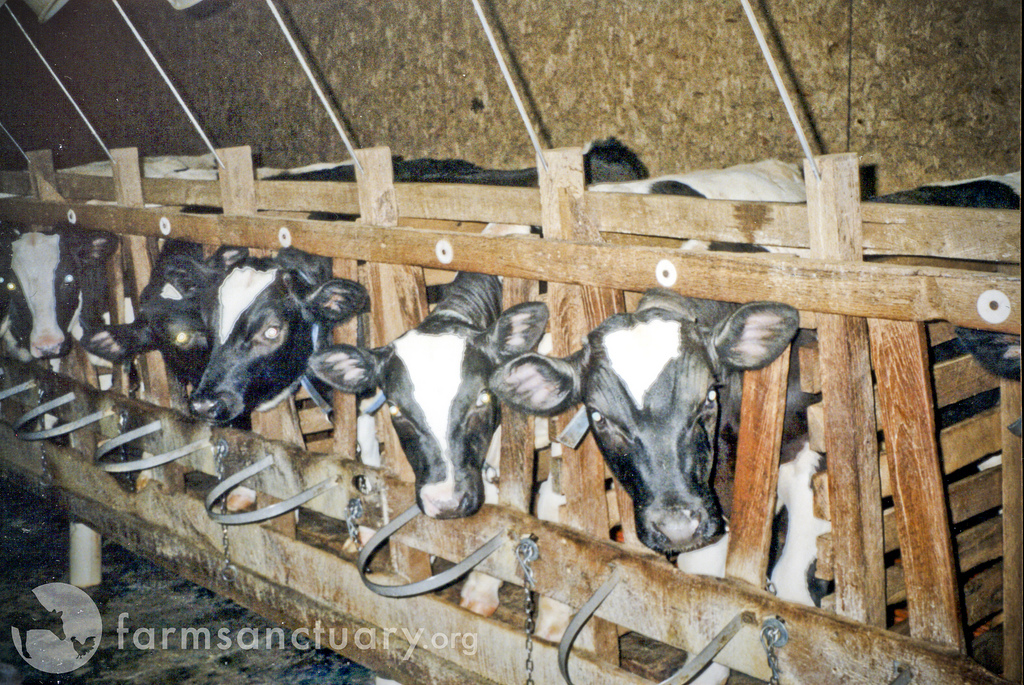
Covert filming by an Animal Equality investigator has revealed disturbing undercover footage of deliberate violence and neglect on Madox Farm, a large dairy farm in Carmarthenshire, South Wales. The troubling scenes include workers kicking and punching cows in the face and stomach, and hitting them with metal shovels. The footage was broadcast to millions of people on BBC One’s Panorama. Milk from the farm is supplied to Freshways, the UK’s largest independent dairy processor and wholesaler. Freshways distributes dairy products to established retailers and businesses including Costa Coffee, British Airways, Londis, Budgens and P&O Cruises.
The True Cost of Milk: Our Footage On BBC Panorama
15/02/2022
Madox Farm: What We Found
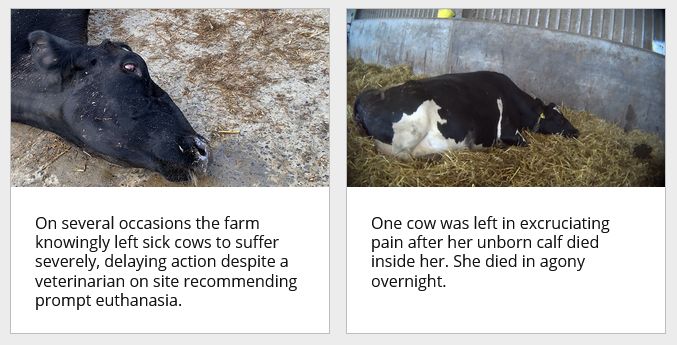
Animal Equality’s investigator worked undercover on Madox Farm for several months and documented troubling scenes of abuse and neglect, including a number of serious legal violations.
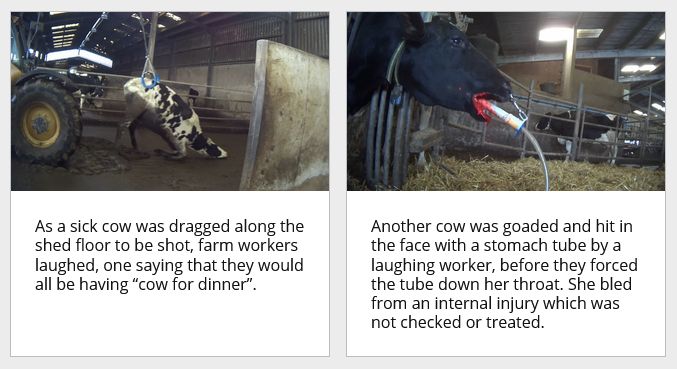
The footage reveals workers punching and kicking cows in the face and stomach, as well as hitting them with sharp, metal shovels. It also shows cows unable to stand being hoisted by their hips with a lift and dragged against the cold concrete floor.
But that’s not all that our cameras documented. Listed below are the main problems we found on the farm, which unfortunately are widespread in the dairy industry. …….
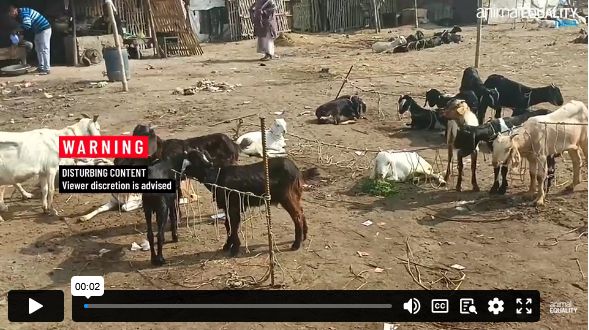
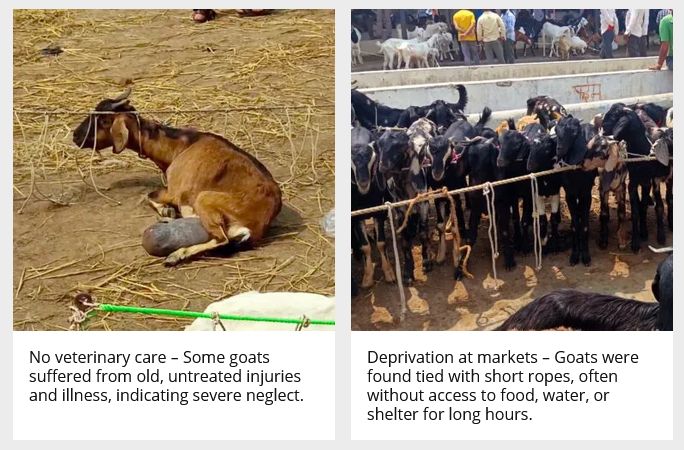
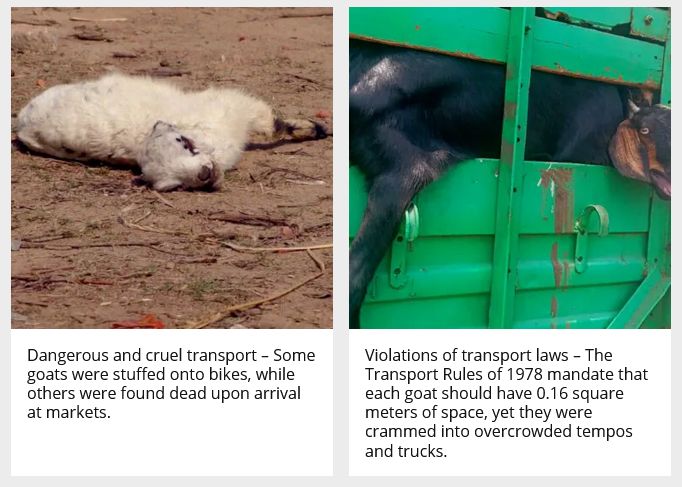
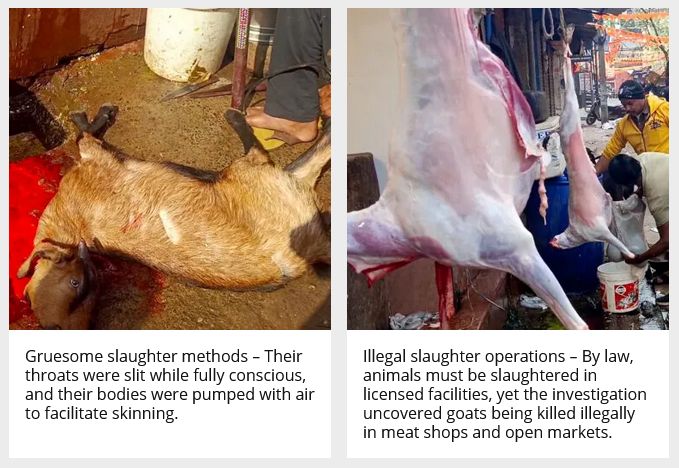
A groundbreaking investigation by Animal Equality has exposed widespread cruelty and blatant illegalities in the goat meat industry across Maharashtra, Uttar Pradesh, Jharkhand and Bihar. The organization documented horrific conditions in 7 farms, 5 markets, and 4 slaughter facilities, revealing the appalling suffering inflicted on goats at every stage of their lives.
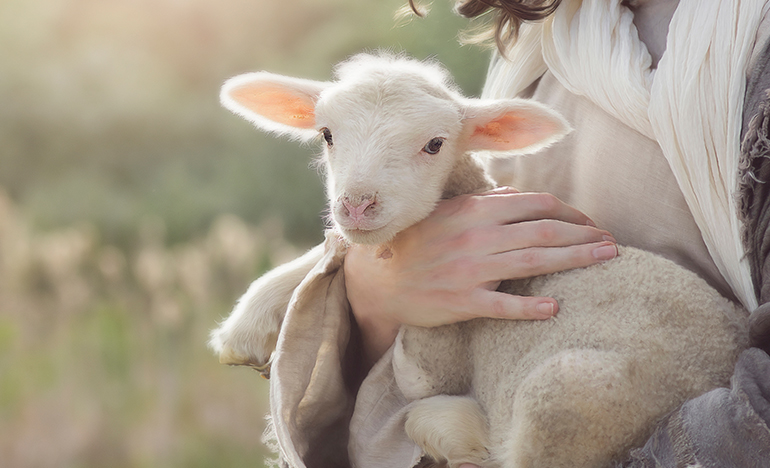
Every year again we witness the impossible, in Christian countries, the result of a Faith gone utterly wrong. The lamb, the very symbol of Innocence and of Jesus Christ, being subjected to a level of cruelty, and in huge numbers, that defies understanding.
After all …
So much for wishful thinking, and quite possibly the Lord’s own thoughts on the issue, and man’s relationship with these defenceless creatures, and indeed all of the Animal Kingdom.
And THIS is the reality … year after year after year.
Investigation documents cruelty at UK sheep slaughterhouse
November 4, 2019 Updated: January 20, 2025
Animal Equality UK has released a new investigation filmed inside a sheep slaughterhouse. The disturbing recordings, filmed during July and August 2019 at Farmers Fresh Wales slaughterhouse in Wrexham, North Wales, detail unimaginable cruelty and immense suffering. Farmers Fresh Wales supplies customers in London and across the Midlands, as well as continental Europe. …..
Instead of sitting down to a family dinner over the holidays, Animal Equality investigators were on the road, documenting the suffering of lambs transported from Eastern Europe to Italy for slaughter.
Every Christmas and Easter, Animal Equality documents the long and difficult journeys that lambs undergo from Eastern Europe to Italian slaughterhouses. These lambs, many only weeks old, end up on the tables of millions of Italians during the holidays.
Transport: The Investigators’ Daily Journal
Although the transport trucks tend to follow predictable routes, it’s not always easy to map their movements. We located and followed some trucks, being careful not to lose them while we gathered as much information as possible.
Shocking cruelty in lamb industry revealed once again
Animal Equality launches it’s ‘Save a Lamb’ campaign with a video that shows the cruelty lambs suffer in modern farms and slaughterhouses.
March 23, 2015 Updated: February 24, 2025
International – Through the release of a new video showing the life of a lamb in 60 seconds, Animal Equality launched on Saturday, March 22nd it’s 2015 ‘Save a Lamb’ campaign.
(watch Video on Page)
The video was filmed entirely by Animal Equality undercover investigators in farms and slaughterhouses in Italy. The practices shown in the footage are standard and common practice in the meat industry. ….
Underwater factory farms are one of the biggest causes of suffering on the planet. Forcing billions of fishes to spend their lives swimming in endless circles in cages before suffering inhumane and painful deaths. We call on the European Commission to include the protection of fish welfare among the priority objectives of the revision of the EU legislation on animal welfare.
The new investigation
A new investigation by Essere Animali reveals the shortcomings of the current European Union legislation on animal welfare, which clearly fails to guarantee the protection of farmed fish. The shocking images filmed during the investigation — which was conducted at several trout farms as well as a few sea bass and sea bream farms — reveal farming, transport and slaughter practices that cause enormous suffering to the animals.
By releasing this investigation, Essere Animali joins and relaunches the Compassion in World Farming campaign, aimed at asking the European Commission to include the protection of fish welfare among the priority objectives of the revision of the EU legislation on animal welfare.
From cage to fur farming and fish welfare, key animal welfare concerns are being addressed very differently across the EU’s 27 Member States.
In this report, we break down the steps that different countries in the EU are taking on a range of animal welfare issues – or lack thereof. The stark differences in their approaches highlights the critical need for the EU to publish its long-awaited revision to the animal welfare legislation, which has not been updated for decades, and which is not sufficiently protecting the wellbeing of animals across Europe.
Only by modernising and strengthening these laws will the EU be able to effectively harmonise the approaches of all Member States to animal welfare: improving the lives of billions of sentient beings, easing compliance for farmers, ensuring fair competition, and aligning agriculture with its sustainability and resilience goals.
Translation of above text: An excerpt from a biased article in late 2016 about the adequacy of the conditions in the live transports (since then, countless horrors have been documented, all of which turn out to be adequate):
“The issue of animal cruelty is very important to the Ministry of Agriculture and to me personally,” Uri Ariel clarified. “We decided to conduct a surprise inspection of a shipment of calves arriving in Israel, in order to see the reality up close. The conditions on the ship were adequate.”
According to him, the professionals in veterinary services are doing a sacred job to reduce harm to animals, “We are constantly examining new ways to see what else can be done to reduce harm to animals imported into Israel.”
“Animal cruelty is a well-known prohibition in Judaism, an example of which is the rule ‘You shall not muzzle an ox,’ which was already written in the Torah thousands of years ago. Judaism taught humanity not to harm animals, and we as a country see this as a moral and professional obligation,” emphasized the Minister of Agriculture.
Well, where did it all start with me and that wonderful world of animals; defending and speaking for their rights; Veggie and veganism, and yes, the darker world of cruelty investigation work.
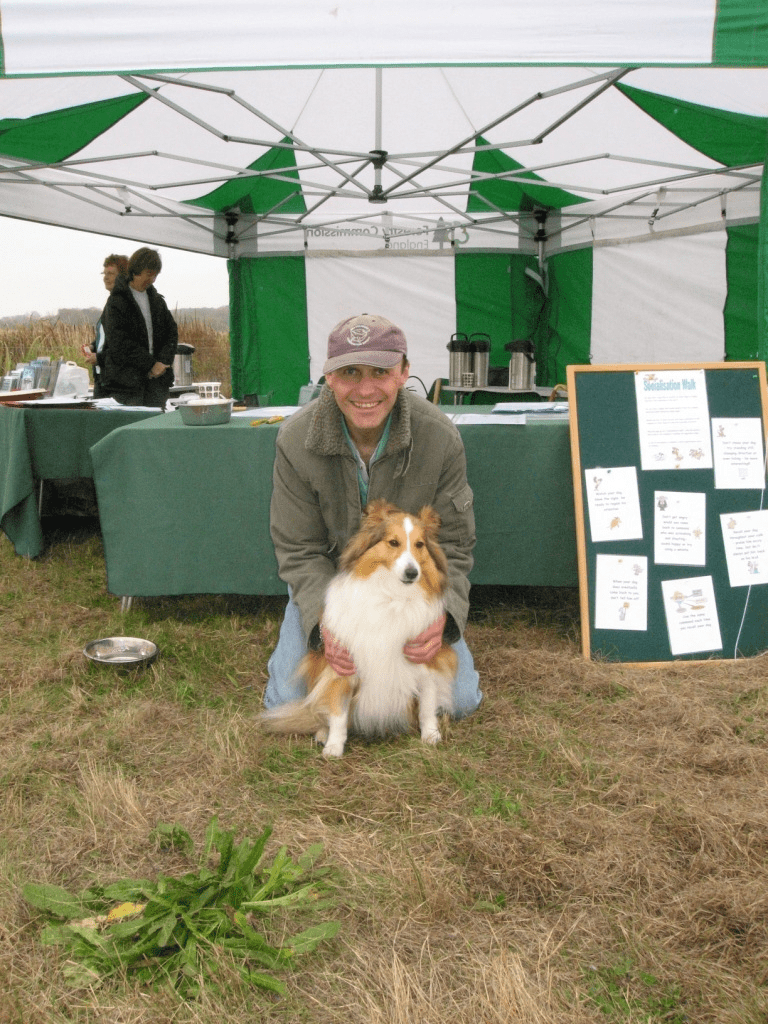
When I was a young lad; aged 8 years, I had owned my own dog for about 3 years – a beautiful Shetland Sheepdog (see picture) named ‘Sheba’. She was a gift from my parents; and having her taught me primarily respect for other living things, as well as taking responsibility for ensuring she was at her best at all times, fed, kept safe and illness free, and loved incredibly.
I was also a bit of a Deisel head even at that age – trucks were my thing, and every weekend I was out on my bike witnessing all the heavy freight heading down to Dover (a major port in SE England) ready for their mass departure from Calais (France) at Sunday midnight which allowed the start of another working week for British hauliers in mainland Europe. In France in those days (70’s), they were banned from roads at weekends; unlike the UK.
I lived near to a major road route down to the Kent Channel ports; and for a young boy, it was heaven; trucks from all over the UK heading down to Dover all day every Sunday. Then, one Sunday ‘it’ happened. My world changed and has never been the same since.
In those days, Transport Ministry inspectors often secured a lay by near to my home, where they (with the police) would pull over heavy freight to ensure they were compliant with paperwork, road taxes and all the necessary for their trip across the Channel and a new working week in Europe.
As I say, I was 8 years old, but I spent many hours up close and dirty as the heavy freight was pulled over by the police so that the Ministry men could undertake their checks. Scania’s were, and still are, my favourite; https://youtu.be/1lBoP0Qwaeg – that sound !!
Anyway, one Sunday it was raining a bit, but I was still out; (school all week so you needed something interesting !) watching the big rigs get pulled over. I watched a lot, and enjoyed massively; friendly truckers always willing to give me a wave, or better still, a blast from their air horns. And then; out of the blue, the police decided to pull over something which I had never experienced before – a livestock transporter.
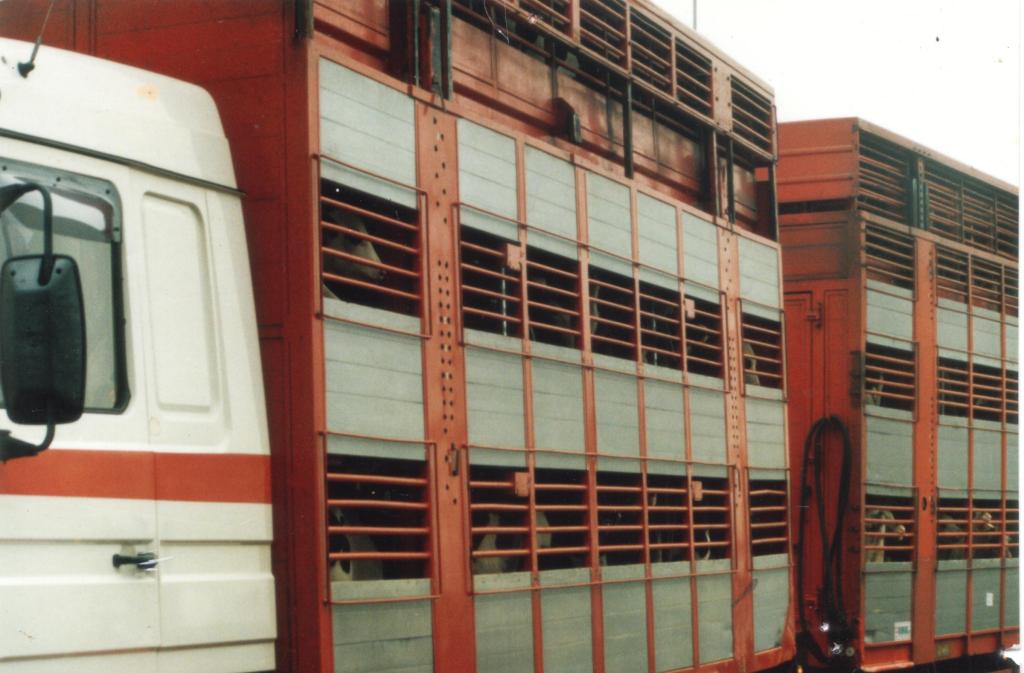
I went over towards it as it stayed at the checkpoint; but immediately there was something different. It was stacked high with live sheep. In those days, it was legal for livestock trailers to not have to be fitted with an upper deck roof; hence the poor unfortunates on the top deck continually suffered throughout the journey in the wind and full exposure to any driving rain. I could also see through lower deck slats at those cramped together and suffering at lower levels; packed in like sardines in a tin. I knew immediately that what I was witnessing was wrong; simple; animals should not suffer or be suffering as they did. After a while the transporter must have been given the all clear, and it lumbered back onto the highway destined for the port (Dover) and a final destination somewhere in Europe where ‘something would be done’ to the sheep. I knew nothing about it or them, but I knew that it (what I had witnessed) was wrong. No ‘if’s’ or ‘buts’.
So that Sunday afternoon, saddened and shocked that this was being allowed; I headed back home on my bike; but, that same afternoon I made myself a simple promise; that if and when I got older to a point that someday I would be a voice for those suffering animals and all others being transported; then I would be !
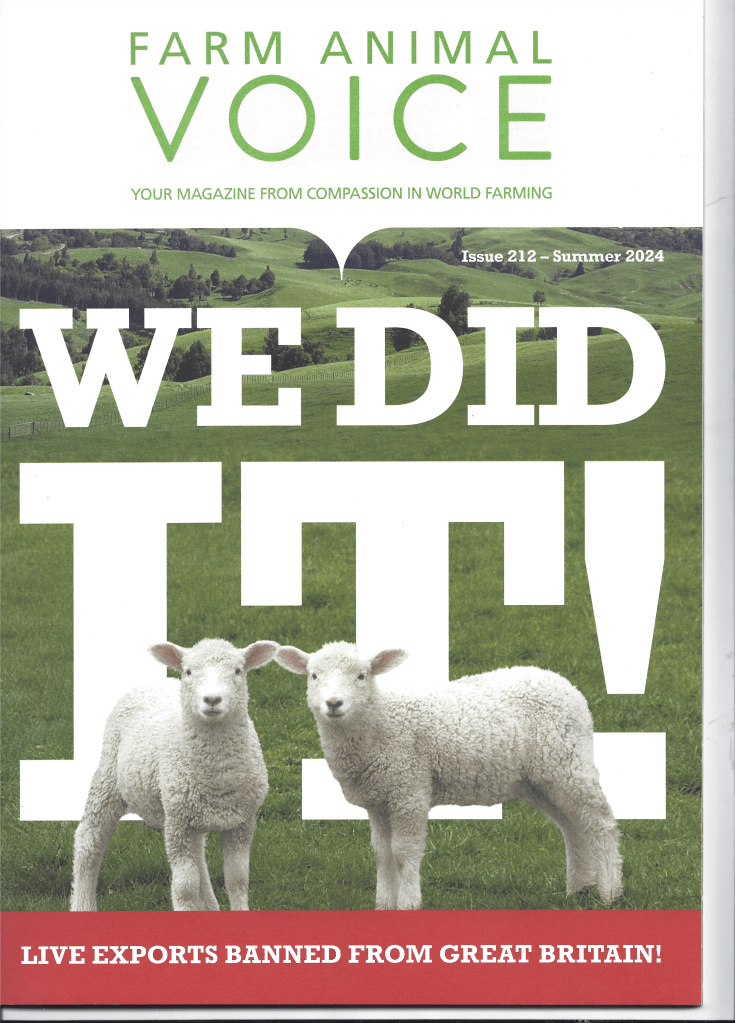
Cut to Summer 2024; finally my dream of ‘that kid’ aged 8 years, of doing something; and the resultant live export ban on all British farm animals from the UK to overseas destinations became a reality. But, there had been a great deal of work in between.
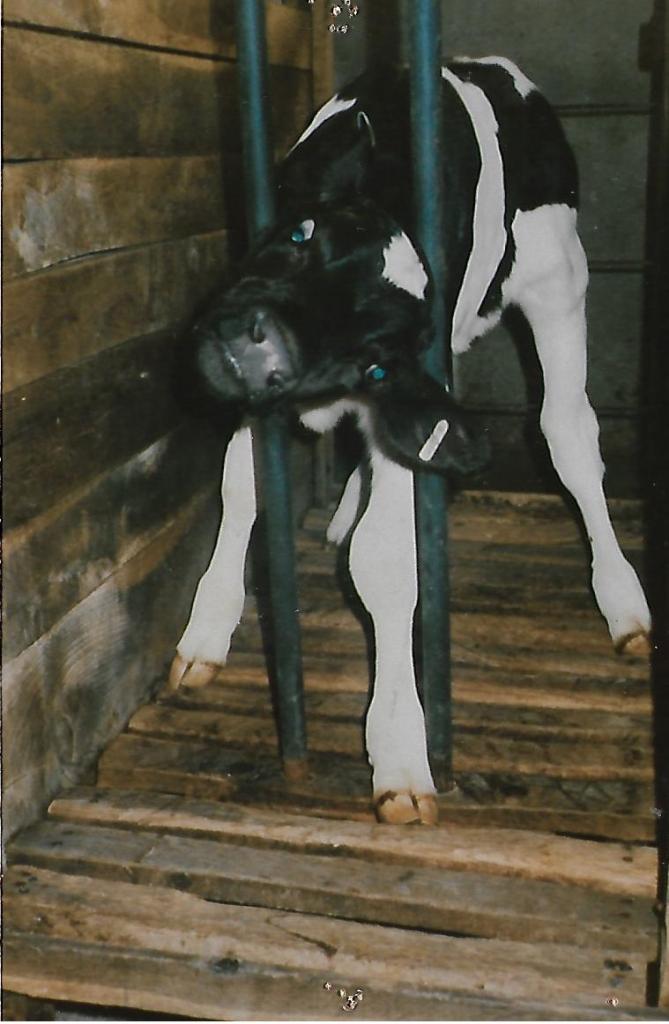
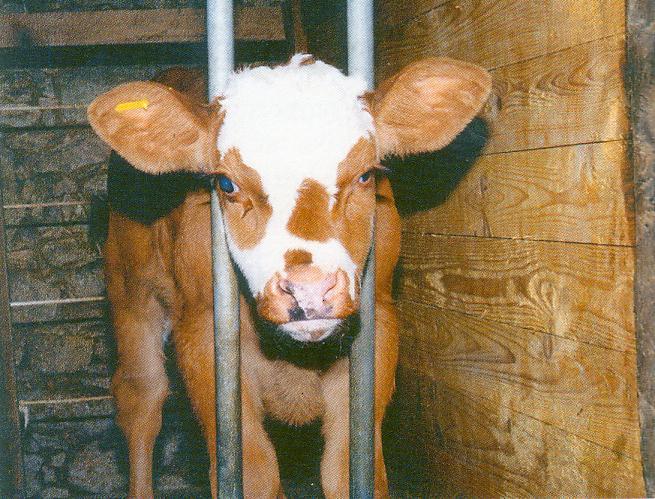
I really got deeply involved again when I was around 18 years old; I could drive, had my own car and had started a pretty stable job working as a trainee Technical Author in Military Aerospace Flight Controls; Autopilots and all that jazz. Every day whilst on my drive to work; using ‘that’ same highway, I continued to witness, pass, shout, and give the finger to livestock drivers headed down to the ports. Their cargoes were always the same; the silence of the lambs and sheep, the quietness from the intelligent pigs, and what got to me most of all, the bellowing of the baby calves. Mere babies themselves in need, but deprived of, the milk from the mothers they would never see again. In my days at the ports protesting against the trade; you could always hear the calf transporters before you saw them; it was heartbreaking because you knew what they were going to – even worse at that time, you could really do little about it.
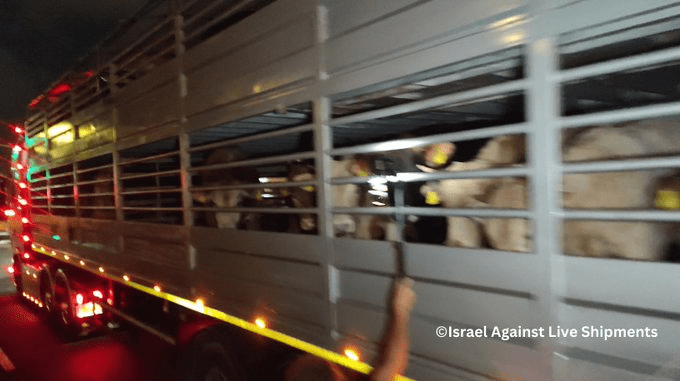
A large number of animals are still being exported to ports in Israel where they are at high risk. Vulnerable cows and sheep are being sent into the war zone from Member States including Ireland, Romania, Croatia, Slovenia, Hungary and Lithuania, where they face rocket fire, air strikes, and mistreatment by distressed port workers and handlers.
The long journeys to Israel’s largest port, Haifa, have severe effects on the health of these sentient beings, causing respiratory illnesses, ulcers, leg injuries, motion sickness and heat stress. Their suffering is only magnified on arrival in Israel, as from Haifa port to the surrounding quarantine and fattening farms, they face daily barrages of rockets and continuous air raid sirens.
Reports have claimed that a number of dairy farms around Haifa have been hit by missiles in the last weeks, killing a large number of cows. In addition, the unsafe conditions around the port are causing workers to use electric prods to get the cattle off the ships as quickly as possible.
Since the war started, there have been over 100 shipments of cattle and sheep from Europe to Israel. Livestock has continued to be exported to Lebanon since the war expanded in that region.
10 NGOs, including Eurogroup for Animals and Ethical Farming Ireland, have now sent a letter to European Commissioner for Health and Food Safety, Stella Kyriakides, urging her to suspend all live export to Israel and Lebanon with immediate effect.
Ethical Farming Ireland has also urged Ireland’s Minister for Agriculture Charlie McCanalogue to not authorise any more shipments to Israel until the conflict is over.









 World Animals Voice