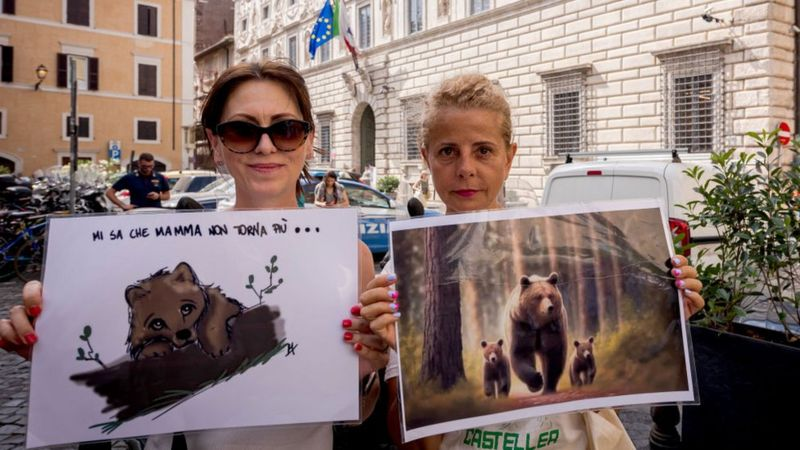
Malta – ‘Enforcement is very weak on all animal welfare legislation’ – Commissioner Alison Bezzina
The Ministry for Animal Rights recently unveiled its three-year plan for animal welfare reforms, which has brought the issue back into the public eye and revived discussions on related matters.
In an interview with The Malta Independent on Sunday,Commissioner for Animal Welfare, Alisson Bezzina, reflected that she is extremely happy that the ministry has taken on her recommendations for legislative changes that would benefit animals, saying that a lot of the suggestions that she made over the years have been included as part of the planned reforms.
World Federation for Animals champions animal welfare for sustainable development
26 July 2023
At the High-Level Political Forum on Sustainable Development (HLPF), the World Federation for Animals (WFA) and its members advocated for recognising animal welfare’s pivotal role in achieving sustainable development. The HLPF was held at the United Nations Headquarters from 10 to 20 July 2023.
A key focus for the WFA was the UN Member States’ negotiations of the forthcoming Political Declaration. In response to the WFA’s calls and persistent advocacy, the most recent draft of the Declaration includes a commitment to protecting wildlife. WFA will continue to advocate for further broadening this commitment to safeguard other living species as well.
Protecting wildlife and other living species is not just an environmental imperative; it is a moral responsibility and a key pillar of sustainable development. Each species plays a unique role in our delicate ecosystem. Preserving these diverse forms of life ensures a resilient planet.
Jessica Bridgers, Deputy CEO of WFA
In a significant step backwards, the HLPF removed an explicit reference to the One Health approach for pandemic prevention, preparedness, and response strategies, which had been included in an earlier draft. The One Health approach recognises the interconnectedness of the health and well-being of people, animals, plants, and ecosystems. Previous Ministerial Declarations in 2021 and 2022 have acknowledged the interdependencies between human, animal, and environmental health.
Omitting the promotion of One Health in the Political Declaration signifies a concerning decision by UN Member States to overlook a science-based approach to sustainable development that increases the resilience of communities vulnerable to zoonotic outbreaks worldwide.
Dr. James Yeates, CEO of WFA
WFA and its members will continue to engage UN Member States to further support the adoption of an ambitious and impactful Political Declaration at the SDG Summit in September 2023. At the Summit, heads of state and government will conduct a comprehensive review of the state of the Sustainable Development Goals (SDGs) and endorse the Declaration, providing political guidance to accelerate their delivery.
This is a critical year for protecting human rights and animal welfare during the mid-term review at the United Nations. The upcoming UNFSS Stocktaking 2+ in Rome this month, the SDG summit in September, and UNFCCC CoP 28 will be very important to continue to recognise the linkages between the rights and well-being of people and animals. After last year’s landmark UN Environment Assembly resolution on the relationship between animal welfare, sustainable development, and the environment was adopted, the 2023 HLPF Political Declaration must also fully recognise the key principles of the Resolution, which includes recognising the importance to One Health.
Jackson Zee, Co-Leader of the Animal Issues Thematic Cluster
When we consider the quality of life of animals who are other-abled, it’s joyous to see how much love and play are core elements that make a life worth living.
Although first-time visitors may express sadness in seeing dogs with physical impairments, our volunteers almost always express finding, after even just a few days, that it’s not the number of legs that measure happiness.
Instead, the dogs’ happiness is expressed in their play, curiosity, mischief and in the friendships they form with other dogs and people.
Thank you for helping us provide not only a safety net for the healing, the blind, the 2-and-3-leggers, the oldies and youngies, but also place where every bed can become a trampoline when the mood strikes!
Transformed by trust, Cheeto won’t stop playing!
Cheeto was in excruciating pain from a laceration to the side of his face, and cried out in fear when we approached. We gently placed a blanket over his eyes to calm him down enough to let us carry him to our ambulance.
He was so forlorn during his first treatment and we found the wounds were very deep. But within just days the swelling had reduced, his pain was subsiding and suddenly he became a whirlwind of love! Meet Cheeto now!
Trapped in a sewer, a paralysed dog needed our help to get out.
We’d received a call that a dog was lying in a sewage drain, unable to move. We found him forlorn and worried, sitting perfectly still as the cold sewage water rushed past him.
We found that his hind legs were not responding when we checked for sensation, indicating spinal injury. Spinal injuries have different rates of recovery depending on the severity, and we were very worried by the lack of sensation in his toes. But we gave him a chance, and began his bedrest and physical therapy in hopes that the sensation and movement would come back to his legs.
After several weeks working with him daily and helping him stand, Hopper surprised us all!
More shade and shelter for our biggest boys and girls.
Preparing for this year’s monsoon season which began a few weeks ago, we have built more shade throughout the shelter including an addition in the large animal hospital, giving more space where the biggest boys and girls can go for a nap or night’s sleep without getting wet or muddy.
Thank you for giving us the means to continually improve Animal Aid’s shelter each year.
Your wonderful donations at work!
Our June statistics reflect an increased number of spay-neuter surgeries thanks to the re-opening of our Animal Birth Control (ABC) Center, and we thank our donors for enabling this wonderful boost
Lovely ways to help animals.
100% of the proceeds go to our street animal rescues
AnimaNaturalis, together with Equalia, FAADA and over 50 other Spanish animal protection organisations have launched a campaign to influence Spain’s political agenda and encourage citizens to vote in the national elections this Sunday 23rd July.
Following disappointing results for the leading Spanish Socialist party (PSOE) in the May local elections, Prime Minister Pedro Sánchez called snap elections for the end of July. The Popular Party (PP) under Alberto Núñez Feijóo have their eye on victory, but neither the PP nor PSOE are projected to win enough votes to govern on their own – with the conservatives likely needing the support of far-right party Vox, and the Socialists looking to left-wing group Sumar.
Under AnimaNaturalis’ initiative, the new coalition of animal protection organisations in Spain have been working together to ensure that the main political parties include animal welfare commitments, such as explicit support for the end of cages in European livestock farming based on the “End the Cage Age” initiative.
The coalition prepared a decalogue of 17 asks for animals in the next term. A website launched earlier this month, AgendAnimal, includes a ranking of political parties according to their commitments to these asks.
The ranking shows support for many of the asks by parties Sumar, PACMA, Junts and ERC. Closing fur farms received the most consensus (6 parties), and 5 parties commit to move towards the end of cetacean captivity.
The union of animal organisations is key to achieving our objectives and defending the rights and welfare of animals effectively. Together we are stronger in our fight for a world where all living creatures are treated with compassion and respect. We have always been clear about it, but at such a decisive moment for Spain as the one we are currently experiencing, we could not act otherwise.
Cristina Ibáñez García, Lawyer and Coordinator AnimaNaturalis International
See below the decalogue of asks for animals:
Repeal Law 18/2013 for the regulation of bullfighting as cultural heritage
Develop the regulations of Law 7/2023 on the protection of animal rights and welfare
Include companion animals expressly excluded from Law 7/2023
Reduce veterinary VAT for pets from the general rate of 21% of the reduced rate of 10%
Develop a clear labelling system for meat products and derivatives
Support the transition to a cage-free system
Prohibit the slaughter of day-old chicks
Ban force-feeding ducks and geese to produce foie gras
Promote good aquaculture practices that prioritise animal welfare and sustainability
Close fur farms
Apply and promote the protection of fauna in wind farms and power lines
Prohibit pigeon shooting
Promote R&D of alternative methods to animal experimentation
New regulations on zoos
Moving towards the end of cetacean captivity
Build a state rescue centre for seizures of CITES species
Guarantee the continuity of the General Directorate for Animal Rights
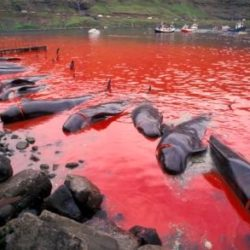
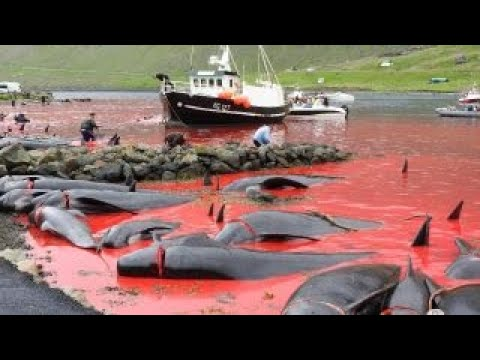
Cruise line apologises after passengers witness dozens of pilot whales being slaughtered
We have campaigned against this along with thousands of others for decades – at least the uninformed may know a bit more about the abuse that takes place every year.
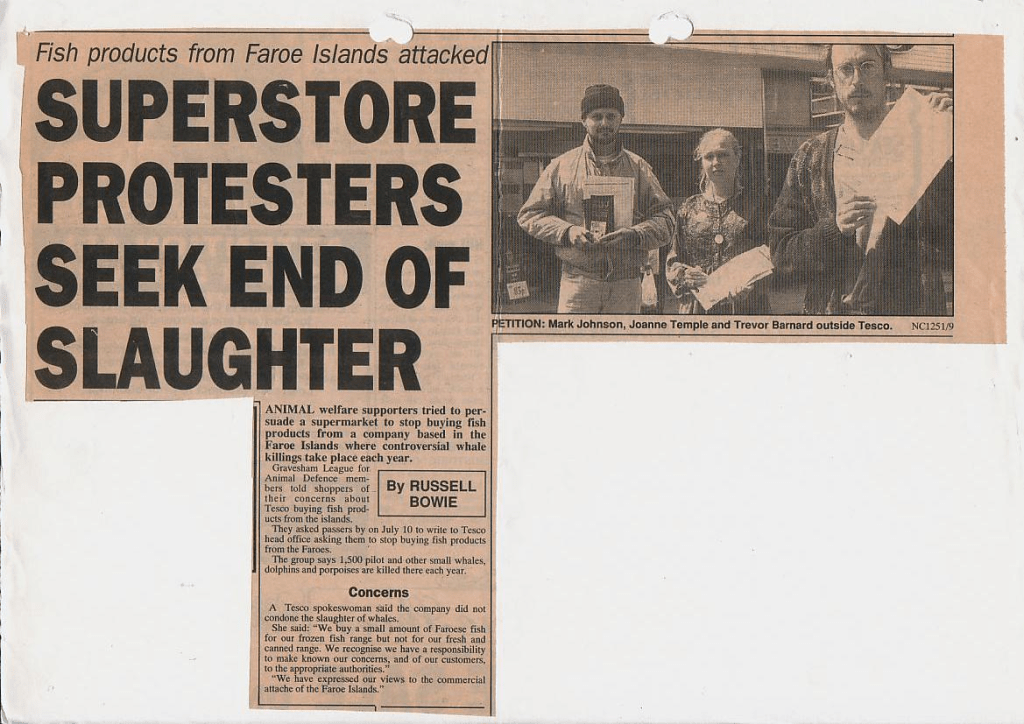
Myself, Joanne and Trev fight to get Faroese fish stopped in our local supermarket – when was this ? late 80’ s ? To see more pictures please click on https://serbiananimalsvoice.com/about-us/
Others have called on cruise ship companies to boycott the Faroe Islands in order to end the killing of whales in the area. “Cruise companies need to take a stand in support of ocean wildlife and remove the Faroe Islands from itineraries,” Rob Read, the chief operations officer at Captain Paul Watson Foundation UK, told Yahoo News Australia. “Their continued visits to the Faroe Islands inadvertently supports the abhorrent practice that is the Grindadráp.”
European Parliament to vote on two major climate and nature laws this July
9 July 2023
Two plenary votes are coming up at the European Parliament that could have a huge impact on the planet; one on the Industrial Emissions Directive and the other on the Nature Restoration Law. It’s critical that policymakers vote in favour of nature, as well as for an ambitious threshold for animal agriculture, so that we can get to work on the urgent task of mitigating our impact on the climate and natural landscapes.
Find out below why these laws are so important, what impact these two plenary votes could have and what we, along with some of our members, have to say about them.
Adopted in 2010, it’s currently the main policy in Europe to regulate pollutant emissions from industry, including from air pollution and wastewater discharge.
In 2022, the Commission adopted proposals to make the IED stronger by including emissions from large cattle farms within its scope, in addition to the large pig and poultry farms that were already covered.
Any installation controlled by the IED is forced to reduce emissions, and needs a permit to operate. The original Commission proposal suggested including more industrial-size animal farms, with a threshold of 150 or more livestock units (LSU). 150 LSU corresponds to, as examples, a large farm with 500 pigs, 150 dairy cows, 10,700 laying hens or 21,400 broiler chickens.
The goal of this revision was to bring the Directive more closely in-line with the goals set out in the European Green Deal, and other relevant policies. The debate around it has also put the intensification of EU animal farming in the spotlight.
On July 10, the European Parliament will vote on the Commission’s proposal. If they vote in favour of it, amazing steps could be taken to reduce our industrial emissions – especially from agriculture.
If they vote against it, however, these systems will continue to cause great damage to nature and the climate – which they’re already doing at an alarming rate.
What is the Nature Restoration Law?
Last year, the European Commission adopted a proposal for a Nature Restoration Law, which focuses on how we can recover and protect our ecosystems. Among its targets, the proposal aims to restore at least 20% of the EU’s land and sea areas by 2030 and all ecosystems in need by 2050.
There are plenty of positive examples of where nature restoration strategies have been successful. Deploying these kinds of strategies at EU level, then, would have sweeping impacts on biodiversity, land and marine ecosystems, the health of our soils (which is critical for food security) and more. As with the Industrial Emissions Directive, it’s extremely important that policymakers acknowledge the necessity of this move and vote in its favour.
What are the stakes?
The 2020 State of Nature in the EU report states that only 14% of habitats and only 27% of non-bird species currently have good conservation status. Moreover, the 2021 assessment for the EU Red List of Birds showed that 1 out of 3 bird species declined over the last few decades. These numbers demonstrate that, beyond species’ populations, wild animal individuals in the EU are suffering from a decline in the quality of their habitats. Habitat loss is a major source of stress for wild animals, restraining their movements and threatening their access to food, water and shelter.
These issues clearly can’t be allowed to develop any further. Only action at EU level will help us to mitigate our impacts on the climate and environment in a meaningful way. That’s why we’re working with our members to call on the European Parliament to address these plenary votes with the seriousness they deserve.
It’s time for our policies to meet our planet’s needs!
We’re looking to the European Parliament to redefine ‘climate change’ -by changing the course of the climate crisis, instead of letting it continue – and using their power for the planet’s good.
Hi all; just to give you an update; I have just come out of hospital after a 2 week stay. Old cycling leg injury which has always caused some problems.
I will try to get back on track over the next few days, but as you will appreciate, 2 weeks worth of e mails to get through also.
Bad news that Zac has resigned from government as he has no faith in Rishi and the environment – I fully agree with him and I know this is yet another issue that the Tories will pay very heavily for at the next general Election which will probably be within the next year or soon after.
1,502,319 signatures were officially submitted to the European Commission (EC), calling on the EU to ban fur farming and the placement of farmed fur products on the market once and for all.
Fur Free Europe was launched in May 2022 and received the support of more than eighty organisations from all around Europe. It closed on March 1st, earlier than its official deadline, thanks to a record number of signatures collected: 1,701,892 in less than ten months. The ECI also successfully reached the signatures threshold in eighteen Member States. The signatures were submitted to the relevant Member State for validation.
On all fronts, the existence of fur farming holds no reasonable grounds. In fur farms wild animals such as minks, foxes and racoon dogs are kept in tiny cages, hindered from displaying natural behaviour and killed solely because of the value of their fur.
In addition, the farms pose a significant risk on animal and human health, as proven during the COVID-19 pandemic, when outbreaks caused variants to be transmitted from animals to humans. From an environmental perspective, the use of toxic chemicals in the production of fur makes it one of the most polluting industries. The fur industry also poses serious threats to biodiversity, with some farmed species escaped from fur farms now considered Invasive Alien Species (IAS), causing significant adverse impacts on European native wildlife.
The ECI organisers will now meet with the European Commission and then attend a public hearing at the European Parliament, after which the European Commission has to publicly respond to the initiative, before the end of the year.
This marks the 10th successful European Citizens’ Initiative (ECI) since the tool was launched, and 7 out of 10 ECIs were dedicated to animal issues. Fur Free Europe represents the most successful ECI for animal welfare, and the third most successful overall.
The overwhelming public support to this initiative has made one thing clear: fur must become a thing of the past. We are so proud to have achieved yet another step towards ending this cruel and unnecessary practice and now we call on the EC to use the new animal welfare legislation to make the wish of 1.5 million European citizens come true.