Welcome to the Vegan Recipe Club newsletter! We’ve got a new sweet/savoury crêpe recipe for you, perfect for all the March celebrations! Enjoy our new super-quick ramen dish which works in every season. We’re delighted to welcome our friends at The Word Forest Organisation who are doing some amazing work and have provided us with their favourite recipes!
‘Ham’ & ‘Cheese’ Crêpes
Fill your savoury crêpe with lovely melty ‘cheese’ and ‘ham’ for the ultimate quick comfort meal.
This crêpe batter is extremely plain and simple so it can be used to make sweet or savoury pancakes! We’ve got lots of filling ideas for you so pick your favourites and enjoy 🙂
This is one of Tracey’s favourite bread recipes to teach. It looks complicated but it’s dead easy and it pulls all sorts of colourful seasonal veg into play!
Ever wondered what a week of vegan food looks like for us at Viva!’s Vegan Recipe Club? Our social media coordinator, Pia, is lifting the lid on her foodie-habits and offering some fabulous tips to make every day filled with delicious plant-based delights!
I always find it revealing how videos demonstrating the violent death required of ALL exploited animals, are typically restricted, labeled graphic, and warning of disturbing images, completely opposite to what the agriculture adverts and propaganda deceptively promote, but you’ll NEVER get an agriculture industry employee, supporter, representative, or apologist (ie, all who comprise >90% of the human population) provide the truth of the suffering and violence necessary of animals, who are denied all opportunity to defend their bodies, their children, their lives. Conversely, nobody-in-the-history-of-ever has restricted footage or images of crop harvesting or apple picking.
Don’t let the explicit content that you so effortlessly inflict on vulnerable, defenseless animals prevent your education and hypocritically challenge your ethics.
And for all the radical cat-and-dog extremists who vilify the cat-and-dog-meat trades and relentlessly share the graphic footage of dogs being butchered alive and cats being boiled while conscious: why are you so happy to participate in the same torture, torment, and cruelties inflicted on other animals?
The USA routinely boils chickens alive, as well as other animals including lobsters and crabs and pigs, whose flesh and body parts you piously pass around on your nice dinnerware; I think people spend so much time picking out china patterns because pretty plates and other weapons of destruction deflect from the required violence and suffering of those on them.
And before you virtuously scream about “quick, ethical killing”: killing is inherently unethical, regardless of method or place, you don’t kill animals because you actually believe NOT killing animals is UNETHICAL, there is NO form of killing that is more humane than NOT killing. All killing causes suffering and destroys life, which can NEVER be “ethical”. Why you think that your transient taste preference validates the END OF LIFE is the epitome of privilege, arrogance, hubris, and selfishness. It’s not like you have to literally hold yourself back from eating your dog or cat or rabbit or whatever-animal-you-claim-to-like, if you can prevent killing your dog as “food”, you can prevent killing pigs.
There are those who ask, “Why should I listen to vegans?” … Which makes me wonder if you also ask, “Why should I listen to people opposed to child exploitation?” Really? This SHOULD be a no-brainer: Less harm is ALWAYS better. But for the GOP-ers and apologists who simultaneously cause and dismiss the suffering of others (I have no room to unpack the screaming hypocrisy of leftists who also ignore the suffering of others), you’d perhaps be more interested in the financial aspect: Me? I make NO money advocating on behalf of animals, I actually spend money on this blog. But, for the people who relentlessly oppose using gas “euthanasia” on cats and dogs, but who consume pigs who are predominantly slaughtered using gas, the former CEO and president of Smithfield Foods (that kills and profits from the suffering of pigs, in case you missed the association, because nonvegans are often naive and willfully ignorant about the animals they inflict with pain and fear and the entities they pay to cause such), which is actually owned by a Hong Kong, China-based company (the irony), earned $14,000,000.00 in approximately 5 years ……………………………
Who’s fooling whom? Why do you listen to the ones who depend on your complacency and conformity to take your money to kill? (Not to mention the subsidies used to prop up the death industry, if it wasn’t subsidized, a pound of “ground beef” would be about $35.) This also should be a no-brainer.
We are ALL animals who have the capacity to experience emotions and pain, if you enjoy “bacon” but condemn cat and dog flesh, guess what? You enable others to consume cats and dogs by your very support of animal exploitation of other animals: it’s all related, you just define the suffering of some animals in ways that provides you comfort causing it. To care for one species requires you reject the exploitation of all.
Don’t like facts? Too bad, you must not actually like cats or dogs either, then. Was that offensive? Too bad again, the violent torment forcibly endured by animals is what is ACTUALLY “offensive”. Have you ever seen the morally outraged masses absolutely verbally eviscerate and threaten with actual harm, others who kill cats and dogs? If your immediate reaction to my words is, “iF VEgaNs wERe mOrE NiCE I’d Be vEgAn…”: Cry more, who do you normally blame for your inability to be a decent human animal since you either don’t actually know any vegans, or you ignore the super nice ones? I posted a video just last week of nice, respectful Ed Winters encouraging veganism while destroying carnist arguments, if you won’t be vegan for the actual animals, be vegan for Ed.
And, too, what other social justice issues do you require personal benefit and niceties to support? Veganism is for animals, not your ego, you ignore the trillions of “nice” animals whose throats are stabbed and are therefore incapable of respectfully asking for your support, so don’t pretend reading a 5-minute vegan plea or watching a 30-second video had such a negative influence on you that you feel forced to continue greedily supporting the death industry, which includes dogs and cats. SL
A controversial vegan advertisement debuted on UK television channels over the weekend. Tom Bursnall, director of plant-based food company Miami Burger and producer of the advert, expects it will spark conversation and backlash. Bursnall created the 30-second ad in collaboration with the charity Vegan Friendly
Take PETA’s Cruelty-Free Shopping Guide along with you next time you head to the store! The handy guide will help you find humane products at a glance. Order a FREE copyHERE
Searching for Cruelty-Free Cosmetics, Personal-Care Products, Vegan Products, or more? Click HERE to search.
Free PDF of Vegan & Cruelty-Free Products/Companies HERE
Want to do more than go vegan? Help others to do so! Click below for nominal, or no, fees to vegan literature that you can use to convince others that veganism is the only compassionate route to being an animal friend:
The impetus for the EU to develop and adopt the Farm to Fork strategy was the necessity of making the food system resilient, by adopting healthier and more environmentally sustainable practices, including improved animal welfare and a shift to healthy, sustainable diets.
The crisis in Ukraine has made large agri-businesses cry foul, claiming that without access to Ukrainian and Russian fertilisers, cereals, gas and oil, it is necessary to u-turn on the EU’s objectives and roll back policies that will make its food system more resilient.
The Farm to Fork strategy shows, on the contrary, foresight. Its roll-out will streamline and ensure food security by making the EU less permeable to volatility and constraints in international markets. By moving away from the most industrial and intensive forms of animal agriculture and promoting a shift to more plant-based diets, more people can be fed using less land and resources.
The outcry is about feed, not food
Agri-businesses cynically claim that the war in Ukraine will cause a food crisis, whereas the stress is on feed. The EU wastes 20% of its food, and exports more agri-food than it imports, with a positive trade balance worth €4bn to €6bn each month.
Access to cheap feed for animals and chemicals for intensive feed-crops is under stress because of the war. The Farm to Fork strategy aims at avoiding that intensive animal farming and its supply chains come into competition with food for people.
The EU produces over 290 million tonnes of cereals, 32 million more tonnes than are used domestically. Yet only 20% goes directly to feed people. The lion’s share is for feed (56%) and almost as much cereal is exported (45 million tonnes) than is destined as food for Europeans.
A resilient food system to weather this and future crises
A resilient food system will ensure that domestically produced food-crop is primarily used as food for people, while farm animals feeding themselves primarily by grazing. Agricultural production is, currently, mostly diverted to intensive animal farming. Apart from its detrimental impact on billions of animals it sustains an – economically and medically – unhealthy overconsumption of animal products and reliance on imported feed.
The Farm to Fork strategy will contribute towards cutting the EU’s reliance on the production and import of industrial feeds and allowing the EU’s agricultural sector to increase its production of food for people. The strategy’s objectives of moving towards a greater plant-based diet, reducing the consumption of red meat and improving the well-being of farmed animals will help the EU weather international crises like the deplorable war unfolding at its borders. Overall, the consumption of animal products would need to be reduced by around 70% in the EU in order to stay within the planetary boundaries.
With the war in Ukraine bringing the limits of the EU’s food system, heavy in animal protein, to light, the Commission should accelerate the roll-out of the Farm to Fork strategy: reduce the EU’s reliance on meat production that diverts home-grown food crops for people to feed for animals and requires significant imports of both feed-crop and fertilisers.
As Commission Vice-President Frans Timmermans said on 8 march 2022, “Farm to Fork is part of the answer, not part of the problem”.
Together with 85+ NGOs we sent a letter to Ms Ursula von der Leyen, President of the European Commission; Mr Frans Timmermans, Executive Vice-President for the European Green Deal; Ms Stella Kyriakides, Commissioner for Health and Food Safety; Mr Janusz Wojciechowski, Commissioner for Agriculture; and Mr Virginijus Sinkevičius, Commissioner for Environment, Oceans and Fisheries, asking them to defend the Farm to Fork strategy.
The joint statement, released on 7 March, by the Food and Agriculture Organisation (FAO), World Organisation for Animal Health (OIE) and World Health Organisation (WHO) reinforces that farmed mink have been shown to be capable of infecting humans with the SARS-CoV-2 virus. It recommends prioritisation of monitoring SARS-CoV-2 infection in wildlife and preventing the formation of animal reservoirs.
Three years into the pandemic, the emergence of SARS-CoV-2 variants continues as the virus evolves.
In a new statement from the major global health bodies WHO, FAO and OIE, the risks associated with potential animal reservoirs are laid out, including the risks from both domestic and wild animal populations. The infection and spread of the virus in animal populations could lead to the emergence of new SARS-CoV-2 variants that are then passed back to humans.
In addition to domestic animals, free-ranging, captive or farmed wild animals such as big cats, minks, ferrets, North American white-tailed deer and great apes have thus far been observed to be infected with SARS-CoV-2.
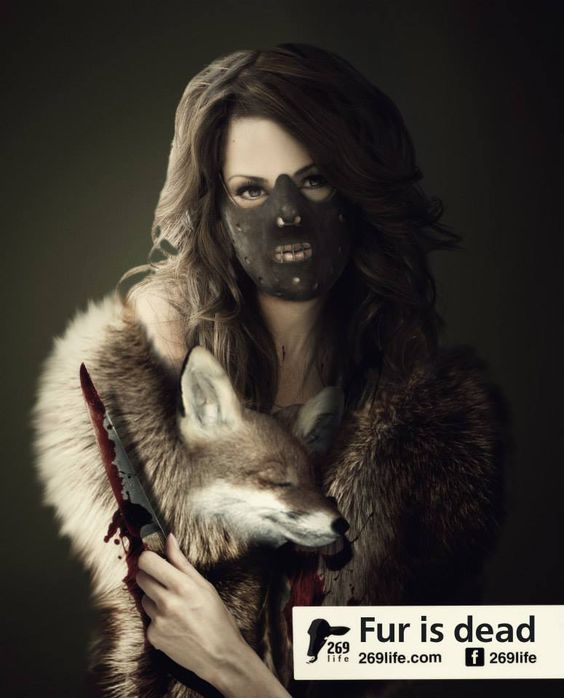
In 2021, Eurogroup for Animals and the Fur Free Alliance released a scientific statement on public health risks associated with SARS-CoV-2 and intensive mink production, signed by numerous scientists from the fields of virology, infectious diseases, clinical microbiology, veterinary medicine and environmental health.
Mink farms, where thousands of mink are housed together in high density, constitute high risk potential reservoirs for SARS-CoV-2 as well as for associated mutations.
FAO, OIE and WHO are calling on all countries to take steps to reduce the risk of SARS-CoV-2 transmission between humans and wildlife with the aim of reducing the risk of variant emergence and for protecting both humans and wildlife.
Although EfA welcomes the above mentioned recommendations, it has been shown that monitoring measures haven’t been enough to contain the spread of the virus in fur farms in the EU. In a letter sent to the Commission in June 2021, EfA and FFA expressed their concern about how fur farmers have been systematically breaching the biosecurity rules recommended by the OIE4 in some Member States. After the implementation of new EU rules to ensure harmonised monitoring activities, new outbreaks of the SARS-CoV-2 virus were detected in European fur farms.
Future spillover between animals and humans can thwart the efforts to eliminate or control the disease. EU mink farms must not become a reservoir for future spillback of SARS-CoV-2 from animals to humans.
Another recent study has found SARS-CoV-2 related viruses in trade-confiscated pangolins in Vietnam. It shows just how much a reform of wildlife policy is required to control the risks of future pandemics, and how wildlife trade risks spillover from viruses that are not detected with current screening methods.
The Amazon contains between 90 and 140 billion metric tons of carbon – Getty Images
The Amazon rainforest is moving towards a “tipping point” where trees may die off en masse, say researchers.
A study suggests the world’s largest rainforest is losing its ability to bounce back from damage caused by droughts, fires and deforestation.
Large swathes could become sparsely forested savannah, which is much less efficient than tropical forest at sucking carbon dioxide from the air.
The giant forest traps carbon that would otherwise add to global warming.
But previous studies have shown that parts of the Amazon are now emitting more carbon dioxide than can be absorbed.
“The trees are losing health and could be approaching a tipping point – basically, a mass loss of trees,” said Dr Chris Boulton of the University of Exeter.
The findings, based on three decades of satellite data, show alarming trends in the “health” of the Amazon rainforest.
The more trees cut down, the less the forest can soak up emissions – Getty Images.
There are signs of a loss of resilience in more than 75% of the forest, with trees taking longer to recover from the effects of droughts largely driven by climate change as well as human impacts such as deforestation and fires.
A vicious cycle of damage could trigger “dieback”, the scientists said.
And while it’s not clear when that critical point might be reached, the implications for climate change, biodiversity and the local community would be “devastating”.
Once the process begins they predict it could be a matter of decades before a “significant chunk” of the Amazon is transformed into savannah – a vastly different ecosystem made up of a mixture of grassland and trees.
“The Amazon stores lots of carbon and all of that would be released into the atmosphere, which would then further contribute to increasing temperatures and have future effects on global mean temperatures,” Dr Boulton said, adding that stopping deforestation would go some way to addressing the problem.
Around a fifth of the rainforest has already been lost, compared to pre-industrial levels, they said.
The research was carried out by the University of Exeter, the Potsdam Institute for Climate Impact Research (PIK) and Technical University of Munich.
“Deforestation and climate change are likely to be the main drivers of this decline,” said Prof Niklas Boers of PIK and the Technical University of Munich.
Commenting, Dr Bonnie Waring of the Grantham Institute – Climate Change and Environment, Imperial College London, said: “These latest findings are consistent with the accumulating evidence that the twin pressures of climate change and human exploitation of tropical forests are endangering the world’s largest rainforest, which is home to one out of every 10 species known to science.”
The findings, based on satellite data from 1991 to 2016, are published in the journal Nature Climate Change.
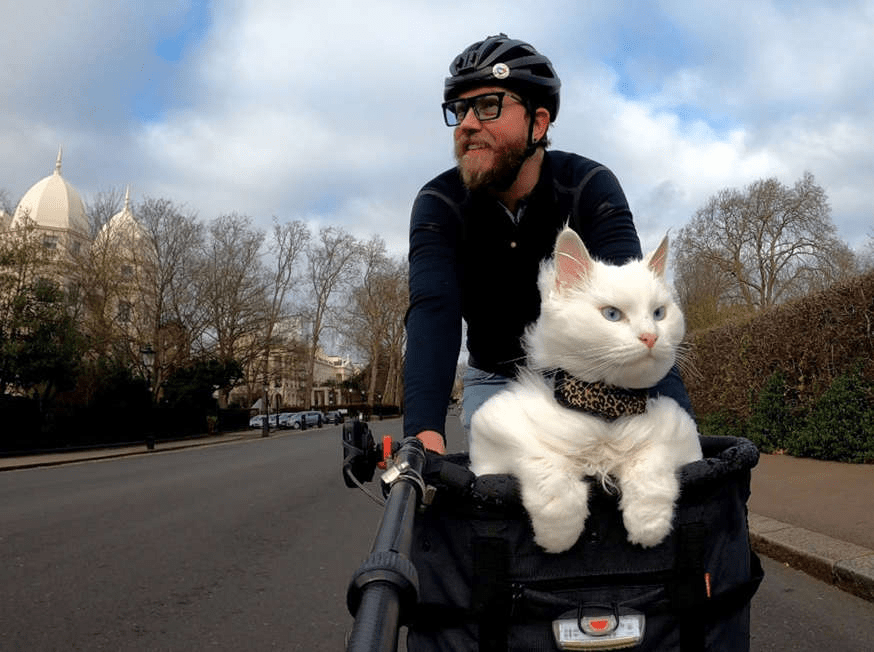
Sigrid rides in owner Travis’s bike basket (Picture: @sigirides/Caters News)
Norwegian forest cat Sigrid may be deaf, but it doesn’t stop her getting out and about.
In fact, the fluffy white moggy likes nothing more than going for a cycle – and you may even have spotted her traversing the streets of London in her owner’s handlebar basket.
Software engineer Travis Nelson, 46, takes Sigrid with him when he explores the city, with the four-year-old cat attracting plenty of attention from passers-by.
A typical journey for the pair will begin in Regent’s Park and end up in Jubilee Park, so Sigrid can see the sights.
Travis said: ‘This is fairly normal for us! Although we usually stop for more pets.
‘She definitely loves the bike rides. She often begs at the door to go out and gets excited when I start messing with my bike.
‘She’s always happy and inquisitive when we’re out.’
Travis first took Sigrid out on his bike when he was made redundant during the pandemic, looking to try something new with his ‘best friend’.
What started with training her to walk on a lead led to her being comfortable enough to relax in a basket, even wearing goggles to protect her eyes from wind.
Travis now shares photos and videos of their journeys together, during his time out from work spending up to four hours a day editing content and replying to Instagram messages.
Spot Jeremy Clarkson in the back, as well as Sigrid’s chic cycling goggles (Picture: @sigirides/Caters News)
Speaking to Ham and High, he said: ‘I usually describe us as best friends. We’re together all the time. Sigrid does mean a lot to me. It’s been a tough year and she’s been a big comfort.
‘It’s a little odd now, almost every time we go riding we get recognised by someone. It feels like we have friends everywhere.’
Sigrid’s unique hobby has seen them attending the Pride Ride together, as well as their picture being shown on screens on the Moscow Metro.
It’s really more about the fun of it for the duo, however, and the adventurous cat has no problem making her intentions to head outside known to her owner.
Travis added: ‘She always seems to love going outside. She’ll stand at the door and whine.
‘She sees me messing with my bike and she starts running around getting excited, it’s her favourite thing to do.’
Travis and Sigrid’s usual route is through Regent’s Park, where passers-by often stop to pet the intrepid kitty (Picture: @sigirides/Caters News)
Love the picture of her in her little goggles – cool !
Two men were killed in a camel attack at a petting zoo in Tennessee, officials say.
Law enforcement were called to Shirley Farms in Obion, Tennessee, after reports of a “loose” camel in the area.
When sheriff’s deputies arrived on the scene on Thursday afternoon they found “two unconscious victims on the ground.”
Both men died of their injuries at the scene, said authorities.
Officials say that while deputies tried to remove one of the victims for medical treatment, the animal attacked an Obion Sheriff’s Office patrol car and charged at the deputies.
“It was at this time officers had to put the camel down for the safety of everyone on scene,” the department said in a statement.
Authorities have identified the victims as Bobby Matheny, 42, of Ridgely and Tommy Gunn, 67, of Obion.
It is unclear what kind of camel was involved in the incident, which took place around 100 miles north of Memphis.
There was no immediate information on how the camel got loose on the farm.
The Aquaculture Advisory Council (AAC) has published its Recommendations to the European Commission and the Member States, one on fish welfare in live transport, and on setting up a Fish Welfare Reference Centre.
Most fish in European aquaculture are moved between sites at least once during their life, and many are moved several times between or within sites. The live transport of fish is governed by EU regulation 1/2005 on the protection of animals during transport but currently contains provisions that cannot and should not be applied in fish transport.
As part of the Farm to Fork Strategy, the European Commission is now reviewing this regulation with a view to making a new legislative proposal. Eurogroup for Animals, Compassion in World Farming, and Vissenbescherming, have worked with aquaculture producers and other stakeholders in the AAC to develop these consensus positions.
Regarding fish welfare in live fish transport, the AAC notes that it is necessary to take the specific needs of fish, and sometimes species-specific needs, into consideration when establishing rules for animal and fish transport. The AAC makes detailed recommendations covering:
1. Pre-transport planning and preparations, including proper vehicles and equipment
2. Journey preparations, inspecting and preparing the fish and equipment
3. Loading and unloading, for most finfish species the most stressful part of live transport.
4. The journey itself should be gentle, with continual monitoring of oxygen and temperature.
5. Post-journey monitoring of appetite, behaviours, disease and mortality.
DG-SANTE, in cooperation with Member States, has already set up Animal Welfare Reference Centres in relation to pig welfare, poultry welfare and ruminants’ and equines’ welfare. The AAC has now made the recommendation that a fish welfare reference centre should be established to address the welfare of fish and other farmed aquatic animals that are produced and imported into the EU.
The AAC highlights priorities for the reference centre including:
the development of species-specific guidelines,
establishing validated indicators,
covering all stages including hatcheries, rearing, transport and slaughter.
WAV Comment – Supporter George has made contact with kind words about the Vegan info we are putting on the site.
In addition George has provided us with a link regarding cruelty free beauty shopping, and we repeat the link provided to us – please have a look and find out more.
As said, thanks George for your kind words and the supply of the link which we hope will be of great benefit to supporters.
We follow this with the news which has just arrived with us – a press release from our animal buddies at Gaia in Belgium. Here below is a repeat of the press release:
Nine years after EU ban, animals will once again be dying in the name of beauty
10 March 2022
GAIA
Press Release
On the ninth anniversary of the EU law preventing the sale of all cosmetics products tested on animals, animal protection NGOs Cruelty Free Europe, Eurogroup for Animals and GAIA will not be celebrating, as chemicals rules look set to render the bans meaningless.
Yesterday, the organisations held a vigil for the cosmetics animal testing bans close to the headquarters of both the European Commission and Council in Brussels. They were joined by the French street artist Ckeja, who painted live throughout the vigil.
Despite huge public support for the bans[1], cruel animal tests are now being required by European authorities, including on ingredients used solely in cosmetics. Proposals to extend the scope of chemical safety legislation under the Chemicals Strategy for Sustainability look set to massively increase the amount of regulatory animal testing taking place in Europe, including tests for cosmetics’ ingredients, namely make-up, shampoo, moisturiser, soap, perfume and toothpaste.
A study carried out in 2021 by the European Centre for Alternatives to Animal Testing found that 63 chemical safety assessment dossiers in the EU’s chemicals database had used the results of new animal testing for cosmetics risk assessment, with this number looking set to increase as the European Chemicals Agency carries out more reviews. This is testing that has taken place since the bans[2] came into place.
Europe’s leaders often trumpet how brilliant the EU’s cosmetics animal testing bans are – and how they were ground-breaking and a model for the world. However, we know that more and more animal testing is being required by regulators for ingredients in cosmetics, against the wishes of European consumers and cosmetics brands. But we can all stand up and say that we want our bans back and we want them strengthened by signing the Save Cruelty Free Cosmetics European Citizens’ Initiative at savecrueltyfree.eu. We have the power!
Kerry Postlewhite, Director of Public Affairs, Cruelty Free Europe
Non-animal approaches to ensure the safety of cosmetics and other consumer products have been routinely used in the EU for decades. There is no reason to test ingredients on animals when advanced non-animal assessment strategies are available and offer reliable alternatives to animal testing. With this ECI, we call on the European Commission to commit to actions that can ensure the protection of human health and the environment by managing chemicals without the use of animals, and to invest in human-based, non-animal approaches for regulatory decision-making.
Reineke Hameleers, CEO, Eurogroup for Animals
The 2013 EU trade ban on cosmetics tested on animals is in danger. It would be a real shame if the clock would be turned back.
Ann De Greef, CEO, GAIA
Notes to Editors
[1] 74% of adults in EU Member States agree that animal testing for cosmetic products and their ingredients is unacceptable in all circumstances, Savanta ComRes survey for Cruelty Free Europe, July 2020.
[2] As well as the 2013 ban on the sale of all cosmetics products tested on animals, the EU had previously banned the testing of cosmetics products on animals in 2004, and the testing of cosmetics ingredients on animals in 2009 – Ban on animals testing.
Video and photos of the Brussels event on Thursday 10 March are available here. Interviews are also available on request.