Day: May 29, 2023

USA: Hey, Non Vegans; What You Are ……..

With thanks as always to Stacey at Our Compass for sending this over

Regards Mark

Our Compass – Hey, nonvegans, what you’re really saying is … | Our Compass (our-compass.org)

Hey, nonvegans, what you’re really saying is …

MAY 29, 2023

by Stacey

Source Feelin’ Vegan Instagram & Feelin’ Vegan Facebook

Veganism is a call to renounce the core practice of our culture—reducing beings to mere harvestable and abuseable commodities—and to practice, in every aspect of our lives, its opposite: mindfulness, inclusiveness, equality, and respect. – Dr. Will Tuttle

Download Your FREE Vegan PDF HERE

Order a FREE vegan kit HERE

Dairy-Free Info HERE

Take the Dairy-Free Challenge HERE

Click HERE for more Dairy-Free

Fish alternatives can be found HERE

Learn about eggs HERE

Find bacon alternatives HERE and HERE

Take PETA’s Cruelty-Free Shopping Guide along with you next time you head to the store! The handy guide will help you find humane products at a glance. Order a FREE copy HERE

Searching for Cruelty-Free Cosmetics, Personal-Care Products, Vegan Products, or more?
Click HERE to search.

Free PDF of Vegan & Cruelty-Free Products/Companies HERE

Click HERE to find out How to Wear Vegan

Want to do more than go vegan? Help others to do so! Click below for nominal, or no, fees to vegan literature that you can use to convince others that veganism is the only compassionate route to being an animal friend:

PETA HERE

Vegan Outreach HERE

Get your FREE Anti-Speciesism Activist Kit from PETA HERE

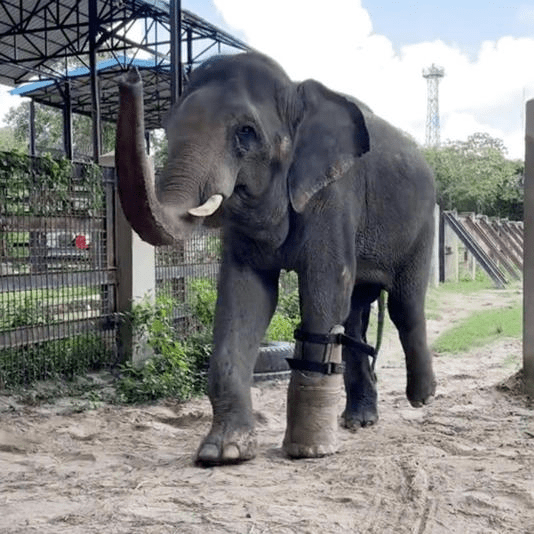
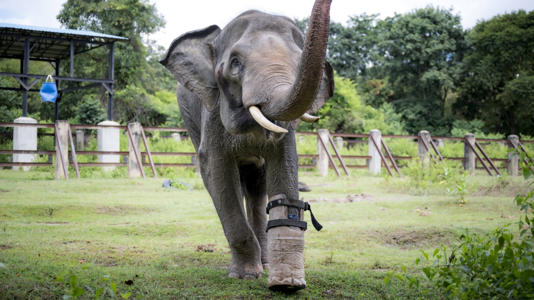
Cambodia: Elephant with a missing foot is given a prosthetic so he can walk again.

Elephant with a missing foot is given a prosthetic so he can walk again

Elephant with a missing foot is given a prosthetic so he can walk again (msn.com)

An elephant who lost his foot to a snare when he was only a year old can walk, run and swim again now he’s been fitted with a prosthetic.

Chhouk, an 11-year-old Asian elephant, was taken in by the Wildlife Alliance, a conservation organisation in Cambodia.

The organisation is partnered with Paradise Wildlife Park, a UK-based group which helped to fund the prosthetic foot, which is made out of old tyres and other recycled materials.

Cam Whitnall runs Paradise Wildlife Park and Big Cat Sanctuary and, along with his family, supports animal welfare causes worldwide.

Cam, 27, said: ‘It’s amazing – you can’t help but smile.

‘It’s a really special moment, to see what we’re helping to conserve and help, not just Chhouk but all over the world.

‘It’s the best feeling in the world to help animals.

‘The level of care that he gets is brilliant and he has a great life now. There’s no better feeling.’

Click on the top link to see video footage;

Regards Mark

Poland: Pig farming across Europe could look a lot different with high animal welfare standards in place.

All Photos – Pstra.

Firstly; thank you Jack for your kind comments about the site and posts.  Appreciated.

Pig farming across Europe could look a lot different with high animal welfare standards in place

To protect the health and happiness of farmed animals, as well as reach the EU’s sustainable food and farming goals, it’s critical that much fewer animals are farmed, and those that are enjoy the highest possible animal welfare standards.

We spoke to farmer Maciej, who works for the Pstra Wybiegana group in Poland, about his experiences of raising pigs whose welfare is made a priority each day.

Across Europe, millions of pigs are suffering on factory farms: where their natural instincts are stifled, their bodies are mutilated and they spend significant periods of their lives trapped in dirty, tiny cages.

It doesn’t have to be this way. In their revision to the animal welfare legislation, the European Commission must include strict, specific rules for pigs to ensure they can live satisfying and engaging lives. These assurances are the least any sentient being deserves – and there are a range of case studies across Europe that show exactly what kind of measures work to ensure pig welfare.

One such example comes from a pig farm in the heart of Poland, Pstra Wybiegana – a collaborative effort by two farms to raise pigs following extremely high animal welfare standards. We asked farmer Maciej to tell us more about their efforts to ensure their pigs lead good quality lives under their care. 

Why have you chosen to farm following high animal welfare standards?

We just feel like this is the only way humans should work with animals – we should of course all be following the highest possible animal welfare standards we can! They deserve the very best of what we can offer them.

We also think that by following these standards, we’re offering our consumers peace of mind when they buy animal products from us, as well as contributing to a more sustainable planet and better food systems.

By only selling small amounts locally of high quality animal products, we encourage our consumers to eat much fewer animal-derived products in general: which is better for public health and the environment. By operating on this scale, we’re also supporting the local economy, while at the same time putting a lot of effort into making our farm truly nature friendly. By only working with a small number of pigs we’re able to give each of them a lot of attention too, which is really gratifying.

Tell us a bit about your farm. What do you feed your pigs?

Our pigs have a diverse diet, which includes steamed potatoes, greens, grain middlings and whey. 

Potatoes give our pigs energy, greens give them fibre and vitamins, and grain middlings and whey supply proteins, vitamins and water. All of these different ingredients have real nutritional value – and what’s more, they taste great. Our pigs love their food – but we don’t overindulge them, because it’s important to their welfare that they have opportunities to forage for their own snacks in the wild, as this is one of their deeply-ingrained natural instincts. Fortunately, our variety of outdoor areas provides plenty of opportunities to do that. 

What kind of habitats can your farmed pigs access?

Our pigs are able to experience a range of different habitats and terrains, and we let them out all year round.

We think that this diversity in their environment is important, as they’re able to get a lot of benefits from being exposed to a variety of areas. As a few examples, we provide them with:

Large, grassy grounds – so our farmed pigs can enjoy digging and rooting in search of food, as well as playing in water

Runs – which have been specifically designed to help them interact with each other and enjoy themselves

Showers – where they can cool down in the summer 

Small rock areas – to stimulate their brains and give them something to bite on, which is good for their dental hygiene

Cosy indoor areas – to which they can retreat and relax in comfortable hay when they want a moment alone, or shelter from adverse weather.

How do your farmed pigs socialise?

Along with using our runs and enjoying our showers together, you’ll often see our farmed pigs moving in groups. It’s impossible for them to be lonely. From what we’ve seen, they prefer to be in herds with no more than 40 – 50 pigs, wherein they can build their own hierarchy and establish a leader. Of course, these groups are successful as well because we have such a mixture of environments for them to live in. It’s not hard for them to get some space when they need to, so they all feel relaxed and secure here.

What would you say to a farmer who’s nervous about transitioning to a higher animal welfare farming model?

I would say that the more people care about their animals’ lives, the better. Following high animal welfare standards is the only humane way to work with animals, and it’s critical we respect them. You can make a profit, too, by farming at a smaller scale – on our farm, we use the power of local connections to exist very comfortably next to the global market. 

We love higher animal welfare principles, and they work. We can see it in our pigs who are healthy, happy, and thriving, which also makes it a pleasure for us to work with them. We think an important step in the road ahead is consumer transparency. People increasingly care about animals and want to ensure their animal-derived products come from sources where high animal welfare standards are set.

In Poland, we’re trying to implement such a standard for pork called ‘Pstra Wybiegana’. It’s based on a system of digital transparency, which shows consumers that we take the best care of our pigs at every step of the production chain. Farmers and clients can both use the system to record and find out more about the origins of their pork. We believe this will be some kind of revolution in Poland, and will encourage consumers even more to think of animal welfare when they shop.

It’s critical the European Commission considers all farmed species in their revision to the animal welfare legislation, making sure to leave no animal behind

Regards Mark

Below – The current EU system for many – WRONG, WRONG, WRONG !

EU: Animal Equality secure a happy result from the PETI Committee on outlawing fast-growing broiler breeds.

Animal Equality secure a happy result from the PETI Committee on outlawing fast-growing broiler breeds

29 May 2023

Animal Equality

On May 24, the European Parliament’s PETI Committee discussed the petition submitted by Animal Equality Italy to outlaw fast-growing broiler breeds on the basis of incompatibility with EU law. MEPs and the European Commission, represented by Kirsten Vornhagen, exchanged views on this vital issue affecting the lives of billions of birds farmed in the EU.

Across Europe, countless broiler chickens are leading lives filled with suffering. To support high levels of production on factory farms, they’re bred to grow very rapidly, which means they often experience severe health problems. Our member Animal Equality brought this issue to the EU institution’s attention this week, by getting a petition in the PETI Committee of the European Parliament to ban the farming of fast-growing broilers across Europe. We’re delighted to report the results of the meeting were positive.

The Petitions Committee’s opinion marks a major step toward ending the suffering of billions of chickens throughout the European Union. Indeed, the breeding of these animals, genetically selected to suffer for the benefit of the meat industry, is an aberration contrary to any animal welfare standards. It is now necessary for the European Commission to act to prevent the unjustified exploitation of these animals from continuing any further.

– Animal Equality’s Vice President for Europe, Matteo Cupi

The animal welfare provisions are there, but they need to be respected, and it is up to the EU Commission to make sure that happens. I am really glad that there is this petition and I think it is necessary to ask the Commission whether the law or the reported practice should be changed.

– MEP Margrete Auken

It was decided the petition will be kept open, and it was further confirmed the European Commission was aware of the issues it raised. Kirsten Vornhagen from the Commission’s Animal Welfare Unit mentioned that one of the options the Commission is looking at in their impact assessment of the upcoming animal welfare legislation is a legal requirement for the use of slow-growing breeds, as recommended by EFSA. We welcome this initiative as one that has the potential to bring about immense positive change to the billions of broilers farmed in the EU. We will be closely following the developments in this space. 

It’s critical that the Commission factors in all kept animals in their ongoing revision to the EU’s animal welfare laws! Learn more here.

Regards Mark

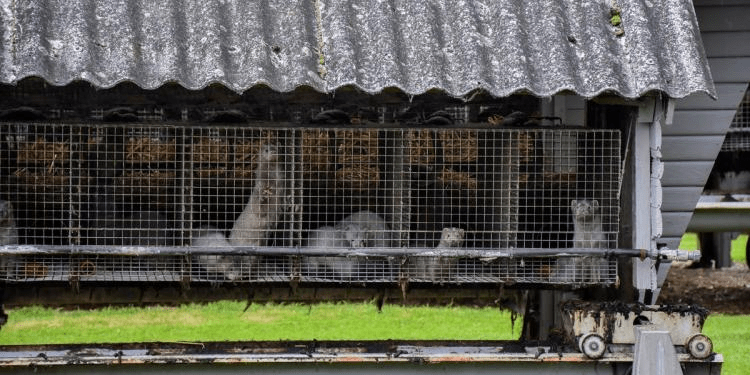
Sweden: Djurens Rätt exposes troublesome links between mink farms and factory farming.

Djurens Rätt exposes troublesome links between mink farms and factory farming

29 May 2023

Djurens Rätt

In a new report, Djurens Rätt has revealed that the mink farms in Sweden directly contribute to the death of a minimum of 30 million fish per year, in addition to the hundreds of thousands of minks killed for their fur. Through feed production, with links to depleted seas and chicken factory farming, the report shows economic incentives between mink farms and other factory farms.

Public opinion has already turned against mink farming for fur in Sweden due to the poor living conditions for animals and cruel killing methods, as proven by the European Citizens’ Initiative Fur Free Europe which calls for an EU-wide ban on fur farming and the sale of farmed fur products. 

The new report reveals a lesser known problem; that Swedish mink farms also contribute to extensive suffering in other species and the loss of at least 30 million individual lives per year. Mink farming was also found to contribute to funding chicken factory farming, which has created economical motivation for farmers to protect the existence of fur farms. Djurens Rätt wants to see a ban on mink farms to combat the problem.

Animal welfare is evidently a part of sustainability, and it is not sustainable to breed carnivores in small wire cages in a system that also contributes to suffering in other industries. The report Djurens Rätt published is more proof that mink farms are unsustainable and need to be phased out immediately

Camilla Bergvall – President, Djurens Rätt

Key conclusions

There would be positive effects for sustainability and Sweden’s biodiversity if mink farms closed.

There are intimate economic links between mink farms and other factory farms, especially within the chicken industry and in fisheries. 

Slaughterhouse waste in Sweden is increasing with rising animal production. It is currently not used in a sustainable way.

Read the report “The troublesome links between mink farms and factory farming”.

Regards Mark