Month: May 2023

Brazil: Live animal exports might be banned in Brazil – setting the scene for the kind of change we want to see in Europe.

Live animal exports might be banned in Brazil – setting the scene for the kind of change we want to see in Europe

9 May 2023

A trial court in Brazil recently ruled to ban live exports, following a number of NGOs filing lawsuits against the practice based on the harm it causes to farm animals. While the decision is not yet final, this is the kind of bold move we need to see European policymakers make against live animal transport in the EU – a system within which millions of poor sentient beings suffer physically, mentally and emotionally each year.

Animals are not things. They are sentient living beings, that is, individuals who feel hunger, thirst, pain, cold, anguish, fear.

Djalma Gomes, federal judge (source).

On April 25, a potentially historic ruling was made by a trial court in Brazil to end live animal exports. This decision was made following the tireless efforts of several NGOs who, since 2017, have been campaigning to end all live animal exports from Brazil after NADA, the largest live cargo transport ship in the country, came under scrutiny for its extremely poor animal welfare conditions.

Brazil’s call for a ban should inspire the EU to look at its own Transport Regulation more closely

While this ruling will not be final until it is reviewed by a higher court (Brazil’s Third Regional Federal Court) – a process which could take years – it’s an extremely promising first step towards changing the country’s live animal export industry in a truly effective way, mirroring a recent move by New Zealand to ban live exports by sea.

Both bans also send a strong message to the rest of the world, that we hope European policymakers take note of: that the live animal export sector is filled with serious affronts to animal welfare, and needs to be addressed at a dramatic scale. Farm animals often suffer hugely on long journeys, whether travelling via land or sea, including by being:

Starved and dehydrated – as they often travel for several hours without being given food or water

Exhausted – due to the strain these journeys put on them, and the impossibility to relax. A WELFARM investigation found animals being transported from Poland to the Franco-German border were kept in their trucks for 20 hours with no breaks

Subjected to overheating – especially when they are being transported in the summer, when temperatures soar

Crammed together – which can cause injuries and further stress to these animals as they are transported, a process which is already entirely unnatural to them.

Not only do these sentient beings suffer immensely on these journeys, but the rules that are already in place to protect them through the EU’s Transport Regulation are not even being adequately enforced. Over Easter this year, our member Essere Animali together with the Italian police stopped seven trucks transporting lambs arriving from Romania, Hungary and Slovakia. Six of these were violating the EU’s transport rules, including by overcrowding the trucks, overlooking injuries to the animals and more. 

Much firmer rules and restrictions: how should Europe’s live animal transport sector be addressed?

In 2019, over 1.6 billion farmed animals were transported alive across the EU and to non-European countries. It’s clear the European Commission’s Transport Regulation needs a serious overhaul if it is to effectively improve the lives of farm animals across Europe, as our extensive white paper on the subject explores in more detail. 

Beyond creating much stricter rules for animals transported between EU countries, however, it’s important that policymakers also consider taking similar steps to Brazil and New Zealand by enacting a full ban on live animal exports to countries outside of Europe’s borders. When animals are transported to third countries, it’s much easier for the EU’s transport rules to go unfollowed. Banning live exports to non-European countries entirely would be the only way to ensure the EU’s high animal welfare standards are not being undermined elsewhere in the world.

Ideally, international instruments for animal welfare will also be developed in future to ensure that animals are protected globally, by strong and enforced regulations that have their welfare at their heart. But Europe can already inspire great change in this area – and improve the lives of billions of European farm animals – by making powerful revisions to animal legislation that prioritise their essential needs and comfort. More insights into animal welfare during transport can be obtained in our 2022 position paper.

We have our fingers crossed that change is ahead

The live animal transport sector has always been notoriously difficult to monitor, as well as one in which the welfare of animals has been easily cast aside. We’re impressed with Brazil’s recent ruling, and hope it inspires policymakers both in Europe and the rest of the world to give the sector the kind of attention it deserves. If it does, the future will look a lot brighter for billions of farm animals.

Regards Mark

India: Congratulations To AAU; 2.5 BILLION Views Showing Their Animal Rescues.

Wow ! – we are so happy to read that AAU has reached an incredible 2.5 BILLION views on YouTube; so very much deserved by all the crew there who make endless sacrifices for the welfare of animals.  We congratulate them on such a fantastic milestone.

If you want to check out many of AAU videos then you can visit all of our past posts at  https://worldanimalsvoice.com/?s=animal+aid+unlimited to see all the wonderful work that our friends undertake.

For starters, watch a blast from the past, showing a mother dog guiding AAU rescuers to recover her puppies from a collapsed building:

Dear Mark,     

We’re proud to share that we have reached nearly 2.5 billion views on our YouTube channel, making our videos the most watched animal rescues in the world. 

We document our rescue stories to inspire people around the world to get involved in helping animals. Whether the viewer becomes a donor, or even just shares the video with a friend, it helps animals in the long run.

We’re thrilled that billions of people over the years have wanted to watch and be a part of helping so many animals. Thank you, because we sure couldn’t do this without you. 

Healing Andy’s burn took months, and wow, we’ve bonded big-time.

This loveable boy was so traumatized by a massive burn wound that we found him in a state of complete despair. Sadly, bulls can be victims of abuse, and often have boiling hot water or even oil thrown on them to scare them away.

His eyes were wide as he innocently tried to bear his terrible pain. We brought him back to our hospital and began what would be a months-long journey of healing for this brave young bull.

Burn wounds can be very difficult to heal because of the damage to the layers of skin. During the course of his stay with us, while he indulged our routine wound dressings and bandage changes, his trust grew, his appetite soared, and he seemed to agree that love and affection feel beautiful! 

For animals who need extra love and care, make a donation today.

Find out how this circling, brain-injured puppy earned the confident name “Breezy!”

Something was very very wrong. Even from a distance we could see that this puppy’s neck was twisted in a terrible way, thrusting his head almost backwards. He had suffered a head trauma, probably hit by a car in a hit-and-run.

Thankfully, a passerby noticed that he was alive and called us for help. We gave him supportive care and treatment for several days while he remained semi-comatose, but on the third day, we were delighted that he wanted to eat on his own. With a little help to stabilize his neck, this little gem seemed to tell us “I’m ready to live!” It took 2 months of baby-steps for Breezy to re-learn some basic motor skills, but wow, he has ’em nailed down now! Meet loving, loveable Breezy today.

Help an animal in their hour of greatest need: Make a donation today.

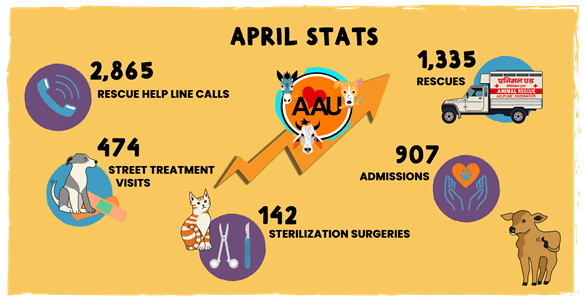
April stats:

Here’s how your support helped animals in April!

On April 22nd we caught the first group of dogs that we brought back to our recently renovated Sterilization Center. After so much planning and organizing, to finally have the first dogs at the center (all such sweethearts) and give them their first bowls of food and water, and prepare them for their surgeries, felt like the real ribbon-cutting. We have already had several animal lovers bring their community dogs for spay and neuter which is heart-warming to see. 

Thank you for your incredibly generous support that makes saving so many lives each month possible. 

Shop here to support AAU:

Animal Aid Unlimited Shop

We thank you deeply for all you do, are, and inspire for animals

Founding family Erika, Claire and Jim, and the Animal Aid Unlimited team.

Regards Mark

UK: A Disgusting Government – The government has allowed animal testing for makeup ingredients to resume despite a 25-year ban. So People Campaign and Fight For What ?

Reproduced from a BBC article – link given at end.

Animal tests for makeup resume after 25-year ban

By Esme Stallard

Climate and Science Reporter, BBC News

5 May 2023

The government has allowed animal testing for makeup ingredients to resume despite a 25-year ban.

It changed a policy on animal testing to align with EU chemical rules, according to a High Court ruling.

The High Court said on Friday that the government was acting legally after a case was brought by animal rights activists.

More than 80 brands have said they are “dismayed” by the government’s new position.

A Home Office spokesperson told the BBC: “We are pleased that the High Court has agreed with the Government’s position in this case. The government is committed to the protection of animals in science”.

Animal testing for makeup or its ingredients had been completely banned in the UK since 1998. Animal testing had only been allowed if the benefits gained from the research outweighed any animal suffering, for example for medicines.

But in 2020 the European Chemicals Agency (ECHA), an EU agency which oversees chemical regulation, ruled that companies needed to test some ingredients used in cosmetics on animals to ensure they were safe for workers manufacturing the ingredients.

During the case it was revealed that since 2019 the government had been issuing licences for animal testing of cosmetic ingredients in line with EU chemical rules, which it retained despite leaving the EU in 2020.

This could include testing chemicals commonly found in foundations and concealers by forcing rats to inhale or ingest them.

It is not known how many such licenses were issued or to whom.

Cruelty Free International (CFI), which brought the case, argued this was illegal and in breach of the animal testing ban for makeup and its ingredients, which has stood since 1998.

Mr Justice Linden ruled in favour of the government, saying that the change in policy still met existing laws, although he said it was “regrettable” the public had not been informed.

The change in the government’s position has been heavily criticised by major beauty and cosmetic brands, including Unilever, Body Shop and Boots. Most major brands have long campaigned to end animal testing.

Cruelty Free International said it was “outrageous” that the government had effectively lifted the ban.

Christopher Davis, director of activism and sustainability at the Body Shop said they would “campaign vigorously” against the changes.

“Allowing animal testing for cosmetics would be a devastating blow to the millions of people who have supported campaigns to end this appalling practice,” he told the BBC after the ruling.

The ingredients that may be tested on animals include homosalate – a common sunscreen ingredient used already in many foundations and skincare products.

In low doses homosalate is safe but in higher concentrations the evidence for its impact on the human immune system are inconclusive.

Manufacturers can now apply for licenses to undertake animal testing before production begins, to ensure the safety of workers. But they still cannot undertake any animal testing to check the safety of the makeup for consumers. This should be done using other methods.

Mr Justice Linden said that nothing was stopping the government from introducing an absolute ban on animal testing of makeup products if it desired.

Cruelty Free International CEO Michelle Thew said: “The case shows clearly that [the government] was prioritising the interests of contract-testing companies over those of animals and the wishes of the vast majority of British people who are strongly opposed to cosmetics testing.”

CFI said it would appeal the decision made by the court and ask the government to reinstate the complete ban in the UK.Dr Julia Fentem, head of the safety and environmental assurance centre at Unilever – one of the world’s largest cosmetic companies – said tests potentially required under the new policy were “unnecessary”, and that safety tests could be carried out without animal involvement.

A new chemicals strategy is expected to be published this year outlining the government’s position on the use and testing of chemicals in the UK – which may include further guidance to cosmetic companies.

Animal tests for makeup resume after 25-year ban – BBC News

Also read  Animal testing for make-up restarts in UK after 25-year ban (msn.com)

Regards Mark

Belgium: New images from GAIA: millions of piglets castrated in Flanders without anaesthesia.

New images from GAIA: millions of piglets castrated in Flanders without anaesthesia

4 May 2023

GAIA

Press Release

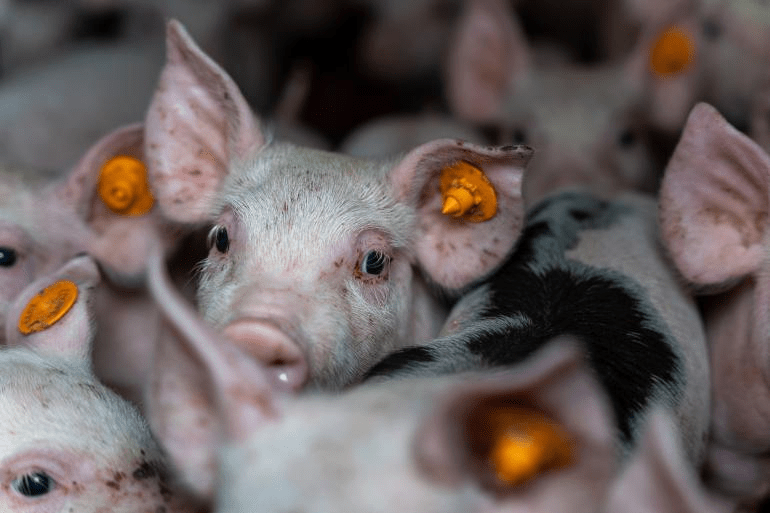
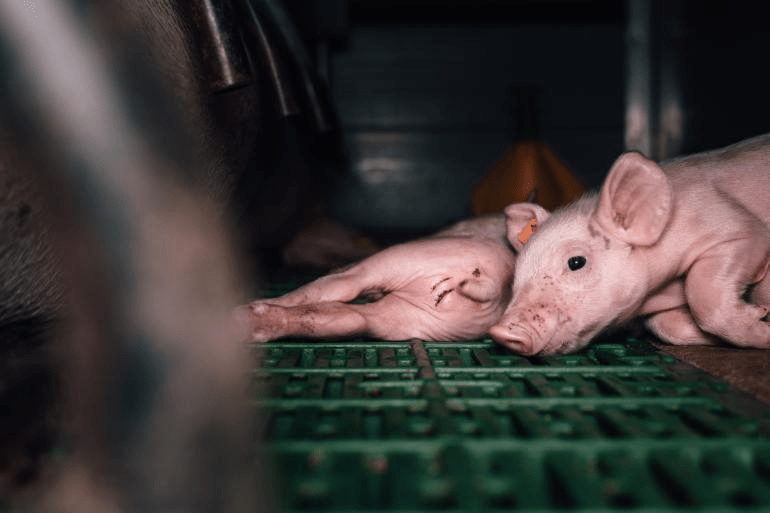
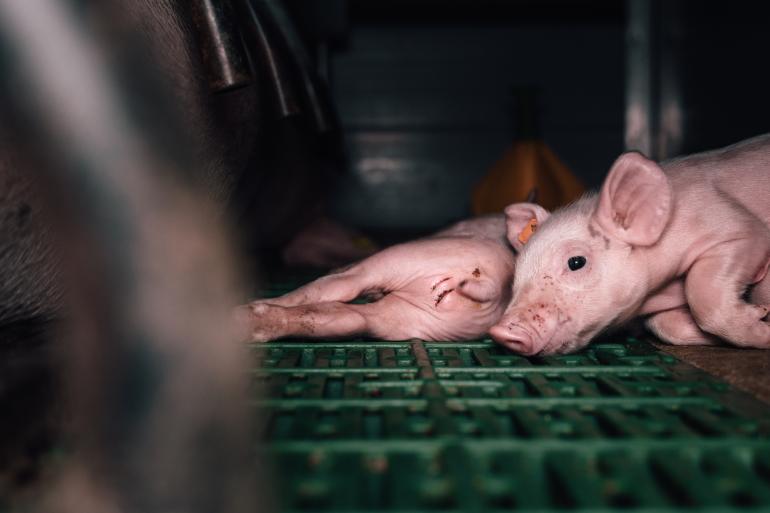
A new investigation from GAIA reveals how painful piglet castration really is. Every year millions of piglets are castrated in Flanders (Belgium) without anaesthesia, and GAIA is launching a petition to stop this practice.

In Belgium, 5 to 6 million male pigs are bred every year and 80% of them are castrated (annually 4 to 4.8 million piglets). The piglet is castrated surgically at three to seven days of age to prevent it from developing the sexual hormones that can affect the meat’s odour in 3-5% of the carcasses, called ‘boar taint’. Alternatives to painful surgical castration exist, namely in the form of a vaccine or raising entire boars.

A new survey by Ipsos shows that 3 out of 4 Belgians (86%) are in favour of a legal ban on the surgical castration of piglets. In The road to end piglet castration report published today, GAIA is calling for a ban on this gruesome practice.

97 to 100% of Belgian piglets (3.9 to 4.8 million) are castrated without anaesthesia and only 85% receive meloxicam, an anti-inflammatory agent, as prescribed by BePork, the Belgian quality label for pork. Although analgesics and anaesthetics, used individually or in combination, can reduce pain or induce unconsciousness during castration, the way in which these substances are used in the field is insufficient to prevent severe suffering. 

The only way to ensure a painless procedure would be to apply the same protocol used for cats and dogs (namely a combination of sedation and gas anaesthesia with pre-and post-operative pain relief). Only a trained veterinarian has the necessary competences to properly follow that type of procedure thus requiring time and costs that the farmers are virtually unable or unwilling to carry.

Both the vaccine against boar taint (15% of Belgian male pigs are vaccinated) and the rearing of intact boars with detection of boar taint at the slaughterhouse (8% of Belgian male pigs are kept as intact boars) are two good solutions and therefore alternatives to castration that pig farmers can use to manage the risk of boar taint, without surgically castrating the piglet. 

Only a legal ban on the castration of piglets will remove the very serious and unacceptable suffering experienced by Belgian piglets during and after castration. Some retailers, such as Colruyt, have already decided to stop selling meat from castrated piglets, and McDonalds Belgium no longer buys it.

Ann De Greef, Director, GAIA

Our battle against the surgical castration of piglets spans two decades. Scientific evidence and public outcry against this practice are overwhelming and can no longer be ignored. There is no justification whatsoever for the European Commission to allow for this painful mutilation to continue and we are confident that the revision of the animal welfare legislation will include a full ban in favour of the tried and tested humane alternatives.

Reineke Hameleers, CEO, Eurogroup for Animals

Notes

Ipsos survey

Video

The road to end piglet castration report


International Conference on Human-Wildlife Conflict and Coexistence.

International Conference on Human-Wildlife Conflict and Coexistence

2 May 2023

Written by Nick Clark

Wandering through the ancient streets of Oxford on the morning of a long awaited conference, I was enamoured by the beauty that human settlements and cities can create. Upon entering the conference, which brought together over 600 experts from all over the world in the iconic halls of Oxford University, my expectations hosted a chance to learn from examples of successful good practices, where humans had learned to adapt to the challenges of living along wild animals.

On my way out of the conference, my optimism had fractured, and was replaced by a deeper understanding of the challenges we face to work towards coexistence, but with newly established relationships which showed a tumultuous, but possible path to improve the outcomes of conflicts for wild animals.

To sum up an extremely well organised, well run, welcoming and highly enjoyable three day conference, filled to the brim with knowledge and expertise; human-wildlife conflict is hard to manage. In essence, and for the record, I agree completely: coexistence will not be achieved without making sure that all stakeholders involved feel their voice has been heard, and that decisions are not made on people’s behalf without their participation. Compromise is key, on all sides. Of course, each situation is different and the challenge of this conference was to mix high level discussions with cases from all over the world, involving humans with their own cultures, beliefs and problems, and animal species with their own unique life history, behaviour and ecology.

The forgotten stakeholder in much of the discussion were the wild animals themselves; voiceless, vulnerable, magnificent, and impressively miss-understood. There was a distinct human-centric approach throughout. I missed recognition of the sentience of the animals being discussed; instead conversations focussed on the benefits generated by animals for people, and how benefits can be shared with different human stakeholders, rather than the intrinsic value of animals, alive, in nature. Alas, few voices raised that it is humans that unsustainably encroach on the habitats of wild creatures, leaving fragmented landscapes with unavoidable boundaries where people and animals compete for the same resources. Lamentably, local communities often suffer the biggest losses from wild animals that have the least to do with the underlying causes of conflict. Yet we expect these people to change their behaviour to accommodate animals? That is a tough one! 

In my opinion, clear and honest communication about wild animals is the first step that is often lacking. Imagine the continued misguided and sometimes manipulative messaging of the “big bad wolf” that permeates our society and much discourse in rural places. Wouldn’t attitudes change if there were more honest brokers in the media?

So let’s briefly touch on the sessions. I felt the need to be in two or three places at once, as the topics of discussions were tantalising. However, I was dismayed to find that the first high level panel What future for large carnivores in Europe? Chasing the elusive state of coexistence included representation of a Hunting Association, without the voice of groups who do not take the lives of animals for entertainment. In general the discussion was nuanced and recognised the growth of wolf populations due to important and successful policies, but called for flexibility in management in areas where populations are rising very quickly. I hoped to raise the point that the Habitats Directive and other conservation tools include built-in flexibility, so long as all other preventative means have been tried and failed. Listening to arguments to use lethal control as a first resort, rather than the last one, without the chance to respond left a jadedness going into the rest of the conference.

My spirits were lifted in the Bridging the gap between science and stakeholders session. In fact, it was stated that there is limited evidence for the effectiveness of both lethal, and non-lethal methods, deepening my conviction that more research into alternatives and their effectiveness is paramount as a first step, before resorting to any lethal decisions. The encouraging projects from the Wolf Fencing Team Belgium sees hundreds of volunteers helping to increase wolf acceptance among farmers by facilitating their shift to wolf-proof fences, reducing the chance for conflict. The session heard, for the first time in the conference, a description of how human society can change to reduce conflict, via reducing our overall consumption habits and our need to alter landscapes. We were also graced with the wisdom of Susan Stone, Founder/Director of the International Wildlife Coexistence Network and Co-Founder at Wood River Wolf Project. She provided compelling evidence that non-lethal methods can cost less money and result in fewer lost sheep than lethal ones, with the importance of using varied methods, temporally mixing them, and understanding when to use guarding dogs effectively. This panel greatly sparked my interest.

Friday saw a flurry of activity, where large carnivores and elephants were once again top of the agenda. I would have appreciated a larger overall range of animal taxa discussed, such as rodents, ungulates, birds or badgers, but this day did see the discussion turn to new conceptual frameworks and fertility control, broadening the scope of the conference. A fantastic session from Adam Grogan of the RSPCA saw the presentation of the International Consensus Principle of Ethical Wildlife Control. These principles are at the core value of how Eurogroup for Animals believes wild animals should be humanely managed, and were all the more pertinent given the strong lack of evidence that lethal management of animals is any better than non-lethal alternatives. In support of this, we published a position paper on seeking alternatives to lethal management.

A highly informative session on the new IUCN SSC Guidelines on human wildlife conflict provided compelling animal welfare reasons why translocation of animals is not always the best option in conflict scenarios, since animals need to re-learn their landscape, and in many cases suffer and die in their new location; or they attempt to travel home to their original habitat, or cause conflict in their relocated territory. Further chapters on livelihoods, poverty and wellbeing were discussed; planning across landscapes; and the importance of designing social research thoroughly. We were treated to a refreshing reminder for scientists to ‘KISS’ (Keep It Simple Stupid), while talking to journalists, though I was left with the question. If we keep it simple, how can we get across nuanced information, as it is often because information is so simplified in the media that can lead to negative, emotional and sometimes incorrect. Just take the idea that at least if you kill a wolf, that wolf can no longer take any more sheep; which ignores the social disruption for the wolf pack and what that might mean for wolf behaviour, or that if the conditions that caused the wolf to venture into that area remain the same, then other wolves are likely to fill the void.

The highlight for me came from the final keynote speech from Gabriela Lichtenstein, IUCN SSC Regional Vice Chair for Latin and MesoAmerica. The spuriously named presentation “A sustainable use perspective turned my frown upside down, when a story of the vicuna (a previously endangered, and smallest camelid species in the world) was recognised as far more valuable alive, than dead, in a project where locals would benefit from protecting the species, and using the wool in an animal welfare conscious and sustainable way. This talk brought together all the elements that the conference was about: participation, local voices and decisions, management plans and benefits sharing. The welfare of the animals was mentioned multiple times, and it even gave me a chance to ask a question and highlight this as a great example of the International consensus Principles of Ethical Wildlife Control in action! Tragically, lobbyists promoting the killing of animals fought hard enough to actually change the policy in the area to actually include the killing again of these lovely animals. It hit me then, that our work is only just beginning, and that animal protection organisations need, and deserve, a seat at this table, and at this conference

All in all, this conference was an eye opening, learning experience, which lived up to expectations, and to the grand location which hosted it. I truly believe that placing the welfare of individual animals at the heart of decision making, while allowing the participation of everyone affected, can lead to better decision making, human attitude and behaviour change, and more successful coexistence strategies. Thank you to the organisers!

Videos from this important conference will be made available here.

EU: No Animal Left Behind: why do farmed fish need specific laws to protect their welfare?

No Animal Left Behind: why do farmed fish need specific laws to protect their welfare?

2 May 2023

Fish are farmed in their billions in Europe, yet sadly, they currently receive little to no welfare protection, and many of their needs are still unknown. Countless fish are farmed in the EU every year in awful conditions where they experience overcrowding, high mortality rates, inhumane slaughter methods, and stress and injuries from routine handling and transport. The European Commission has the power to address these issues when revising the animal welfare legislation this year, by including species-specific laws for fish in farming, transport and slaughter.

Fish are sentient animals with individual personalities, who experience diverse emotions and live complex lives. Importantly, each species of fish is unique and varies greatly from another, which also means that their needs are not ‘one size fits all’. Fish in aquaculture are not domesticated animals – most are carnivorous predators and many of them are solitary animals by nature. 

Just like other animals, their environment impacts their wellbeing, whether its available space, water quality, water temperature, etc., there are a lot of factors to take into account for each fish species. 

Unfortunately, to date, fish have been neglected and misjudged. As our recent exposé revealed, billions of fish are suffering in the EU because aquaculture systems are based on a poor understanding of their needs and natures, and high mortality rates have been accepted with little regard for the welfare of the fish involved.  https://www.youtube.com/embed/dJwhDA63egY?autoplay=0&start=0&rel=0&enablejsapi=1&origin=https%3A%2F%2Fwww.eurogroupforanimals.org The needs of farmed fish have been neglected for too long

These poor beings often spend up to two years: 

Packed in overcrowded conditions where diseases can spread quickly

Being routinely handled, which is extremely stressful for farmed fish and can cause scale loss, skin, fin and eye injuries, muscle bruising, reduced appetite and impaired development

Struggling psychologically, as the farm environment is devoid of stimulation, particularly when compared to the dynamic, ever-changing sea and river environments in which fish evolved to live.

If they manage to survive the farming environment, the journey to slaughter is yet another tribulation, where fish typically undergo:

Starving for days or even weeks, which can increase aggression, competition and stress amongst farmed fish

Crushing as they are lifted out of the water in a large group net

Inadequate transport methods where water quality, water movement, noises and vibrations are severe stressors

A slow death from asphyxiation as the fish are put on ice or into an ice slurry bath which can last for minutes or hours. 

Learn more about these issues on pages 7-9 of our new exposé report

It’s time for the European Commission to protect farmed fish

The European Commission has the power to dramatically improve the lives of farmed fish when they revise the animal welfare legislation later this year. They must factor in strong, precise, and targeted rules for fish welfare that take into account their sentient status and the best welfare practices that we know of. 

They should be handled with care, offered enriching lives and slaughtered in a way that doesn’t inflict intense suffering. There is no substitute for these basic needs. 

We’re trying to change history for farm animals this year through phase two of the No Animal Left Behind campaign

Add your voice to our movement!