Three people have been banned from keeping horses for seven years after admitting neglect.
Kerry Ruth Pugh, 43, and Jessica Paige Pugh, 21, each pleaded guilty to an animal welfare offence relating to a horse called Autumn, which a vet described as the thinnest he had ever seen.
Despite putting on weight after being taken into RSPCA care from the stables at Wellington Heath near Ledbury, Herefordshire, Autumn had to be put down.
Oliver Daelan Fairy, 21, pleaded guilty to an offence relating to another horse, Totti.
Hereford magistrates’ court heard the two horses were found to be emaciated, which was likely to be due to high worm burdens and lack of a suitable diet.
Continue reading each horses story, complete with photos at
JAKARTA (Reuters) – Indonesian Francine Widjojo is hitting the campaign trail with cats and treats in hand to run as a Jakarta legislative candidate and raise awareness of animal cruelty along the way.
Indonesia, the world’s third-largest democracy, will hold presidential and legislative elections on Feb. 14 and campaigns are now in full swing.
On posters scattered across the Indonesian capital, Francine can be seen holding Yakult, a white cat she rescued as a kitten and one of 27 that live in her home.
The 44-year-old walks around town holding a bottle of cat treats with a Yakult sticker, urging people to join her to feed strays in the city.
“One of the issues that I will be fighting for is for Jakarta to be a pet-friendly city,” she told Reuters last month while attending a vaccination event for Yakult, adding that if elected as a Jakarta lawmaker, she wants to increase sterilisation and vaccination for pets in the city.
People in some parts of the Southeast Asian nation are known to consume cat and dog meat and the government has faced pressure from animal rights groups to end it.
The agricultural ministry classified dog meat as not for human consumption in 2018, but that has had little impact on the trade as there weren’t fines that could be enforced on those who sold such meats, activists said.
The government of the Central Java province said it intercepted over 200 dogs that were transported there for consumption last month.
Activists rallied in Jakarta this month to call for a national ban on dog and cat meat trades, according to the animal welfare group The Humane Society International.
Francine, who is running for office with the Indonesian Solidarity Party that is headed by President Joko Widodo’s youngest son, plans to fight against corruption and racial and religious intolerance.
But she said animal cruelty is not commonly addressed in Indonesia, and vows to “fight this together”.
(Reporting by Yuddy Cahya Budiman; Additional reporting by Zahra Matarani; Writing by Stanley Widianto; Editing by Jacqueline Wong)
A ban on cages that applies to imports? California makes it a reality
8 February 2024
As of January 2024, California is now cage-free. This rule applies to all products, including imports, a precedent that should pave the way for the EU.
The ban on cages, known as Proposition 12, was put to a vote and approved by more than 62% of voters in 2018. The legislation bans extreme confinement of laying hens and calves raised for veal from 2022, but pig producers (the biggest sector impacted by the legislation) were given a transition period until the end of December 2023. As of January 2024, the legislation applies to all sectors.
This is one of the most progressive pieces of animal welfare legislation in the world. It will significantly reduce suffering for animals as it sets specific minimum space requirements for animals raised for food, effectively banning cages for laying hens, sows, and calves. The legislation has the potential to improve the lives of millions of animals in California, but also around the world as it bans sales of imported products derived from animals raised in these conditions.
Businesses and producers exporting to California, the biggest economy in the US valued at around $3.8 trillion in 2023, will have to comply with the ban. Producers such as the Canadian pig company DuBreton announced it was Prop 12-certified in November 2023. In the UK, the Red Tractor Certification scheme, which already assesses farms to ensure they meet certain animal welfare requirements, will also give farmers the option for Prop 12 checks.
The National Pork Producers Council (NPPC) had challenged the cage-free rules considering they breached the Commerce Clause of the US Constitution. However, the Supreme Court upheld the right of California to set its own animal welfare standards for all products, regardless of their origin.
Now, the legislation is having a spillover effect across the country. The wheels are turning in Massachusetts, which will impose housing requirements for animals. Michigan also passed a bill which mandates cage-free conditions for laying hens and prohibits the sale of caged eggs by December 2024. At least 15 other US States have already banned sow stalls, battery cages for hens, crates for calves raised for veal, and other practices that negatively impact animal welfare.
Proposition 12 paves the way to include imported products in the much awaited revision of the EU’s animal welfare legislation. At the moment, most of the EU’s animal welfare standards do not apply to imports, thereby making low welfare products from abroad cheaper to import, which fuels cruel animal production in third countries.
As shown in the latest special Eurobarometer on animal welfare, 84% of Europeans believe that something has to be done to change the way we import animal products, either by imposing import requirements or a very strict labelling system.
The European Commission must take the opportunity to listen to EU citizens and adopt more import requirements related to animal welfare.
Limited progress: revision of Annexes III and IV of Directive 2010/63/EU restricted to a few species
7 February 2024
On 4 January 2024, the European Commission launched a public consultation to update Annexes III and IV of Directive 2010/63/EU on the protection of animals used for scientific purposes. Eurogroup for Animals welcomes the efforts to include standards for the care and accommodation of animals and acceptable methods of killing for species previously overlooked. However, we regret that the revision missed the opportunity to update existing provisions for other species.
In October 2023, the Scientific Committee on Health, Environmental and Emerging Risks (SCHEER) issued an opinion in support of a revision of Annexes III and IV of Directive 2010/63/EU, with Eurogroup for Animals contributing input in response to a call for information. Considering this opinion, the Commission launched a public consultation to revise Annexes I and III to VIII to ensure that they reflect the state of technical and scientific progress.
We particularly welcome the newly introduced provisions addressing appropriate housing and care standards for cephalopods, zebrafish and passerine birds, as well as appropriate methods of killing cephalopods. We also applaud the prohibition of using inert gases for killing rodents, a position that we have been advocating for several years. However, the revision failed to seize the opportunity to amend the provisions in these two annexes for other species, despite our repeated calls for an update in the light of recent technical and scientific advances.
In our response, we commented on the newly introduced provisions, while also emphasising the need to update other aspects of Annexes III and IV. In brief, we recommended the following:
For the revision of Annex III of Directive 2010/63/EU on the care and accommodation of animals used for scientific purposes:
Water quality parameters specific to each stage of development for commonly used fish species (other than zebrafish) should be included.
The minimum cage height for rats should be increased to 30 cm.
Nursing rabbits should have a nesting box with an entrance that they can close to isolate themselves from their young in order to minimise stress and aggressive behaviour.
Dogs should always be provided with access to an outdoor run, unless there is a scientific or veterinary justification for not doing so.
The minimum time after birth that macaques are allowed to be separated from their mothers should be revised, to not less than 10-14 months.
For the revision of Annex IV of Directive 2010/63/EU on the killing methods of animals used for scientific purposes:
Confirmation of death by rigor mortis is not appropriate and should be removed.
Methods of killing zebrafish at stages <16 days post-fertilisation should be addressed. Based on the literature, we recommend that the use of a mixture of lidocaine hydrochloride, sodium bicarbonate and ethanol be included as a suitable method of killing.
Birds can experience severe distress and suffering when killed by CO2 and decapitation. These methods should therefore be deleted.
The use of a percussive blow to the head to stun fish can cause unnecessary suffering. Consequently, this method should be deleted.
Rodents killed by decapitation may experience conscious pain before the onset of insensibility. As a result, this method should be deleted.
2040 climate target – EU Commission half-heartedly recognises the role of shifting diets
6 February 2024
Press Release
Today, the European Commission published its communication starting the process for establishing a 2040 intermediary climate target on the EU’s road towards climate neutrality by 2050, yet it fails to recognise the full potential of shifting diets to fully achieve these goals.
The final text no longer includes a reference to a 30% cut in non-CO2 emissions from agriculture, such as CH4 emissions from livestock and N2O emissions from soils. Similarly, parts of the communication recognising the role of lifestyle changes, including dietary shifts, in bringing greenhouse gas emissions down have also been dropped. On a more positive note, the communication stresses the role of the food industry in contributing to food environments making healthy diets an easy and affordable choice for consumers.
The last-minute watering down follows the farmers’ protests which have unfolded across Europe. Policymakers are responding to farmers’ discontent by settling on short-sighted compromises and rolling back climate policies, rather than adopting necessary long-term measures. Yet, the agriculture and food sectors have great potential to enable dietary shifts, reduce climate-harming emissions and improve human and animal health.
The link between dietary patterns and greenhouse gas emissions is now beyond question. It is beyond understanding that the Commission has deliberately ignored it. If we want to be serious on the climate crises, EU policymakers must regulate food environments, and make our food choices healthy and sustainable by default. They must use the One Health approach – in all policies – as a reflex, not a slogan.
Dr. Milka Sokolovic, Director General, European Public Health Alliance (EPHA)
Today the Commission failed to recognise the need for shifting to healthy, plant-rich diets and raising fewer animals under much higher conditions to achieve the EU’s climate objectives. Without such a transition the EU falls short on its ambitions on animal welfare whilst jeopardising its climate, environmental and health objectives.
Reineke Hameleers, CEO, Eurogroup for Animals
However hard the Commission tries to handle farmers with kid gloves, facts are stubborn things: our food and agriculture systems contribute a big chunk of the EU’s climate impact. Consumers are willing to change the way they eat and play their part in the fight against climate change, provided sustainable, healthy food becomes more available and affordable. Now the ball is in the court of the next European Commission, who will have to urgently dust off the overdue Sustainable Food Systems law and put it on the table. Such law must incentivise industry and retailers to better support consumers in the transition.
Monique Goyens, Director General, European Consumer Organisation (BEUC)
This short briefing outlines why shifting diets has a positive impact on health and climate.
I had a really nice e mail this morning from Michelle; who told me about her daughter Katie who is working throughout the month of February with her friends to achieve their ‘Voices for Animals’ badge.
Michelle says – This is a senior badge that explores the connection between humans and animals so they can make informed choices and help others make them too. The badge requires the girls to investigate animals used for science, take a look at animals used for sports and entertainment and dive deeper into animal rights issues.
“Your web page had all of the information we were looking for, so Katie requested I reach out and let you know how much you’ve helped us!”
Well we try to help; and it sounds like some of our posts have helped with your research – great !
Katie’s troop meet on Fridays after school; so in accordance with the request, I am putting this out days in advance.
Well done everyone in the troop for speaking up for the animals – they cannot speak to defend themselves, and so we have to be a voice for them all. I am sure you will all get your badge and pass with flying colours !
Europe should move towards a plant-based food system, the report states
Funding should be moved away from animal agriculture towards “lower-emitting products and activities,” according to Europe’s top scientific advisors.
The European Scientific Advisory Board on Climate Change made the comment in a new report titled “Towards EU climate neutrality.”
Specifically, the board recommends “better aligning the EU’s common agricultural policy with the EU climate ambitions.”
The common agricultural policy (CAP) has been a key part of the European Union (EU) since 1962. The CAP currently takes up about a third of the EU’s budget. The majority goes to subsidies for animal farmers.
Lucia Hortelano, EU Senior Policy Manager, ProVeg International told Plant Based News(PBN): “We agree with this report that subsidies for intensive animal agriculture should be shifted towards the production of more climate-friendly, plant-based foods. This proactive shift will pave the way for a legacy that future generations will deeply appreciate.”
Animal agriculture holds back EU progress
The report from the European Scientific Advisory Board does not introduce any new targets. Instead, it fills in some gaps from previous documents.
One major gap is meat and dairy. Animal agriculture is responsible for around 16.5 percent of global greenhouse gas (GHG) emissions. Despite this, policymakers have ignored food system change as a solution for years. At COP28, the UN Food and Agriculture Organization (FAO) mentioned “benefits” of cutting meat consumption in rich countries but fell short of calling for a transition towards a plant-based food system.
Calls for a plant-based food system have been getting louder. In a recent letter, 250 scientists and experts urged the US Secretary of Agriculture to “address both production and consumption of animal-based foods.” A growing number of councils and governments around the world have endorsed the Plant-Based Treaty.
Now, the EU’s leading climate scientists have acknowledged that animal agriculture is holding back progress on climate change.
Hortelano added: “By prioritizing funding for a climate-friendly initiative, we can contribute to a healthier planet, cleaner waterways, and improved well-being for countless animals. The EU is in a position to set a powerful example to the rest of the world by channelling its finances into research and development, production and export of plant-based foods.”
Subsidies for plant-based transition needed
The report mentions the lack of financial incentives for farmers to transition towards plant-based food as a key issue to address.
The authors note a need to “strengthen measures to encourage healthier, more plant-based diets,” as well as “develop a strategy for a just transition to a food system consistent with climate neutrality.”
This means updating the CAP to support farmers away from emission-intensive animal agricultural. Elsewhere in the report, the scientists are more blunt. The EU needs “concrete policies for delivering a sustainable food system, reducing food waste and encouraging healthy, plant-based diets,” they write.
Despite the report’s strong conclusions, some campaigners and politicians remain unconvinced that it will lead to anything in practice. Anna Spurek, COO of Green REV Institute, told PBN that the European Commission is “spending public money on meat and dairy advertising campaigns, and shelving the draft regulation on a sustainable food system.”
Spurek added: “Work has now started on the Common Agricultural Policy after 2027. But we are under no illusion. Unfortunately, the climate crisis and the planet will not wait – it is time to veganize the CAP.”
Thousands of farmers have been protesting across Europe in recent days, and many gather today in Brussels to denounce the unfair competition brought about by the implementation of Free Trade Agreements (FTA) like the EU-Mercosur, and the resulting poor working conditions and low income.
Friends of the Earth Europe, Eurogroup for Animals and the European Trade Justice Coalition (ETJC) share European farmers’ frustration over having to compete with imported products exempt from the EU environmental, labour and animal welfare standards. As President Macron, who reportedly asked the European Commission to stop the EU-Mercosur negotiations, meets Ursula Von der Leyen today at a summit of European Union leaders, groups reinforce the call to end the EU-Mercosur deal and stop other FTAs in progress.
The crises of climate, workers rights and inequality we face cant be solved by more outdated and unjust trade agreements, negotiated behind closed doors. We need a u-turn on trade policy and to put the planet, and people at the centre. The only reasonable call is for more countries to join France in their demand to put a full stop to this disastrous deal.
Leah Sullivan, Coordinator, ETJC
Environmental, animal welfare, and trade justice NGOs also denounce current populist discourses seeking to blame green and progressive legislations for farmers’ unease. Farmers need fair and stable prices for more environmentally and animal welfare friendly produced food. In order to successfully transition to sustainable food systems and achieve food sovereignty, the EU must uphold the European Green Deal’s farming objectives and reform its Common Agricultural Policy.
When thousands of farmers protest in Europe against unjust free trade agreements, a fight supported by environmentalists and a large part of civil society, how can the Commission still put corporate giants’ economic interests above our common well-being? The negotiations of the EU-Mercosur deal, a toxic and outdated deal, must stop now and for good”.
Julie Zalcman, trade campaigner, Friends of the Earth Europe
If implemented, the EU-Mercosur deal will create further unfair competition between European and South American farmers, reinforce the intensification of monocultures, intensive animal farming and extractive models in South America, and fuel deforestation, pesticide use and human rights violations. Those issues are inherent to the deal and cannot be fixed with a non-enforceable joint instrument, as proposed by the EU Commission.
Even with the proposed joint instrument, the agreement would still increase the risks of animal cruelty, deforestation and human rights abuse due to the EU’s demand for commodities such as soya, beef, and poultry.”
Stephanie Ghislain, Political Affairs Manager, Eurogroup for Animals
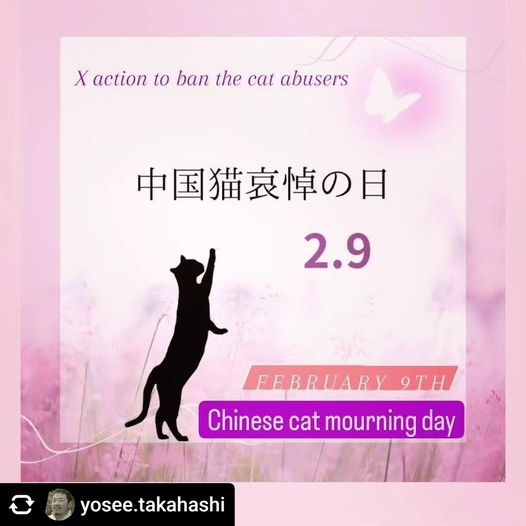
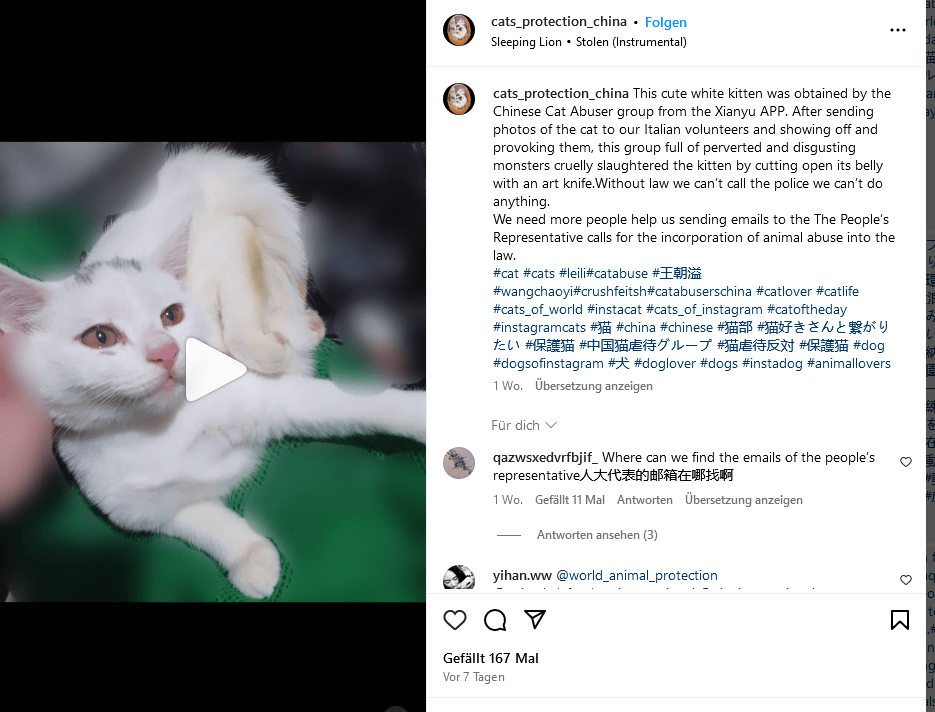
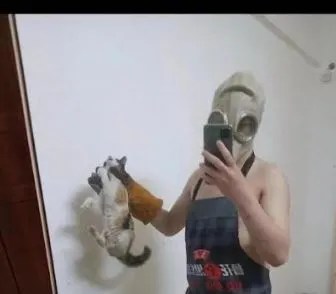
We would like to pay our respects to the cats who sadly passed away in China.
This is an action where everyone can post their thoughts for the cats who died after being tortured and abused by the heartless people of China for decades.
People all over the world are standing up and raising their voices to help these children.
Do you cry every day thinking about the cats in China? Isn’t it painful?
We can never forget it…
On this day, in mourning the loss of Chinese cats, we would like you to post your thoughts about those cats.
Just as you would light incense sticks and mourn when a family member dies, We would like you to post this in a way that speaks to the cats who died in agony and tears without anyone knowing.
Please post one throughout the day on February 9th, without any time limit.














 World Animals Voice