


|
|
|||
|
|
|||
|
|||
|
|||
|
|
|||
|
|||
|
|||
|
|
|||
|

|
|
|||
|
|
|||
|
|||
|
|||
|
|
|||
|
|||
|
|||
|
|
|||
|

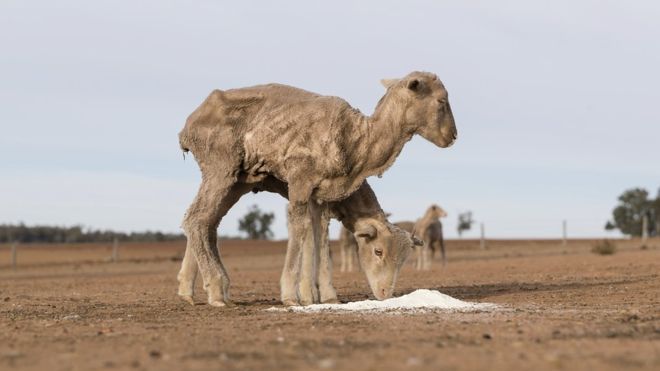
New South Wales drought now affects entire state
Source: https://www.bbc.co.uk/news/world-australia-45107504
Australia’s most populous state, New South Wales (NSW), is now entirely in drought, officials have confirmed.
A dry winter has intensified what has been called the worst drought in living memory in parts of eastern Australia.
NSW produces about a quarter of Australia’s agricultural output. It was officially listed as “100% in drought” on Wednesday.
The state and federal governments have provided A$576m (£330m; $430m) in emergency relief funding.
“There isn’t a person in the state that isn’t hoping to see some rain for our farmers and regional communities,” said NSW Minister for Primary Industries Niall Blair.
Southern Australia has just experienced its second-driest autumn on record, according to the Bureau of Meteorology, with rainfall 57mm (2.24in) below average.
Less than 10mm of rain was recorded in parts of NSW in July, and drier than normal conditions are forecast in coming months.
On Wednesday, officials said 23% of NSW was classified as being in “intense drought”, with the remainder in drought or drought-affected.
But the problem is not confined to NSW – more than half of neighbouring Queensland is in drought. Parts of Victoria and South Australia are also experiencing dry conditions.
On Sunday, Prime Minister Malcolm Turnbull warned that the country had become a “land of drought”.
Farmers have told harrowing stories of failing crops, severe water shortages and being unable to feed livestock.
Some people had spent up to A$10,000 per truckload of hay just to feed their animals, Mr Turnbull said.
“It’s like you are in jail every day,” Queensland farmer Ashley Gamble told the Nine Network. “You turn up here because you’ve got to turn up. It’s just depressing.”
Farmers are already eligible for annual relief payments of up to A$16,000 each. Earlier this week, Mr Turnbull announced additional payments of up to A$12,000.
The prime minister said that although drought was considered “part of the Australian climate”, farmers needed help.
“What we have to is make sure we [the government] back them in when the times get as tough as they are now,” he told the Australian Broadcasting Corporation earlier this week.
However, some have criticised the measure as “too little, too late” and too onerous to claim. Almost 20,000 eligible people are yet to apply for the grant.
No, the so-called millennium drought of 1997-2005 is often cited as the most devastating – it ravaged almost 50% of Australia’s agricultural land.
That event coincided with two El Nino systems, which are often associated with droughts in Australia.
Earlier this year, meteorologists rated Australia as having a 50% chance of experiencing an El Nino in its spring beginning in September.


Pakistan to plant 10 billion trees in bid to combat climate change

Source:
Pakistan’s new government will plant 10 billion trees over five years to combat climate change, it has said.
It is an expansion of the existing “billion tree tsunami” project by new prime minister Imran Khan to restore 350,000 hectares of forest in Khyber Pakhtunkhwa province, according to Climate Home News.
As well as releasing oxygen, the trees are expected to help prevent flooding from glaciers in the north of the country.
Malik Amin Aslam, of the cricket star’s Pakistan Tehreek-e-Insaf (PTI) party, told Climate Home News: “Pakistan is facing the brunt of climate change, so I think climate preparation, making sure our development is totally climate compatible, our infrastructure is resilient to climate shocks, is going to be very high priority.”
Pakistan is one of the countries most affected by climate change and PTI’s manifesto made several environmental pledges including supporting cleaner energy, water-saving initiatives and building dams.
Pakistan has more glaciers than any other country outside the polar region: more than 7,200 in the Karakoram, Himalayan and Hindu Kush ranges, according to the Pakistan Meteorological Department (PMD).
They feed the Indus River system, the country’s water lifeline. But data gathered over the last 50 years shows that all but about 120 of the glaciers exhibit signs of melting, due to rising temperatures, meteorological officials said.
Killer heatwaves ‘will leave parts of China uninhabitable by 2070’
A glacial lake burst in Pakistan’s northern Gilgit-Baltistan province in July, sweeping away villagers’ homes.
Such events are just the start, glacier expert and PMD head Ghulam Rasul told news agency Reuters this week.
“The disasters caused by glacier outbursts in these areas will not stop here. They will continue in the future because there are so many glaciers at risk of bursting,” he said.
Years of deforestation, combined with climate change, have led to a spike in temperatures in the region, which has caused glaciers to melt, Rasul said.
Over the past 80 years, he said, the average temperature in Gilgit-Baltistan has increased by 1.4C compared to a rise of 0.6C in the lower-lying regions of Sindh, Punjab and Khyber-Pakhtunkhwa.
More about: | climate change


|

|


Dear Mark,
Extinction is forever. If we lose the polar bear… the manatee… the orca whale… the sage grouse… the bearded seal… we will never get them back.
Yet the Trump administration just announced alarming plans to dramatically weaken the Endangered Species Act — a landmark law with an astonishing 99% success rate that has been a literal lifesaver for hundreds of species on the brink of extinction.

Trump’s plan is a devastating blow for threatened wildlife. They don’t have a voice to fight back — but we do. Right now, the Interior and Commerce Departments are accepting comments from the public on this disastrous plan.
We need your help to mobilize a massive public outcry that will let President Trump, Commerce Secretary Wilbur Ross, and Interior Secretary Ryan Zinke know we’re watching them — and we will not stop fighting to protect threatened and endangered species.
Make no mistake: This is the biggest attack on the Endangered Species Act in decades. The very agencies that are charged with saving imperiled species are trying to gut the law’s bedrock protections. The proposed rollbacks would:
The Trump administration is giving its friends in the drilling, mining, and logging industries the green light to destroy fragile wildlife habitats and drive our most threatened species to the brink of extinction, just to bolster corporate polluter profits.
The bald eagle, the humpback whale, and the grizzly bear are just a few of the hundreds of iconic species saved by the ESA. It’s no wonder that an overwhelming majority of Americans support the law and want their elected officials to protect it.
At NRDC, we’ve led the fight to add imperiled animals and plants to the Endangered Species List, and we’ve successfully defended vulnerable wildlife like humpback whales and rusty patched bumble bees in court.
Now, we’re fighting tirelessly to protect the Endangered Species Act itself from the Trump administration’s attacks. And if necessary, we’ll take Trump and his allies to court to save the ESA.
But we can’t do it alone. Please join our fight today by calling on the Trump administration to save the ESA — and the countless species whose lives depend on it — while we still can.
Thank you for standing with us at this critical time.
Sincerely,
Rhea Suh
President, NRDC


https://www.bbc.co.uk/news/uk-england-south-yorkshire-45081527

Endangered brown bears rehomed at Yorkshire Wildlife Park
Four endangered bears have been rehomed in Yorkshire after being transported more than 5,400 miles from Japan.
Riku, Kai, Hanako and Amu had been living in cramped conditions ( 3 x 3 metres on concrete only) at a museum on the island of Hokkaido.
All four are now settling in to their new home at the Yorkshire Wildlife Park (YWP), near Doncaster, after being flown from Tokyo to London.
Animal charity Wild Welfare said the bears will receive “rehabilitation, enrichment and lifelong care”.
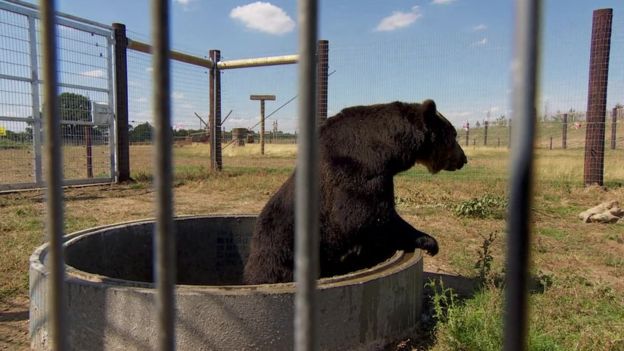
Above – first time ever it has played in water or felt grass underfoot.


TAKE MORE ACTION: EVENTS:
|

None of the photos below are directly associated / published in the article by Chris. – WAV.
Palm oil producers are wiping out orangutans – despite multinationals’ promises

Some of the world’s biggest companies are failing in their pledge to stop deforestation by 2020. Don’t let them forget it.
Few who watch the documentary Red Ape: Saving the Orangutan tonight on BBC2 could fail to feel some sense of responsibility for the desperate situation faced by Indonesia’s orangutans. These extraordinary creatures are our closest relatives, sharing 97% of our DNA. Their similarity to us is astonishing. They are intelligent, inquisitive, smile and show empathy. They even laugh when tickled, like us, when most other animals have evolved to be ticklish only in an itchy, irritating sort of way as a protective reflex. Encountering orangutans in the wild is like nothing else I’ve experienced.
They once thrived in Indonesia’s lush, green rainforests but over the last 50 years they have been forced from their home and killed. In the last 16 years alone, 100,000 Bornean orangutans have been lost. All three species – Bornean, Sumatran and the Tapanuli, a species discovered only last year – are now on the critically endangered list. The reason? It started in the 1960s as forests were logged for timber, but now it’s palm oil.

Global demand for palm oil has increased six-fold since 1990. It’s in half of all packaged products on supermarket shelves and to avoid it completely would be incredibly tricky. Although palm oil in food can no longer be described simply as vegetable oil and must be clearly labelled (thanks to an EU directive in 2014), there is no such law for products such as soap, shampoo and other cosmetics. The supermarket Iceland’s decision to ditch palm oil from all of its own-brand products was, it says, a response to the palm oil industry’s catastrophic failure to halt deforestation and deal with the problem.
Even the Roundtable on Sustainable Palm Oil (RSPO) – the industry body charged with ensuring registered companies trade only in oil that has not come from deforestation – is failing spectacularly. Just over a week ago, Greenpeace exposed massive rainforest destruction in Papua allegedly caused by palm oil companies that are subsidiaries of a current RSPO member. Buying from them were big multinationals including Unilever, Nestlé, Pepsico and Mars. The companies concerned have responded by saying they are taking Greenpeace’s claims seriously and taking appropriate action. But if Greenpeace’s assertions are correct, no company can claim the palm oil it uses is 100% “sustainable”.

Red Ape reveals the truly remarkable work that International Animal Rescue workers are doing on the ground to save these animals. At this crucial stage in their existence, every life saved is vital to their survival. But if we want to save orangutans in the long term, as John Sauven, Greenpeace UK’s executive director, says in the programme, we must save their home – the rainforest. You can sign Greenpeace UK’s petition to support this mission.
Orangutans spend 95% of their lives in the trees, but right now, Indonesia’s forests are disappearing at the rate of one football pitch every 25 seconds. In the absence of industry reform, multinationals such as those mentioned above must take responsibility. In fact, back in 2010 they actually promised to take responsibility. Then, members of the Consumer Goods Forum pledged that by 2020 they would no longer buy palm oil from any company that decreased the net amount of rainforest. But have they done anything about it? Not much, it seems. In fact, in January this year, when Greenpeace asked 16 companies to publish which palm oil traders they were buying from, many refused – although not those listed above.
With rainforest clearance continuing and the Indonesian government boasting a projected increase in palm oil production from 36.5m tonnes in 2017 to over 42m tonnes by 2020, the situation really is dire. And it’s not just orangutans that are threatened. More than 69% of Sumatran elephant habitat has been destroyed within one generation, and there are fewer than 100 Sumatran rhinos left in the wild. People are part of this conflict too. Land grabbing and exploitation of workers, including the use of child labour, is endemic. And decades of deforestation for palm oil have created conditions ideal for furious forest and peatland fires. These fires, often deliberately started by companies clearing the land, threaten the health of people across southeast Asia and drive climate change.

Indeed, if nothing is done, eventually we will all pay the price, since land-use change, mainly from tropical deforestation, accounts for 12% of global carbon emissions. Keeping these forests intact really is vital for all life on Earth. There can be no more delaying until the next decade. 2020 is less than two years away and the burden of responsibility lies firmly with the multinationals. Palm oil can be produced without destroying rainforests but only if big companies support it. I won’t let them forget their zero-deforestation promise. Will you?

• Chris Packham is a naturalist, nature photographer and author

First case of a killed blue whale for 40 years
It is controversial, cruel and forbidden – and yet they did it: Icelandic whalers killed and slaughtered a blue whale. This is reported by the US environmental organization “Sea Shepherd”. Blue whales are threatened with extinction, killing them is strictly prohibited. The outrageous incident is the first in 40 years.
Blue whale hunting has been banned since 1986!
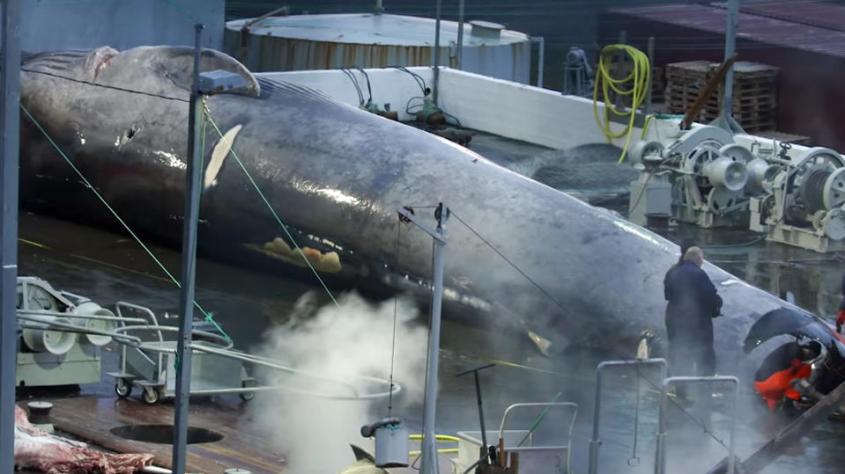
Here the whale is brought ashore, slaughtered and dissected (Photos: Sea Shepard, Hart to Port)
It came into the public eye because volunteers of the environmentalists made videos and pictures of how the whale was dragged to the factory of the company “Hvalur” where it was killed and disassembled.
Blue Whales are the biggest animals of our planet. They grow up to 30 meters long and are threatened with extinction. Worldwide there are estimated to be only 10,000 to 25,000 animals. The hunt for the animals has been banned since 1986.
The hunt for a blue whale 40 years ago was the last to be proven, reports the World Conservation Union IUCN, an international non-governmental organization and umbrella organization of numerous international governmental and non-governmental organizations based in Switzerland.

Here the cruel procedure takes its course.
Industrial whaling dramatically reduced stocks of large whales in the first half of the 20th century. Many species have been or are threatened with extinction.

The whalers do not seem to be aware of any guilt.
Despite growing international criticism whales are still hunted, their meat is considered a delicacy in some countries such as Japan. Whaling is today only operated by a few states.
(Source: rtl.de)
Yes! it is and remains a murder.
And this murder is practiced every day on millions of living beings. All over!!
Because the animal with the two legs, the human animal, despite evolution, despite civilization, regards culinary satisfaction as the highest level of its species development, that makes him an icy killer.
If one – because of education or conviction – can enjoy and eat the body of an animal, though one is well informed about its suffering and torture processes, we speak of a moral problem.
Best regards, Venus


