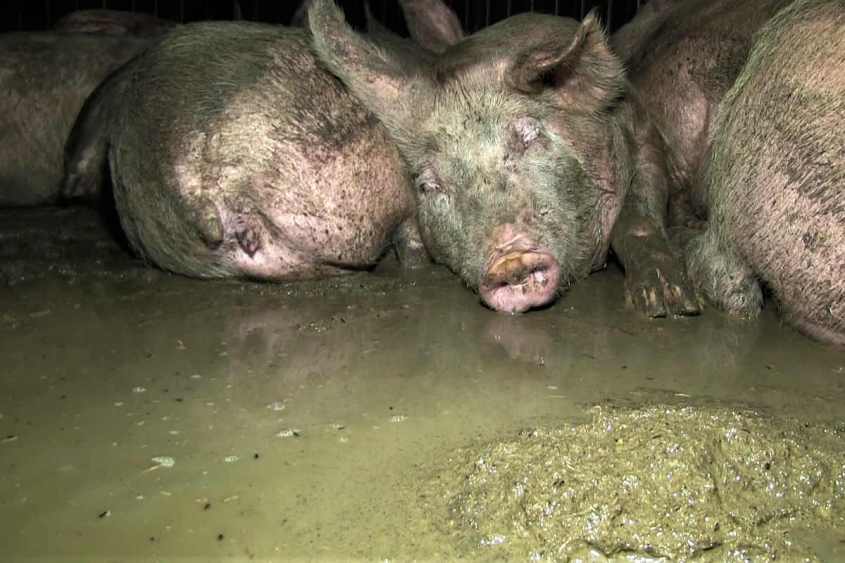
Category: Farm Animals

England: ‘Full investigation’ launched over ‘cruel’ Morrisons chickens grown on Norfolk and Suffolk farms.

‘Full investigation’ launched over ‘cruel’ Morrisons chickens grown on Norfolk and Suffolk farms


‘Full investigation’ launched over ‘cruel’ Morrisons chickens grown on Norfolk and Suffolk farms | ITV News Anglia

Supermarket chain Morrisons says it has launched an urgent investigation after campaigners claimed chickens on farms run by its suppliers are being grown so fast they can barely stand up.

In a video narrated by the naturalist Chris Packham undercover filming claims to show fast-growing birds deformed and dying on farms in Norfolk and Suffolk.

Open Cages, an animal welfare charity, said new breeds of birds that grow fast feed consumers want for cheaper chicken. They claim modern chickens grow 400% faster than those farmed in 1950.

These chicks are born and locked into these giant factory farms. And in only 35 days are forced to grow to a monstrous size. Frankenchickens are cheap and efficient. Basically all cheap chicken will come from Frankenchicken breeds . People look at this footage and they will think that this is an anomaly – they’ll ask me if something illegal is happening here but no this is perfectly legal.

Connor Jackson, Open Cages Chief Executive

The organisation filmed in four intensive chicken farms in May and June. 

Those farms supply the Cranswick chicken factory which provides meat for Morrisons labelled Red Tractor approved, something designed to reassure people of high standards. 

ITV News approached Red Tractor for a comment but have not had a response at the time of writing. 

TV naturalist Chris Packham said it is ‘cruel beyond belief’ and is calling for Morrisons to sign the Better Chicken Commitment which would mean only slower growing chickens are used.

Other retailers like M&S, Waitrose and KFC are among 240 companies across Europe to commit to stop selling the fast growing birds. 

In a statement Morrisons say they have launched a ‘full investigation’ and that they ‘care deeply about animal welfare’.

We care deeply about animal welfare and require all our suppliers to maintain the highest standards. We have asked Cranswick to conduct a full investigation and get back to us.

Morrisons

Cranswick have yet to respond to our requests for comment, but elsewhere the company has said “we take the welfare of chickens at our farms very seriously and it is always our first priority.”

ITV news has not been able to independently verify the footage that came out of the farms. The video is also edited so may not reflect overall conditions the chickens face.

Morrisons Related:

Morrisons Misery.com

it’s #MorrisonsMisery for Chickens!

FrankenChicken:

Morrisons claims to “take animal welfare seriously.” However, despite horrific animal suffering in its supply chain, it has refused to sign up to the Better Chicken Commitment. These scientific measures are backed by over 40 animal protection charities from across Europe. Bred to grow so fast their bodies can’t keep up, ‘FrankenChickens’ sold at Morrisons are living lives of misery. It’s time for change. When will Morrisons hold true to their word and take this issue seriously?

BRED TO SUFFER

Birds have been so genetically manipulated that they grow to be three times as large as they would without such invasive tampering — and in less time. This accelerated growth leaves birds crippled under their own weight and causes a myriad of other problems.

TRAPPED IN FILTH

Industrial farming operations house hundreds of thousands of birds inside filthy, windowless sheds. Due to this severe overcrowding, these birds are provided slightly less space than a sheet of paper to live on. Often they are unable to walk and lie in ammonia-laden litter causing sores and respiratory problems.

Regards Mark

Australia: Live Exports – Update From Stop Live Exports.org.

Friday 13th August 2021.

Dear members and supporters

It’s been a while since you’ve heard from us, we know. There have been a few changes!

The current pandemic has made it challenging to hold the usual events we do, as we can’t accurately predict how many people will turn up, or if the event will be able to go ahead. We are still here though, monitoring situations at home and abroad, commenting on media and industry stories regarding yet more atrocities for Australian animals, this time in Indonesia, Jordan, and UAE.

Our other focus is on the up-and-coming federal election, now expected to be sometime from March to May 2022. We have also been busy developing new branding to maximise our effectiveness (it’s been over a decade since the last one.)

Some of you will be aware that I moved to Tasmania in May this year. I am still doing the job I have been doing for the past nine years, as much of the work is done remotely, and what can not be, is undertaken by our volunteers. The committee has some fresh blood, and a new president, Rebecca Tapp. They are dynamic, enthusiastic, and have some great ideas. Our committee continues to meet regularly, and I join in via Zoom.
Here is a photo of some orphaned lambs I recently adopted – Buster and Lucille. Unlike the tens of millions of other Australian sheep, they will have a long, safe, and happy life.

Sadly, we will not be holding a quiz night this year, as the planning is quite demanding and time-consuming, and with the situation in other states thanks to the Covid-19 delta strain, we just feel everything is too unpredictable to hold that event this year.

However, the Human Chain will go ahead on Sunday 17 October, unless there are any restrictions on attendance numbers or social distancing, in which case we will also opt to defer for a year. We have had over 1200 people attend in the past, which is not ideal for an event that requires a Covid Plan. Please keep an eye on your emails and our Facebook page for any last-minute changes.

You might have read in the media over the past month, that there have been yet more ESCAS breaches reported in Indonesia (thanks PeTA), Jordan (the one Middle Eastern country we export to where a royal family edict requires animals slaughtered in government facilities to be stunned first), and UAE (thanks Animals Australia for both exposés). There is also another complaint lodged by Animals Australia regarding cattle being leaked from the supply chain in Indonesia, but this has not yet been reported on by the media.

In this, the tenth year of reporting and investigations of Exporter Supply Chain Assurance System (ESCAS) breaches, STILL we are seeing animals mistreated and being channelled out of supply chains and treated horrifically at slaughter. Surely, after a decade of ESCAS, a one-strike rule should apply to any country not strictly adhering to ESCAS regulations.

Fremantle has been quiet, with only four ships in total docking since the northern summer trade moratorium started on 1 June. Three ships loaded feed and continued to Portland, and one loaded cattle bound for Mauritius. Liberal MPs have recently called for a dramatic shortening of the 1 June to 17 Sept moratorium on live animal exports to the Middle East, stating that it can be done successfully. This is despite records from the last monitored shipment that left in that season, showing that sheep were subjected to days of wet-bulb temperatures of up to 34 degrees (sheep suffer from heat stress once wet-bulb temperatures exceed 28 degrees). So despite their claims that “only” 28 sheep died and the voyage was, therefore, a success, one can be assured that every single animal on board suffered to some degree with wet-bulb temperatures at that level.

In 2018, the Labor Party pledged to phase out live sheep exports in under five years. We urge you to contact your Labor MP and ask them to not go back on their word. With a federal election now expected in 2022, please remind them of what their constituents want – an end to all live export, but at the very least, a cessation of the live sheep trade; this would likely also see an end to any cattle being sent by sea to the Middle East, as it would no longer be cost-effective. Whilst the aim of our organisation is to end the trade in all live animals, we see the live sheep trade to the Middle East as the priority, both because of the length of the voyages, and the lack of stunning in all but one destination country. Animals Australia has made it easy for you – just click here.

We are so grateful for your unwavering support, which has been vital in helping us continue our important campaign to end the live export trade. Though we have experienced a drop-off in donations and memberships due to the global pandemic, we have a solid, strong community that stands steadfast and determined to stop this trade once and for all. Thank you for everything you do for the animals.

If you are unsure of whether your membership or monthly financial pledge is still current, or you wish to recommence membership or monthly donations or increase or decrease the amount, feel free to get in touch with me at  info@stopliveexports.org and I can assist. If you know you are no longer a member or have never been a member, sign up here, and if you wish to start or recommence monthly donations, which greatly help us fund our ongoing campaign, sign up at GiveNow here. You can pay via credit card or direct deposit; weekly, monthly, quarterly, or annually, or make a one-off donation.

Follow us on Facebook for all the latest.

For the Animals

Katrina Love
Campaign Manager

Regards Mark

US-Pennsylvania: “humane” turkey farm

If you’ve ever shopped at Whole Foods, you may have seen signs posted in the meat department that say things like “enriched environment” and “treated humanely.”
But what a PETA investigator documented at a series of Pennsylvania turkey factory farms tied to a Whole Foods supplier reveals that these signs are probably worth less than the recycled paper they’re printed on.

Farm workers feeding “humanely raised” turkeys to stores such as Whole Foods were filmed torturing animals.

The horrifying masked footage obtained by a worker who was secretly doing a side job for People for the Ethical Treatment of Animals (PETA) also shows that the worker is trampling, kicking, and beating birds.

Taken at Plainville Farm in New Oxford, Pennsylvania. The farm also supplies stores such as Publix and Harris Teeter. After being fatally injured by a worker, the bird was photographed cramping in pain and left to die on the concrete floor of a harshly illuminated barn.

The footage was shot by PETA activists who worked 11 shifts in 10 different plain buildings in July and August this year, claiming that the company is “humanely” raising birds in a “stress-free environment.”
Pennsylvania police have been investigated and told the New York Post Thursday that their animal cruelty office is “currently” reviewing information from animal advocacy groups.

Workers on a plainville farm can be seen picking up large birds with fragile wings and necks before throwing them into the air across the farm.

“Instead of trying to stop this abuse, one supervisor himself kicked a turkey and repeatedly encouraged workers to abuse the bird,” PETA said.

It is about “terrible atrocities.

“A worker picks up a bird, tries to break his neck, and then puts her between his legs. When he hugs her with an injured neck, he mimics masturbation,” PETA reviews from DailyMail.com.

It is stated in the video. [The worker] Then drop her on the floor, kick her, and let her die.

The disturbing footage shows workers picking turkeys with their necks and fragile wings, throwing them across the room “like a game” to each other and to other turkeys.

Workers can also be seen kicking injured or dying turkeys on the ground.

Continue reading “US-Pennsylvania: “humane” turkey farm”

UK: UK-Australia Free Trade Agreement sets a dangerous precedent for Animal Welfare. Do Johnson and Liz Truss Care ? – Probably Not.

UK-Australia Free Trade Agreement sets a dangerous precedent for Animal Welfare

After several weeks of anticipation, the UK and Australia announced on 15 June that they have reached a political agreement on a trade deal. The future Free Trade Agreement (FTA) will grant huge trade preferences to Australian beef and sheep meat, with no further condition on animal welfare standards. This is a dreadful precedent for UK trade policy.

The Agreement in Principle, published on 17 June, confirms that the FTA will open duty-free and unconditional tariff-rate quotas (TRQs) for beef and sheep meat, starting at 35,000 tonnes for beef and at 25,000 tonnes for sheep meat. In both cases, the volume is set to increase over ten years (up to 110,000 tonnes for beef and 75,000 tonnes for sheep meat yearly), after which the TRQs will be replaced by unconditional liberalisation, accompanied by safeguards for another 5 years. 

This result is a huge disappointment for the animal welfare movement. As most UK animal welfare standards are not applied to imports, such a trade deal is likely to fuel intensive and unsustainable farming in Australia, which is extremely detrimental to animal welfare. For instance, feedlots are common practice in Australian beef production and transport rules allow for journeys of up to 48h without food or water. The UK committed to use trade deals to promote animal welfare abroad. Yet, by abandoning the possibility to condition preferential market access to the respect of UK-equivalent animal welfare standards, it renounces to the best tool to achieve this purpose. Conditional liberalisation was part of the calls expressed by the Trade and Agriculture Committee (TAC) earlier this year. 

Similarly to the EU-Mexico Global Agreement, the UK-Australia deal is set to include a chapter on Animal Welfare and Antimicrobial Resistance (AMR). This is welcome, but the language described in the Agreement in Principle lacks ambition. The UK government is likely to depict the inclusion of non-derogation and non-regression clauses in this chapter as a victory , however, considering the low level of Australian animal welfare standards, a commitment not to lower such standards – or not waiver them – is hardly a ‘success’. In addition, non-derogation and non-regression clauses can usually only be activated when the derogation to or regression of the standards has an impact on trade or investments, which is very hard to prove. 

Allowing such cheap low quality imports in the market in Great Britain will have various implications. In addition to further fueling unsustainable practices in Australia, the massive market access granted to Australian beef and sheep meat could undercut English, Scottish and Welsh farmers, as they remain subject to higher standards – and thus, higher costs. For farmers in England and Wales, this comes at a time when they begin to transition to a fundamentally new type of income support system, one that rewards them solely for better environmental stewardship and for better animal husbandry. If not well managed, this new system could potentially lead to a lowering of the availability of higher welfare British products, and thus to a greater share of lower welfare imports. In addition, central and devolved governments in the UK have set out a range of ambitious agendas to improve farm animal welfare- notably within England – and the lack of measures on imports could well diminish the support for these reforms among farmers in Great Britain. 

By negotiating very fast, without even having published a trade strategy, the UK seems to have sold out animal welfare for the sake of a quick deal. Addressing animal welfare in trade policy requires a long term vision and an understanding of the far-reaching interlinkages between animals and trade. The UK-Australia deal is thus a very bad precedent and does not bode well for future negotiations with the US, Mercosur or India.

Regards Mark


The World’s Largest Restaurant Chain Commits to Improve Chicken Welfare.

The World’s Largest Restaurant Chain Commits to Improve Chicken Welfare

Subway has announced the commitment to improve chicken welfare in its European supply chain by 2026.

August 12, 2021

HISTORIC PROGRESS: On Wednesday, August 11, Subway announced the commitment to improve chicken welfare in its European supply chain by publicly committing to the European Chicken Commitment (ECC). This was not an easy feat, it took 22 non-profit organizations from 16 European countries and 1.5 years of campaigning to push the company to this end. Subway had already committed to the North American version of the ECC, the Better Chicken Commitment, for all its US and Canadian stores.

THE COMMITMENT: Subway now joins the growing list of hundreds of companies that have pledged to improve chicken welfare in their supply chains by adopting the European Chicken Commitment. Other prominent brands include Burger King and Popeyes. The ECC requires companies to provide chickens more space, natural light, enrichment such as perches and pecking substrates, and bans the use of fast-growing breeds, which can cause painful deformities and heart attacks.

Protest in Verona, Italy

THE FORCE BEHIND IT: Animal Equality played a major role in this campaign along with other coalition members of the Open Wing Alliance. We sent campaigners to Amsterdam to protest and attempted to meet with Subway’s leadership, held protests in Italy, Spain, and the UK, and activated our social media networks where thousands of animal advocates from all around the world took part in highly impactful digital actions. Subway couldn’t ignore the importance of raising their animal welfare standards any longer.

THE IMPACT: As of June 2021, Subway has approximately 37,500 locations in 104 countries and territories, and an annual revenue of around $10 billion. This policy commitment not only will positively alter the lives of millions of chickens used in Subway meals, but this commitment also sets a strong precedent for future campaigns to improve farmed animal welfare in the restaurant industry.

WHY IT MATTERS: Chickens raised for meat are among the most abused animals on the planet. Bred to become much larger than normal, at an alarmingly unnatural rate, fast-growing chickens suffer from broken bones, organ failure, and even death from not being able to reach food and water. They are kept in filthy conditions, crammed by the tens of thousands in dim barns that have no enrichment for the chickens to engage in natural behaviors. At the end of their shortened lives, chickens are forced to endure live-shackle slaughter, a horrific practice where birds are forcibly hung upside down and slammed into metal shackles, a process which sometimes breaks their bones. The ECC aims to address these major abuses faced by chickens used for food.

HOW YOU CAN HELP: This major step in animal protection happened because of the actions of passionate animal lovers and those who believe in progress in animal welfare. Animal Equality’s volunteers, the Animal Protectors, played a significant role in achieving this move forward for hens, as well as other corporate policies. Would you like to be informed of easy online actions you can take for animals? Sign up to become an Animal Protector today!

Regards Mark

England: GOOD FARM ANIMAL WELFARE AWARDS GO VIRTUAL – From CIWF London.

GOOD FARM ANIMAL WELFARE AWARDS GO VIRTUAL

Good Farm Animal Welfare Awards go virtual | Compassion in World Farming (ciwf.org.uk)

Today (24th June), we hosted our virtual Good Farm Animal Welfare Awards.

The annual awards were streamlined this year to allow businesses affected by the COVID-19 pandemic to progress towards the delivery of their existing animal welfare commitments. But, despite a difficult 12-months for the industry, we are pleased to recognise 10 leading food businesses for their inspiring and often innovative work in the field of farm animal welfare and sustainable food production.

CLEVER MARKETING PUTS ANIMAL WELFARE ON THE POLITICAL AGENDA

This year’s Best Marketing Award was presented to French, higher welfare poultry producers, Les Fermiers de Loué, whose clever combination of humour and political relevance generated huge public interest with their street marketing campaign promoting their higher welfare credentials.

INNOVATION IN ANIMAL WELFARE

Hilton Seafood UK and Danone both received Special Recognition Awards for their innovative work and their capacity to provide a global baseline for best practice in animal welfare. Danone stood out for its global assessment tool for dairy cow welfare and Hilton Seafood UK’s more humane method of slaughter of King Prawns will benefit more than 100 million animals in its first year, with the potential to benefit billions of animals across the industry!

CHAMPIONING ‘LESS AND BETTER’

Italian manufacturer Barilla was awarded a Special Recognition Award under the Planet Friendly banner for successfully implementing cage free eggs across its entire operation in over 100 countries, benefitting over 2 million hens each year. In addition, Barilla has significantly reduced its greenhouse gas emissions, by decreasing its use of egg as an ingredient and by the impressive achievement of offsetting three of its brands’ CO2 emissions completely.

SUSTAINABLE FOOD AND FARMING ACCOMPLISHMENTS

Small producers Lynbreck Croft and Hollis Mead Organic Dairy were awarded in the Sustainable Food & Farming category for producing higher welfare meat, dairy and eggs in ways that protect, improve and restores wildlife and the environment.

McDonald’s UK & Ireland was a worthy winner of a Sustainable Food & Farming Corporate Award for their Regenerative Beef Project. Their rotational grazing approach helps to rebuild the soil, recharges watersheds and increases biodiversity. With over 4 million customers every day to McDonald’s in the UK alone, this project demonstrates the game-changing potential for the industry.

GOOD EGG AND RABBIT ACHIEVEMENTS

Leading Italian producer, Galbusera, received a Good Egg Award for its commitment to sell only cage-free eggs, and Chinese producer Happy Eggs received the very first Good Egg Award in China. Additionally, Nature d’Eleveurs owned by LDC in France received a Good Rabbit Commendation for committing to higher welfare, cage-free production for fattening rabbits.

OVER 2.2 BILLION ANIMALS BENEFITTING

I’m humbled to share that, since our Food Business programme and awards began in 2007, the total number of animals benefitting is over 2.2 billion,” says our Global CEO, Philip Lymbery. “This is a truly amazing impact, which fills me with great hope for the future, for animal welfare, humankind and our planet. I’d like to congratulate and thank all of this year’s winners for all they are doing to make life better for millions of farmed animals.”

Read more about our Food Business impact.

Regards Mark

USA: For US Citizens To Sign – Tell Costco That Animals Deserve Better.

ASPCA

This is for US citizens to sign.

A recent investigation by Mercy For Animals into a chicken farm supplying wholesale grocery giant Costco revealed absolutely horrifying conditions. Tens of thousands of birds are spending their short, painful lives crowded together in sheds—many suffering from open skin sores and agonizing injuries related to their hyper-fast growth rates.

Whatever you eat, we can all agree that this is not okay. Costco needs to hear this from its customers and the American public.

Sign our open letter to Costco below, which we’ll deliver to executives as we ask them to address this urgent issue by adopting meaningful and transparent animal welfare standards.

Action Link – Tell Costco: Animals Deserve Better | ASPCA

Regards Mark

GROUNDBREAKING: Plant Based Food Market To Skyrocket To $162 Billion, Says Bloomberg.

GROUNDBREAKING: Plant Based Food Market To Skyrocket To $162 Billion, Says Bloomberg

A new report by Bloomberg Intelligence has found that the plant-based meat and dairy sectors are growing at an unprecedented rate

A groundbreaking new report has predicted that the plant-based food market will exceed $162 billion within the next decade. A growing preference for sustainable, healthier foods is pushing the movement.

‘Explosive growth’

Bloomberg Intelligence (BI) produced the report, called Plant-Based Foods Poised for Explosive Growth. BI provides research on more than 2,000 companies, 135 industries, and all global markets. 

The plant-based food market was valued at $29.4 billion in 2020. This means if BI’s predictions are correct, the market will soar by 451 percent. 

Major plant-based meat and dairy brands like Beyond Meat, Impossible Foods, and Oatly are driving some of this growth. Their partnerships with restaurants, fast-food chains, and global food manufacturers are making vegan options more accessible to the masses. Additionally, the collaborations are challenging stereotypes around plant-based food.

Source: Bloomberg Intelligence, OECD FAO Agricultural Outlook 2021-2030, GFI 2020 State of the Industry Report

‘Here to stay – and grow’

According to BI’s Senior Consumer Staples Analyst, Jennifer Bartashus, the meat-free movement isn’t slowing down.

“Food-related consumer habits often come and go as fads, but plant-based alternatives are here to stay – and grow,” she said.

“The expanding set of product options in the plant-based industry is contributing to plant alternatives becoming a long-term option for consumers around the world.” 

Vegan dairy, in particular, could take up 10 percent of its global market shares in the next decade. Meanwhile, BI predicts that the alternative meat market will surge from $4.2 billion to $74 billion in the next decade.

But plant-based meat sales could actually surpass $74 billion, hitting $118 billion by 2030. This would be ‘a more aggressive but still realistic scenario’, BI said.

Population growth

The planet’s ever-growing population could also tip the scales in favor of plant-based eating as resources become more scarce. 

The production of meat and dairy products requires significantly more resources than plant-based foods, including water, land use, and crops. Experts have warned that our current food system won’t be able to support the world’s snowballing population.

A 2018 study published in Elementa: Science of the Anthropocene found that we already grow enough food to feed the 9.7 billion people that are anticipated to be on Earth by 2050. But large amounts of it are funneled into animal agriculture.

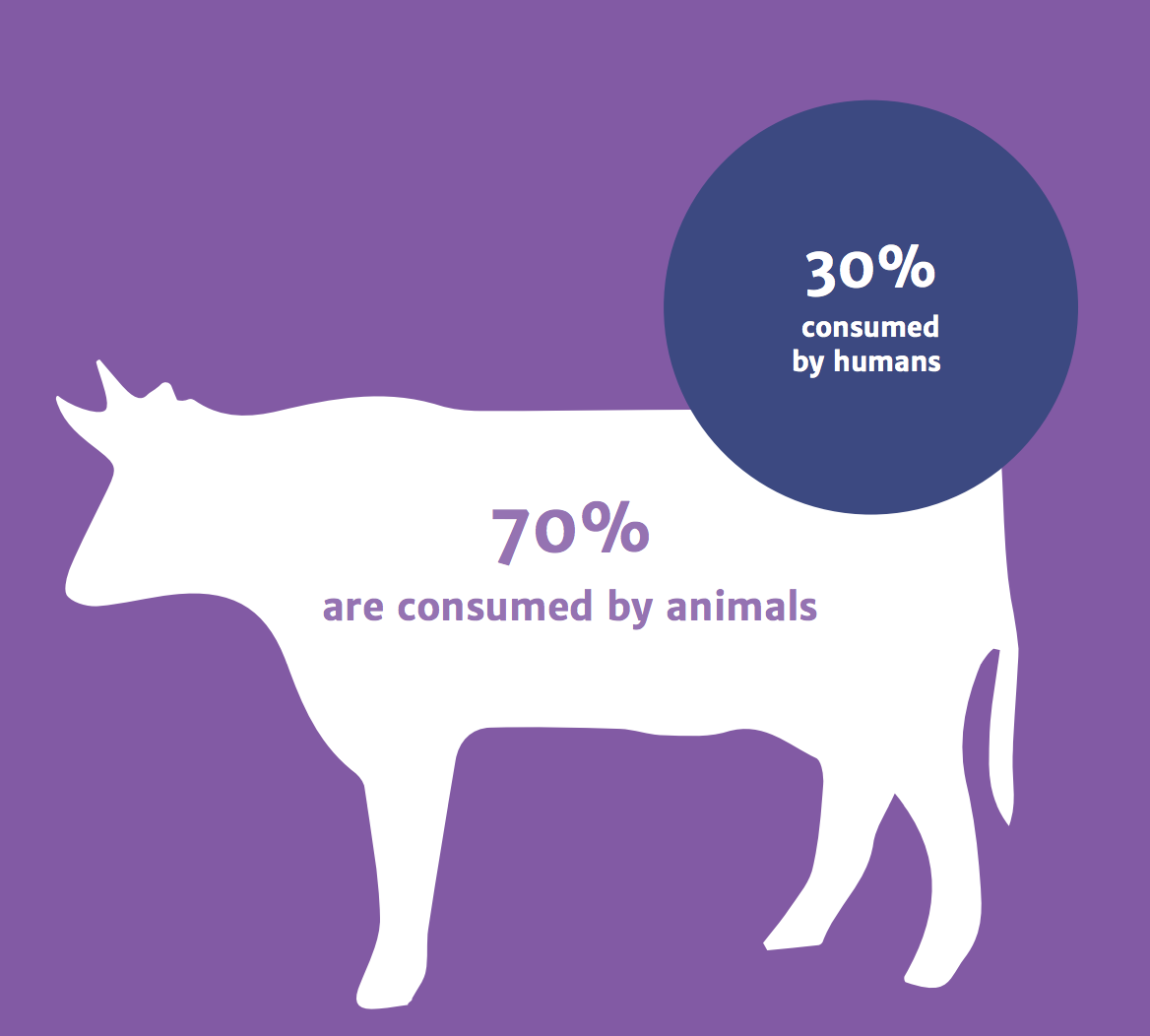
Livestock consume roughly 34 percent of global crop production, the study found. Less than half of the world’s cereals are consumed by humans. 

Flexitarians

The number of vegans in the world climbs higher all the time. Currently, around 5 percent of the population identifies as vegan, BI’s report noted.

But it’s not just vegans and vegetarians driving the plant-based market. Flexitarians are boosting it in a big way, too. Flexitarianism refers to lifestyles whereby people mostly eat plant-based foods but occasionally include animal products in their diet. BI named flexitarians a ‘key demographic’ for alternative meat products, now making up a third of the US population.

https://plantbasednews.org/news/economics/plant-based-market-skyrocket/

Regards Mark

Nestlé’s Meal Delivery Service Launches 6 Vegan Options For The First Time; and Wunda Pea Milk Also.

Nestlé’s Meal Delivery Service Launches 6 Vegan Options For The First Time
Freshly just introduced six new vegan options Credit: Freshly

Nestlé’s Meal Delivery Service Launches 6 Vegan Options For The First Time

Freshly is seeing growing demand for meat-free, plant-based options

Nestlé-owned brand Freshly just launched its first-ever vegan ready meal range.

Freshly is a weekly subscription service that delivers fresh, cooked meals. A team of chefs and nutritionists developed the meals without artificial ingredients, chemical preservatives, and highly processed sugars.

Purely Plant

Freshly is introducing six plant-based options under its Purely Plant brand. Customers can reheat the meat-free meals in around three minutes.

The vegan items include the Creamy Buffalo Cauli Mac and Cheeze, Farmstead Baked Pasta with Melty Cashew Cheeze, and an Indian-Spiced Chickpea Curry Bowl.

Freshly also offers a Moroccan Herb Falafel Bowl, the Rainbow Harvest Plant-Based Burger, and its Unwrapped Salsa Verde Burrito – also known as a ‘naked burrito’.

Surging demand

Demand for plant-based food climbs higher all the time. A report from earlier this year found that the US vegan food market increased by 27 percent during 2020.

This is nearly twice as fast as the total US retail food market, which grew by 15 percent.

According to Freshly, 65 percent of its customers identify as ‘flexitarian’. Flexitarians eat mostly plant-based meals but occasionally consume animal products.

Freshly Founder and CEO Mike Wystrach said the company is ‘thrilled’ about the new additions.

“We’re thrilled to provide our customers with a convenient way to incorporate minimally processed, plant-based meals into their routines,” he said.

“We recognize that it can be challenging to eat a more plant-based diet without sacrificing on taste; but with the launch of Freshly’s Purely Plant, we’re laser-focused on delivering a variety of delicious, convenient, and better-for-you meal options, while also supporting flexitarians looking to make simple changes towards a more plant-based lifestyle.” 

Nestlé controversy

Some consumers may be weary of supporting Nestlé for ethical reasons.

The world’s largest food and beverage company has been accused of using child labor, unethical water mining, and causing significant deforestation.

Read more about the issue here.

Nestlé To Launch New Plant-Based Pea Milk In UK Stores Next Week

The Wunda range is rivalling Swedish plant-based giant Oatly on its quest to ‘offer something different to what’s already on the shelves’…

Nestlé is bringing its range of plant-based pea milk to UK stores next week under the Wunda brand.

It comes after the food giant launched in Europe last month.

Wunda pea milk

The Wunda range is made from protein-packed yellow peas sourced in France and Belgium and promises to offer ‘strong nutritional value’ in comparison to similar products on the market.

Nestlé claims the range is high in fiber, low in sugar and fat, and enriched with calcium. Moreover, they are a source of vitamins D, B2, and B12.

Customers in the UK and Ireland will be able to find the products in Tesco and Coop stores from June 28. And, each 950ml carton retails at £1.90.

Nestle is set to launch its Wunda plant-based pea milks in the UK and Ireland later this month
We want to offer a drink that tastes great and makes using a plant-based milk alternative a tasty, positive, no-compromise experience’ Credit: Instagram

Nestlé launch

Managing Director of Food and Dairy at Nestlé’s UK and Ireland team is Honza Dusanek.

He told The Grocer that the company is ‘really excited’ to bring Wunda to the area and that the expansion is part of a wider aim of making plant-based milk alternatives popular among people who enjoy dairy.

‘We want to offer a drink that tastes great and makes using a plant-based milk alternative a tasty, positive, no-compromise experience that is good for you and good for the planet’, he said.

Moreover, the brand is looking to ‘disrupt the market’ and ‘offer something different to what’s already on the shelves’.

In Europe, the brand said it was already witnessing a ‘quiet revolution’ in the plant-based dairy sector.

Plant-based pea milk

The plant-based milk market is certainly expanding – including one of the industry’s leaders, Oatly.

The Swedish oat milk brand recently announced plans to open one of the world’s largest plant-based factories in the UK.

Additionally, another renowned brand – Linda McCartney  – is also launching plant-milks in the UK this summer.

Competition is rife, however.

Oatly launched a legal battle against one of its rivals Glebe Farm Foods earlier this month over accusations the brand had too similar a packaging style. 

The giant is seeking damages and calls for Glebe to stop using the PureOaty name.

Read our in-depth piece on whether vegans should support Nestlé here

Nestlé To Launch Plant-Based Pea Milk In UK Stores Next Week (plantbasednews.org)

Everyone has to accept it now, the future (thankfully) is plant based !

Regards Mark

Regarding The Pain Of Farmed Animals.

With thanks as always to Stacey at ‘Our Compass’ – Regards Mark

Regarding the Pain of Farmed Animals

by Stacey

All animals exploited for food, die for food. As long as animal exploitation exists in an accepting, apathetic world, animals will suffer: no animal farm is a humane animal farm, that’s the lie people exploit to validate the violence they inflict on animals. And don’t forget that globally, >90% of animals exploited for consumption were “produced” in intensive operations, and that figure rises to >95% in the USA.

Stop pretending there is a right way to do the wrong thing, if you care about animals, you’ll stop your participation in their exploitation. And even if you don’t care about animals, that still doesn’t give you the privilege to abuse their bodies and kill them. You don’t have to love or care for animals, you just have to not hurt them. SL

Source United Poultry Concerns

By Karen Davis, PhD, President of United Poultry Concerns

Factory farms are places in which large numbers of genetically and chemically manipulated animals are warehoused to grow into food for human consumption. In these places, animals are mired in the squalor that results when groups of creatures of any species are crowded together in accumulating waste. We now know that these animals are not only forcibly confined in environmental filth including toxic gases, but that they are caged in bodies wracked with painful deformities and diseases inflicted on them by human beings. They are locked into what the twentieth-century animal rights activist Henry Spira referred to as “the universe of pain and suffering” from which there is no escape but in death.

By “we,” I mean those of us in the animal advocacy movement who focus particularly on the plight of farmed animals and who track the evidence reported by agribusiness researchers specializing in farmed animal “diseases of production” and “welfare.” For example, in “Pain in Birds,” animal scientist Michael Gentle writes that the “widespread chronic orthopedic disease in domestic poultry,” added to the fact that there is a “wide variety of receptors in the joint capsule of the chicken,” including pain receptors, supports the behavioral evidence that the birds are in chronic pain.

In 1990, the American Association of Avian Pathologists identified three of the most common bone pathologies associated with the forced rapid growth of present day poultry: Angular bone deformities, in which the bones become bowed in or out or twisted; tibial dyschondroplasia, in which the bones develop fractures and fissures; and spondylothesis, in which the vertebra become dislocated and/or cartilage proliferates in the lower backbone, pinching on the spinal cord and lower back nerves.

For all of these tortures, no pain relief is offered. Having been in a “pain management” program since May following my spinal surgery, I both can and cannot imagine the unrelieved suffering of these birds. I think about their suffering in its own right and also in terms of our society’s expectation of immediate pharmaceutical relief for everything from mild depression to minor stomach upset.

Before Factory Farms

In his book Animal Revolution, Richard Ryder (who coined the term “speciesism”) offers a glimpse of how animals were prepared for meals in the typical 18th-century English household during the Age of Enlightenment. Alexander Pope, the great English poet of the time, described “kitchens covered with blood and filled with the cries of creatures expiring in tortures.”

Many people believe that the pre-factory-farming era was idyllic, or nearly so, for chickens, turkeys, and other farmed animals. In reality, factory farming is an extension of age-old attitudes and practices toward animals raised for food. For example, Keith Thomas, in Man and the Natural World, observes that poultry and game birds in previous centuries “were often fattened in darkness and confinement, sometimes being blinded as well.”

Geese were thought to put on weight if the webs of their feet were nailed to the floor, and “it was the custom of some seventeenth-century housewives to cut the legs off living fowl in the belief that it made their flesh more tender.” The London poulterers, Thomas writes, “kept thousands of live birds in their cellars and attics” in conditions forecasting today’s factory farms.

In A Natural History of the Senses, Diane Ackerman describes culinary practices that arose in eighteenth-century England, when “bored city dwellers became fascinated by sadism,” including the idea that “torturing an animal made its meat healthier and better tasting.” One recipe starts out: “Take a red cock that is not too old and beat him to death.” Another instructs:

Take a goose, or a Duck, or some such lively creature pull off all her feathers, only the head and neck must be spared: then make a fire round about her, not too close to her, that the smoke do not choke her, and that the fire may not burn her too soon; not too far off, that she may not escape free: within the circle of the fire let there be set small cups and pots of water, wherein salt and honey are mingled; and let there be set also chargers full of sodden Apples, cut into small pieces in the dish. The Goose must be all larded, and basted over with butter: put then fire about her, but do not make too much haste, when as you see her begin to roast; for by walking about and flying here and there, being cooped in by the fire that stops her way out the unwearied Goose is kept in; she will fall to drink the water to quench her thirst, and cool her heart and all her body, and the Apple sauce will make her dung and cleanse and empty her. And when she roasteth, and consumes inwardly, always wet her head and heart with a wet sponge; and when you see her giddy with running, and begin to stumble, her heart wants moisture, and she is roasted enough. Take her up and set her before your guests and she will cry as you cut off any part from her and will be almost eaten up before she be dead: it is mighty pleasant to behold!

Eighteenth-and nineteenth-century literature offers additional testimony regarding the treatment of chickens and other domestic fowl. In Tobias Smollett’s novel The Expedition of Humphry Clinker, published in 1771, the Welsh traveler Matthew Bramble complains during a visit to London that “the poultry is all rotten, in consequence of a fever, occasioned by the infamous practice of sewing up the gut, that they may be the sooner fattened in coops, in consequence of this cruel retention.”

In order to whiten their flesh, calves, sheep, birds, and sometimes lambs, were stuck in the neck so that the blood would drain out slowly for hours and days. The wound would be stopped up and the animal would be left to linger alive for another day or so. In The Rural Life of England, William Howitt describes the practice of hanging live turkeys in the kitchen upside down by their heels to bleed out “through a vein opened under the tongue,” to improve their color. This is also how calves became veal prior to the adoption of the veal crate in the twentieth century – they were suspended upside down from the kitchen ceiling.

Continued on Page 2