Category: Farm Animals

Dog Meat Free Indonesia – Celebrities Ricky Gervais and Peter Egan join campaigners in calls for Indonesia to close down its Live Animal Markets.


Celebrities Ricky Gervais and Peter Egan join campaigners in calls for Indonesia to close down its Live Animal Markets

Celebrities Ricky Gervais and Peter Egan join campaigners in calls for Indonesia to close down its Live Animal Markets

18 March 2020


7


As the coronavirus COVID-19 continues to cause global chaos, sickness and fatalities, and Indonesia reports its first human infections, international and Indonesian celebrities join forces with campaigners from the Dog Meat Free Indonesia coalition to call on the Indonesian government to take action to close its cruel and filthy live animal markets to safeguard human and animal health and welfare.

18th March, Jakarta: Celebrities Ricky Gervais and Peter Egan have joined the Dog Meat Free Indonesia (DMFI) coalition in their calls on President Joko Widodo (Jokowi) to take action to close the country’s macabre live animal markets amidst the growing global health crisis.


Whilst the virus is now known to have originated from the Huanan Seafood Wholesale Market in Wuhan, China, where a huge variety of wildlife species were being sold alongside dogs and other domesticated animals destined for human consumption, campaigners warn that these types of gruesome markets are still rife in many parts of the region, including Indonesia.


2


The DMFI’s latest campaign supported by international and Indonesian celebrity ambassadors is committed to raising public and political awareness of the unsanitary conditions in these markets, that, together with the contamination risks of having so many animal species caged and killed alongside one another, present the perfect breeding ground for new and deadly diseases. The World Health Organization (WHO) states that 70 per cent of global disease-causing pathogens discovered in the past 50 years came from animals, and COVID-19 is no different.

In the video released by the DMFI coalition today, actor and comedian Ricky Gervais warns, “It’s not the first time a terrible disease has started because of people eating things they shouldn’t. I mean this one comes from eating pangolins. Pangolins! Stop eating everything that moves! It’s going to kill us all!.”

Campaigners warned President Jokowi in an open letter in January of the grave dangers of the country’s live animal markets and unregulated trade in wildlife, and called for “preventative and proactive measures to make sure Indonesia is not the next point of origin of a deadly virus.” The authorities in Indonesia are finally starting to feel the pressure after announcing the country’s first cases of the deadly disease on the 2nd March, with the numbers of infections on the archipelago steadily rising in the world’s fourth most populous country, and with the French Prime Minister calling it the “biggest health crisis in a century”.


30


Other countries affected by the deadly outbreak have already started to adopt landmark measures to tackle the source of the virus. Following a temporary ban in January, on the 24th February, China approved a landmark proposal which prohibits “the illegal wildlife trade, abolishes the bad habit of overconsumption of wildlife, and effectively protects the lives and health of the people”; and on the 26th February, China’s fifth largest city, Shenzhen, proposed legislation with the additional measure of a city-wide ban on the consumption of dogs and cats, to reflect the special relationship between people and domesticated companion animals, which it has called the “consensus of all human civilisation”. On the 9th March, the Prime Minister Nguyen Xuan Phuc of Vietnam ordered the Ministry of Agriculture and Rural Development to submit a directive for a ban on wildlife trade and consumption by the 1st of April. The DMFI campaigners hope that Indonesia will follow their example.

“The coronavirus outbreak has not only exposed the huge public health risks associated with live animal markets, it has also shone the global spotlight on the horrors of these animal markets and trades. Finally, governments are realising that they cannot keep these cruel and unregulated trades and practices alive and also keep their citizens safe, and we urge Indonesia to take similar urgent actions. Populations of protected species of wildlife are being decimated, companion animals are being stolen, and every month, tens of thousands of animals are illegally transported into, and slaughtered in, densely populated cities to supply the demand for dog, cat and “exotic” meat,” explains Lola Webber, co-founder of Change For Animals Foundation and co-ordinator for the Dog Meat Free Indonesia coalition.

Continue reading more at:

https://www.dogmeatfreeindonesia.org/our-work/news/item/celebrities-ricky-gervais-and-peter-egan-join-campaigners-in-calls-for-indonesia-to-close-down-its-live-animal-markets


Officials In China Move to Stop the Cat and Dog Meat Trade. Add Your Name To the Petition to Support This.

China


Officials in Shenzen, China have finally moved to end the deadly cat and dog meat trade amid fears of devastating illnesses like coronavirus.


Add your voice to help save cats and dogs by urging officials to pass the proposed ban immediately.


This bill would protect wild animals, too, by outlawing consumption and sale of turtles, frogs, snakes, pangolins, and more.


These poor creatures await their deaths in small, cramped cages. Dogs and cats may be beaten, sliced and even burned alive.


This must end, and the ban in Shenzen could create a ripple effect throughout China and the rest of the world, and finally stop the cruelty.


Sign the petition to join Lady Freethinker in supporting this ban and calling to protect animals from suffering, and shield humans from future pandemics


PETITION TARGET: Chinese Ambassador to the U.S. Cui Tiankai

Officials in Shenzhen, China recently moved to ban the horrifying dog and cat meat trade amid growing concerns that eating infected meat can transmit coronavirus and other diseases. Add your voice to show your support for this proposal, and urge officials to stop all dog and cat slaughter as soon as possible.

If enacted, the law, which coincides with a larger national movement to permanently end China’s wild animal trade, would ban consumption of all animals not on a “white list.” In addition to dogs and cats, the legislation would outlaw eating snakes, turtles and frogs, which are popular in southern China.

Now a global health emergency, coronavirus has killed over 2,700 people. The only way to prevent future outbreaks is to abolish the dangerous and largely unregulated wild animal trade, according to conservationists.

It is imperative for local administrations to step up and implement their own legislation moving to abolish the cruel dog and cat meat trade. Animals’ lives and our health depend on it.

Sign this petition urging Cui Tiankai, the Chinese Ambassador to the U.S., to support the proposed dog and cat meat ban in Shenzhen, as well as other city and provincial governments attempting to adopt similar policies.

China: In China, anything with four legs but a table, and anything with two legs and not a person — we’ll eat it. Too Many People ?

China
.

A butcher selling a yak's head to a customer at a market in Beijing.

A butcher selling a yak’s head to a customer at a market in Beijing.

Photo – AFP via Getty Images


A man sells grilled pigs at a street market ahead of the upcoming Lunar New Year, in Phnom Penh, Cambodia.

A man sells grilled pigs at a street market ahead of the upcoming Lunar New Year, in Phnom Penh, Cambodia.  Photo – EPA


Listen, in China, anything with four legs but a table, and anything with two legs and not a person — we’ll eat it.”

You can usually smell the markets before you see them.

Especially if you’re downwind.

It’s a sickly, almost sweet and nauseating smell of death. Once inside, the fetid stench — made worse by blistering temperatures and zero refrigeration — is overwhelming, and it is places like this where the deadly coronavirus originated.

In stall after stall, a mix of live and dead animals, which run the gamut from the known (pig, ox, duck, chicken) to the rare or unknown due to the condition of the carcass — stare back at you. In the wet areas of the market — usually reserved for fish and sea creatures and where the ground is slick with water and often blood — the stink is worse.

The animals that have not yet been dispatched by the butcher’s knife make desperate bids to escape by climbing on top of each other and flopping or jumping out of their containers (to no avail). At least in the wet areas, the animals don’t make a sound. The screams from mammals and fowl are unbearable and heartbreaking.

These unregulated markets must stop.

Not only are they wiping out precious wildlife, they are the root of most modern epidemics and outbreaks. They literally threaten all life on the planet.


Read the full article at:

https://nypost.com/2020/01/25/inside-the-horrific-inhumane-animal-markets-behind-pandemics-like-coronavirus/


The Chinese wildlife trade is mired in long-held beliefs about the benefits of eating exotic and often endangered animals for good health. But the reality stands in stark contrast. The markets in China where live wild animals, including endangered species like pangolins, are bought and sold have often acted as petri dishes for the germination and spread of deadly diseases like Severe Acute Respiratory Syndrome (SARS) and the deadly bird flu, with each outbreak claiming hundreds of human victims.

Now, once again, China’s wildlife markets have spawned another global public health crisis with the deadly coronavirus, a pneumonia-like illness that has so far claimed nearly 80 human lives and sickened at least 2,700 more, providing more evidence than ever why the country needs to shut down its wildlife markets for good.

Chinese society is boiling with anger at wildlife policy failures,” says Humane Society International’s China policy specialist, Peter Li.

Social media is full of posts condemning the refusal to shut down the wildlife markets. This is the worst Chinese New Year in China’s recent history.”

The last time China made an effort to close down its wildlife markets was after the SARS outbreak some 17 years ago in 2003, although that effort ceased about six months later.


Read the full article at:

https://blog.humanesociety.org/2020/01/coronavirus-offers-more-proof-why-china-needs-to-shut-down-live-wild-animal-markets-for-good.html


Why wild animals are a key ingredient in China’s coronavirus outbreak

Before its closure, exotic animals — from snakes to civet cats — were available at a wet market in the central Chinese city of Wuhan that is ground zero of a new virus killing people with pneumonia-like symptoms and infecting growing numbers of others around the world.


Read the full article from the Bangkok Post at:

https://www.bangkokpost.com/world/1842104/why-wild-animals-are-a-key-ingredient-in-chinas-coronavirus-outbreak%22While

One comment from the following:

America: shoot everything that moves

China: eat everything that moves

https://www.youtube.com/watch?v=-JFC81JEoIw


China eases unlawful restrictions on hog production

http://www.xinhuanet.com/english/2020-03/10/c_138863746.htm


BEIJING, March 10 (Xinhua) — Chinese authorities have stepped up support for hog production, reducing the number of zones where pig breeding is forbidden by unlawful measures, an official said Tuesday.

The country’s environmental and agricultural regulators have jointly urged local authorities to standardize the zoning and management of pig breeding. To date, the ban on 14,000 areas has been lifted, said Liu Zhiquan, an official with the Ministry of Ecology and Environment.

The supply of pork is closely related to people’s food consumption. Actions of restricting hog breeding beyond the provisions of laws and regulations in the name of environmental protection should be firmly opposed, Liu said at a press conference.

A circular was jointly released by the environmental and agricultural regulators in November 2019, simplifying procedures of environmental impact assessment for large-scale pig husbandry projects.

The country will further accelerate environmental impact assessments for pig breeding companies while implementing supervision to ensure enterprises take necessary measures for environmental protection.


WAV Comment – sure they will, we doont think !!!


China has taken a string of measures to enhance hog production and will work to return hog production capacity to normal levels by the end of 2020.


The Karmic Interconnections Of Humans and Animals. By Gene Baur.

Gestation_crate_(Farm_Sanctuary)


WAV Comment – with thanks to Stacy at ‘Our Compass’ for sending over.

We fully support what Gene says in the article; for far too long the animals have suffered in silence. Now humankind is affected in its financial pocket; the stock exchanges of the world, its travel restrictions; let alone the massive costs (ie our taxes) by governments attempting to enforce, maybe just for once, governments will listen and more importantly; realise where they are going wrong, and if they continue with current practices; will continue to go wrong for all mankind in the future.

Governments and their advisors think they know best; but usually it is the folk in ‘the trench’ who know reality. Seems like Gene has been in the trench for a while.

Well done Gene.


https://our-compass.org/2020/03/16/coronavirus-and-the-karmic-interconnectedness-of-humans-animals/


Source The Hill
By Gene Baur


The COVID-19 coronavirus has killed thousands of people around the world, including 14 in the U.S., and its origin in animals and global spread should remind us how inextricably linked we are with other life on Earth. We share the same planet and breathe the same air, and we also exchange microbes including germs. Now, with our burgeoning human population and global economy, we face new threats from a wider distribution of diseases like this new strain of coronavirus.

For some background, the World Health Organization (WHO) explains: “Coronaviruses (CoV) are a large family of viruses that cause illness ranging from the common cold to more severe diseases such as Middle East Respiratory Syndrome (MERS-CoV) and Severe Acute Respiratory Syndrome (SARS-CoV)… Coronaviruses are zoonotic, meaning they are transmitted between animals and people.” COVID-19 was thought to have come from a live animal market where animals are often sold as food in Wuhan, China in December 2019, and so far it has been confirmed in nearly 80 countries and declared a “public health emergency of international concern” by the World Health Organization.

No one yet knows how many people will be infected or die from COVID-19, but it has characteristics similar to the bird flu, known as the “Spanish Flu,” which killed millions during World War One.

SARS, MERS, and COVID-19 are contagious diseases that jump from animals to humans, and more needs to be done to curtail these, including banning live animal markets. But, other potentially fatal zoonoses also warrant attention.

The Centers for Disease Control and Prevention (CDC) warns: “…3 out of every 4 new or emerging infectious diseases in people come from animals.” These include viruses, bacteria, fungi and parasites, and they infect millions of U.S. citizens every year.

In the U.S., almost ten billion animals are exploited and slaughtered every year. Most live short miserable lives in overcrowded factory farms, which are a breeding ground for disease, including emerging pathogens and virulent strains of antibiotic-resistant bacteria.

In addition to foodborne illness and environmental pollution, animal agriculture can also incite global pandemics like H1N1, which was initially called “swine flu” because it was linked to a similar disease in pigs, but its connection to animal agriculture has since been largely obscured.

The H1N1 pandemic killed hundreds of thousands of people around the globe, including over ten thousand in the U.S., according to CDC: “From April 12, 2009, to April 10, 2010, CDC estimated there were 60.8 million cases (range: 43.3-89.3 million), 274,304 hospitalizations (range: 195,086-402,719), and 12,469 deaths (range: 8868-18,306) in the United States due to the (H1N1)pdm09 virus… Additionally, CDC estimated that 151,700-575,400 people worldwide died from (H1N1)pdm09 virus infection during the first year the virus circulated.”

While animal-borne illnesses continue to threaten human health, agribusiness has a vested interest in preventing consumers from thinking about it — under the oversight of the U.S. Department of Agriculture (USDA).

Since the 1980s, Farm Sanctuary has investigated farms, stockyards and slaughterhouses and worked to prevent irresponsible agricultural practices, such as the transport and slaughter of downed animals, animals too sick even to stand. T

he USDA defended the practice for decades, dismissing our concerns about diseased animals entering the food supply. Finally, after confirming mad cow disease in the U.S., the agency agreed that downed cows should not be slaughtered for human consumption. Unfortunately, however, other diseased and debilitated animals are still entering the U.S. food supply, including half a million downed pigs every year.

We continue challenging this inhumane and risky practice, and we are also challenging a new USDA policy to remove limits on slaughterhouse line speeds, and give the industry more authority to police itself. The USDA and other government officials need to protect the public, instead of serving the short-sighted financial interests of agribusiness.

Government programs should encourage diverse organic farms that build soil and create ecological sustainability and resilience, instead of chemically dependent mono-crops and factory farm confinement, which denude and despoil the earth.

We should invest in plant-based agriculture and grow crops to feed people instead of farm animals, which would feed more people with less land and fewer resources, allowing rainforests and other vital ecosystems to be preserved, along with biodiversity and the earth’s natural capacity for regulating greenhouse gasses and other environmental threats. We all benefit when our common home, the earth, is healthier.

Transitioning agriculture and government policies will take time, but each of us can make daily choices to help the planet and ourselves. Eating nutritious, plant-based foods can help fortify our immune systems, thereby enhancing our ability to withstand various threats, including from contagious viruses like COVID-19.

Our disrespectful treatment of other animals and the earth has consequences, and when they are harmed, ultimately, so are we. All life on Earth is connected, and it’s in our interest to act accordingly.


Gene Baur is the president and co-founder of Farm Sanctuary, a national farm animal rescue and advocacy organization.


Click HERE to go Dairy-Free

Order a FREE vegan kit: http://www.peta.org/living/food/free-vegan-starter-kit/

Take PETA’s Cruelty-Free Shopping Guide along with you next time you head to the store! The handy guide will help you find humane products at a glance. Order a FREE copy HERE

Searching for Cruelty-Free Cosmetics, Personal-Care Products, Vegan Products, or more?
Click HERE to search.

Click HERE to find out How to Wear Vegan!

Want to do more than go vegan? Help others to do so! Click below for nominal, or no, fees to vegan literature that you can use to convince others that veganism is the only compassionate route to being an animal friend:

PETA: https://www.petaliterature.com/

Vegan Outreach: https://veganoutreach.org/order-form/

Get your FREE Activist Kit from PETA, including stickers, leaflets, and guide HERE

Have questions? Click HERE


UK: Will Their Be An ‘End the Cage Age’ Debate in London on 16/6; Or Does A Gutless Government Find More Excuses To Delay ?

England


WAV comment – with global governments not having the guts to tell the Chinese to clean up their act when it comes to livestock wet markets and the terrible abuses which we see all the time in China; and for which the whole planet is now suffering; we actually have doubts that the debate in UK Parliament scheduled for 16/3 to end caged animal farming will actually take place – after all, is it not more important to debate how to control the virus than go back to the Chinese and inform them that their lack of legislation regarding animal welfare legislation is the whole reason for the planet now being up to its neck in virus controls and regulations ?

Gutless governments who do not really want to raise the underlying issue for all these problems with the Chinese – lets see what happens in UK Parliament on 16 March, and if the issue is debated. Or will Coronavirus; take precedent over everything else once again as it has done for weeks.

We will watch and report on the ‘yes’ or ‘no’ debate in the next few days.


UK Government to Debate Ending The Cage Age!


This debate presents a historic opportunity to ramp up political pressure to end caged farming once and for all.


End the Cage Age Debate!

In March 2019 Viva! joined forces with animal protection organisations around the country to launch a parliamentary petition calling for an end to the cage age.

Over 16 million farmed animals are confined to cruel cages, in the UK, and unable to express many of their natural behaviours as a result. The response was overwhelmingly positive with more than 65,000 people signing the petition in its first two weeks. By securing over 107,000 signatures the petition triggered a parliamentary debate, which was unfortunately postponed due to the proroguing of Parliament in August 2019!

The government initially responded on 22 March 2019 by emphasising the successes of earlier campaign work to prohibit battery cages, sow stalls and veal crates, yet what they failed to recognise was the wealth of scientific evidence demonstrating how so-called ‘enriched cages’, farrowing crates and calf hutches continue to compromise welfare and are detrimental to the well-being of farmed animals.

Undercover investigators for Viva! Campaigns have filmed the shocking reality of our ‘high standards of husbandry’ time and time again, and urged the British public to Face Off against these industries. We’ve found between 40 to 80 egg-laying chickens crammed into cages that provide less than a postcard size of extra space than the banned battery cage; pigs confined to barren metal barred crates with little room to move forwards or backwards let alone turn around (much like the old sow stalls); and frightened unweaned calves, some well over the recommended eight weeks of age, housed alone in hard plastic hutches – many without ‘visual and tactile contact with other calves’.

The government’s disappointing response however came as no surprise when the current laws to protect farmed animals are few and far between. The regulatory system provides us no level of assurance and plans to increase the maximum penalty for animal cruelty from six months to five years leaves a lot to be desired when so many animal abusers walk free from court.

The petition will now finally be debated on 16 March 2020, presenting a historic opportunity to ramp up political pressure to end caged farming once and for all. Please call on your MP to join the debate and vote in favour of the ban!

The most powerful action you can take to end animal suffering, protect the environment and improve your health is to go vegan. For all the help and support you need to make the change see: viva.org.uk/easyvegan.

https://www.viva.org.uk/what-we-do/latest-updates/end-the-cage-age?mc_cid=f4cef6eba5&mc_eid=26c03356b8 

Veganophobia or the meat paradox

Many meat eaters react irritably to a vegan lifestyle. There is a psychological reason for this: the meat paradox!

Hausrind Bos primigenius f taurus zwei Kaelber im Kuhstall Portraet Deutschland domestic cattl

This text comes from the “taz.magazin on the weekend”.

To my great joy, the topic of veganism is more topical than ever! More and more people are open to a switch to plant-based nutrition; in Germany alone, almost half a million registered for the veganuary campaign in January, of which one or the other has certainly stayed on. Excellent!

With the popularity, however, the vegan rage of many meat eaters increases, which I also experience in the online comments on this column every now and then. The most hated are vegans who, for ethical reasons, do without animal products – which is strange considering that a large part of our society would like to see less cruelty in the world. Or?

anonymous justicepng

Not at all, says the American psychology professor Hank Rothgerber. Because the reason for this veganophobia is the so-called “meat paradox”. The cognitive dissonance that meat eaters experience when they have to reconcile their diet and their love of animals. Because when we have two incompatible views in our heads and live one of them, it causes stress.

Now our brain knows a few tricks to protect us from this stress. I experienced that myself.

Previously, the first trick, I was a master at completely ignoring the reality of meat and milk production. Finally, there were pictures of grinning pigs on my sausage packaging and happy cows wandered over green mountain pastures on my milk cartons.

turbokuh-milch_1000

And, second trick: Sooo much meat, I said to myself, I don’t eat at all. A liver sausage bread for breakfast, spaghetti Bolognese for lunch and the salad with a little steak in the evening – almost half vegetarian.

Schwein ohne Bein-Karikaturpg

Stupidly, this mental trickery no longer works if you are directly confronted with a vegan lifestyle. Then the “meat paradox” hits your head again.
You feel condemned, that stresses and makes you angry.
And who is to blame for the anger?
These stupid, better eaters, on which you dump your bad feelings. This is how you resolve the dilemma in your head instead of changing your behavior and reducing meat consumption. I felt the same way.

veganes sloganpg

Today I know that when in doubt it is better to be for something rather than against it. For the animals. For the environment. For social justice. For delicious vegetable food. Then the spark jumps faster and enables a conversation with each other.

schwein gibt die Handjpg

And who knows… maybe there will be a million in Germany in 2021 who will try vegan in January.

https://taz.de/Psychologie-der-Vegan-Wut/!5663922/


And I mean…The favorite excuse of all meat eaters: vitamin b12.

My first thought at the sight of twitching, bleeding pigs with electric tongs or “CO2 anesthetic”, scalding bath, cutting throats etc., is not the lack of vitamin B12 or 6 or 100, but the lack of responsibility and compassion of a society that already knows all of this but a shit cares.

We have ethics and morality. This is the basis of our basic law, from which unfortunately only human animals benefit.
But the nonspeciesist morality command us to avoid suffering, torture and murder of non-human animals, that means the morality command us to stop eating animals.
This morality is the future of a civilized society.

tote schagsköpfe mit zitatjpg

My best regards to all, Venus

What is humane?


anonymous-was ist humane o

What exactly is “humane” about what we do to innocent sentient beings like cows, pigs, chickens, turkeys, goats, sheep, and fish?
Here is the definition of humane, for anyone interested:

Definition of humane
1 : marked by compassion, sympathy, or consideration for humans or animals.
Can one “compassionately” slaughter another sentient being who wants to live?
Does this line of logic propagating “humane slaughter” apply elsewhere to be consistent both morally and logically?

Can there be such thing as humane rape? How about humane child molestation? Humane dog fighting?
Or is this word when used in conjunction with an injustice like violating another’s bodily autonomy against their will the very definition of an oxymoron and the epitome of contradiction?

Anonymous for the Voiceless

My best regards to all, Venus

USA: The United States is trailing behind other countries, including Mexico and India, when it comes to animal protection laws.

american-flag-120402148


United States Trails Behind Mexico and India When It Comes to Animal Protection Laws, Report Finds


Source:  Newsweek – USA – https://www.newsweek.com/united-states-mexico-india-animal-protection-laws-report-finds-1491419


Image result for USA intensive animal systems


The United States is trailing behind other countries—including Mexico and India—when it comes to animal protection laws for farmed and wild animals, a report published by non-profit World Animal Protection (WAP) has revealed.

In its latest Animal Protection Index (API)—a global ranking of animal welfare policies in 50 countries—the organization has awarded the United States a “D” grade, while the two aforementioned countries received “Cs.” The U.S.’s ranking has not improved since the first edition of the API, which was published in 2014.

According to the API, animal protection laws at the state level in the country—where most originate—are inadequate, inconsistent, and sometimes contradictory. At the federal level—where only a few key laws exist—WAP found that there was a lack of accountability.

Below are the four main reasons outlined in the report which contributed to the award of the “D” grade:

  1. “The federal government’s key legislations limit which animal species and groups are covered.
  1. Most animal protection legislation is are created at the state, not federal, level, giving rise to inconsistencies in enforcement.
  2. The number of exemptions or exceptions allowed in both federal and state legislation means that most animals and welfare-impacting practices are not covered.
  3. Lack of transparency regarding animal welfare enforcement reports and audits mean there is little accountability for authorities.”

WAP experts say that a failure to improve standards will lead to the continued suffering of millions of animals, while also raising the risk of disease outbreaks.

“The longer poor animal welfare practices continue, the greater the risk of zoonotic disease outbreaks becoming more frequent, including but not limited to salmonella, avian influenza and most recently, the COVID-19 pandemic currently happening worldwide,” Alesia Soltanpanah, Executive Director World Animal Protection, U.S., said in a statement provided to Newsweek.

“Improving conditions for farmed animals and ending the commercial trade in wild animals, will not only guarantee the welfare of billions of animals but could also help prevent the next big human health hazard.

There is no federal legislation protecting farm animals during the rearing phase. Intensive, close confinement production systems are common, causing great suffering, causing animals to be stressed and immunosuppressed while also destroying the local environment and endangering the health of people and wildlife in the area,” Soltanpanah told Newsweek.


“The U.S. also allows the continued practice of fur farming and allows animals to be used for various entertainment purposes causing great suffering.”

In 2014—when the first API was published—the United States only had a few key animal laws at the state level, according to WAP. These included the Horse Protection Act of 1970, the Humane Methods of Slaughter Act of 1958, and the Animal Welfare Act (AWA)—which set general standards for certain animals bred for commercial sale, used in public exhibitions or biomedical research, or transported commercially.

Since then, several pieces of legislation have been introduced at the state and federal level, which have helped to improve animal standards, according to the report. For example:

  • In 2018, California passed Proposition 12, which effectively banned the most restrictive forms of confinement on farms.
  • In October 2019, California also banned the sale of fur from 2023—the first state to do so. Earlier that year, it also outlawed the use of wild animals in circuses.
  • And at the federal level, the Preventing Animal Cruelty and Torture Act (PACT) became law in November 2019, making animal cruelty a felony.

However, gains such as these were not enough the improve the U.S.’ grade, given that the Trump administration has weakened several protections for animals. According to Soltanpanah these include:

  • “Granting permits to trophy hunters to kill endangered species and bring them back to the United States.


trump1


  • Lifting environmental protections on national parks and monuments which provide habitats for wildlife, and allowing mining and drilling in formerly protected lands.
  • Rolling back protections for species categorized as ‘threatened’ and allowing economic factors to influence which species are classified as ‘endangered.’
  • Overturning a ban on the hunting of predators in Alaskan wildlife refuges and proposing to overturn a ban on extreme sport-hunting practices such as baiting grizzly bears.
  • Allowing poultry processing facilities to have faster line speeds, which increases risks to chickens and workers.
  • Rolling back environmental protection laws under the Clean Water Act which reduces environmental oversight of factory farms and threatens wildlife.”


trump feb 2

Trump – Making America A ‘D’ Grade – worth grinning about ?


Soltanpanah notes that these efforts to weaken animal protections—in addition to the abundance of “loopholes” and exceptions for many species in U.S welfare laws—has meant that many animals are still suffering, despite several promising pieces of legislation being passed in the past few years.

“This index should be a wake-up call for our political leaders with the message that we are failing to protect the vast majority of animals in this country,” Soltanpanah said in the statement. “We are calling on the Trump administration and local governments to improve animal welfare standards and enshrine animal protection into current and critical debates on food, public health, and sustainable development.”

In the API, World Animal Protection urges state and federal government to increase protections for farmed and wild animals in the United States, making a number of recommendations:

  1. Recognizing all vertebrates, cephalopods, and decapod crustaceans as sentient, while expanding the AWA so that it applies to all sentient animals.
  1. Removing exemptions in the PACT Act for animals killed for food or used in scientific research.
  2. Banning the production and sale of fur products.
  3. Outlawing forms of entertainment that cause animal suffering, such as circuses, rodeos, fights, races, rides, and the use of marine mammals in shows.
  4. Supporting the reintroduction of the Humane Cosmetics Act to phase out cosmetic animal testing and the sale of cosmetics tested on animals.

No countries were awawarded an “A” ranking in the API, however, Sweden, the United Kingdom and Austria received the highest scores—all “Bs.” On the other end of the scale is Iran with a “G” rating. According to the Index, Iran lacks any policies or legislation recognizing the sentience of animals, while also falling short in other areas, such as government accountability for animal welfare.

The report singled out the United States, China, Vietnam, Egypt, Azerbaijan and Belarus, for concerning animal welfare practices related to intensive farming and/or wildlife markets—which could lead to disease outbreaks.

Newsweek has contacted the White House for comment regarding the findings of the API.


China: Too little, Too Late … But Now Their Are Huge Financial Losses, Will Things Change ? ……. Thought Food !

china


WAV Comment:  Sadly, it is only when people personally start to lose money and group finances, do they wake up to the realities that others have been talking and warning about for years.  This article by the Guardian (London) reflects this.

‘Wildlife farming – promoted by Chinese government agencies as an easy way for rural Chinese people to get rich’.

Well now the Chinese, with their lack of legislation for animal welfare and its controls, are now paying the price.  Please don’t come to us with your sob, sob stories, you (China) are now reaping what you sowed; or actually failed to sow, many years ago when you should have introduced animal welfare legislations.

Today, 13/3/20; your inactions have put the planet into a global shutdown.   Oh my god, money is being lost on the worlds stock exchanges at rates not seen for decades.  Global sport is in shutdown and football clubs and racing teams will possibly have to review their future strategies.  You could start by looking at the pathetically gross salaries which you pay some of these people.

The animals have now bitten back big time – and the world; ignore their warnings at your peril.  We shed not one tear for the financial losses of the big corporations – the ignorants, the money grabbers; who only have self interest and personal gain at the top of their pyramid.

You have now been sent a clear message – so, take it on board and more importantly, do something positive (other than financial gains) as a result. 

Wake up world – the animals have now sent a clear message – they need you to give a shit !


give a shit


Tue 25 Feb 2020 03.01 GMT

Nearly 20,000 wildlife farms raising species including peacocks, civet cats, porcupines, ostriches, wild geese and boar have been shut down across China in the wake of the coronavirus, in a move that has exposed the hitherto unknown size of the industry.

Until a few weeks ago wildlife farming was still being promoted by government agencies as an easy way for rural Chinese people to get rich.


Freshly-slaughtered meat from wildlife and farm animals is preferred over meat that has been slaughtered before being shipped.


But the Covid-19 outbreak, which has now led to 2,666 deaths and over 77,700 known infections, is thought to have originated in wildlife sold at a market in Wuhan in early December, prompting a massive rethink by authorities on how to manage the trade.

China issued a temporary ban on wildlife trade to curb the spread of the virus at the end of January and began a widespread crackdown on breeding facilities in early February.

The country’s top legislative officials are now rushing to amend the country’s wildlife protection law and possibly restructure regulations on the use of wildlife for food and traditional Chinese medicine.


A civet cat is inspected on 10 November 2004 at a farm in Lu’an, China


The current version of the law is seen as problematic by wildlife conservation groups because it focuses on utilisation of wildlife rather than its protection.

“The coronavirus epidemic is swiftly pushing China to reevaluate its relationship with wildlife,” Steve Blake, chief representative of WildAid in Beijing, told the Guardian. “There is a high level of risk from this scale of breeding operations both to human health and to the impacts on populations of these animals in the wild.”

The National People’s Congress released new measures on Monday restricting wildlife trade, banning consumption of bushmeat and sales of wildlife for meat consumption at wet markets between now and the time the Wildlife Protection Law can be amended and adopted. Untouched however, are breeding operations for traditional Chinese medicine, fur and leather, lucrative markets known to drive illegal poaching of animals including tigers and pangolins.


Live peacocks wrapped up in plastic bags, in Xiangyang, China


For the past few years China’s leadership has pushed the idea that “wildlife domestication” should be a key part of rural development, eco-tourism and poverty alleviation. A 2017 report by the Chinese Academy of Engineering on the development of the wildlife farming industry valued the wildlife-farming industry those operations at 520bn yuan, or £57bn.

Just weeks before the outbreak, China’s State Forestry and Grassland Administration (SFGA) was still actively encouraging citizens to get into farming wildlife such as civet cats – a species pinpointed as a carrier of Sars, a disease similar to Covid-19. The SFGA regulates both farming and trade in terrestrial wildlife, and quotas of wildlife products – such as pangolin scales – allowed to be used by the Chinese medicine industry.


Fox cubs in cages at a farm which breeds animals for fur in Zhangjiakou, Hebei province


“Why are civet cats still encouraged to [be eaten] after the Sars outbreak in 2003? It’s because the hunters, operators, practitioners need that. How can they achieve that? They urged the government to support them under the pretext of economic development,” Jinfeng Zhou, secretary-general of the China Biodiversity Conservation and Green Development Foundation (CBCGDF), told the Guardian.

On state TV the popular series Secrets of Getting Rich, which has aired since 2001, often touts these kinds of breeding operations – bamboo rats, snakes, toads, porcupines and squirrels have all had starring roles.

But little was known about the scale of the wildlife farm industry before the coronavirus outbreak, with licensing mainly regulated by provincial and local-level forestry bureaus that do not divulge full information about the breeding operations under their watch. A report from state-run Xinhua news agency on 17 February revealed that from 2005–2013 the forestry administration only issued 3,725 breeding and operation licenses at the national level.

But since the outbreak at least 19,000 farms have been shut down around the country, including about 4,600 in Jilin province, a major centre for traditional Chinese medicine. About 3,900 wildlife-farming operations were shuttered in Hunan province, 2,900 in Sichuan, 2,300 in Yunnan, 2,000 in Liaoning, and 1,000 in Shaanxi.

There is little detail available about the animals farmed across China, but local press reports mention civet cats, bamboo rats, ostriches, wild boar, sika deer, foxes, ostriches, blue peacocks, turkeys, quails, guinea fowl, wild geese, mallard ducks, red-billed geese, pigeons, and ring-necked pheasants.

Neither do reports offer much detail about the shutdowns and what is happening to the animals, although Blake said he does not think animals are being culled, due to issues over compensation.

Chen Hong, a peacock farmer in Liuyang, Hunan, said she is concerned about her losses and whether she will get compensation after her operations were suspended on 24 January.

“We now aren’t allowed to sell the animals, transport them, or let anyone near them, and we have to sanitise the facility once every day,” Chen said. “Usually this time of year would see our farm bustling with clients and visitors. We haven’t received notice on what to do yet, and the peacocks are still here, and we probably won’t know what to do with [them] until after the outbreak is contained.

We’re very worried about the farm’s future,” she added. “The shutdown has resulted in a loss of 400,000–500,000 yuan (£44,000–55,000) in sales, and if they decide to put an outright ban on raising peacocks, we’ll lose even more, at least a million yuan(£110,000).

On a visit to Shaoguan, Guangdong province, last year, the Guardian and staff from CBCGDF saw a caged facility previously used for attempted breeding of the notoriously hard-to-breed pangolin.

While there were no longer pangolin at the site, several locals near the facility confirmed the species had been raised there, along with monkeys and other wildlife.

Besides being used for Chinese medicine, much of the meat from the wildlife trade is sold through online platforms or to “wet markets” like the one where the Covid-19 outbreak is thought to have started in Wuhan.


Rats bred in Qinzhou, China, 24 July, 2019


All animals or their body parts for human consumption are supposed to go through food and health checks, but I don’t think the sellers ever bothered,” said Deborah Cao, a professor at Griffith University in Australia and an expert on animal protection in China. “Most of them [have been] sold without such health checks.”

There have been calls for a deep regulatory overhaul to remove the conflicting duties of the forestry administration, and for a shift in government mindset away from promoting the utilisation of wildlife and towards its protection.

“The ‘referee-player’ combination needs to be addressed and is the toughest [challenge],” Li Shuo, a senior campaigner at Greenpeace East Asia told the Guardian. “This goes back to the institutional identity [of the SFGA] which was established to oversee timber production. Protection was an afterthought.”

Proposals include fully banning trade in wildlife that is protected or endangered within and outside of China, plus bans on raising and selling meat from known carriers of diseases that can impact humans such as civets, bats and rodents.

There are concerns that in trying to prevent outbreaks authorities may go too far in the culling of wild animals that can carry disease.

“Some law professors have suggested ‘ecological killing’ of disease-transmitting wild animals, such as pangolins, hedgehogs, bats, snakes, and some insects,” Zhou said. “We believe lawmakers need to learn [more about] biodiversity before advising on the revisions to the law, or they’ll bring disaster.”

Additional research and reporting assistance provided by Jonathan Zhong.

https://www.theguardian.com/environment/2020/feb/25/coronavirus-closures-reveal-vast-scale-of-chinas-secretive-wildlife-farm-industry


Germany: pathological hypocrites of politics


BERLIN taz.magazin | Animal rights activists have urged the Greens to remain tough in the fight against sows that are too narrow. “There must be no wobbling of the Greens,” said the President of the German Animal Welfare Association Thomas Schröder on Monday at the taz.magazin

banane rep deutschlandpg

The head of the largest animal welfare association in Germany demands that the ten state governments with green ministers in the Bundesrat must prevent the “box stands” that have been banned but widespread from being legalized for decades.

“The Greens have always claimed that they are also the animal protection party. Now it’s your responsibility. Now they have to deliver, ”added Jasmin Zöllmer, consultant at the ProVieh organization. From Friday to Monday afternoon, around 370,000 people signed an online appeal from the Campact and Foodwatch to the Greens to “end the martyrdom of millions of sows now”.

FerkelMinister of Agriculture Julia Klöckner


Federal Minister Julia Klöckner (CDU) wants to delete the most disregarded regulation, which says that the animals must be able to stretch their legs when lying down, and after a transition period of up to 17 years (!!!), the crate stands are to be slightly larger.
The times of the animals the times of the animals in it in the birth cycle should be reduced from several weeks to 12 days.

Like the animal rights activists, the Foodwatch consumer organization also demands that crates be abolished immediately. “A farmer who has a crate will use it as he sees it economically necessary, because there is no one who will control how long the animals will be in there,” said Matthias Wolfschmidt, International Campaign Director of Foodwatch , the taz.magazin. Due to a lack of staff, the veterinary offices would seldom check every farm.

schweine kasten mit ferkel-PETA-D

Green leaders want to compromise

The federal chairmen of the Greens, Annalena Baerbock and Robert Habeck, wrote Foodwatch: “We Greens want to say goodbye to the crate.” But since the party does not rule alone in the countries, it must find a compromise (!!!)
The Greens wanted the rule that the sows should be able to stretch their legs while lying down. A transition period of 15 to 17 years is “clearly too long”. The fixation could be reduced to 5 days.

Schönes Foto mit Schwein und Ferkel

The 1.8 million sows in Germany are usually kept for months in metal racks that are only about the size of the pig. It cannot turn around and only lie down slowly. This has the advantage that the young animals are not easily crushed. In addition, the crate stall makes it easier for staff to keep track of which sow is already inseminated. The metal frame also saves space, because more freedom of movement is required outside the cage.

Deutshe Schweine in Zellenpg

Animal rights activists criticize that the crates often caused ulcers in the shoulder and hip area. It is cruelty to animals to keep the sows out of contact with their counterparts and without opportunities to walk around, to live out their drive to explore or to wallow. If sows had enough space, not much more piglets would be crushed without a crate.

schweinekasten Fabrik

The Higher Administrative Court of Saxony-Anhalt therefore requested in 2015 that the crate be either at least as wide as the standing pig or that it must be possible to put the limbs in neighboring empty cages without disabilities. The Federal Administrative Court upheld the verdict from Saxony-Anhalt in 2016.
This has been disregarded in German companies for years!

Box stands with a width of 65 cm (young sows) or 70 cm (sows) and a length of 200 cm are currently common practice, although narrower box stands can also be widespread in regional businesses.

On request, Klöckner’s ministry informed the taz.magazin that the draft regulation would significantly improve animal welfare. After all, the fixing times would be shortened considerably and the box stands would be enlarged.
Shorter transition periods would “not be feasible, especially for small companies, without confronting them with unsolvable financial difficulties,” said the ministry.
“It is important to keep production in Germany and to avoid further structural breaks – because only in Germany do we have concrete options for influencing husbandry conditions and thus animal welfare (!!!)”

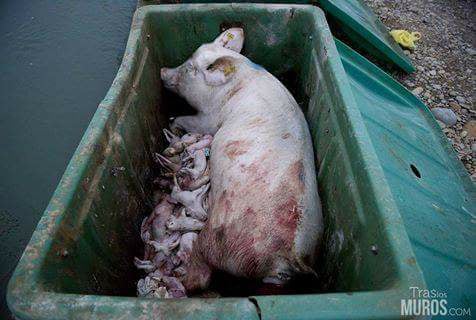
Schwein mit verwesten FerkelnnThat is what we mean by “animal welfare”…


https://taz.de/Tierschuetzer-gegen-Kaefige-fuer-Schweine/!5666524/


And I mean…The main responsible for the painful animal husbandry, are the animal torment industries, their political lobbies like the hypocrites and opportunists Greens for example, and their clients, that’s us!
Farm animals in captivity in a confined space are not punished. Otherwise there would be no cheap meat and cheap milk products in bulk in all possible discounters.

Animals are fattened, have no run, pigs cannot wallow themselves, cows are raped, after a short life farm animals are slaughtered, animals suffer and cannot escape, etc. etc.
All of this is legal, all with deliberate political support and thanks to the corrupt politicians who work hand in hand with the meat mafia it will be not punished.
When will the animal murder factories be closed? When will the humiliating and illegal pigs be abolished?

Countries in Africa (and other countries around the world where people are starving) would be happy if 90-98% of the world’s soybean harvest, 50% of the world’s grain harvest, and around 40% of the animals stolen from the sea in the 900,000,000 (Germany) / 85,000,000,000 (worldwide) would not be fed to the animals of the factory farms, but would be made available to them as food!

It always goes on, on, on. The petitions against castes are in full swing, the votes are reaching the millions, and the factories are getting bigger.

We signed 1.5 million votes for the abolition of the pig boxes.
This was obviously a great help to the career of some EU officials.

endthecageagepng

My best regards to all, Venus