Category: Farm Animals

France: Animal experiments in stables come to light


frankreich flaggepg


No! That’s not in China, that’s in France! But we immediately remember the holes on the bear’s body in China to get the bile fluid!!


Have you ever heard of “fistula cows”? Cows with implanted “window” to the stomach…?

It is implanted into a living being, in the case of a cow, by surgery, an externally accessible access, and through this opening contents can be filled and samples taken.
Why? Investigation of methane formation in the stomach of the cows. As we all know, methane production causes greenhouse gases that destroy our environment.

fistelkuehe

The invention of this torture is not new, it’s officially from the 19th century, but we think it could also be a torture method from the time of the Holy Inquisition.

What is new is the strong courage of the animal rights activists of the L214 group, which has brought this vile, fascist practice to light for the first time.
Thank you very much to L214!

This video shows live cows with built-in holes in their bodies that look like portholes or windows inside. These are inputs to the rumen, one of the four stomachs, and to make it easier for the meat mafia to examine the digestive system of the animals.

finstel Kuhjpg

The images were filmed in February and May inside a private agricultural research facility in Saint-Symphorien, northwestern France. The facility belongs to a division of the French food research giant Avril which said:  the “six fistulated cows” there were monitored “extremely rigorously” by vets (!!!). The stables are run by the company Sanders – one of the largest French feed producers.

L214 said:  the practice was “symptomatic of the way animals are considered as simple machines at our disposal” and has launched an online campaign to end it.

“As citizens, we call on the ministers for research and agriculture to immediately ban experiments aimed at increasing the productivity of animals,” it said.

According to the activists, these artificial holes are emblematic of how to deal with animals as soulless machines at our disposal. The animal protection group claims to have filed a complaint with the local prosecutor for “illegal experiments and serious animal abuse”. An online campaign has also started.  Signez la pétition : https://www.l214.com/vaches-hublot

“This process is used worldwide for research purposes only,” (!!!) Avril Group said in a response to the L214 investigation. “This is currently the only solution to study the digestion of plant proteins.”

It added: “This analysis is essential for many advances in breeding and, in particular, to improve the digestive health of millions of animals, reduce the use of antibiotics and reduce emissions of nitrates and methane related to livestock.”

It also criticised L214 for unnecessary “illegal intrusion” at the facility, which it said “regularly opens its doors to the public.”

 Signez la pétition : https://www.l214.com/vaches-hublot

https://www.euronews.com/2019/06/20/cows-with-portholes-into-stomach-filmed-by-animal-rights-group


And we mean: The company Avril and every animal barracks, which operates such torture, does not need to keep its door open to the public.
They all have to close the holes in the animals’ bodies, which they torture illegally and uselessly every day.

The visitors know today that the holes in the body of the cows do not reduce the problem with the methane, nitrate and antibiotics and certainly can not solve it.
Who eats animals and their products causes a climate catastrophe and cooperates in these medieval torture methods against animals.

My best regards to all, Venus


India: More Brilliant Work From the Crew at Animal Aid Unlimited -22/6/19.

INDA0001


We humans have a tough time describing the personalities of animals. But each of us can probably say that every animal we’ve ever known, from a dog to a donkey, from the cow in the field to the chipmunk on our windowsill, has a personality we can feel, though we may lack the words to express it. That’s why the ability to share their stories through videos has been such a godsend for animals–enabling animals who may be on the other side of the world to reveal themselves as the unique, silly, wise, grand, naughty and indescribably sweet characters they are. 

Thank you. We are delighted to let you “meet” a few more of the precious personalities who are alive today because of your support.

udi

animal aid unlimited india


Sweetest puppy looked like a balloon from severe subcutaneous emphysema


This sweetheart’s tail was almost the only thing she could move as her body filled with air. But she seemed to use her wagging tail to ask for help. And she desperately needed it. Her entire body was swelling up from head to toe as air escaped out of her lungs after a probable perforation following a trauma. We could see the outside wound, but not what was happening inside to cause this balloon effect. At Animal Aid’s hospital our medical team diagnosed her with a rare condition called subcutaneous emphysema. We treated her with antibiotics and compression bandages, and within a few days she felt so much better that she has to show you herself! Meet beautiful Puff today!  


Please donate, for big help to small ones. 


A piece of string almost cost Jitu his legs 


The string was knotted tightly around two of his legs, and this handsome young dog was in an extremely life-threatening situation. We don’t have any information about how this happened but sadly we do suspect it may have been done to him intentionally. The blood supply had been dangerously reduced and the swelling in his legs caused by constricted veins threatened to make his legs necrotic (dead). If a few more days had passed like this, gorgeous Jitu would have likely died a very painful death.

But a caring little boy found this suffering street dog, and told his father, who called Animal Aid to the rescue. Jitu’s suffering must have gone on for several days before he collapsed in agony. But thanks to you, we saved him. Meet sweet Jitu today. 


Please donate, because rescue gives animals back their lives.


Babies in the house, jump! jump!

These dream team kids (baby goats) came into the world a couple of days ago. Their mother had such severe mastitis (infected udder) that she cannot feed her babies so we are bottle feeding them and even when her infection has cleared she is unlikely to produce milk for them. As you might imagine, these tiny little twin brothers came out of the shoot silly, naughty, and 100 percent adorable. We’ve named them Marlon and Darlin’. 


Please donate for babies whose mothers are ill.


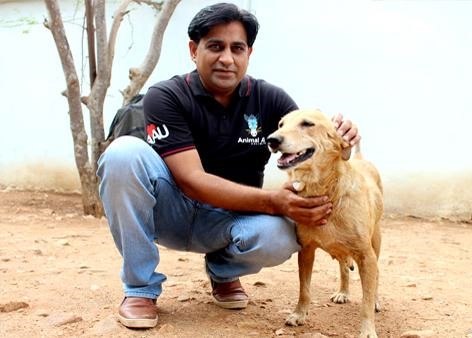
Celebrate the Caregivers: Dr Vaibhav 

DR VAIL

When Dr Vaibhav Harsola speaks, he is careful, gentle, thorough and efficient–just like his surgeries. Whether a routine spay or a complicated wound repair; an eye removal or an amputation, Dr Vaibhav is an expert at saving lives through his outstanding surgical skills.

Dr Vaibhav also brings a great range of administrative skills and is our liaison with government officials for animal issues in Udaipur. We join many animals in our gratitude that we have Vaibhav’s talent on board.


Yulin is eyerywhere!


China


More than 10,000 dogs fall victim to China’s dog meat festival Yulin every year.
Also on 21st of June 2019 it was time again!


But Yulin is everywhere – Every day millions of animals die!
They are cruel pictures and we often hear them screaming.
Every day we see them driving, the trucks with their cargo: Animals! Living and suffering beings!
Often without adequate care they are carted across thousands of miles across Europe.
It’s insane, it’s a crime.
The European Commission currently forecasts around 170 million “useful” livestock transports each year.
Around half a billion poultry, pigs and cattle are transported on European highways every year.

Just so that the animal can be slaughtered cheaply, it is transported to a low-wage country and then back as meat back to the meat counter. A cruel suffering, what the animals have to endure. –

And again every day we read the inflationary question: why so much whirlwind for the dogs of Yulin and not for the millions of other victims?

A mass murder of animals can not be justified because the general logic and ethics says: that happens everywhere.
Yes! This actually happens everywhere and therefore we feel anger, powerlessness, sadness!
Yulin is a crime, as it is the millions of crimes every day against animals we cruelly murder to eat them.

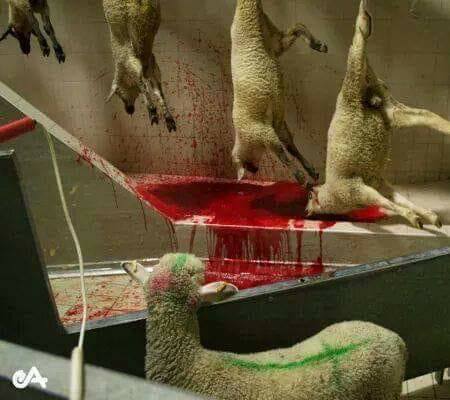
lämmlein sieht die Schlachtpg
Yulin is indeed everywhere, and our mission is to eliminate EVERY Yulin.
The uprising against Yulin is not because we value a dog’s life more than a pig’s life.
We also do not think that wiser or more productive people have special rights and therefore they should not be tortured or imprisoned.

Every living being has the basic right to life and freedom, the victims of Yulin industry as well as the daily victims of the meat industry.

For this we need an ethical awareness, an extension of the moral capacity of modern consumers to achieve peaceful and just living together with the animals and no longer regard them as slaves and servants.

My best regards to all, Venus


Animal markets: animal cruelty in compliance with the system

There are no animal markets without suffering and stress for the animals.

Animals’ Angels goes against abuses, and wants to reach an end in the long term markets. In an effort to improve the situation for the animals on the markets, we are in dialogue with traders and local authorities.

Animals_Angels_Tiermaerkte_VERWEIS

Here are some of the reports from the cruel situation in the animal markets,  all over the world.

1. Saleyards and animal markets in Australia

Australia

Australia is one of the world’s largest ‘producers’ and exporters of so-called ‘farmed animals’ and likes to boast its animal welfare laws. Although these are in force, the animals are not adequately protected on the transports and markets. Dealing with them is rude and careless. Since 2004 Animals’ Angels devotes itself completely to these animals and demands changes.

On markets and sale yards in Australia the most lucrative deals are possible. In these auctions we always see the same problems:

Totally crowded pens.
Animals pushed to the ground, who are barely able to get up.
No water, no food.
No shade despite high temperatures.
Overheated animals.
Missing / insufficient care of injured / ill animals.
Forcible unloading and loading.
Overcrowded transport vehicles.
Animals with trapped body parts, with no possibility to break free.
Transport of non-transportable animals.
Insufficient weather protection: no roofs on the top truck level.

Compliance with animal welfare laws is expected by the parties involved.


2. Animal markets in Bulgaria

bulgarienpg

In Bulgaria there are only a few animal markets left. The conditions for the animals there are however intolerable and far from the specifications of the EU. Lack of infrastructure, completely unsuitable transport vehicles, a very crude, often brutal handling of the animals and lack of official control lead to serious animal protection violations. That is why Animals’ Angels has been working to improve the situation for the animals on the Bulgarian markets since 2013, and calls for their closure.

Tiermarkt-Bulgarien-Schafe-Boden-BIGA-BG

In March 2013, Animals’ Angels checked the Bulgarian animal markets for the first time and reported to the competent authorities at national and EU level about the abuses found. Since 2017, we are back on site and unfortunately had to find the same problems again. In March 2018, we reviewed the conditions on site again, but unfortunately without significant improvement.


3. Animal markets in Indiarespect for cows?

India

India is known as the land of sacred, flower- decorated cows. But behind the scenes it looks different: India is the world’s largest dairy producer and the largest exporter of beef.
The handling of cattle on markets, during transport and during slaughter is unimaginable cruelty, despite the strict animal welfare laws. This also applies to other farm animals, such as pigs and poultry. Since 2012, we are on site and are committed to patience and perseverance for change.

Tiermarkt-Indien-Rinder-UEberladen-BIGA-IND

The handling of the animals is rough and brutal. The transporters are systematically overloaded. We also observe how the animals are fixed on a truck lying on the ground – a particularly perfidious transport practice that we only know from India.

India’s laws to protect animals in transport and markets are more advanced and many times more stringent than in Europe. But the practice looks different:

No shade, despite enormous temperatures.
No water supply.
There is often a lack of loading ramps and the simplest infrastructure.
The unloading and loading of the cattle are hectic and brutal. With sticks, the animals are beaten and pushed, even on the most sensitive parts of the body.
Pigs and chickens are offered for sale with their legs bound on the ground.
The means of transport are absolutely unsuitable for animals. Goats and chickens are transported with laced legs on bicycles, scooters or in luggage compartments. Cattle in car rickshaws or on loading areas of open trucks.
Overloading is one of the main problems. Cattle are forced to stand side by side in the back of the truck or forced to their knees and tied to the ground. The powerful animals tremble all over and urinate out of fear and stress.
There are hardly any controls. Bribery is a ubiquitous problem.


4. Animal markets in Morocco

 

marocopg

Agriculture, and especially livestock farming, is one of the main economic pillars of Morocco. Nevertheless, there is no national animal protection law that at least guarantees the minimum requirements for the protection of the “farm animals”. Even today, the majority of ‘farm animals’ are traded and sold in so-called souks (weekly markets in towns and villages). The conditions for the animals and the handling of them are terrible. Since 2014, Animals’ Angels has been there to raise awareness and achieve sustainable change for the animals.

Tiermarkt-Marokko-Schafe-Boden-BIGA-MA

In Morocco mainly small-scale animal husbandry predominate. Many rural families live with and from their animals, which they regularly sell at souks (weekly markets). There we find again and again the same, destructive animal welfare problems:

Brutal and medieval methods of slaughter.
Animals tied together on the legs, necks or wings.
Animals raised and carried on legs and coat.
No water and no food.
No shade, despite high temperatures.
Neglected, exhausted and dehydrated animals.
Injured or sick animals are not cared for.
Missing infrastructure.
Completely overworked ‘loads’ animals, such as donkeys and horses.

The shipments on the markets reflect the catastrophic conditions:

Absolutely unsuitable transport vehicles without loading ramp or ventilation.
Cattle being dragged onto double-decker transporters without a ramp.
Sheep stowed away on roofs of vehicles or in luggage compartments.
Chickens hanging upside down or transported in sacks.
Very brutal handling during unloading / loading.

Animal welfare is irrelevant – despite the fact that the Moroccan government gives agricultural development top priority. To date, there is no animal protection law in Morocco and there is no official contro


5. Animal markets in Poland

poland


While ‘slaughter’ animal markets in Germany are almost a thing of the past, in Poland they are still an integral part of ‘livestock farming’. Animals’ Angels has been operating in Poland since 2003. With perseverance, perseverance and a good local partner, we have contributed to the fact that Polish livestock has become firmly established in the critical public and political discourse.

Tiermarkt-Polen-Festliegende-Kuh-BIGA-PL

In most animal markets in Poland, the current EU legislation is not implemented:

The animals have no access to water.
Most of them are short on hard concrete floor.
The transport vehicles are often unsuitable.
Even if fixed ramps are available, many animals are pulled without ramp on the loading areas, pushed and beaten.
Poultry is sold and transported in plastic bags and potato sacks.
The authorities are still far too seldom in violation of the Animal Welfare Act.

6. Animal markets in Romania

-flag-of-romania-pg

Large parts of the population of Romania live in the countryside and breed and keep animals for their own needs. Since these animals also have a lively trade, local animal markets have a long tradition here. Since Romania joined the EU in 2007, EU legislation on the protection of animals during transport has also applied here. However, our research in recent years clearly shows that these laws are widely disregarded in the markets.

Tiermarkt-Rumaenien-Schweine-Karren-BIGA-RO

In the animal markets in Romania, the applicable EU laws are not enforced. We constantly observe and document similar problems there:

The animals are transported in all kinds of inappropriate vehicles: on horse-drawn vehicles, bicycles, in the trunk of passenger cars or on the back of mini-vans and sprinters.
Due to the lack of infrastructure, the animals are often sold directly out of the vehicles, and not placed in pens.
The animals usually do not get water – even in summer.
The animals are tied to the legs, placed on the often wet, cold and dirty soil, and so offered for sale.
Violent treatment, such. B. wearing or grinding on individual limbs, wings or ears.
Illegal slaughter on some markets (mainly before Christmas or Easter).

Tiermarkt-Rumaenien-Schweine-Schlachtung-BIGA-RO
So-called ‘train tests’ for horses, in which the animals usually have to pull heavy objects under lashes to demonstrate their strength.
No or insufficient supervision or sanctions by the responsible veterinarian.


7. Animal markets in Spain

Spain

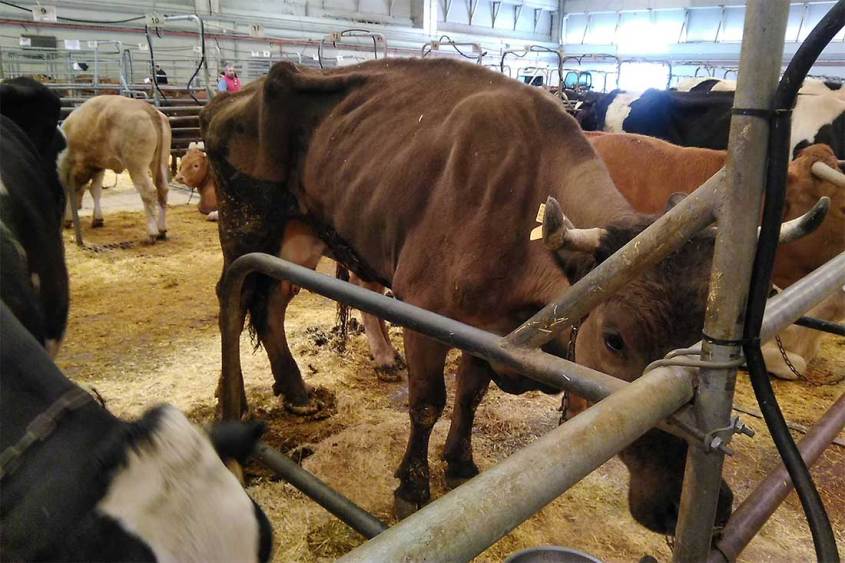
Animal markets still play an important role, especially in northwestern Spain. First and foremost, cattle, but also horses, sheep and pigs are traded on the weekly markets. From there they are transported to various regions throughout Spain as well as partly to France and Portugal. So-called ‘Ferias’ – traditional animal markets that take place once a year – are available almost everywhere in Spain.
Tiermarkt-Spanien-Abgemagerte-Kuh-BIGA-ES

At least here, together with ANDA (Asociación Nacional para la Defensa de los Animales), we have achieved much for the animals on the markets:

We have made animal welfare on the markets in Spain
Improved infrastructures for the animals in all markets
Prohibition of certain animal tormenting measures
Increased and improved veterinary controls
Euthanasia of severely injured and sick animals in the markets
Animal welfare campaigns in the markets
We have established a good relationship with the market directors
For many traders and farmers, we have started a rethinking process

Nevertheless, there is still (too) much to do. We believe that the markets are phased out. They should be replaced by other trade routes to spare the animals additional stress. As long as they still exist, we use them for intensive controls and education and training campaigns.

8. Animal markets in Tanzania

tansania pg

In Africa, Tanzania is considered a showcase country when it comes to the protection of “Nutz’tieren. Rightly and wrongly, as we find. On the one hand, the country has progressive legislation and the government trains nationwide animal welfare inspectors. But the markets and vans are in chaos and suffering. Of the ambitions of the state government is hardly anything in the animals. Since 2014, we work locally and focus on training and training.

Tiermarkt-Tansania-Tiertransport-Verladung-BIGA-TAN

The strict animal welfare law does not apply to the animals in Tanzania. On markets, during transport and when the animals arrive at the slaughterhouse, we repeatedly document the same problems:

Brutal, chaotic loading and unloading.
Lack of care for injured animals.
Completely overloaded transport vehicles.
Animals tied together on the legs.
Exhausted and dehydrated animals.
Inadequate, ailing or missing infrastructure.
Inappropriate transport vehicles.
No water and food.
No shade.

Despite modern legislation and the regular control of markets and animal transports, the authorities have so far held nobody accountable for the lack of care and brutal treatment of the animals.

https://www.animals-angels.de/projekte/tiermaerkte.html


My comment:  In Germany, the animal welfare deficiencies at these events are inherent in the system – animal suffering is under the cover of animal love.

It is mainly reported on the animal markets from abroad.
But also on many weekends animal markets take place in Germany and there countless animals suffer from fear and stress – to the pure entertainment of visitors and hobby breeders.
In Bavaria alone, more than 700 animal markets take place each year. At the same time these animal markets are moving in a kind of  lawless space where they are rarely or only insufficiently controlled.

It is traded on countless exchanges with all living beings, which the “market” has to offer: Birds, reptiles, amphibians, horses, small mammals, but also dogs and cats are sold like “junk ware”.

The suffering of the animals does not count for dealers, breeders and many visitors.

“Animals are the pitiful slaves and victims of the most brutal part of humanity”. (John Stuart Mill)


My best regards to all, Venus


Delicatessen from Austria!


österreichische Flagge


Is not it just amazing? The photos that follow are not just a selection of some horrible pictures, they are randomly removed from the folder – this is what it really looks like behind the scenes! In the meantime, even the greatest optimists must realize that the pink farm idyl does not exist!

Five visited stables – five criminal charges, five times animal cruelty!

A cut of 100%! Delicatessen from Austria!!

ställe in Austria 1

We almost miss the words about what a recent research in Salzburg’s cow stables brought to light – this is only a term permissible at the end of the day:
INCOMPREHENSIBLE!!!!

In the last 2 or 3 years we had several times one in the Salzburger Land, resident farmers because of the horn connection of his bulls display. The Vet authority told us afterwards, from now on the problem would be eliminated, the cruel tying on the horns would be history!

Of course, we are of good faith, but then of course we always want to make sure ourselves that what they have said to us, the promised, has really been implemented.

It will not surprise you, we will disappoint you on a regular basis; so again – unbelievable, no! much worse than that, actually really unbearable, we found now again everywhere bulls chained by the horns.

ställe Austria 2

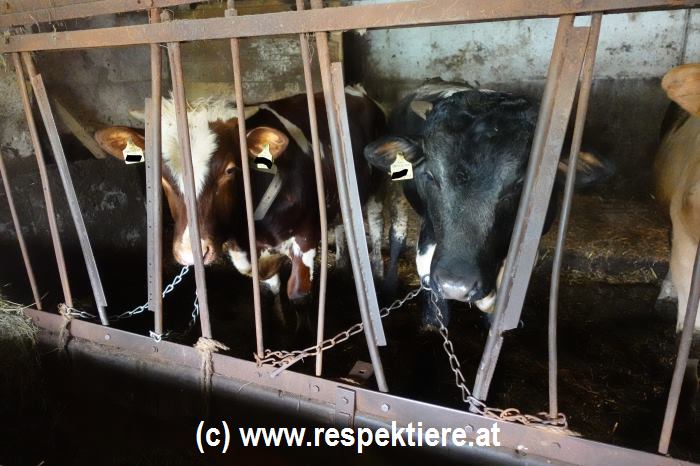
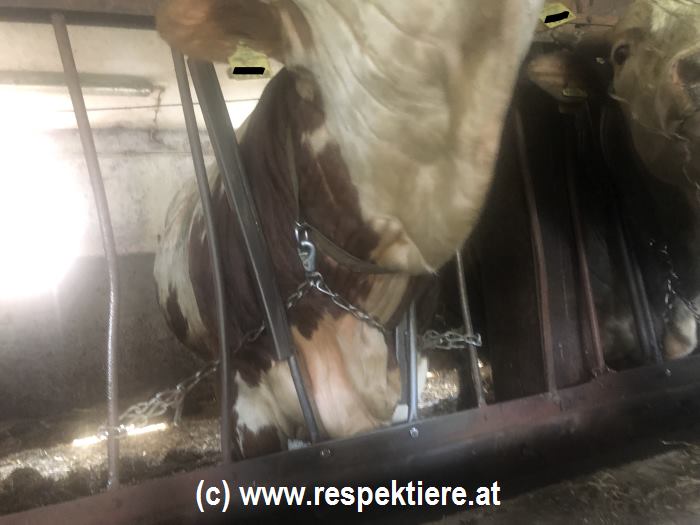
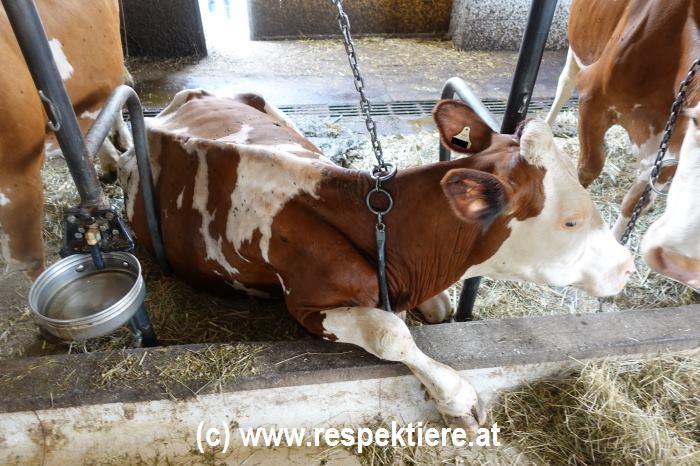
Moreover, it is not the case that the detainees are well housed – all of them are permanently chained, and not ‘just’ by ordinary means – please see the photos, such an attitude is highly inadmissible (of course, any tethering must finally be forbidden, note)!
Here, the chain is pulled around the neck, then wrapped around the bars on the left and right and fastened. What remains as a radius of movement?
When standing up, the limbs slide upwards over the iron bar a few centimeters, often not even determining that; In addition, the system is amateurish, inadequate, ‘put together’ – just, pure shit!

ställe Austria 3

But what if the authorities simply have no effect on an old, grumpy and stupid farmer? And worse:  how good are the chances of improving grievances when it comes to an influential farmer?
How many of them are in Salzburg !!

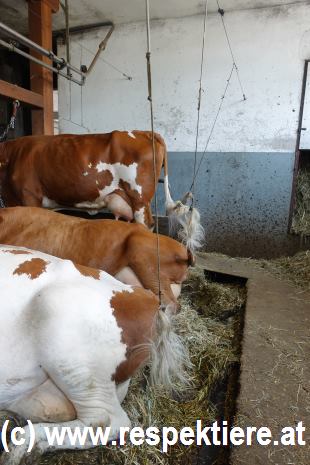
Another ‘cow farmer’, in the same environment. Again, neighbors notice that the animals are ‘never at all’ outside; as well as, the stable is in the middle of town, surrounded by buildings.

But may this be a reason for lifelong custody? Would not it rather run so that, if the circumstances do not allow an at least halfway welfare animal husbandry, that then just no animals may be kept in such places ??? But we would not be in Austria …

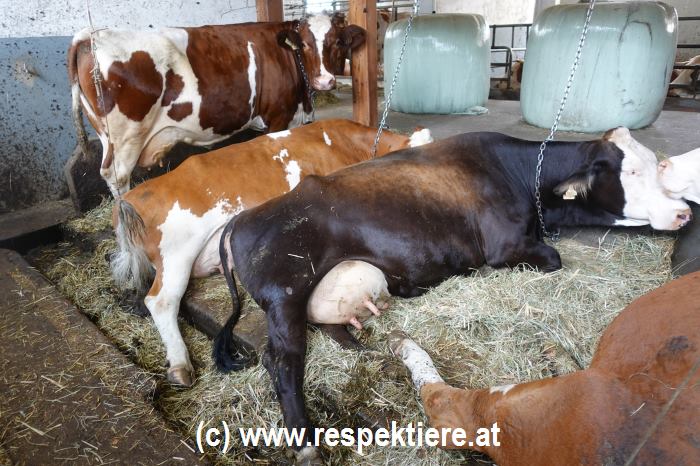
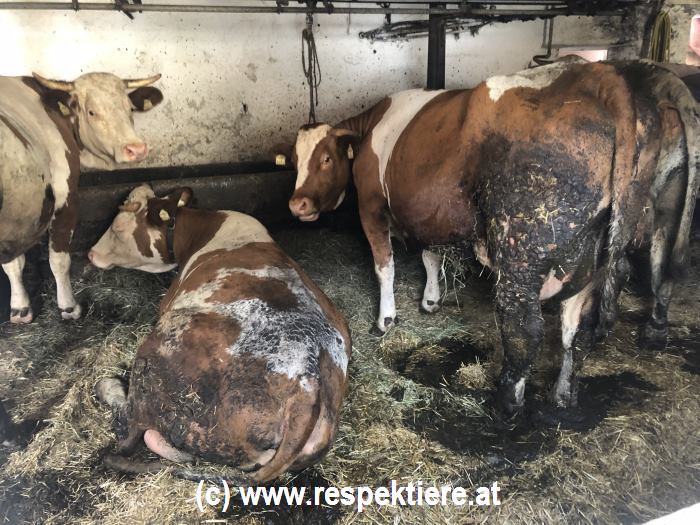
The lying areas for the cows are too short; The animals are therefore with the hind legs in the feces gutter, an intolerable condition. Their tails are tied up with laces.

ställe Austria 6
Especially a cow seems injured; low-viscosity feces in large quantities surrounds their mooring, and it stands with a forefoot very unnatural on the concrete parapet. Her hind legs are tied together. Expert diagnosis: paresis. She would have to be under constant veterinary treatment, which the official veterinarian has to verify; a permanent bondage of the hind legs is also prohibited!

ställe Austria 5

Next stable, just a few meters away!!.

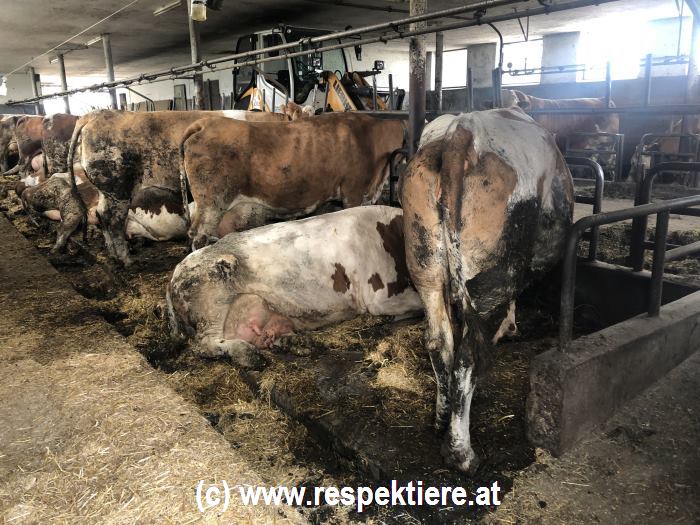
ställe austria 11The terrain smothered in the dirt. We are here in a richer environment, a so-called Nobel suburb of Salzburg; but apparently the states do not really bother anyone. At least not so much that there are – justified – criticism. ‘

ställe austria 13

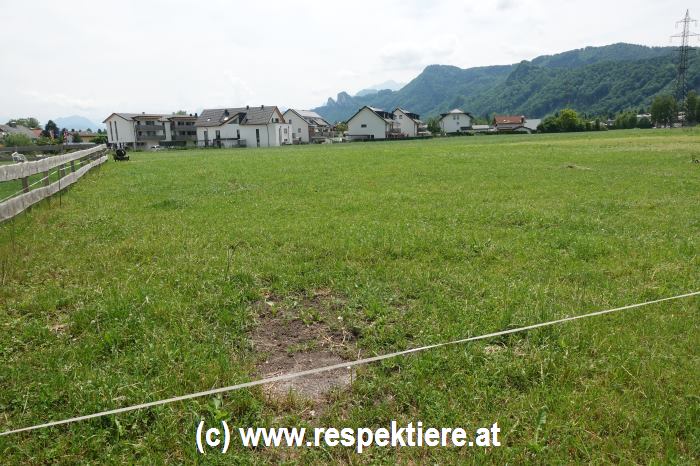
Even for this place applies: although there is a large lawn behind the farm, it is said that the cows would NEVER be outdoors. We have no doubt about it.

The cows are like the stable itself – dirty from top to bottom. Manure flows behind the chained animals. Some are in it too. In addition, the lying areas are once again too short. A calf is in a box, young animals are tied shoulder to shoulder.

ställe austria 16
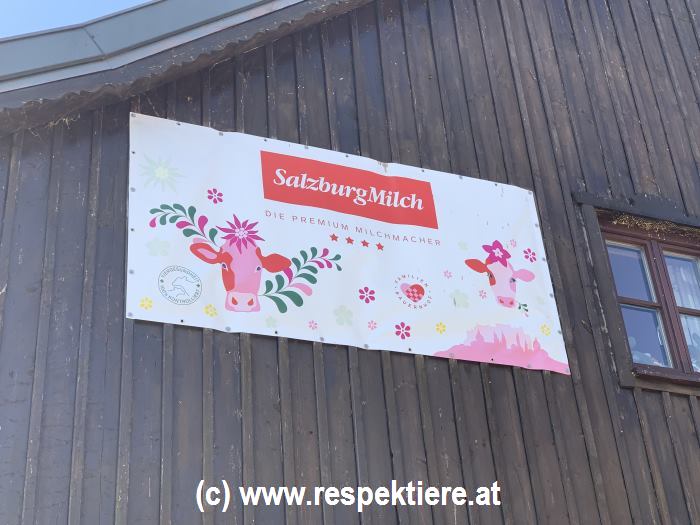
In the next courtyard, in thick letters, ‘Salzburg Milk – Premium Milk Maker’ is emblazoned. Interesting: Salzburg Milch” is currently running a major advertising campaign with enormous effort, ‘animal health’ is a buzzword for this.

ställe austria 10

Generous announcement: as the “first” dairy to renounce the year-round tethering!!! (which, according to law anyway no longer is allowed … probably thea did not know that, but does nothing, still sounds beautiful and pet-friendly and modern). At least 120 days per year, all suppliers must grant their milk producer, the cows, access to a pasture. In ‘premium operation’ even more so. Theoretically at least

All the neighbors confirm it: Here, the animals NEVER come outside the whole year, although extensive meadows are fenced just behind the stable.

ställe Austria 8

A cow obviously suffers from an inflamed udder, she lies alone and abandoned – at least on straw.
The other cows in the stable are tied to thick chains. To ‘premium chains’, certainly …

ställe austria 17

The managing director of the “premium” company “Salzburger Milk” Christian Leeb said in an interview in the newspaper: “We want to give milk consumers a good feeling that they are consuming healthy products, from animals, those who are doing well (!!!) All our dairy products receive 100 percent animal health”.

We go to another farm, in the same environment. Everywhere are components, machines, materials, distributed in the landscape. Chaos. The confusion gives rise to an idea of animal husbandry. The interest is aroused;

Every time we think the height of cruelty has been reached, someone puts it somewhere else.

stier mit ring in der Nase

It’s dirty, all cows are hanging on heavy chains. Did I say all? A mighty bull rises, laboriously. In pain. A whole life in shackles, forced to one and a half square meters. Probably 1000 kg of existence, limited to getting up and lying down.
And the gentle giant actually hangs on a NOSE RING !!! Unbelievably !!!

Ultimately, the next question arises here at the latest: does such a government, like the Vet authority really need it? What is their use then? If this instance seems incapable of enforcing even the smallest of the animals’ rights? Is not this something THE bankruptcy declaration of an entire profession par excellence?
We like to be persuaded of the opposite, but words are simply too few, they are not enough. After all, only the deeds count. 

https://us12.campaign-archive.com


My comment: I know Tom Putzgruber, the chairman of the association “Respect animals” in Austria, and I would like to thank him in the name of all the uncountable animals for which he literally uses his whole life and his whole existence with a force that is in any case unattainable and very difficult to imitate for me.

“Gigantic suffering weighs on many of our animal fellow creatures worldwide,” he always says.
Tom Putzgruber, and his small team has resisted all the animal misery for many years.

in faraway Africa, in Romania, in Mauritania for the labor donkeys, in Bulgaria, in Serbia … everywhere and around the world he travels to alleviate animal suffering.

eselputzgruber
“In some of the indigenous dialects of Mauritania, there is not even a word for donkeys, they are often referred as “the beasts that one beats “, he says!

Thank you, Tom, for everything you do for our fellow creatures.

My best regards, Venus


Further questions?

USA: Fair Oaks Farm ARM Investigation – Extended Cut – 1 hour and 30 minutes.

USA-Flagge


In early June we released the footage of undercover filming by ARM activists. Here is the link to our first report:

https://worldanimalsvoice.com/2019/06/12/fuck-fair-oaks-farms-and-coca-cola/


Here is the full extended (1 hour and 30 minutes) cut of the footage; a lot of which was not seen in the original.


See for yourself the treatment – ABUSE – of the young calves. Kicked; punched; hit it the face with branding irons; left to suffer and die alone without any medical attention or supervision.

Fair Life Milk Exposed | Operation Fair Oaks Farms Extended Cut | ARM Investigation | The Full Story

From the Animal Recovery Mission Website –
On June 4th, 2019, ARM released disturbing footage of one of its most grueling factory farm investigations to date. Initiating in 2018, an ARM undercover investigator captured surveillance evidence of the systematic and horrific animal abuse that is occurring at the Fair Oaks Farm’s

This place needs to close, and close now. All those involved with the cruelty shown must be made accountable and prosecuted under the full weight of the law.

We (WAV) have seen a lot of animal abuse in our time over the years; but we find the footage here; showing very young and vulnerable baby calves, particularly disturbing.

Watch, Repent and most importantly, Take Action to follow this up with the authorities.

This is what your pint of milk costs.  Cows milk is for baby calves, not humans.

England: ‘Oliver’ The Pig – Rescued By Police From A Busy Road. Now With the RSPCA Looking for a Forever Home. Enjoy the Video.

England


https://ladyfreethinker.org/video-police-officers-rescue-adorable-pig-from-busy-road/?utm_source=Newsletter&utm_medium=Email

Watch the video by clicking on the above link; or see it below.


Meet Oliver, an adorable piglet who was rescued by police officers in the English city of Coventry in the West Midlands last Tuesday morning.

The officers discovered the lost pig wandering along a busy road and quickly relocated him to the safety of a squad car, where he settled comfortably into the passenger seat.

Oliver instantly took a liking to the officers and enjoyed the attention he received from them, as you can see in this video.

The officers named the little pig after Charles Dickens’ fictional runaway orphan, Oliver Twist.

In the video, one policeman also jokingly introduces Oliver as his new police partner and calls him a “good boy.”

The lovely piglet was transported to the RSPCA, where he’s currently being cared for until a forever home is found for him.

In the meantime, Oliver will receive “lots of hogs and kisses,” the police department assured the public in a Tweet.

Watch this clip for an uplifting dose of cuteness!


Today (14/6) Has Been ‘Stop Live Transport International Awareness Day’.


stop live transport


Today (14/6) has been the ‘Stop Live Transport International Awareness Day’; a global day of action against the transportation of live animals.

As it is now late in the evening, we do not currently have reports and pictures of the events of today; but we shall be covering this soon when more information is provided.

In the mean time we will give you the link to the CIWF (London) web site, which has been one of the key players in this event,

The site link is   –   https://www.ciwf.org.uk/

Watch the video made by CIWF of Scottish calves being driven to Ramsgate in Kent; before onward shipment in mainland Europe. As you will have seen on past post we have made on this site, these very young calves are all males; a by product of the dairy industry which in reality does not want them – only female cows produce milk and as such are the only ones required to replenish the herd on dairy farms and facilities.

Here below is the video – Published on 1 May 2019

An investigation documenting the live transport of calves from Scotland to the port of Ramsgate (Kent, England) and onto Abbeville, France.


As it is now late in the evening here in England, we do not currently have reports and pictures of the events of today; but we shall be covering this soon when more information is provided.

More to come on this very soon, as we get reports in.

Regards Mark