Category: Farm Animals

Spain: Press Release – Animal welfare NGOs expose bull’s mistreatment: transport company fined.

Animal welfare NGOs expose bull’s mistreatment: transport company fined

15 March 2023

AWF

Press Release

In 2020, the young bull Ferdinand was supposed to be loaded onto a substandard livestock vessel at the port of Cartagena, Spain. However, he was unfit for travel, unable to move and heavily mistreated. Workers subjected him to prolonged electric shocks and kicking. Animal Welfare Foundation (AWF) filed a complaint against the transport company and veterinarian authorities, based on evidence collected together with Animals International and Welfarm. The investigation that followed the complaint revealed further violations. The export company in charge is one of the largest in Spain and has now been fined 4,500 Euros.

AWF filed an administrative complaint in 2020, and the case was classified as two serious administrative offences with major infringements of the transport regulation. The infringements were secondary and rather formal findings and are not directly related to animal abuse. They include lacking coordination between the different stages of the transport and a lack of communication which made it impossible to properly inspect all the animals.

In July 2020, Animal Welfare Foundation, Animals International and Welfarm witnessed and filmed how young bulls from different European countries were loaded from trucks onto a livestock vessel that exported them from Cartagena to Benghazi, Libya. One of them, a French bull who was named Ferdinand by the investigators, was injured and too weak to walk. At this point, he should have been euthanised on the spot. However, although clearly unfit for travel, workers forced him out of the truck by dragging him with a rope. Later, he was forced inside again because he was unable to walk through the vessel ramp. 

After the stressful procedure, the driver left the port and parked the truck at a petrol station nearby, with Ferdinand inside in the blazing sun, to take a prolonged lunch break. At this point, the NGOs called the police, who were not able to identify violations immediately and had to let the driver proceed.

Animal welfare NGOs call for ban of live exports and stronger penalties for violators

Ferdinand’s case is only one out of many, and highlights the systematic failure of animal welfare during transport. The organiser did not coordinate the arrival of the trucks properly and veterinarians had no chance to control the process correctly. A few months after the incident, the vessel (ABEER K, formerly ETAB) was detained in Raša, Croatia, due to severe deficiencies. Some of those can affect animal welfare onboard, such as the water conditions, structural conditions and fire safety.

The importance of animal welfare in livestock transport was once again underscored recently in an audit report on Spain’s livestock transport industry. The audit found that many sea transporters follow generic contingency plans that are unlikely to protect the welfare of animals during emergencies. Additionally, there is an insufficient number of official staff during loading, and delays in loading can create risks for the welfare of the animals, as they lack proper facilities to rest, feed, and water animals. New legislation will not be able to solve the defective nature of live transports.

“The suffering of the bull was obvious, but not even mentioned in the administrative verdict file. The procedure was carried out with clear opacity and lack of coordination by the competent body. We do not know whether the investigative measures we requested were carried out”, says Maria BoadaSaña, Project Manager at Animal Welfare Foundation. “I hope that the ruling in the Ferdinand case will encourage stronger penalties for those who violate the regulations. We have been making this point for years. There is a notable lack of controls by veterinarian authorities, and examining one violation will often lead to other findings.”

Gabriel Paun, EU Director at Animals International, adds that “Ferdinand’s injuries were so severe that he was unable to walk, and yet he was still subjected to prolonged electric shocks and kicking. He was then pulled by a tractor on a rope to get him back into the truck. After that, he melted in pain and heat at a petrol station in bright sun while the driver enjoyed his lunch. This is not just a violation of regulations; it is a moral and ethical issue that needs to be addressed.”

Adrienne Bonnet, Head of Campaign, Advocacy and Legal Department at Welfarm, states: “It is sad to see a French animal end up in such a situation. The member states of the European Union need to address animal welfare issues in a joint effort. From the approval of transport vehicles to slaughter methods in third countries, such situations can only be prevented if live transports of long duration within and from the EU are stopped.”

Without the intervention of the three NGOs, the case would not have been exposed at all. This leaves transport companies with the impression of an acceptable risk: The sanctions for bad practices are not strong enough to act better in the future, even if they are considered major infringements.

NGOs call for a ban of live exports altogether. Many member states of the European Union use Spain as a loophole to send their animals from industries that would otherwise not be as profitable to third countries.

Regards Mark

Italy: Live Footage From Cages Shows the Reality of Italian Factory Farms.

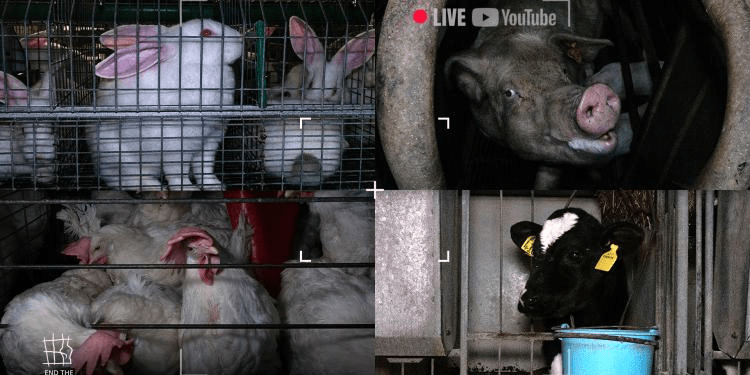
24h LIVE footage from factory cages: dive into the heartbreaking reality of confined animals on Italian factory farms

11 March 2023

Essere Animali

Essere Animali has launched a 24h live broadcast from four different intensive breeding farms in Italy, to illustrate the sad fate of caged animals first-hand.

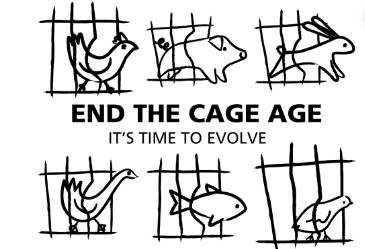
Conducted for End the Cage Age, the coalition that aims to end the use of cages for animals bred for food, the project consists of a real live broadcast from rabbit, calf, sow and chicken farms.

From 10 p.m. on Friday 10 March until 10 p.m. on Saturday 11 March, the everyday life of these animals – who are forced to live in cages in extreme confinement, and with no possibilities to express their natural behaviours – will be shown.

You can access the livestream below, or via this link.

The End the Cage Age initiative has collected more than 1.4 million signatures validated throughout Europe, and has achieved success so far with the European Commission’s commitment to work for a ban in the EU on cage farming. Cage farming is also considered by the scientific community as being in stark contrast to the animal welfare standards the farming sector should meet, and has further been criticised by the European Food Safety Authority.

But there is still a lot of work to be done. In Italy, more than 40 million animals are still bred in these conditions, and it is essential that the government and relevant companies work together to phase out this practice.

It’s what the animals desperately need, and what EU citizens clearly want. In fact, according to a poll by YouGov Plc (2020), 84% of Italian citizens believe that the use of cages is cruel to animals, and 83% call for agricultural funds to be used to incentivise the transition to cage-free farming. It’s time to answer the public’s calls for change and put an end to animals living behind bars.

footage from factory cages: dive into the heartbreaking reality of confined animals on Italian factory farms.

Regards Mark

Belgium: GAIA calls on Flemish Animal Welfare Minister to do his damned duty for caged hens.

10 March 2023

GAIA (Belgium)

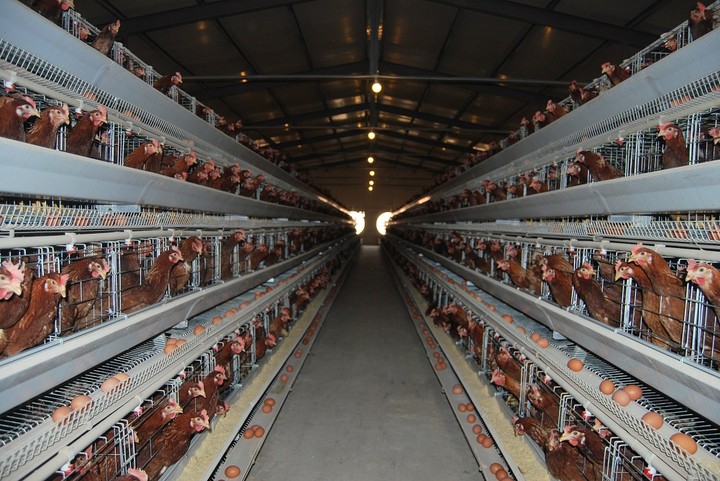
In his own words, Flemish Animal Welfare Minister Ben Weyts said, “It is our damned duty to avoid animal suffering”. With new investigative footage, GAIA is calling on the Minister to turn his words into actions and ban enriched cages in Flanders for more than 3,000,000 laying hens currently confined to the space of an A4 piece of paper.

There are currently more than 3 million laying hens in cages in Flanders. The hens are locked up there for the duration of their lives – 13 months – in which time they have to produce as many eggs as possible. 

Footage released by GAIA from a laying hen farm in Sint-Gillis-Waas clearly demonstrates the problem of caged hens. Countless chickens are housed in unhygienic metal grid cages stacked on top of each other, too restricted to spread their wings properly.

The sanitary condition of the farm is deplorable and the metal grids cause a lot of injuries and suffering. The footage shows that the plumage of many chickens is damaged, and many chickens do not survive – carcasses are seen everywhere. 

Wallonia, the French-speaking region of southern Belgium, already banned cages for laying hens in 2018. 

Almost three-quarters of Flemish people (72%) agree that keeping chickens in cages should be banned, according to a 2022 study by Ipsos. 

At the end of February, the European Food Safety Authority (EFSA) published their opinions on the welfare of laying hens and broilers. They clearly indicated that poultry should not be kept in cages and advise better living conditions, such as aviaries with covered outdoor areas or “winter gardens”, which are already used in some farms in Flanders.

Chickens are welfare-sensitive animals and deserve a better life, Mr. Minister. You know that yourself and it is your damned duty to avoid avoidable animal suffering, as you so aptly put it. We count on you to really get to work on this now, to take your role as Animal Minister to heart and to abolish the cages, starting with all cages for laying hens.

Ann De Greef, Director of GAIA

Read more at source

GAIA

End The Cage Age

Regards Mark

EU: Civil society denounces opacity and lack of democratic debate on EU-Mercosur agreement.

9 March 2023

As Europe’s trade ministers gather on 9 March for an informal trade Council, environmental, animal protection and trade groups denounce the Commission’s closed-door negotiations with Mercosur countries that aim to push through a controversial Free Trade Agreement (FTA), that has been the subject of public outrage and been rejected by national parliaments across the EU.

The lack of democratic debate and transparency around the protocol further damages the legitimacy of the EU and risks weakening European and national parliaments’ ability to comprehensively debate the consequences of the trade agreement.

The EU-Mercosur FTA has been dormant since the European Parliament and some Member States have refused to ratify it “as it stands” following massive civil society mobilisations from across the EU and South America denouncing the FTA as a bad deal for people, animals and the planet, that prioritises corporate profits at the expense of planetary boundaries.

Yet again the Commission is showing its anti-democratic face by pushing the toxic EU-Mercosur deal across the finishing line. Despite public opposition from both sides of the Atlantic, the EU’s negotiators are still discussing the annex in complete secrecy. Parliaments and civil society play a crucial role in scrutinising trade agreements as they are being negotiated, not once when they are ratified and it’s too late to reverse the impacts it will have.

Audrey Changoe, trade campaigner at Friends of the Earth Europe

Now, the European Commission is seeking to revive stalled discussions with an “additional instrument” – or annex – that is being presented this week to Mercosur countries, despite proof of the rampant devastation of the Amazon.

The European Union’s push for ratification of the EU-Mercosur deal is not supported by public opinion. Three-quarters of Europeans want the deal to be scrapped if it leads to deforestation and environmental damage. Despite public concerns, the Commission refuses to share the content of the additional document and is discussing it behind closed doors.

European and South American civil society groups reiterate their calls to stop the deal and reject these additional annexes and protocols and call for a different kind of relationship between the continents. 

No greenwashed protocols or annexes can fix an inherently bad deal whose aim is to promote trade in products driving deforestation, land grabbing, massive pesticide use, carbon emissions and human rights violations. The good news is that an alternative model exists, which could both strengthen ties with the countries and populations of the Mercosur while basing our relations on sustainability and cooperation.

Leah Sullivan, Seattle to Brussels Network

The recent EU legislation on imported deforestation does not make the FTA acceptable, first and foremost because it cannot offset all the deforestation: it ignores many ecosystems that, just like the Amazon rainforest, are also destroyed by intensive animal agriculture. The scope of products it covers is very limited, as it does not include animal products derived from animals fed by soy on intensive farms. In addition, the EU still does not have any new import requirements related to animal welfare standards.

Stéphanie Ghislain, Political Affairs Manager at Eurogroup for Animals

Regards Mark

Australia: Finally, Will We Now See An End To The Live Export Trade ?

This is a lot more than fantastic news ! – as anti export campaigners here in the UK for decades, we know the fight involved and send huge congratulations to all of our anti export campaigner friends in Australia.  After decades of fighting, it now appears that the terrible suffering for Australian animals in the live trade will be coming to an end.  It will not happen overnight; it never does, but now at east there is light at the end of a dark tunnel which will stop the suffering of many millions of animals.

Congratulations friends !!

Regards Mark

The pathway to ending live sheep export.

20 years after Animals Australia’s first investigation into the cruelty of the live sheep trade – the Albanese government has enacted a plan to bring it to an end.

The Australian government has appointed an Independent panel to oversee the phase-out of the live sheep export trade. This means that the Albanese government fully intends to keep its election commitment — and that live sheep export will end.

Very soon, every Australian will have the opportunity to contribute to a public consultation which will help determine how and when the phase out will occur. 

You can register here to be part of that process.

The live export of sheep is going to end, and this would never have happened without the unwavering support of thousands of caring Australians over many years

Continue reading about this at:

The pathway cleared to end live sheep export | Animals Australia

Regards Mark

This is a lot more than fantastic news ! – as anti export campaigners here in the UK for decades, we know the fight involved and send huge congratulations to all of our anti export campaigner friends in Australia.  After decades of fighting, it now appears that the terrible suffering for Australian animals in the live trade will be coming to an end.  It will not happen overnight; it never does, but now at east there is light at the end of a dark tunnel which will stop the suffering of many millions of animals.

Congratulations friends !!

Regards Mark

The pathway to ending live sheep export.

20 years after Animals Australia’s first investigation into the cruelty of the live sheep trade – the Albanese government has enacted a plan to bring it to an end.

The Australian government has appointed an Independent panel to oversee the phase-out of the live sheep export trade. This means that the Albanese government fully intends to keep its election commitment — and that live sheep export will end.

Very soon, every Australian will have the opportunity to contribute to a public consultation which will help determine how and when the phase out will occur. You can register here to be part of that process.

The live export of sheep is going to end, and this would never have happened without the unwavering support of thousands of caring Australians over many years

Continue reading about this at:

The pathway cleared to end live sheep export | Animals Australia

Regards Mark

Australia: Not Exactly the Tops When It Comes To Animal Welfare – Savage Shearing Exposed; Mulesing, Live Exports, Useless Trade Deals; Do We Go On ? – World Animals Voice

Australia: The Australian People Have Given Their Opinion On Climate Change, Live Animal Exports, and More. – World Animals Voice

Australia: Breaking News Just In 21/5/22 – Could This Result Be A Positive Towards Stopping Live Animal Exports ? – World Animals Voice

Australia: Live Exports – Update From Stop Live Exports.org. – World Animals Voice

Australia: Chances They (Governments) Take With Live Animal Exports – Crew Member from the ‘Al Messilah’ Livestock Carrier Docked in Fremantle Has Tested Positive for COVID-19. – World Animals Voice

South Africa / Australia: NSPCA WIN Court Case and STOP Live Exports From South Africa After Same Exporter Loses In Australia. – World Animals Voice

Australia: Live Exports – Rural Export & Trading or RETWA, is seeking an exemption to regulations because a disease outbreak on one of their ships meant they couldn’t get their last shipment out before the deadline. – World Animals Voice

Australia: Cattle Station Abuses Exposed – With Live Exports, A Farming Nation at the Top of the Tree When It Comes to Animal Abuse. – World Animals Voice

EU: European Citizens Made it Clear: It’s Time for a Fur Free Europe – Over 2 Months Before Official Petition Closes !

European citizens made it clear: it’s time for a Fur Free Europe

1 March 2023

Press Release

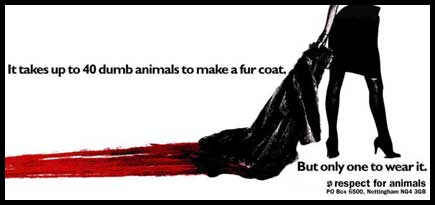
The European Citizens’ Initiative (ECI) Fur Free Europe closes earlier than its official deadline thanks to a record number of signatures collected. In less than ten months more than 1.7 million citizens signed to end this cruel practice, sending a strong message to the European Commission (EC).

Fur Free Europe was launched in May 2022 by Eurogroup for Animals and received the support of more than eighty organisations from all around Europe. The ECI calls for a ban on fur farming and on the placement of farmed fur products on the European market. 

Successful from the get go, Fur Free Europe collected 50,000 signatures on its launch day and now, 2,5 months before its official closing deadline, 1,701,892 signatures have been collected, offering a safe margin for the achievement of 1 million validated signatures. The ECI also successfully reached the signatures threshold in twenty one Member States, three times the minimum requirement of seven Member States. 

The decision to close the ECI earlier has been taken due to the potential impact that it could have on the upcoming revision of the EU animal welfare legislation, as part of the EC’s Farm to Fork Strategy. 

By the end of 2023, the EC will publish a proposal aimed at improving the EU’s animal welfare legislation to align it with the latest scientific evidence. While it’s possible to improve welfare standards for domesticated animals, science has clearly shown that this is not possible for wild animals on fur farms. Consequently, a ban on fur farming should be included in the proposal.

Moreover, since imports of animal products should follow EU standards, the ECI also calls for a ban on placing farmed fur products on the European market. Indeed, the organisers didn’t want to export cruelty to third countries but aimed to definitively end the suffering created by the fur industry in Europe.

I could not be prouder of our joint efforts. This citizens initiative gained momentum from day one and proves that European citizens, represented by all the organisations involved, are sending a crystal clear message to the European Commission: it’s high time for a Fur Free Europe. Fur farming represents a massive moral blind spot and, with the new animal welfare legislation coming up, the EC has the opportunity to end this unnecessary suffering once and for all.

Reineke Hameleers, CEO, Eurogroup for Animals

It’s exciting to see that Fur Free Europe didn’t need the full available year to collect the required signatures, proving that the issue is clearly a priority for European citizens. After the validation process is over, the Parliamentary one will start. As chair of the Fur Free Europe working group at the European Parliament, I am honoured to lead the process and make sure that citizens demands are heard and we can finally put an end to fur in Europe.

Anja Hazekamp MEP (Party for the Animals, NL) chairwoman of the Fur Free Europe working group, Intergroup on the Welfare and Conservation of Animals

More info:  Fur Free Europe | Eurogroup for Animals

Regards Mark

Ukraine: One Year of War in Ukraine: What Has Been Done for Animals?

One year of war in Ukraine: what has been done for animals?

24 February 2023

Djurskyddet Sverige

Written by Valentyna Vozna

Please click on any of the words in Purple to get more information – WAV.

A year ago we were counting at first the hours, then the days that it would take the Russian army to take over Kyiv. Today, we are still counting, and sadly it is already the one year anniversary of the war. Even though protracted war means more suffering for both people and animals, we would like to showcase the successes of our collective work to help the animals of Ukraine.

Today, we celebrate one year of tireless work of the international community, who did not hesitate to come to the rescue of animals a year ago; people from all over the world showed an unprecedented unity and willingness to make a contribution to someone else’s fight for freedom.

We also celebrate the hard work of all the animal volunteers who chose to stay in the country in order to take care of the animals, risking and often giving up their lives to help animals over the past year. 

In the early days of Russia’s invasion of Ukraine, Eurogroup for Animals and its members convened a Taskforce to help address the plight of Ukrainian companion animals. The members are still determined to help the animals in Ukraine, regardless of the effort and resources it requires.

Over the past year, the Taskforce members have had numerous meetings to share information and decide on their strategy. They developed a network of trusted partners, and implemented varied projects such as providing pet food to animals, including in the most dangerous zones. They have supported local veterinarians, animal shelters and clinics, sterilisation and vaccination projects, and sent generators and mobile clinics in order to help animals in Ukraine, as well as receiving refugees with pets in the EU, providing them with all the necessary assistance.

© FOUR PAWS | Maksym Havrylov

To name just a few of their projects: 

Animalia supported the Best Friend Shelter Reconstruction Project; 

Cat Care Community supported shelter “Drug” (meaning Friend) in Kramatorsk and Ukrainians arriving to Latvia with pets;

Deutscher Tierschutzbund created an animal aid camp at Medyka border point in Poland for pets brought from Ukraine in cooperation with the Bundersverband GDT e.V. and IFAW; supported German member shelters, Polish shelters and organisations active in Poland (e.g. DDAO), so they can provide help to Ukrainian pets, including advocating for pet-friendly refugee camps and quarantine facilities for evacuated animals; evacuated an asiatic black bear from a rescue centre near Kyiv to the animal welfare centre Weidefeld; with the help of the Tierhilfe Hoffnung e.V. animals with no alternative option were evacuated from their animal welfare centre in Odesa (and other locations), and sent food, a generator, and other supplies to enable the centre to continue its work;

Djurskyddet Sverige launched a sterilisation project in Zhytomyr with the support of Animal Help ZT, sterilising and vaccinating animals of refugees and even animals brought by soldiers from front lines;

FOUR PAWS launched Kishka project – a sterilisation project aimed to sterilise 10,000 cats all over Ukraine; prepared a Shelter Adoption Program in the Ukrainian language; cooperated with USAVA in order to provide veterinary care for pets and strays; conducted sterilisation and vaccination against rabies project in 20 municipalities with a mobile clinic and a catching team; helped launch UPAW platform; helped rescue several bears and admitted them to their sanctuary Domazhyr, including from front lines such as Bakhmut;

GGI launched a sterilisation project, cooperating with numerous veterinary clinics, financially supported 30 shelters and sent 160 tons of pet food and 12,000 rabies vaccines to Ukraine;

Home4Pets provided help to refugees with pets in Czech Republic, including finding accommodation, as well as sent pet food to Ukraine; 

IFAW partnered with Mykolaiv Red Cross and Nova Ukraine in order to provide food and veterinary care to animals; launched free vaccination, sterilisation and microchipping project called Protect your pet with USAVA; cooperated with Save Pets of Ukraine initiative, founded by the Ukrainian manufacturer of food for cats and dogs Kormotech, in order to provide food to shelters in Kyiv, Kharkiv, Dnipro, Lviv, Zhytomyr and Odesa regions; brought five big cat cubs rescued from the exotic pet trade in war-torn Ukraine to a permanent home;

© FOUR PAWS | Maksym Havrylov

© FOUR PAWS | Maksym HavrylovNaturewatch Foundation continues their spay and neuter project in Kharkiv region despite the war; additionally, they launched Drains for Ukraine project to help feed free-roaming animals;

RSPCA collected assistance to Ukrainian pets, as well as donated to FOUR PAWS to support their team in Ukraine;

Save the Dogs and Other Animals cooperated with 400 volunteers in Ukraine channelling food to abandoned animals; created an animal aid camp at Isaccea border point in Romania to assist refugees with pets; 

Worldwide Vets carried out frontline animal sterilisations and treatments, provided horse food grants, rescued 9 lions from Odesa who now reside in America, and fundraised for a mobile clinic equipped to sterilise, vaccinate and treat cats and dogs;

The members have collectively supported UPAW by sending pet food and making financial donations.

The needs of animals in Ukraine today? 

Food

Veterinary care, including rabies vaccinations

Sterilisation

The foremost need of animals today is access to food, which is especially acute in times of cold winter conditions in Ukraine. The Ukraine Taskforce members have been providing food to their partners in Ukraine, who then redistribute it to those most in need. The situation is the most challenging at the front lines: there are many abandoned animals left to fend for themselves. Increased numbers of free-roaming animals are driven by abandoned unsterilised animals, since sterilisation of owned animals has never been widely practised in Ukraine even before the war. It is impossible to count these animals, but we are talking about hundreds of thousands if not millions of animals in need of food.

We realise that, unfortunately, the provision of food to animals in Ukraine will be a never ending need, which is why the Taskforce also focuses on a more systemic approach: the sterilisation of both owned and free-roaming animals. This is the only way to humanely manage the population and reduce their suffering. The Taskforce members partner with local veterinarians, some of whom have mobile clinics on the ground, while others have their teams in Ukraine who sterilise animals.

We coordinate our efforts in order to cover as many regions as possible. Last, but not least, animals are in constant need of veterinary care. Many are injured on front lines during military activity, but also in car accidents in more peaceful areas. 

What lessons can we draw from this year? 

Animals are part of the family or have economic value for people. We saw thousands of pictures of Ukrainians evacuating with their animals. We know about thousands of stories of people who left their animals locked in their homes, expecting that the war would be over in just a few days and they would come back home; instead they found themselves having to re-enter dangerous zones days later in order to evacuate their pets. Meanwhile, people such as managers of animal shelters, animal guardians in zoos and farmers refused to evacuate even from the front lines if the animals could not be evacuated with them. Humans are bonded to their animals and this influences human evacuation behaviour. 

Local communities were the first responders to the plight of animals in Ukraine. Whilst this will be the case in any disaster, the direct involvement of private persons is not always safe. Ideally volunteer activity on the ground should be coordinated by the government and the NGOs who have special procedures for animal rescue, evacuation or first aid. It can be dangerous for untrained people to try and manage animals under stress, as not all free-roaming animals are social. Volunteer activity by private individuals could be encouraged since they are the first responders on the ground, but they need to comply with the minimum safety procedures and they should not operate in silos. 

© FOUR PAWS I UPAW

There is a lack of coordination among international and local animal welfare NGOs involved in Ukraine. Everyone chooses their own way to support: directly helping individuals financially, investing into the reconstruction of veterinary clinics and shelters, or sending in-kind donations. Unfortunately, there is a lack of communication among all the stakeholders, which may lead to duplication of efforts and hamper the ability to reach those most in need. Eurogroup for Animals’ Ukraine Taskforce urges everyone involved in Ukraine to join us. We are happy to share information about our projects and our expertise. 

You can help animals in Ukraine today by:

Donating to UPAW 

Adopting from a local shelter, which will liberate resources for Ukrainian animals

Donating to an NGO in your country who is helping animals in Ukraine

Thank you everyone who has been involved in helping animals in Ukraine and around the world. 

Regards Mark

EU: EFSA Opinions on the Welfare of Laying Hens and Broilers (Meat Chickens).

From ‘Eurogroup for Animals’.

EFSA opinions on the welfare of laying hens and broilers

23 February 2023

The long-awaited EFSA opinions on the welfare of laying hens and broilers have been published, and it is very encouraging to see that the recommendations confirm that the Cage Age must end.

Laying Hens

For laying hens, the EFSA clearly indicates that cages should no longer be used, and painful mutilations, such as beak trimming, should be abandoned in favour of other preventive measures against injurious pecking (e.g. enrichment materials). 

The recommended maximum stocking density is 4 birds/m2 (as opposed to 9 birds/m2 in the current legislation) and the prospective cage-free systems should also include elevated structures, as well as 1 nest/7 hens. 

The EFSA further stresses that systems that provide daylight, outdoor access or covered verandas have positive effects on behaviour and help to prevent feather damage. Thus, the presence of a covered veranda is recommended for all categories of birds and should always be available (if the climate allows for it). The availability of an outdoor range is also encouraged. In terms of lighting regime, natural light should be provided in addition to artificial light. Both laying hens and breeders should be able to have eight hours of continuous darkness per day (with artificial lights turned off) as well as periods of dusk and dawn. Feed restriction practices cannot be performed except for the time before slaughter, and for no longer than 10 hours. 

The new scientific opinion stresses the importance of systematically measuring animal welfare by adopting harmonised assessment methods and scoring systems across the EU. 

It is important to highlight that several welfare assessment protocols already exist for poultry but are currently only used voluntarily. Among the important parameters to monitor, according to the EFSA, are on-farm mortality, wounds, plumage damage, keel bone fractures and carcass condemnation at slaughter. Implementing protocols to monitor, among others, keel bone fractures and plumage condition will also serve to encourage further progress in genetic selection and to enable producers to choose strains that are more resilient, with a reduced risk of bone lesions and other kinds of injuries. 

We are glad to read that many of these recommendations are in line or close to our position outlined in the Hens’ Asks

Broilers

The main recommendations on broiler welfare include a maximum stocking density of 11 kg/m2, which is considered essential for broilers to express natural behaviours, to rest properly and to support health. Considering that, due to the existing derogations in the Broilers Directive chickens are often reared at stocking densities up to 42 kg/m2, this recommendation is extremely welcome. 

Another crucial set of recommendations regard measures to move away from selection for fast growth rates. The EFSA recommends using slower-growing commercial breeds and selecting new slower growing breeds that do not require to be kept on restricted diets to retain better health. Genetic selection should not aim to obtain breeds with even faster growth rates. This will also ensure that broiler breeders are no longer kept on restricted diets that cause chronic hunger. Genetic selection should obtain strains with a growth limited to a maximum of 50 g/day to allow the broilers to maintain better health and be active. The EFSA points to the fact that the slower the hybrid grows, the higher the level of animal welfare. Welfare in broilers and their breeders must be improved both by emphasising these traits in the selection index, as well as using hybrids with lower growth rates. Of course, the EFSA also emphasises that cages cannot be used for broiler breeders. 

All forms of mutilations should be avoided in broiler breeders and all preventive methods should be in place to avoid the potential welfare consequences that could appear when mutilations are not performed.

In terms of rearing environment, the EFSA stresses that on-farm hatching enables newborn chicks to have immediate access to feed and water. This prevents prolonged hunger and thirst. During the rearing phase, covered verandas should be provided to both broilers and breeders to allow birds to choose between different temperatures, light conditions and substrate quality and promote foraging, exploratory and comfort behaviours.

Elevated platforms and dark brooders for broilers and perches for broiler breeders should be provided to create functional areas and environmental enrichment to the birds. Dry and friable litter should be provided from day one and new litter material should be added throughout the rearing period to support comfort and exploratory and foraging behaviour.

Once again, the EFSA stresses the importance of implementing harmonised assessment methods and scoring systems to measure mortality on farm as well as the prevalence of wounds, carcass condemnation, and footpad dermatitis in broilers at slaughter. These iceberg indicators can be useful to monitor the on-farm welfare of broilers in Europe.

The scientific opinion also mentions that as the culling of day-old male chicks has now been banned in some European countries (with more to follow most probably, and with the ambitions of the EU Commission to propose such a ban EU-wide), rearing the males of dual-purpose hybrids (animals bred for meat and egg production) is a good alternative to rearing slower-growing broilers. In-ovo sexing was also mentioned as an alternative to male chick culling in the opinion on laying hen welfare. 

We warmly welcome the ambitious limit to stocking densities at 11 kg/m2 and the emphasis on the importance of the influence of genetics on broiler welfare (which, sadly, was not as pronounced in the opinion on laying hen welfare). 

However, it is concerning that thinning isn’t explicitly discouraged. It is also regrettable that more information on the specifics of higher welfare breeds wasn’t included, as well as a clear recommendation to phase out the use of fast-growing breeds.

Regards Mark

EU: New Rules on Transport By Sea Are Ignoring the Problem – EU Weasel Words as Always.

New rules on transport by sea are ignoring the problem

21 February 2023

Press Release

Last week the European Commission introduced new rules on transport by sea. While civil society and European citizens are expecting to see a real change in this area, the new rules only scratch the surface of the problems it faces. In light of the forthcoming revision of the Transport Regulation, more could, and should, be done.

On 17 February 2023, The European Commission (EC) adopted an implementing and a delegated act intended to facilitate the inspections and official controls on livestock vessels. 

More specifically, the acts impose rules on the recording, storing and sharing of records of official controls, on contingency plans in the event of emergencies, on the approval of vessels, and on minimum requirements applicable to exit points for the transport of animals by sea.

The new provisions appear to primarily address administrative gaps. As such, they will have limited impact on better protecting animals during typically long and challenging sea journeys.

The creation of a new electronic database to be shared among all Member States will enable the sharing of information on ship conditions and on the official controls. While, in principle, this could be a positive development, such a database is a toothless instrument when it comes to transports to destinations outside the EU, of which no mention is made. 

The new rules stipulate that vessels must be inspected by a team of experts (an official veterinarian and a maritime expert), but there’s no mention of an increase in the thoroughness of the inspections. Let us not forget that only 6% of 78 EU-approved livestock vessels were purpose-built to transport animals, and in the period 2019-2020 alone, no less than 2,504 deficiencies were found.

Another novelty is that an official veterinarian must be present during the first trip of an approved vessel. Given the duration and risks associated with such journeys, an official veterinarian should be present on all journeys and at all stages of the journey

While it’s good that minimum requirements for control posts at the seaport exit points are established if an additional part of the trip is planned by road, the controls during arrival, unloading, and other transportation phases after arrival remain uncovered.

The Transport Regulation is currently being revised by the EC and we expect a new proposal by the end of the year. This new proposal should take into account:

The recommendations of the Committee of inquiry on animal transport (ANIT)

EFSA’s latest scientific opinion on the welfare of animals during transport

The European citizens’ demands on live transport, clearly mirrored in several public campaigns like Stop the Trucks and No Animal Left Behind 

Eurogroup for Animals and its more than eighty members have been clearly asking to:

Prohibit the transport of live animals to third countries/territories (outside of the EEA)

Set out species-specific reduced maximum journey times

Prohibit the transport of day-old chicks and unweaned calves under 12 weeks of age 

Transport times to ‘start’ from the moment of loading, and to end from the moment of ‘unloading’.

Back in July 2022, 13 Member States called for an ambitious revision of the Transport Regulation including maximum journey times as well as a shift to a meat and carcass trade. There is resistance from other Member States which would like to keep this cruel practice as it currently is, specifically on live export. However, we call on Commissioner Kyriakides to stand by her statement: “Doing nothing is not an option. Change is necessary because animal welfare is a key component of our sustainable food production system”. 

“Live animal exports will never be able to meet animal welfare needs, considering that journeys can last several days, or even months. The only way to truly assure animal welfare is to ban this practice. With the current revision of the animal welfare legislation, the EC has the real opportunity to change the lives of millions of animals. The Transport Regulation needs to be thoroughly revised and we trust these two acts won’t stop the momentum for real change. Maximum journey times and a ban on live export are at the core of the needed change.” – Reineke Hameleers, CEO, Eurogroup for Animals. 

Regards Mark

I have personally been involved with live animal transport for over 35 years.  Mainly the export of British animals to mainland Europe via Southern ports, especially Dover; I have taken part in undercover investigations especially those relating to the export of live horses from England.

To be blunt, I gave up on the EU and the stopping of live animal transport about 10 years ago;  the EU, despite all its weasel words and PR, does not want stoppage in the transport of live animals.  There is no EU legislation for stray dogs – why ? – because stray dogs are a ‘by product’ of many member states who do not take action to reduce numbers; and it is common in several other places around the world also; stray dogs DO NOT earn each member state any money; they are considered a nuisance, but transporting live animals on the other hand between members states does make a lot of money; hence the reluctancy of the EU to really want to do anything in legislation about stopping long distance live animal transport in favour of a carcass trade

If the EU had legislation about strays, then there would be very positive actions relating to reductions in numbers – basically, spaying a stray animal is more than half the battle; spayed animals do not continue to produce more pups and kittens.  The money spent each year in stray animal actions would easily pay for a spay / neuter program in that country.  I have personally campaigned and fought the government in Serbia since 2005 to improve stray animal welfare. Here is the link to my site associated with stray animal actions in Serbia.

https://serbiananimalsvoice.com/

So, why not EU legislation for strays ? – because it is not interested, simple as that – money saved and gained from stray controls is a nogo; where as exporting live animals between member states is a big money earner; so that is why there is the farce know as Regulation 1/2005 which should ‘protect’ animals during transport – it does not; simple, and I say that as a person with experience who has battled this out with the EU for decades.

Here is a link to all the EU waffle about legislation to protect animals in transport:

EUR-Lex – 32005R0001 – EN – EUR-Lex (europa.eu)

I have used it for prosecutions for years, and I virtually know this legislation word for word.  But, the EU member states do not apply the legislation as a consequence; and as a result the animal suffer massively.

Take a look at these and then tell me EU legislation ‘works’;

Come on EU, get a grip; ban live exports NOW.

All photos – Mark

South Korea: Animal Rights Groups Urge Suspension of Traditional Bullfighting.

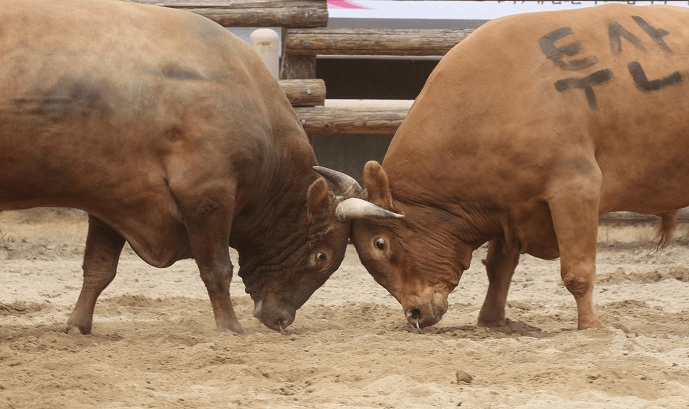
Animal Rights Groups Urge Suspension of Traditional Bullfighting

Groups like the Korean Animal Welfare Association on Monday held a press conference in front of the National Assembly, urging politicians to remove exceptions for bullfighting in the Animal Protection Act.

“Cows are herbivores that do not fight in the wild. It amounts to animal abuse if humans force them to fight for mere amusement,” the groups said.

The Animal Protection Act stipulates in Article 8 that inflicting an injury upon an animal for gambling, advertising, amusement or entertainment amounts to animal abuse.

There is an exception, however, in cases specified by the Ordinance of the Ministry of Agriculture, Food and Rural Affairs, such as folk games, exempting bullfights held in 11 provinces located across the country from punishment.

Image Credit: Yonhap / photonews@koreabizwire.com

Animal Rights Groups Urge Suspension of Traditional Bullfighting | Be Korea-savvy (koreabizwire.com)

Regards Mark