Category: Farm Animals

With thanks as always to Stacey at ‘Our Compass’:
The video which is posted here must be seen by as many people as possible.
“Lies, deception and intimidation” – don’t think so; so the truckloads of dead birds being hauled away after gruesome deaths to be converted into compost is footage of ‘lies and deception’ is it ? – we suggest the clown who says this in the video gets in touch with the real world of abuses and Iowa state factory farming which is forever making the news for all the wrong reasons.
HE is the one who needs to distance himself from political lies, deception and intimidation. (I am in England so not certain of peoples positions) but would guess then that he is probably an Iowa state politician who voted for ag gag and who does not want the real truth to come out. Sorry chum, but you are living in your pathetic world of the dim and distant past; people have no respect any more for you or those of your kind.
You may still consider yourself very important, but we look at you in another light; that of the abuser who wants to sweep his abuses under the carpet and keep them hidden. The reality which you dismiss under your pathetic terms is now fortunately being exposed to the world, and will continue to be exposed to the world. Get a grip; or even better, resign. Old fossils belong in the ground, not parliaments.
Regards Mark
There is a saying, and that is:
“The best way to predict the future is to create it!”
– Denis Gabor
Avian Flu kills millions, Gov Kim Reynolds says it’s a “disaster” only when it affects human profit, but it’s ALWAYS A DISASTER for animals who are brutalized and tortured
Source Direct Action Everywhere (DxE):
This Iowa farm just killed 5 million birds during an outbreak of avian flu, and we documented the horrific aftermath of the mass killing, including birds left behind after surviving “ventilation shutdown.”
Taxpayer dollars paid for the farm’s last mass killing after infectious disease ran rampant in 2015. Now, the farm’s billionaire owner, former Senator Glen Taylor, who also owns the Minnesota Timberwolves and Star Tribune, may be getting bailed out once again despite posing a public health threat.
(Because billionaires have a lot of money, you’ll support them having more money to reward their putrid, disgusting actions causing unimaginable suffering?
Would you trust Glen with your cat? I don’t trust Glen with dirt – look at the abysmal mess he’s made out of it already, but he’s old so he doesn’t care that his legacy is cesspools of bacteria, pus, and decomp poisoning a world – much less a live being capable of pain and misery.
Just because the Timberwolves team sucks is no reason to take it out on vulnerable, defenseless animals, who, by their very nature of vulnerability and as acceptably abused by humans, deserve the MOST care and empathy, which excludes exploiting them in any way. SL)
Learn more about Direct Action Everywhere: https://www.directactioneverywhere.com/
(Because not caring about animal suffering doesn’t preclude the effects your abusive behaviour has on Planet Earth, which affects everyone. SL)
Support the right to rescue animals from harm: https://righttorescue.com/
(Because if someone stole your dog, intent on killing and eating her, what would you do to save her? SL)
Download Your FREE Vegan PDF HERE
Order a FREE vegan kit HERE
Dairy-Free Info HERE
Take the Dairy-Free Challenge HERE
Click HERE for more Dairy-Free
Fish alternatives can be found HERE
Learn about eggs HERE
Find bacon alternatives HERE and HERE
Take PETA’s Cruelty-Free Shopping Guide along with you next time you head to the store! The handy guide will help you find humane products at a glance. Order a FREE copy HERE
Searching for Cruelty-Free Cosmetics, Personal-Care Products, Vegan Products, or more?
Click HERE to search.
Free PDF of Vegan & Cruelty-Free Products/Companies HERE
Click HERE to find out How to Wear Vegan!
Want to do more than go vegan? Help others to do so! Click below for nominal, or no, fees to vegan literature that you can use to convince others that veganism is the only compassionate route to being an animal friend:
PETA HERE
Vegan Outreach HERE
Get your FREE Activist Kit from PETA, including stickers, leaflets, and guide HERE
Have questions? Click HERE
In closing;
https://www.thesun.co.uk/news/15021581/iowa-governor-kim-reynolds-husband/


The Timberwolves aren’t done with protesters delaying their games.
An animal rights activist chained herself to the basket stanchion Saturday during Game 1 of the Timberolves-Grizzlies playoff series in Memphis, Tenn.
The woman, wearing a T-shirt that read: “Glen Taylor Roasts Animals Alive” — appeared during a stoppage of play in the second quarter with yellow chains and attempted to secure herself to the stanchion after throwing flyers on the floor.
The protester, who appears to be another member of the animal rights group Direct Action Everywhere (DxE), was unchained by security before five people carried her out of the main area to the cheers of fans inside FedExForum.
The protest seemed to be related to the one carried out by a woman who tried to glue her hand to the court before the Timberwolves’ play-in game against the Clippers in Minneapolis on Tuesday night.
The animal rights group Direct Action Everywhere — which tweeted that the person who chained her self to the basket was Zoe Rosenburg — has accused Taylor, the Timberwolves’ majority owner, of the inhumane killing of 5.3 million chickens in a recent mass killing following an outbreak of bird flu in Taylor’s Iowa egg factory.
Taylor is in his last season as the team’s owner. The NBA approved a $1.5 billion deal that will net Alex Rodriguez and partner Marc Lore, the Walmart CEO, a 20 percent minority share of the Timberwolves with chances to buy more stakes in the team in 2022 and beyond to make them the majority owners.. The deal also includes an ownership stake in the WNBA’s Minnesota Lynx.
Taylor did get some good news in the end as his seventh-seeded Timberwolves stunned the No. 2 seed Grizzlies, 130-117, to take a 1-0 lead in the Western Conference first-round best-of-seven series. Anthony Edwards led Minnesota with 36 points in his first playoff game of his career.
Protestor chains herself to basket during Timberwolves-Grizzlies (nypost.com)
Regards Mark

The alternative protein sector – including cell-based meats – is gaining momentum across the globe
Cultured Beef Burgers Arrive In Africa For The First Time – Plant Based News
Africa’s first-ever cultivated beef burger has been unveiled.
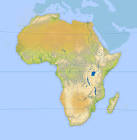
Mzansi Meat Co debuted the new burger this week at an event in Cape Town, South Africa. It’s the first cellular agriculture startup on the African continent.
Founded by Brett Thompson and Tasneem Karodia, the company is on a mission to feed Africa’s growing population with sustainably produced protein.
Like most cellular meat companies, Mzansi Meat Co’s food scientists cultivated the burger in a lab, after collecting cells from a living animal (in this case, a cow from a local animal sanctuary).
The cells were isolated and grown in a culture medium. Then, they were placed on an edible structure and combined with spices and flavoring to produce the end product.
Why produce cultured meat?
Conventional animal agriculture is destructive to the environment and contributes 14.5 percent of annual global greenhouse gas emissions. This has motivated innovators to think of new ways to produce the foods we love, in more sustainable ways.
While many brands are making meat-like products out of plants, the cell-based meat market is growing too.
Mzansi Meat Co is the first to produce a cultured meat burger in Africa, but in Singapore, cell-based meat has already appeared on restaurant menus.
The Singapore Food Authority became the first in the world to approve the sale of cultured meat in 2020. And last year, California brand Eat Just debuted cultured chicken at 1880, one of the country’s top restaurants.
‘Our burger is only the beginning’
Mzansi Meat hopes to follow closely in Africa.
“Cellular agriculture wasn’t an industry in Africa until Mzansi was born,” said Thompson. “Our burger is only the beginning, we now know it’s possible and the next step is scaling up. It starts with one small beef burger and we aim to be producing tons of cultivated meat every month in the future.”
According to Karodia, the brand will now focus on cultivated sausages. After that, it’ll tackle meat that can be substituted in traditional cuisines across Africa. “Everything we make will be braai-friendly and ready for the fire,” she said.
The cultivated meat market has significant potential when it comes to removing animals from the food system. According to McKinsey, a management consulting firm, by 2030, the sector could make up “billions of pounds of the world’s meat supply.”
Regards Mark


WAV Comment: Often in animal welfare, there are not immediate solutions to concerning animal welfare problems. Tenacity (the quality or fact of being very determined; determination.) has to be something; and is something, which all of us in the rights / welfare movement need to have and show. To put it simply, if you give up, you lose.

UK animal people did not give up; in fact, their resolve strengthened. Why:
Despite the huge success in getting animal sentience recognised in EU law, the recognition of animal sentience in the UK took a big step backwards following the Brexit referendum in 2016.
The following year, Compassion in World Farming discovered that the UK Government’s European Union (Withdrawal) Bill, which formally enacted Brexit, would not carry across provisions from EU Treaties – including Article 13 of the Treaty on the Functioning of the EU.
This meant that reference to animal sentience would disappear from UK law when the UK formally left the EU on 31st December 2020. Both the recognition of animals as having the capacity to have feelings, including pain and joy, and the requirement for governments to pay “full regard” to their welfare when formulating and implementing policy, would be lost from UK law. Read more about what Brexit meant for Animal Sentience in this news article.
Campaigning on animal sentience in the UK starts again
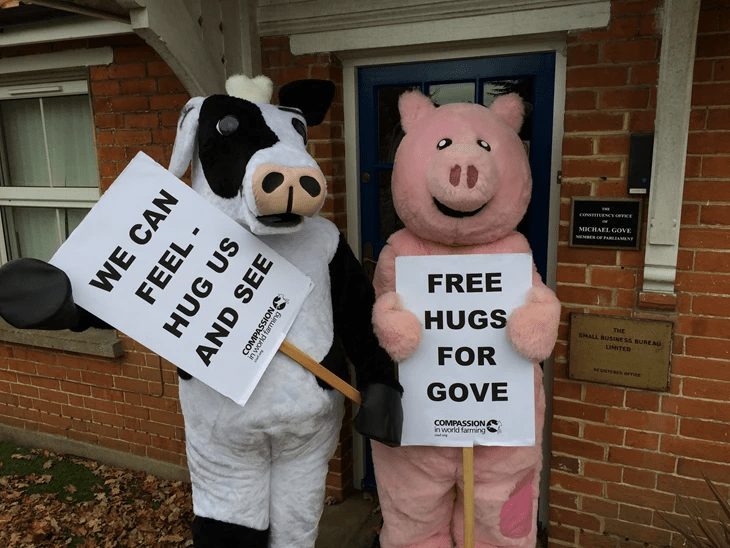
We (CIWF) had to start campaigning immediately to ensure that this cornerstone of animal welfare law was not lost when the UK left the EU. We mobilised supporters to lobby the Government, contacted Members of Parliament, and liaised with other NGOs to alert them to the threat to animal welfare. Unfortunately, it faced strong Government opposition and was narrowly defeated when it was put to the vote in Parliament.
And finally, on the 12th of December 2017, following the media furore over the vote in Parliament – and under pressure from a 155,000-strong Compassion petition, the UK Government announced a new Bill would be introduced. This was a momentous moment as the Bill would permanently incorporate the legal recognition of animal sentience into UK law post-Brexit.

2018: Campaign setback as Government delays sentience legislation
Despite the positive announcement from the Government at the end of 2017, the campaign to recognise that animals are sentient beings faced even more setbacks in the following years.
Firstly, Parliament’s Environment, Food and Rural Affairs Select Committee published a report which suggested the Bill should be redrafted. The Committee raised concerns that, as the Bill was worded, paying regard to animal sentience would lead to the slowing down or freezing of policymaking and result in widespread Judicial Reviews. Following that report, the UK Government announced in September 2018 that the legislation relating to animal sentience would be delayed.
2019: Over 100,000 calls for animal sentience recognition
In September 2019, our Senior Policy Manager, James West, handed in a 103,000-signature petition to Downing Street, alongside other members of the #BetterDealForAnimals coalition. The petition called on the UK Government to introduce legislation recognising animal sentience and require that full regard be given to animal welfare in UK Government policies.
2020: MPs debate animal sentience
As a result of the 2019 petition reaching over 100,000 signatures, MPs debated the issue in March 2020. Watch the highlights of the debate.
Then, following continued inaction from the Government, in September 2020 dedicated Compassion campaigners took action again.
Thousands of people urged their MPs to call on Ministers to introduce animal sentience legislation before 1st January 2021. This was the day after the UK would formally leave the EU, at which point EU laws recognising animal sentience at the time were due to run out.
2021: UK Government introduces Animal Welfare (Sentience) Bill
As the clock struck 11pm on 31st December 2020, despite persistent campaigning, animals in the UK were, for the first time in almost a quarter-century, no longer recognised as sentient beings under the law.
Then, on 13th May, the efforts of compassionate people around the country finally worked in British animals’ favour. The UK Government announced it would introduce the Animal Welfare (Sentience) Bill as part of its ‘Action Plan for Animal Welfare’.
During the summer and autumn of 2021, the Bill progressed through the House of Lords, completing all its stages by December 2021.
Today – 7/4/22.
On Thursday 7th April, we achieved a momentous victory for animals.
The updated Animal Welfare (Sentience) Bill was voted through by the House of Lords which means that animals are legally recognised as sentient beings once again.
Thank you to everyone who emailed politicians or signed petitions, donated in response to this campaign, shared posts on social media, and asked friends and family to take action.
It’s official. UK law will now recognise that animals can feel joy, pain, and fear once again..
Read about the highs and lows of sentience over several decades:
Animal Sentience: the highs and lows | Compassion in World Farming (ciwf.org.uk)
In the end, positive results always come to those who have the tenacity to fight and continue fighting. Never ever give up the fight(s) for your issues;
Regards Mark


5 April 2022
RFA
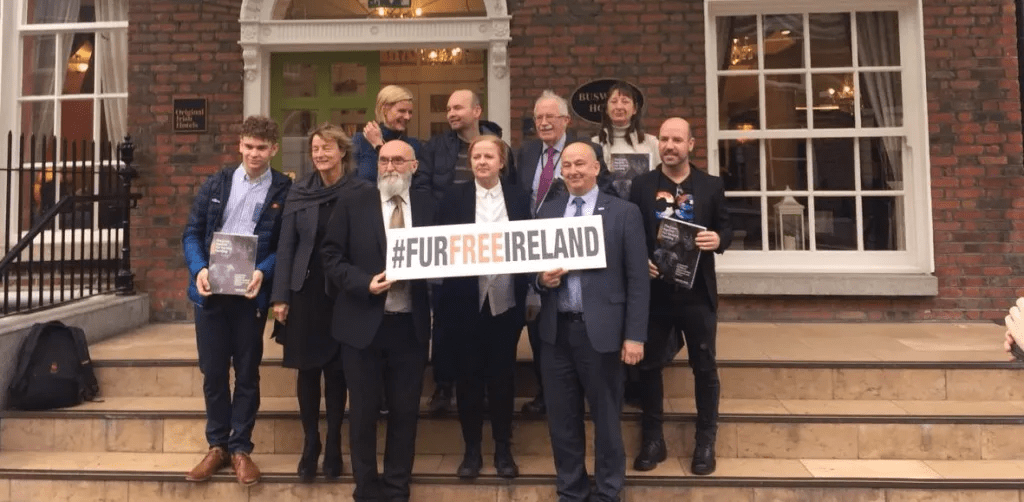
On 29 March, a bill to ban fur farming successfully reached the final stages of the parliamentary process in the Republic of Ireland.
The Animal Health and Welfare and Forestry (Miscellaneous Provisions) Bill 2021 passed its final stage in the Seanad, despite some objections from a minority of senators about compensation for fur farm workers. It received support from across the political spectrum in both houses of the Oireachtas.
The legislation will now go to the President, who will sign it into law.
There are currently 3 operational fur farms in the country, which are expected to be closed during the course of 2022 after the success of the bill.
Respect for Animals conducted a poll regarding public opinions of fur farming amongst people of Ireland in 2018. 80% of respondents agreed that the farming and killing of animals for their fur should be banned.
In 2021, several other European countries took steps to implement national bans on fur farming, including Italy, Estonia and France.
Ireland finally takes a historical step and joins the increasing number of European countries that say no to fur farming, a practice that has no place in a society that genuinely cares for animal welfare.
Bethania Malmberg – Programme Officer Fur Animals, Eurogroup for Animals
This is a historic day for animal welfare in the Republic of Ireland and another nail in the coffin of the cruel and callous global fur industry. A critical report by Veterinary Ireland considered, in depth, the scientific evidence regarding mink farming and concluded that, on animal welfare grounds ‘there should be an immediate ban on the farming of mink, and similar wild animals, for the production of fur’. It is essential that legislators around the world – including at EU-level – take urgent action to end the cruelty of fur factory farming once and for all.
Mark Glover – Director, Respect for Animals
VICTORY: Republic of Ireland passes law to ban fur farming | Respect for Animals
Regards Mark

4 April 2022
On 15 March, the European Parliament adopted its position on the revision of the EU’s Corporate Sustainability Reporting Directive (CSRD). The report, led by MEP Pascal Durand, calls for animal welfare to be included in the scope of the revised legislation. Eurogroup for Animals welcomes this move and calls on Member States to accept this in the coming trilogue.
The EU’s Corporate Sustainability Reporting Directive (CSRD), initially adopted in 2014, defines how companies should report on all extra-financial activities, including on the impact their business has on sustainability. In April 2021, the European Commission put forward a proposal to review this text, notably to extend the scope to all large companies and introduce more detailed and EU-wide reporting requirements, but the proposal missed out on animal welfare.

The position adopted by the European Parliament’s Legal Affairs (JURI) committee suggests adding animal welfare to the scope of the required reporting. According to the text, businesses would thus need to report on how their activities impact the welfare of animals, both in terms of “living and transport conditions”. The report also proposes enhanced reporting for companies operating in high-risk sectors for sustainability, such as “animal production and seafood industry”.
After the EU Code of Conduct on responsible business and marketing practices, which successfully incorporated animal welfare concerns, this report represents another milestone for animal welfare in the context of the debates on corporate sustainable governance. Indeed, the report recognises that animal welfare is linked to sustainability and should be taken into account by companies when establishing and reporting about their impacts on sustainability.
All eyes are now on the Council as “trilogue” negotiations with the European Parliament have already started. In this context, Eurogroup for Animals calls on the Council to uphold the objectives of the Green Deal and the Farm to Fork strategy and thus agree with the European Parliament on a text encompassing and recognising the inherent links between animal welfare and sustainability.
Regards Mark

6 April 2022
The third report from the Intergovernmental Panel on Climate Change (IPCC), launched on 4 April, covers the mitigation pathways that can reduce greenhouse gas emissions. It follows upon the previous report launched earlier this year that detailed the catastrophic consequences of climate change and concluded that the brief window to secure a liveable future is rapidly closing.
António Guterres, Secretary-General of the United Nations, warned during the press conference that the world is on a fast track to climate disaster. He called for rapid progress to shift to renewable energy, end the funding of coal, protect forests and ecosystems and reduce methane emissions.
The report warns that methane emissions continue to increase, the main source being enteric fermentation from ruminant animals. In addition to its contribution to global warming, diets heavy in animal protein also contribute to land being used inefficiently. Arable land is used to grow crops for animal feed, with negative impacts on ecosystems and biodiversity.
Conversely, a shift to plant-based diets has significant mitigation (action of reducing seriousness – WAV) potential according to the IPCC. More plant-based diets, with only a moderate intake of animal-source food, can lead to substantial decreases in greenhouse gas emissions.
IPCC notes that a dietary shift comes with co-benefits for animal welfare but also reduced land use for feed production, less nutrient run-off as well as health benefits, reduced mortality from diet-related diseases and lowered risk of zoonotic disease and antibiotic use.
The IPCC recognises that cellular agriculture, such as cellular fermentation and cultivated meat, can bring “substantial reduction in direct GHG emissions from food production”. The report notes that these food technologies use less land and water, have a lower nutrient footprint as well as address concerns over animal welfare.
On alternative proteins, the report indicates that insects could be a mitigation opportunity. However, insects are reared industrially to feed intensively farmed animals, thereby propping up animal production and they are often fed on crops that could be consumed directly by animals or people, which accentuates an inefficient way of producing food.
While lifestyle changes can accelerate climate change mitigation, these changes require systemic changes across all of society including on land use, the report states. When governments meet in Egypt this November at COP27 they will discuss the targets for cutting greenhouse gas emissions in line with the Paris Agreement to limit global warming to 1.5°C.
The report is a strong call on governments to take forceful actions to speed up the shift to more plant-based production and consumption and to reduce the number of animals raised for food production.
Regards Mark


Posted on the 4th April 2022
A recent ‘One Poll’, commissioned by Animal Aid, has shown that the majority of people believe that it is always wrong to cause animals pain and suffering.
The poll asked the question, “Is it ever acceptable to cause pain and suffering to animals?”, to which 71% of people answered “no”. The results show, as Animal Aid suspected, that most people ‘want to be kind’ but are seemingly unaware that there are many things we do on a daily basis that cause animals pain and suffering – for the food we eat, for entertainment, in the wild, and in laboratories.
Most people wouldn’t dream of harming animals, but our daily actions can cause animals huge amounts of pain and suffering – from the food we eat, the entertainment we choose to attend, and from the products we buy and use.
What can you do ?
In the second episode of our brand-new podcast, Conversations on Compassion, our hosts interview XCellR8 co-founder, Dr Carol Treasure about her journey into living with compassion. We learn everything from what inspired Carol on her journey, to the ethical implications of some scientific language – and if there’s such thing as an average day in the lab! Take a listen now
On Sunday 24th April it’s World Day for Animals in Laboratories and we’ll also be sharing some facts about some of the animals who currently suffer in laboratories – so keep an eye on our social media!
It has been hard to ignore the Cheltenham festival, which this year claimed the lives of four horses. Ahead of the Grand National, we’re asking people to support horses by not betting.
If you’re out and about in London, see if you can spot our adverts on London buses, a reminder that horse racing is a dead sport. We’d love to see your pictures, so do share these with us on social media – and be sure to tag us so we can see them!
This week, we’ll visit London, Bristol and Liverpool (Monday, Tuesday and Wednesday respectively) with our ‘ad-vans’. These will host mobile screenings of our brand-new film “71%”, narrated by the fantastic Benjamin Zephaniah – poet, author, musician and legend. You can watch the full film here!
Enjoy a compassionate Easter with animal-friendly treats for every bunny! 🐰
Find truffle-filled eggs, zesty chocolate bunnies, deliciously dark chocolate hens, white chocolate treats and much more! All proceeds go towards our work to help animals. 🙏
Hop on over the Animal Aid shop and fill your basket with vegan goodies galore
We want to say a big thank you to everyone who supported our campaign to #BanSnares! Together we have reached the target of 100,000 signatures – a month ahead of the deadline! We’ll update you with more details of this campaign in due course.
With kindness,
The Animal Aid team!
Website – Home – Animal Aid
Regards Mark

Enjoy ol Vic – a British icon:
When these Londoners were asked to try a new milk, they were more than happy to offer praise for the creamy drink, but when a disturbing “fact” about the milk was revealed, everything changed. People were disgusted when they were told that the drink (which was actually soya milk) came from a dog. But if the thought of drinking dogs’ milk makes you feel ill, why drink the milk from any other animal?
After all, there is nothing “normal” about artificially inseminating a cow and forcing her to give birth, only to tear her beloved calf away from her so that the milk that nature intended for her baby can be consumed by humans instead. Humans are the only species on the planet to drink another animal’s milk, and cows’ milk is no more natural for us than dogs’ or rats’ milk would be.
____________________________
So, if you “accidentally” drank dog’s milk, or cat’s milk, would you be angry? Pissed off? Morally outraged? You’re not the victim who’s forcibly impregnated, separated from her infants, and then violently killed.
Right?
Did you know there are actual industry video shorts on how to “safely” steal a calf from her mother, to protect the kidnapper from an angry and fearful mother trying to SAVE HER CHILD? Yeah, it’s all about how violent cows can be and how the farmer is just the innocent bystander risking bodily injury to nobly take an infant SO HUMANS CAN DRINK THE CALVES’ NATURALLY-INTENDED MILK INSTEAD.
What would YOU do if someone tried to take your child?

But what if, say, dogs were farmed for their flesh and for their breastmilk? Would that be ok? I mean, people say ALL THE TIME how much they love animals, but eat them, and farmers always say they care for the animals better than their own kiddos and then kill them. Right? Effing yikes.
So what about love for Fido or Fluffy or Lassie or Benji? Can you show THEM how much you care?
Find out more about this unique and dog-lover owned business venture at Elwood’s Organic Dog Meat
I bet you can also hear Sam Elliot proclaiming, “Dog. He’s what’s for dinner………………..”
(Be aware that due to some negative feedback they’ve received, ie., angry messages, hostile tweets, violent phone calls, death threats … they are monitoring their feedback more frequently, but want to let you know how important dogs are to them, and how much they love dogs like you love pigs, chickens, cows, lambs, so please keep an open mind and remember this is all for the love of animals.)
SL
Download Your FREE Vegan PDF HERE
Order a FREE vegan kit HERE
Dairy-Free Info HERE
Take the Dairy-Free Challenge HERE
Click HERE for more Dairy-Free
Fish alternatives can be found HERE
Learn about eggs HERE
Find bacon alternatives HERE and HERE
Take PETA’s Cruelty-Free Shopping Guide along with you next time you head to the store! The handy guide will help you find humane products at a glance. Order a FREE copy HERE
Searching for Cruelty-Free Cosmetics, Personal-Care Products, Vegan Products, or more?
Click HERE to search.
Free PDF of Vegan & Cruelty-Free Products/Companies HERE
Click HERE to find out How to Wear Vegan!
Want to do more than go vegan? Help others to do so! Click below for nominal, or no, fees to vegan literature that you can use to convince others that veganism is the only compassionate route to being an animal friend:
PETA HERE
Vegan Outreach HERE
Get your FREE Activist Kit from PETA, including stickers, leaflets, and guide HERE
Have questions? Click HERE

Regards Mark
With thanks to Stacey as always. Stacey | Our Compass (our-compass.org)