Leading animal welfare charity the League Against Cruel Sports has praised politicians in Wales following a crucial vote on snaring.
A vote in the Senedd tonight [TUESDAY] has paved the way for a complete ban in Wales on cruel traps known as snares, the first country in the UK to take this big step forward for animal welfare.
The vote to ban snares was part of the stage three debate on the Agriculture (Wales) Bill, during which amendments designed to water down the snares ban were defeated.
The legislative process now moves on to the fourth and final stage in which the Senedd is expected to ratify the bill as early as next week, subject to King’s consent.
It follows over five years of campaigning by animal welfare charity the League Against Cruel Sports.
Will Morton, head of public affairs at the League Against Cruel Sports, said: “Wales is leading the way in animal welfare by being the first country to ban these cruel and indiscriminate traps.
“We thank the thousands of campaigners who are backing the ban in Wales and the MSs who gave cross party support to make it become a reality.”
The debate tonight saw the defeat of amendments to allow so-called humane cable restraints, a term used by the shooting industry lobby to try and mask the cruelty of these devices.
Snares are cruel wire traps – nearly quarter of a million lie hidden in the British countryside at any one time – and are used by shooting industry gamekeepers on ‘game’ bird shoots to trap wildlife.
They tighten around the neck, torso or legs of the animal and cause immense pain and suffering to their trapped victims for hours or days before the animal is either shot or faces a lingering death.
They trap indiscriminately and government figures from Defra show nearly three quarters of the animals caught are not the intended target species.
Polling carried out by YouGov in January 2021 showed 78 per cent of the Welsh public wanted snares to be made illegal.
Once the Agriculture (Wales) Bill is passed – something that is all but inevitable – it will then come into force two months after receiving royal assent.
Will added: “The ban on the use of snares will protect wild, farmed and domestic animals from falling victim to these brutal devices, a move that will be welcomed by the vast majority of the Welsh people.
“The next step is to lobby the UK and Scottish governments to follow the precedence set in Wales and to ban these barbaric devices.”
Animal Welfare Ambition Needed in EU-Australia Agreement
18 May 2023
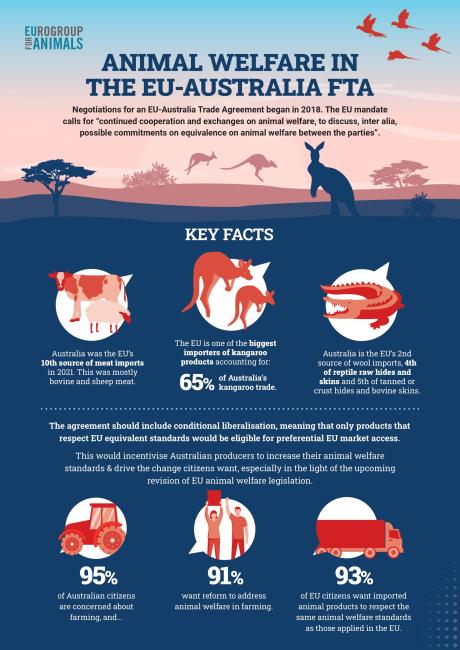
As negotiations for a trade agreement between the EU and Australia enter the final stage, Eurogroup For Animals urges both sides to seek ambitious measures on animal welfare.
The EU and Australia are nearing the end of negotiations for a free trade agreement, with both sides expecting talks to conclude this summer. It is therefore critical that the partners take the opportunity of these final stages to achieve ambitious provisions on animal welfare in the agreement, including the recommendations outlined in our EU-Australia fact-sheets.
The EU and Australia together represent 473 million citizens, many of whom believe more should be done to improve the lives of animals. According to a 2019 report commissioned by the federal Department of Agriculture and Water Resources, 9 out 10 Australians are concerned about farming, and nearly as many want a reform to address this.
In Europe, animal welfare is a great ethical concern. The consultation on the Future of Europe found one out of seven EU citizens consider animal welfare a priority issue, 89% of EU citizens want the EU to do more to promote animal welfare at a global level, and 93% consider that imports of animal products should comply with the same animal welfare standards as those applied in the EU.
While animal welfare is linked to sustainable food systems, unconditional trade policies fuel the negative impacts of intensive livestock farming by prioritising profits above all. Notably, 96% of Australian beef exports to the EU are finished in feedlots, which are detrimental to animal welfare, particularly in terms of health and nutrition.
According to the EU’s own impact assessment, a Free Trade Agreement with Australia granting further market access to Australian beef without any animal welfare condition would fuel beef production on feedlots, increasing water, soil and air pollution in Australia. Eurogroup for Animals calls on the EU and Australia to condition the beef quota to meat derived from animals fed with grass, hence explicitly excluding feedlots.
It is also critical that animal welfare be prioritised in the negotiations in relation to the handling (in particular introducing pain relief for all painful procedures and mutilations, including mulesing), transport and slaughter of bovines and sheep.
Other topics less relevant to current trade flows must also be discussed, such as conditioning the lowering of tariffs on broiler-related products to the respect of the coming revised EU rules on broilers, which should to be aligned with the “Better Chicken Commitment” – already endorsed by Australian companies such as HelloFresh, My Food Bag, Marley Spoon and Domino’s – and laying hens with a conditionality on cage-free which would support the Australian government’s pledge to phase out battery cages by 2036.
Male chick and female duckling culling must be banned, argue several MEPs
16 May 2023
Last Thursday, MEPs gathered at a plenary session at the European Parliament to share their views on banning male chick and female duckling culling. We were pleased to see most of those involved in the debate were against the brutal practice – but now, it’s vital the appropriate steps are taken to phase it out effectively in Europe.
Male chick and female duckling culling is inherently inhumane – where young birds are sent to slaughter at just one day old to be gassed or macerated, as they serve no ‘use’ to European food production. It’s a barbaric way to treat any sentient being – the European Commission must ban the practice in their ongoing revision to the animal welfare legislation.
Fortunately, this is a perspective many MEPs seemed to share at the plenary session held on May 11, where an end to the practice and alternative methods for managing day-old poultry populations was discussed. Some speakers referenced the fact that many Member States have already banned the practice (showing the EU that such a ban can be enacted effectively on a large scale), and that in addition, there has been progress made towards the use of in-ovo sexing technologies, which would determine the sex of these young birds before they hatch and therefore eliminate the need for such cruel slaughter.
Several MEPs showed particularly strong interest in a ban, calling male chick and female duckling culling “cruel”, “brutal” and “devastating”. Among the most passionate speakers were Niels Fulsgang and Clare Daly, who represented Denmark and Ireland respectively. Many MEPs referred to Article 13 of the Treaty on the Functioning of the European Union, as well, which acknowledges that animals are “sentient beings”. The clear message was that there is a strong dissonance between this acknowledgement and this barbaric practice, which is still allowed under European law – a dissonance that must urgently be addressed for the welfare of millions of animals each year.
Based on the responses to this open question and the reaction from policymakers to L214’s event on male chick and female duckling culling in January this year, we’re optimistic that European policymakers will continue to work towards an EU-wide ban with no derogations, ensuring a strong and effective legislation that leaves no male chick or female duckling behind, no matter their ‘use’ assigned by the industry.
The European Commission can draw inspiration from the Member States who have already made progress in this area, and have at their disposal the latest science that shows much more humane alternatives to the practice are available and viable.
Debate about the Industrial Emissions Directive puts the intensification of animal farming in the spotlight
17 May 2023
Next week the European Parliament’s Committee on Environment, Public Health and Food Safety (ENVI) votes on the proposal for the revised Industrial Emissions Directive (2010/75/EU), commonly called ‘IED’. The debate around the revision shows that EU animal farms have intensified during the past decade to bigger farms and more intensive rearing of animals.
The IED controls emissions from the largest industrial installations in the EU, including large pig and poultry farms. Any installation controlled by the IED is forced to reduce emissions and needs a permit to operate. The EU agricultural sector is responsible for half of the methane emissions, a powerful greenhouse gas, and for ⅔ of the pollution from ammonia emissions. The EU is currently not on track with reducing its emissions and it is necessary to address more of the large livestock farms.
The European Commission’s proposal for a revision of the Directive seeks to bring the IED in line with EU’s climate targets, the Zero Pollution Action Plan and the Global Methane Pledge (pledging to reduce methane emissions by 30% by 2030). In addition to large pig and poultry farms, the Commission proposes that the IED should also cover cattle and lower the threshold to cover farms with 150 or more Livestock units (LSU). 150 LSU corresponds to, for example, a large farm with 500 pigs, or 150 dairy cows, or 10,700 laying hens or 21,400 broiler chickens.
A threshold of 150 LSU would cover the largest commercial cattle farms in the EU, and increase the coverage of intensive pig and poultry farms. The new proposal will increase the IED’s coverage from 18% to 60% of emissions of ammonia from cattle, pigs and poultry, and extend the coverage from 3% to 43% of methane emissions. This would help the EU achieve its climate commitments and help improve air and water quality.
The proposal has been criticised for affecting a larger proportion of farms than initially foreseen.
The debate surrounding the proposal is illustrative of another important issue affecting the EU: the intensification of animal farming. In fact, even though the proposal will affect significantly fewer farms than originally planned, the relative number of farms (i.e. the percentage) is higher, as farms have become larger with more intensive breeding and the smaller farms have declined.
The debate also reflects how the animal industry does not bear the true costs of its production. For example, the new threshold of 150 LSU would cover 135.000 farms (according to data from 2020). The cost for the farms is estimated to be around 2.400 euro on average per farm per year while the emissions reduction will come with human health benefits of 5.5 billion euros per year, according to Commission figures. Given the large ‘hidden’ costs that intensive animal agriculture has for the environment, public health and animal welfare, the sector should not be exempted from the ‘polluter pays’ principle.
The Commission’s proposal runs the risk of being watered down by the European Parliament and the Council by increasing the threshold or removing cattle from the scope. As the Parliament’s Committee on Environment, Public Health and Food Safety votes on the proposal next week, Eurogroup for Animals calls on the Members of the European Parliament to honour the EU’s commitments to the climate targets, the Zero Pollution Plan and the Global Methane Pledge and uphold the proposed threshold of 150 LSU for cattle, pig and poultry.
Swedish Public Procurement Agency sets criteria for healthier chicken breeds
11 May 2023
Djurens Rätt
As a first in Europe, new criteria developed by the Swedish National Agency for Public Procurement includes standards for higher welfare chicken breeds, in line with European Chicken Commitment. Djurens Rätt welcomes the development and its potential to reduce the suffering in chicken factory farms.
Public sector food procurement represents a significant lever to drive improvements for animal welfare standards, sustainability and support for local food producers. Since 2022, Sweden’s Public Procurement Agency has been working to update the criteria for chicken and turkey meat with input from an advisory group, which included Djurens Rätt.
Several of Djurens Rätt’s suggestions were included in the final criteria, such as the opportunity to procure meat from higher welfare chicken breeds, thereby excluding meat from fast-growing chickens. This is in line with the European Chicken Commitment (ECC) or Better Chicken Commitment, a policy that outlines the minimum standards required for chickens to live healthier, happier lives. It includes maximum stocking densities, improved environmental standards and more.
Djurens Rätt is of course very happy that our participation in the advisory group has led to positive outcomes for chickens. Facilitating municipalities and regions to reject the use of fast growing chickens will reduce suffering at large. It is important to simultaneously reduce consumption of chicken meat in order to strengthen the protection of animals in the long term.
No Animal Left Behind: why do farmed pigs need specific laws to protect their welfare?
15 May 2023
Did you know over 240 million pigs are farmed in Europe? Trapped in bleak and unhygienic factory farms, they are forced to face a number of awful scenarios. Where sows often spend a large portion of their lives in a tiny cage with not even enough room to turn around, piglets are mutilated, and pigs bred for meat are lowered into gas chambers before being slaughtered. The European Commission has the power to help pigs immensely by creating specific rules for their welfare in the ongoing revision to the animal welfare legislation.
Learn about the issues piglets, sows and grower pigs face on pages 31 – 54 of our No Animal Left Behind report. All sources cited below have come from this report.
Able to understand words, solve problems and play games, pigs are incredibly clever – in fact, they rank within the seven most intelligent animals worldwide. Mother pigs are especially nurturing, and go to great lengths to take care of their young piglets, from building nests to ‘singing’ to them when it’s time for their dinner. These expressive and caring creatures love to be touched, too, and will often cuddle and sleep nose to nose.
Yet pigs are living horrible lives in the EU’s factory farms – even when they are only piglets
From the moment they are born, factory farmed pigs are in line to suffer. Male piglets are castrated to avoid developing ‘boar taint’, a largely cosmetic issue that only affects 0 – 3% of piglets on factory farms – yet despite these small numbers, a 2016 survey found that 18 out of 24 countries castrated over 80% of their pigs. This is completely needless, and causes acute pain to these babies – as does ‘tail docking’, another procedure to which they are subjected, in which their tails are cut off. Though legislation banning the routine use of this procedure has been in force since 1994, audits between 2016 – 2019 found that 95 – 100% of pigs had docked tails in Germany, Hungary, the Netherlands, Italy, Spain and Denmark, proving that the legislation is vastly ignored and unenforced.
Their bodies mutilated, these poor piglets can’t even turn to their mothers for comfort.
Millions of sows are wasting away in tiny crates
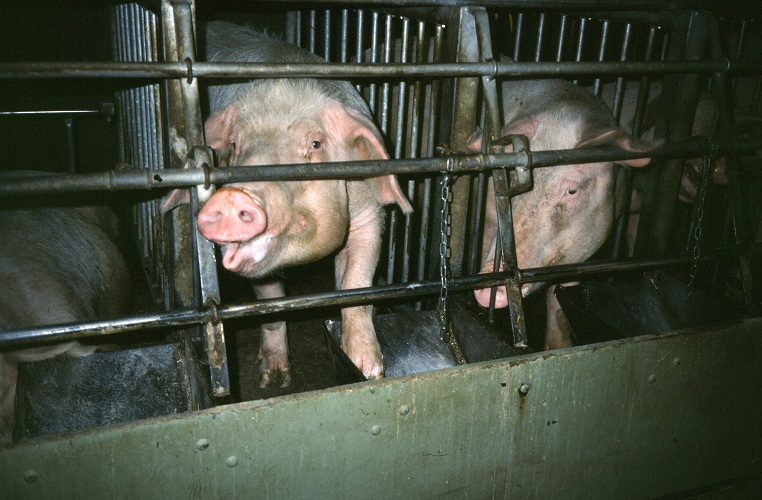
Sows on factory farms are confined for many weeks at a time to miniscule crates, where even doing the most simple movements, like standing up and sitting down, can result in injuries sustained from banging into the bars they are trapped behind.
Forced to produce up to two litters of 10 – 12 piglets a year, these poor mother pigs do nothing but suffer, with their bodies used as machines – they are not even fed properly, as pregnant sows are given a reduced portion of food to ensure high productivity. The stress together with being starved and confined leads to frustration and aggression. Being kept in such a state causes numerous health issues like mouth sores, reduced muscle and bone strength, and urinary tract infections.
Where a mother pig in the wild would create a comfortable space for her babies and travel far to find nest materials, caged sows on factory farms can do little more than lie on their side. It’s a boring and painful existence.
After struggling their whole lives, grower pigs face a terrifying slaughter
Most of the EU’s grower pigs are raised indoors in dirty, barren pens. Fighting is common as they are crammed so closely together, as well as illnesses – especially respiratory disorders, as a result of the poor air quality and high stress in these unnatural habitats. Fed poor and unhealthy diets aimed to maximize production and not welfare, they frequently suffer from gastrointestinal problems like gastric ulcers, which can affect up to 60% of pigs in intensive farming systems.
These poor sentient beings are not even slaughtered humanely, with many of them stunned using CO2, a gas that’s extremely painful for pigs. From the moment they are exposed to it – while being lowered into a gas-filled chamber in a crate or gondola – they hurt. High concentrations of CO2 can severely irritate their eyes, noses, throat, and lungs. It can also directly stimulate their brain’s ‘fear response’, meaning in the moments before their death, these pigs are often terrified. Tragically, CO2 stunning is not even always effective in rendering these pigs unconscious, so they are slaughtered awake. It’s an unendurable end.
Learn more about the problems with CO2 stunning and raising sows in cages in our new exposé report.
Europe’s farmed pigs don’t have to live this way
The horrors pigs are exposed to across the EU are completely needless and must be stopped. Higher welfare conditions for farmed animals are what European citizens have come to expect, and it’s what the animals themselves deserve.
In their ongoing revision to the animal welfare legislation, the European Commission must include specific rules for pigs that protect them from unnecessary suffering, ensure they can go outside, support them in creating strong and healthy relationships with their piglets and each other, and allow them to exercise their natural behaviours.
Ending the confinement of sows would be a powerful place for policymakers to start – and we’ve already put together a new report to help make it happen, filled with case studies, scientific evidence, and data from all over Europe.
It’s time to ensure farmed pigs can lead lives worth living, full of enjoyment, satisfaction and comfort – it’s their right as sentient beings. Who’s with us?
1600 mink culled due to COVID outbreak on Italian fur farm, despite ban
13 May 2023
LAV
Following a delay in implementing the Italian ban on fur farms, 1600 mink have been culled due a new SARS-CoV-2 outbreak. The farming of animals for the production of fur has been prohibited since 1 January 2022 in Italy, however there are still thousands of mink housed on five farms.
In April, after confirming the presence of the SARS-CoV-2 virus on a mink farm in Calvagese della Riviera, the culling of all 1600 minks began. This was the fourth COVID-19 outbreak in an Italian farm.
The mink housed on this farm had been awaiting transfer to shelter facilities since the implementation of the fur farming ban.
LAV launched a new appeal to Minister Lollobrigida denouncing the enormous delay in defining the procedures for the transfer.
Continuing to keep thousands of mink housed in intensive systems poses serious risk to the health not only of the animals, but also of humans, given that they can transmit, mutate and serve as intermediate hosts of SARS-CoV-2.
At the same time as the WHO announced that COVID-19 is no longer a global health emergency, the outbreak in Calvagese della Riviera was detected, acting as a reminder that swift action should be taken in order to avoid future pandemics.
In addition to the animal welfare problems inherent to fur farming, several questions regarding the public health risks have been tabled to the European Commission, whose answer has been that a EU-wide ban on fur farming would be a disproportionate and unjustifiable measure.
The European Citizens’ Initiative Fur Free Europe gathered 1,701,892 signatures from across the European Union, and continues to call on the European Commission to ban fur farming on ethical, public health and environmental grounds.
Recently, the MEPs Working Group for the European Citizens’ Initiative tabled another question on the threat to public health posed by fur farms. In its reply, the Commission stated that “in terms of both SARS-CoV-2 and HPAI in mink farms, Member States assess local health risks and take measures according to the epidemiological circumstances and in line with the SARS CoV-2 risk assessments carried out by the European Centre for Disease Prevention and Control (ECDC) and the European Food Safety Authority (EFSA) as well as the EFSA/ECDC/EU Reference Laboratories joint assessment on the HPAI situation that is regularly published”.
I am starting off with a different gripe tonight. Wednesday, I think it was, I sat through the second round of Eurovision song contest qualifiers. After 4 songs, I went out to take some painkillers for my back; only then did I realise that actually they also helped me get through the rest of the qualifying songs:
My cat could probably write, and sing, something better. The whole second qualifier was, well, rather bad in my opinion. I had to throw the telly out of the window before the end.
But something I really cannot get a grip with is why Australia is taking part in the Eurovision song contest ? – Australia IS NOT part of Europe: so why are they in it ?
The TV star leads a host of celebrities and animal welfare campaigners calling on the Government to deliver on its pledges about protecting animals and cracking down on abuse
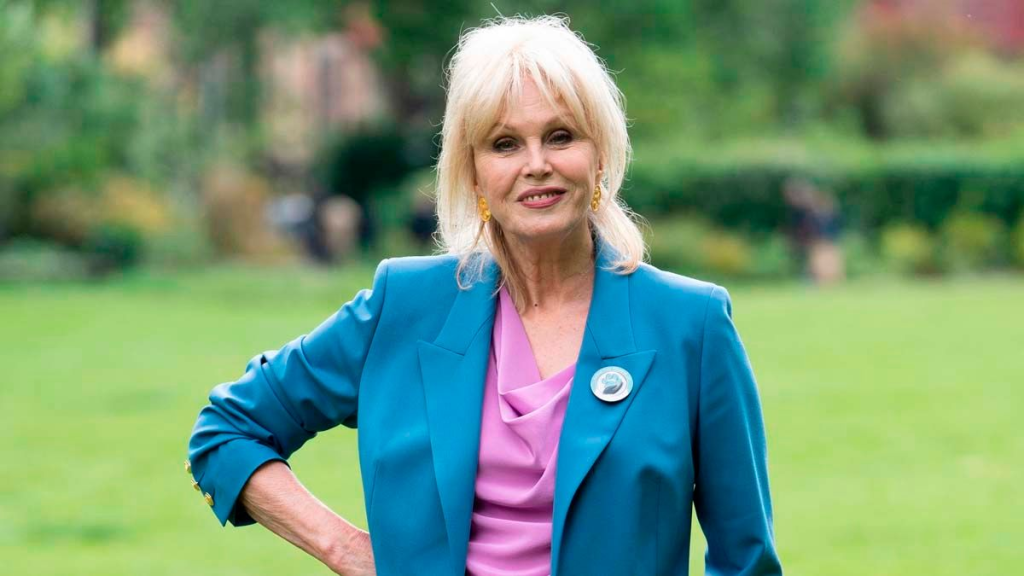
Actress Dame Joanna Lumley today urges Rishi Sunak to keep Tory pledges on boosting animal welfare.
The Absolutely Fabulous star is among celebrities to sign a letter calling on the Prime Minister to deliver on Conservative promises made in 2021 – including to drive through new legislation to tackle abuse of animals and bolster protections.
Dame Joanna, 77, told the Mirror: “Animals are being utterly let down by the Government’s dismaying failure to deliver the plans it promised two years ago.
“I urge the Prime Minister to progress vital animal protection measures, including the Kept Animals Bill and a ban on the import of cruel fur, as a matter of the utmost importance.”
The letter, which was also signed by Pop Idol singer Will Young, TV presenter Kirsty Gallacher and Countdown’s Susie Dent, tells the Tory leader: “Britain prides itself on being a nation of animal lovers and in May 2021 the Government pledged to reinforce our country’s position ‘as a global champion of animal rights’ with the publication of its Action Plan for Animal Welfare.
“The plan promised the animal-loving British public it would deliver improvements in the lives and wellbeing of millions of animals.
“But two years on, we and the animals we care so deeply about have been badly let down.”
The current version of the legislation, the Animal Welfare (Kept Animals) Bill, is stuck in the Commons.
If passed, it aims to tackle cruel puppy smuggling, live exports, banning keeping monkeys as pets and improving zoo regulations.
But a separate letter from 25 animal charities and campaign groups tells the PM the legislation has “been left languishing as the Government’s Kept Animals Bill has not been given parliamentary time for over 17 months”.
It adds: “Our patience, and our trust, has now been exhausted.
“The Kept Animals Bill, and the majority of the Action Plan, now appears to be little more than an inconvenience to a government that believes it can quietly abandon its promises.
“Animal issues matter to voters.”
Humane Society International’s senior campaigns director Claire Bass said: “The Government’s apparent disinterest and unwillingness to deliver its own Action Plan for animals is frankly baffling.
“MPs tell us they receive more constituent correspondence calling for better animal protection than any other issue, so passing legislation like the Kept Animals Bill and a ban on fur imports should be an easy and obvious choice in terms of popular policy.
“But instead, we and animals are enduring endless delays, seemingly deprioritised by this Government despite huge public concern.
“We urge Mr Sunak to remember his party’s promises and start delivering the action that animals deserve and voters expect.”
People for the Ethical Treatment of Animals vice-president Elisa Allen said: “Animals are in peril and the Government has seemingly abandoned them as time is running out for it to make good on its word.”
RSPCA chief executive Chris Sherwood claimed that “animals have been left in limbo by continued inaction on key animal welfare issues”.
Regards Mark
UK General Election in about 12 months – oh, and animal welfare people vote – so lets get moving !
Update 12/5/23 – I have been contacted directly by Steve at Cruelty Free International regarding the issue of UK animal testing for cosmetics. I show his full response below which covers how the UK government “Home Office disclosed that it had been secretly granting licences to test for cosmetics since February 2019”.
I have also included additional info from the CFI site and also a link to the site. They have actions which you can take, so I suggest that a visit there is a good starter. Obviously, people can write to their own MP’s about this all based on the info provided.
Cruelty Free International issued the following statement yesterday:
“Unfortunately, the Prime Minister is misinformed about the Government’s position on animal testing for cosmetics. A policy banning such tests was first introduced in 1998. However, in a letter to Cruelty Free International in August 2021, the Home Office admitted that the policy had ‘changed’ (i.e. been abandoned), to bring the UK into line with an EU ruling in a case called Symrise.
“When Cruelty Free International challenged the new approach in a recent judicial review, the Home Office disclosed that it had been secretly granting licences to test for cosmetics since February 2019. A High Court judge ruled that legally it was entitled to, based on his interpretation of EU general chemicals legislation known as REACH and its relationship with the EU Cosmetics Regulation.
“Importantly, however, the judge also said that there was nothing to prevent the Government from reinstating the policy ban. This is what the Government said in 2015 in the context of another judicial review:
‘… For the avoidance of any doubt, we are advising you that the current UK ban on testing cosmetics in animals is an absolute ban… No licence authorising the testing of cosmetics (finished products or ingredients) has been issued since 1998 … The UK’s policy ban remains in place even where EU legislation would appear to require or permit such testing’.
“The Government also said separately that the policy applied to worker safety testing. The Prime Minister’s statement refers to tests ‘for the consumer’. Whether labelled as consumer or worker safety, the animal tests are identical. The Government is now unquestionably once more allowing cosmetics testing on animals for the benefit of consumers.
“The 2015 statements constitute the policy the Government abandoned in 2019, paving the way for cosmetics testing on animals once again.
All the PM needs to do is to reinstate the policy. The Government does not have to slavishly follow legislation coming from the EU. It should do what the overwhelming majority of British people want.”
Please let me know if you need any further information.
The UK government has admitted that it secretly abandoned the UK’s ban on animal testing for cosmetics in 2019 – but as part of the ruling in our Judicial Review of the policy, a High Court judge has told the Home Office that it can reinstate the ban.
Click on the above link to continue reading more from CFI.









 World Animals Voice