MourãoPortugal, 5 february 2022, at 15:00
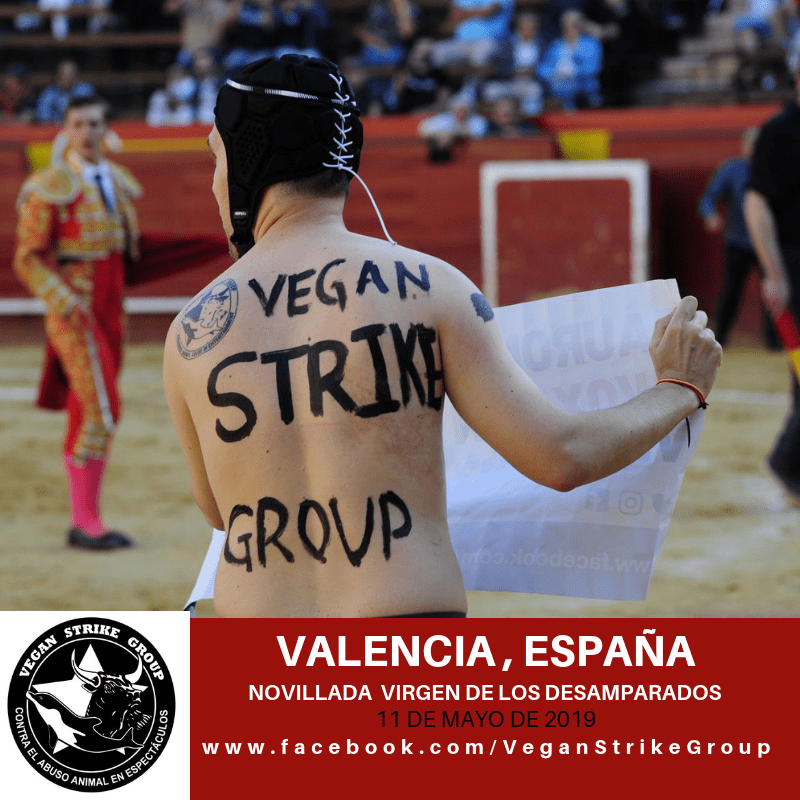
Activists from the International Vegan Strike Group have stood up against the suffering inflicted on horses and bulls in preparation for and during a bullfight in a Portugese bullfight arena.
The activists come from Portugal, France and the Netherlands.
This was the fourth time the Vegan Strike Group has shut down a bullfight in Portugal.
In 2016 and 2019 the animal rights organization already did this in the capital Lisbon and in 2018 in the touristic southern Albufeira.
Bullfighting is a very cruel form of animal cruelty. Every year, more than 250,000 bulls and cows are tortured and killed worldwide during bullfights and related events. Tens of thousands of bulls and other animals are also seriously mistreated at village festivals.
In Portugal, bulls are not killed in the bullring. While bleeding, they are transported to the slaughterhouse later.
Horses are also greatly exploited in the bullfighting sector.
They are used time and again in the arena and experience a lot of fear and stress. Again and again the horses see and smell the blood, fear and death of the bulls. Sometimes they themselves are so badly injured that they die from their injuries.
Bullfighting is under a magnifying glass. In Portugal, the richest and largest football club Benfica has stopped offering a discount on bullfighting in Lisbon if fans bought a football ticket.
In addition, the French branch of Mercedes-Benz has decided to distance itself from the bullfights. This is a very important step, because bullfighting has become increasingly dependent on subsidies and sponsorship from companies in order to survive.
It is therefore now the time to continue to exert pressure through (direct) actions.
Please continue to support the peaceful actions from the Vegan Strike Group in the bullfighting arenas by sharing their posts.
And I mean…With animal suffering so obvious, one wonders how some primitive people can claim to perceive culture while at the same time witnessing slaughter.
Is it really the case that the preservation of a cultural asset justifies the torment of living beings?
Should such a bloody tradition even be considered an intangible cultural asset of the 21st century, or should it already lie dormant in the past?
What would we lose in “culture” if bullfighting were completely banned worldwide?
We would be one step further towards civilization, because it is not contemporary to torture and kill animals for pleasure.
The only hope remains in the future.
Because surveys show: the younger the respondents, the less support for bullfighting.
So we can only wait until the last Hemingway dies so that torture is no longer equated with culture.
We send our full respect and solidarity to the courageous activists.
On January 31, 2022, a judgment of historical importance for animal welfare was made in the District Court of Oslo –
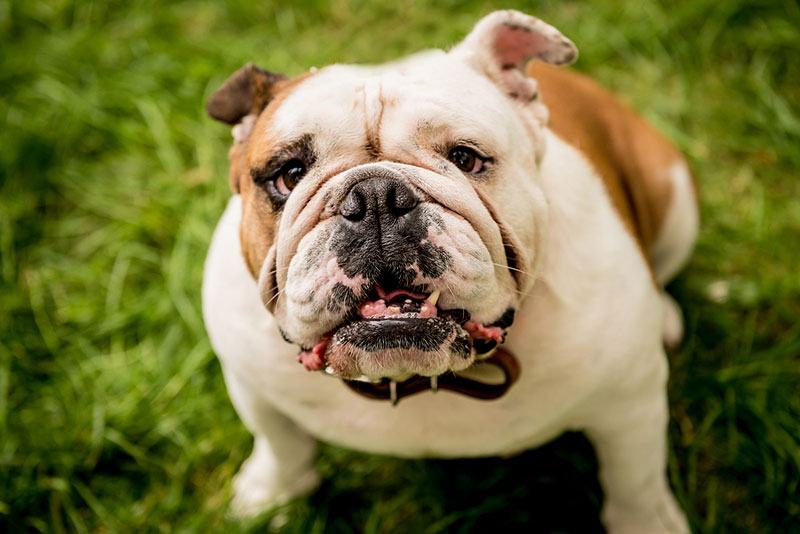
In the future, the torture of English Bulldogs and King Charles Spaniels will be banned under Article 25 of the Norwegian Animal Welfare Act.
The decisive impetus for this was a lawsuit by the animal rights organization “Animal Protection Norway”.
This was submitted because the two breeds are particularly heavily burdened by hereditary disorders.
English bulldogs suffer from diseases of the skin, the kidneys and especially the respiratory tract due to their breed.
King Charles Spaniels, on the other hand, suffer from heart problems, headaches, eye and joint diseases.
The “Norwegian Kennel Club”, the “Bulldog Club”, the “Cavalier Club” and six other breeders were unreasonable and disappointed. But animal rights activists around the world are pleased with this verdict.
Quote from Åshild Roaldset, Managing Director at Dyrebeskyttelsen Norge:
“The verdict will receive international attention. This is a victory for Norwegian animal welfare and especially for our dogs. Dogs have the right to be bred to be healthy.”
We very much welcome this step, because torture breeding is a serious problem in animal welfare.
It is precisely these two breeds that have been massively bred illegally in Norway.
Well that’s the end of it now!
We appeal to all governments on earth to generally ban defined torture breeding of any species.
Breeders only care about one thing, namely their own profit.
This should be prevented worldwide and the rights of animals and their integrity protected.
And we also appeal to all animal lovers out there in general not to buy from breeders and to enrich them, but to adopt one of the many animal souls in need of help in the countless animal protection facilities on earth.
Breeders are making a fortune while animal sanctuaries and shelters are brimming with wonderful creatures.
And I mean..In both races, increasingly extreme ideals of beauty led to massive health problems.
Inbreeding has led to them increasingly passing on genetic diseases.
The King Charles Spaniel breed is susceptible, among other things, to the so-called myxomatous mitral valve disease, a form of heart failure in dogs.
This puts them at an increased risk of a certain heart disease, for example.
Especially in the past 30, 40 years, at a time when animal welfare was being promoted with words and emergency dogs were being rescued all over Europe, Bulldog dogs were massively robbed of their health and zest for life.
The Bulldogs were getting bigger, wrinkled, wider, deeper.
At the dog shows, veritable excesses of bizarreness were celebrated.
The fact that the dogs can hardly breathe, that the severe wrinkles on their face require lifelong care and that 80% of the puppies are born by Caesarean section does not interest this scene of the so-called Bulldog friends at all.
Another well-known example is the pug, which was supposed to appear particularly flat-nosed and bug-eyed for a long time. As a result, many Pugs suffer from respiratory and corneal problems, and some specimens can even lose an eye
We would like all countries to change their minds and follow Norway’s example
Until then, there is one thing we can do: Adopt! don’t buy your friend from breeder
Franck Riester & Julien Denormandie, French ministers for Trade and Agriculture, called on the EU to apply more EU standards to imports as they presented the priorities of the French presidency of the Council to the European Parliament.
Eurogroup for Animals recalls that in order to be successful, the initiative, known as “mirror clauses”, must go beyond environmental, animal and public health standards, to encompass animal welfare.
On 24 January, Trade minister Franck Riester called for more EU environmental and sanitary standards to apply to imports, implying the measures could be adopted erga omnes, and thus apply to all imports and not only to those with preferential market access in application of a trade agreement. According to him, the European Commission recognises the legitimacy of these “mirror clauses”, as several EU rules already apply to imports, such as the rules on welfare at the time of slaughter or the ban on import of beef derived from animals who received antibiotics as growth promoters. The following day, agriculture Minister Julien Denormandie qualified reciprocity in standards as a top priority, calling for the withdrawal from the EU market of “imports from third countries which do not respect EU standards”.
Eurogroup for Animals welcomes the approach behind the French proposals of “mirror measures”. Nevertheless, we call for this approach to go beyond environmental and public health measures and to encompass animal welfare. Indeed, it should not only be about accelerating the implementation of the already adopted regulation on veterinary medicines, or strengthening the maximum residue levels for pesticides. This is a matter of consistency between EU trade and agricultural policies at times where the EU is revising its animal welfare legislation. The EU should take the opportunity of this revision to include imports within the scope of the new legislation, as suggested already by the Commission’s communication on the European Citizens’ Initiative (ECI) “End the Cage Age”.
By conditioning imports of animal products to EU-equivalent animal welfare standards, the EU would not only improve the welfare of trillions of animals, but also foster more sustainable methods of production abroad. Indeed, access to the EU market could be a positive and powerful leverage to incentivise farmers and producers to switch to more sustainable and humane methods of production. Such a measure is supported by 93% of EU citizens who want a legislative change to impose all EU animal welfare standards on imported food products. This ethical concern raised by EU citizens can guarantee that the measure would be WTO-compliant.
WAV Comment – It always rains in London ! – Giving the horses a change of scenery – away from Hyde Park. Certainly better than all the cars and other traffic clogging the streets. VERY well looked after animals – mucked out 3 or 4 times every day I think when in the London barracks.
All the Royal Horse Art, dropings and urine soaked straw is collected from the barracks each day and taken by truck to the royal botanic gardens at Kew (West London); where it is made into compost for the gardens as explained: – there is a famous saying at Kew where all the horse dung in the ‘windrow’ reaches a very high temperature (spontaneous combustion) and the London fire brigade sometimes get a call from Kew asking them if they can come over and put all the poo out ! (with some water to lower the temperature). RHA Horse poo – great compost = great plants at Kew gardens.
Mark
Residents in South London street were left puzzled this weekend after a ‘parade’ of 30 horses were seen casually walking past their street. The animals were seen on Friday (February 4th) on an early walk in the rain, filing past houses in pairs, the were captured by one curious resident who shared a post on Reddit
“Anyone know why there’s a parade of horses marching round Battersea?” the user asked. A flurry of comments on the social media platform followed with many users quick to offer suggestions as to what the horse might be doing.
One said: “It is the Household Cavalry Mounted Regiment taking their horses out for exercise. They do this once a week to get them away from Hyde park. “I once saw the entire line going through the McDonald’s drive through at the Wandsworth Roundabout.”
Another had a different theory as to why they seem to have ventured further from home. “I’m guessing they’re related to the Household Cavalry that are based in central London. They’re often seen around the Hyde Park neck of the woods but perhaps they fancied a change of scenery?”
A third said it was routine exercise for the animals: “This is the Kings troop – usually based in Woolwich but also have stables in St James and exercise around central.”
While a fourth agreed that the animals were from the royal cavalry but disagreed on their regiment.
“It’s King’s Troop, Royal Horse Artillery. The Household Cavalry have black horses and would be wearing blue or red silks, depending on regiment (Blues & Royals or Life Guards). They’d also only lead 1 horse, not two like in this video.
“However they look like the Kings Troop Royal Horse Artillery – who may be rehearsing for the ceremonial events this year for the jubilee.
Others were distracted by something else, and instead more interested in the house from where the pictures were taken. One person said,
“I don’t know anything about the horses but can I just say I often walk past your flats and envy the people who live there, they’re absolutely gorgeous
While another added: “I was going to mention this too, I’ve walked past them since childhood and it’s always been a dream of mine to live there.”
Alaska’s dangerous Iditarod dog race is set to begin on March 5. And despite the fact that the 2022 death race hasn’t even started yet, already at least one dog has been killed. Just last month while training for the Iditarod, a team of dogs was hit by a truck. One of the dogs, Noddy, was killed.
Last year, in addition to holding in-person protests, PETA exposed abundant abuse during the race:
Nearly 200 dogs were pulled off the trail during the race because of exhaustion, illness, injury, or other causes.
Musher Dallas Seavey finished first after four dogs he pushed beyond the breaking point had to be removed from the trail.
Musher Martin Buser apparently put an injured dog back in the harness and forced him or her to continue racing, despite video footage showing the dog limping.
This pointless, cruel race is a matter of life and death for dogs.
Please take action now to urge companies to drop their Iditarod sponsorships.
Take action for dogs:
Note that here you can send several messages one at a time – simply follow the send instructions to each supporter company:
It’s been reported that in the first Iditarod race, at least 15 dogs died—and the body count has continued to pile up since then.
Other dogs barely make it out alive. Take 2021’s race: By the time it ended on March 18, nearly 200 dogs had been pulled off the trail because of exhaustion, illness, injury, and other causes, forcing the rest to work even harder. Musher Dallas Seavey—who has raced dogs who have tested positive for opioids, operates a kennel accused of killing dogs who didn’t make the grade, and owns property where a whistleblower reported finding dying puppies—finished first after four dogs he pushed beyond the breaking point had to be removed from the race. Musher Brenda Mackey admitted that she pulled out of the race after the dogs she forced to run suffered from “the most awful diarrhea I’ve ever seen,” violently vomited, and developed aspiration pneumonia, the leading cause of death for dogs in the Iditarod. And musher Martin Buser apparently put an injured dog back in the harness and forced him or her to continue racing.
Discover nine other reasons why the Iditarod is a deadly nightmare for dogs forced to race:
Dog deaths in the Iditarod are so routine that the official rules call some of them an “Unpreventable Hazard.”
The Iditarod has killed more than 150 dogs since it began in 1973. Five died in 2017 alone. In just the last decade, dogs competing in the event have died from various causes, including asphyxiation, heart attacks, trauma from being struck by a vehicle, freezing to death, excess fluid in the lungs, and acute aspiration pneumonia—caused by inhaling vomit.
If the dogs don’t die on the trail, they’re still left permanently scarred.
The American Journal of Respiratory and Critical Care Medicinereported that more than 80 percent of the dogs who finish the Iditarod sustain persistent lung damage. A separate study in the Journal of Veterinary Internal Medicine showed that dogs forced to take part in endurance racing had a 61% higher rate of stomach erosions or ulcers. And in a paper in Medicine & Science in Sports & Exercise—the official journal of the American College of Sports Medicine—researchers concluded that dogs used in sled races suffer from airway dysfunction similar to “ski asthma” (an asthma-like condition caused by intense exercise in cold weather), which persists even after four months of rest.
There’s no retirement plan.
Breeders of dogs used in sledding have freely admitted that “surplus” dogs are killed. They may be killed if they aren’t fast or fit enough for competition or if they don’t meet certain aesthetic standards—for example, if they have white paw pads. Dogs who finish the race but are no longer useful to the industry may be shot, drowned, or abandoned to starve.
Even when the race ends, dogs’ misery doesn’t.
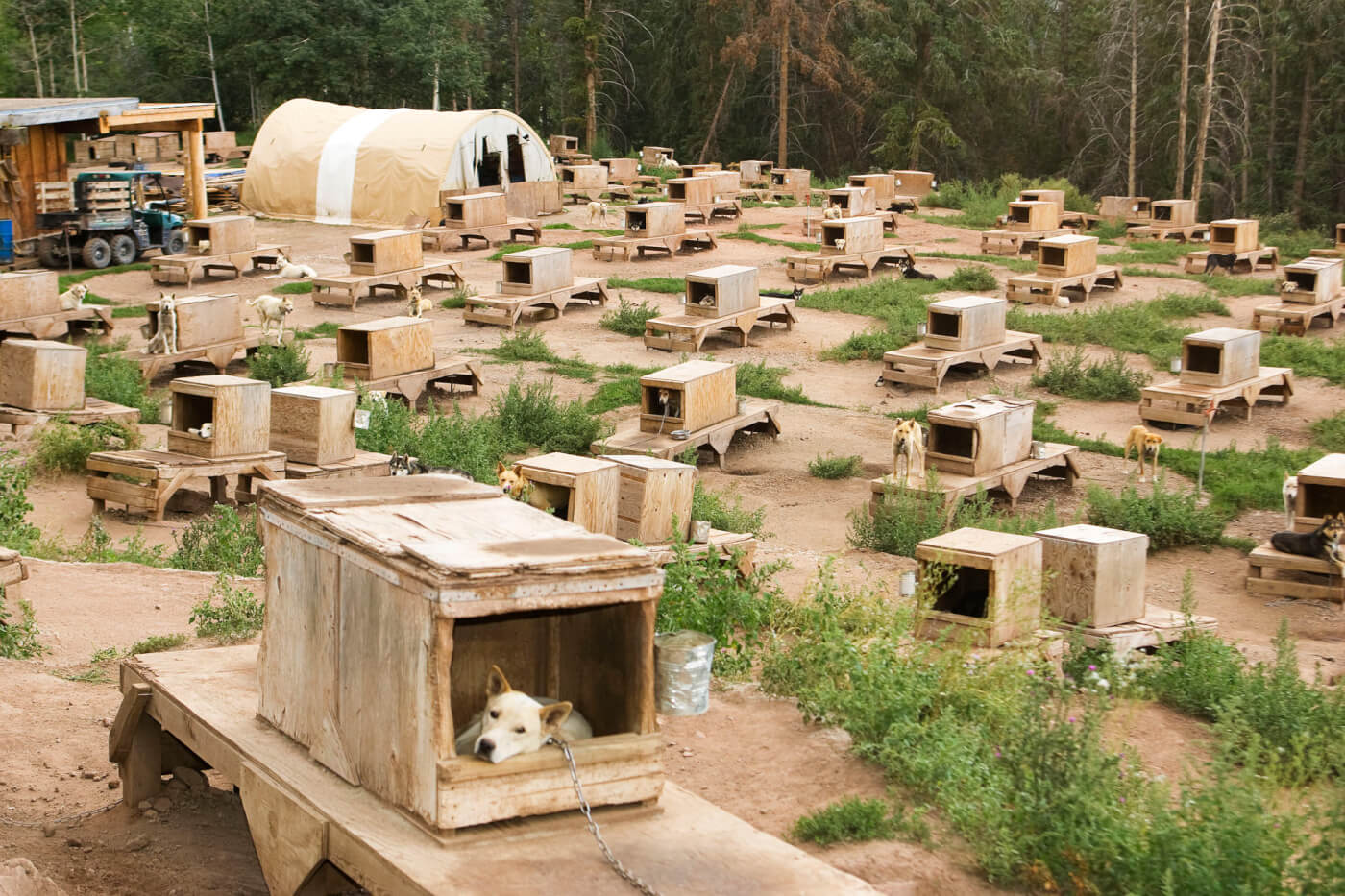
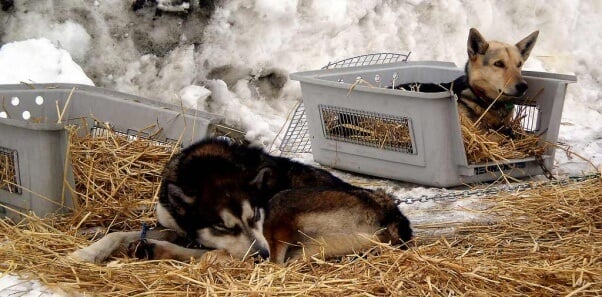
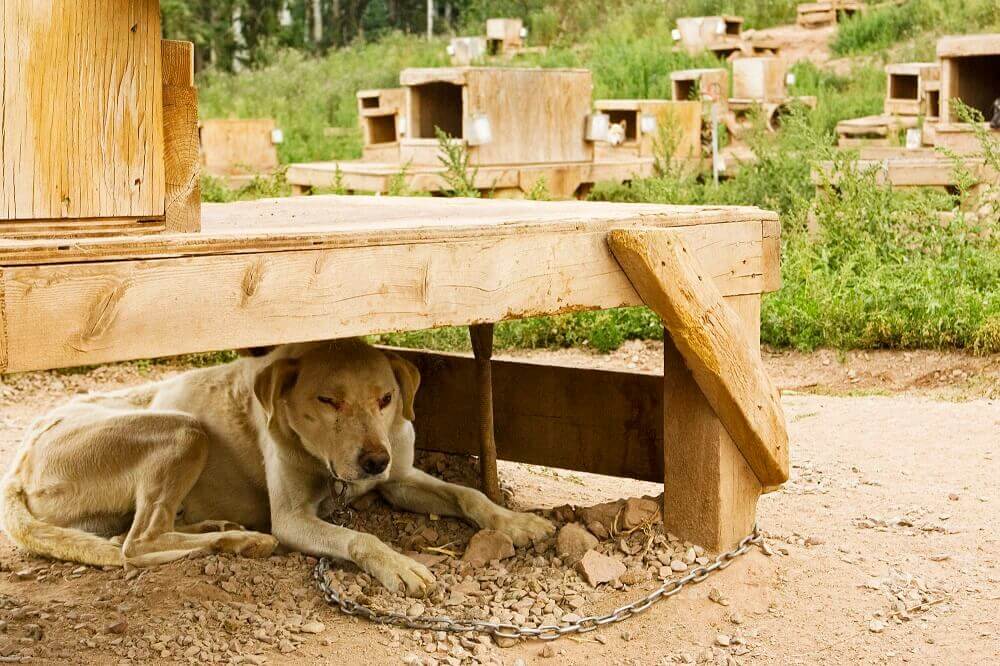
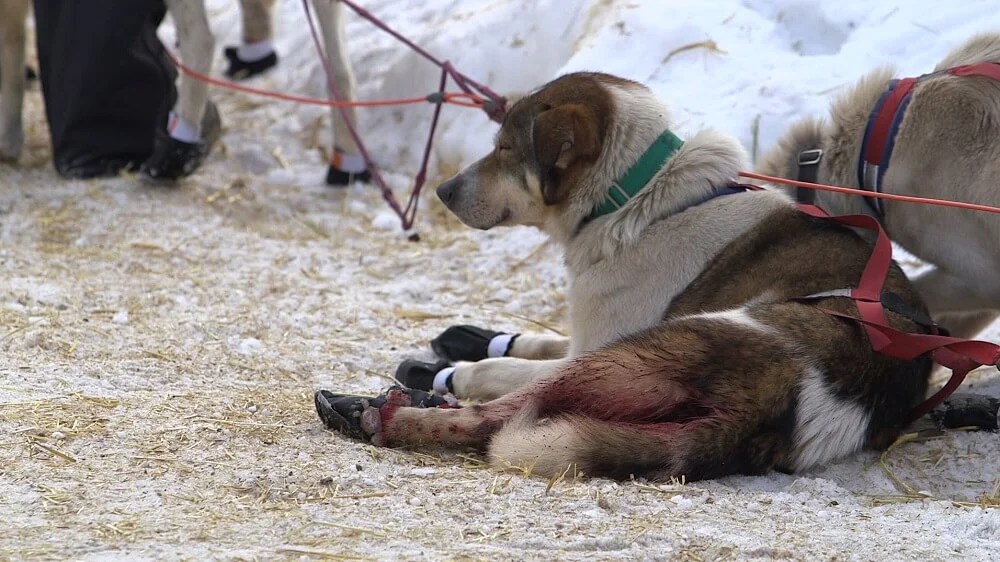
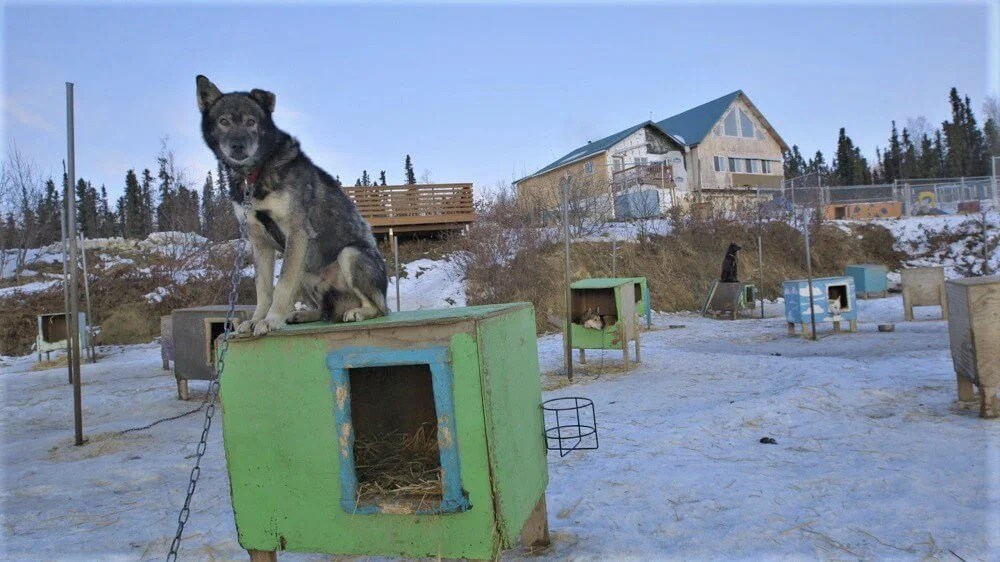
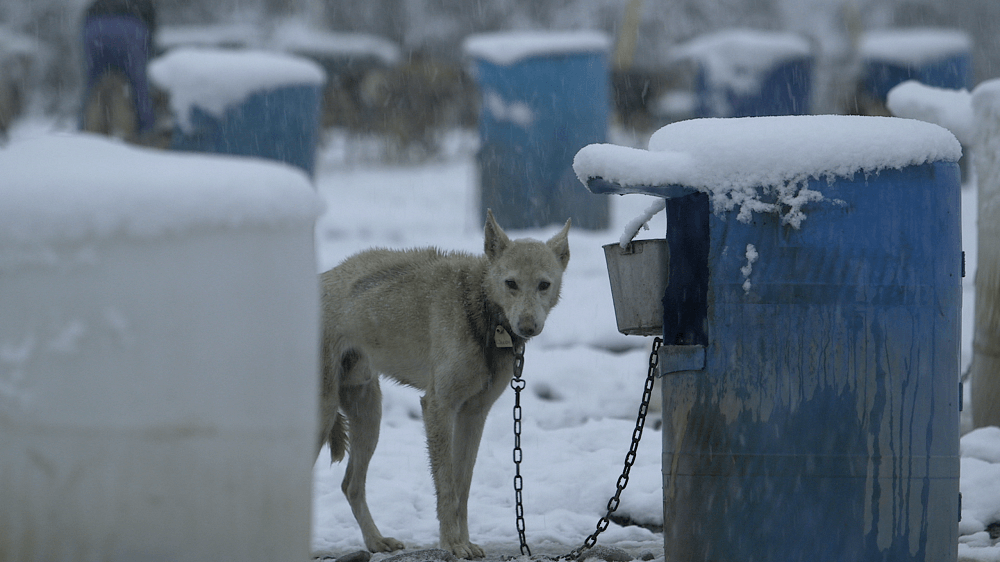
A PETA eyewitness worked at two dog kennels owned by former Iditarod champions and found widespread neglect and suffering there. Dogs were denied veterinary care for painful injuries; kept constantly chained in the bitter cold with only drafty, dilapidated boxes or plastic barrels for “shelter”; and forced to run even when they were exhausted and dehydrated.
Dogs pull mushers’ sleds up to 100 miles a day.
During therace, they’re expected to run approximately 1,000 miles in less than two weeks, and race rules mandate only 40 hours of rest over the entire span of the race. They’re prohibited from taking shelter during any part of the race, except for veterinary exams or treatment.
As many as half the dogs who start the Iditarod don’t finish
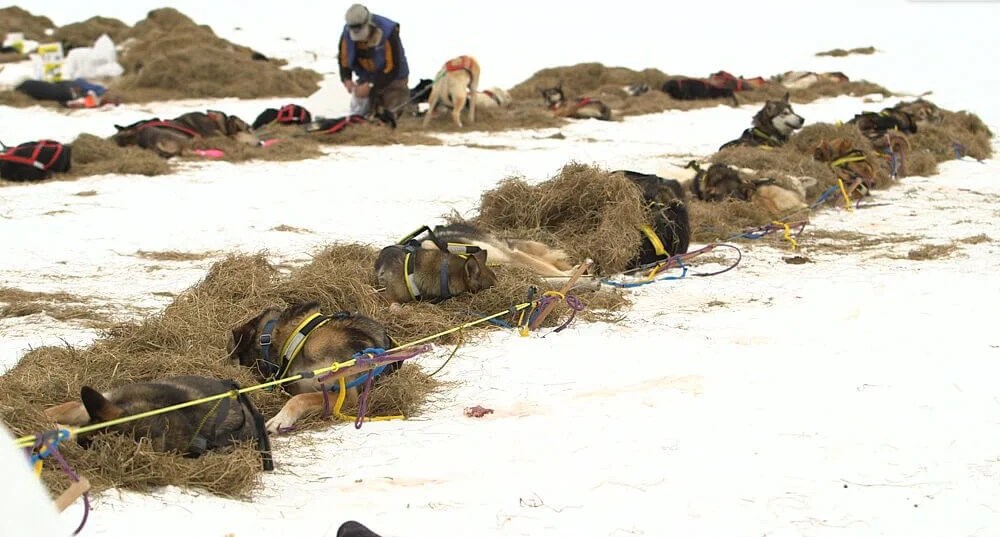
Injured, sick, and exhausted dogs are often “dropped” at checkpoints, but event rules require that only dogs who started the race be allowed to finish, meaning that the remaining animals must work under even more grueling circumstances, pulling even more weight.
No dog would choose to run in this arctic nightmare.
Orthopedic injuries are the number one reason that dogs are “dropped” from the Iditarod—which makes it clear that no dog, regardless of breed, is capable of handling the grueling race on ice, through wind, snowstorms, and subzero temperatures. Even wearing booties, many incur bruised, cut, or swollen feet. They also suffer from bleeding stomach ulcers, pull or strain muscles, and sustain other injuries.
Thousands of dogs are bred each year for sled racing.
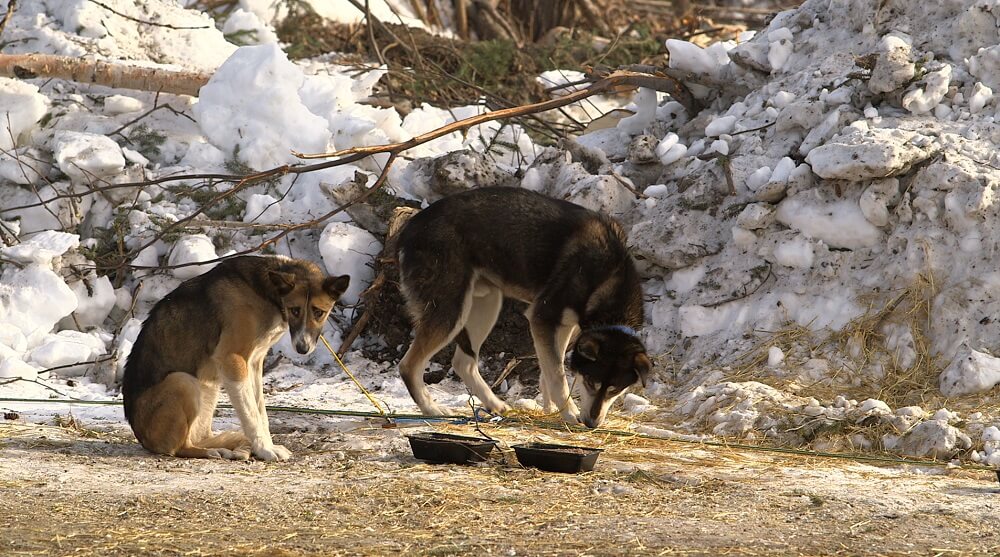
While only a few dozen dogs raised for the race will ultimately be deemed fit enough to compete, many more will be kept tethered and chained for most of their lives, some with nothing more than dilapidated plastic crates as their shelter.
Dogs at dogsled breeding compounds have died of numerous ailments.
Some have frozen to death, while others have died of complications from eating rocks—presumably a result of the intense frustration of spending years on a chain.
Dogs Deserve Far Better Than a Lifetime of Isolation, Cruelty, Suffering, and Death on the Iditarod Trail
An investigation has been ordered after the world’s second-biggest trawler shed more than 100,000 dead fish into the Atlantic, sparking claims they were dumped deliberately.
The spill from the FV Margiris off the French coast was caused by a tear in the super trawler’s net, according to the fishing industry group PFA, which represents the vessel’s owner.
Footage of the giant floating carpet of dead fish in the Bay of Biscay was taken by environmental campaign group Sea Shepherd France.
France’s maritime minister Annick Girardin has described the images as “shocking” and said she had asked the country’s national fishing surveillance authority to investigate.
The fish were blue whiting, a sub-species of cod, which is used by the industry to mass-produce fish fingers, fish oil and meal.
Sea Shepherd France has cast doubt on claims it was accident and believes the fish were discharged on purpose.
The group’s head, Lamya Essemlali, said: “It’s forbidden for a fishing vessel to throw overboard bycatch.
“It is supposed to bring the bycatch to port and to make a declaration.
“The EU regulation has been implemented so that we can reduce the non-selective fishing methods because it’s very demanding, time-consuming and costs money for a fishing vessel to go back to port and unload the bycatch, and then go back at sea.
“So the temptation is big for these vessels at sea without any witness, any control, to just throw overboard all the bycatch and stay in the area, and keep on fishing.”
She added: “There is total impunity at sea. There is no control, no witnesses and no fines.
“There is a lot of money to be made and we have to improve the controls at sea, we have to put remote e-monitoring cameras onboard all the fishing vessels.”
Trawlers like the Margiris use giant drag nets more than a kilometre long and process the fish on-board.
Ms Essemlali said: “It has an impact on the fish population itself but also it has an impact on the predators, like dolphins, because the fish that these super trawlers are fishing are the main preys of dolphins and sharks. And basically, we are driving dolphins to starvation.”
Thousands of dead dolphins have washed up on France’s Atlantic coast over the past years.
Following protests by activists against super trawlers, the Margiris was forced to leave Australian waters in 2012.
Traffic data by marinetraffic.com on Friday showed the vessel, which is owned by the Dutch company Parleviliet & Van der Plas and sails under the flag of Lithuania, was still fishing off the French coast.
Trawlers like the Margiris use drag nets measuring over a kilometre in length and process the fish in on-board factories, a practice heavily criticised by environmentalists.
Following protests by activists, the Margiris was forced to leave Australian waters in 2012.
Camels are forced to wrestle with each other until one falls over or shows fear
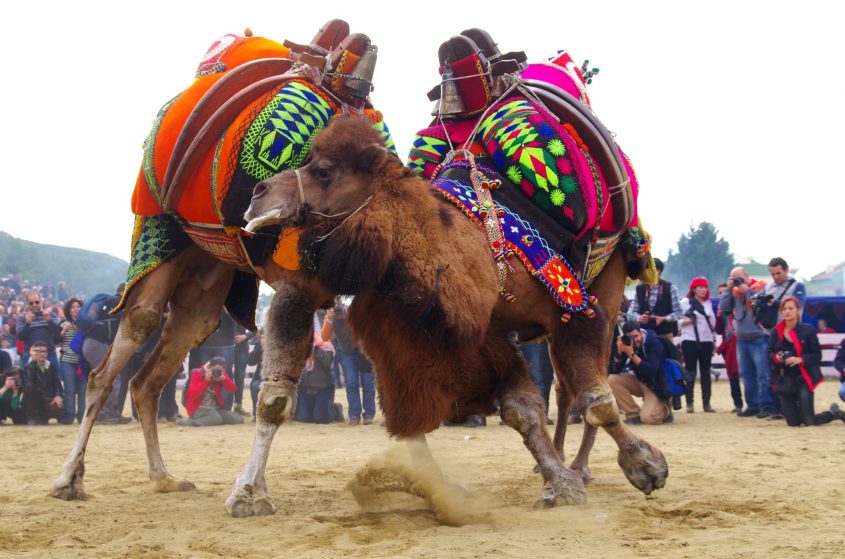
Every year around mid-January, the annual International Camel Wrestling Festival in western Turkey commences. The contest area fills with hundreds of camels covered in brightly colored decorations – as well as muzzles to keep them from biting and seriously wounding each other – who will tussle until humans declare one of them the victor.
But now, the “sport” is now coming under heat from Turkish animal lovers who want to protect camels from abuse and cruelty.
This year, handlers gathered 152 camels together for the tradition’s 40th event.
During the tournament, thousands of eager spectators surround the wrestling creatures, setting up barbecues and roaring as camels dominate one another. Vendors even sell camel meat snacks and street food to viewers who munch on the cousins of the very animals they’re watching.
And meanwhile, camels wrestle until one or the other topples over, screams out, or retreats in fear.
Spectators claim that because the sport is billed as “wrestling” instead of fighting, it’s not harmful to the animals and is instead just an innocently fun pastime.
Turkish animal lovers are pushing back, calling the annual wrestling matches “shameful” and are pushing others to see the inhumanity.
These animals are exposed to unnatural conditions that cause them to feel confusion, stress, fear, and panic – which is how humans are able to force them to act in aggressive ways, just for our entertainment.
From the loud noises of spectators, to the training involved in convincing camels to wrestle each other, animals are still being used and exploited.
It’s time for us to stand with animal lovers in Turkey and elevate their voices. Demand protections for camels and an end to this exploitative contest forcing camels to wrestle each other!
Sign the petition to demand an end to these inhumane camel wrestling matches!
And I mean…In Spain, bullfighting has a long (and nowadays unacceptable) tradition. In many other countries, roosters are let loose on one another in an arena, to the amusement of the spectators.
The primitives are entertained by it, and make profit from it.
Camel wrestling was originally a competition between caravan owners.
Camel wrestling season is a highlight in Turkey today.
People climb to watch and see the camel fights during the festivals while vendors sell camel meat alongside the venues.
The animals fight in front of the spectators and suffer, are wounded or even kill each other.
During the fight, which lasts a few minutes, one camel must wrap its neck around the other camel’s neck or trip the loser and pin him to the ground.
The winner gets prize money and the loser gets butchered.
Although Turkey’s Animal Welfare Law bans animal fighting and a change in the law last summer introduced fines and jail terms, municipalities obtain “special permits” from district governor’s offices for such events under the guise of festivals.
The reptile was suspected of eating livestock on private property in Okeechobee County, and was considered a threat. The owner of the property agreed to have it killed.
“I had no idea the magnitude of how big his body was until we pulled him completely out of the lake,” said Mr Borries.
“Size does matter,” he wrote on his company Facebook wall, Dynamic Outdoors TV, with images of him standing next to the enormous creature, sitting on its back and pulling open its jaws. “To me, it was a once-in-a-lifetime opportunity,” he told WXXV News 25.
Mr Borries staked out the animal, estimated to be 80-years-old, before daylight, spotted it on an island in the lake and shot it.
The hunter has come under fire for killing the animal, instead of trapping it or sedating it and having it relocated to a wildlife sanctuary.
“I hope God forgives you for needlessly killing this creature,” wrote one person.
“Pretty hard to kill an 80 -year-old alligator wow be proud,” said another user.
“This is disgusting!!! Do you feel like a big man now you could have put your obvious large ego away and contacted any of the wonderful alligator reserves where this magnificent creature could have lived out its life. But no, the big man’s hunter had to kill an animal that was surviving and you just acted like an animal right back, instead of being a human and understanding nature,” said another.
“Shooting a huge barely moving animal with a high powered rifle and calling it hunting is an insult to real hunters,” commented another.
“What an incredibly cowardly thing to do. Did anyone not think of MOVING it, instead of murdering it?” wrote another.
Dynamic Outdoors defended its actions by explaining how dangerous gators this size can be. “Just like sharks, a small one can leave you with an injury that may be recoverable but an incredible large/oversized specimen can take [you] out,” it wrote on social media.
This gator was about a foot short of a state record, reported the Sun Herald. The longest gator captured in Florida was 14 feet, 3.5 inches and was caught in Lake Washington, Brevard County.
Mr Borries has said the gator will not go to waste – most of it will be used as meat and be eaten, although he will take a trophy for himself and is having a full, life-size mount made of the gator’s hide.
 The activists come from Portugal, France and the Netherlands.
 Bullfighting is a very cruel form of animal cruelty. Every year, more than 250,000 bulls and cows are tortured and killed worldwide during bullfights and related events. Tens of thousands of bulls and other animals are also seriously mistreated at village festivals.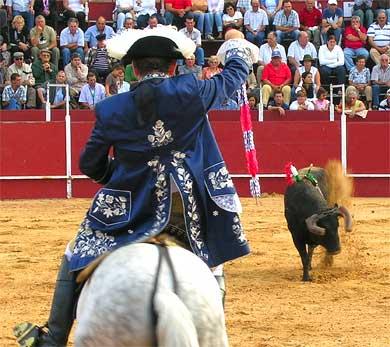
 It is therefore now the time to continue to exert pressure through (direct) actions.
 The decisive impetus for this was a lawsuit by the animal rights organization “Animal Protection Norway”.
 We very much welcome this step, because torture breeding is a serious problem in animal welfare.
 Breeders are making a fortune while animal sanctuaries and shelters are brimming with wonderful creatures.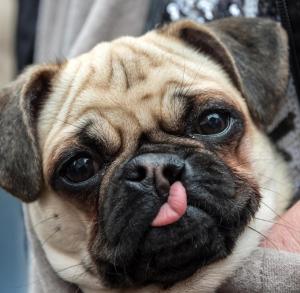














 Camel wrestling season is a highlight in Turkey today.