Category: General News

USA (Arizona): Board of Supervisors (AZ) Passes Proclamation Condemning Wildlife Killing Contests.

USA-Flagge

Project Coyote

FOR IMMEDIATE RELEASE – December 20, 2018

Yavapai County Board of Supervisors (AZ) Passes Proclamation Condemning Wildlife Killing Contests

Unanimous vote follows Dewey-Humboldt Town Council resolution

YAVAPAI COUNTY, Ariz. — The Yavapai County Board of Supervisors voted unanimously yesterday in favor of a proclamation that opposes wildlife killing contests. Arizona citizens belonging to a coalition known as I AM WOLF NATION in partnership with Project Coyote and other wildlife and animal protection organizations have been working to end wildlife killing contests in Yavapai County and other Arizona localities. Yavapai County’s proclamation follows on the heels of a similar Dewey-Humboldt Town Council resolution that passed in November.

Wildlife killing contests are cruel events in which participants compete for fun and prizes by killing the greatest number or the heaviest of the target species. Last week, dozens of coyotes were slaughtered in the Santa Slay Coyote Tournament in Yavapai County and on public lands throughout Arizona. Manufacturers and sellers of firearms, predator-calling devices, and hunting gear were among its sponsors. Though the public at large remains largely unaware of these contests, killing contest social media posts often show photos of participants piling up and posing with the corpses of wildlife they have killed.

Increasing public outrage has led to several national newspapers editorializing against wildlife killing contests. Last week, on December 14, Pulitzer Prize-nominated columnist Linda Valdez wrote in The Arizona Republic: “The wildlife in Arizona belongs to all the people of Arizona. Did anyone ask you how you feel about contests [that] put a dollar value on killing as many wild animals as possible? Is that how you want your wildlife treated?”

Yavapai County’s proclamation recognizes that coyotes and other native carnivores play a key role in maintaining healthy ecosystems—which includes controlling rabbit and rodent populations. Just as importantly, the County proclaims that wildlife killing contests serve no genuine ecological or wildlife management purpose. The County proclamation further acknowledges that wildlife killing contests threaten the safety and well-being of hikers, dog walkers, bird watchers, hunters, horseback riders, and other outdoor enthusiasts who use public lands where killing contests take place.

“We applaud the Yavapai County Board of Supervisors for taking a strong stance against wildlife killing contests in Arizona,” said Matt Francis, Prescott, Arizona resident and a Project Coyote Program Associate. “The Arizona State Legislature should recognize that Arizona citizens will no longer tolerate these barbaric contests and should ban wildlife killing contests statewide.”

“Our team recognizes and appreciates Yavapai County making a statement against killing contests, which are blood sports and should never be compared to hunting as contest proponents try to do,” said Betsy Klein, Sedona, Arizona, resident and co-founder of I AM WOLF NATION™. “As an organization, we recognize the long-standing tradition of hunters and hunting in Arizona. In fact, hunters who practice fair chase principles have called these contests ‘inhumane’ and have openly opposed them, knowing there is a distinct difference between hunting and senseless slaughter.”

Currently, there is a contest slated to take place in Flagstaff in March of 2019 that will target bobcats, coyotes, and foxes.

Coyote killing contest organizers often justify the slaughter by claiming that by reducing the coyote population they are helping to reduce conflicts with coyotes. “There is no documented scientific evidence that coyote killing contests permanently reduce coyote abundance, increase populations of deer or other game species, or prevent conflicts between predators, humans and livestock,” said Dave Parsons, MS, retired career wildlife biologist with the U.S. Fish and Wildlife Service, former hunter, and Project Coyote Science Advisory Board Member. “Wildlife killing contests are symptomatic of a broader problem of misguided wildlife governance by state wildlife agencies that fail to recognize and value the crucial ecological roles of native predators.”

The Arizona Game and Fish Department (AZGFD) itself recognizes that killing coyotes doesn’t reduce their numbers, stating on their website: “Removing coyotes from one area generally results in other coyotes moving in from surrounding areas and breeding faster.” There is no way to know the effect that wildlife killing contests have on coyote populations in Arizona because AZGFD does not monitor the contests or track the number of coyotes killed in these events.

U.S. Congressman Raúl Grijalva of the 3rd Congressional District of Arizona, who serves on the House Committee on Natural Resources, recently weighed in on the issue: “Do you want a coyote-killing contest on your public lands this Saturday? Neither do we. Neither do Arizona locals in the threatened area. Let people know this is happening.”

Earlier this year, the city council of Albuquerque, New Mexico, unanimously passed a resolution calling for a state legislative ban on killing contests. Tucson and Pima County have passed similar resolutions in recent years. Vermont and California outlawed killing contests in 2018 and 2014, respectively. The National Coalition to End Wildlife Killing Contests, a growing alliance of more than 30 state and national wildlife and animal protection groups, along with local citizens, will pursue similar policy changes at the state and local levels across the nation in 2019.

* * * * *

I AM WOLF NATION — The power of the collective, working to protect the wolf and other persecuted wildlife in Arizona. For more information about joining the local effort to end wildlife killing contests, please visit our website.

Project Coyote, a national non-profit organization, is a North American coalition of scientists, educators, ranchers, and citizen leaders promoting compassionate conservation and coexistence between people and wildlife through education, science and advocacy. Visit ProjectCoyote.org for more information.

To learn more about wildlife killing contests, visit the National Coalition to End Wildlife Killing Contests’ website here.


England: Scientists accuse officials of cherry-picking data to defend Badger Cull.

England


Record 32,000 badgers shot in annual cull

 A badger

Source – https://www.theguardian.com/environment/2018/dec/18/record-32000-badgers-shot-in-annual-cull

Scientists accuse officials of cherry-picking data to defend disease-control scheme

More than 32,000 badgers were killed in England this autumn during the annual cull, which is intended to reduce tuberculosis in cattle.

Government officials claimed the culls were effective and starting to reduce prevalence of the disease in cows. But independent scientists said the officials were cherry-picking data and making up targets as they went along.

TB in cattle costs taxpayers £100m in compensation each year, with 33,000 infected animals slaughtered in 2017. The environment secretary, Michael Gove, approved a huge expansion of badger culling in September. This resulted in the largest number of animals killed to date.

An independent review of TB control, commissioned by Gove and published in November, concluded that frequent trading of cattle and poor biosecurity on farms was “severely hampering” control efforts. It was wrong to blame badgers as the main cause of the outbreaks, the scientists said, although Gove had told them not to assess whether the current badger culls were working.

Data published on Tuesday shows that in the 30 culls taking place across England, 32,601 badgers were shot this autumn, the highest number on record.

An earlier 10-year trial of badger culling showed it was vital to kill at least 70% of badgers in an area to reduce TB in cattle, but as a protected species badgers must not be wiped out either. Therefore, minimum and maximum cull targets are set.

In all but one case, the initial targets were reviewed “as operations progressed”. Almost half the culls failed to meet their initial targets, with one in Devon killing three times more than the initial minimum.

“The ways that these targets were altered varied between sites in a completely non-standard way,” said Prof Rosie Woodroffe, of the Institute of Zoology, who was part of the 10-year trial. “The scientific term for this methodology is ‘making it up as you go along’.” She said the government appeared to have no idea of actual badger populations.

Natural England, the government’s nature agency, licences the badger culls. Its chief scientist, Tim Hill, said: “Industry-led badger control continues to deliver the level of effectiveness required by the policy to be confident of achieving disease control benefits.”

However, Woodroffe said the reduction in badger numbers was impossible to estimate from the information gathered and so there was no basis for such confidence. “We are all used to politicians making optimistic statements based on unreliable data. For a scientist to do so is deeply worrying,” she said.

The government’s chief vet, Christine Middlemiss, said the first cull areas, in Gloucestershire and Somerset, were starting to see drops in TB in cattle, and a full analysis of the data was under way.

Harmony Fund – December News. Please Donate If You Can.

We are more than pleased to have a monthly standing order with Harmony; so that so many strays in need the world over can be cared for a little more.

Please join up or give them a donation if you can – thanks – WAV.


J Depp.png

Harmony Fund Website – https://harmonyfund.org/

Facebook – https://www.facebook.com/HarmonyFundAnimalRescue/

Twitter – https://twitter.com/harmonyfund?lang=en

Har 1

With their knees pressed against the snowy ground, our rescue volunteers are pouring bag after bag of kibble and coaxing hundreds of frightened dogs and cats to have something to eat as they begin another winter day.

The animals we feed congregate in landfills, cemeteries, factory complexes, empty fields and at the forests’ edge. Our street feeding programs are not the most heralded part of our work, but they are absolutely critical in supporting the comfort and survival of animals awaiting rescue.

There is always a steady flow of animals welcomed into the rescue program, but we can only take more of them in when others are adopted out.

During the “waiting period” we give homeless animals the simplest form of human kindness. We bring them food to make sure they are not searching for their next meal, which often results in days with nothing palatable to eat. When we offer them meals, the animals have far less exposure to the wind and snow. They can eat and then hunker down in their hiding places. It truly makes a huge difference. And in the near future, we hope to expand community spay/neuter operations to sterilize higher numbers of homeless animals.

Your ongoing donations are the only reason we will be able to buy more food at the end of the month to begin this mission all over again in January. We are more thankful than words could ever say.

—————————-


Har 2

Bosnian native Naida Kaltak is a 365-day-a-year hero who leaves very early each morning, often before the sun is up, so that she can bring meals to animals before she goes to work.

“The weather is terrible with temperatures below freezing,” said volunteer Nancy Wilkinson who helps us translate conversations with Naida. “Thankfully the kennels are insulated, but it is the poor strays we worry so much about. The strays especially need food these days to help keep warm and to make sure that, if nothing else, they have full tummies. Naida has to travel on foot to many locations, and even for her at home, the water is frozen. Life is not easy at the best of times, but in these conditions…”

“There are two mums and seven pups that are at the garbage dump,” Nancy explained. “Naida has been feeding them but she knows the pups, at least, will not survive the winter. She can’t possibly take them all in unless she has funds to cover their costs.”

“Naida is drowning in debt and now there are injured puppies,” Nancy continued. “She doesn’t take every dog she sees but some just can’t be left. The first dog has two broken legs after being hit by a car and couldn’t move. The second boy was also hit by a car and if she hadn’t taken him, his injuries would have become infected and he surely would have lost his life after suffering a great deal. The third tiny boy was hiding by the rubbish bins in the middle of Sarajevo and sadly many people saw him and just walked by. He has a broken scapula. The fourth is a little girl, again no one stepped up, she has a broken femur.”

We would like to send Naida a donation next week to get more dogs to safety, to cover some of the big veterinary expenses for the animals struck by cars and to help her continue her daily rounds at the edge of the forest where many homeless dogs are living.
Click Here to Donate to Naida’s Rescues

————————————-


Har 3

It has been a very good year for the dogs at Sasha’s free-running dog sanctuary in Serbia. As winter begins to dust the ground with snow, the dogs are in their best possible condition as nourishing food is flowing. But even more exciting is the news that adoptions are picking up and we hope to find homes for 150 dogs over the next twelve months.

“For the first time, five shelter dogs went to Sweden,” Sasha said earlier this week. “Starting in January, our rescue partner there has agreed to adopt 10 of our dogs each month. And in December alone, 19 dogs were adopted to homes in Belgium. I am so happy that a large number of dogs will find their warm homes now and in 2019.”

“Every year, the number of dogs has increased, since the situation around the adoptions was far worse than it is now,” Sasha continues. “But our teammates at the Dog Happiness organization in Belgium promote new adoptions and collect resources for additional feeding, hay, wood, equipment for workers, parasite tablets, ampoules against fleas, new dog houses and so forth. Without that help I do not want to imagine what the overall situation would be. They sacrifice their annual vacations and all their free time to help dogs, they give me great support, strength and will to solve all problems related to shelter. And the main pillar that keeps entire shelter up is, of course, the Harmony Fund. You have unconditionally helped the last 5 years and I am very happy to work together with you to create the best possible conditions for the dogs. I am convinced that life does not happen randomly. We were brought together for a purpose.”

As the year draws to a close, we want to offer all of you our very deepest thanks. Together we have made a difference of hundreds of Serbian dogs and will continue to do so for many years to come. Your donations are helping us to be sure the dogs have ample food, shelter, veterinary care and protection-from-cruelty. They play with balls, they explore the grounds and they even enjoy some home cooked meals. All of this is made possible through your kindness.


How can we make the killing more sustainable?


deutsche flagge


In Germany, the most read weekly magazine is “Der Spiegel”. Earlier, and as long as the newspaper was under the leadership of its founder, Rudolf Augstein, was a left-liberal news magazine with a very good level.

Today “Der Spiegel” has come down to the level of Infotainment.

On Monday, 17.12.2018  the following article has been published as a “main topic”. Title: “No meat is not a solution either”! Obviously, the subject was difficult to handle, so the article is written by 3 (!!) journalists!

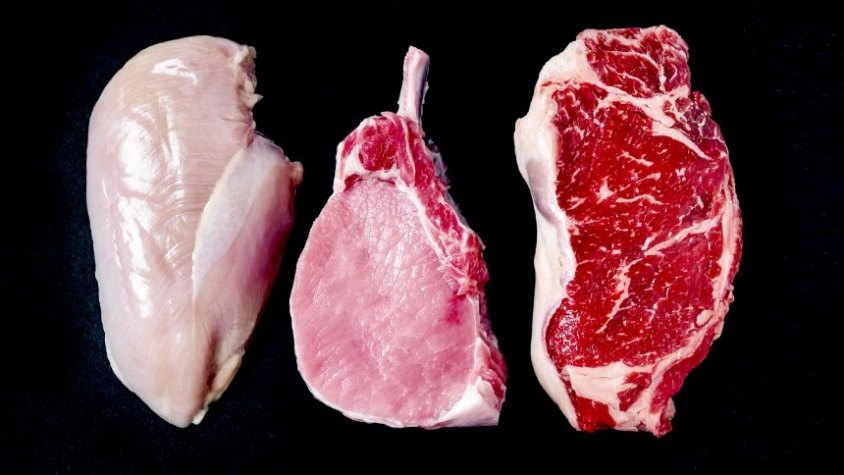
Raw meat (chicken breast, pork chop, and beef steak)Foto: der Spiegel

The item

The journalists beginn with the following question: “Have you already ordered the holiday roast? No fear! nobody wants to ruin it for you. We are not vegetarians ourselves. But we have to ask ourselves the question: how can we produce meat more sustainably?” “We all have to ask ourselves this question”.

The reader should not have the opportunity to see that this is not the question! Not for vegans and even for vegetarians the burning question is how can we reduce the meat consumption so, that in the future, the meat eaters will be in the minority of the population.

Der Spiegel continues: “More and more people are eating more and more meat. Over the past 50 years, the world’s population has doubled – and world meat production has even tripled. By 2050, meat consumption could once again grow by 85 percent, warns the UN!”

Here begins the central idea of the article to work manipulatively. If statistics give us only bleak predictions anyway, then the posted question: how can we produce meat more sustainably? “appears as an urgent need! And so the question is not meat or not meat,
but which meat and why.

Der Spiegel: On the other hand, meat is a pleasure. It has been part of our culture for millennia. And it can also be a valuable protein source. Protein from animal products is often easier for humans to use than vegetable protein. Without these animal proteins, humans might not have been able to evolve to Homo sapiens”!

Subsequently, three Homo sapiens appear on three videos: a master butcher, a policeman and hunter, and a journalist who visits an organic farm with gooses.

der Schlachter-Spiegel

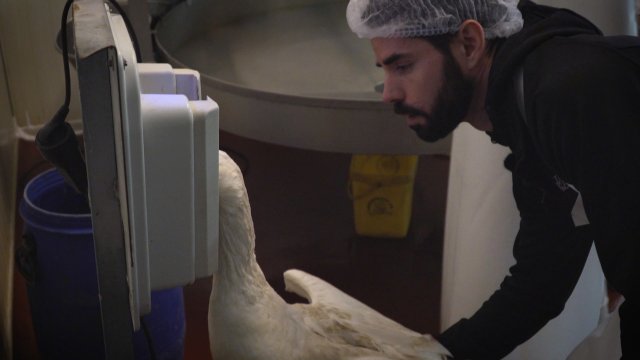
The two of them must have paid an extra sum, because they advertise directly their meat business. The journalist cuts the neck of a (bio) goose with a knife himself and ends the murder act with the sentence: “It was not as bad as I thought, I think the procedure is not bad!”

Why all the embarrassing theater? is the question.
Because the title “No meat is not a solution” brings money and readers. Finally, 98% of the country eat animals.
The title “no meat is a solution” would only have problems with the sale, nobody wants to read that he has to stop eating meat.
The butcher,who runs a business with Alfa-class meat, which he produces by hand. 100 gr. 2 Euro!
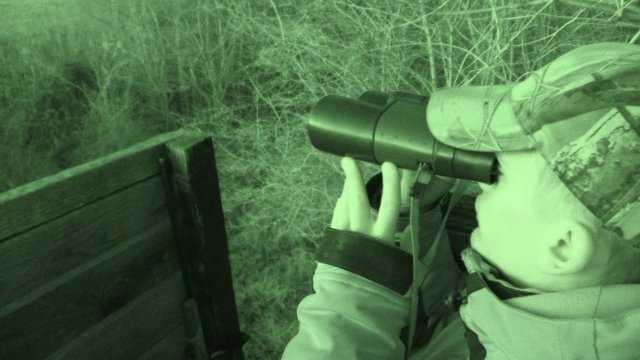
The cop, who” plays” hunters in his free time, only sells fresh and healthy bodies from the forest, which he sells in his shop.

der Jäger-spiegelpg
Both are THE solution, for  “der Spiegel”, a solution that favors the higher profits, but at the same time puts the magazine in Boulevard Scala.
Look at the videos on the link! they are unfortunately in German, but the third will understand everyone. It is the visualization of the title that I gave in my article.

der Journalist-spiegel

http://www.spiegel.de/wissenschaft/mensch/fleisch-wie-koennen-wir-unseren-fleischkonsum-nachhaltiger-gestalten-a-1242634.html#js-article-comments-box-pager

My best regards, Venus

UPDATE: THAI ZOO ORDERED TO TEMPORARILY HALT PERFORMANCES FOR EMACIATED ELEPHANTS


Thai

UPDATE: Thai Zoo Ordered to Temporarily Halt Performances for Emaciated Elephants


The management at Samutprakarn Crocodile Farm and Zoo in Thailand has been ordered by the country’s Department of National Parks, Wildlife and Plant Conservation to remove two thin elephants from the park’s performance schedule until their health improves.

Following an outpour of complaints about the emaciated condition of the animals at Samutprakarn, officials examined them on Wednesday, according to spokesperson Sompote Maneerat.

The two elephants who have been removed from the circus-like acts are reportedly underweight because they lost some of their teeth and couldn’t chew food properly, which affected their ability to absorb nutrients — though management has also claimed to keep the animals thin so they’re able to perform dangerous tricks.

To rehabilitate the elephants’ health, the agency recommended that zoo management use pellet and chopped feed. They made the same recommendation for a half-blind horse who was not used in any shows but was found in the same condition as the elephants.

While the physical aspects of the zoo were, shockingly, approved by the inspectors, they suggested ways for the zoo to improve the quality of life of the confined animals, such as chimpanzees and tigers.

The zoo’s license was also out-of-date, the officials discovered. It had expired in April 2016 and the zoo was instructed to submit additional documents upon seeking renewal. However, this has not yet been done.

While we’re happy that the elephants are receiving a much-needed break from performing, we believe that it’s in their best interests to never have to perform again, or endure the decrepit conditions at this zoo, which fails miserably to provide the environment or care that wild animals need.

petition 1

Lady Freethinker has started a petition campaigning for the elephants to be removed from Samutprakarn and relocated to a sanctuary, where they may live out the rest of their lives in freedom and peace.

100 Dogs Saved from Dog Meat Smugglers in Nanjing, China

China


100 Dogs Saved from Dog Meat Smugglers in Nanjing, China

100 Dogs Saved from Dog Meat Smugglers in Nanjing, China

Image Credit: Ping An A Fu

Police intercepted a vehicle packed full of dogs destined to be slaughtered for the dog meat trade in Nanjing, China last week.

Heading from the Henan province in central China to Hangzhou, the vehicle was detained because the driver did not have the documentation required for transporting the dogs and could not prove where they had come from.

The police called upon Nanjing’s largest animal rescue center, Ping An A Fu (meaning Peace and Luck), to assist with rescuing the dogs. On arrival, staff from the organization discovered 108 medium to large dogs stuffed into only nine tiny wire cages.

The malnourished, hungry and stressed animals were taken to safety at Ping An A Fu’s center in the Pukou district to be quarantined. There, they received comfortable beds made of hay, water, food, and medical care.

Although all the rescued dogs survived that first night, some died later due to other medical problems.

“Most of the dogs are healthy now although some still need continued medical attention,” said Lu, a volunteer for Ping An A Fu. “Deaths were simply unavoidable as the conditions of some of the dogs when we received them were just too dire.”

Staff at the rescue center report that most of the dogs are friendly and comfortable around people, indicating that they may be beloved family pets that were swiped off the street for the horrific dog meat trade — a common occurrence throughout China.

“If it is not for the police who enforced laws strictly and saved the dogs from meat dealers, these 108 dogs would have been meat dishes,” the organization posted on Facebook.

Although animal advocates estimate that the popularity of eating dog meat throughout Asia is decreasing, around 20 percent of China’s population continues to consume it, believing it to be good for their health. Their consumption accounts for half the dogs slaughtered in Asia every year.

Thanks to the Nanjing police and the amazing team at Ping An A Fu — who currently care for more than 10,000 animals — these lucky pooches will be heading for a much better life.


Spain: Finalizing Bill to Classify Animals as Sentient Beings, Not ‘Objects’.

Spain


Spain Finalizing Bill to Classify Animals as Sentient Beings, Not ‘Objects’

Animal rights in Spain are about to change, as the Spanish Congress work on finalizing a bill which will see them classified as sentient beings, rather than “movable property.”

Currently, pets can be seized as material assets if guardians default on payments; this bill would prevent that from happening.

In the case of a separation or divorce, the best interests of the animal would come first when deciding which partner the pet stays with. In America, only two states — Illinois and Alaska — take animal wellbeing into consideration during custody battles.

This Spanish bill has been a year in the making, with 115 amendments introduced since it was first drafted last December by the Popular Party (PP).

Although animal advocacy groups acknowledge the bill is a step in the right direction, they all agree that there need to be broader changes to animal welfare legislation throughout the country. Among the issues discussed by animal rights groups is the use of animals in circuses and bullfighting — still a heated and highly controversial topic.

“Right now that depends on municipal authorities,” says Avelino Barrionuevo of the PP. “What’s required is political determination and courage, because Spain is trailing at the back of the pack when it comes to animal protection in Europe, even though social awareness has increased in recent years.”

The European Union acknowledged that animals were “sentient beings” nearly 10 years ago in 2009, with New Zealand, France, and Quebec following suit in 2015.

Although all US States have laws in place to protect animals from abuse and cruelty, in many states, they are still classified as property.

Politicians say the bill should be ready by February 2019, giving animals in Spain more rights and protections in line with the rest of the European Union in the coming years.


The “Tigers” film: Nestlé`s baby food scandal!


Pakistan

2018 was marked by scandals for the Swiss food company Nestle.

Nestlé, the largest food producer in the world, has an annual turnover of 80 billion euros.
Why is Nestlé one of the most hated companies in the world? The allegations date, from the contamination of baby food on the genetic manipulation of ingredients to animal experiments and the exploitation of children. Unethical advertising, manipulation of uneducated mothers, pollution and much more.

In addition, the Group is digging up water there, where none is left. Nestle is the world’s largest food company and the group has a history that makes even hardcore industrialists shudder.
But 2018 should not end well for Nestlé, because in India, the much-anticipated feature film “Tigers” by Oscar winner Danis Tanovic was shown.
Tigers is based on the true story of a former seller of Nestlé baby milk in Pakistan. Meanwhile, 15 million people have clicked on the” Tigers” trailer on Youtube. After 21 years, it is now possible in India and the subcontinent to hear the story of Nestle’s terrible scandal.

Twenty-one years have passed since Pakistan proved how Nestlé violated the WHO Code. It was in the 90s and this is a sad story about poverty, breastfeeding and greed. In less developed countries (LEDCs), Nestle has particularly addressed the poor. Your baby food should be almost as good as breast milk, which is highly unethical for several reasons.

Mutter mit Kind und Flaschejpg

The first problem was the need for clean water. Most of the people targeted by the corporation – especially in Africa – did not have access to clean water (many still do not), so the water had to be boiled. Due to the low literacy rate, many mothers were unaware of this. Therefore, they mixed the baby food with contaminated water and endangered their babies. Nestlé seems to have knowingly ignored this and encouraged mothers to use baby food even when they were aware of the risks.

Drinking water is vital. But global supplies are unevenly distributed. The supply of drinking water has been made the main task of the Swiss group Nestlé and as a precaution buys everything that looks like a source of water, because Water Makes Money.

Nestle8 Arschloch Chef Zitatjpg

To date, several countries and organizations are boycotting Nestlé, although Nestlé claims to comply with WHO regulations.

Also in 2018, a recent study shows how Nestlé leads consumers astray with promises of promises and different additives!

Nestlé has been criticided by all corporations  worldwide, but Nestlé, the international Swiss corporation, is also the world’s largest supplier of baby food, accused of breaching ethical marketing rules and manipulating consumers with misleading claims about the nutritional benefits of its breastmilk substitute. Nestlé is also accused of selling ‘substandard’ baby milk in South Africa. It is not the first time that Nestlé has problems with baby food. Already in the 1970s and 1980s, there was the first scandal about milk powder from Nestlé and, as the film shows, even in the 1990s.


The “Tiger” Story

For the first time ever, a whistleblower in Pakistan managed to trace the system of bribery of health workers and doctors in minute detail. He found out that the baby food of his new company killed hundreds of children. After that began a lonely and dangerous fight against the company. Although the film premiered on September 8, 2014 at TIFF and was shown at film festivals in Berlin and New York, it was never released in India. Until then the streaming platform Zee5 got the rights to “Tigers” and on November 21, 2018 the Indo-French production for the video-on-demand service published.

The film looks at the life of Ayan, a pharmaceutical vendor who states that the baby formula he uses to achieve excellent results is the cause of malnutrition and even the death of infants. The real Ayan from “Tiger”, Syed Amir Raza Hussain, then awaited his second child – it was to induce him to take action against the company that had occupied him.

A message from the man behind the film “Tigers” Emraan Hashmi 2018.

The film “Tigers” based on my life story of personal sacrifice to expose an injustice and principled stand against Nestle in defense of the health of babies and their families. The film was directed by the Oscar winning director Danis Tanovic and me was portrayed by the famous Indian actor Emraan Hashmi. The mission we began in Pakistan was on a very small scale, but thanks to the filmmakers it has come into a very powerful medium to reach people all around the world. I am grateful to everyone who worked on this film and made it possible. I was not expecting that at the end of the filmi would be accepted with a standing ovation @ TIFF!

I am thankful that people love it and understand what we have been struggling to do as a family.

My comment: I remember that my mother was a fan of this multinational group and all of us have been fattened with Nestlé milk for years!
She did not know any better, but today, if we want, we almost all have a cheap and uncomprehended access to information and knowledge.
Therefore, make sure that you do not support and access the “Tigers”, as much as possible.

Best regards, Venus


Australia: ‘The Sheep Trade Is Finished’.


Australia


“Sheep trade is finished…”
Sydney Morning Herald, 13 December 2018

Mark, this was a very welcome media headline to end what has been a huge year in our efforts to end live export. It refers to a new ‘heat stress assessment model’ which would effectively stop sheep exports for half the year, presenting another huge blow to the future viability of the trade.

So much has happened this year. And with politicians heading home for the summer break, and with four live export bills yet to be voted on — I thought you may be wondering, what now?

The short answer is that politicians have 13 more chances over 13 parliamentary sitting days to bring on a vote to end live sheep exports. If they don’t, then the Australian people get to make the decision for them at the next Federal election. And, as you know, for the first time in our history there is a point of difference on this issue between the two major parties.

Let’s pause for a moment to take that in.

After 50 years of condemning animals to unconscionable cruelty — after half a century of thinking their secrets would stay hidden at sea — the live sheep export industry’s days are well and truly numbered.

They’re numbered because compassionate and determined people like you, Mark, have refused to stay silent. Because, day and night, for eight months, you have answered our call for help every time we found a strategic opportunity to fuel this campaign for the animals onwards.

live ex ship
Now, as a result of our collective efforts, live exporters no longer enjoy majority political support. Two additional live export bills were introduced to the Federal Parliament during the final parliamentary sitting week, sending a striking message from a powerful new cross-bench straight to the Morrison government that this issue is more palpable than ever, and will not go away.

South Australian MP Rebekah Sharkie cited that she gets dozens of emails every single day calling for live export to end. The new Independent member for Wentworth, Dr Kerryn Phelps, said her electors made it clear during the by-election that they will no longer tolerate the trade. And long-time friend of the animals, Andrew Wilkie, reminded his fellow parliamentarians that every poll ever conducted has made Australia’s opposition to this cruellest of trades clear.

These are your voices, your emails, your phone calls, your letters, being echoed by your political representatives.

Mark, I would have loved nothing more than to head into Christmas with a parliamentary decision to end the trade. However, after 15 years investigating and exposing the horrors this industry inflicts on animals, I can wait a few more months. After all, it’s already been a year of truly milestone moments:

  • More than 500,000 sheep were spared from ‘cooking alive’ at sea during the deadliest Northern summer months.
  • Australia’s biggest sheep exporter — the company exposed on 60 Minutes — was banned from operating, permanently.
  • We hauled the live trade before the Federal Court, and won, and now the regulator remains under investigation for covering up cruelty.
  • New standards being forced on the industry will effectively end shipments during the hottest months, and impact the commercial viability of all export voyages — for both sheep and cattle.
  • So fearful is the industry of a pending political vote that they ‘voluntarily’ committed to stop shipments across the sweltering June to August period next year. And now, this ‘heat stress’ review will likely mean there will be no sheep shipments for 6 months next year.

So, while the year is rapidly drawing to a close, 2018 will be remembered as the year Australia’s cruellest trade began to unravel. Mark, with your help, we are determined to ensure that 2019 will be commemorated as the year Australians voted to bring it to an end.

For the animals,

Lyn White AM

Animals Australia


Animal news from around the world.