Category: General News

Pakistan: Pakistan to plant 10 billion trees in bid to combat climate change

Pakistan


Pakistan to plant 10 billion trees in bid to combat climate change

clim 3

Source:

https://www.standard.co.uk/news/world/pakistan-to-plant-10-billion-trees-in-bid-to-combat-climate-change-a3904961.html


Pakistan’s new government will plant 10 billion trees over five years to combat climate change, it has said.

It is an expansion of the existing “billion tree tsunami” project by new prime minister Imran Khan to restore 350,000 hectares of forest in Khyber Pakhtunkhwa province, according to Climate Home News.

As well as releasing oxygen, the trees are expected to help prevent flooding from glaciers in the north of the country.

Malik Amin Aslam, of the cricket star’s Pakistan Tehreek-e-Insaf (PTI) party, told Climate Home News: “Pakistan is facing the brunt of climate change, so I think climate preparation, making sure our development is totally climate compatible, our infrastructure is resilient to climate shocks, is going to be very high priority.”

Pakistan is one of the countries most affected by climate change and PTI’s manifesto made several environmental pledges including supporting cleaner energy, water-saving initiatives and building dams.

Pakistan has more glaciers than any other country outside the polar region: more than 7,200 in the Karakoram, Himalayan and Hindu Kush ranges, according to the Pakistan Meteorological Department (PMD).

They feed the Indus River system, the country’s water lifeline. But data gathered over the last 50 years shows that all but about 120 of the glaciers exhibit signs of melting, due to rising temperatures, meteorological officials said.

Killer heatwaves ‘will leave parts of China uninhabitable by 2070’


A glacial lake burst in Pakistan’s northern Gilgit-Baltistan province in July, sweeping away villagers’ homes.

Such events are just the start, glacier expert and PMD head Ghulam Rasul told news agency Reuters this week.

“The disasters caused by glacier outbursts in these areas will not stop here. They will continue in the future because there are so many glaciers at risk of bursting,” he said.

Years of deforestation, combined with climate change, have led to a spike in temperatures in the region, which has caused glaciers to melt, Rasul said.

Over the past 80 years, he said, the average temperature in Gilgit-Baltistan has increased by 1.4C compared to a rise of 0.6C in the lower-lying regions of Sindh, Punjab and Khyber-Pakhtunkhwa.

More about: | climate change


Australia: Do you know what Mulesing is ?

australia


Do you know what Mulesing is ?

 Comment – and to think that Aus sheep suffer this before they suffer the live export trade !
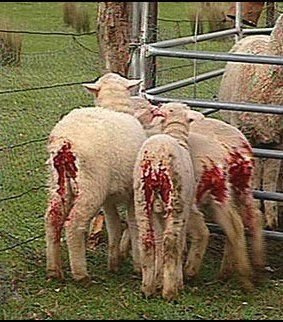
Mule 1

https://en.wikipedia.org/wiki/Mulesing

Mulesing is the removal of strips of wool-bearing skin from around the breech (buttocks) of a sheep to prevent flystrike (myiasis).[1] The wool around the buttocks can retain feces and urine, which attracts flies.

The scar tissue that grows over the wound does not grow wool, so is less likely to attract the flies that cause flystrike.

Mulesing is a common practice in Australia for this purpose, particularly on highly wrinkled Merino sheep.[1] Mulesing is considered by some to be a skilled surgical task.[2] Mulesing can only affect flystrike on the area cut out and has no effect on flystrike on any other part of the animal’s body.

Mulesing is a controversial practice. The National Farmers Federation of Australia says that “mulesing remains the most effective practical way to eliminate the risk of ‘flystrike’ in sheep” and that “without mulesing up to 3,000,000 sheep a year could die a slow and agonising death from flystrike”.[3]

The Australian Veterinary Association (AVA) “recognises the welfare implications of mulesing of sheep. However, in the absence of more humane alternatives for preventing breech strike, the AVA accepts that the practice of mulesing should continue as a sheep husbandry procedure”. The AVA also supports the use of analgesics and the accreditation of mulesing practitioners.[4]

The Australian Royal Society for the Prevention of Cruelty to Animals accepts mulesing when the risk of flystrike is very high, when it is done properly, and even then only as a last resort.[5] The animal rights organisation PETA strongly opposes mulesing, says the practice is cruel and painful, and that more humane alternatives exist,[6] and claim that sheep can be spared maggot infestation through more humane methods, including special diets and spray washing.[7]

In July 2009, representatives of the Australian wool industry scrapped an earlier promise, made in November 2004, to phase out the practice of mulesing in Australia by 31 December 2010.[1][8][9] Mulesing is being phased out in New Zealand.[10]
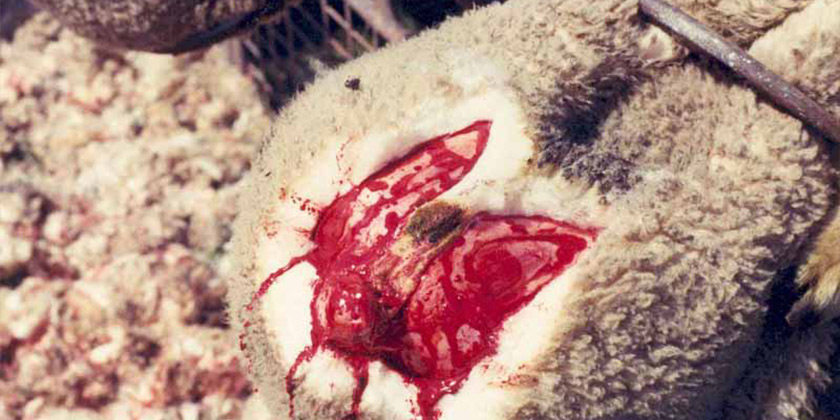
 Mule 2

Mulesing is a procedure which, in Australia, is carried out by a person who has completed the mandatory accreditation and training programme, usually a professional mulesing contractor.[1]

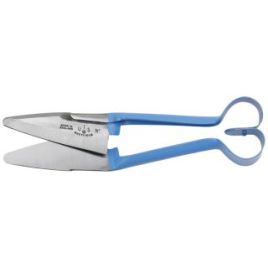
While the lamb is under restraint (typically in a marking cradle), the wrinkled skin in the animal’s breech (rump area) is cut away from the perianal region down to the top of the hindlimbs. Originally, the procedure was typically performed with modified wool-trimming metal shears, but now there are similar metal shears designed specifically for mulesing. In addition, the tail is docked and the remaining stump is sometimes skinned.[13] The cuts are executed to avoid affecting underlying muscle tissue.

The New South Wales Department of Primary Industries states in the Standard Operating Procedures that, “While the operation causes some pain, no pre or post operative pain relief measures are used”. Antiseptics, anaesthesia and painkillers are not required by Australian law during or after the procedure but are often applied, as the procedure is known to be painful to the animal.[1][2] Products have been approved for pain relief during the procedure, including Tri-Solfen. The minor use permit for Tri-Solfen[14] makes the product available for use by both veterinarians and sheep industry employees, such as mulesing contractors and graziers.[15]
Mule 3

After a heavy mules, non-wooled skin around the anus (and vulva in ewes) is pulled tight, the cut heals and results in smooth scar tissue that does not get fouled by fæces or urine. Most sheep have a light mules which does not leave the skin bare, but simply removes the skin wrinkle leaving a reduced area to grow wool and stain.[13]

When managed according to the standards, policies and procedures developed by the CSIRO, lambs are normally mulesed a few weeks after birth. The operation usually takes less than a minute. Standard practice is to do this operation simultaneously with other procedures such as ear marking, tail docking, and vaccination. Because the procedure removes skin, not any underlying flesh or structure, there is little blood loss from the cut other than a minor oozing on the edges of the cut skin.

Mulesed lambs should be released onto clean pasture. The ewes and suckling lambs should receive minimal disturbance until all wounds are completely healed (about four weeks). Observation should be carried out from a distance.[1]

Mulesing should be completed well before the flystrike season, or else chemical protection should be provided to reduce risk to the lambs and ewes.

Lambs that are slaughtered soon after weaning generally do not need mulesing because they can be protected by chemical treatment for the short time they are at risk.[16]

Comparison to crutching

Mulesing is different from crutching. Crutching is the mechanical removal of wool around the tail, anus (and vulva in ewes) in breeds of sheep with woolly points where this is necessary. Mulesing is the removal of skin to provide permanent resistance to breech strike in Merino sheep. Other breeds tend to have less loose skin, and wool, so close to the tail and may have less dense wool.

Crutching has to be repeated at regular intervals as the wool grows continuously. Frequent crutching of Merinos reduces the incidence of flystrike, but not as much as mulesing.[citation needed]

At the time mulesing was invented, crutching was done with blade shears. In Australia, these have been almost universally replaced with machine shears. Hand shears were being used when Mules inadvertently carried out the procedure during crutching. Mulesing would not inadvertently occur using modern machine shears.


Non-surgical alternatives

Several non-surgical alternatives are currently being researched:

  • Insecticides: Any number of insecticides are now available for prevention of fly strike.[40] and even early reviews proclaimed the effectiveness of using dip across the whole animal, rather than cutting one small portion that left the rest of the animal still susceptible “dipping is still the most cost effective means of protecting sheep from flystrike”. [41]
  • Topical protein-based treatments which kill wool follicles and tighten skin in the breech area (intradermal injections)[39]
  • Biological control of blowflies.[12]
  • Plastic clips on the sheep’s skin folds which act like castration bands, removing the skin (breech clips).[39]
  • Tea tree oil as a 1% formulation dip where tests have shown a 100% kill rate of first stage maggots and a strong repellent effect against adult flies, which prevented eggs being laid on the wool for up to six weeks.[42]

USA: Trump to Change The ESA – Bad News For Animals.

USA

ESA 1

Hi Mark,

It’s been heartbreaking to watch a mother orca push around her dead calf for more than a week off the West Coast. She’s been trying to keep its head above water and, in her grief, is now falling behind her family.

Only 75 of these endangered West Coast orcas are left in existence — a 30-year low. We’ve launched a lawsuit in defense of these beautiful creatures.

Southern Resident killer whales are one of the most endangered species on the planet, but the Trump administration is dragging its feet in granting protection.

These orcas are exactly the kind of species the Endangered Species Act is meant for. They need immediate action to increase their food supply of chinook salmon. Our new lawsuit seeks a protected area for these whales so they have enough food and are spared from vessel noise, motor boat traffic and water pollution.

Now Trump and his right-wing anti-wildlife cronies in Congress are trying to weaken the Act as a gift to big business and industry, who will be able to develop, bulldoze and drill all over the habitat of species struggling to live.

Orcas will vanish. So too will polar bears in the Arctic, where oil and gas companies will pillage polar bear habitat.

Trump, Interior Secretary Zinke and Congress are doing all they can to undercut protections for wildlife. If Trump’s new rules go into effect, and without immediate protection, West Coast orcas and other species will be lost forever.

This is all part of the most severe, dangerous threat to the Endangered Species Act we’ve ever seen. We can’t let these attacks go through.

We need you with us to fight for wildlife, endangered species and the laws they depend on to survive.

Please give to our Trump Resistance Fund today and have your gift doubled.

For the wild,

ESA 2


Kierán Suckling
Executive Director
Center for Biological Diversity

P.S. We’re fighting for endangered species day in, day out. The best way to support that fight is by joining Wild Uprising and starting an automatic monthly donation.


USA: Trump Intends To Weaken The Endangered Species Act – Take Action.

USA

ESA 1

Dear Mark,

Extinction is forever. If we lose the polar bear… the manatee… the orca whale… the sage grouse… the bearded seal… we will never get them back.

Yet the Trump administration just announced alarming plans to dramatically weaken the Endangered Species Act — a landmark law with an astonishing 99% success rate that has been a literal lifesaver for hundreds of species on the brink of extinction.

ESA 2

Trump’s plan is a devastating blow for threatened wildlife. They don’t have a voice to fight back — but we do. Right now, the Interior and Commerce Departments are accepting comments from the public on this disastrous plan.

We need your help to mobilize a massive public outcry that will let President Trump, Commerce Secretary Wilbur Ross, and Interior Secretary Ryan Zinke know we’re watching them — and we will not stop fighting to protect threatened and endangered species.

TAKE ACTION: Submit an official comment calling on the Trump administration to reverse course and save the Endangered Species Act.

Make no mistake: This is the biggest attack on the Endangered Species Act in decades. The very agencies that are charged with saving imperiled species are trying to gut the law’s bedrock protections. The proposed rollbacks would:

  • Make it more difficult to extend protections to threatened species, delaying lifesaving action until a species’ population is so small it may be challenging or impossible to save
  • Exempt climate change from key parts of the law, making it more difficult to protect the polar bear, the bearded seal, and many other imperiled species that are impacted by the effects of climate change
  • Require economic factors to be analyzed when deciding if a species should be saved
  • Make it easier for companies to build roads, pipelines, mines, and other industrial projects in critical habitat areas that are essential to imperiled species’ survival

The Trump administration is giving its friends in the drilling, mining, and logging industries the green light to destroy fragile wildlife habitats and drive our most threatened species to the brink of extinction, just to bolster corporate polluter profits.

Tell them you won’t stand for it. Submit a comment calling on Secretary Zinke, Secretary Ross, and President Trump to halt their attacks on the Endangered Species Act.

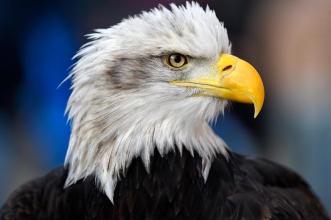
The bald eagle, the humpback whale, and the grizzly bear are just a few of the hundreds of iconic species saved by the ESA. It’s no wonder that an overwhelming majority of Americans support the law and want their elected officials to protect it.

At NRDC, we’ve led the fight to add imperiled animals and plants to the Endangered Species List, and we’ve successfully defended vulnerable wildlife like humpback whales and rusty patched bumble bees in court.

Now, we’re fighting tirelessly to protect the Endangered Species Act itself from the Trump administration’s attacks. And if necessary, we’ll take Trump and his allies to court to save the ESA.

But we can’t do it alone. Please join our fight today by calling on the Trump administration to save the ESA — and the countless species whose lives depend on it — while we still can.

Thank you for standing with us at this critical time.

Sincerely,

Rhea Suh
President, NRDC

ESA 3

Tapanuli: Solidarity with our ancestors!


Indonesia


The Tapanuli orangutan is a sensation. Only 800 animals are still alive, hidden in the forests of Sumatra. Their habitat is threatened by a Chinese dam.

Only a few months ago, in November 2017, scientists found that the orangutan in Tapanuli is a separate species and not a subspecies of the Sumatran Otrang-Utan. They gave him the name Tapanuli orangutan (Pongo tapanuliensis). Genome analysis has shown that the Tapanuli orangutan split off from the Borneo orangutan line 670,000 years ago. Pongo tapanuliensis is the rarest orangutan species.

orang-utan-orang-utan-baby-borneo-pongo-palmöl

Continue reading “Tapanuli: Solidarity with our ancestors!” →

England: 4 Rescued Bears Flown 5,500 Miles From Tiny Cages In Japan To England To Start New Life In Sanctuary.

England

https://www.bbc.co.uk/news/uk-england-south-yorkshire-45081527

yorkshire bear

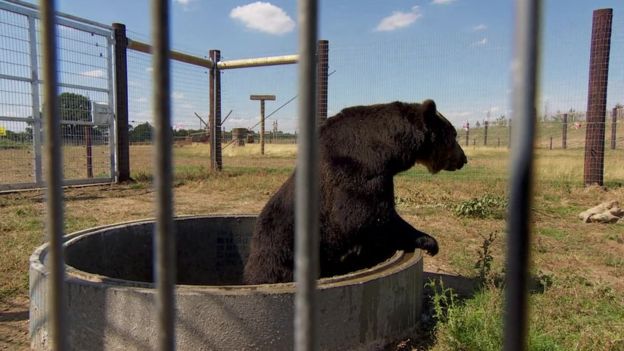
Endangered brown bears rehomed at Yorkshire Wildlife Park

Four endangered bears have been rehomed in Yorkshire after being transported more than 5,400 miles from Japan.

Riku, Kai, Hanako and Amu had been living in cramped conditions ( 3 x 3 metres on concrete only) at a museum on the island of Hokkaido.

All four are now settling in to their new home at the Yorkshire Wildlife Park (YWP), near Doncaster, after being flown from Tokyo to London.

Animal charity Wild Welfare said the bears will receive “rehabilitation, enrichment and lifelong care”.

yorkshire bear 2

Above – first time ever it has played in water or felt grass underfoot.


“I would go to jail for the protection of the animals”


Switzerland


In the Romandie (also called French-speaking Switzerland, with a population of 2 million) Virginia Markus is the best-known pioneer of the Anti speciesists, a radical animal protection movement.
Especially her actions cause a stir: In March, she and 18 of her co-workers freed 18 kids from a slaughterhouse near Rolle (VD), having previously recorded the conditions in a slaughterhouse with hidden cameras and occupied appropriate facilities. There are several criminal cases against her.


virginia Markus, AntispeziesistinVirginia Markus

On 3.08.2018 she gave a very good interview in the “Neue Zürchner Zeitung”. I only translated the main points of this interview because it is quite long, but you can read the whole thing from the link.

https://www.nzz.ch/schweiz/fuer-tiere-wuerde-ich-auch-ins-gefaengnis-gehen-ld.1408633

NZZ: You chose the radical form. When did you eat your last piece of meat?

Markus: When I was 18, my former geography teacher showed me the effects of meat consumption on the environment. That opened my eyes. The decision to live vegetarian was easy, because I was always surrounded by animals. It was harder to give up my beloved cheese six years later. But I had to do it because I realized that if I only consume dairy products, I’m indirectly responsible for the deaths of animals.

NZZ: In what way?

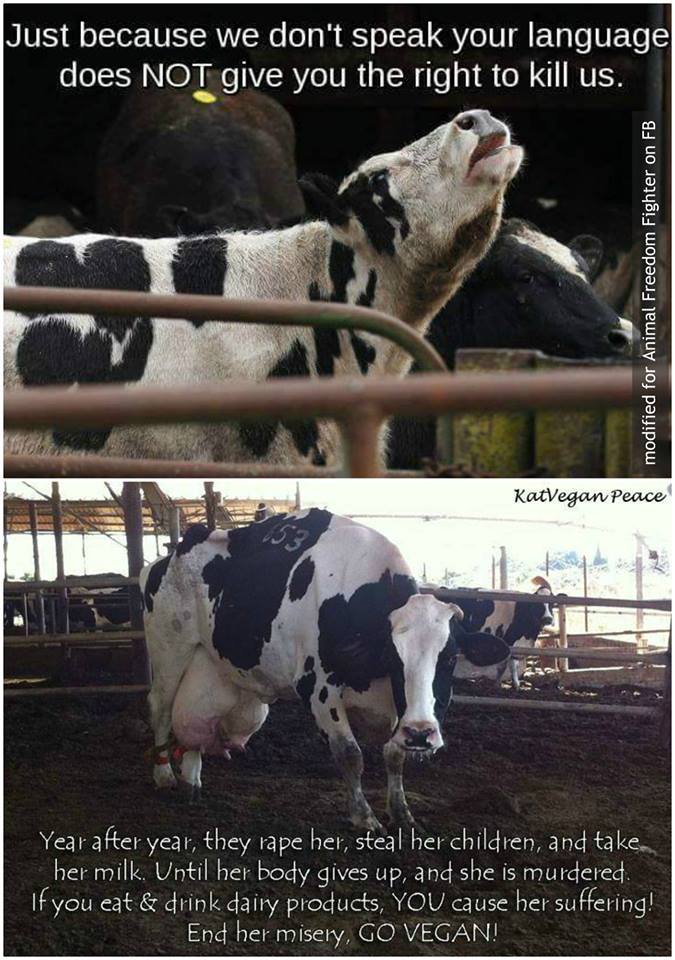
Markus: Many people feel that a cow is constantly giving milk. It is not so. She has to give birth to a calf regularly, which will soon end up on the slaughter if it is male. And if she does not produce enough milk, the cow is also slaughtered. That is irresponsible for me. The decision not to eat any more animal products was a liberation for me: at last I could live in harmony with my values.
By consuming animal products, one is jointly responsible for murdering an animal.


schöne grafik über MIlchkühen_n

NZZ: Do you – ethically speaking – make no distinction between animals and humans?

Markus: No! as far as their will to live is concerned. An animal that suffers is like a person who suffers. Which of course does not mean that there are no physiological and cognitive differences.

NZZ: In nature, there are also differences and a hierarchy: A cat hunts the mouse – and we humans keep us the livestock.

Markus: A cat acts by instinct, she can not think the consequences of her actions. Fortunately, we can do that. There are no people born with the instinct to kill.
I do not deny that it can give pleasure to eat meat. But that does not justify doing it – it implies sacrifice. By consuming animal products, one is jointly responsible for murdering an animal.
In other areas of life, nobody also questions that one must put own pleasure back, if it is to the detriment of others. Why not with the food?

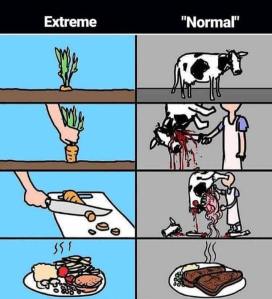
Extreme-Normal Karikatur

NZZ: They not only hide cameras, they also block roads to slaughterhouses and even liberate animals. Four criminal cases are currently pending against you. Why should not the law apply to you?
Markus: Only in this way can we sustainably influence public opinion. Civil disobedience is only a remedy for us when all others are exhausted. We force the society, so to speak, not to close its eyes.
Our first big goal is that cows, calves and other fattening animals in Switzerland are as well protected as cats and dogs. Still, animals do not have the same rights as humans. So in our opinion, more radical methods are needed to combat this malady.

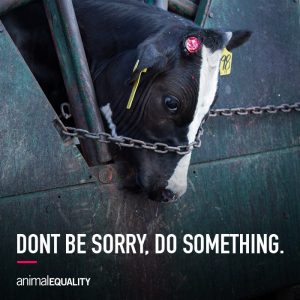
Kalb-Animal Equality

I am insulted on all possible channels, someone has already bitten me the tires. To some extent, I can even understand the anger of many people. However, I am not insecure by such reactions, as well as by judicial decisions. For the protection of the animals I would go to jail.

Last question: what has become of the liberated kids?
Markus: I can only reveal so much: 17 of the 18 rescued animals still live. They had to be elaborately maintained, meanwhile they are all well again.

My best regards, Venus


India: Latest Great Rescues From Animal Aid Unlimited.

INDA0001


Dog found unconscious in a field makes beautiful recovery

We got a call that someone had found a dog collapsed unconscious in a field. Half of her face lay in a shallow pool of water and we could not awaken her. We hurried her back to Animal Aid’s hospital and found that she had most likely suffered trauma to her head. She showed all the signs of a brain injury. It took several hours for her to gain consciousness, but even after waking up she was unable to walk.

Throughout the weeks that followed, she won our hearts with her trusting eyes and the brave efforts she made–a little more each day, to stand, to walk, to give and to receive love. Gradually, we could see changes taking place in her abilities.

After two months, look what Angela can do!


Please donate for the animals who need extra time to heal.


Donkey found hiding in shed with rope severing his leg

We found a frightened donkey hiding in a shed with a horrific injury on his leg caused by a rope that had been tied around his leg for many weeks. The tight rope had caused a deep wound that was severely infected, necrotic and infested with maggots and was so painful he couldn’t bear any weight on the injured leg at all. We could see how scared he was standing in the shed, but his eyes met his rescuers with incredible trust.

We feared we wouldn’t be able to save his mangled leg, but after several weeks of treatment, this gentle boy started to recover…

Please donate to save injured animals in India.


Baby goat drowning in well reunited with her mama

We got a call that a baby goat had fallen in a well and was quickly losing her strength. We found her barely paddling and struggling to breathe. After rescuing her from the well we were so relieved to find that despite being exhausted and traumatized from nearly drowning, she was fine. More than anything, this beautiful girl wanted to be back by her mama’s side. Watch the reunion.

Please donate today for life-saving animal rescue in India.


Collapsed lung and head injury, train accident victim’s amazing recovery.


We found him next to the tracks, his nose split in two, breathing with great difficulty and very disoriented. When we brought him back to Animal Aid’s hospital, our vet found that he had a collapsed lung which is a very life-threatening condition. We had to place a tube in his chest to allow his lung to expand and function normally again, suture his badly injured nose and upper lip and stabilize him with fluids and other medications. With so many life-threatening conditions, we were so worried that we may not be able to save him despite our best efforts. But this brave young boy had an amazing spirit and triumphed against all odds.

Please donate to help the next brave little one who is in a crisis.

England: Farm banned by Red Tractor for pig cruelty supplies meat to major wholesalers.

England

Source:

https://www.independent.co.uk/news/uk/home-news/pig-animal-cruelty-red-tractor-rosebury-farm-dunstable-inspectors-ban-a8470011.html

Farm banned by Red Tractor for pig cruelty supplies meat to major wholesalers

‘The sound of piglets’ heads being smashed against the wall, the cries of agony as their tiny teeth are clipped, and the terrified squeals of pigs being forced onto the slaughter truck with electric shocks could all be straight out of a horror film’

A farm where workers inflicted a string of torments on animals is a supplier to one of Britain’s biggest abattoirs that sells meat to major wholesalers.

It also sells pigs to a local butcher – prompting campaigners to say the footage proves it is a myth that locally bred meat means higher welfare.

Video taken at the Bedfordshire farm revealed a litany of abuse that broke welfare regulations including:

  • A worker swinging a tiny piglet by one leg and smashing its head against a wall
  • Piglets teeth being clipped off without pain relief
  • Pigs being illegally and repeatedly shocked with an electric prod in their sides and neck
  • A piglet left frothing at the mouth on a pile of corpses
  • Dozens of dead piglets littering the floor of the farrowing (birthing) shed as well as live piglets trapped in crates with dead siblings
  • Pigs crammed into barren pens so small they are forced to lie on each other in the heatwave
  • At least one creature suffering from a tumour or hernia

Animal-welfare investigators uncovered the breaches of regulations at Rosebury Farm in Dunstable, Bedfordshire, which had passed five Red Tractor inspections this year including one last month – all of which the farm had been alerted to in advance.

Footage of wounded pigs raises questions over Red Tractor scheme


But an unannounced inspection took place lafter the activists, from Animal Equality, disclosed the footage. The farm was then suspended.

The activists’ evidence showed how when piglets were slammed against a wall one continued to kick for at least 10 seconds, suggesting it died in extreme pain.

Last month The Independent revealed how animals at a farm that had been inspected and authorised by Red Tractor officials were found to be suffering from painful, infected injuries.

The practice of using an electric prod is restricted to “extreme circumstances only” under law. At Rosebury Farm in Dunstable workers were filmed using an electric prod to load pigs onto a lorry heading to an abattoir.

The investigators trailed one lorry load of pigs from the farm to Cheale Meats in Essex, a slaughterhouse that supplies the biggest wholesalers in the UK. It is believed meat from Cheale ends up in major supermarkets.

Another lorry went from the farm to Evans & Son, a “traditional” butchers in Bedfordshire that boasts of selling only local meat.

Many consumers mistakenly believe that buying meat from a local butcher or farmers’ market means the animals had a better life.Toni Shephard

Dr Toni Shephard, executive director of Animal Equality, said the investigation showed it was not true that local butchers or farmers’ markets guaranteed better welfare.

She said: “The sound of piglets’ heads being smashed against the wall, the cries of agony as their tiny teeth are clipped, and the terrified squeals of pigs being forced onto the slaughter truck with electric shocks could all be straight out of a horror film.

“Yet these harrowing scenes are from the much romanticised local, family farm producing British pork under the Red Tractor label.

“It’s time consumers were told the truth – labels and certificates do not prevent animals from suffering in the meat industry, but choosing from the ever-increasing selection of meat-free options will.”