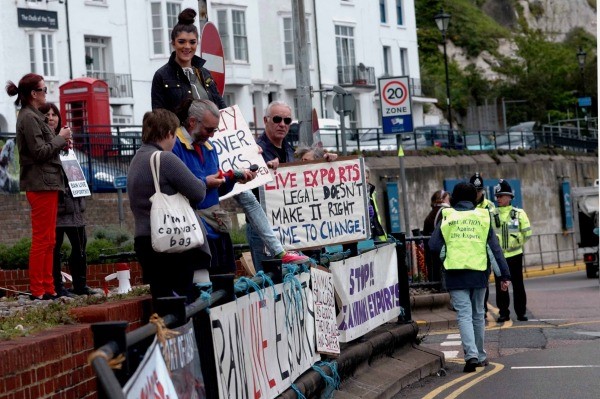
WAV Comment: Lets face it, we always hear promises from all the Australian governments about how things are going to get better. Australian sheep have a bad time from the minute they are born until they have been live exported to and barbarically slaughtered in the dregs that are other parts of the world. And lets not forget the mulesing which takes place in the Australian farms; – hacking off chunks of flesh without any form of anaesthetic. And now the UK says it is setting up a trade deal with them ! – for example:
Pesticide limits in Australia are 200 times higher than the UK’s. Australia also have 144 licensed pesticides, whereas the UK only licenses 73 of these substances.
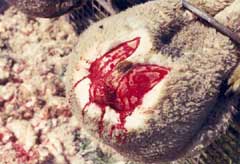
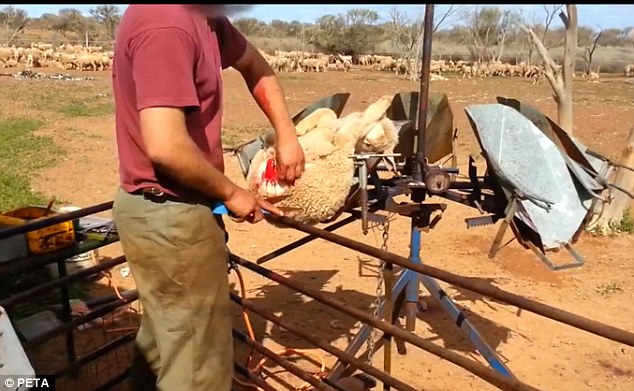
I’m writing to share shocking new footage filmed inside a Victorian shearing shed earlier this year. The video shows a ewe – injured during shearing and badly bleeding – being held between the knees of a shearer, who is crudely stitching up her gaping wound without administering any pain relief. The shearer then mops up her blood with her own fleece.
This is far from the first time cruelty has been documented at an Australian wool operation.
Hours of eyewitness footage compiled by PETA over the years shows shearers hitting sheep with closed fists and electric clippers, kneeling on their necks with their full weight, and slamming them into the floor.
Sheep deserve better, and Australians deserve to know the truth about wool jumpers. Will you please help us speak up for sheep by sharing this exposé far and wide?
Once people know better, they can do better. Sharing information is the first step towards creating a kinder world for animals.
Want to know more about wool? The wealthy wool industry loudly and consistently extolls the virtues of the material, so it can be hard to sort fact from fiction. That’s why we’ve launched a new website, WoolFacts.com, to help consumers and designers develop a deeper understanding of the impact wool production has on animals and the planet.
We have had the following sent through from Ana; she asks ‘what can we do ?’.
Sadly Ana, probably very little now, as this all appears to already be done and dusted according to the article. The new deal has already been done. We agree with the statement in the article:
“Animals Now said the measure would provide an economic incentive to “an industry that abuses animals.”
“To continue to give a customs exemption for the import of live calves is to give benefits to a handful of businessmen, and to transfer hundreds of millions of shekels from the public purse to the meat industry, while humanity is dealing with the climate crisis, is simply absurd,” it said.
Article:
Government deal to boost beef industry pilloried as bad for climate, public health
Agriculture minister says NIS 420 million accord will help cut prices, while rights activists say permanent customs tax exemption on import of live calves is a license for abuse
A range of activist groups on Thursday denounced a new deal between the Agriculture and Finance ministries and the Israeli Cattle Breeders’ Association to boost the beef industry.
The agreement, reached Wednesday, commits the government to investing more than NIS 420 million ($122 million) into the local beef industry over the next seven years; removing customs duties on imported beef products; turning a temporary exemption on customs duties for livestock imports — which is renewed annually — into a permanent exemption; and increasing the number of foreign workers that can enter Israel to work in the sector.
Agriculture Minister Oded Forer described the agreement as, “more good news for dealing with the high cost of living,” that would help cut the price of beef, “a product that is in increasing and constant demand from year to year,” while also supporting the cattle breeders and giving the sector certainty.
The Israeli Association of Public Health Physicians and the Israel Forum for Sustainable Nutrition, however, warned in a statement that encouraging beef consumption was bad for public health, the environment and for fighting climate change.
According to UN estimates, livestock is responsible for around 14 percent of human-generated greenhouse gases, especially methane.
“To continue to give a customs exemption for the import of live calves is to give benefits to a handful of businessmen, and to transfer hundreds of millions of shekels from the public purse to the meat industry, while humanity is dealing with the climate crisis, is simply absurd,” it said.
According to Agriculture Ministry figures, a record 856,630 calves and lambs were shipped to Israel in 2021 for fattening and slaughter, an increase of 42% over a year earlier.
Per capita, Israelis are among the highest consumers of beef in the world.
More than 1.4 billion cows, sheep, and goats as well as millions of other animals are killed each year to feed the fashion industry’s demand for skin – but how much do we really know about the journeys of the sensitive individuals whose skin is stolen?
The global leather supply chain is complex, making it difficult for consumers to determine the origins and sometimes even the species of the animals used for the items they purchase.
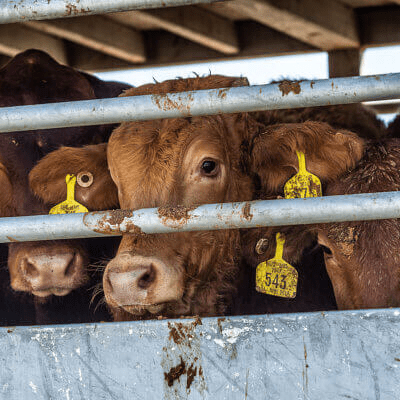
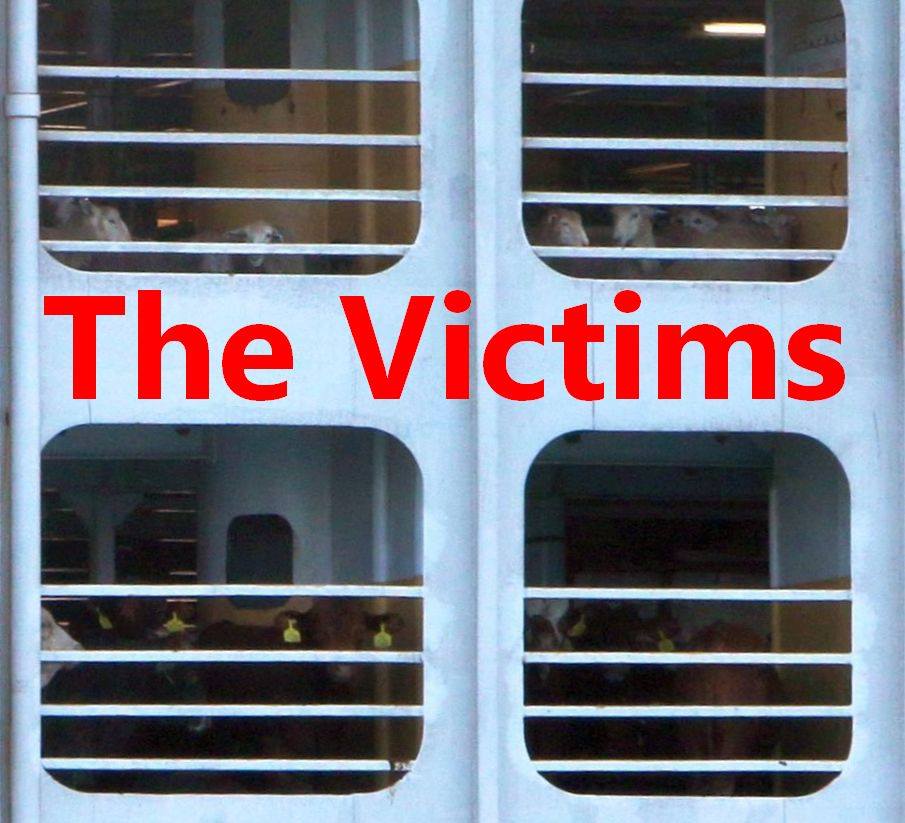
Live export is a process in which trembling animals are pushed onto a severely crowded truck or ship and transported many thousands of kilometres.
A new PETA video tells the story of how the leather trade fuels the live-export industry from the perspective of an investigator who has witnessed it firsthand.
Butchered Alive: Australian Cattle Killed Overseas for Leather Shoes
In 2021, PETA Asia investigators visited seven Indonesian abattoirs at random, some of which were part of the Australian government’s Exporter Supply Chain Assurance System.
At these facilities, the investigators found botched stunning or sometimes none at all. They witnessed animals being prodded repeatedly with metal rods and gasping for air as blood filled their throats.
The investigators learned that the skins of some Australian cattle were sold to a fashion brand that exports leather shoes worldwide.
Chilling scenes of abuse of Australian animals have been documented at Indonesian abattoirs this year, prompting a fresh set of complaints to be filed against Australia’s live-export industry, but consumers must take action as the government has shown no inclination to lift a finger.
The footage is a harrowing glimpse into the trade that supplies flesh to dangerous wet markets and skin to the global leather industry. Some of the facilities visited by PETA Asia investigators are even part of the Australian government’s Exporter Supply Chain Assurance System (ESCAS), dispelling all doubt about government inaction.
In the same month this abuse occurred, Australian Livestock Exporters’ Council (ALEC) CEO Mark Harvey-Sutton expressed his “full confidence in the standards the Australian industry upholds”. Watch the footage below and decide if you can say the same. If not, please stop buying leather right now!
Botched Stunning or None at All
PETA Asia investigators visited seven randomly selected abattoirs in Indonesia in April and May 2021 and filed an official complaint.
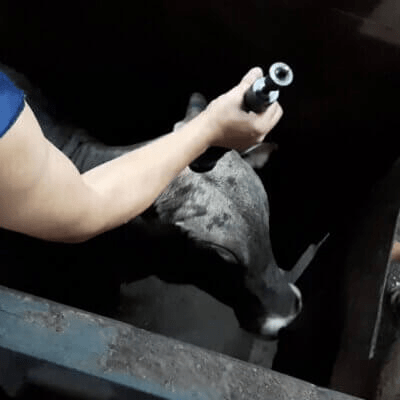
They found steers and bulls being forced into restraint boxes and shot in the head with captive-bolt guns. The cattle were often fully aware of what was happening to them. They slammed their bodies against the metal chute they were trapped in, in a futile attempt to turn around and escape.
Workers repeatedly failed to stun cows adequately. Clearly still conscious after being shot in the head, one steer was jabbed 64 times in the face and on his torso with a steel rod to try to force him to stand back up so a worker could shoot him again.
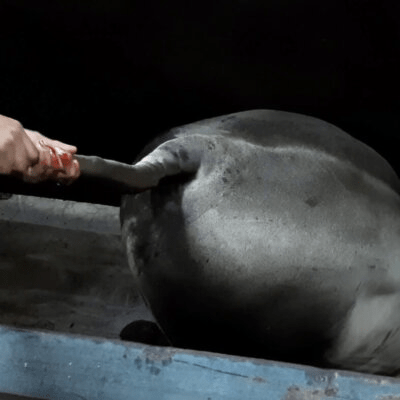
Workers also violently twisted his tail until it was broken. In a last-ditch attempt to move the struggling, panicked steer, they pulled on his broken tail a dozen times.
Then there were those for whom stunning wasn’t even attempted at all. Some cattle were simply physically restrained before their throats were slit – which, believe it or not, is a killing method approved by the Australian government.
ALEC boasts on its website that 95% of Australian cattle in Indonesia are now stunned prior to slaughter. But based on what investigators saw, that’s not the case.
Butchered Alive
Abattoir workers viciously yanked and deliberately stepped on animals’ tails, apparently in a crude attempt to check for consciousness. Some cattle still kicked, but they were butchered anyway, with no further attempts at rendering them unconscious.
Steers who were still moving and whose heads dangled by only a strip of flesh after their throats had been slit were hung by the neck on metal hooks. Their legs continued to thrash as they were dragged across the bloody floor and then hoisted up.
Investigators saw animals blinking after their throats were cut, gasping for air as blood filled their throats. Some suffered this way for up to 12 minutes after being shot with a captive-bolt gun.
Monica KH Bando, a veterinarian with more than 13 years of clinical and research experience, said the footage captured by investigators depicted “egregious violations of acceptable animal welfare standards for livestock” including “[p]oorly designed facilities, unsanitary conditions, substandard handling, restraint methods that induce stress and distress, lack of stunning and ineffective stunning, and inhumane killing methods”.
10 Years of Failure
Workers told investigators that the cows being slaughtered came from Australia, and most wore Australian National Livestock Identification System ear tags.
These are just a tiny percentage of the millions of animal victims of Australia’s live-export trade. Australia exported more than 1.8 million animals in 2020, and the vast majority of them were cattle.
It’s been a decade since cruelty in the live-export trade to Indonesia was exposed by Animals Australia on national TV in the programme Four Corners, after which a traceability programme – Export Supply Chain Assurance System – was put in place.
The programme hasn’t provided “assurance” of any kind. In fact, it’s been a colossal failure. It was supposed to stop this kind of cruelty. There have been 184 reports of non-compliance (just reports – the number of incidents would be far higher) since it was established.
When this latest footage was filmed, the Department of Agriculture was still investigating cruelty complaints against Indonesian abattoirs made by Animals Australia in 2020.
The Government Ignores This, but We Have the Power to Stop It
The Australian government should be preparing for a future without live exports, but it’s not. Every new exposé is “shocking” to those in power, but are you really surprised? When animals are crammed onto ships as though they were inanimate commodities and then sold for slaughter, how can anyone expect them to be treated as if their pain mattered?
Australia is a nation of self-proclaimed animal lovers, so many of us blame somebody else for the cruelty – the government or people overseas. Never mind that these cattle were slaughtered for meat and leather sold all over the world, potentially even in Australia.
The live-export industry is the meat industry and the leather industry. If you buy meat at an Australian supermarket or purchase a pair of leather shoes, you’re putting money in the pockets of the same people who send these animals to be slaughtered in hideous, painful ways overseas.
And since the leather produced in Indonesia is exported globally, you could be wearing or sitting on the skin of the same animals you’ve just watched in this video. PETA Asia investigators found that the skins of some Australian cattle were sold to a fashion brand that exports leather shoes worldwide.
If you continue to buy the flesh or skin of animals, you send the same message to producers that the government does, i.e. that this industry has a social license to continue and a sustainable future. Please, act now to change the market and spare animals’ lives every time you buy a meal, a pair of shoes, a jacket, or a belt. Personal responsibility will end this trade. Let’s go!
In April 2021, New Zealand announced a ban on all live exports (including breeding “stock”) by sea, citing the need to “stay ahead of the curve in a world where animal welfare is under increasing scrutiny”. New Zealand actually banned export for slaughter all the way back in 2008. In May 2021, the UK announced that it intends to ban the live export of animals for slaughter and fattening.
Meanwhile, Australia is still leaving a bloody trail around the world, causing animals misery en route and in every port they reach.
This investigation shows that no regulations, reviews, or reports are making the barbaric business of shipping and killing live animals more humane
Around 8/6/22 we wrote to our (UK) Member of Parliament (MP) expressing our concerns over the UK-Australia Free Trade Agreement (FTA) and animal welfare issues. We had serious concerns over the UK animal standards being lowered down to Australian levels by this deal, especially with Australia still undertaking the mulesing of sheep, using up to 16 times as many antibiotics on Australian farms compared to those being used in the UK, and of course, the continuation of live animal exports from Australia to the Middle East.
You can read our letter of concern by clicking here:
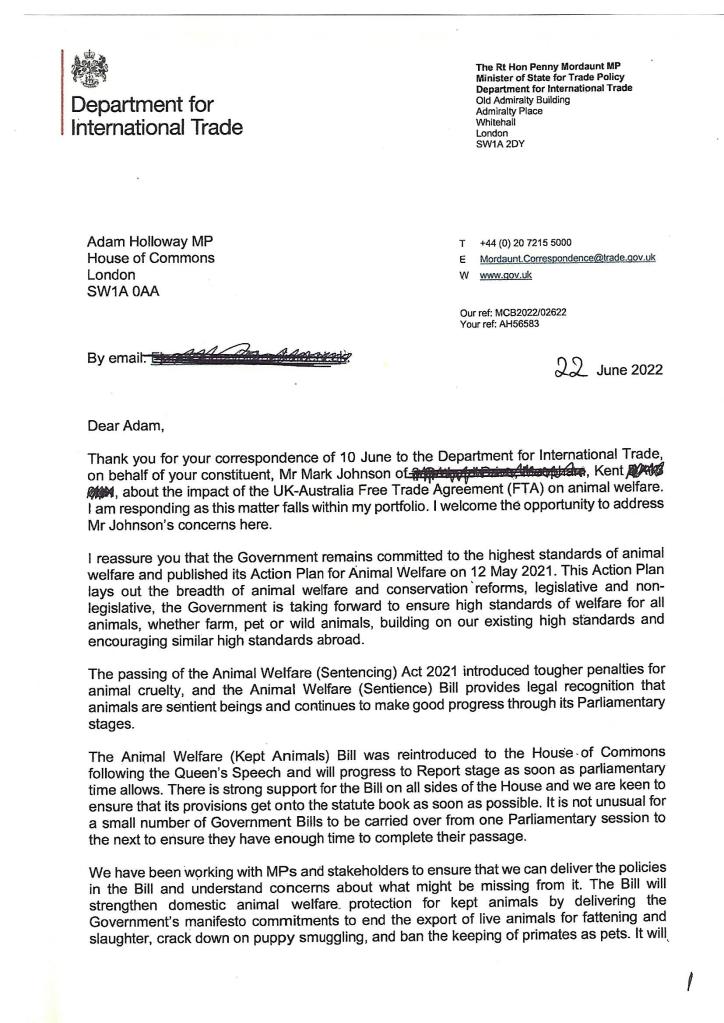
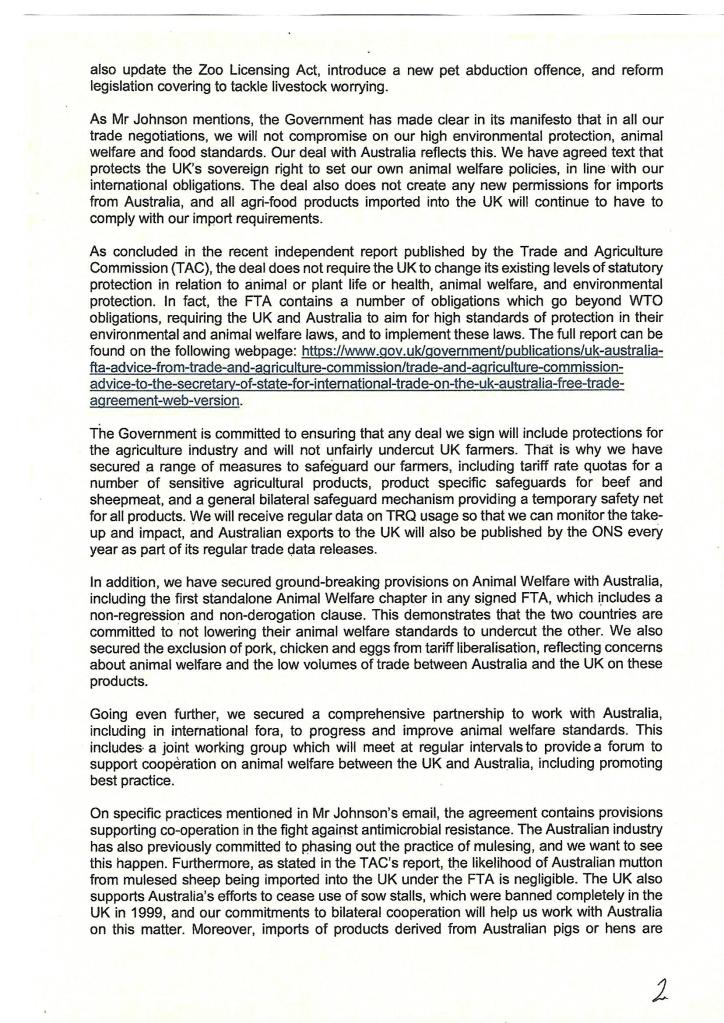
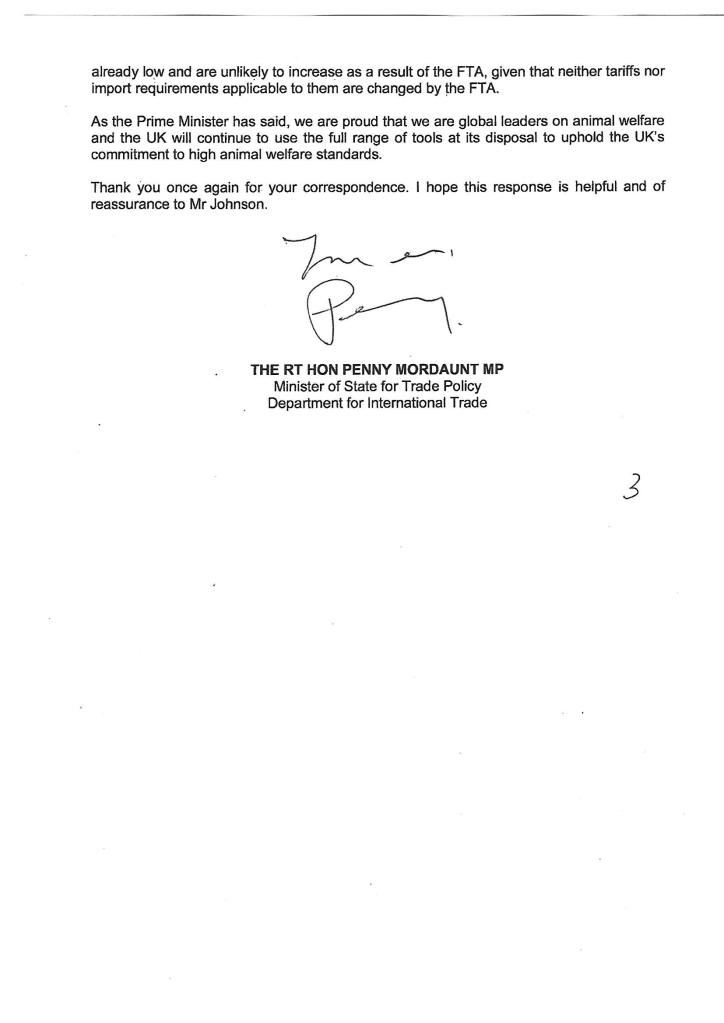
We now have a letter returned to us dated 22/6/22 from Rt Hon Penny Mordaunt MP; the UK Minister of State for Trade Policy at the Department for International Trade.
I am publishing the letter below for everyone to read if they wish.
Minister Penny Mordaunt (MP)
Today is the 24/6; and I need to inform people that yesterday, the 23rd; the British government led by Boris Johnson, suffered 2 defeats in by elections in the South West of England and also in the North.
We at WAV are non politically biased; we just fight for the better treatment and welfare of living, sentient beings. These defeats though cannot simply be dismissed as a mid term ‘thing’ that happens in politics; many see this as something deeper, possibly a reflection of a government in crisis which is doing little and expecting the ‘normal working man (and woman)’ to pick up the tab.
Animal welfare deals included in the UK – Australia FTA are a concern to us here in the UK. Australia has lower standards, the UK has better. We are keen to read in Penny’s letter that things are still moving on to deliver the (UK) Governments Manifesto commitment to end the live export of live animals for both further fattening and slaughter. We are pleased to announce that despite the Bill not reaching law yet; live animals have not been exported to any degree (when compared to the past) for many months now. The Bill is working its way through both houses of Parliament in order to become law; and as we have campaigned against this sick business for nearly 35 years, we want to see action now !
The second page of Penny’s letter declares that the UK government has “secured ground breaking provisions on animal welfare with Australia, including the first stand alone animal welfare chapter in any signed FTA”. We welcome the comprehensive partnership with Australia to progress and improve animal welfare standards. These include a joint working group who will meet regularly to provide a forum to support cooperation on animal welfare issues between the UK and Australia, which includes best practices.
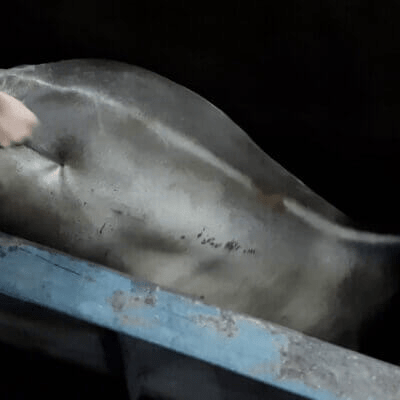
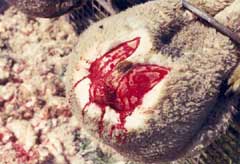
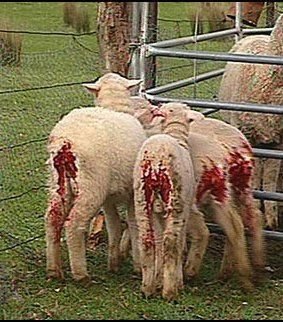
A ‘mulesed’ sheep in Australia.
Time to stop this abuse Australia.
We also welcome and support the UK governments and Australian efforts to stop the use of sow stalls, which were banned in the UK in 1999, 23 years ago !, and the commitments for bilateral cooperation which will see this practice also being stopped in Australia.
I will leave you to read the response to us from Penny, outing the UK government approach to animal welfare ‘move forwards’ with Australia. If we can make more efforts to stop live exports, the mulesing of live sheep, get the pigs out of sow stalls, and make differences for caged animals in Australia, then we may be on the road to further progress.
Finally, the massive government defeats in the UK yesterday sent a clear message to government that the common man and woman are not happy; and that things need to change, or else we change you by electing a different government.
So, get on and pass the (UK) animal welfare legislation to give animals a voice.
The use of vessels which have exceeded their ‘scrap by’ dates and then purchased to be converted into livestock carriers are something which is seen all too much (unfortunately) by those of us monitoring the live animal export industry.
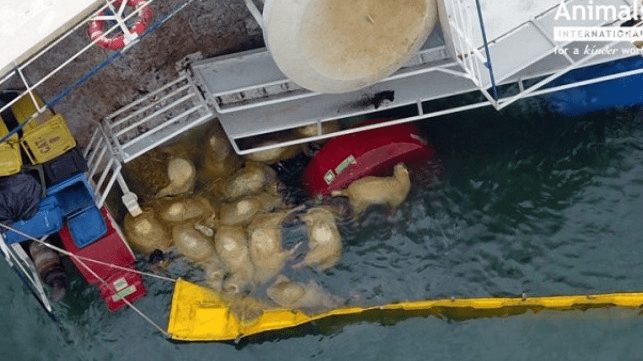
When the ‘Queen Hind’ sank after leaving the Romanian port of Midia in November 2019, many thousands of sheep also drowned there. Who is pulling one when they paint ‘Safety First’ on the vessel ?
180 out of 14,600 animals survive – Safety First !
Queen Hind
Only 180 sheep survived the ‘Hind’ incident out of the 14,600 initially believed to have been onboard, which was carrying them from Romania, the EU’s biggest exporter of the animal, to Saudi Arabia.
But the revelations uncovered during salvage about the Hind having secret decks only increased the death toll of the sheep carried by several thousands, and also raised fresh questions on whether overloading was to blame for the capsize.
Seems strange does it not, that the Sudan incident happening very recently, included the failure of an official PSC ministry inspection of the vessel over a 10-year gap from 2008-18. Were the extra 4 decks fitted onto the vessel during this time ? – yes; and could this have been what caused the vessel to become ‘top heavy’ and overturn when fully loaded with animals ?
We are not afraid to say, but we also question if these incidents are about compensation issues. If you have a very old ship and it is written off, do you not get insurance money which will probably buy you a better one ? – and the livestock ?; somebody somewhere is going to get compensated for the ‘loss’ of the cargo one assumes.
A disgusting business which belongs in the history books. No doubt it will happen again, what once, twice or more ?
I simply ask the question; how are these old rust buckets allowed to cross the oceans of the world carrying livestock when they have not had an official inspection for over 10 years ? – when I have a car, it has to be inspected and pass rigorous (MOT) testing by the authorities each and every year. ‘My car’ carries 4 or 5 people, not 15,000 live animals; so should ithe floating death traps not be inspected more regularly to higher standards when operating ? – especially when they are that old in the first place.
Baffled ? – yes I am, just like many others.
Regards Mark
—————————————————————–
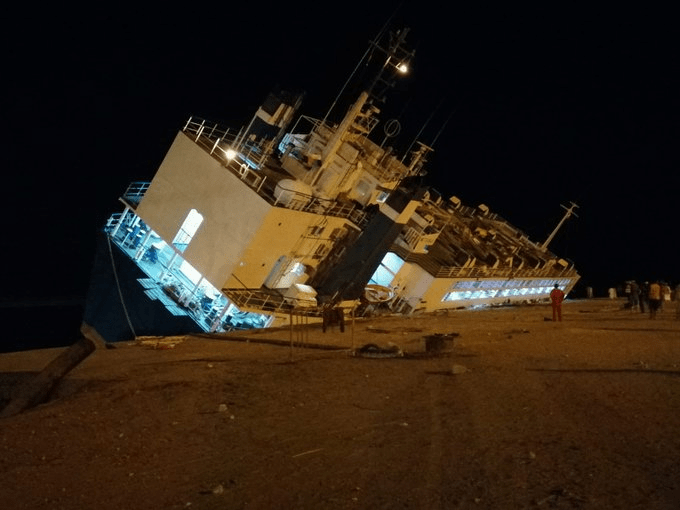
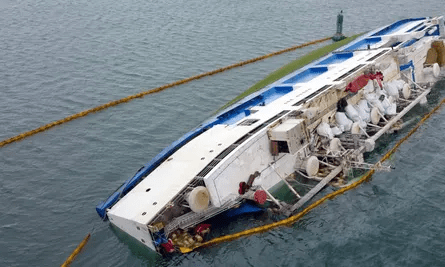
The vessel Al Badri 1 (misreported as the Badr 1) began sinking at the pier at Suakin, Sudan in the early hours of a recent Sunday morning. The vessel capsized slowly, officials told The Guardian, and the crew had enough time to disembark. Only some 700 sheep escaped and survived.
The loss of the Al Badri 1 may affect the port’s operations, as well as the environment, given the potential for a fuel oil spill and the effluent from the decay of thousands of sheep. The vessel is now submerged next to its berth, interfering with the pier’s use until the wreck is cleared.
The Al Badri 1 (ex name Henry Stahl,Ester 1, Ytong 1, Malak 1) was a stern-ramp ro/ro freighter originally built in 1973 and converted into a livestock carrier later in her lifespan.
She had a history of port state control deficiencies in recent years, as well as a 10-year gap from 2008-18 in which she had no PSC inspections.
Images from before and after the Al Badri 1’s conversion suggest that four extra decks were welded on above the ship’s main deck level to add more space for livestock.
Worldwide, livestock carriers are generally older than the average merchant ship, and the average fleet age for the class exceeds 40 years. Almost all are conversions, often from ro/ro vessels.
The ships selected for the conversion process have usually already arrived at the normal age for demolition (about 30) when they begin their new life, based on a 2021 study by Animal Welfare Foundation, Tierschutzbund Zürich and Robin des Bois.
A similar incident occurred aboard the livestock carrier Queen Hind in November 2019. The vessel capsized off the coast of Romania under unusual circumstances, drowning almost all of the 15,000 sheep on board.
From the Romanian incident – Secret decks for extra animals have been found in a livestock carrierthat sank off the Romanian port of Midia in November drowning thousands of sheep, according to the company carrying out the massive salvage operation.
Only 180 sheep survived out of the 14,600 initially believed to have been onboard the Queen Hind, which was carrying them from Romania, the EU’s biggest exporter of the animal, to Saudi Arabia.
But the revelations about secret decks are likely to increase the death toll by several thousands, and raise fresh questions on whether overloading was to blame for the capsize.
The vessel was left on its side in the water as it sank not far from port, with sheep corpses piling up around it. Images of the tragedy made headlines worldwide and led to renewed calls by animal activists to impose a ban on live exports from Europe to non-EU countries, particularly the Middle East and north Africa.
We also understand that the vessel in the Sudanese incident was officially only allowed to carry 9,000 animals; yet 15,800+ being carried drowned. Thus, it would appear as we always suspect with these cheap rate bathtubs which are used in this business, the vessel was carrying twice as many animals as it should have been; which we expect (are very certain of) being the cause of the incident in the first place.
It has happed before – see the ‘Queen Hind’ secret decks data above.
As the summer season approaches, Welfarm launches its new campaign to end the suffering of farm animals in hot weather.
Climate change will increase the intensity and frequency of heat waves, posing increased risks to farm animal welfare. The IPCC Sixth Assessment Report recently showed that climate change is causing a steady increase in temperature. This increase is not without effect on farm animals.
For several years, Welfarm has been reporting on the suffering of animals transported by extreme temperatures. On 19 May, Welfarm decided to go one step further by alerting the general public and institutional actors to the consequences of global warming for farm animals whether on farms or in trucks and boats.
With this new campaign Welfarm calls on authorities to radically change the conditions under which animals are kept and transported to put an end to the suffering they endure during heat waves.
Welfarm’s demands are as follows:
With regard to livestock
Reduce densities,
Ensure an appropriate environment for the animals (access to open-air for terrestrial animals, shaded ponds for fish).
With regard to transport
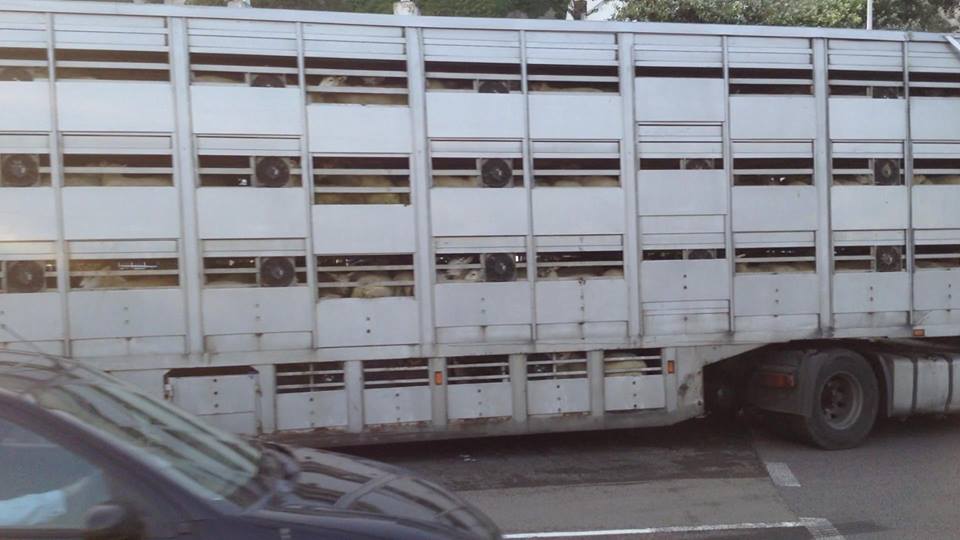
No transport of animals at temperatures above 30°C,
Ban on export of live animals to non-EU countries.
Regarding transport, Welfarm has relaunched its Truck Alert application, which makes it possible to report trucks transporting animals during hot weather.
For more information on the campaign or to sign the petition: click here.
There’s just LESS THAN A WEEK TO GO until Ban Live Exports: International Awareness Day!
Will you stand up for animals on Tuesday 14th June?
This year we’re going all-out to highlight the horror of the ‘once in a lifetime’ trips that sheep, cattle, and pigs are forced to ensure during live export.
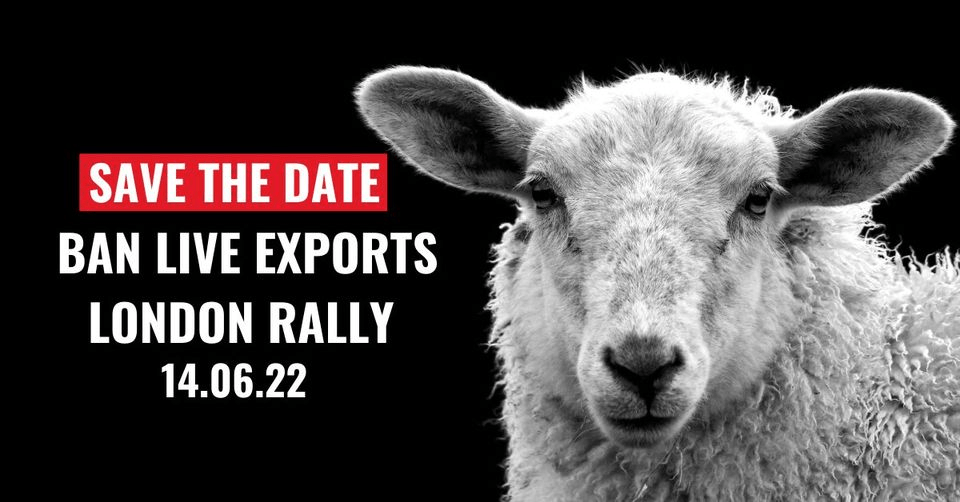
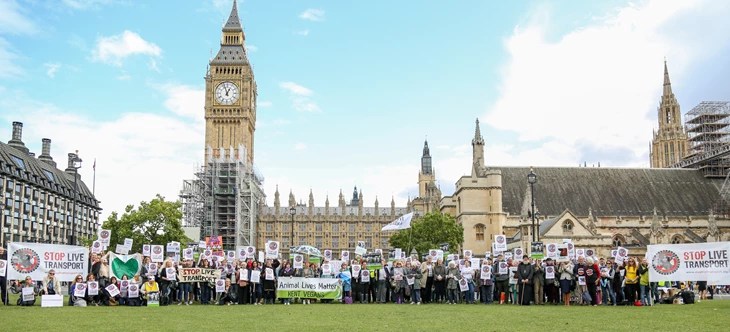
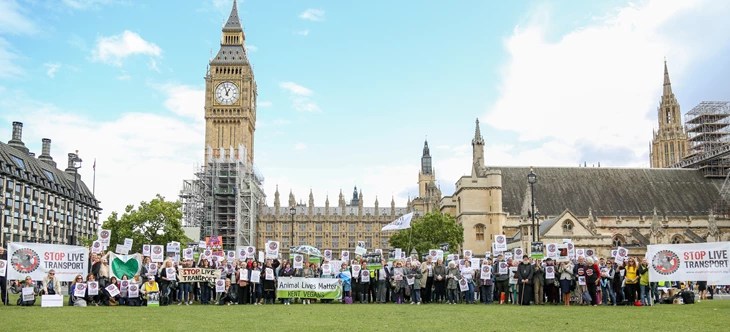
At CIWF UK, we’re all set for our ‘Hell Tours’ London Rally, which is taking place at Parliament Square, on June 14th from 12.30pm-2pm. And today we are launching a brand-new action to end the horror of live exports.
Hi all; I have now completed and sent my letter today 8/6/22 (by e mail) to my Member of Parliament (England); you can read it below.
I have also sent him several pictures of sheep in Australia which have undergone ‘mulesing’ without any form of anaesthetic.
I hope the letter explains my position of the issue of a UK – Australia FTA; and I now await response, which I will publish upon receipt.
Regards Mark
Dear Mr. Holloway Member of Parliament for Gravesham, Kent.
You and I have met in the past, and you have also had letters from me relating to an issue that is very close to me – that of stopping live animal exports / transportation. In lieu of the vote relating to Boris Johnson on 6/6/22; I now feel then need to write once again.
I have had the pleasure of knowing, working, and campaigning with Mr Philip Lymbery, Global CEO of Compassion In World Farming International, for over 30 years. I recently met up with Phil at Ramsgate, when we joined the anti live export campaigners at a public meeting opposing the trade through the harbour.
There are two issues that I wish to bring to your attention; for me, important issues that will have a major influence on how I vote in future – and they are:
Post Brexit Government promises to end live animal transport from the UK.
In June 2021, the UK government put forward legislation to ban the export of live animals for slaughter and fattening. There was a Defra consultation on the issue; for which I personally submitted responses. This consultation set the backdrop for the proposed legislation to ban animal exports.
The Animal Welfare (Kept Animals) Bill reached the House of Commons last autumn (2021), following massive public support and receiving cross party support from a number of MP’s. BUT, despite intense lobbying since, the Bill has not been seen in Parliament since last November; and consequently it ran out of time to be passed in the 2021/22 Parliamentary session.
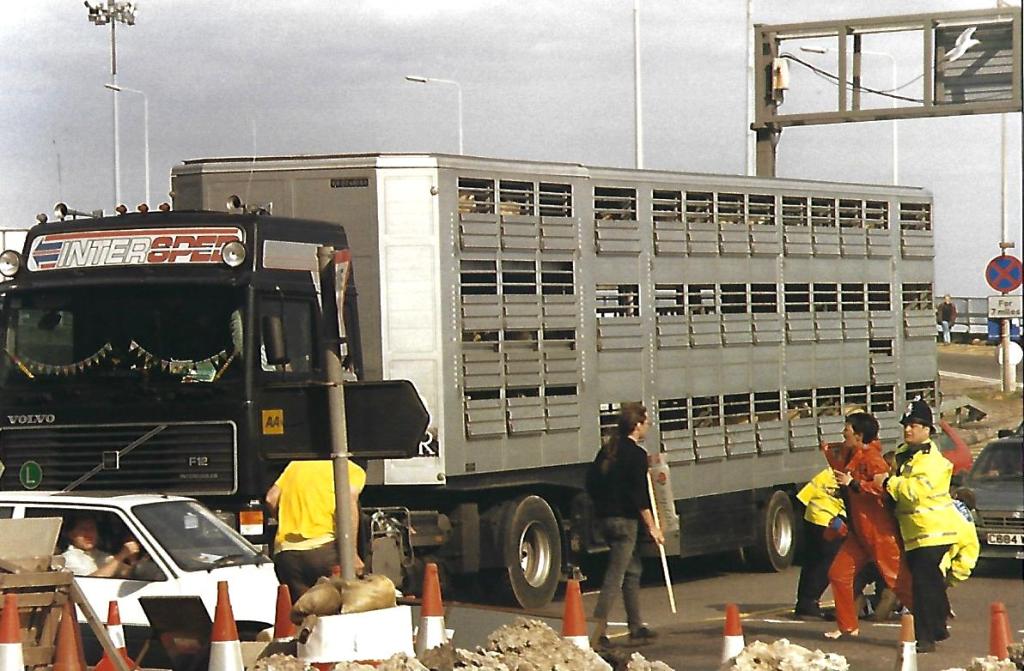
The dithering actions of the Conservative government and possibly opposition parties, means that today, 8/6/22, it is still legally possible for the export of live farmed animals to be undertaken from anywhere in the UK. Exporter individuals such as Mr Onderwater, the Dutch exporter and haulier who has used Ramsgate so often in the past are effectively still legally able to use Kent ports for this sordid trade if they so wish.
Thus, I consider that the Animal Welfare (Kept Animals) Bill needs to be given priority in the new Parliamentary session in order that UK live animal exports can be confined to the history books which is the only place they now deserve. I call on Mr Johnson, Mr Eustace and many other MP’s to give this issue the priority it deserves and get the legislation passed. There are other issues which parliament should be acting on despite heating costs and the price of food; so please look at these other important issues and get the legislation through parliament.
Campaigners against the trade from all over the planet will be taking part and demanding their governments do not just ‘talk the talk’, but actually pass legislation to stop this abhorrent business for once and all. Recent actions on awareness days have seen NGOs and campaigners in over 40 countries – from Brazil, to Australia, to South Korea – global actions have included solidarity marches through Kathmandu, a petition launch in New Zealand and a giant projection on the white cliffs of Dover here in England.
I request the action of Mr Boris Johnson MP; Prime Minister, to live up to his promise of ‘the best is yet to come’; and to thus get the Bill relating to live animal exports passed to prevent future sufferings from here in the UK; hopefully setting a standard to which other nations will adhere.
The UK Government has now signed a trade agreement with Australia – which one can only consider as bad news for British farmers and British animals.
We all saw how Liz Truss MP thought it, the agreement, was the best thing since sliced bread.
But, in its 2019 Election Manifesto, the Conservative party asserted us voters that:
“In ALL of our trade negotiations, we will NOT compromise on OUR high environmental protection, animal welfare and food standards”.
So, possibly you can write and tell me where you Conservatives subsequently went wrong; keeping in mind the following issue on the deal with Australia. Do I need to state:
Australia still allows pigs to be kept in cages during early pregnancy, whilst sow stalls have been illegal in the UK since 1999.
Confining hens in barren cages is still legal; and common in Australia, when the UK banned such systems in 2012.
The use of antibiotics on farm animals is rife in Australia. Australian farmers are known to use up to 16 times as many antibiotics on farms as we use here in the UK.
In Australia, sheep are mutilated every year through ‘mulesing’; a process undertaken on sheep stations, and without anaesthetic for the animals involved, where large chunks of its skin at their rear end, under the tail, are cut away. Please refer to attached pictures and see how abusive this is and the suffering endured by every animal involved – “we will not compromise on animal welfare standards” ! – it looks as if you have failed by not getting Australia to act on this as part of the trade negotiations just as one example.
Around 40% of Australian beef comes from cattle fattened on cruel, intensive feedlots; unlike those systems used in the UK.
Yet the new UK-Australia FTA fails to prohibit imports that don’t meet UK standards. Liz Truss can smile and consider herself good at trade deals; but when it comes to those between the UK and Australia, I personally think otherwise.
Even before tax parries are removed, Australian products like beef and lamb will have huge tariff-free quotas. The latest UN Food and Agriculture Organisation data shows UK imports of Australian beef are currently around 1,600 tonnes a year. In the first year after the FTA is implemented, the tariff free quota on beef alone will be almost 22 times higher than this.
If this deal is ratified by the UK Parliament, higher welfare farming methods used in the UK, when compared to Australia, could immediately be undermined by cheap, factory farmed imports. Remember Conservative promises – “we will not compromise on animal welfare standards”. Cheap factory farmed imports from Australia will encourage low welfare standards and practices to continue over there. These actions by Australian producers will thus put additional pressure on British producers to cut their standards as a result; which begs the question, where will the UK be in relation to very high standards that it always preaches.
The UK – Australia trade deal is a betrayal of us all; and of our high welfare British farmers who have improved standards throughout these islands. Of course, it will be the farm animals that will suffer most as a result of this Conservative policy in which we were all informed by government, “In ALL of our trade negotiations, we will NOT compromise on OUR high environmental protection, animal welfare and food standards”.
As a voter and animal welfare campaigner, I feel the need to inform you that I consider you have already failed in standards with your actions for a FTA with Australia.
Spencer is doing his bit for AAU despite personal health issues; and a donation is the least that can be done is to support him and the wonderful Animal Aid Unlimited (AAU)..
Second; live animal transport is happening the world over; on the road, rail and at sea right now, today, 1/6/22. Everything needs to be done to raise as much publicity about the international live export awareness day on 14/6 as possible. It does not matter where you are in the world, or how big or little a group you represent; just get involved on your patch.
I have personally seen the suffering of this disgusting business for well over 30 years; and now it is time to confine it as a sick chapter in the book of animal history – abuses.
Please support BOTH these asks for help;
Regards Mark (WAV)
Animals Angels.
Recent Live Export IAW – London.
From ‘Compassion In World Farming’ (CIWF) – London.
There’s two weeks to go until our seventh annual Ban Live Exports: International Awareness Day!
After two years of exclusively online events due to restrictions on gatherings, we’re so excited to be back with a rally in London. Will you join us on Tuesday 14th June and show your support for a ban on the live export of animals?
Rally location confirmed
The flagship UK event for Ban Live Exports Day will be at Parliament Square in London from 12.30-2pm on Tuesday 14th June. Join campaigners from far-and-wide as we come together with MPs and special guests to help end this suffering.
How to get involved:
■ Join our London rally and help call on the UK Government to progress the Kept Animals Bill, which would ban live exports from Britain, without further delay. ■If you can’t join us in London, don’t worry. We’ll be livestreaming at the event on our Facebook page so you can watch online. ■Get your banners ready! Download one here, or make your own, to bring to the rally or post a selfie on social media on June 14th with the hashtag #BanLiveExports. ■ Keep your eyes peeled as next month we’ll be launching brand-new actions to demand the UK Government, and the EU, end this cruel trade for good.
Together we can take the next steps towards ending a cruel, outdated, and unnecessary global trade. I look forward to standing with you on June 14th.
Sarah Moyes Senior Campaigns Manager UK
PS: Don’t forget to head over to our Facebook event and let us know if you’re able to join us for this day of action.
Regards Mark
On tour in the Netherlands againstall factory farming.