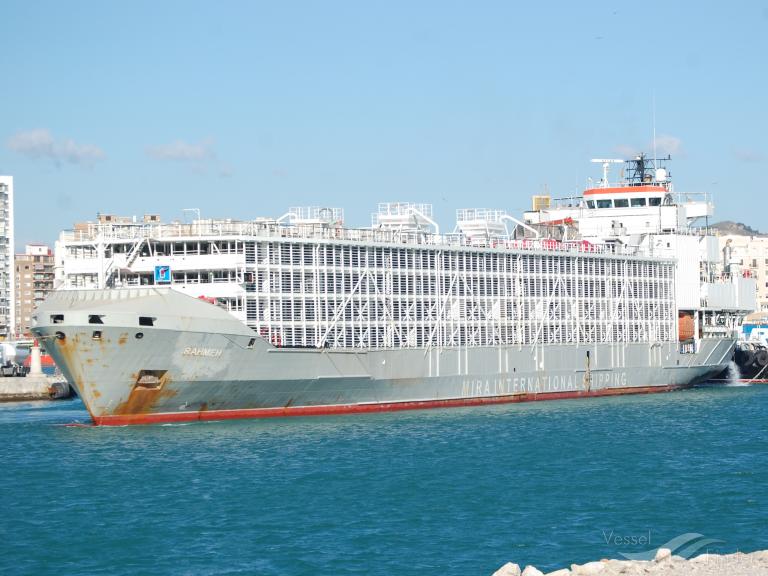
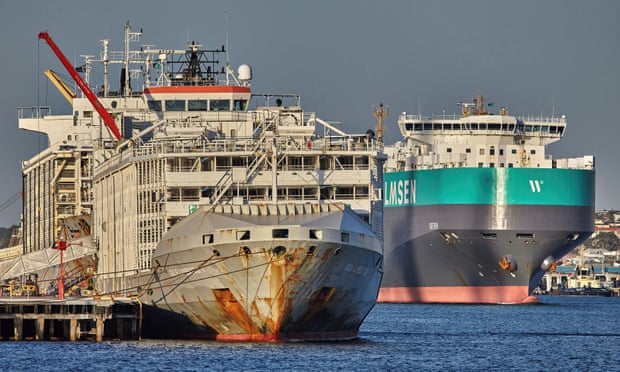
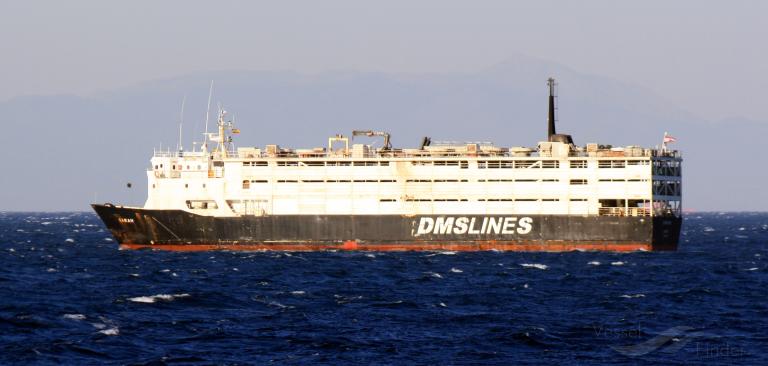
A cargo ship carrying 43 crew and nearly 6,000 cattle sank off Japan after reportedly losing an engine in rough seas caused by Typhoon Maysak, a survivor has said.
The Filipino crew member, named as Sareno Edvarodo, a 45-year-old chief officer, was rescued late on Wednesday after Japanese navy P-3C surveillance aircraft spotted him wearing a life vest and waving while bobbing in the water.
Cargo ship with 43 crew and nearly 6,000 cattle sank off Japan, survivor says | World news | The Guardian
Edvarodo, who was in good health, told rescuers the ship capsized before sinking, said Yuichiro Higashi, a spokesman for the Japanese coast guard’s regional headquarters conducting the search.
The Panamanian-registered vessel, called Gulf Livestock 1, sent the distress call from the East China Sea early on Wednesday, to the west of Amami Oshima Island in south-western Japan, Japanese public broadcaster NHK reported.
According to Edvarodo, the ship lost an engine before it was hit by a wave and capsized, a coastguard spokeswoman said.
Crew were instructed to put on lifejackets as the ship capsized, he said, adding that he had jumped into the water and had not seen any other members of the crew before he was rescued.
The crew comprises 39 Filipinos, two Australians and two New Zealanders, Kyodo news agency said.
The Australian Department of Foreign Affairs and Trade (Dfat) said it was in touch with the families of the two Australians on board.
“The Australian government is providing consular assistance to the families of two Australian crew members on board a cargo vessel reported missing in Japanese waters,” Dfat said.
The cause of the distress was not immediately known, but the weather was rough in the area due to Typhoon Maysak. Strong winds and torrential rain from the typhoon had initially hampered the search operation, but the weather has improved, Higashi said.
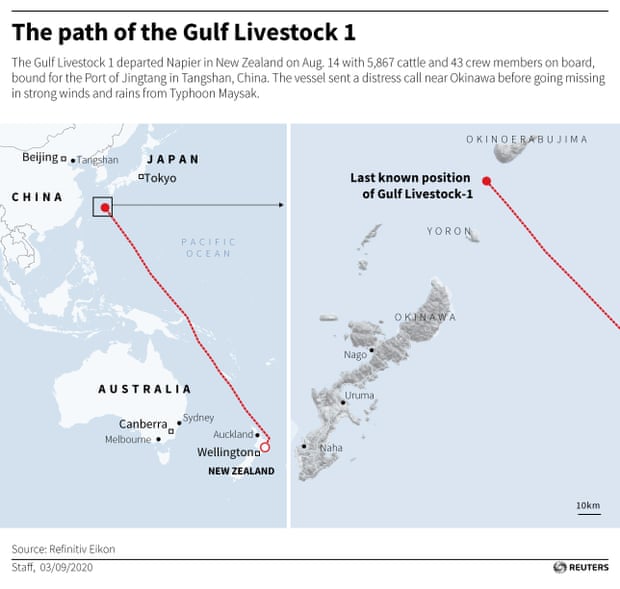
The vessel, owned by Gulf Navigation Holding based in the United Arab Emirates, departed Napier in New Zealand on 14 August with 5,867 cattle on board, New Zealand’s foreign ministry told Reuters.
The vessel was en route to the Port of Jingtang in Tangshan, China, with an estimated journey of approximately 17 days, it said.
New Zealand animal rights organisation SAFE said the tragedy demonstrated the risks of the live animal export trade.
“These cows should never have been at sea,” said campaigns manager Marianne Macdonald.
“This is a real crisis, and our thoughts are with the families of the 43 crew who are missing with the ship. But questions remain, including why this trade is allowed to continue.”
Typhoon Maysak had weakened to a tropical storm as it arrived off the east coast of North Korea on Thursday.
North Korean state TV showed flooding along the eastern coast but there were no immediate reports of casualties.
The country is vulnerable to natural disasters due to its poor infrastructure, with flooding in deforested mountains and hills a particular concern.
Earlier on Thursday, the typhoon had caused brought down trees and caused flooding in parts of South Korea, knocking out power to more than 270,000 homes and leaving at least one person dead.
Reports say the Gulf Livestock 1 issued a distress signal at around 1:20 a.m. local time Wednesday (3/9/20) while around 115 miles west of Amami Oshima Island in southwestern Japan. … The ship is reported to be carrying 43 crew members.19 hours ago
The Japanese Coast Guard is searching for a livestock carrier with 43 crew members on board after a distress signal was sent from the vessel on Wednesday.
Reports say the Gulf Livestock 1 issued a distress signal at around 1:20 a.m. local time Wednesday while around 115 miles west of Amami Oshima Island in southwestern Japan.
The ship is reported to be carrying 43 crew members.
The search is being conducted in the general vicinity of Typhoon Maysak, which was last reported to be packing 130 mph winds, equivalent to a Category 4 hurricane.
The Gulf Livestock 1 was reportedly transporting cattle from Napier, New Zealand to Tangshan, China. The vessel was built in 2002 and registered in Panama. It is owned by Dubai-based Gulf Navigation.
In late July, the Philippine Navy rendered assistance to the Gulf Livestock 1 after it lost propulsion off Balut Island in Southern Philippines. Repairs were eventually completed without incident.
Ship carrying 43 crew and almost 6,000 cattle missing in typhoon off Japan
A ship carrying 43 crew and nearly 6,000 cattle from New Zealand to China has capsized after losing an engine in stormy weather in the East China Sea, the only crew member rescued so far told the Japan Coast Guard (JCG) Thursday.
The Gulf Livestock 1 sent a distress call from west of Amami Oshima island Wednesday as Typhoon Maysak headed through the region towards the Korean peninsula, bringing strong winds, heavy seas and drenching rains.
The JCG said it had rescued one crew member, Sareno Edvarodo, a 45-year-old chief officer from the Philippines, on Wednesday night while searching for the ship.
According to Edvarodo, the ship lost an engine before it was hit by a wave and capsized, a coastguard spokeswoman said.
When the ship capsized, crew were instructed to put on life jackets. Edvarodo told the coastguard he jumped into the water and did not see any other crew members before he was rescued.
Pictures provided by the JCG showed a person in a life jacket being hauled from choppy seas in darkness.
Three vessels, five airplanes and two divers had been deployed to continue the search, the coastguard said.
The crew included 39 people from the Philippines, two from New Zealand and two from Australia, it added.
The Philippines government said it was coordinating with Japan’s coastguard as it searched for the missing crew members ahead of another typhoon expected to hit the area.
Typhoon Haishen was already in the northwest Pacific, tracking through the East China Sea towards South Korea.
At least one person was reported killed in South Korea after Typhoon Maysak made landfall Thursday when strong winds shattered a window in the southern city of Busan.
The Gulf Livestock 1 departed Napier in New Zealand on Aug. 14 with a cargo of 5,867 cattle bound for the Port of Jingtang in Tangshan, China. The journey was expected to take about 17 days, New Zealand’s foreign ministry told Reuters.
New Zealand animal rights organization SAFE said the tragedy demonstrated the risks of the live animal export trade.
“These cows should never have been at sea,” said campaigns manager Marianne Macdonald.
“This is a real crisis, and our thoughts are with the families of the 43 crew who are missing with the ship. But questions remain, including why this trade is allowed to continue.”
Last year, New Zealand’s government launched a review of the country’s live export trade, which was worth around NZ$54 million ($37 million) in 2019, after thousands of animals being exported from New Zealand and Australia died in transit.
A conditional ban on the live export of cattle was one of several options being considered, Agriculture Minister Damien O’Connor said.
WAV Comment – I (Mark) have campaigned against the export of live farm animals now for around 30 years. In the past I have campaigned a lot with Phil L (see Comment in article). At the end of 2020 the UK should be free from the shuackles of the EU – taking back control; which will then allow us (as a nation) to stop live animal exports – something we have not been able to do all the time a member state of the EU. I just hope other EU membvber states follow the UK in getting out of this dinosaur which ignores all the evidence as far as live animal transport is concerned.
Ottawa, Canada — The International Vegan Film Festival will be doing something entirely new for its third annual event. It’s going virtual.
The 2020 Festival will take place online with digital screenings, panels, filmmaker Q&As and more from October 10th – 17th. The event will take place on the Eventive platform with the full schedule of event and ticket information being released in mid-September on the Festival website.
Founded in 2018, The International Vegan Film Festival is the world’s premier vegan film festival, dedicated to celebrating the vegan ideal: a healthier, compassionate, environmentally-friendly lifestyle that can be achieved through the consumption of plants and animal-free alternatives.
“Like many other live events around the world, we’ve had to adapt to prioritize the safety, comfort and well-being of our community,” said Festival Executive Director, Shawn Stratton.
The full list of films playing in the festival will be available in late September. Below are a few of the films that will be included:
Regan Russell – A Short Documentary
On the morning of June 19, 2020, Regan Russell was outside Fearmans slaughterhouse in Burlington, Ontario for a special vigil to give water to thirsty, dehydrated pigs when a pig transport truck drove right into her and dragged her body for more than 15 meters. This documentary showcases Regan’s young life, her involvement in animal rights, her last day of activism, and the aftermath of her death.
Butenland
The story of a former dairy farmer, an animal rights activist and the first cow retirement home.
A farm that has become a farm for life – the former dairy farmer Jan Gerdes and the animal welfare activist Karin Mück have created a place with their project Hof Butenland where there are no more livestock: a peaceful coexistence that seems almost utopian.
INVISIBLE
INVISIBLE is a short film exploring a dangerous and secret world that has never before been documented. Following undercover investigators ‘Sarah’ and ‘Emily’ (their names have been changed to protect their identities) on an investigation at a pig farm in Europe, INVISIBLE grants the viewer unprecedented access to a world that is deliberately and painstakingly covert.
Stratton said that “this year has given us an opportunity to think creatively about how we can make the festival more accessible and innovative than ever before, and we are excited to deliver a memorable experience that honors all the reasons we’ve become known as the premier event for vegan-themed content creators and film enthusiasts.”
This year’s fest still promises to highlight more short and feature-length films than ever. The full program and lineup will be released next month. It’s also planning “virtual social opportunities” to facilitate discussions between filmmakers and audience members.
“One of the reasons I started the International Vegan Film Festival was to help people discover outstanding vegan-themed films they have not heard of before or may never had an opportunity to see. I also wanted to give vegan themed filmmakers another platform to highlight their work to more audiences. You can discover and re-discover the enormous positive impact becoming vegan can have on health, farmed animals, and the environment through the film festival. With the festival now going online, we are making it even easier for people to discover these outstanding films.”
Judges
The Festival judging panel includes a who’s-who of the vegan world, including Miyoko Schinner, the founder of Miyoko’s Creamery, Dale Vince, CEO of Ecotricity—the UK’s first and largest green energy provider—and owner of the all-vegan Forest Green Rovers football club, as well as David Flynn, one of the twin brothers behind Irelands vegan ‘foodie empire’ Happy Pear.
As well, Seth Tibbott, the founder and Chairman of The Tofurky Company and author of In Search of the Wild Tofurky, has recently agreed to join this year’s IVFFF Photo Essay Contest judging panel.
Vegan Photo Essay Contest – submissions close Aug 31, 2020
Aside from the film festival, they also put on other initiatives such as a virtual screening in partnership with We Animals, and a Photo Essay to showcase creativity amongst professional and amateur photographers. Until August 31, 2020, applicants can submit a series of 3-5 images depicting vegan lifestyle, health and nutrition, animal welfare, or environmental protection. Winners will be announced during the festival in October and will also receive a $250 CAD cash prize.The jury is seeking a sequence of images that conveys a compelling story or message – with each image strong enough to stand on its own while conveying a greater narrative when viewed in the photographer’s desired sequence.
Stratton says, “The Vegan Photo Essay Contest is a great way for anyone with a camera and a story, not just professionals, to be involved in the festival.” The contest even has a Youth category to encourage young people to become more involved in sharing vegan themed stories.
Take PETA’s Cruelty-Free Shopping Guide along with you next time you head to the store! The handy guide will help you find humane products at a glance. Order a FREE copyHERE
Searching for Cruelty-Free Cosmetics, Personal-Care Products, Vegan Products, or more? Click HERE to search.
Want to do more than go vegan? Help others to do so! Click below for nominal, or no, fees to vegan literature that you can use to convince others that veganism is the only compassionate route to being an animal friend:
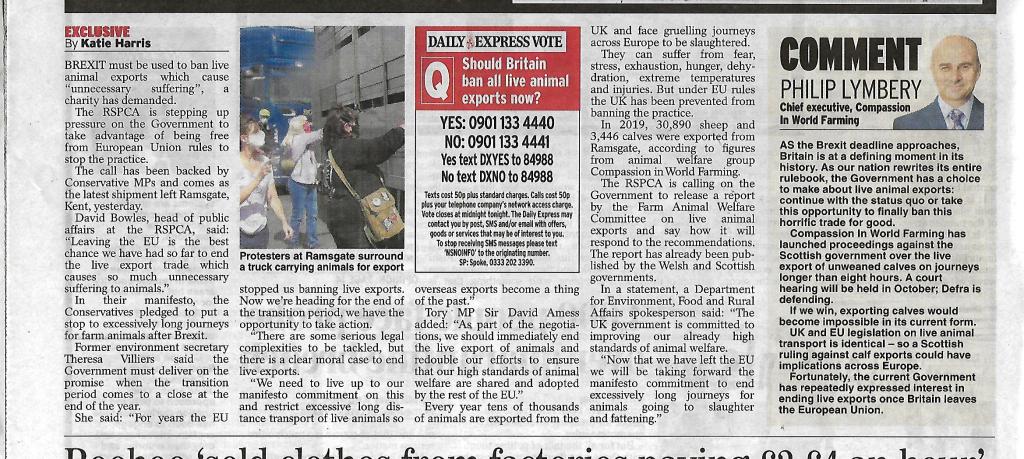
We have never been fans of Phil Hogan – he is pro live animal exports and as the ex Agriculture Commissioner at the EU; disregarded anything that the EU Parliament did with regard to amending live animal transport regulations.
Bye Phil – take a well deserved and very very long hike – you have never done any animal any favors and as far as we are concerned you have now got your just rewards.
We are only sorry that it took so long for people like you to get hit.
We are sure that all the animals will be rejoicing along with us at the news today.
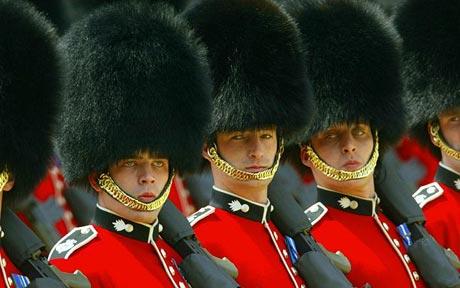
This is an issue which has been a ‘battleground’ for UK animal campaigners and the official British government Defence Ministry for many years. As an animal activist; I have been involved with this in the past as I feel the use of bearskin is completely unnecessary now days; and has been for many years.
If London soldiers (and others) have to parade around in furry hats; then let them; fine; I have no objection to that; but all I say is that with the progress in faux fur over the years; there is no need now for real bearskins to be used in a soldiers hat. The wearing of bearskin caps goes way back to 1815 when the British fought at Waterloo; have we not moved on a bit since then ? – over 200 years later ?
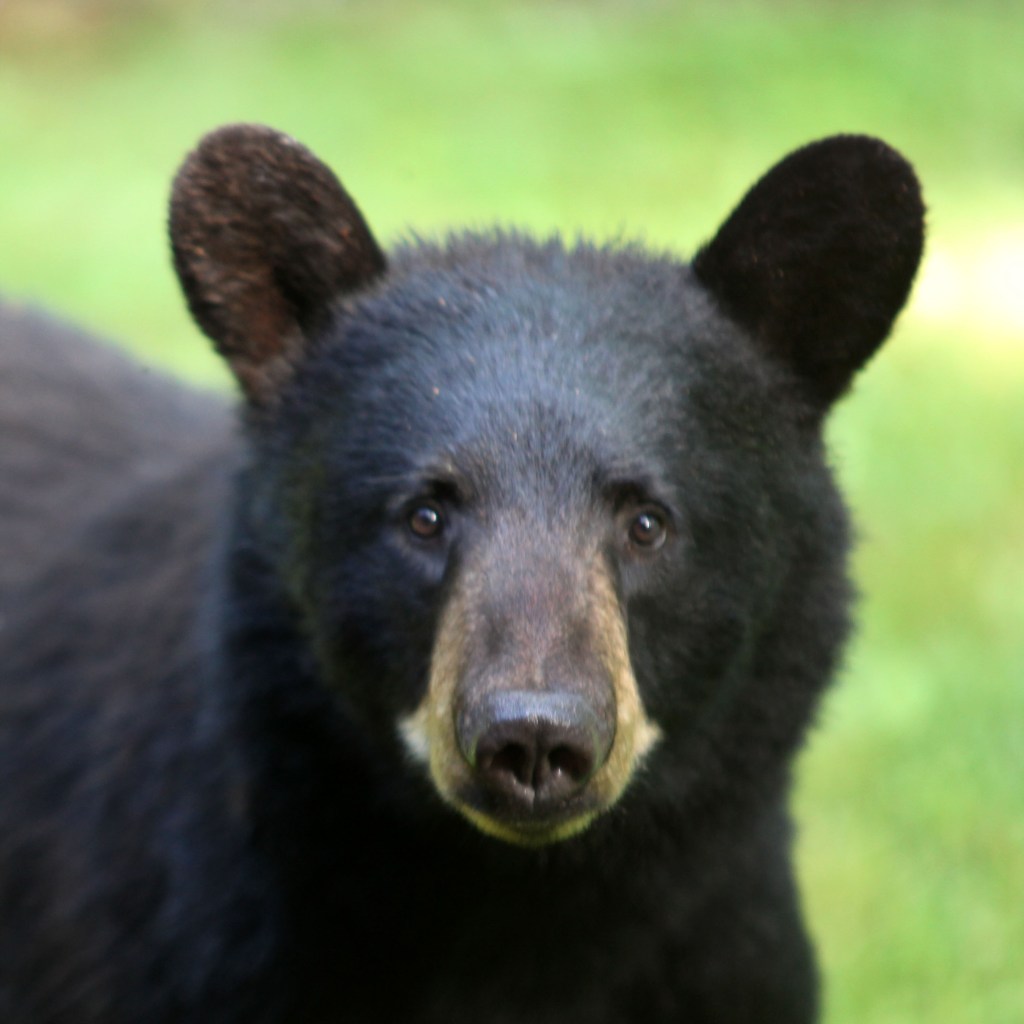
I have argued the case for a ban on real bearskin with my MP in the distant past; and have always had the reply of ‘indigenous peoples need to get the skins’ as (in my opinion) an excuse for the unnecessary killing of bears. That is what it comes down to – the slaughter of bears to make hats – it is unnecessary in 2020 as there are a lot of options available that do not involve any cruelty.
Fur farming was banned in the UK some 20 years ago; and we as Brits are well proud of that. Tribute must go to Mark and the team at ‘Respect for Animals’ who undertook a fantastic campaign to achieve this. His work continues everywhere – find out more at http://www.respectforanimals.org/
From what we now understand, once the UK has finally left the EU next year (2021) and is not bound by single market (EU) rules; new legislation could be introduced (in the UK) to ban the use of real bearskin in the guards hats. It may seem a bit confusing – the UK formally left the EU at the start of 2020; but it is now in a ‘transition period’ (during 2020) with the EU where trade deals are going to be negotiated and set. This is to allow trade between the UK and the EU; so at the moment, despite leaving the EU, the UK cannot really introduce its own legislation; free from the rules of the EU, until new trade negotiations are completed this year (2020). Issues like animal welfare are included in the negotiations; and with higher, good welfare standards than in some places within the EU; UK activists do not want to see the UK lowering standards to those of some EU nations with issues such as intensive farming and fur.
Very recently; the UK government DEFRA; (Department for Food, the Environment and Regional Affairs) confirmed a sale ban which could raise standards (laws) further with regards fur products by the introduction of new laws; once the UK is completely free in 2021. The ban could affect both new and vintage coats, and also see shops selling decades old furs from being sold. Many areas in London are already not selling any fur products; a move which we welcome.
DEFRA said in their statement: “the UK has some of the highest welfare standards in the world and this is both a source of pride and a clear reflection of British attitudes towards animals. Fur farming has been banned in this country (UK) for nearly 20 years, and at the end of the transition period we will be able to properly consider steps to raise (our) standards even further. This is something that the Government is very keen to do”.
We at WAV would also include here the issue of live animal exports. Under current EU rules, the UK cannot introduce an individual state ban on live animal export; but this will be possible in 2021; post trade negotiations; when the UK is free from the shackles of the EU and can make its own legislations. In 2021 we are hoping that with campaign pressure and the vast majority wish of the British people voicing opinion against live export, the UK government will ban the export of live animals to Europe by (primarily) the Dutch and that the UK will formally stop this disgusting trade in sentient beings that we have been directly involved with for decades.
Read more on the Dutch association with UK live animal exports here:
Back to bearskin hats for soldiers. It is thought that the British Army purchases between 50 and 100 skins each year.; at a cost of around £650 per skin. HIS UK which is being consulted on the issue, stated that there could be ‘pragmatic exemptions’ from outdated fur being worn; such as with hats already in use by the military. But any ban on fur could apply under normal circumstances to charity shops, vintage fashion shops, anything in fact both on the high street or online which relates to fur.
Plans should take place in 2021 to have consultations on the issue; with an opportunity for both business and the general public to have their say. Even now, 81 MP’s and over 750,000 Britons support a ban on the sale of fur. Through effective and educational campaigning; the AR movement and organisations such as ‘Respect for Animals’ have won in the desperate attempt by the fur industry to withdraw itself from the animal suffering and grim truth that we all see regarding fur and fur farming.
Mark at WAV says – you cannot meet the complex behavioural and biological requirements of highly active and highly inquisitive animals such as mink, foxes and raccoon dogs by keeping them in the utmost deplorable conditions which we have all seen and posted about regarding fur farms. It is a simple fact; no amount of any PR spin by the fur industry and the animal killers will change that. A fur ban is not simply a fur wearing ban; it is about the saving of and the sparing of millions of animals the excruciating torment of confined life on a fur farm. It is time for the UK government to acknowledge the very strong British public opinion that any trade in the fur industry is cruel and unacceptable. It is time for a complete ban in every way as soon as the chance arises in 2021.
But until the UK officially leaves the EU on 31st December 2020, it cannot implement a unilateral ben on the fur trade and all its associated products. We understand that any new / future law would need most importantly to protect animal welfare, and that a draft government Bill / documentation on the fur ban has already been produced by HIS UK with the government. Meetings to date between parties have been described as ‘productive’.
A spokesperson for the British Fur Trade Association has said that ‘it beggars belief that in the middle of a pandemic and a recession, the government is secretly working on plans to ban the fur in people’s wardrobes. He went on declaring that fur is a natural and sustainable product that comes from highly regulated (??) and humane (???) sources which have increased sales by over 200% in recent years due to their ‘popularity’. Also declaring that the government needs to reject the pressure being exerted by ‘animal rights groups’ and instead focus on issues that actually matter to people !
So, no win for either at the moment; although it seems very much like the UK is coming out on the side of fur bearing animals. We at WAV fully support this approach. and we look forward very much to 2021 for many reasons. If we get a full fur ban in every way in the UK, and also stop by law the export of live animal exports, then things are moving on positively big time.
The government has a choice; it listens and acts on behalf of the people, or the people throw them out when they have the chance. A simple choice; and we hope they listen to the wishes of the vast majority of the British people.
Mark, you don’t need to read this news article — it contains distressing content. But I wanted to make sure you were aware of it and to seek your help once again, to apply strategic pressure where animals need it most right now (details below).
We secured this major media story in the Sydney Morning Herald today — exposing brutal treatment to cattle that should have been wiped out of the live export industry nine years ago.
You’d be forgiven for thinking that this image was from our 2011 live export investigation in Indonesia. The sad reality is that it was captured just two weeks ago in Aceh, on the island of Sumatra.
Having witnessed first-hand the distress caused by these awful slaughter boxes — installed by Australian industry officials — it’s been deeply disturbing to see them still being used — and in complete defiance of Australian live export laws.
Perhaps most alarming is that the cattle being brutalised in this footage are going through Australian approved and audited slaughterhouses — exposing an auditing and monitoring system that is failing.
And once again, had this appalling situation not been reported by Animals Australia, it would still be continuing.
One of the great flaws of the regulatory system put in place after our investigations in Indonesia is that ‘approved’ slaughterhouses can still allow brutal methods of slaughter — such as sledgehammering or the use of cruel restraint boxes — as long as Australian animals are killed via other means.
Putting aside that no animal — be they Australian or otherwise — should be subjected to such brutality, it’s absurd to expect that these rules be followed night after night or for anyone to trust that they will be when there is no independent oversight inside these facilities.
And we’ve just seen again in Indonesia, the most graphic example of what happens when Australia’s live export industry is left to its own devices.
Animals Australia has lodged a legal complaint and we believe the offending exporter should be stripped of their licence. But in addition, we are calling for CCTV cameras to be introduced into all facilities that handle and kill Australian animals overseas — and importantly, for the live export regulator to have access to live feeds.
Animals are at greatest risk in this trade when exporters think nobody is watching.
Mark, I know that like us, you just want this trade to end. But while it remains legal, we need to push for every possible additional protection we can get. And independently monitored CCTV cameras would add a layer of scrutiny that animals desperately need right now.
The best chance we have of the Minister and the regulator taking notice of this very reasonable request is if they’re feeling pressure from Federal MPs — the very politicians who exist to represent you — many of whom by all accounts, are just as fed up with this industry as we are. So please take a few minutes to contact your MP now — you can find their details here.
[You’ll note that ordinarily we provide a template letter to make it as efficient as possible for you to take action for animals. And thousands of people did that last week — if you were one, thank you! But in this case, your message will carry the greatest weight if you write it yourself. It doesn’t need to be long — just note this latest case of live export cruelty and demand independently monitored CCTV cameras to be installed in all places that import Australian animals, and for licence cancellations for exporters who break the rules].
Exhausted, lying helpless on the scorching road and about to be stuffed alive into a car boot. She is one of thousands of Australian sheep we found being offered for illegal sale and slaughter across Jordan during the recent ‘Festival of Sacrifice’. And, sadly, in Indonesia, we discovered and documented the unthinkable occurring again…
Now we need your help to call for the Australian exporters responsible to be stripped of their licences.
Mark, when Australia’s live export industry ignores regulations, it makes an inherently cruel industry even crueller. Which is why I am so very grateful for your generosity and support which ensured our team of investigators were exactly where animals needed them to be.
Evidence gathered during our latest investigations reveals widespread breaches of Australia’s live export laws, with sheep and cattle being subjected to cruelties that the industry has long promised had been wiped out.
Exporters would have been banking on COVID-19 restricting our ability to monitor their activities, but, as ever, they underestimated the commitment of our supporters and the courage of our investigators. Thanks to you we were able to gather the evidence to lodge legal complaints and we will do all we can to hold those responsible to account.
Here’s just a snapshot of the media confirming a ‘regulatory system’ in complete disarray:
Perhaps our most shocking discovery in recent days is that some Australian cattle exported to Indonesia were still being killed in brutal slaughter boxes that were banned after our landmark investigation in 2011.
In these Australian government-approved — and industry-audited — slaughterhouses, animals were also being subjected to horrific roping slaughter. This is another outlawed practice that sees frightened animals pulled and tripped onto their sides before having their throats cut while fully conscious.
Mark, if live exporters thought a global pandemic would hamper our investigations, they were wrong. If they thought restricted international travel this year would provide them with a protective shield in importing countries, they were also wrong.
Thanks to your support, our dedicated team of local investigators were there for animals in the most difficult of circumstances this year. Our promise to you, to them — and to the animals — is that we’ll use this evidence to push for the strongest possible action. Please take a moment to add your voice to these calls here.
Mark, having been in Indonesia in 2011 as well as in the Middle East on countless occasions witnessing what animals endure, I know you will also be thinking, ‘when will this end’?
All I can say to you is that a day will come when this industry will be no more. And when that day comes you will know that it was your compassion for these animals, and your commitment to stay the course with us, that was a key reason why.
From the bottom of my heart, thank you for enabling us to be there for animals.
With my deepest thanks,
Lyn White AM Investigations Director
P.S. Our investigators working across eight countries also gathered evidence that will fuel our efforts to end live export from Europe and South America. We’ll be working with our international team to maximise outcomes for all of the victims of this global trade in animal cruelty, thanks to you.
What with the Panama registered livestock ship (Sarah M) operating for Irish exporters taking Irish cattle to Libya; and the environmental disaster today relating to a ‘Japanese owned’ but Panama registered tanker “Wakashio”, causing environmental havoc in Mauritius, I decided to look into ‘Panama and shipping’ a little more.
With great help from the BBC in London, here is what was found.
Panama is a small nation of approximately three million, yet it has the largest shipping fleet in the world, greater than those of the US and China combined.
Thanks to its location and slender shape, Panama enjoys a position as the guardian of one of the world’s most important marine trade routes, which connects the Pacific and Atlantic oceans.
Cheaper foreign labour
Most merchant ships flying Panama’s flag belong to foreign owners wishing to avoid the stricter marine regulations imposed by their own countries.
Panama operates what is known as an open registry. Its flag offers the advantages of easier registration (often online) and the ability to employ cheaper foreign labour. Furthermore the foreign owners pay NO income taxes.
About 8,600 ships fly the Panamanian flag. By comparison, the US has around 3,400 registered vessels and China just over 3,700.
Under international law, every merchant ship must be registered with a country, known as its flag state.
That country has jurisdiction over the vessel and is responsible for inspecting that it is safe to sail and to check on the crew’s working conditions.
Open registries, sometimes referred to pejoratively as flags of convenience, have been contentious from the start.
By last year, almost three quarters of the world’s fleet was registered under a flag of a country other than its own.
The registry is lucrative for Panama, bringing in half a billion dollars for the economy in fees, services and taxes.
However, critics of the system point to the ease of hiding the true identity of shipowners and the lax enforcement of rules and regulations.
Luis Fruto, representative of the International Transport Workers’ Federation (ITF) in Panama, says the country turns a blind eye to its “responsibilities in order to acquire higher registration”.
The ITF has led a campaign against flags of convenience since 1958. It considers that Panamanian registration is better than some “from a safety viewpoint, but it remains seriously flawed in areas such as oversight, accident investigation and crew assistance”.
Two years ago, Mr Fruto investigated the death of a woman sailor, 22, on her first voyage. She became trapped in machinery that was reportedly faulty and died.
The ITF says that, rather than heading for the nearest port as rules dictate, the ship continued to sail for more than two weeks with her body in a freezer.
Further investigation by the ITF suggested that some of the shipping certificates had been bought.
International legal requirements insist that countries operating open registries inspect vessels, comply with international regulations and investigate accidents and corruption.
But critics say that Panama cuts corners in all these tasks, putting maritime workers at risk.
Indeed, accidents involving Panamanian-registered ships are high.
In 2000, ITF general secretary David Cockroft was able to buy a Panamanian first officer’s certificate for $4,000 to navigate a ship – even though he had no maritime skills or experience.
Despite repeated assurances that the country was cleaning up its act, Roberto Linares, the head of the Panama Maritime Authority, resigned in June after it was discovered that workers were being certified without the proper qualifications.
“Panama’s registry will last for ever,” said Jorge Luis Sanchez, professor at the International Maritime University of Panama. “Those who don’t like the open registry can opt to do something else with their ships.”
Jazmina Rovi, former director of the Panama Maritime Law Association, said unions are better off enforcing uniform standards than eliminating the registry altogether.
With the new maritime administrator sworn in last month, it remains to be seen whether Panama will crack down on corruption and safety breaches or continue to live with the taint that still clings to flags of convenience.
We (WAV) doubt that the crew operating the Panamanian registered livestock vessel ‘Sarah M’ are that familiar with the EU Regulation 1/2005 on the protection and welfare of animals in transport. Thus, one has to ask if the Irish operators of the Libyan consignment; the Purcell Brothers and Curzon Livestock. have concerns about animal welfare; or is it simply a case of getting the cheapest deal possible to operate a shipping vessel to carry livestock at any cost – and that is to find one registered in Panama ?