Time and again, we are disappointed, and frustrated, and gobsmacked by what this industry is allowed to get away with. Unfortunately, the Government (and the very elected politicians who fought for those basic safeguards) backflip whenever the carrot of live exporter profits follows the stick of animal cruelty.
But there are some silver linings to this dark cloud.
Every incident that happens, and every action you take, is another chip away at this industry, adding to its horror public track record, of decades of repeated evidence of suffering and cruelty.
We had a measure of success in the northern summer ban, a measure we could not possibly have foreseen before the notorious Awassi Express journeys of 2017 blasted a long-overdue spotlight on the routine heat stress, suffering and death this industry was willing to inflict upon Australian sheep.
There were no plans or intentions to include an independent observer on this ship, but thanks to your efforts, there is one on board now. With your support, we wrote to politicians to urge attention to this issue, we kept phoning and emailing the department, and we saw multiple people speaking out in favour of our call (including the WA Premier himself).
While we sadly weren’t able to stop the ship from leaving, at least there’s someone on board now who can record the consequences of this absurd decision. We’ll be keenly awaiting their reports, images and video evidence.
And now we can also let you know that we’ve submitted a formal animal welfare complaint to the West Australian Government. The evidence of the suffering these sheep are likely to endure is overwhelming, and we believe it may be in breach of WA’s animal protection legislation.
This ship should never have been allowed to leave.
This has been an extraordinary chain of actions and decisions by the regulator, and we will continue to work over the coming weeks and months to find out how it has unfolded and to ensure it can never happen again.
Finally, regardless of the outcome for this shipment, we believe that – much like those five disastrous journeys of the Awassi Express in 2017 – this latest debacle may be a turning point for this disaster-plagued industry.
The failure of the federal government to uphold even its own regulations, despite its knowledge of the dangers;
The failure of live exporters to adhere to their own promised moratorium, introduced as a last-ditch measure to avoid a total ban;
And the strange chain of events that led to this surprise exemption decision, may prove to be the final blow to any remaining public trust or confidence in the industry or the regulators.
Industries cannot survive without community support, and the RSPCA believes this latest live export fiasco is likely to have significant long-term consequences for the industry, and may in fact expedite the inevitable end to live sheep exports.
As with Animals Australia, the RSPCA Australia, and (here) the crew at Stop Live Exports.org, we are united in our support for everyone who is fighting this disgusting trade in sentient beings.
Below; in ‘What to do now’; SLE have given a series of things which you can do to follow up the Al Kuwait shipment which took place yesterday. The vast majority of good people are against the abusers who undertake this business; and they know public opinion is against them vastly.
We currently are still fighting live animal exports here within the EU and there is also the case of live calves being exported by the Scottish, via the English port of Ramsgate.
Decent people around the world are wholeheartedly against this abusive trade in live animals. We are proud to be pert of the team and do what we can to support the innocent animals that need us more than ever.
Please take actions as detailed in the ‘what to do now’ links below. Phone, e mail, anything, but please do something. The sheep are on the way to terrible deaths in a foreign land now; and sadly there is nothing much which can now be done to help them. But politics is politics; and politicians need your votes and your support. Please don’t support any political parties or politicians who support this trade – and let them know it ! – they can run but they cannot hide. They will always be remembered as abusive supporters of an abusive trade. Get them our of their positions; and soon.
Regards Mark
Dear Mark;
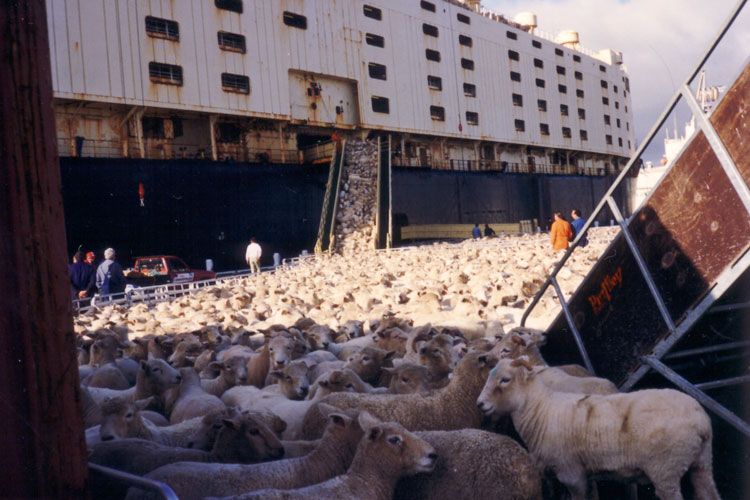
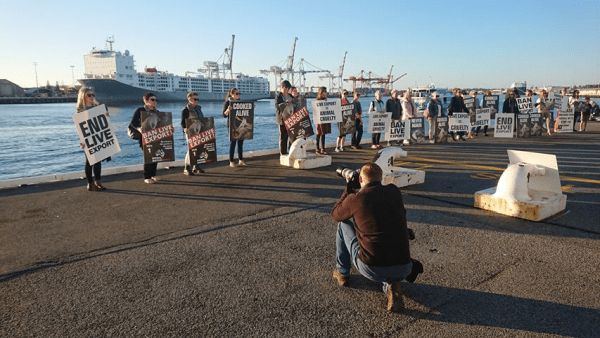
As you may or may not be aware, we held a flash protest down at the port yesterday evening as the Al Kuwait loaded 35,000 sheep bound for Kuwait, 17 days after the 1 June deadline. If you were able to make it down there to join us, thank you. If the notice was too short or you didn’t hear about it (or you’re in another state or territory), we’re sorry – due to the CoViD19 restrictions, we had to apply for a police permit and were also awaiting the results fo Animals Australia’s federal court action to apply for an injunction to stop the ship loading.
All pictures – Renee Denys
On 2 June, an exemption to the Northern Summer Trade moratorium was denied to Emanuel Exports’ sister company, Rural Export & Trading WA (RETWA), by Tina Hutchence, Assistant Secretary to the Live Export branch of the federal Department of Agriculture (the branch that acts as the “Independent” Regulator of the trade). A second application was received by RETWA, and on Saturday 13 June, an exemption was granted by David Hazlehurst, Deputy Secretary of the federal Department of Agriculture, Water and the Environment (DAWE).
How this all came about and the legislation and rules for exemptions is a long and convoluted story I won’t go into here, but needless to say, the federal government legislated the northern summer ban to offer some protection to sheep being sent into the Middle East, with a ban on shipping sheep there from 1 June to 14 September inclusive. They then proved that legislation useless, by granting an exemption to RETWA’s parent company, Kuwaiti Livestock Transport & Trading (KLTT), despite there being no exceptional circumstances to merit such an exemption.
WHAT TO DO NOW ?
At the rally, we asked you to do six things:
1/ Email Tina Hutchison who denied the exemption, and say THANK YOU for upholding the legislation and looking after the welfare of the sheep by denying the original application for an exemption:
tina.hutchison@agriculture.gov.au
2/ Email David Hazlehurst and let him know what you think of his decision, and what a mockery it has made for the Summer Trade Ban Order 2020. Be firm, honest, but please do not use threats or physical violence or resort to name-calling.
35,000 sheep will be heading out of 21 degrees Fremantle and into 45+ degree Kuwait to have their throats cut whilst fully conscious after it had already been found ELEVEN days ago that exporting them after the deadline posed significant risks to their welfare:
david.hazlehurst@agriculture.gov.au
3/ Have a chat with David Littleproud. Whilst it was his decision to grant the exemption, and it was under his watch the more restrictions to the trade were introduced, we feel he should know how the public feels about this horrendous decision by the Deputy Secretary:
Parliamentary Office: (02) 6277 7190
David.Littleproud.MP@aph.gov.au
He also has THREE electoral offices in Queensland:
(07) 46622715
(07) 4622 7166
(07) 4661 2494
4/ Email the CEO of the Australian Livestock Exporters Council (ALEC), Mark Harvey-Sutton.
ceo@livexcouncil.com.au
Tell him to get a real job that doesn’t involve subjecting animals to pain and suffering.
5/ Leave feedback on the DAWE website. Oops – that page has been removed since this yesterday… we wonder if the phone number still works. Call 1800 900 090
6/ Contact your local federal MP and all 12 WA Senators (or Senators in your state or territory). Go HERE,
scroll down and enter your postcode. That will bring up your local MP and all your Senators – click on the email icon, or call them if you prefer that.
Let them know what you think – they are elected to represent YOU.
Thank you for your ongoing support, and if you are not a member or donor yet, you can make a one-off, weekly, monthly, quarterly or annual donation via GiveNow by credit card or direct debit and the fees are about 1/10 of PayPal. Regular small donations are of the greatest assistance to our campaign. Any donation over $25 in a year counts as membership and we’ll send you some stickers if you’re a new member.
A HUGE thank you to everyone who has donated or taken action in response to our legal fight against the export of young calves from Scotland.
The court hearing for our Judicial Review has now been set for 4th August. But, yesterday,
The Scottish Government applied for a delay.
We want to stop animals suffering NOW. So we’ve submitted an objection to this outrageous attempt to play for time – and the court may decide for or against a delay in the next few days.
In the meantime, let’s keep up the fight for justice for calves. If you haven’t already done so, please take action here.
URGENT – Take action now and e mail the Scottish Government:
Thank you to everyone whotook a stand on Sunday for the 5th annual International Awareness Day against live exports. Not least to Compassion’s fantastic patron and stalwart animal welfare campaigner, Peter Egan, who led our UK day of action.
Social media was awash with #BanLiveExports, and policy makers around the globe felt the heat of public opinion against this appalling trade. See how the world united for animals on 14th June.
A DAMNING REPORT ON EU LIVE EXPORTS…
In a new report about the export of EU animals by sea, the European Commission documents sub-standard vessels, inadequate checks on ships and poor legal accountability. It also identifies illegally high temperatures in trucks, and under-reporting of animals who are unfit to travel.
Compassion, and other NGOs, have been raising these concerns for years. Now, finally, the Commission has acknowledged that this trade is failing to protect animals. Find out more here.
… AND PRESSURE IS BUILDING
40 MEPs have now joined Compassion and over 35 other NGOs to campaign for an immediate halt to EU live exports during the COVID-19 pandemic.
Meanwhile, due to concerns about legal compliance, the Dutch Agriculture Minister has stopped all live exports where a 24-hour rest stop outside the EU is required. Exports will only restart if transporters can guarantee animals will be rested.
This follows persistent campaigning by CIWF Netherlands and other organisations. It sets an important precedent, and adds to the pressure for urgent European Commission action against live exports.
WAV Comment – money before welfare – a global problem.. We stand with Animals Australia throughout in their fight to speak up for those who have no voice. Lets hope the Australian elections are very soon.
Mark, I so wish I was contacting you with better news…
Despite the extraordinary efforts of our legal team, who worked day and night over the past three days, we were unable to get the exemption granted to ship 50,000 sheep to Kuwait overturned by the Federal court.
I know how you will be feeling at this news. The deepest sense of injustice, of betrayal. The northern summer ban that was introduced to ensure exporter interests were never again put before the welfare of animals, has failed at its first test.
As you know, commitments were made, only to be broken. Laws enacted, only to see exemptions granted to those laws. Sheep who should be spared, will now be shipped into the extreme heat of a Middle East summer.
I’m sure you may be wondering, how did things go so fundamentally wrong? The answer to that question will start a conversation that animals desperately need us to have.
It would be easy to blame the regulator or the government or the exporter — but their actions are based on and influenced by one underlying factor — a legal system that denies animals raised for food the same compassion, moral consideration and legal protection as other animals in human care.
As a result, vulnerable beings who feel fear and pain are decreed property, items to trade, lives to be bought and bartered, warm bodies to be brutalised.
This cannot be allowed to continue. For when profits have the power to impair our compassion — it is not only animals who suffer, our own humanity is violated and diminished.
Throughout history there have been ‘moments in time’; occurrences that are so at odds with our truth, with our humanity, with our potential, that we are forced to look within and ask, ‘how did we come to this place?’ Inevitably, the answers sought and found fuelled needed transformation.
Let us commit to making the decision to grant this exemption and ship these sheep to Kuwait one of these ‘moments in time’. Let it be the catalyst for a conversation that as a society we need to have — as to how deeply and profoundly programmed we are to think about animals raised for food differently — and the consequences animals bear as a result.
These sheep were not considered by authorities for who they are — vulnerable beings whose well-being is dependent on human kindness and consideration. They became numbers on applications and on spread sheets.
In the granting of this exemption, we will never see a more striking example of the legacy of an inherited belief system that deems animals who are eaten as less deserving of our care and protection.
My commitment to these animals and to you today Mark, is to work even harder to create the shift in human thinking needed to bring all animals into our circle of compassion.
While today has been a difficult day, it makes me ever more grateful for your faith and support, for your presence in this world, and for the compassion and kindness that resides in your heart.
We can and will pave that pathway to a kinder world together.
I (Mark) have personally been involved with live calf exports from the UK for around the past 30 years. You can see more about this at https://serbiananimalsvoice.com/about-us/
Like ALL live animal exports it is a disgusting trade which is operated by people who are even more disgusting. Ten years ago I produced a formal report on the calf trade from the UK to Europe, which you can review via the above link.
Here is the link to just one of the undercover investigations taken at that time; and which formed one part of the investigation report which was presented to the EU. As you can see; clear evidence that the ‘rules’ for ‘protecting’ the calves was being blatantly ignored; information which was presented to the EU, who; as always; did nothing about it.
Nothing much has changed ten years later; the EU disregards all the evidence presented to them, whilst drumming on about how good they are for ‘welfare’. Don’t believe it; they are useless and will do whatever they can to delay and postpone making changes that are beneficial to the animals. For the EU the facts are simple; it is financial gain well ahead of animal welfare; despite all the yukspeak that comes from their lips.
We battled at Dover to stop the calf exports for so long; wonderful people fighting at the right, compassionate end of the cause; I was glad to know them all and to be able to call them all true friends; and to be united in fighting the disgusting trade of animal abuse. More recently (as you can read in the article); the calf trade changed from Dover just round the coast to Ramsgate. It has been operated there by a Dutchman named ‘Onderwater’; who operates an ex Soviet battle tank carrier called the ‘Joline’ to get the animals across to the port of Calais in France; from where they continue their miserable journey South within Europe.
Here is a picture of the Joline – ex Soviet battle tank carrier now turned into a live animal transport ship !
When we get news about the Scottish court case you will be the first to hear. I want this to be a welfare victory for so many reasons; I cannot even start to describe. I also want the victory for John; who fought for so long against this vile and disgusting business.
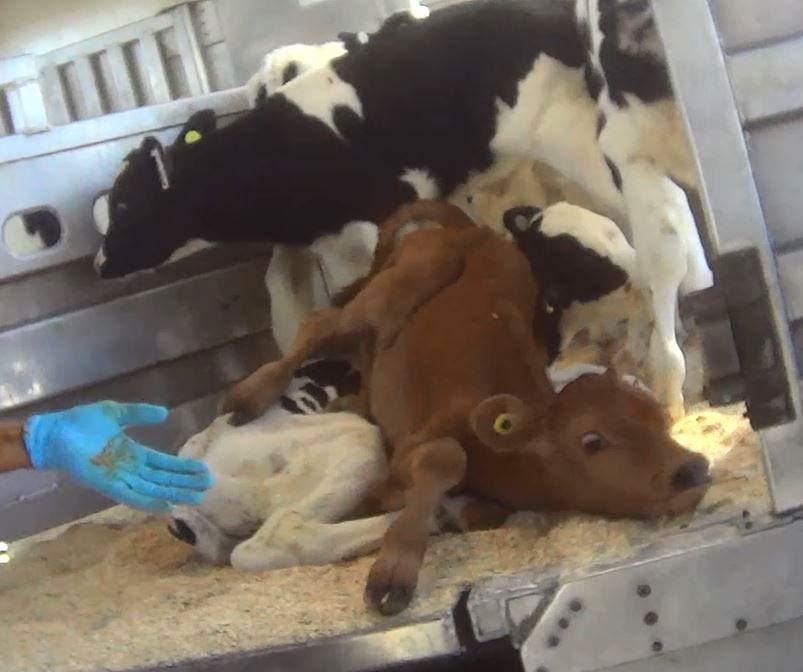
By supporting the dairy industry – milk, cheese, cream etc; you are supporting this kind of animal abuse. Young male calves, of no use to the industry as milk machines; ripped from their mothers side at just a few hours old; crammed onto trucks and exported for hours and hours to die in a foreign land. It is a sick business, and the sooner you distance yourself from everything that is involved with t, the better. Baby cows should be with their mums – simple as that.
Scottish government defends ‘illegal’ live calf exports as court battle looms
The Scottish government is going to court to defend the practice of sending live baby calves to Europe, even though Boris Johnson has previously backed a ban on live exports after Brexit.
Experts say Scotland’s calf exports are illegal because journeys breach an eight-hour time limit, and they have launched a court battle to try to halt the exports.
It comes as the findings of an investigation suggest paperwork on last year’s shipments submitted to authorities was misleading. Opponents of the trade suspect it was an attempt to evade a potential future ban.
About 5,500 very young male calves discarded by dairy farmers each year are sent abroad, particularly to Spain and even north Africa, where they are fattened and slaughtered as beef or veal.
By law, journeys over eight hours are not permitted for unweaned calves unless, after nine hours of travel, they are given a one-hour break for rest, water and “if necessary”, food.
In practice, the animals – still dependent on their mothers’ milk – are not unloaded after the first nine hours, according to campaign group Compassion in World Farming (CiWF).
Instead they are transported from Scotland to northern France through the port of Ramsgate for up to 23 hours without food – in breach of the law on journey limits, it’s claimed.
CiWF has launched judicial review proceedings against the Scottish government, saying that if it wins, British live calf exports could not continue in their current form, which “could spare thousands of unweaned calves every year from suffering on exhausting journeys”.
But live exports form a large source of income for Scottish farmers, and Holyrood is fighting back, trying to get the case dropped.
The UK government’s Department of the Environment, Food and Rural Affairs (Defra) is also thought to be planning to defend live exports if the case goes ahead.
The prime minister has previously condemned live exports, having pledged – before the Brexit vote – that leaving the EU would allow the UK to ban the trade, which European law did not permit.
In 2018, Mr Johnson condemned the trade as “barbaric”, writing in The Sun of the “nightmare” journeys animals endure: “They are terrified. They slip and slide in their own excrement as the boats buck in the swell. They travel for more than 100 hours in conditions of such extreme discomfort that campaigners have been protesting for decades.
“The animals know they are going to die – and they are going to die far from home.”
The Scottish parliament has previously debated banning exports of live A spokeswoman said: “It is most unlikely that breeding is the reason for more than 3,400 two- to six-week-old male calves being exported, given the numbers being exported per sailing, the conditions in which they are exported, and the age of the calves in question; these calves are clearly not of breeding age.
“We are worried that the decision to begin classifying these exports for ‘breeding’ may be an attempt to evade any potential future ‘fattening’ or ‘slaughter’ export ban.”
In a reply to CiWF, seen by The Independent, rural economy minister Fergus Ewing wrote: “I can assure you that there was no intention to mislead and that officials will sense-check any future data of this kind.”
He added: “Our knowledge of the trade permitted us to deduce that the likely purpose was fattening.
And the 2019 Conservative election manifesto promised to end “excessively long journeys for slaughter and fattening”.
But CiWF has discovered that official logs on every sailing last year bar one listed the purpose of the export as “breeding” – so the shipments would be exempt from any ban.
A spokeswoman said: “It is most unlikely that breeding is the reason for more than 3,400 two- to six-week-old male calves being exported, given the numbers being exported per sailing, the conditions in which they are exported, and the age of the calves in question; these calves are clearly not of breeding age.
“We are worried that the decision to begin classifying these exports for ‘breeding’ may be an attempt to evade any potential future ‘fattening’ or ‘slaughter’ export ban.”
In a reply to CiWF, seen by The Independent, rural economy minister Fergus Ewing wrote: “I can assure you that there was no intention to mislead and that officials will sense-check any future data of this kind.”
He added: “Our knowledge of the trade permitted us to deduce that the likely purpose was fattening and production, although the possibility remains that certain of the transported calves may have been later used for breeding.”
The Independent has approached the Scottish government for a comment.
A spokesman for Defra said the government would be launching a public consultation in due course on “excessively long journeys for slaughter and fattening” – which it pledged at the election to end.
The government held a call for evidence in 2018 on controlling live exports for slaughter and to improve animal welfare during transport after Brexit, but Defra says the new consultation will be wider in scope.
As you may have heard, the Government has backflipped under pressure from a live exporter and agreed to exempt them from rules that would’ve protected tens of thousands of Australian animals from a torturous journey into the Middle East at the most dangerous time of year.
Just one week ago, they made the right decision, upholding their own regulations in accordance with the overwhelming science and evidence.
But now, after promising to independently regulate this reckless industry based on the science and evidence, the government is apparently unable to stand up to the live exporter and uphold its own laws.
So they’ve given in. And in doing so, they’ve shown beyond doubt that they cannot uphold these important animal protection regulations in the face of industry pressure.
Australians – including farmers – know there are rules they must follow when it comes to caring for their animals.
If they don’t follow the rules, there are consequences.
So why don’t the same rules apply to live exporters?
And why does our government keep giving in to them?
Live exporters are playing by their own rules and making a mockery of our regulations, and the Australian Government is letting it happen.
This exemption is an absurd decision by the regulator, and how it has come about needs to be heavily scrutinised.
Three out of every four Australians want live exports to end. But everyone agrees the industry should be well managed and regulated.
That’s not happening.
Time and again, live exporters like RETWA / KLTT bring negative attention and damage the international reputation of Australian agriculture by flagrantly risking the welfare of our animals.
This cannot be allowed to continue.
They don’t respect our rules. And if the Australian Government and the regulator can’t stop this from happening, live export cannot continue.
The clock is ticking.
First, this shock exemption has been with no notice and no consultation. That’s just not good enough.
We’re asking the Minister to uphold the law and stop this shipment.
Second, we’re insisting there must be an independent observer on board at the very least – as is current government policy – so the live export industry cannot hide the truth.
Photo is from archive and is not associated with this article.
Hi Mark,
This is just a quick note as I know that over the past 48 hours your mind, like ours, will have been with the 50,000 Australian sheep who inconceivably are now scheduled to be shipped to Kuwait this week.
Like me, you may ask yourself, ‘How can this be? Surely there is something fundamentally wrong here?’ And yes, you would be right, there is.
We were not going to allow this shipment to proceed without doing everything in our power to prevent it.
Yesterday afternoon, after working day and night, our legal team filed an urgent application in the Federal Court seeking to challenge the Department of Agriculture’s decision to grant the exemption. Our case will be based on the fact that the decisionmaker was obliged to afford Animals Australia an opportunity to be heard in relation to this application. We are seeking an urgent trial on this matter as the window to overturn this decision is so limited.
There is much to play out in coming hours and days. No doubt the Department and exporter will rigorously defend this decision, but be reassured that our brilliant legal team will be in the Federal Court this morning doing all things humanly possible on behalf of these sheep, and us — the community who care so deeply about them.
Mark, know that we are only able to take this swift action to defend these animals because of you. Thank you so much for supporting these critical efforts as always.
I will keep you updated on developments.
For the animals (and especially for each one of these sheep),
Around 3.8 million animals are transported every day in the EU alone.
That is 1.4 billion animals a year.
As in all sectors of the economy, animal transport is about money: animals are transported to where the greatest profits are: Pigs are born in Austria, fattened in Spain, and slaughtered in Lebanon.
Animal transports take place under cruel conditions. The longer an animal is transported, the more the animals suffer.
Strict savings are made on feed, bedding, and drinking water, as additional weight means higher transport costs.
Nine million pigs, four million cattle, three million sheep, 400 million poultry, and more than 100,000 horses from Eastern Europe are on the move.
The usual journey time for international animal transports is between 50 and 90 hours.
Horses that are transported from Lithuania to Sardinia are 100 hours in the transporter, cattle that are shipped to the Middle East for a whole week.
It’s hard to believe, but transporting live animals is more economical than transporting them slaughtered in a refrigerated truck. This includes the reason why animal transporters travel long distances at home and abroad instead of slaughtering the animals in a slaughterhouse near the fattening plant.
There are applicable EU directives that stipulate the transport of animals without unloading, but these are hardly checked. Permitted would be 29 hours for cattle, 24 hours for pigs and horses, 19 hours for calves, and lambs.
If it is checked and infringement is found, the punishments are trivial and in no way act as a deterrent. Compliance with the applicable EU directives is also practically prevented because of a simple reason: along the main European traffic routes, there are hardly any suitable unloading stations for breaks.
In November 2001, the EU Parliament introduced a legislative initiative according to which duration of 8 hours and a maximum distance of 500 kilometers should not be exceeded when transporting live animals.
In July 2003, the EU Commission finally put the following completely inadequate proposal on the table: after nine hours of driving, twelve hours of rest should follow.
But not just once, but often one after the other at will!!
According to the proposal, “slightly injured” animals are also transported on. An unbearable situation for all animal rights activists!
It was also decided to end export subsidies for live animal transport to third countries. But due to countless exception rules, which are also laid down by the EU Commission, these laws are completely ineffective.
We have beautiful laws and tons of exceptions!! There are so many exceptions that export subsidies for cattle increased from 58 to 67 million euros between 2002 and 2003!
Until today, instead of reducing long-distance transport, the EU is still promoting these live animal transports!
Why they are animal transports so lucrative?
Because EU subsidies continue to flow and flow in favor of factory farming, the animal traders and the freight lobby …
This means that instead of reducing long-distance transports, the EU is promoting them until today because the commissioners in Brussels do the best lobby work for the meat industry.
And because, despite the information, despite videos from the hell of animal transports and animal farms, meat-eaters still want to eat dead animals and their products!
But we can change this murderous world order, it must be feasible to awaken conscience in this society. That must be our goal!
Our job is not to complain about, we need struggle and effectiveness.
Today is “Ban Live Exports” International Awareness Day, an opportunity to speak up for the hundreds of thousands of animals who are forced to make long, harrowing journeys to their deaths.
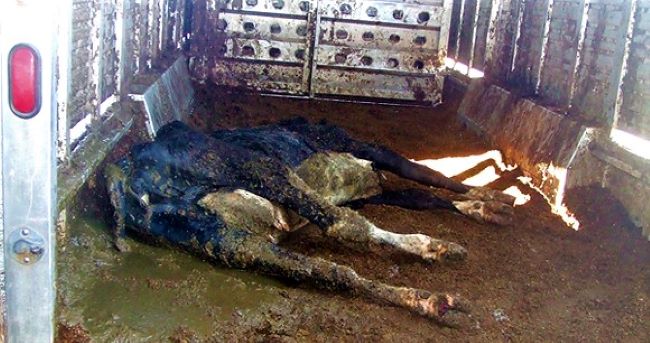
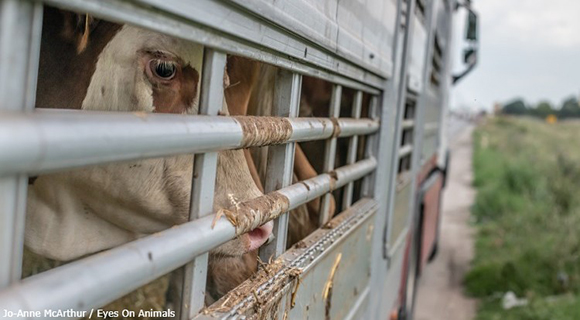
Live animals, including babies and pregnant females, are transported hundreds or even thousands of miles from the UK to the EU and beyond in dangerous conditions and all weather extremes, causing them distress, injury, and disease. They can be in transit for days, often without sufficient food, water, or rest. Many die as a result.
Now that the UK has left the EU and its trade restrictions no longer apply, we have a realistic chance of securing a ban on live exports. Please write to environment secretary George Eustice – and ask all your friends to do the same – to urge him to prevent thousands of animals from suffering and dying on lorries and ships every year.








![everybody[1]](https://serbiananimalsvoice.files.wordpress.com/2008/03/everybody1.jpg)