Category: Vegan Recipes

WATCH: No Mercy Shown for Mothers in Animal Farming

https://www.idausa.org/campaign/farmed-animal/latest-news/watch-no-mercy-shown-for-mothers-in-animal-farming/

May 9, 2025 – Posted by Lia Wilbourn

Animal farming rips apart the sacred bond between mother and baby; there’s nothing “humane” about it. Mother hens, cows, goats, turkeys, pigs, and sheep all care for their young and are fiercely protective of them, each in their own way. In animal farming, the mother’s desire and ability to protect and nurture her babies is robbed from her.

Mother birds exploited in the food industry—whether hens, turkeys, ducks, or geese—along with their babies, are all killed. In the wild, they stay in the nest to incubate their eggs, keeping them warm, and rarely leaving. Once hatched, the mother guides her chicks to food, alerts them of threats, and shields them from harm with her wings.

Whether in “free-range” or “cage-free” warehouses—marketing lies to keep consumers buying—or in cages, male chicks in the egg industry are killed because they don’t produce eggs, often by maceration. Their mothers are slaughtered too, while still young. Sexual violation, forcible impregnation, and the stealing of babies are done to virtually all female farmed animals, including birds, pigs, cows, goats, and sheep. 

In nature, before giving birth, mother pigs also build nests to create a safe environment for their piglets and will often defend them aggressively. Yet pregnant mother pigs in animal farming are confined to tiny metal cages—called gestation or farrowing crates—barely larger than their bodies, often forcing them to lie in their own waste. After months of this torture, her piglets are taken from her shortly after birth. Then she’s forcibly impregnated again. 

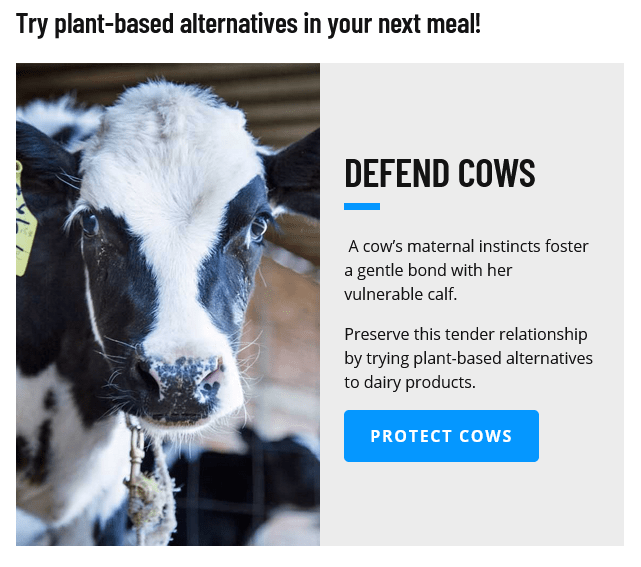
Cows, just like human mothers, carry their babies for nine months. When they give birth, they will lick and nuzzle their calves clean, stimulating circulation and bonding. The calves receive essential colostrum from their mother’s milk which helps strengthen their fragile immune systems.

But in the dairy industry, baby cows, goats, and sheep are taken from their mothers within a day or two so that humans can steal, consume, and profit from their milk. From the searing pain of branding and disbudding (burning off tender horns without painkillers) to the heartbreak of mother-baby separation, mothers are left physically wounded, exhausted, and grief-stricken. 

Female calves are kept alone in tiny hutches for months, often in extreme weather, only to be forced into the same cycle—sometimes before they’re a year old. Male calves, deemed worthless because they don’t produce milk, are slaughtered. 

It’s common to see mothers chasing after their stolen babies, left bellowing in desperation and anguish, often for days. This cruelty repeats until she collapses or stops producing enough milk for the ranchers. Then she’s frequently beaten or shocked to force her onto a truck to the slaughterhouse. Many animals are slaughtered, even skinned alive, while still conscious. 

All this torment and killing repeats endlessly for unnecessary products we’re better off without. Better treatment or painless death doesn’t make exploitation ethical. We have no right to their bodies. Using and killing mothers, babies, or any animal for culture, taste, profit, or convenience is the opposite of compassion; no animal farming is humane.

We must speak up for all mothers and their babies—including those who are the most ignored, oppressed, and killed on the planet. Every one of them was once someone’s baby, and every mother loved them. Neither these babies nor their mothers deserved what was done to them.

To defend all animals, live vegan.

Sign our alert urging Congress to redirect subsidies from the mass slaughter of mothers and babies to a plant-based food system.

Small animal farms and “grass-fed” ranching are not humane or sustainable — focusing only on factory farms is damaging and limits true reform.

*****************

Tell Congress to End the Killing of Mothers & Their Babies in Animal Farming

https://www.idausa.org/campaign/farmed-animal/latest-news/tell-congress-to-end-the-killing-of-mothers-and-their-babies-in-animal-farming/

In Defense of Animals

In the dairy and egg industries, all male babies and their mothers are killed. Many people don’t realize that most animals slaughtered for food products are infants. Yet, Congress and the United States Department of Agriculture continue funneling billions in taxpayer dollars to support animal agribusiness. Demand that the U.S. government redirect subsidies away from this industry of cruelty and mass slaughter of mothers and their babies.


In the United States alone, over 2 million sheep are slaughtered annually, with the vast majority being lambs—babies. This number spikes during Easter, and the average age at slaughter is 6-8 month

Male calves in the dairy industry have little to no value to dairy farmers, as they don’t produce milk, and so they are killed. They’re either shot shortly after birth or sold to veal “farms,” where they’re confined alone in tiny crates for up to 16 weeks—essentially tortured—to prevent muscle development and keep their flesh tender. Some are used for “breeding” or eventually slaughtered to be turned into meat products.

Male baby goats, called “kids,”, and male lambs are also slaughtered in the goat and sheep milk industries. So are all their mothers. Male baby chicks in the egg industry are killed immediately after hatching, most often either tossed like garbage into giant blenders, shredded alive, or suffocated.

In Defense of Animals

Though animal farming uses sanitized terms like “artificial insemination” and “breeding,” the young females are tightly restrained, and in dairy, the device used on female cows is often referred to as a “rape rack.” Forcible impregnation is done manually with a catheter, pipette, or, in the dairy industry, an entire arm—an extremely stressful and often painful experience. Farmers collect sperm from bulls, male goats, and male sheep through manual stimulation or using an electroejaculator.

Pregnant mother pigs are caged in “farrowing crates,” often so small they can’t turn around for months on end. After her newborn piglets are taken away, the mother is forcibly impregnated again, trapped in an unrelenting cycle of solitary confinement and suffering. Though pigs can live up to 20 years, they are killed at just six months old. Like all farmed animals, they’re trucked without food or water for several days—often in extreme cold or heat—to the slaughterhouse, where they suffer even more in a terrifying death.

Animal agribusiness claims that “stunning” makes animals insensible to pain, but its actual purpose is to immobilize them so they can’t fight back. The most common method to “stun” pigs is in CO₂ gas chambers, where they feel everything, often screaming in agony and desperately fighting to escape. The industry calls this “controlled atmosphere stunning” and deems it “humane.” Many animals are still conscious while being slaughtered.

When mother cows can no longer produce enough milk to be profitable, they are slaughtered at around five years old. Their natural lifespan is up to 25 years.

Mother hens in the egg industry and mother turkeys in the poultry industry are killed at 1-2 years old. Their natural lifespans are up to ten years. Regardless, even if they were allowed longer lives before being forced into slaughterhouses, using and killing animals for unnecessary products—for tradition, taste, habit, or profit—is the epitome of unjust, cruel, and violent.

Despite evidence linking animal products to increased risks of heart disease, cancer, diabetes, and Alzheimer’s, the United States Department of Agriculture (USDA) continues to promote them in its dietary guidelines, while research shows that eliminating animal products can reduce these disease risks. Yet, in March 2025, the USDA allocated an additional $10 billion to bolster animal agribusiness. Where is government cost-cutting when it’s truly needed?

It’s time to end speciesism and for those in charge of our food system to stop the monstrous torment and killing of sensitive, feeling, defenseless animals. Call on Congress and the USDA to stop funding the horrors of animal agribusiness and redirect subsidies to support a slaughter-free, plant-based food system.

What YOU Can Do — TODAY:

… on page …
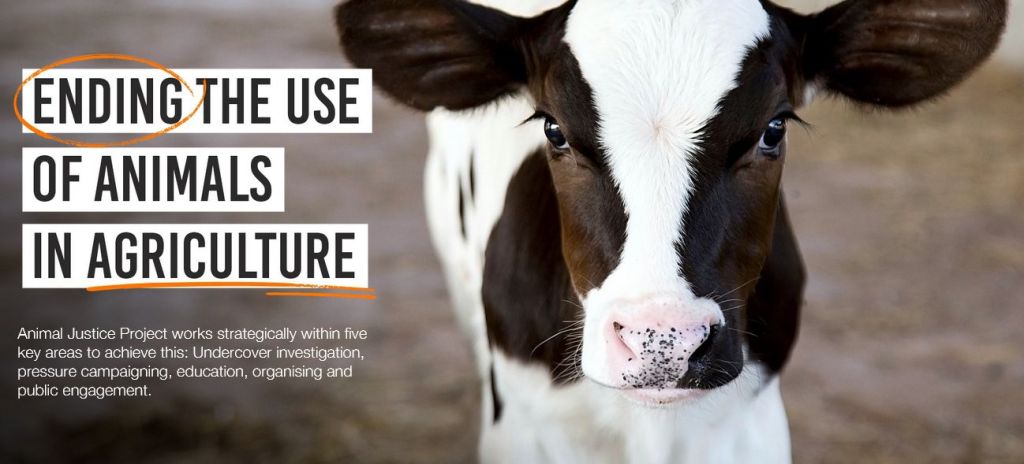
Introducing: “The Animal Justice Project”

https://www.animaljusticeproject.com/

*******************

Well worth a Visit.
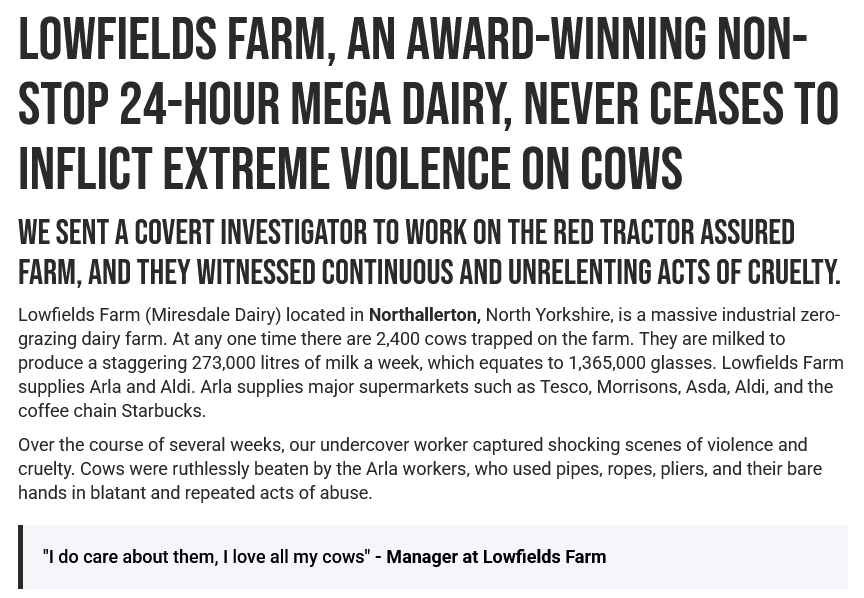
And .. to move directly to their most current Investigation and Campaign – after today’s post about similar abuse on a farm in Wales in 2022 investigated by “Animal Equality” …
*******************

https://www.animaljusticeproject.com/campaigns/lowfields

Continue reading on page …..

https://act.animaljusticeproject.com/page/166964/action/1

https://www.thepetitionsite.com/889/679/711/

(IT) Italy’s male chick killing ban stalls, Colosseum lights up in protest

https://animalequality.org/news/2025/03/28/italys-male-chick-killing-ban-stalls-colosseum-lights-up-in-protest/

Italy banned male chick killing in 2022, yet the slaughter quietly continues. From the heart of Rome to its most iconic landmark, advocates are demanding action.

March 28, 2025

  • Italy banned male chick killing in 2022, but enforcement has stalled due to loopholes and government delays. 
  • Male chicks are killed in the egg industry because they cannot lay eggs or grow quickly enough for meat. Millions are ground up alive or suffocated each year.
  • Animal Equality has long pushed for in-ovo sexing, a technology that determines a chick’s sex before hatching.
  • Animal Equality projected a message onto the Colosseum, displaying hatchery footage and urging ministers to enforce the ban.
  • Advocates have also taken to the streets, protesting outside Italy’s Agriculture and Health Ministries.

Update February 2025 – Animal Equality projected a message onto the Colosseum, calling for enforcement of Italy’s male chick-killing ban. The display showed footage from hatcheries alongside the faces of the three Italian ministers responsible for implementing the ban. These were accompanied by the words: “Act now, stop the slaughter of male chicks!”

Advocates also launched a manifesto against chick killing, backed by journalist Giulia Innocenzi and singer-songwriter Giorgia.

Update December 2024 – Animal Equality’s Vice President for Europe spoke about male chick killing on TV program Mi Manda Rai Tre. 

Update November 2024 – Protesters gathered outside the Agriculture and Health Ministries, condemning delays in the ban’s enforcement.

Update September 2023 – The Italian government outlined enforcement for the male chick killing ban. However, loopholes remain, allowing exceptions for sexing errors, machine failures, and more. A letter signed by Animal Equality and other groups urged the government to close these gaps.

Update August 2023 – Some members of Italy’s Chamber of Deputies–similar to the U.S. House of Representatives–asked to clarify enforcement of the 2022 male chick-killing ban. Officials formally requested answers from the Ministers of Agriculture and Health.

Update August 2022 – Italy’s Chamber of Deputies gave final approval for a ban on male chick killing. The law passed by a wide margin and is slated to take effect by 2026. Animal Equality’s Director for Italy spoke at a press conference to mark the occasion in the Parliament’s press room.

Animal Equality has launched a campaign urging Italy’s government to end the killing of male chicks in the egg industry. 

The petition–directed at the Ministries of Agriculture and Health–calls for officials to promote in-ovo sexing technology and support companies that adopt it. 

Italy’s largest supermarket chain–Coop–voiced its support just hours after Animal Equality’s campaign launch. The company announced online and in the media that it will adopt in-ovo sexing technology as soon as possible.

Why are male chicks killed in the egg industry?

Around the world, millions of male chicks are killed every year because they can’t lay eggs or grow fast enough for meat. Within hours of hatching, they are typically ground up alive in industrial macerators, gassed, or in some cases, electrocuted.*

*While electrocution is allowed in the U.S., it is not allowed in Europe.

In Italy, tens of millions are discarded as waste each year. The practice is just as widespread in the U.S., where hundreds of millions are killed annually.

Billions of baby birds face death on the day they are born simply because their lives are not profitable. Please sign the petition to end this massacre.

A proven solution: In-ovo sexing

In-ovo sexing technology identifies a chick’s sex before it hatches, preventing millions of male chicks from being born into the egg industry. Several countries have already adopted this method.

The process works by detecting the embryo’s sex within the first days of fertilization. This is done through a minimally invasive or non-invasive test.

Various in-ovo sexing technologies are available, though some are still in development. 

Egg-free: The best way to protect chicks

While in-ovo sexing prevents male chicks from being killed, millions of hens still suffer in the egg industry. They endure short, stressful lives, only to be slaughtered when their production slows.

The simplest, most effective way to protect them is to choose plant-based alternatives. Check out delicious, compassionate, egg-free recipes on Love Veg (https://loveveg.com).

Shift Funding From Animal Agriculture, Says EU Science Board.

Europe should move towards a plant-based food system, the report states

Funding should be moved away from animal agriculture towards “lower-emitting products and activities,” according to Europe’s top scientific advisors.

The European Scientific Advisory Board on Climate Change made the comment in a new report titled “Towards EU climate neutrality.”

Specifically, the board recommends “better aligning the EU’s common agricultural policy with the EU climate ambitions.”

The common agricultural policy (CAP) has been a key part of the European Union (EU) since 1962. The CAP currently takes up about a third of the EU’s budget. The majority goes to subsidies for animal farmers.

Lucia Hortelano, EU Senior Policy Manager, ProVeg International told Plant Based News (PBN): “We agree with this report that subsidies for intensive animal agriculture should be shifted towards the production of more climate-friendly, plant-based foods. This proactive shift will pave the way for a legacy that future generations will deeply appreciate.”

Animal agriculture holds back EU progress

The report from the European Scientific Advisory Board does not introduce any new targets. Instead, it fills in some gaps from previous documents.

One major gap is meat and dairy. Animal agriculture is responsible for around 16.5 percent of global greenhouse gas (GHG) emissions. Despite this, policymakers have ignored food system change as a solution for years. At COP28, the UN Food and Agriculture Organization (FAO) mentioned “benefits” of cutting meat consumption in rich countries but fell short of calling for a transition towards a plant-based food system.

Calls for a plant-based food system have been getting louder. In a recent letter, 250 scientists and experts urged the US Secretary of Agriculture to “address both production and consumption of animal-based foods.” A growing number of councils and governments around the world have endorsed the Plant-Based Treaty.

Now, the EU’s leading climate scientists have acknowledged that animal agriculture is holding back progress on climate change.

Hortelano added: “By prioritizing funding for a climate-friendly initiative, we can contribute to a healthier planet, cleaner waterways, and improved well-being for countless animals. The EU is in a position to set a powerful example to the rest of the world by channelling its finances into research and development, production and export of plant-based foods.”

Subsidies for plant-based transition needed

The report mentions the lack of financial incentives for farmers to transition towards plant-based food as a key issue to address.

The authors note a need to “strengthen measures to encourage healthier, more plant-based diets,” as well as “develop a strategy for a just transition to a food system consistent with climate neutrality.”

This means updating the CAP to support farmers away from emission-intensive animal agricultural. Elsewhere in the report, the scientists are more blunt. The EU needs “concrete policies for delivering a sustainable food system, reducing food waste and encouraging healthy, plant-based diets,” they write.

Despite the report’s strong conclusions, some campaigners and politicians remain unconvinced that it will lead to anything in practice. Anna Spurek, COO of Green REV Institute, told PBN that the European Commission is “spending public money on meat and dairy advertising campaigns, and shelving the draft regulation on a sustainable food system.”

Spurek added: “Work has now started on the Common Agricultural Policy after 2027. But we are under no illusion. Unfortunately, the climate crisis and the planet will not wait – it is time to veganize the CAP.”

Regards Mark

Bad: Italy bans cultivated meat and meat-related labelling for plant-based food.

17 November 2023

In a move that flies in the face of evidence that we must reduce industrial farming and increase plant-based diets, Italy has announced a ban on the production, sale or import of cultivated meat as well as the use of meat-related wording on labels to describe plant-based foods.

The Italian parliament passed the bill with 159 votes in favour to 53 votes against. MEPs in favour of the bill claimed it would help to protect national traditions and prevent “synthetic” foods from entering the market.

Whilst no cultivated meat is currently commercially available in the European Union, the ban is aimed at preventing novel foods from developing in the country. Breaching the law would result in a fine of up to €60,000.

As the European Commission continues to evaluate novel foods such as cultivated meat, the ban could later be challenged at EU level.

The bill also prohibits the use of meat-related wording on labels to describe plant-based foods. This will hinder producers of plant-based products with expensive re-labelling, and will prevent consumers associating the relevant language with plant-based products. 

The measure is a deliberate attack on progress, preventing Italy from evolving despite the direction more and more European and non-European states are taking instead, with a significant push towards food transition. We are in front of the legalisation of an anti-scientific stance, which allows the livestock lobby to continue to exploit, violate and kill millions of animals, moreover, harming the health of all people, opposing transformation in every way.

Domiziana Illengo, LAV

The passing of this bill is a clear sign of resistance against the critically needed move towards better food systems for people, animals and the planet. 

Sad -you would hope they have learned by now;

Regards Mark

England: Keeping hens clucking, pigs oinking and cows mooing. Free to live their best lives. Now that’s what we call plant positivity.

Disclaimer.

The purpose of this site is to be informative of animal welfare / rights issues.  I never take any financial support for advertising products or anything else at all; what you see is input, nothing else.  What you see here in this post is my input to a food which I fully support.  It can be purchased here in the UK no problem – overseas ?; for more info and products go to Vegan organic Bakery baking delicious pies, quiches, tarts and nut roasts (clivespies.com)

They say:

We want to make eating animals a thing of the past.

With your help, we’re changing the world, one irresistible bite at a time. Choosing Clive’s keeps hens clucking, pigs oinking and cows mooing. Free to live their best lives. Now that’s what we call plant positivity.

We say:  Last night for dinner, as we have many times before, had a Clives nut roast with vegetables, seeds and herbs.  Click on link above. It was great as always; if you are able, then please give it a try.

Regards Mark

Enjoy – Going to the city by Hugh Cornwell.

England: German Analysis of 37 Studies Shows Meat and Dairy Out, But Changing to Whole Grains, Beans, Nuts and Olive Oil Significantly Reduces Cardiovascular Disease and Type 2 Diabetes. (Guardian London).

Plant-based swaps may cut diabetes and heart disease risk, major review finds

Analysis of 37 studies finds largest health benefits come from replacing processed meat, with 20% reduction in type 2 diabetes

Replacing meat and dairy with whole grains, beans, nuts and olive oil may significantly reduce cardiovascular disease and type 2 diabetes, according to a major review into the impact of diet on health.

Researchers in Germany analysed 37 published studies to assess the benefits of switching from red and processed meat, poultry, fish, eggs and dairy products to plant-based foods such as beans, nuts, whole grains, oils, fruit and vegetables.

Read in full at:

Plant-based swaps may cut diabetes and heart disease risk, major review finds | Health | The Guardian

Regards Mark

England: Your Ultimate Vegan Summer Meal Guide.

Your Ultimate Vegan Summer
Meal Guide


July may be over, but don’t mourn the end of summer just yet. Bask in the sunshine and make the most of August with summer grilling and weekend getaways. Enjoy beefy burgers, juicy hot dogs, and bubbly brews or hit the road for an escape into nature or the ultimate vegan California road trip. There’s still plenty of time for summer fun.

Find out a great deal of Vegan recipes and news by clicking here:

Your Ultimate Summer Meal Guide: What’s In Season? Plus, Cookbooks and Vegan Recipe Ideas  | VegNews

Regards Mark