Category: Vivisection

And we thought, we have seen everything…


USA


The ingenuity of animal experimenters knows no bounds: merciless, cruel and perverse in the hunt for money and fame

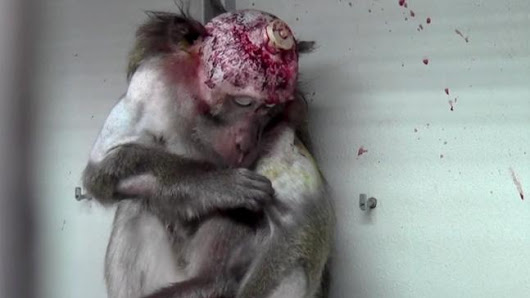
Anyone who has hoped, with the pictures of monkeys with open brains and electrodes in it, to have already looked the worst devil in the face, must be said for some days: No, it is still sicker, even crass, even more perverted.
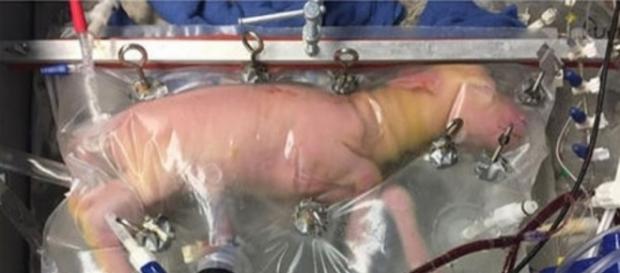
The Animal Experiments team led by Emily Partridge of the Children’s Hospital in Philadelphia proudly publishes incredible atrocities: They removed unborn lambs from live ewes and kept them in plastic bags (biobags), for weeks before most of the animals were killed to examine them.

lamm-Lammfötus-uberlebt-wochenlang-in-kunstlicher-gebarmutter-

According to Spiegel-Online, the umbilical cord of the unborn lambs was connected via cannulas to an artificial placenta.

The lambs were kept for weeks in a plastic bag filled with artificial amniotic fluid.
This was also biobag “baptized”, a special mockery of animal and nature conservation friends, for whom the name Biobag had a positive meaning so far. Netzfrauen.org writes that in three years experiments on humans are planned!! At the end of the experiment, the animal experimenters want to develop an artificial uterus for human babies and present the following video:


Why animal experiments only help the exploiters and not the humans

The animal rights organization “Doctors Against Animal Experiments” emphasizes that animal experiments are not transferable to humans. Therefore, clearly benefit animal experimenters who earn honor and money with it. Incidentally, the German population does not believe in animal testing at all, according to a representative Forsa survey commissioned by Doctors Against Animal Experiments”.

Schaffen karikatur in KZ_nPicture: Jo Frederiks

Most interviewees did not consider animal testing necessary, just cruel and would like to see them stopped. In the following video, the “Doctors Against Animal Experiments” show very clearly, why animal experiments are useful to the ambitious and greedy exploiters, but certainly not to humans:

https://de.blastingnews.com/meinung/2017/04/tierschutz-lebende-ungeborene-lammer-in-plastiktuten-001660733.html?fbclid=

My comment: The experiment reminds us of the experiments in concentration camp, in the Nazi period. At that time people were the victims, today it is the non-human animals that are the victims.
But there is another, important difference too:
At that time, we did not know exactly what kind of crime happened to people. Today, and thanks to undercover investigations by animal rights activists, we know very well what is going on in the laboratories. Therefore, we have no excuse for our silence and indifference, about the criminal acts of the experimenters and their crimes.

My best r egards, Venus

Dogs Tested On In Labs Feel Grass For The First Time. Cruelty Free Best Cosmetics.


Always buy non tested cruelty free products.

https://www.independent.co.uk/extras/indybest/fashion-beauty/fragrances/best-vegan-organic-natural-perfume-a8335201.html

https://www.dolma-perfumes.co.uk/    –  Fantastic – use all the time.

https://bombcosmetics.co.uk/about

https://bombcosmetics.co.uk/   –  Just the best – especially for present packs – bath bombs etc.

https://www.peta.org/living/personal-care-fashion/these-companies-dont-test-on-animals/

https://www.crueltyfreekitty.com/ultimate-guide-to-cruelty-free-makeup/

http://features.peta2.com/shopcrueltyfree/cruelty_free_companies_search.aspx?Donottest=8

https://www.animalaidshop.org.uk/perfumes   


USA: The victims of the laboratory industry are rising


USA

In 2015, there were 767,622 animals used for medical experiments in the US, the lowest level since the United States Department of Agriculture began keeping records in the early 1970s. That included roughly 138,000 rabbits, 98,000 hamsters, 11,000 sheep, 46,000 pigs; 20,000 cats, 61,000 dogs, 173,000 guinea pigs, 28,000 “other farm animals,” and nearly 62,000 “nonhuman primates.”

Hun im Labor-Mundtestn

In 2016, the number of animals used for scientific testing rose to 820,812. Last year, it dipped slightly, to 792,168. Today, according to Pew, 52% of Americans are against animal testing. However, there have never been more nonhuman primates used for lab experiment tests than there are right now.

Increased funding from the National Institutes of Health (NIH), which supports a majority of US primate research, is one factor behind the recent rise in primate testing. The other reason “the numbers are trending up, is because these animals give us better data,” Jay Rappaport of the Tulane National Primate Research Center in Covington, Louisiana, told Science magazine. “We need them more than ever.”


VIV-monkey-family

Continue reading “USA: The victims of the laboratory industry are rising”

A real animal is someone, not some thing!


All of you who have children should show this video to them. It describes the reality in laboratories in a real way, only without real animals. And be well prepared when the kids ask questions. We are responsible for transmitting the truth to the next generations.
Perhaps, this generation will be the one who ends the suffering of the animals in each sector.
And for that it has to know the truth.

My best regards, Venus

USA: Petition:Stop Deadly VA Paralysis Experiments on Dogs.


USA-Flagge


SIGN: Stop Deadly VA Paralysis Experiments on Dogs

Posted by Carly Day

 SIGN: Stop Deadly VA Paralysis Experiments on Dogs


Petition Link –  https://ladyfreethinker.org/petition-stop-deadly-va-paralysis-experiments-dogs/


PETITION TARGET: Secretary of Veterans Affairs Robert Wilkie

The US Department of Veterans Affairs (VA) is moving forward with plans to torture and murder dogs in a series of horrific experiments.

In these gruesome and cruel tests right out of the dark ages, dogs are sliced open, paralyzed, traumatized and then put down once they are no longer “useful.”

Some of the shocking procedures the VA performs on dogs include:

·         Removing parts of live dogs’ brains.

·         Placing electrodes on dogs’ spinal cords and inducing coughing. Then the spinal cord is severed, and testing continues.

·         Pacemakers are implanted, then researchers purposely induce abnormal heart beats, create heart attacks and block the dogs’ arteries with latex. The nerves that assist the brain in controlling their hearts are severed. The dogs are then forced to run on treadmills to further stress their hearts.

These innocent animals suffer from immense physical pain and emotional distress. Once the research is complete, all the dogs are killed.

In spite of the controversy surrounding these gruesome experiments and continued pressure from both lawmakers and animal advocacy groups, the VA continues to subject dogs to these unethical and needless tests. We must speak out to end this travesty.

Sign this petition urging Secretary of Veterans Affairs Robert Wilkie to stop these experiments, and turn his focus to finding humane research methods that do not involve animal torture.

 petition keyboard

Petition Link –  https://ladyfreethinker.org/petition-stop-deadly-va-paralysis-experiments-dogs/


trump feb 2

USA: Cruel Lab Testing on Primates in the U.S. Hits All-Time High.

USA-Flagge


lab peimate

Cruel Lab Testing on Primates in the U.S. Hits All-Time High

Posted by Carly Day | October 24, 2018

The New England Anti-Vivisection Society (NEAVS) has released shocking new findings on the exploitation of primates in animal testing in the US, revealing that the number used in medical research has hit a record high.

An astonishing 75,825 primates were being held in testing facilities in the country at the end of 2017. This alarming number lies in stark contrast to the increasing percentage of Americans who oppose medical testing on animals — 46 percent, with even higher percentages in opposition to testing on non-human primates.

Looking deeper into these figures, NEAVS found that the number of primates used in testing has increased by 15 percent, while the number of people who oppose animal testing has risen by 13 percent.

“Polls consistently show that a clear majority of Americans oppose cruel medical testing on primates,” Mike Ryan, director of policy and government affairs at NEAVS told Lady Freethinker. “It’s stunning to learn that the number of primates being caged in isolation and forced into painful tests has never been higher.”

Obviously, public opinion is not a concern worth noting for those who conduct the tests. The National Institute of Health (NIH) continues to fund animal experiments at increasing levels in spite of the fact that so many Americans oppose the practice.

The most commonly used monkeys in research include macaques, squirrel monkeys, baboons, and capuchins; these animals are used in both biomedical and behavioral research.

Earlier this year, the Food and Drug Administration (FDA) shut down a study that looked into nicotine addiction after four squirrel monkeys died as a result of the experiment. Following this incident, FDA commissioner Scott Gottlieb began an investigation of all FDA programs that use animals.

The NIH claims to be committed to investigate ways in which animal testing can be “replaced, reduced and refined,” but these shocking figures show a contrasting trend.

“Two numbers have never been higher: The percentage of Americans that oppose primate testing, and the number of primates suffering in tests in the U.S,” says Ryan. “It’s time for NIH to make good on its promise to Congress that they’re sincerely trying to “reduce, replace, and refine” this cruel work.”

Loretta’s story

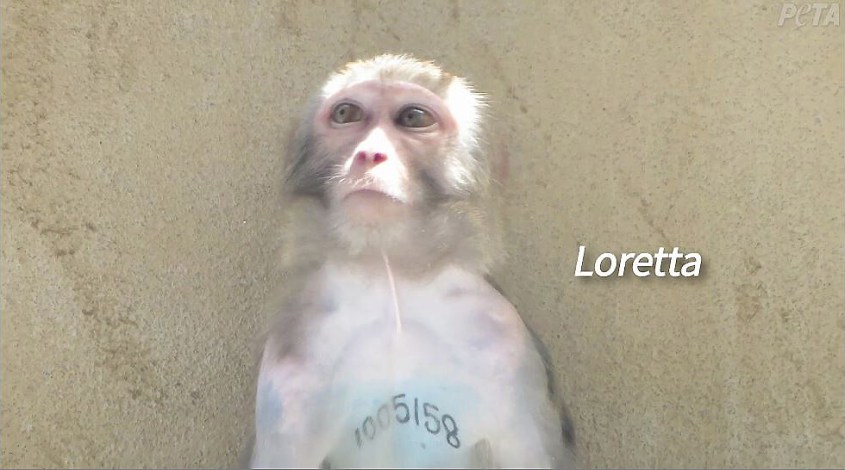
LorettaLoretta didn’t even have a name—she had a number.

For chimpanzees, 2013 was a great glimmer of hope when health institutes (National Institutes of Health) announced they would stop using their state-owned chimpanzees for experiments.

PETA now revealed that there are still 110,000 primates locked up in laboratories in the United States – under dreadful conditions.

Primate Products Inc. (PPI for short) takes the monkeys from the wild to warehouses where they are often kept in very unhygienic conditions. Subsequently, the animals are sold to laboratories.

Loretta is one of many monkeys who have suffered enormously.

Tattooed in black ink across her chest, the numbers 1005158 only became more visible as her hair fell out in patches, likely as a result of the stress that she endured at Primate Products, Inc. (PPI), a notorious facility that imports and warehouses primates before selling them to laboratories. A PETA eyewitness gave Loretta a name, likely the first act of compassion she’d ever been shown.

Continue reading “Loretta’s story”

Unilever is taking a stance on products tested on animals.

Maus-Tierversuch-02-c-PETA-USA_680


Written by Zachary Toliver | October 9, 2018

Unilever is taking a stance on products tested on animals, and consumers will approve. First, Dove—one of the most widely recognized and conveniently available personal care product brands in the world—has banned all tests on animals anywhere in the world and has just been added to PETA’s Beauty Without Bunnies cruelty-free list!

Dove will begin using our cruelty-free bunny logo on its packaging in 2019.

On top of that, consumer goods giant Unilever—which owns the Dove brand—has banned all tests on animals not required by law for all the rest of its products. Unilever will be added to PETA’s list of companies “Working for Regulatory Change.” This category recognizes companies that test on animals only when explicitly required by law, are completely transparent with PETA about what tests on animals have been conducted and why, and work diligently to promote the development, validation, and acceptance of non-animal methods.

Consumers Want Compassionate Change

We hope other companies will follow Dove’s compassionate choice to spare animals cruel, horrifying tests and go cruelty-free.

Always make sure that the products you buy are from the more than 3,500 cruelty-free companies that are included in PETA’s Beauty Without Bunnies searchable global database of companies that don’t test on animals.

By purchasing only cruelty-free products, you can help save conscious, feeling rabbits, guinea pigs, mice, rats, and other animals from excruciating tests, a lifetime of suffering, and death. Need help finding out which products are cruelty-free? We have you covered:


Order a cruelty free shopping guide here:  https://www.peta.org/living/personal-care-fashion/order-cruelty-free-shopping-guide/


Target 2023: The European Parliament is pushing for a global ban on testing cosmetics on animals.

translator.png
Global.


https://www.oipa.org/international/unog-conference-animal-tests-ban-cosmetics-ep-resolution/


Target 2023: The European Parliament is pushing for a global ban on testing cosmetics on animals

With a non-binding resolution adopted by 620 votes in favour, 14 against and 18 abstentions, MEPs call on the European Union to launch a diplomatic campaign for a worldwide ban on testing cosmetics on animals by 2023.

Animal testing for cosmetics is already banned in the EU and now MEPs want the ban extended to the rest of the world.

On 16 November a conference will be held at the United Nations office in Geneva, organized by OIPA, LSCV (Swiss League Against Animal Testing and for animal protection) and ATRA (Swiss Association for the Abolition of Vivisection) under the topic “Animal Tests Ban for Cosmetics: Debate on a EP’s Resolution”. Many issues will be discussed during this meeting, among which the current situation for animal tests and the search for strategies to end cosmetics animal testing globally.CLICK HERE TO SIGN UP AND PARTICIPATE

The protection and welfare of animals is something that can be achieved through diplomacy too.

On 3 May, the European Parliament called for the EU to advocate a global ban “on animal testing for cosmetics and on international trade in cosmetic ingredients and products tested on animals”, and invited EU leaders to “use their diplomatic networks to build a coalition and to launch an international convention within the UN framework” in order to ban all animal testing for cosmetics before 2023.

However, this worldwide operation turns out not to be so easy: around 80% of countries worldwide still allow animal testing and the marketing of cosmetics tested on animals, including large producers such as China.

However, even Europe cannot be considered a safe place for lab rats. This is why the initiative also seeks to improve the effectiveness of the ban within the EU. In fact, MEPs note that there are loopholes in the EU system, as some cosmetic products are tested on animals outside the EU before being re-tested in the EU using alternative methods and placed on the EU market. They also point out another serious problem: most ingredients in cosmetic products are also used in many other products, such as pharmaceuticals, detergents or foods, and may therefore have been tested on animals under different laws.

The data collected since the entry into force of the EU ban in 2013 demonstrates that the ban has not prevented the EU cosmetics industry from thriving and providing around two million jobs, and being the world’s largest market in this sector. In short, MEPs say that, looking at the figures, these products can remain safe for our health while not causing falls of production and preserving the animals’ welfare.

Moreover, it has been demonstrated that Europeans care deeply about animal welfare. According to the Special Eurobarometer survey of March 2016 on Attitudes of Europeans towards animal welfare, 89% of EU citizens agree that the EU should do more to promote a greater awareness of the importance of animal welfare internationally and that it is important to establish high animal welfare standards recognized worldwide.

On 16 November 2018 the United Nations office in Geneva will host a conference organized by OIPA, LSCV and ATRA that will bring together experts in the field. This meeting aims at promoting practical strategies for a worldwide ban on animal testing in view of the future convention that the United Nations will, it is hoped, propose for subscription to non-UE states too.

For those interested in participating at the conference organized by OIPA, LSCV and ATRA “Animal Tests Ban for Cosmetics: Debate on a EP’s Resolution”, please sign up through the following link https://reg.unog.ch/event/25958/.


USA: Airlines To Be Forced To Transport Live Primates For Vivisection ? – Take Action.

USA-Flagge


We have covered this recently on another post; but the issue is very important; so regard this as an update.  WAV.

Previous post:

https://worldanimalsvoice.com/2018/09/25/usa-legal-complaint-may-force-airlines-to-ship-primates-to-labs-even-if-they-have-stopped-now-take-action/


Nearly every single commercial airline refuses to fly monkeys and other animals to laboratories.

But a group is now trying to force them to do so.


If it’s successful, airlines will be have no choice but to ship tens of thousands of monkeys to U.S. laboratories where they’d be caged, poisoned, cut into, and worse—until the day they’re killed.

Federal records show that monkeys in laboratories have died when gauze was left in their bodies after surgery, when they were left in cages that were put through scalding-hot washers, and in other horrific ways.


We’ve worked so hard to help airlines ban shipping animals to laboratories, and we’re not about to let some depraved group of experimenters force them to do it again.

Speak Up! Urge Decisionmakers Not to Force Airlines to Ship Monkeys to Labs


For all animals,