Sacramento – Please see the following statement from Amy Meyer, Associate Director of Primate Experimentation Campaigns at PETA, regarding a just-posted enforcement action taken by the U.S. Department of Agriculture against Valley Biosystems, a contract testing laboratory in West Sacramento. The facility, which used 371 monkeys in experiments and confined another 1,247 monkeys last year, has received an Official Warning, a rare occurrence reserved for the most egregious offenses. The agency’s action follows USDA’s earlier pair of critical violations of the federal Animal Welfare Act at the laboratory for incidents in which two monkeys died by strangulation in separate incidents:
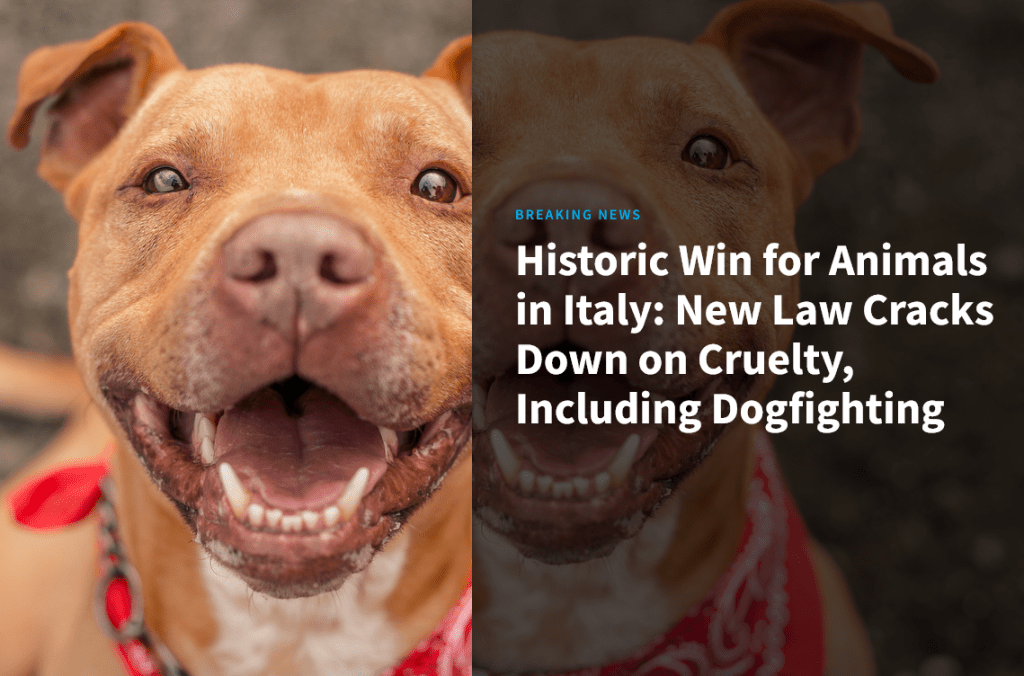
The Italian Senate has officially passed Bill AS 1308, a significant legislative advancement aimed at reinforcing animal protection across the country. The bill, previously approved by the Chamber under the name AC 30, introduces comprehensive amendments to the criminal code, criminal procedure code, and related provisions to address and deter crimes against animals, including the brutal practice of dogfighting.
One of the key aspects of the new law is the redefinition of the criminal code’s Title IX bis, replacing the outdated concept of “Crimes against the human sentiment toward animals” with the clearer and more progressive “Crimes against animals.” This change reinforces the idea that animals are deserving of legal protection in their own right, as sentient beings, not merely as subjects whose suffering might offend human sensitivity.
The bill also significantly increases penalties for acts of cruelty, including the killing of animals without necessity, mistreatment, and violations of the ban on unauthorized animal fighting or competitions. In particular, sentences for organizing or participating in animal fights have been increased, aiming to better deter those involved in these violent and illegal activities.
Additionally, the law introduces harsher penalties for crimes committed in aggravating circumstances, such as in the presence of minors or against multiple animals, as well as for the dissemination of videos or images of such acts via digital platforms. This is a critical step in tackling the spread of animal cruelty content online.
“The final approval of AS 1308 represents another important step in the protection of animals in Italy. We’ve made further progress towards the full recognition of non-human animals as sentient beings and victims of crimes, finally overcoming the outdated concept of exclusively protecting the ‘human sentiment’ towards them. We are pleased with the increase in penalties for dogfighting, a criminal activity that we have been combating for years through the ‘Io non combatto project,’ and the expansion of penalties to anyone participating in dogfighting in any capacity,” said Alessandro Fazzi, institutional relations consultant for Humane World for Animals Italy.
“We hope that it will soon be possible to intervene to offer even greater protection for minors, and also to introduce specific social rehabilitation programs for all those who commit crimes against animals, starting with those who participate in dog fights,” continued Fazzi. “By combining these requests with what has been approved today, our country will be able to take truly significant steps toward a more advanced legal civilization.”
A notable provision also addresses the management and recovery of animals seized in criminal proceedings. Under the new legislation, these animals can now be permanently assigned to certified organizations that can provide care and rehabilitation, helping to ensure they are not left in limbo during often-lengthy legal processes. The bill further includes a nationwide ban on keeping dogs chained, a practice often linked to dogfighting, except in strictly defined health or safety circumstances.
“The recently approved bill marks a significant step forward for all those who dedicate themselves every day to the protection of animals. It is a strong signal that strengthens the recognition of animals as sentient beings, deserving of direct protection. It also represents a concrete evolution on an operational level, particularly for the management of animals who are victims of crimes, taken from criminal circuits, and placed under judicial seizure,” said Federica Faiella, president of Fondazione Cave Canem, “I’m especially thinking of the dogs involved in fighting: this law finally recognizes their right to be immediately placed on a path of psychological and physical recovery and, where possible, welcomed into a family setting. This avoids the paradox of animals saved from abuse who remain trapped in the judicial system for years, confined to detention facilities.”
Although some proposed amendments, such as dedicated funding for law enforcement training or the ban on the import and export of hunting trophies from endangered species, were not included in the final version, the bill nonetheless marks a decisive move forward. It modernizes Italy’s approach to animal welfare by aligning legal language and enforcement practices with contemporary views on animal rights and ethical treatment.
By recognizing animals as victims of crime and ensuring stronger legal and institutional tools to protect them, this bill lays the groundwork for more robust animal welfare policies in the future. It sends a clear message that cruelty against animals will be met with serious consequences and that animal protection is a core part of a civilized, humane society.
AI may soon be able to decode whalespeak, among other forms of communication – but what nature has to say may not be a surprise
harles Darwin suggested that humans learned to speak by mimicking birdsong: our ancestors’ first words may have been a kind of interspecies exchange. Perhaps it won’t be long before we join the conversation once again.
The race to translate what animals are saying is heating up, with riches as well as a place in history at stake. The Jeremy Coller Foundation has promised $10m to whichever researchers can crack the code. This is a race fuelled by generative AI; large language models can sort through millions of recorded animal vocalisations to find their hidden grammars. Most projects focus on cetaceans because, like us, they learn through vocal imitation and, also like us, they communicate via complex arrangements of sound that appear to have structure and hierarchy.
In Switzerland, animal welfare issues are mainly discussed with regard to wildlife, companion animals and so-called “farmed animals”. In doing so, we forget about the individual whose interests we neglect the most and who are hardly – if at all – protected by the law. We are talking about the “invisible” animals – pigeons, rats, bees and fish.
These animals are subjected to immense daily suffering. Pesticides strip bees of their navigational abilities; rats face an agonising death from rodenticides; sick pigeons lie lifeless on the streets of our cities; and fish are confined in aquaculture basins under conditions that would be deemed unacceptable even in factory farming.
Considering the capacity for suffering as a crucial moral criterion is the core concern of Sentience. Therefore, we believe that all these animals deserve more attention, consideration, and protection. To eradicate today’s injustices, we must, together with you, sharpen public awareness and advocate for animals’ interests in politics.
Even small changes – such as banning certain rodenticides or pesticides, maintaining pigeon lofts, and improving water quality in aquaculture – can improve the well-being of billions of animals. By signing our petitions today, you help bring political attention to the “invisible” animals.
This January, a 57-year-old man in Baltimore received a heart transplant from a pig. Xenotransplantation involves using nonhuman animals as sources of organs for humans. While the idea of using nonhuman animals for this purpose might seem troubling, many humans think that the sacrifice is worth it, provided that we can improve the technology (the man died two months later). As the bioethicists Arthur Caplan and Brendan Parent put it last year: ‘Animal welfare certainly counts, but human lives carry more ethical weight.’
Of course, xenotransplantation is not the only practice through which humans impose burdens on other animals to derive benefits for ourselves. We kill more than 100 billion captive animals per year for food, clothing, research and other purposes, and we likely kill more than 1 trillion wild animals per year for similar purposes. We might not bother to defend these practices frequently. But when we do, we offer the same defence: Human lives carry more ethical weight.
But is this true?
Most humans take this idea of human exceptionalism for granted. …..
Briana figures she’s probably killed more than 300,000 animals throughout her career. Most of them mice. The occasional rat. Sometimes a hamster. At the biomedical research facility where she used to work, at a university in the United Kingdom, the method of execution wasn’t always the same. Some test subjects were killed by an overdose of anaesthetics, others by a rising concentration of carbon dioxide that was slowly pumped into a sealed enclosure.
But the most common technique was something called cervical dislocation. Ten times a day, on average, for more than 10 years, Briana’s job involved taking a mouse by the tail in one hand, pinching its neck with the other, and yanking hard to dislocate its vertebrae.
“The last week before Christmas was always the worst; I’d spend an entire day just breaking necks,” she tells VICE World News over email. “Having to kill so many animals and be part of their suffering left me feeling like there wasn’t much point in my existence.”
We would like to introduce you to an excellent site; named ‘Our Compass’ https://our-compass.org/about/ which is run by friend Stacey in the United States.
OC, as will now refer to it, is a ‘vegan abolitionist community focused on nonhuman animals, the harm inflicted on them due to human exploitation and speciesism, and the necessity of veganism as the only meaningful and humane response to support animals and their liberation from humans’.
As you will see by clicking on the above link, OC provides an insight into many major animal abuse / suffering issues, as well as photos, videos, and sample letters which you can use as a baseline for taking your own campaigning further.
For example:
OC has many different resources and subjects. I (Mark) know that Stacey (OC) will agree with myself and Diana when I say that like this WAV site, it is often harder; no, impossible; to give every subject animal around the world the coverage that they deserve for their individual cases – by trying to cover everything, you simply touch on a host of activities – Fur; Live transport; Intensive farming; Donkeys in the brick brick industry; Vivisection and big pharma; Hunting; The environment; Saving the Whales; Veganism; Cruelty free; AND Human Rights when coverage is necessary; human traffiking; or in our case, being a voice for the wonderful Tibetan people and their suffering under Chinese rule; – we become an information / reference source on so many issues rather than the ‘specialist’ covering just one.
Whatever; both OC and ourselves are more than happy to push for the day when ALL the cages are opened and the occupants liberated; when you do not cover your body with the skin of an animal that has lived and died under the barbaric fur production industry; when the hunts no loger hunt or animals are spared from the suffering of live transport / live exports.
If you have not visited OC yet; we know that you will find an endless resource the of information and links:
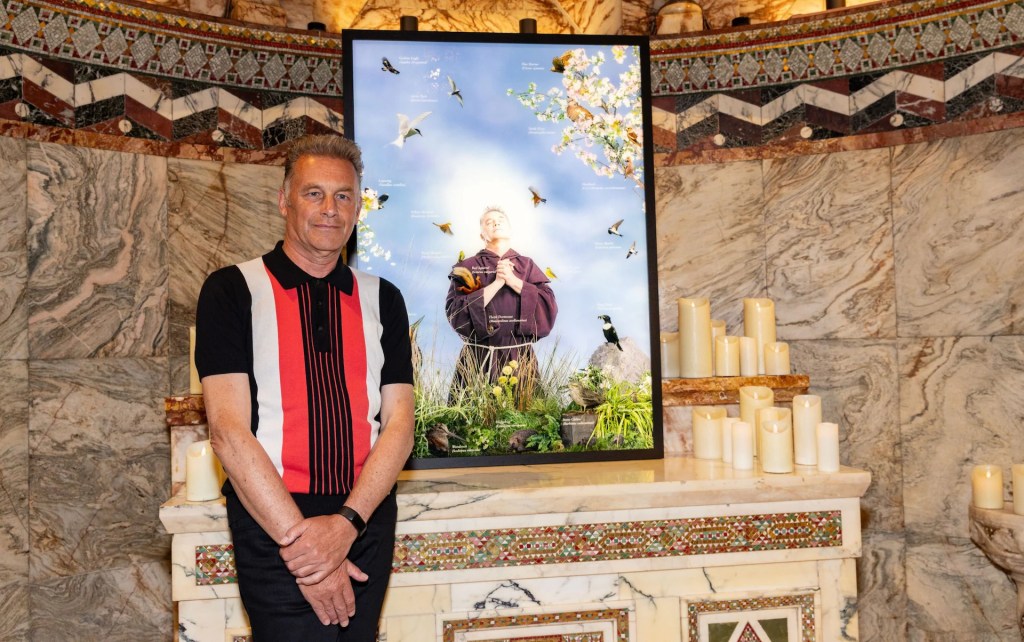
Chris Packham with his portrait, which it is said depicts him as “a living saint”, in the Fitzrovia Chapel Credit: Richard Ansett/Radio Times
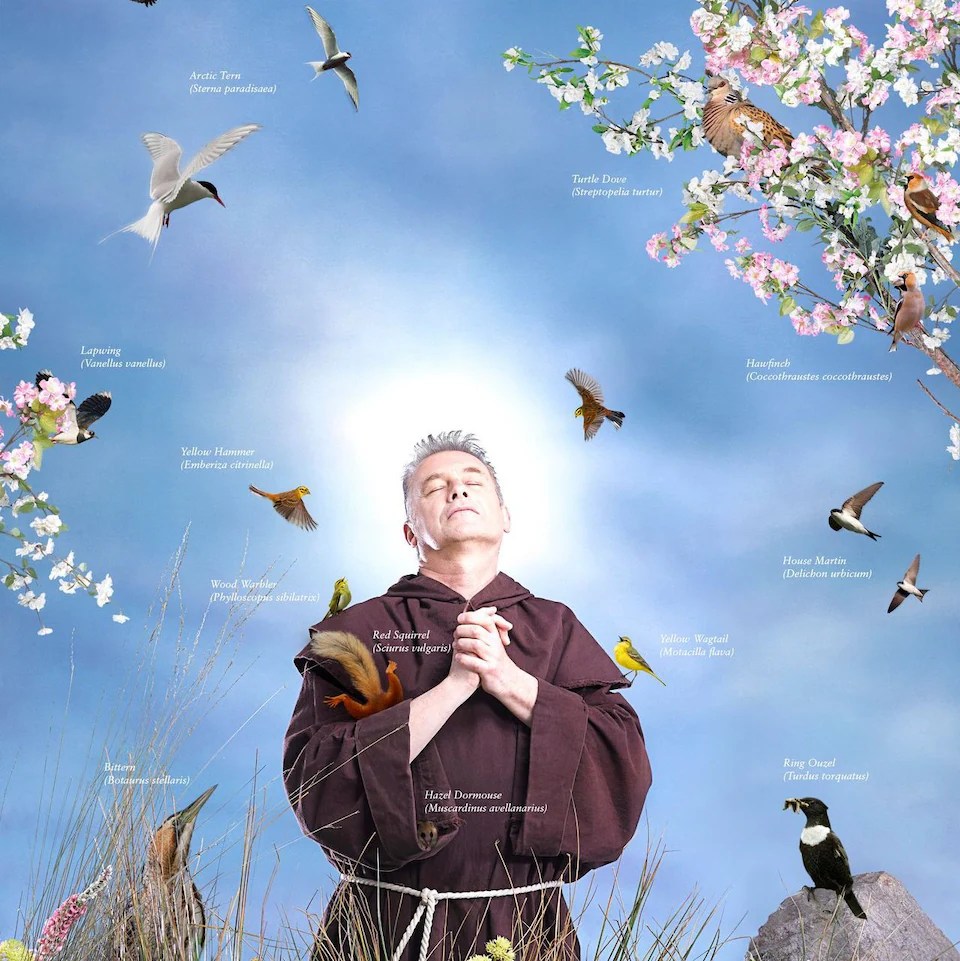
Chris Packham has posed as St Francis of Assisi in a portrait celebrating him as a “living saint”.
The portrait of the presenter and environmental campaigner is now on show on the altar of the Fitzrovia Chapel, central London.
Originally commissioned by Radio Times magazine to mark Earth Day, it is the work of photographic artist Richard Ansett.
Packham is surrounded by images of some of the UK’s most endangered species. Mr Ansett said it also made reference to Packham’s neurodiversity – the presenter was diagnosed with autism in his 40s.
“I hope that every pixel of this portrait offers a safe space for anyone challenged by neurodiversity. Packham’s remarkable connection to the natural world drives him relentlessly to save us from ourselves,” Mr Ansett said.
The portrait of Packham is available to view until May 21 at the former chapel, where it is described as a work “elevating him to the status of living saint”.
Chris Packham is surrounded by some of the UK’s most endangered species in the artwork Credit: Richard Ansett/Radio Times
Packham said: “This photo is about a fundamental level of engagement, an engagement of equals. It conveys the importance of nature to heal us, provide us with a sanctuary in times of terrible trouble.
“But the species featured are also rare or declining so it serves to remind us that our one and only home, our Earth, is on a brink too many are refusing to see and act to protect and repair.
“This is a photograph about love, a love of life, all life.”
The featured species include the red squirrel, the house martin, the woodcock and the hedgehog.
Mr Ansett, an award-winning photographer whose previous works include Sir Grayson Perry in the style of the Madonna and Child, added that the Packham portrait “recognises the difficulties that he has prevailed over to become a success in his career and a positive light for so many people”.
It is “a personal tribute to Packham’s humanity in challenging the worst parts of ours, in our ambivalence to the destruction created in the wake of our own needs”, the photographer said.