Month: March 2020

Switzerland: The strange case of the animal torturer Helga S.


The rat poison was neatly packaged in ham slices, and with a thick thread she additionally reinforced the package with a lethal dose. On Tuesday, Helga S. * leaves her insidious trail in the middle of Dielsdorf, Switzerland. Their goal: to torture dogs and cats in the community.

Grunge Switzerland flag. Swiss flag with grunge texture. Brush s

Attentive neighbors are watching their plans and alert the police. Shortly afterwards, the woman puts it in the act and discovers further prepared bait during the subsequent house search.

But who is the woman who lays her poison right next to a school and a sports field, where small children also play?

giftkodThis is one of the poison baits that Helga S. is said to have laid out.


Candidate for the Zurich Cantonal Council

The 58-year-old is a lawyer and was a lecturer at a Swiss university for a long time.
She was also active in a school supervisory board. In 2003 Helga S. ran as SVP politician for the Zurich Cantonal Council. At the time, she campaigned for her education advertisement and demanded that the young people receive the “best opportunities”.

In Dielsdorf the woman had been considered strange for some time. Neighbor Antonella B. says to 20 minutes magazin: «She has withdrawn very much. Was never there and was not part of our quarters. »
Helga S. triggers great anger with her alleged act. Neighbor Mari S. says: “I wish her the same suffering that she wanted to do to poor animals with the poison baits.”

Helga S. is currently said to be in psychiatric care. It is then sent to the investigative authorities.
The arrested Swiss woman is accused of violating the Animal Welfare Act.
In the meantime, the Zurich cantonal police are warning animal owners in Dielsdorf that other baits may be lying around in the community. It calls for special attention from the population.


https://www.20min.ch/schweiz/zuerich/story/Das-ist-die-Giftkoeder-Legerin-von-Dielsdorf-12644200

And I mean … as soon as Helga S experiences the same suffering that she has inflicted on the innocent animals, she will quickly recognize that cruelty to animals is a murderous act combined with agonizing death and will never try it again.
Psychiatric treatments for animal tormentors produce only costly and very dubious results.


My best regards to all, Venus

What is humane?


anonymous-was ist humane o

What exactly is “humane” about what we do to innocent sentient beings like cows, pigs, chickens, turkeys, goats, sheep, and fish?
Here is the definition of humane, for anyone interested:

Definition of humane
1 : marked by compassion, sympathy, or consideration for humans or animals.
Can one “compassionately” slaughter another sentient being who wants to live?
Does this line of logic propagating “humane slaughter” apply elsewhere to be consistent both morally and logically?

Can there be such thing as humane rape? How about humane child molestation? Humane dog fighting?
Or is this word when used in conjunction with an injustice like violating another’s bodily autonomy against their will the very definition of an oxymoron and the epitome of contradiction?

Anonymous for the Voiceless

My best regards to all, Venus

USA: The United States is trailing behind other countries, including Mexico and India, when it comes to animal protection laws.

american-flag-120402148


United States Trails Behind Mexico and India When It Comes to Animal Protection Laws, Report Finds


Source:  Newsweek – USA – https://www.newsweek.com/united-states-mexico-india-animal-protection-laws-report-finds-1491419


Image result for USA intensive animal systems


The United States is trailing behind other countries—including Mexico and India—when it comes to animal protection laws for farmed and wild animals, a report published by non-profit World Animal Protection (WAP) has revealed.

In its latest Animal Protection Index (API)—a global ranking of animal welfare policies in 50 countries—the organization has awarded the United States a “D” grade, while the two aforementioned countries received “Cs.” The U.S.’s ranking has not improved since the first edition of the API, which was published in 2014.

According to the API, animal protection laws at the state level in the country—where most originate—are inadequate, inconsistent, and sometimes contradictory. At the federal level—where only a few key laws exist—WAP found that there was a lack of accountability.

Below are the four main reasons outlined in the report which contributed to the award of the “D” grade:

  1. “The federal government’s key legislations limit which animal species and groups are covered.
  1. Most animal protection legislation is are created at the state, not federal, level, giving rise to inconsistencies in enforcement.
  2. The number of exemptions or exceptions allowed in both federal and state legislation means that most animals and welfare-impacting practices are not covered.
  3. Lack of transparency regarding animal welfare enforcement reports and audits mean there is little accountability for authorities.”

WAP experts say that a failure to improve standards will lead to the continued suffering of millions of animals, while also raising the risk of disease outbreaks.

“The longer poor animal welfare practices continue, the greater the risk of zoonotic disease outbreaks becoming more frequent, including but not limited to salmonella, avian influenza and most recently, the COVID-19 pandemic currently happening worldwide,” Alesia Soltanpanah, Executive Director World Animal Protection, U.S., said in a statement provided to Newsweek.

“Improving conditions for farmed animals and ending the commercial trade in wild animals, will not only guarantee the welfare of billions of animals but could also help prevent the next big human health hazard.

There is no federal legislation protecting farm animals during the rearing phase. Intensive, close confinement production systems are common, causing great suffering, causing animals to be stressed and immunosuppressed while also destroying the local environment and endangering the health of people and wildlife in the area,” Soltanpanah told Newsweek.


“The U.S. also allows the continued practice of fur farming and allows animals to be used for various entertainment purposes causing great suffering.”

In 2014—when the first API was published—the United States only had a few key animal laws at the state level, according to WAP. These included the Horse Protection Act of 1970, the Humane Methods of Slaughter Act of 1958, and the Animal Welfare Act (AWA)—which set general standards for certain animals bred for commercial sale, used in public exhibitions or biomedical research, or transported commercially.

Since then, several pieces of legislation have been introduced at the state and federal level, which have helped to improve animal standards, according to the report. For example:

  • In 2018, California passed Proposition 12, which effectively banned the most restrictive forms of confinement on farms.
  • In October 2019, California also banned the sale of fur from 2023—the first state to do so. Earlier that year, it also outlawed the use of wild animals in circuses.
  • And at the federal level, the Preventing Animal Cruelty and Torture Act (PACT) became law in November 2019, making animal cruelty a felony.

However, gains such as these were not enough the improve the U.S.’ grade, given that the Trump administration has weakened several protections for animals. According to Soltanpanah these include:

  • “Granting permits to trophy hunters to kill endangered species and bring them back to the United States.


trump1


  • Lifting environmental protections on national parks and monuments which provide habitats for wildlife, and allowing mining and drilling in formerly protected lands.
  • Rolling back protections for species categorized as ‘threatened’ and allowing economic factors to influence which species are classified as ‘endangered.’
  • Overturning a ban on the hunting of predators in Alaskan wildlife refuges and proposing to overturn a ban on extreme sport-hunting practices such as baiting grizzly bears.
  • Allowing poultry processing facilities to have faster line speeds, which increases risks to chickens and workers.
  • Rolling back environmental protection laws under the Clean Water Act which reduces environmental oversight of factory farms and threatens wildlife.”


trump feb 2

Trump – Making America A ‘D’ Grade – worth grinning about ?


Soltanpanah notes that these efforts to weaken animal protections—in addition to the abundance of “loopholes” and exceptions for many species in U.S welfare laws—has meant that many animals are still suffering, despite several promising pieces of legislation being passed in the past few years.

“This index should be a wake-up call for our political leaders with the message that we are failing to protect the vast majority of animals in this country,” Soltanpanah said in the statement. “We are calling on the Trump administration and local governments to improve animal welfare standards and enshrine animal protection into current and critical debates on food, public health, and sustainable development.”

In the API, World Animal Protection urges state and federal government to increase protections for farmed and wild animals in the United States, making a number of recommendations:

  1. Recognizing all vertebrates, cephalopods, and decapod crustaceans as sentient, while expanding the AWA so that it applies to all sentient animals.
  1. Removing exemptions in the PACT Act for animals killed for food or used in scientific research.
  2. Banning the production and sale of fur products.
  3. Outlawing forms of entertainment that cause animal suffering, such as circuses, rodeos, fights, races, rides, and the use of marine mammals in shows.
  4. Supporting the reintroduction of the Humane Cosmetics Act to phase out cosmetic animal testing and the sale of cosmetics tested on animals.

No countries were awawarded an “A” ranking in the API, however, Sweden, the United Kingdom and Austria received the highest scores—all “Bs.” On the other end of the scale is Iran with a “G” rating. According to the Index, Iran lacks any policies or legislation recognizing the sentience of animals, while also falling short in other areas, such as government accountability for animal welfare.

The report singled out the United States, China, Vietnam, Egypt, Azerbaijan and Belarus, for concerning animal welfare practices related to intensive farming and/or wildlife markets—which could lead to disease outbreaks.

Newsweek has contacted the White House for comment regarding the findings of the API.


China: Too little, Too Late … But Now Their Are Huge Financial Losses, Will Things Change ? ……. Thought Food !

china


WAV Comment:  Sadly, it is only when people personally start to lose money and group finances, do they wake up to the realities that others have been talking and warning about for years.  This article by the Guardian (London) reflects this.

‘Wildlife farming – promoted by Chinese government agencies as an easy way for rural Chinese people to get rich’.

Well now the Chinese, with their lack of legislation for animal welfare and its controls, are now paying the price.  Please don’t come to us with your sob, sob stories, you (China) are now reaping what you sowed; or actually failed to sow, many years ago when you should have introduced animal welfare legislations.

Today, 13/3/20; your inactions have put the planet into a global shutdown.   Oh my god, money is being lost on the worlds stock exchanges at rates not seen for decades.  Global sport is in shutdown and football clubs and racing teams will possibly have to review their future strategies.  You could start by looking at the pathetically gross salaries which you pay some of these people.

The animals have now bitten back big time – and the world; ignore their warnings at your peril.  We shed not one tear for the financial losses of the big corporations – the ignorants, the money grabbers; who only have self interest and personal gain at the top of their pyramid.

You have now been sent a clear message – so, take it on board and more importantly, do something positive (other than financial gains) as a result. 

Wake up world – the animals have now sent a clear message – they need you to give a shit !
 

give a shit


Tue 25 Feb 2020 03.01 GMT

Nearly 20,000 wildlife farms raising species including peacocks, civet cats, porcupines, ostriches, wild geese and boar have been shut down across China in the wake of the coronavirus, in a move that has exposed the hitherto unknown size of the industry.

Until a few weeks ago wildlife farming was still being promoted by government agencies as an easy way for rural Chinese people to get rich.
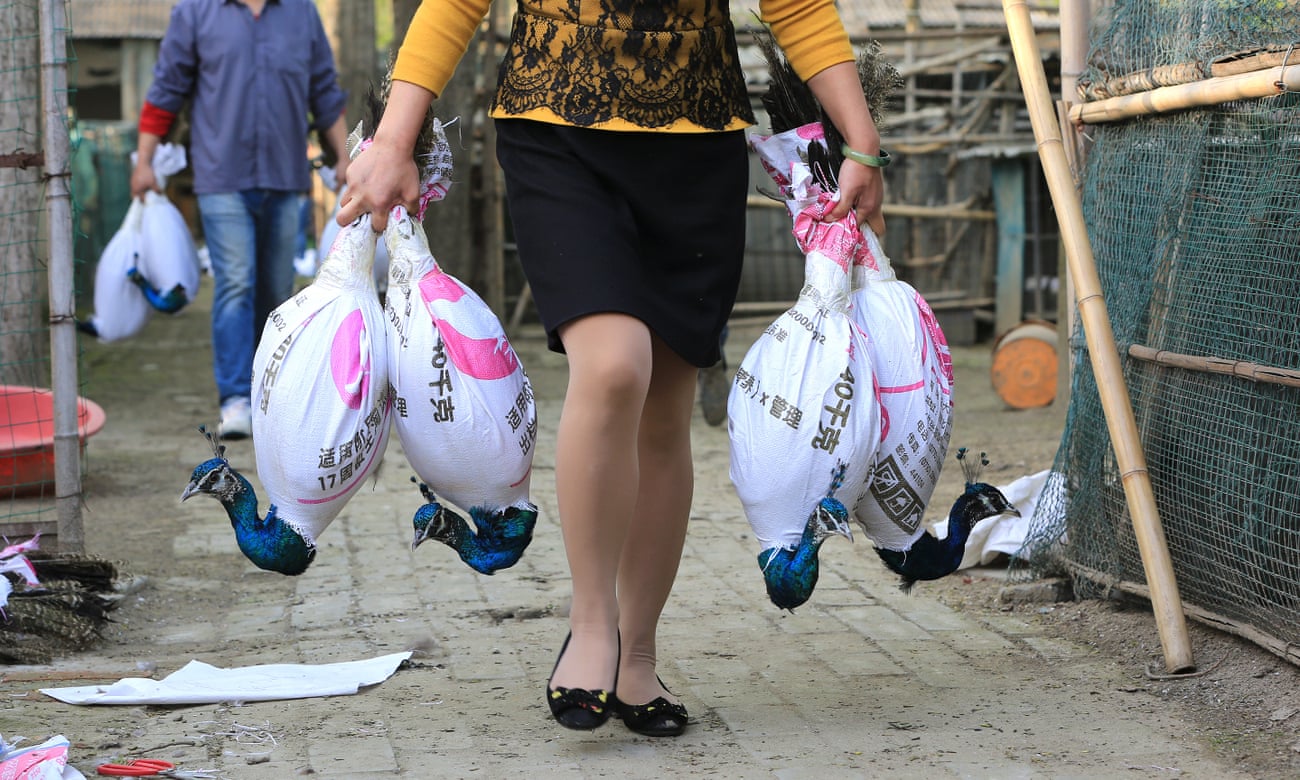
 

Freshly-slaughtered meat from wildlife and farm animals is preferred over meat that has been slaughtered before being shipped.


But the Covid-19 outbreak, which has now led to 2,666 deaths and over 77,700 known infections, is thought to have originated in wildlife sold at a market in Wuhan in early December, prompting a massive rethink by authorities on how to manage the trade.

China issued a temporary ban on wildlife trade to curb the spread of the virus at the end of January and began a widespread crackdown on breeding facilities in early February.

The country’s top legislative officials are now rushing to amend the country’s wildlife protection law and possibly restructure regulations on the use of wildlife for food and traditional Chinese medicine.
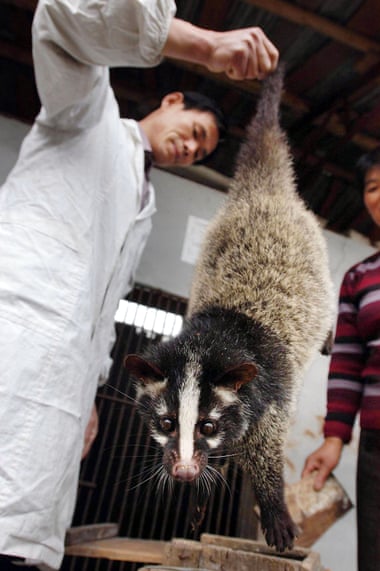
 

A civet cat is inspected on 10 November 2004 at a farm in Lu’an, China


The current version of the law is seen as problematic by wildlife conservation groups because it focuses on utilisation of wildlife rather than its protection.

“The coronavirus epidemic is swiftly pushing China to reevaluate its relationship with wildlife,” Steve Blake, chief representative of WildAid in Beijing, told the Guardian. “There is a high level of risk from this scale of breeding operations both to human health and to the impacts on populations of these animals in the wild.”

The National People’s Congress released new measures on Monday restricting wildlife trade, banning consumption of bushmeat and sales of wildlife for meat consumption at wet markets between now and the time the Wildlife Protection Law can be amended and adopted. Untouched however, are breeding operations for traditional Chinese medicine, fur and leather, lucrative markets known to drive illegal poaching of animals including tigers and pangolins.
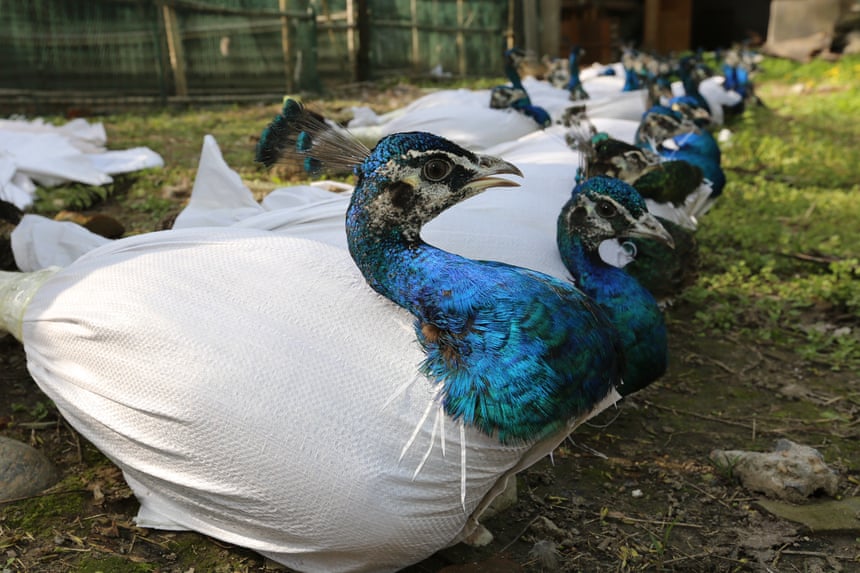
 

Live peacocks wrapped up in plastic bags, in Xiangyang, China


For the past few years China’s leadership has pushed the idea that “wildlife domestication” should be a key part of rural development, eco-tourism and poverty alleviation. A 2017 report by the Chinese Academy of Engineering on the development of the wildlife farming industry valued the wildlife-farming industry those operations at 520bn yuan, or £57bn.

Just weeks before the outbreak, China’s State Forestry and Grassland Administration (SFGA) was still actively encouraging citizens to get into farming wildlife such as civet cats – a species pinpointed as a carrier of Sars, a disease similar to Covid-19. The SFGA regulates both farming and trade in terrestrial wildlife, and quotas of wildlife products – such as pangolin scales – allowed to be used by the Chinese medicine industry.
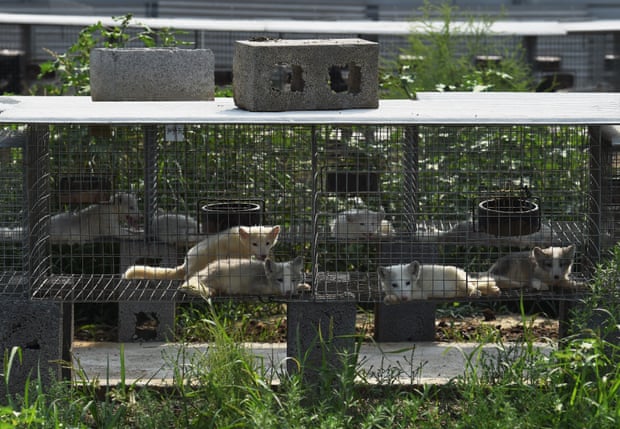
 

Fox cubs in cages at a farm which breeds animals for fur in Zhangjiakou, Hebei province


“Why are civet cats still encouraged to [be eaten] after the Sars outbreak in 2003? It’s because the hunters, operators, practitioners need that. How can they achieve that? They urged the government to support them under the pretext of economic development,” Jinfeng Zhou, secretary-general of the China Biodiversity Conservation and Green Development Foundation (CBCGDF), told the Guardian.

On state TV the popular series Secrets of Getting Rich, which has aired since 2001, often touts these kinds of breeding operations – bamboo rats, snakes, toads, porcupines and squirrels have all had starring roles.

But little was known about the scale of the wildlife farm industry before the coronavirus outbreak, with licensing mainly regulated by provincial and local-level forestry bureaus that do not divulge full information about the breeding operations under their watch. A report from state-run Xinhua news agency on 17 February revealed that from 2005–2013 the forestry administration only issued 3,725 breeding and operation licenses at the national level.

But since the outbreak at least 19,000 farms have been shut down around the country, including about 4,600 in Jilin province, a major centre for traditional Chinese medicine. About 3,900 wildlife-farming operations were shuttered in Hunan province, 2,900 in Sichuan, 2,300 in Yunnan, 2,000 in Liaoning, and 1,000 in Shaanxi.

There is little detail available about the animals farmed across China, but local press reports mention civet cats, bamboo rats, ostriches, wild boar, sika deer, foxes, ostriches, blue peacocks, turkeys, quails, guinea fowl, wild geese, mallard ducks, red-billed geese, pigeons, and ring-necked pheasants.

Neither do reports offer much detail about the shutdowns and what is happening to the animals, although Blake said he does not think animals are being culled, due to issues over compensation.

Chen Hong, a peacock farmer in Liuyang, Hunan, said she is concerned about her losses and whether she will get compensation after her operations were suspended on 24 January.

“We now aren’t allowed to sell the animals, transport them, or let anyone near them, and we have to sanitise the facility once every day,” Chen said. “Usually this time of year would see our farm bustling with clients and visitors. We haven’t received notice on what to do yet, and the peacocks are still here, and we probably won’t know what to do with [them] until after the outbreak is contained.

We’re very worried about the farm’s future,” she added. “The shutdown has resulted in a loss of 400,000–500,000 yuan (£44,000–55,000) in sales, and if they decide to put an outright ban on raising peacocks, we’ll lose even more, at least a million yuan(£110,000).

On a visit to Shaoguan, Guangdong province, last year, the Guardian and staff from CBCGDF saw a caged facility previously used for attempted breeding of the notoriously hard-to-breed pangolin.

While there were no longer pangolin at the site, several locals near the facility confirmed the species had been raised there, along with monkeys and other wildlife.

Besides being used for Chinese medicine, much of the meat from the wildlife trade is sold through online platforms or to “wet markets” like the one where the Covid-19 outbreak is thought to have started in Wuhan.
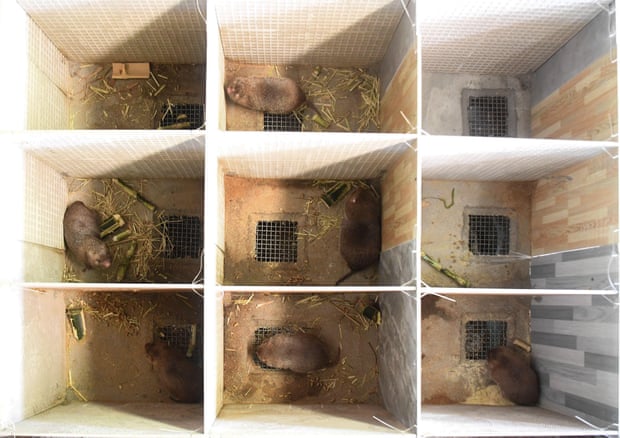
 

Rats bred in Qinzhou, China, 24 July, 2019


All animals or their body parts for human consumption are supposed to go through food and health checks, but I don’t think the sellers ever bothered,” said Deborah Cao, a professor at Griffith University in Australia and an expert on animal protection in China. “Most of them [have been] sold without such health checks.”

There have been calls for a deep regulatory overhaul to remove the conflicting duties of the forestry administration, and for a shift in government mindset away from promoting the utilisation of wildlife and towards its protection.

“The ‘referee-player’ combination needs to be addressed and is the toughest [challenge],” Li Shuo, a senior campaigner at Greenpeace East Asia told the Guardian. “This goes back to the institutional identity [of the SFGA] which was established to oversee timber production. Protection was an afterthought.”

Proposals include fully banning trade in wildlife that is protected or endangered within and outside of China, plus bans on raising and selling meat from known carriers of diseases that can impact humans such as civets, bats and rodents.

There are concerns that in trying to prevent outbreaks authorities may go too far in the culling of wild animals that can carry disease.

“Some law professors have suggested ‘ecological killing’ of disease-transmitting wild animals, such as pangolins, hedgehogs, bats, snakes, and some insects,” Zhou said. “We believe lawmakers need to learn [more about] biodiversity before advising on the revisions to the law, or they’ll bring disaster.”

Additional research and reporting assistance provided by Jonathan Zhong.

https://www.theguardian.com/environment/2020/feb/25/coronavirus-closures-reveal-vast-scale-of-chinas-secretive-wildlife-farm-industry


England: Eating Animals Will Be The Death of Us.

England


Image result for julia galletely viva


Julia Gellately (Above) is the founder and CEO of English animal rights organisation ‘Viva!’. Here is her take on the Coronavirus –


Coronavirus: Eating Animals Will Be the Death of Us

Juliet Gellatley

04/02/2020


Wuhan, China: the sprawling capital city of the Hubei province, known for being the epicentre of culture, education, manufacturing and transportation links. Now, Wuhan has a new reputation.

It is the city which gave birth to the Wuhan novel coronavirus (WN-CoV) the viral disease outbreak which has captured headlines, shut down cities and continues to spread while the rest of the world looks on with horrified abandon.

Coronaviruses are a common type of virus that cause mild illnesses, such as the common cold, but can cause more serious problems like severe acute respiratory syndrome (SARS). Just a quick search will bring up all you need to know about this coronavirus. Where did it come from? How is the virus transmitted and what are the symptoms? Will face masks really keep you safe?

There are many discussions taking place about how we can prevent and stop the spread of disease, followed by calls from experts for better hygiene, tighter controls at airports, banning the unregulated movement of wild animals and limiting human-animal contact. But the obvious solution, the simplest, most cost-effective solution which no-one has yet to admit, is to stop eating animals.

This coronavirus originated from one of Wuhan’s many live-animal markets. Over 100 different animals are sold here, including wolf pups, civet cats, poultry and snakes. These animals are kept in cramped, dirty conditions, with direct contact with humans. These markets are referred to as ‘wet markets’ – so called because animals are often slaughtered directly in front of customers. Aside from the obvious issues with having a high population density made up of humans and animals – a hotbed for disease outbreak – these markets are repulsive places. They are filled with caged, frightened souls, many of whom have been captured illegally in the wild.

The animals are skinned and slaughtered, sending a cocktail of microorganisms into the air. The dreadful, cramped conditions and mix of wild and domestic creatures, alongside the throngs of people choosing their victims, is a pandemic in the making. It was an inevitable consequence of poor hygiene, cross-contamination, and low animal welfare. We reap what we sow and – sadly, for the many people who have now lost their lives to the coronavirus – we have created a new deadly viral disease outbreak.

The saddest part of this story is that scientists saw this coming. Researchers have been stressing the link between human and wildlife health for decades and, in particular, the potential threat of coronaviruses was first identified following the 2003 SARS outbreak (also caused by a virus jumping from animals to humans). Scientists studying bats in the Yunnan Caves realised that the coronavirus was making the jump from bats to humans. It is now thought that the virus spread from bats to snakes, which are then captured and taken to live animals markets and eaten as a local delicacy. Scientists saw this coming; the Wuhan animal markets merely presented the perfect storm for disease outbreak.

As much as we can improve hygiene and as much as we can control the movement of animals, all it takes is another perfect storm to spark the next pandemic. You need only to look at the havoc we have wreaked throughout human history and our continued, damaging relationship with our precious ecosystems, to realise that we need systematic change.

We must have a societal shift in the way we view animals, the environment and our diets. We must stop eating animals. It is time to finally make the connection between animal agriculture and environmental destruction, antibiotic resistance and disease outbreak. We must stop tearing down forests to make way for animal farming or to grow animal feed. We must protect ecosystems and prioritise the safety and freedom of wild animals, leaving them to live their lives away from human contact. If we don’t take urgent and far-reaching action now, eating animals will be the death of us.

The world must wake up and shun all animal products and instead choose vegan. No cruelty, no cages, no blood and no zoonoses. It’s a no brainer.


See lots of other great articles in the Viva! Health March Newsletter by clicking on the following link:

https://mailchi.mp/viva.org.uk/vivahealth-march20?e=26c03356b8


Spain: Let’s eradicate animal abuse once and for all.


No to aid for the cancellation of the bullfighting season!

spanische flagge mit Stier

🐃All bullfights in March were canceled. Madrid, Valencia, Castellón, Murcia, Arnedo … 21 bullfights are already affected and 120 bulls saved because of it
Now the bullfighting sector is asking the government for support to save the season. The Toro de Lidia Foundation and the Minister of Culture José Manuel Rodríguez Uribe requested an emergency meeting. We will not let it happen!

arenajpg

The bullfighting sector, devastated: fairs suspended, thousands of tickets to return, San Isidro in the air … As has been done with sports events and schools, the bullring is being considered places of risk of contagion.

Thus, Madrid, Valencia, Castellón, Murcia and Arnedo have already canceled all the celebrations scheduled for March. There are already 21 bullfights affected, and 120 bulls that, for the moment, are saved! But the bullfighting sector, which is beginning to recognize that the coronavirus is going to be a severe blow to bullfighting, especially for bullfighters, ranchers and bullfighting entrepreneurs, it has begun to react: the Toro de Lidia Foundation has already requested the Minister of Culture, José Manuel Rodríguez Uribe, an emergency meeting “to be able to study the possibility of starting contingency, recovery and support plans for the industry as soon as possible.” We will not allow it!

Stier und Matador

Now or never! Let’s use the opportunity to eradicate animal abuse once and for all. Join the petition to the Minister of Culture, José Manuel Rodríguez Uribe, so that he does not allocate a single euro from public coffers to financially help the bullfighting sector.

The European Central Bank recognizes that the economic crisis that is going to trigger the coronavirus may have the magnitude of the great financial crisis of 2008. Public administrations across the country need to develop a package of measures so that companies do not suffer from liquidity problems due to the cessation of activities. Help for families has also been announced.

We need your help to demand that the government prioritize and not allocate funds to finance the bullfighting rescue. To do this, we ask that you dedicate less than two minutes of your time to perform the following action.

Send a letter to the Ministry of Culture and Sports – In this link is the petition-letter.

https://www.animanaturalis.org/n/45356/no-a-las-ayudas-por-la-cancelacion-de-la-temporada-taurina


Spanier mit Stierschwanz in der Hand_n


And I mean …those are the unexpected damages of the Omnipotent Corona Virus.
Nobody expected them, not even those who created it.
No bullfights, no environmentally harmful world trips, maybe no safaris, and soon there will be no more animal transports.
An animal friendly virus … this corona …

Everyone stays at home and waits for better times. The environment and animals benefit greatly from it.

WHO speaks of an extremely dangerous pandemic!!
Confirmed cases 80,754, including active infections 17,721, cured cases 59,897, deaths 3,136.

With 7, 75 billion human animals … 3000 deaths are the doom of the world.

My best Regards to all, Venus

India: March Videos From ‘Animal Aid Unlimited’.

Grunge India flag. India flag with grunge texture. Brush stroke.

One of the rescues we’ve featured this week is of puppies who got stuck in tar. People often want to know how is it that road tar wasn’t properly disposed, or why there is there so much garbage? The answers are not easy because so much intersects: India experienced a relatively sudden introduction of non-disposable plastics and other materials in a culture that values tolerance, even of things that are offensive. The toxins and dangers in this environment are present around the world, often more lethal, but more hidden. But wherever we live, there are beings who suffer because of human negligence. This video about removing the tar from puppies’ little bodies, however, focuses on the opposite phenomenon: human kindness. Watch the faces of the band of helpers who worked so carefully for hours and hours to make sure these little angels would be happy again.


Hours of effort saved Amber and her sisters locked in rock-solid tar.


Three gorgeous puppies were encased in hardened road tar when our rescue team arrived, and their sibling had died from the toxic hardened tar. Two of the three had made their way back to their mother with tar over half their little bodies.

But one was stuck to the earth, and to avoid pulling her skin off, rescuers had to cut and pry big slabs of stone and tar to carry with her to the hospital where all 3 puppies would undergo hours of labor as Animal Aid staff and volunteers softened the tar by soaking it in cooking oil and pulling it off little bit by bit.

The puppies’ little faces could not have looked more forlorn. By the time the tar was removed, they were soooo exhausted. But all the more WONDERFUL to see them playing in joy after a good night’s sleep in the furry warmth of their Mommy.


Removing tar is difficult, but LOVE is easyPlease donate


After we repaired her neck wound, Sunny-day glowed!


Her skin hung heavily on her throat, detached by a 4-inch cut that exposed all of this sweet dog’s neck muscles. She would need stitches to survive, and when our rescue team arrived, she let us scoop her up without the slightest resistance. We were relieved to see that the edges of the cut were clean enough that suturing was possible. When she healed, she simply glowed. We named her Sunny-day, and wow, just look at her now!


For surgery to save precious souls, please donate.


Stitching this wound saved precious Nugget’s life.


Blood from a deep wound on this sweetheart’s thigh had soaked his hind legs and tail, but that tail wagged in the most earnest announcement of trust, enabling our rescue team to gently and quietly carry him to our ambulance and stitch him up in the hospital. Meet adorable Nugget, whose cheerful and subtle little smile will charm your socks off.


For badly injured tail-waggers. Please donate.


Celebrate the Caregivers!


Himmat

Himmat Gameti has for 2 years grown in his ability at a tremendous rate. He manages the care of dogs in our Spay-Neuter Center where he ensures that both routine feeding and special post-operative medical care are provided “his” 80 ever-changing surgery patients. Himmat is observant, communicative, fast and thorough. He’s also a big sweetheart and we feel so lucky to have his brilliant help as a team leader.


Germany: pathological hypocrites of politics


BERLIN taz.magazin | Animal rights activists have urged the Greens to remain tough in the fight against sows that are too narrow. “There must be no wobbling of the Greens,” said the President of the German Animal Welfare Association Thomas Schröder on Monday at the taz.magazin

banane rep deutschlandpg

The head of the largest animal welfare association in Germany demands that the ten state governments with green ministers in the Bundesrat must prevent the “box stands” that have been banned but widespread from being legalized for decades.

“The Greens have always claimed that they are also the animal protection party. Now it’s your responsibility. Now they have to deliver, ”added Jasmin Zöllmer, consultant at the ProVieh organization. From Friday to Monday afternoon, around 370,000 people signed an online appeal from the Campact and Foodwatch to the Greens to “end the martyrdom of millions of sows now”.

FerkelMinister of Agriculture Julia Klöckner


Federal Minister Julia Klöckner (CDU) wants to delete the most disregarded regulation, which says that the animals must be able to stretch their legs when lying down, and after a transition period of up to 17 years (!!!), the crate stands are to be slightly larger.
The times of the animals the times of the animals in it in the birth cycle should be reduced from several weeks to 12 days.

Like the animal rights activists, the Foodwatch consumer organization also demands that crates be abolished immediately. “A farmer who has a crate will use it as he sees it economically necessary, because there is no one who will control how long the animals will be in there,” said Matthias Wolfschmidt, International Campaign Director of Foodwatch , the taz.magazin. Due to a lack of staff, the veterinary offices would seldom check every farm.

schweine kasten mit ferkel-PETA-D

Green leaders want to compromise

The federal chairmen of the Greens, Annalena Baerbock and Robert Habeck, wrote Foodwatch: “We Greens want to say goodbye to the crate.” But since the party does not rule alone in the countries, it must find a compromise (!!!)
The Greens wanted the rule that the sows should be able to stretch their legs while lying down. A transition period of 15 to 17 years is “clearly too long”. The fixation could be reduced to 5 days.

Schönes Foto mit Schwein und Ferkel

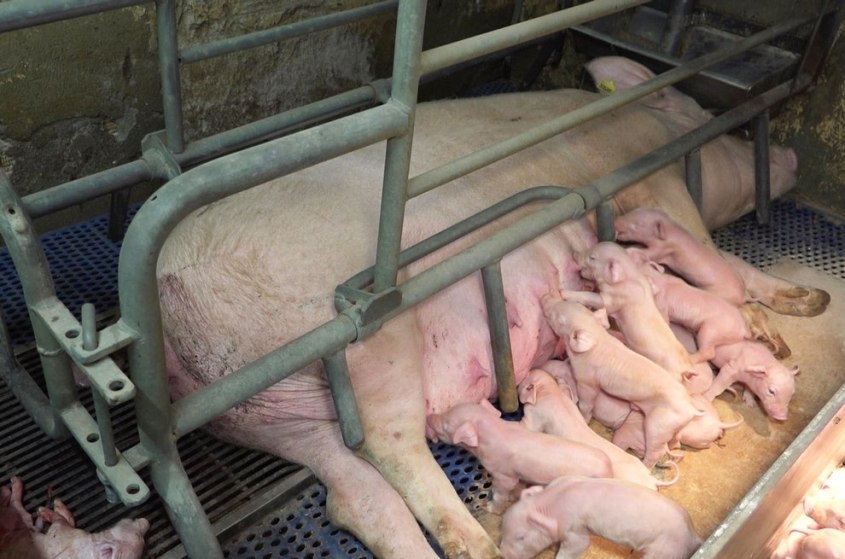
The 1.8 million sows in Germany are usually kept for months in metal racks that are only about the size of the pig. It cannot turn around and only lie down slowly. This has the advantage that the young animals are not easily crushed. In addition, the crate stall makes it easier for staff to keep track of which sow is already inseminated. The metal frame also saves space, because more freedom of movement is required outside the cage.

Deutshe Schweine in Zellenpg

Animal rights activists criticize that the crates often caused ulcers in the shoulder and hip area. It is cruelty to animals to keep the sows out of contact with their counterparts and without opportunities to walk around, to live out their drive to explore or to wallow. If sows had enough space, not much more piglets would be crushed without a crate.

schweinekasten Fabrik

The Higher Administrative Court of Saxony-Anhalt therefore requested in 2015 that the crate be either at least as wide as the standing pig or that it must be possible to put the limbs in neighboring empty cages without disabilities. The Federal Administrative Court upheld the verdict from Saxony-Anhalt in 2016.
This has been disregarded in German companies for years!

Box stands with a width of 65 cm (young sows) or 70 cm (sows) and a length of 200 cm are currently common practice, although narrower box stands can also be widespread in regional businesses.

On request, Klöckner’s ministry informed the taz.magazin that the draft regulation would significantly improve animal welfare. After all, the fixing times would be shortened considerably and the box stands would be enlarged.
Shorter transition periods would “not be feasible, especially for small companies, without confronting them with unsolvable financial difficulties,” said the ministry.
“It is important to keep production in Germany and to avoid further structural breaks – because only in Germany do we have concrete options for influencing husbandry conditions and thus animal welfare (!!!)”

Schwein mit verwesten FerkelnnThat is what we mean by “animal welfare”…


https://taz.de/Tierschuetzer-gegen-Kaefige-fuer-Schweine/!5666524/


And I mean…The main responsible for the painful animal husbandry, are the animal torment industries, their political lobbies like the hypocrites and opportunists Greens for example, and their clients, that’s us!
Farm animals in captivity in a confined space are not punished. Otherwise there would be no cheap meat and cheap milk products in bulk in all possible discounters.

Animals are fattened, have no run, pigs cannot wallow themselves, cows are raped, after a short life farm animals are slaughtered, animals suffer and cannot escape, etc. etc.
All of this is legal, all with deliberate political support and thanks to the corrupt politicians who work hand in hand with the meat mafia it will be not punished.
When will the animal murder factories be closed? When will the humiliating and illegal pigs be abolished?

Countries in Africa (and other countries around the world where people are starving) would be happy if 90-98% of the world’s soybean harvest, 50% of the world’s grain harvest, and around 40% of the animals stolen from the sea in the 900,000,000 (Germany) / 85,000,000,000 (worldwide) would not be fed to the animals of the factory farms, but would be made available to them as food!

It always goes on, on, on. The petitions against castes are in full swing, the votes are reaching the millions, and the factories are getting bigger.

We signed 1.5 million votes for the abolition of the pig boxes.
This was obviously a great help to the career of some EU officials.

endthecageagepng

My best regards to all, Venus

Happy Birthday, Mark!


fruhstucksbrettchen-happy-birthday-to-yooouu

It’s Mark’s birthday today.
He kept it secret, only his animal comrades knew that
And today they gave him an extra portion of love and tenderness.
We wish him all the best! that he remains healthy and active and continues to be our campaigner for animal rights


All the best and love, dear Mark

Venus