New analysis by researchers from the University of Oxford and the University of Minnesota has identified a range of ‘win-win’ foods that both improve human health and have a low impact on the environment.
Foods associated with improved health (whole grain cereals, fruits, vegetables, legumes, nuts and some vegetable oils high in unsaturated fats, such as olive oil) have among the lowest environmental impacts, they found. Foods with the largest negative environmental impacts—unprocessed and processed red meat—were consistently associated with the largest increases in disease risk.
The exceptions were fish, which is a healthy food but has moderate environmental impacts, and processed foods high in sugars, which can be harmful to health but have a relatively low environmental impact. Red meat (pork, beef, mutton, and goat) and processed meat had the highest environmental impacts of all foods and were also associated with the largest increases in disease risk. Other animal-source foods, such as dairy and poultry meat, had moderate environmental impacts and a small impact on disease risk compared to other foods.
Lead author Dr Michael Clark, of the Livestock, Environment and People (LEAP) project at the Oxford Martin School, and the Nuffield Department of Population Health, University of Oxford, says the findings could help consumers make better choices by equipping them with an understanding of the health and environmental impacts of different foods, and enable policymakers to issue more effective dietary guidelines.
‘Diets are a leading source of poor health and environmental harm,’ said Dr Clark. ‘Continuing to eat the way we do threatens societies, through chronic ill health and degradation of Earth’s climate, ecosystems, and water resources.
‘Choosing better, more sustainable diets is one of the main ways people can improve their health and help protect the environment. How and where a food is produced also affects its environmental impact, but to a much smaller extent than food choice.’
Using a comparison of an additional serving per day of 15 different foods, the researchers analysed collections of large epidemiological cohort studies—which follow populations of individuals through time— and life cycle assessments—which are used to estimate the environmental impacts per unit of food produced. The health and environmental analyses each incorporated five outcomes (total mortality, heart disease, stroke, type II diabetes, and colorectal cancer for health; and greenhouse gas emissions, land use, water use, water pollution, and acidification potential for environment), and the results were consistent when applied across nearly all combinations of health and environmental outcomes.
‘The study adds to the growing body of evidence that stresses that replacing meat and dairy with a variety of plant-based foods can improve both your health and the health of the planet,’ said co-author Dr Marco Springmann, of the LEAP project and Oxford’s Nuffield Department of Population Health.
The Center for Biological Diversity do such a fantastic amount of work and legal challenges for the wildlife of the entire USA; they really do deserve as much support as you can give them.
Lots of good news, and actions for you to take, here at:
Andrea Zaccardi, (303) 854-7748, azaccardi@biologicaldiversity.org
Bill Aimed at Killing 90% of Idaho’s Wolves Headed to Governor’s Desk
New Law Would Allow Hunters Unlimited Wolf Kills, Year-Round Trapping on Private Lands
BOISE, Idaho— The Idaho House of Representatives today approved a bill allowing the state to hire private contractors to kill up to 90% of Idaho’s wolf population of approximately 1,500 wolves.
“If this horrific bill passes, Idaho could nearly wipe out its wolf population,” said Andrea Zaccardi, a senior attorney at the Center for Biological Diversity. “Unless we can stop this from becoming law, decades of progress towards wolf recovery will be lost.”
In addition to hiring private contractors to kill wolves, Senate Bill 1211 would allow hunters and trappers to kill an unlimited number of wolves, run down wolves with ATVs and snowmobiles, and trap year-round on all private land across the state. The bill will also increase annual funds for wolf killing by the Idaho Wolf Depredation Control Board from $110,000 to $300,000. Created in 2014, the Board uses taxpayer dollars and other funds to kill wolves.
Bill proponents assert that wolves kill too many elk and livestock. But wolves kill less than a fraction of 1% of Idaho’s livestock annually, and elk population numbers are above management objectives in most of the state.
As a result of today’s 58-11 approval, Gov. Brad Little must decide whether to sign the bill into law or veto it. If this bill is signed into law, the Center will be considering next steps to protect Idaho’s wolves and wildlife, which may include legal action.
“Governor Little must veto this cruel and disastrous bill,” said Zaccardi. “Idaho’s state wildlife agency should be allowed to continue to manage wolves, not anti-wolf legislators dead set on exterminating the state’s wolves. We’re going to do everything we can to fight for the survival of wolves in Idaho.”
The Center for Biological Diversity is a national, nonprofit conservation organization with more than 1.7 million members and online activists dedicated to the protection of endangered species and wild places.
Regards Mark – Please take as much action via the site link given above as you can.
I watched the following on the BBC last night – the ‘Our World’ is a series of special investigations and reports on issues of concern around the globe. The Brazilian elections are to be held in 2022; and the current President, Bolsonaro; shows that he cares very little about protecting the magnificence of the Amazon rainforest. To him, like many global politicians, the end game is all bout money and how much they can make; regardless of the destruction.
Justin Rowlatt (BBC) returns to the Amazon which he reported from a decade ago. The report is very disturbing; as you can see in the video. More than ever it is now time for a massive change to save the remaining Amazon and the indigenous peoples that live within it. Despite what Bolsonaro says, it is not about gold, diamonds and the riches of the Amazon; it is about protecting the environment, the lungs of the planet and the people of the forest.
Cattle ranching as the main farming system in the Amazon basin. Since the beginning of the colonization in the 1960s, around 15% of the Amazon forest has been removed through agricultural practices.
While there are many causes, one of the main causes is cattle ranching, particularly in Brazil. Trees are cut and the land is converted into a pasture for cattle grazing. According to one report, an estimated 70 percent of deforestation in the Amazon basin can be attributed to cattle ranching.
The environmental impact of meat production varies because of the wide variety of agricultural practices employed around the world. … Some of the environmental effects that have been associated with meat production are pollution through fossil fuel usage, animal methane, effluent waste, and water and land consumption.
Undercover of Covid, the Amazon rainforest is under attack. Deforestation is at levels not seen for more than a decade. Brazilian President, Jair Bolsonaro, talks of opening up the forest to development while the environmental policy is under attack from loggers.
Our World obtained a recording of the Environment minister talking about using the cover of Covid to “change all the rules” in the Amazon. For Our World, Justin Rowlatt is on a mission to find out how a tribe he visited a decade ago is faring the face of this assault.
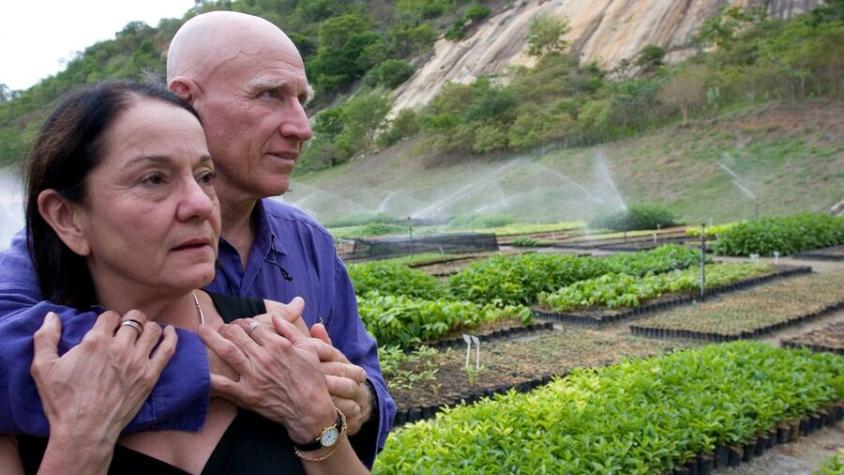
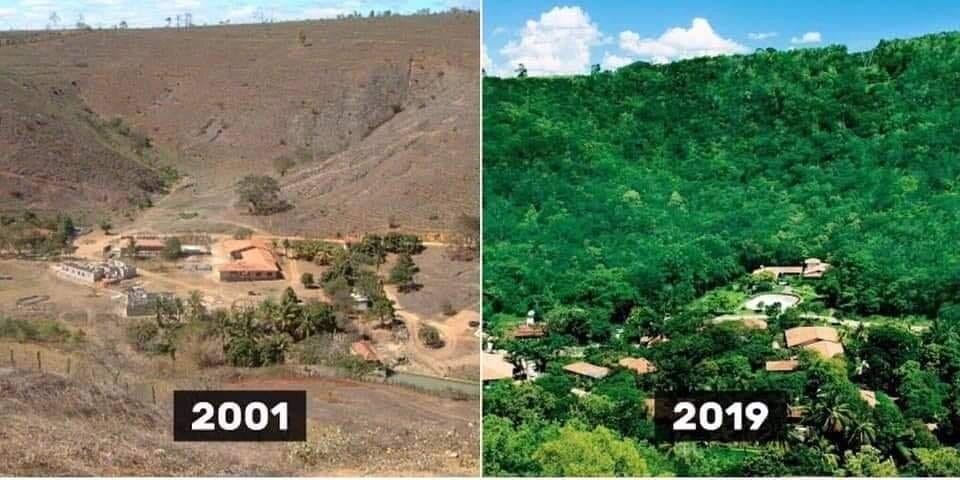
18 years ago, Brazilian photographer Sebastian Salgado* and his wife Lélia decided to reforest their 600-hectare land in Aimorés, Brazil. With their friends, they planted more than 2 million trees!
Today there are 293 species of plants, 172 species of birds, and 33 different animal species, some of which were endangered.
It was just then that his parents signed the farm over to him and his wife Lélia.
Salgado was shocked: There was nothing left of the magical forests through which he roamed as a child and first consciously perceived the magic of light and shadow.
Livestock farming and erosion had turned the farm into a lunar landscape.
“When we got this piece of earth, it was just as wounded, yes, dead as I was. Once it was an ecological oasis. When I was a kid, half of the farm was forest and I grew up in a paradise. But now there was less than half a percent forest left. “
His wife finally had the idea, says Salgado. Lélia said: “let’s rebuild paradise, let’s replant the forest.”
Vegan Conservatives welcome Business Secretary’s comments on growth of veganism
We must be the last generation to industrialise animals
The Vegan Conservatives group has welcomed Business Secretary Kwasi Kwarteng’s call for more people to give up animal products in order to meet the UK’s target of cutting carbon emissions by 78% by 2035.
Speaking to Times Radio, Mr Kwarteng, the MP for Spelthorne, said, “There are challenges in terms of people changing their lifestyle, but that is happening already, without government legislation. The number of people who are vegans, who are reducing their meat intake, is going up all the time. I think that there is a lot of societal change that will actually help us and drive the progress to 2035, where hopefully we will hit the 78 per cent reduction target.”
It’s the strongest signal yet from the Government that it is impossible to address climate change without reducing meat and dairy consumption.
The industrialisation of meat and dairy contributes a triple whammy to the environment: the emissions and pollution created by the animals themselves, the destruction of forestry to feed and graze them, and the haulage and distribution involved. That’s not to mention the £6.1bn annual cost to the NHS, the loss of food sovereignty and the obvious welfare consequences of the industry.
Co-chairman of the Vegan Conservatives, Alison Knight says, “Kwasi Kwarteng is spot on with his call for more veganism in British society. Meat and dairy are environmentally-destructive and categorically not essential elements of a healthy diet and we should follow Canada’s lead in ignoring industry-sponsored “science” in formulating Government policy.
“The alternatives to cheap meat are better for health, better for the environment, better for growers, better for food security and better for the animals – not to mention reducing the risk of global pandemics.
So-called ‘clean meat’ and plant-based meats are on the rise and will be responsible for 35% and 25% of meat consumption respectively by 2040. The Vegan Conservatives are calling for the UK’s Industrial Strategy to include incubators, National Centres of Excellence and national prizes for discoveries and commercialisation, if Britain wants to lead in these areas.
Mrs Knight continues, “Veganism is not at all a political statement – it’s an ethical and pragmatic one. As Conservatives, we want to leave the world a better place than we found it.”
London Assembly Member Andrew Boff says, “Veganism is growing by itself, but were the Government to introduce incentives to drive it, set targets and nudge societal change, those climate targets start to look considerably easier.
“Switching to an electric car is an excellent step, but it’s much more effective to stop consuming animal products.”
Baroness Anne Jenkin says, “It needs to be really easy for people to make better choices. Anybody who has made the change already feels healthier and saves money, as well as knowing that they have cut carbon emissions, so it’s a win-win. As with tackling obesity, the Government needs to make sure that healthy choices become the default option.”
Co-chairman Graham Godwin-Pearson says, “Our grandchildren will look back and wonder why on earth people chose to consume animal products, knowing the cruelty and damage that these products caused.
“People still need to eat and so agricultural reorganisation and retraining is required but the Government can help by offering conversion grants for industrial animals farmers to switch to vertical farming, and for intensive fish farmers to switch to seaweed.
“We must be the last generation to industrialise animals.”
During our campaigns in the Southern Ocean, our crews often had nice encounters with penguins. They are definitely one of our favorites among flightless birds.
But the idyllic images are often deceptive – unfortunately penguins don’t have it easy either: climate change, overfishing, and the destruction of their habitats are affecting penguin populations all over the world.
There are 18 species in the world and in the video you will meet some representatives who we have already run into during our missions.
(Text on the Video): there are 18 different species of penguins some are small and some are large
they cannot fly
but are very good swimmers
and very good at waddling
we fight to protect the penguins
and all marine life
And I mean…Every year on April 25th is World Penguin Day.
It is therefore important to remember the day because it should draw attention to the fact that litter in the oceans and climate change are a threat to animals.
These sea birds are critically endangered.
Because the warming of the earth causes the sea ice to decline, the penguins find fewer and fewer krill, the small crustaceans that they mainly feed on.
Plastic garbage – the garbage from human animals – causes them – like all marine animals – great difficulties.
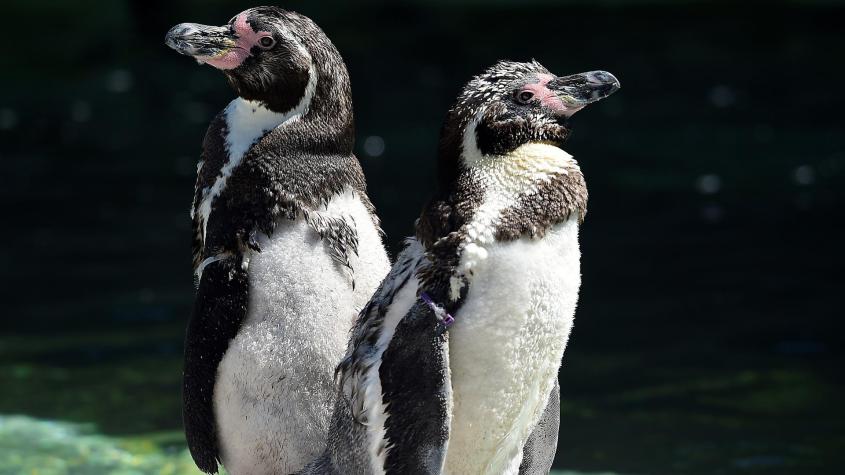
Humboldt penguins are among the most threatened species. Twice as many of them now live in zoos and animal parks as in the wild.
Humboldt penguins
By the way, not all penguins are the same.
Because of ice: not every penguin feels comfortable there, according to the WWF. Some species live in warmer regions, such as the little penguins in Australia.
penguins in Australia.
Penguins can withstand up to -70 degrees. Their water-repellent feathers and the layer of fat protect them from cooling down.
Penguins are considered monogamous and loyal.
We love these wonderful animals and want to continue fighting against the loss of their habitat.
‘Teeming with biodiversity’: green groups buy Belize forest to protect it ‘in perpetuity’
Conservation organisations purchase 950 sq km biodiversity hotspot, helping to secure a vital wildlife corrido
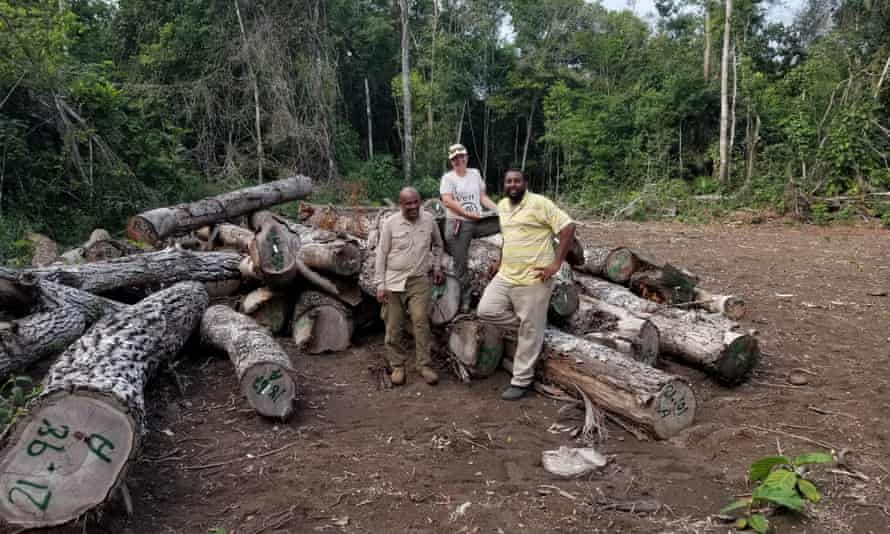
“These logs are historic,” says Elma Kay, standing in Belize Maya Forest, where she has been doing an inventory of felled trees. “These are the last logs that were cut here, for mahogany and other hardwoods, left behind by the previous logging company.”
The last felled trees in Belize Maya Forest. Photograph: Handout
“These logs are historic,” says Elma Kay, standing in Belize Maya Forest, where she has been doing an inventory of felled trees. “These are the last logs that were cut here, for mahogany and other hardwoods, left behind by the previous logging company.”
Trees will no longer be cut down in this 950 sq km (236,000-acre) area, after the land was bought by a coalition of conservation organisations to save one of the world’s last pristine rainforests from deforestation. “The forest will now be protected in perpetuity,” says Kay.
The news is timed to coincide with Earth Day, the annual event established in 1970 to mobilise action on environmental issues.
The newly named Belize Maya Forest is part of 150,000 sq km (38m acres) of tropical forest across Mexico, Belize and Guatemala known as the Selva Maya, a biodiversity hotspot and home to five species of wild cat (jaguars, margay, ocelot, jaguarundi and puma), spider monkeys, howler monkeys and hundreds of bird species.
This means we get to safeguard our biodiversity, from iconic jaguars to endangered tapirs
Elma Kay, Belize Maya Forest Trust
“The minute you start driving through the forest, it’s teeming with biodiversity,” says Kay, one of the directors of the locally run Belize Maya Forest Trust. “I can’t tell you how many ocellated turkeys we saw on the drive in – more than 50. For Belizeans, this forest means we get to safeguard our biodiversity – from iconic jaguars to critically endangered Central American river turtles to endangered tapirs – which is the lifeblood of our economy and our cultural heritage.”
Combined with the adjacent Rio Bravo Reserve, Belize Maya Forest creates a protected area that covers 9% of Belize’s landmass, a critical “puzzle piece” in the Selva Maya forest region, helping secure a vital wildlife corridor across northern Guatemala, southern Mexico and Belize.
Protecting large areas of pristine rainforests will help mitigate the impacts of the climate crisis. “Forests like these hold vast amounts of carbon,” says Julie Robinson, Belize programme director for the Nature Conservancy, one of the partners behind the acquisition. “We’re at a tipping point, so it’s really important to try to reverse the trend we’re on.”
The area was owned by the Forestland Group, a US company that had permits for sustainable logging. When it came up for sale, the Nature Conservancy and others, including Rainforest Trust, World Land Trust, University of Belize Environmental Research Institute and Wildlife Conservation Society, saw an opportunity to buy the land.
“If it wasn’t bought for conservation, the most likely buyers would be for large-scale, industrial, mechanised, monocrop agriculture,” Kay says. “That’s the threat to forests in Belize, especially central Belize, the country’s agricultural belt. What we saved this land from is full-scale deforestation and conversion.”
Since 2011, the Maya Forest corridor, which connects Belize’s Maya mountains and the northern Maya lowland forests shared by Belize, Mexico and Guatemala, has faced high rates of deforestation, driven by land clearances for industrial-scale agriculture. “For decades, the Belize government, Belizeans and conservation organisations wanted to see this area protected,” says Robinson.
Despite the name, Mayans, whose civilisation once stretched across Belize, Guatemala and parts of Mexico, have not lived in the area for many years. Today, their descendants in Belize mainly live in the south. According to Robinson, indigenous peoples were not displaced to make way for industry, as has happened elsewhere in Latin America, but the private land was closed off. “At the time of the Forestland Group’s purchase, there were no people living on the property,” says Robinson. “However, there are local communities all around the property. They didn’t have access to the land.”
Belizeans have an incredible connection to nature. We refer to our country as the ‘jewel’
Julie Robinson, the Nature Conservancy
“There are archaeological sites on the property that date back to AD800,” Robinson adds. “There are also more than 25 cenotes [fresh water sinkholes], the sacred pools of Cara Blanca, which hold incredible Mayan treasures. Very few Belizeans have ever been to these areas. Those cenotes were also being threatened by agriculture. Culturally, it’s important to preserve those elements to reconnect Mayan communities to sacred sites, and also find ways of generating income through them for the communities and the country.”
Now the land has been acquired, Kay is leading the Belize Maya Forest Trust’s consultation process with local communities. Collaborative plans are likely to include low-impact eco-tourism. There may also be some sustainable agriculture, as well as scientific research. The only thing not on the table is the extraction of natural resources, such as timber.
“What surrounds Belize Maya Forest is a multi-ethnic society, including people like me, of mixed Mayan and European descent, and people from neighbouring Central American countries, German Mennonites,” says Kay. “We’re engaging all the different communities to participate in a conservation action plan. Most livelihoods are based on agriculture. One objective will be making agricultural livelihoods more sustainable, so there will be more climate-smart agriculture, agroforestry systems, systems that are restorative for soils.
“We recognise people need to make a livelihood, but it’s about doing that with values that protect the Maya Forest and safeguard it for all Belizeans.”
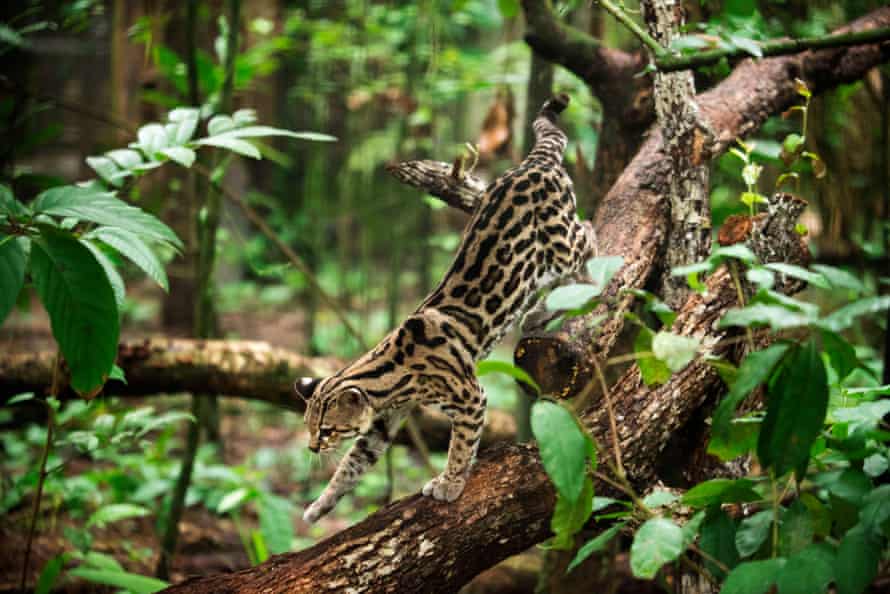
The Belize Maya Forest is home to five species of wild cat, including endangered ocelots. Photograph: Sergi Reboredo/Sipa USA/PA
As the world’s climate and biodiversity crises worsen, philanthropic buying of land for protection could become more common. “It’s absolutely the way forward,” argues Robinson. “But it’s important to do it in collaboration with communities. It can’t be that we just buy a property, lock it up and say ‘this is now protected’. That’s not going to work.”
Belize has launched several initiatives in recent years to protect its natural resources. In 2018, oil drilling off its coast was banned to safeguard marine environments and the lucrative diving industry. Nearly 40% of the country’s land mass is also under some form of protection. “Belizeans have an incredible connection to nature,” says Robinson. “We refer to our country as the ‘jewel’.”
But the government’s environmental policies are also pragmatic, based on the value nature brings, from food and water supplies to tourism, one of the country’s largest generators of income. “People realise we need to have biodiversity and nature, but we need to use it in a sustainable way,” says Robinson. “Development is absolutely important. Belizeans support development and agriculture, but in a way that is in balance with nature”.
As you read this, Cam is desperately waiting to get out of his tiny cage. He is trapped in a bile bear farm in Hai Phong province in Vietnam.
When we visited him at the farm, he was pacing around in the cage, climbing up and down and biting the bars, trying everything to escape this sad and barren environment.
We don’t know anything about his past but can see he is pretty young. He still has his whole life ahead of him.
Without help, his life would consist of nothing but the bars of this cage.
Never getting the chance to feel the grass under his feet. Never climbing up a tree. Never playing with another bear.
Nothing would make us happier, than bringing him to our beautiful BEAR SANCTUARY Ninh Binh. How excited would he be, when he discovers the huge outdoor enclosure for the first time? Experiencing all the lush vegetation, trees, climbing platforms and pools to swim in. Experiencing what a bear life can look like.
Mark, we can’t leave Cam behind, right? Will you help to free the young bear from his tiny cage?














 Humboldt penguins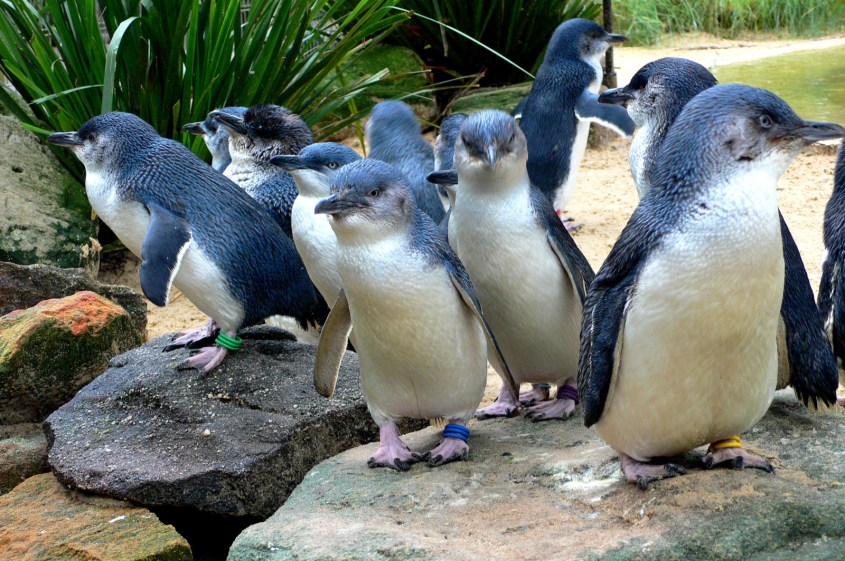

 World Animals Voice