Brutal cruelty to animals-House pigeon equipped with fish hooks:
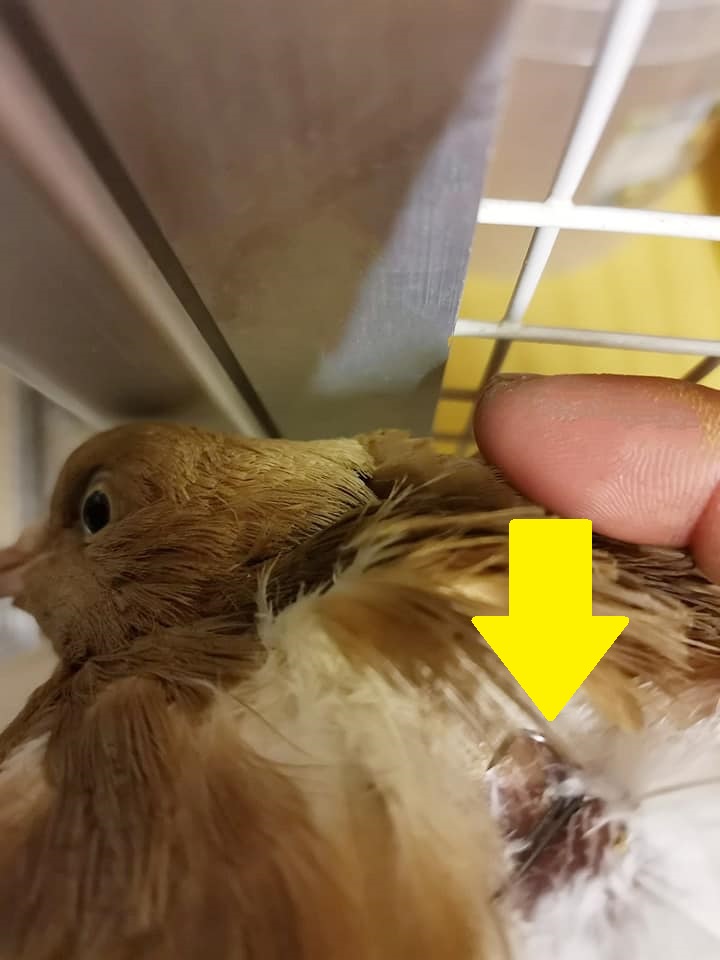
The colleagues from the association “City pigeons” Buchholz e.V. were notified of a live house pigeon that had been prepared with four fish hooks.
The razor-sharp hooks were anchored in the bird’s skin. The animal was found in the city center of Buchholz (Harburg district, Lower Saxony) and fortunately survived the ordeal largely unscathed.
Such “kamikaze pigeons” are usually used to kill peregrine falcons or hawks.
Suspects are mostly pigeon keepers who see the protected birds of prey as competitors for their hobby – namely races.
Anyone who has information in a specific case from Buchholz – for example on the possible origin of the pedigree pigeon used – is welcome to contact Buchholz city pigeons or the committee against bird murder.
And I mean…These are the same people who were concentration camp guards 80 years ago, that is to say, sadists.
They don’t keep pigeons out of love for animals but for reasons of prestige. If one of them doesn’t work, they’ll probably have their neck twisted on the spot.
I have two lolonies of pigeons in my city that I feed since two years every day- it is about 150 animals
It’s illegal in Germany, but I and my clients don’t give a shit.
But even worse than the hostile law against the pigeons is a hateful society against these peaceful animals, which calls the pigeons “Flying Rates”!
And the children of this society, the small children who learned from home “we go hunting pigeons” and terrorize the animals with kicks in places where they can get something to eat.
Obviously a moral change in society’s consciousness is not subject to an evolutionary autopilot.
In other words: what we did not understand centuries ago, we cannot understand today either.
That animals are not our slaves, not our food, not our objects of torture.
Today we are living the greatest apartheid system of all time, making the most intensive use of all technical and scientific possibilities: everything for the well-being of people and everything for the exploitation of animals.
There’s a party for pigs, and you’re invited. A unique vegan music festival, called the Orchard Pig Gig, is coming to the UK this weekend. The event is being advertised as the first of its kind worldwide.
Farm animal sanctuary Pigs in the Woods teamed up with vegan cider brand Orchard Pig to bring the concept to life.
The event will take place at the 10-acre sanctuary, located in Huddersfield, West Yorkshire. Around 20 pigs live on the property, and they will be free to roam the festival grounds and interact with attendees.
Many of the animals were saved from slaughter. For instance, Angel the pig, mother of two pigs who are also at the sanctuary, was rescued from a petting farm. Since the pig family were no longer being used, they were due to be killed.
Another resident, Harry the pig, has been saved from slaughter twice within his first three months of life. Since he was the runt of the litter, he was due to be discarded as waste. And Florence was set to be euthanized by a city farm before she found a home at the sanctuary.
‘Pigs deserve a home’
Orchard Pig Gig will feature local plant-based food, as well as jazz, rap, and classical music performances.
“Our pigs are one of a kind and love to socialize and dance to music,” said Russell Haggata, Operations Director and Chairman at Pigs in The Wood.
“They can’t wait for this year’s Orchard Pig Gig. Our sanctuary wouldn’t exist without the generosity of donations, and we’re aiming to raise over £50,000 to improve the facilities for our pigs so that everyone can experience the joy these animals can bring,” he continued.
Emily Gray, Brand Manager at Orchard Pig, added: “Just like people, pigs deserve a home, and we believe they also deserve to party.”
Animal exploitation sites are some of the most hideous in the world and their doors are always tightly locked, but there are facilities that are even more impenetrable than others: slaughterhouses.
The undercover agents’ cameras document insights that television cannot get and in which atrocities are the order of the day to show what is really going on behind the walls of these places.
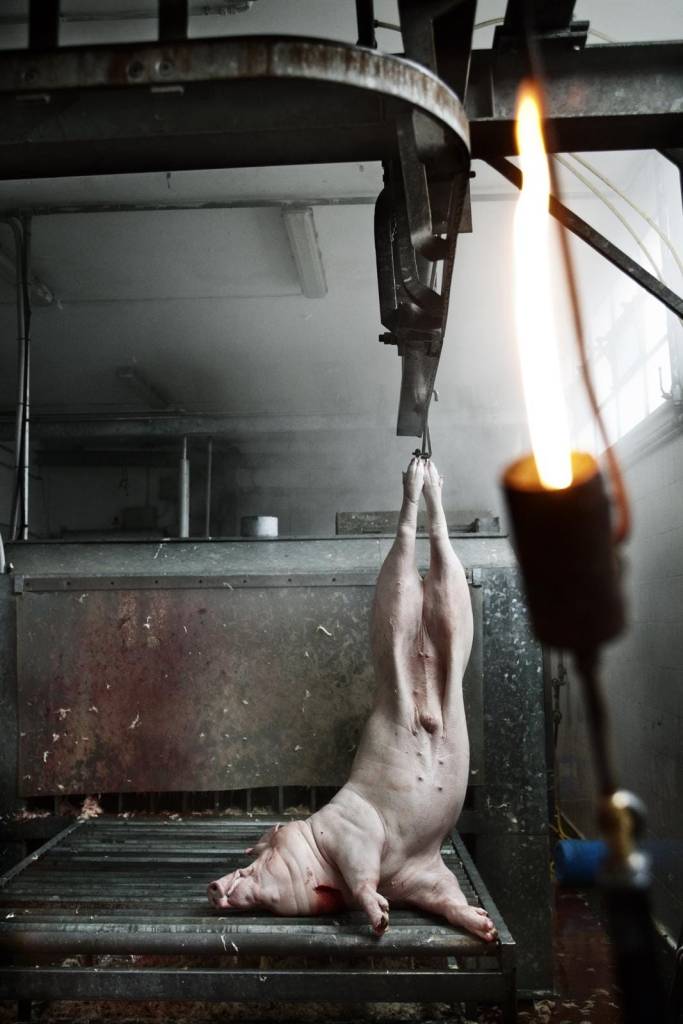
Slaughterhouses around the world hide a cruel and painful reality: billions of animals such as pigs, cows, calves, chickens, rabbits, sheep and fish are brutally killed every day, regardless of their suffering.
The stunning methods are mostly ineffective and cause terrible agony for the animals, who first witness the killing of those in front of them and are then killed themselves fully conscious.
Inadequately equipped facilities, disregarded quality standards, violations of animal welfare laws and hygiene regulations, as well as abuse and mistreatment of animals are the rule.
Animal Equality’s international team has been documenting the cruel practices that the meat industry hides from its consumers for several years in slaughterhouses around the world: in Mexico, Brazil, Spain, the UK, and especially in Italy, where 10 out of 17 are undercover Research has been carried out worldwide.
Recently, the living conditions of animals condemned to be slaughtered are finally gaining more and more public attention, as the latest news from Mexico shows, for example: The Congress of the State of Pueblahas almost unanimously passed the bill to ban illegal slaughterhouses and the slaughter of animals without stunning assumed.
The wind is turning, and that’s also thanks to our investigative work, which we carry out with full determination.
Additional information: in the last few years the scandals in slaughterhouses in Germany have increased, one scandal follows another.
The SOKOanimal welfare association has delivered several undercover investigations to the authorities and to the public. Consequences: Sometimes a slaughterhouse closes and opens the next year next door again.
SOKO Tierschutz-Mecke-Germany
The association SOKO carried out an undercover investigation in a butcher’s company Mecke in North Rhine-Westphalia from May to July 2021.
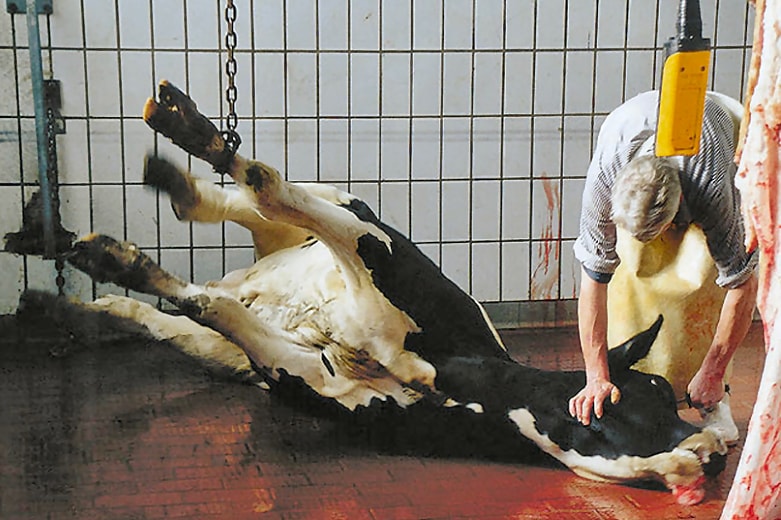
This last undercover is a fatal reminder of the scandals surrounding slaughterhouses that specialize in the illegal slaughter of sick and injured dairy cows.
In the past few months, animals have been systematically mistreated in an animal facility belonging to the Mecke company network.
SOKO-Tierschutz-Mecke-Germany
Workers beat emaciated animals in the most brutal way and to the point of unconsciousness, a sick calf is kicked and dragged by the ears, electric shocks are illegally distributed, cows are dragged around with the winch while fully conscious, and animal experiments are even suspected , because the company apparently trades in the blood of the weakened animals.
The blood is drawn from the animals by the liter while they are still alive, while the animals are still tortured.
SOKO-Tierschutz-Mecke-Germany
A process that counts as a reportable animal experiment.
The Mecke employees comment on this as “emptying” and know that animals are finished after this ordeal and often can no longer get up.
In addition, pictures are shown of small children who beat the cattle with poles
It is now evident that the ridiculous penalties in animal welfare processes are zero deterrent.
The cruelest perpetrators simply moved a few kilometers further, and the veterinary office once again doesn’t know anything – that’s how animal welfare works in Germany. “A major failure of politics and the judiciary,” said SOKO spokesman Friedrich Mülln.
The video is hard, as hard as the reality in slaughterhouses made possible by criminal butchers and corrupt authorities.
For decades this has happened thousands of times and every day in Germany under political fraud, series lobbyism and a powerful meat mafia that has nothing to fear.
People love defining another’s suffering in manners that provides them personal comfort and not the actual victims; animal exploitation is bloody, abusive, violent, and the cause of unimaginable fear and suffering regardless of how aesthetically appealing humans disguise it. If you get angsty by grammar that legitimately describes the horrors animals experience, just remember that nobody takes their beloved cat or dog to be “humanely euthanized” in a slaughterhouse, nor are companies/animal farmers/execs happily transparent regarding this “process” by sharing footage of the gruesome, bloody, agonizing “end” of animals: in fact, the exposure of slaughterhouses is typically only from undercover exposes, former employees, or unnamed current employees. (Although there are some slaughterhouses that film the graphic, fearful, and agonizing killing of unwilling, terrified, innocent animals, the problem is, nobody watches the footage. Who wants to, though, when you can remain willfully ignorant of the violence you inflict on innocents?
And, too, why is footage even needed when the reality of slaughterhouse existences …. well …. exists? It’s a slaughterhouse, its purpose is to kill as fast, as many, as cheaply and efficiently as possible, why people believe that good things happen is one is bizarre.) Stop pretending that just because you’re afforded the privilege of associating violence and pain endured by docile, gentle animals, with pastoral, peaceful, and caring descriptions to provide you comfort means it’s comfortable for the victims: it’s NOT. YOU don’t have to physically suffer the consequences of your delusional grammatical validations, the animals DO regardless of your willful ignorance.
Source Surge Right now, all around the world, the animal farming industries are working with politicians to try and get certain terms banned from being able to be used by plant-based companies. With the EU considering a piece of legislation that could make it illegal to use phrases that “imitate or evoke dairy products”, even if the composition or true nature of the product or service is indicated or accompanied by an expression such as “style”, “type”, “method”, “as produced in”, “imitation”, “flavour”, “substitute”, “like” or similar. This could make it illegal to even say ‘does not contain milk’. Yes, that’s right, we’re not even joking. We wish we were. But this got us thinking about the words the meat, dairy and egg industries use and how they themselves hide behind euphemisms to disguise the reality of their industries. So here’s our round-up of the words the EU and other politicians should be looking to ban, if that is, they do actually care about consumer confusion.
Slaughter or processing? If we said to you, what word would you use to describe hanging an animal on a kill line and pulling a knife across their throat, what would you say? Well, if you were a farmer you would call that processing. The animal exploitation industries have a real problem saying that water is wet. In fact, in 2019, at their annual conference, New South Wales farmers voted for the complete exclusion of the word slaughter and for it to be replaced with the word processing. Why? Because in their view the word slaughter is used to create emotions that discredit animal farming industries and undermine trust in animal farming. One farmer stated: “The word slaughter is not appropriate for our industry… it’s not mass murder.” Whatever helps them sleep at night. But this is a common term used by animal farmers, with slaughterhouses often referred to as meat processing plants. Avoiding the word slaughter seeks to detach the consumer from the reality of what happens to animals by instead using words that allow us to psychologically distance ourselves from what we are paying for. After all, would you rather pay for an animal to be processed or slaughtered?
Mass slaughter or depopulation? At the beginning of the Covid-19 pandemic, many slaughterhouses were forced to close due to outbreaks among the workers. One of the most notable was the Smithfields slaughterhouse that supplies around five per cent of all pig flesh in the US. This caused huge problems in the supply chain. So the next question is, what do you call killing hundreds, even thousands of lives in quick succession because you can’t sell them to have their throats cut? Depopulation. But in reality, depopulation is just a friendlier way of saying mass extermination on farms, which is exactly what it is. One way in which animals are slaughtered en masse by farmers is called ventilation shutdown, where the air supply is cut off to the barns filled with animals. This in turn causes the heat to increase to intense levels causing the animals to slowly suffocate and roast to death at the same time. This method of mass killing is even endorsed by the American Veterinary Medical Association, whilst at the same time they call it unacceptable to leave dogs in cars. Why? Because the temperature will increase which will cause the dog to suffer and die. After this process was exposed by hidden camera footage, the National Pork Producers Council said in an email: “We definitely need to come up with a new name to describe this.” Yet again showing how deliberately these industries attempt to hide the things they do. Other methods of on-farm mass slaughter include pumping foam throughout the barns blocking the airways of the animals causing them to suffocate to death, or using carbon dioxide, where the farmers turn the barns into large gas chambers or create smaller gas chambers in which the animals are gassed to death. By using the word ‘livestock’ we are viewing these animals as mere products, commodities who can be traded and profited from. In essence, it seeks to deny the animals their individuality.
“Euthanasia” Next word. What do you call the act of picking up a piglet by their back legs and slamming them against a wall or the floor to kill them because they’re not growing fast enough or aren’t worth spending money on for veterinary care? Farmers call this euthanasia. But when we think of animals being euthanised, we think of our companion animals being peacefully ‘put to sleep’ because they are severely ill. Well, farmers will describe killing an animal on their farm as euthanising the animal as if it is a merciful act, but instead of it being done in the animal’s best interest, it is done in the farmer’s financial interest. The most common methods of killing birds on a farm include blunt force trauma, which involves hitting an animal over the head until they are dead, neck dislocation, carbon dioxide gassing either head only or in gas chambers, or a captive bolt. For mammals, the most common methods include captive bolts, blunt force trauma, gassing, electrocution or a bullet. But the issue of euphemisms is even more normalised than this, to the point where some of the most common words used to describe animal exploitation actually contribute to the objectification of animals. For example, the term livestock.
Sentient individuals or livestock? By referring to animals as livestock, animal farmers are attempting to create a distinction between the animals they farm and the animals that exist in the world. It essentially ‘otherises’ the animals we exploit and attempts to put them into a different classification, which further perpetuates the idea that it is acceptable to exploit and kill these animals. For example, if you ask someone, “is it acceptable to kill livestock?”, most people will say yes. But if you ask “is it acceptable to kill animals?”, people’s responses would often be very different, even though the question is the same question. However, morally there is no difference between killing a pig or killing any other animal we don’t classify as livestock. This is how ‘othering’ works.
We view the animals we kill as being different and refer to them differently so as to make what we do to them more palatable and less likely to expose our cognitive dissonance. By using the word ‘livestock’ we are viewing these animals as mere products, commodities who can be traded and profited from. In essence, it seeks to deny the animals their individuality. What about the names of animal products themselves, many of which are also named and referred to in a way that disconnects us from the reality of who we are eating? Even though the origins of many of these words can be traced back hundreds of years, referring to animal flesh as meat, pig flesh as pork, cow flesh as beef and baby cow flesh as veal, among others, further detaches us from having to think about the animals whose bodies we are purchasing. Imagine if supermarkets had flesh aisles, rather then meat aisles. Or if instead of bacon, we bought sliced pig flesh with extra fat layers. By turning animals into objects, classifying them differently and using different words to describe them when they are living and when they are dead, it allows us to avoid the discomfort caused by thinking of them in gas chambers or hung up on the kill line about to have their throats cut.
Whether we realise it or not, the animal agriculture industries have been purposefully trying to trick consumers for years, and their on-going attempts to try and censor plant-based companies further proves how worried they are about the prospect of informed consumers making their own decisions.In the end, consumers aren’t being misguided by clearly labelled plant-based alternatives, they are being lied to and deceived by industries that are desperate to keep the objective reality of what happens to animals out of sight and out of mind.
Download Your FREE Vegan PDFHERE Order a FREE vegan kit HERE Dairy-Free Info HERE Take the Dairy-Free Challenge HERE Click HERE for more Dairy-FreeFish alternatives can be foundHERE Learn about eggsHERE Find bacon alternativesHERE and HERE Take PETA’s Cruelty-Free Shopping Guide along with you next time you head to the store! The handy guide will help you find humane products at a glance.
Order a FREE copyHERE Searching for Cruelty-Free Cosmetics, Personal-Care Products, Vegan Products, or more? Click HERE to search. Free PDF of Vegan & Cruelty-Free Products/Companies HERE Click HERE to find outHow to Wear Vegan! Want to do more than go vegan? Help others to do so! Click below for nominal, or no, fees to vegan literature that you can use to convince others that veganism is the only compassionate route to being an animal friend: PETA HEREVegan Outreach HERE Get your FREE Activist Kit from PETA, including stickers, leaflets, and guideHERE Have questions? ClickHERE
To highlight the reality of life for sows living on a factory farm, Dutch filmmaker Eline Helena Schellekens and editor Kate Morgan, have released a new, short film – ‘Motherhood’, which was commissioned by Compassion (CIWF).
‘Motherhood’ comes after the award-winning short film ‘M6NTHS’, from Eline Helena Schellekens, which told the story of life on a factory farm from a piglet’s point of view.
We ask for the prohibition of the forced molting of chickens in Mexico.
New research documents the cruel practice of forced molting in the Mexican egg industry where chickens go up to 7 days without water and food.
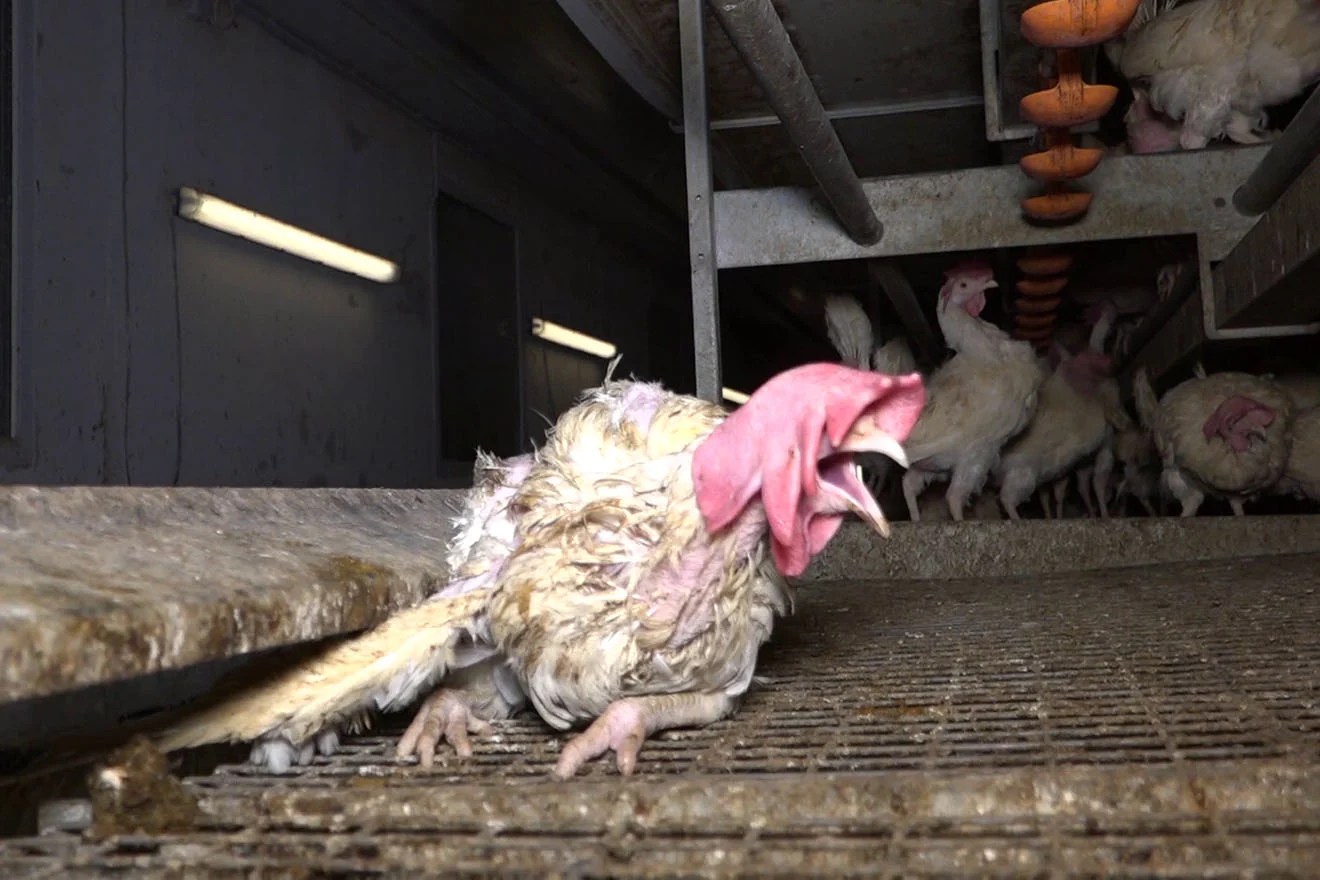
In Mexico there is still a practice, prohibited in Europe, that makes hens used for egg production suffer beyond the serious consequences of being kept in cages for life. It is about the Pelecha or Forced Muda by fasting.
A cruel practice that consists of depriving the hens of water and food for 7 days to accelerate their next laying cycle so that they can be exploited for a longer time, causing them great suffering.
Up to a third of them die during or after the fast.
The Animal Equality Researchers have documented this practice of forced molting so that society knows what happens on the farms and supports the legal initiative that we have presented in Mexico.
A 7-day fast has serious consequences for chickens:
-1 in 3 die during and after the process.
-The most basic needs of animals, such as food or drink, are taken from them in the name of financial gain.
-Demineralization in their bones that aggravates the injuries and diseases they suffer in their legs due to being confined in cages.
-Dehydration and extreme suffering.
-Depression of their immune system that makes them susceptible to developing diseases such as salmonella enteritidis, Escherichia coli and avian typhoid.
-Dermatitis that is aggravated by the loss of feathers.
-Increase in aggressions among chickens that cause wounds that are not treated by veterinarians.
-Total limitation of any natural behavior in chickens such as stretching their wings or walking.
The hens that survive are regrouped in cages with other hens with which they have not lived, this has a great impact on the birds since they will be crowded with others they do not know and added to stress, hunger and thirst, social problems arise and the spread of disease.
THE INITIATIVE
The bill presented in the Congress of Jalisco and for which a positive opinion has already been approved is unprecedented in Mexico because it is the first that seeks to include a chapter on Animal Welfare in the Law for the Protection and Care of Animals of the State of Jalisco in favor of animals used in industrial livestock.
It includes:
-Provide welfare to all animals intended for supply or consumption without making distinctions or exclusions.
-Prohibit forced molting through the deprivation of food and water in chickens used for egg production.
-Define the cage-free system and order the implementation of a State Standard.
-To urge the creation of the Official Mexican Standard for the production of Cage-Free Eggs.
-Seek a greater professionalization of the handling of animals by specifying that only registered operators and in the presence of a veterinarian can perform painful interventions.
Forced molting by fasting has been prohibited in the European Union and India, but in Mexico there is still this practice completely incompatible with animal welfare.
And I mean…Millions of animals in this modern concentration camp are mistreated, tortured and killed.
These affected animals suffer and die for all who eat their meat and eggs.
These animals do not vegetate there voluntarily.
The sacrifice of their freedom and their life is forced out by force.
All of these animals feel and think.
They feel fear and pain, joy and hope, lead a conscious life and want to grow old with their feelings and thoughts.
Therefore, they have a natural right to their life and to protection from torture.
Factory farming all over the world is a legalized crime, to which the power enables, but no morality justifies.
In this industry, the right of the fittest shows only its most hideous grimace.
We have to give animals back their rights.
For decades we have been calling for an end to the cruel and monstrous factory farming, in Europe, many “organic” stables with cows or bigs are not looking much better than in Mexico.
But hope grows under the struggle of the animal rights activists.
Years ago, such initiatives would have been unthinkable.
The power of the system is crumbling.
Ok, we will take back our own control and stop live animal exports !
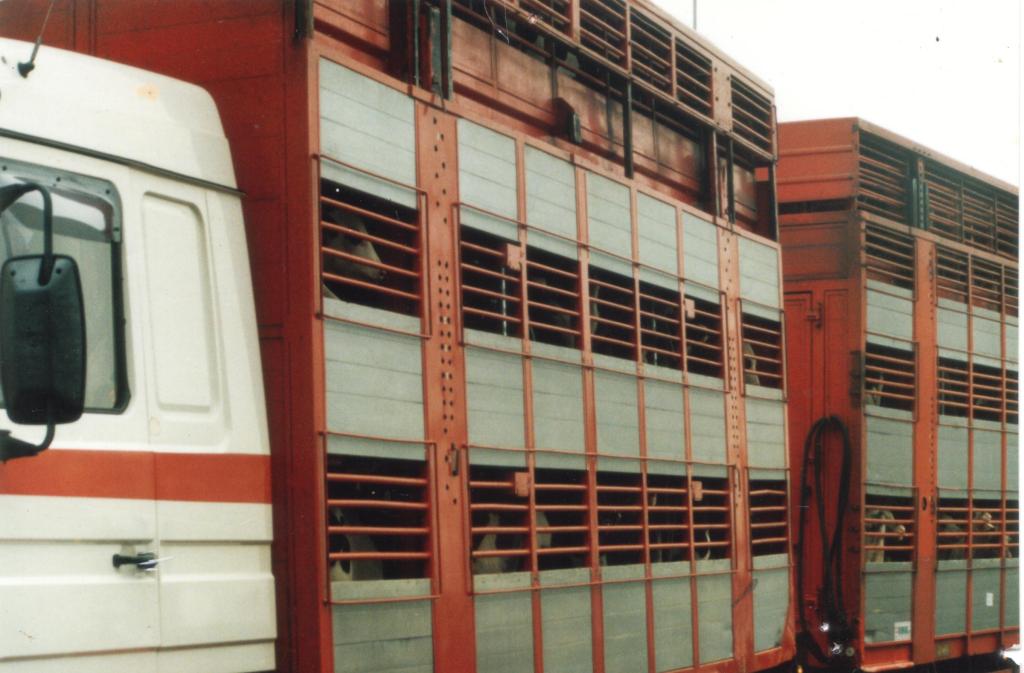
In 2019 over 1,600,000,000 (One thousand, six hundred MILLION) ovines (sheep), bovines (caattle), poultry and pigs were transported alive across the European Union and to non-European (EU) countries. Journeys can last several days or even weeks, exposing animals to exhaustion, dehydration, injury, disease and even death.
Routinely, investigations on live transport both via sea and road find serious breaches of the utter farce which is known as Council Regulation 1/2005 (Transport Regulation); supposedly for the ‘protection’ of animals in transport.
Official audits confirm NGOs’ investigations findings. In 2017, 2018, and 2019, DG SANTE audited 11 Member States and visited Turkey: shortcomings with different levels of severity were found in the majority of them concerning transport both via sea and by road. For instance, the audits carried out in France, one of the biggest EU exporters of live animals, concluded that “the measures in place do not provide satisfactory assurances that exports of live animals operate smoothly and that these journeys are correctly planned and carried out in line with animal welfare requirements to prevent causing unnecessary pain, suffering or injury to the animal”. Particularly problematic is when trucks and vessels load very young animals that are still on milk dietary (unweaned animals).
WELFARM and AWF followed a truck loaded with 155 young calves being transported from Poland to the Franco-German border. Investigators found that the animals were kept in the truck for 20 hours, with no breaks or unloading and no access to water and food, in clear breach of the Transport Regulation detailed above.
It’s even worse in the summer months, when temperatures as high as 30 degrees Celsius create hellish conditions, causing even more health and welfare problems to the animals being transported. Over this period the demand for live animals by third countries increases due to the ‘Festival of Sacrifice’. As a consequence, large numbers of live sheep and cattle are sent to the Middle East via European ports (Cartagena, Midia, Rasa, and Sete are the major exit points for live export) and the Bulgarian/Turkish border, which remains a hotspot with crisis happening every year.
In the past years we have seen the ineffective EU Commission sending letters to the ineffective EU competent authorities warning them about the risk for animal welfare related to the high temperatures. With some exceptions, its calls remained unheard over the years.
The case of Romania is emblematic: a DG SANTE audit revealed how poorly the country is implementing the EU Transport Regulation, moreover it exported 70,000 sheep in disregard of legally binding animal welfare standards and the call of the then EU Commissioner V. Andriukaitis to stop that operation.
In addition to these long journeys impacting the animals welfare, they’re also badly treated by operators with inadequate equipment. Recently we witnessed what happens if one of these ships perishes: the death by drowning of both animals and human beings. Also, organisations have shown that upon arrival in third countries, the majority of the animals are handled in a brutal manner and slaughtered without stunning.
A recent investigation revealed the cruelty with which French farm animals are treated when they reach slaughterhouses in Morocco and Lebanon.
The transport of live animals to non-EU countries is particularly problematic. Besides the problems at departure, the animals have to endure very long journeys in countries where they cannot benefit from the legal protection they receive in the EU. As confirmed by the cases of the animals on board the vessels Karim Allah and Elbeik, very often contingency plans do not exist, regardless they are mandatory by law.
Despite the verdict by the Court of Justice of the European Union (CJEU) establishing mandatory compliance with the EU Transport Regulation provisions until final destination regardless of this being outside the European Union, it is impossible to monitor such a compliance.
De facto this trade continues regardless of the lack of information by Member States and the EU Commission on whether these countries implement EU animal welfare transport standards
Photo – Mark (WAV)
SO, WHAT DOES THE PUBLIC THINK?
Live animal transport emerged as one of the top concerns for EU citizens “for the future of agriculture, fishery and food production in Europe”, in the latest Future of Europe survey.
This was also demonstrated by the success of Eurogroup for Animals’ StopTheTrucks campaign in 2016-2017, which exceeded its target of one million signatures.
POLICY – CURRENT STATE OF PLAY
To allegedly ‘protect the welfare of animals during transport’, the EU set a series of requirements in the Transport Regulation, which entered into force in January 2007 and applies to all the transport across and from the EU. As recently confirmed by the EU Parliament Implementation Report on this matter, the Transport Regulation is outdated and very unevenly implemented.
To shed light on this situation, in 2020 the EU Parliament set up a Committee of Inquiry on live transport to assess the responsibilities of the EU Commission and the EU Member States in implementing and enforcing the Transport Regulation.
Meanwhile, the EU Commission announced the revision of the Transport Regulation in the framework of the EU Farm to Fork Strategy. To make sure the revised text will enhance animal welfare and support the building up of a sustainable food production chain, Eurogroup for Animals wrote a White Paper ‘Live animal transport: time to change the rules’. The paper provides the EU Commission and the EU co-legislators with species- and category-specific provisions and ad-hoc definitions, to ensure the welfare of all the animals transported alive.
Photo – Mark (WAV)
What we (Eurogroup for Animals) want.
Eurogroup for Animals urges the EU to use the revision of the Transport Regulation to introduce both a ban on the transport of live animals outside its borders, and stricter species-specific requirements for transport across the EU (including species-specific maximum journey times).
Additionally, the EU should work on a strategy to shift from live transport to a trade of meat and carcasses as well as genetic material.
What we at World Animals Voice (WAV) want.
At the very least, a complete end to all animals being exported live outside of EU borders.
A priority to be made for trade in carcass meat ‘on the hook, not the hoof’ to take maximum priority over live animal transport to be initiated by the EU.
A one off maximum journey time throughout the EU of 8 hours or less to be applicable for ALL species destined for live transport.
Major emphasis to be placed on a shift throughout the EU for meat and carcass to replace the transport of live animals. Empahasis t be made on plant based foods.
A much needed major review of the paltry regulations defined in Reg 1/2005 on the so called ‘protection’ of animals in transport for animals undertaking an8 hour one off maximum journey.
Guarantees from the EU that all member states will comply with animal transport regulations. Words are not enough, we want actions – member states such as Romania, who are shown to be non compliant, must be banned from the transport of all live animals.
Now that the UK has left the EU (Brexit), and become an independent state once again able to make its own legislation free from the EU, it is currently progressing with an introduction of formal parliamentary legislation which will end the export of live animals for slaughter and further fattening.
Like all UK parliamentary actions, the draft legislation passes between the House of Commons and the Lords, and is scrutinised and amended, until both houses are happy with the draft, which then moves to become formal legislation (law).
Obviously, these actions take time, but they are currently in progress, and soon we hope to announce that the UK has formally stopped the live exports of animals.
But the work for campaigners does not stop with this, which will be seen as a massive victory for animals. Under the EU, live farm animals will continue to be exported. So major attention and actions have to be give to EU campaigner friends to get the ban across the EU.
Pipe dreams ? – maybe, but then a few years back if anyone had said that there was going to be an EU act to ban the caging of farm animals, they would have been laughed out of town. Now it has formally been decided n by the EU, so the hope for very serious actions re live animal transport in Europe is another major campaign. We are confident; like the cages, the EU has to listen and act to its citizens if it wants to retain any credibility.
Like the cage ban, for live exports, it’s time to evolve !
Exploring EU-China cooperation to improve animal welfare and food systems
22 July 2021
News
On 13 July, Eurogroup for Animals and the Good Food Fund hosted the 9th UNFSS China Dialogue. The event, which gathered participants from the political, business, academic and NGO sectors, explored how the EU and China could cooperate to improve animal welfare, and therefore transition towards more sustainable food systems.
During the webinar, experts stressed the growing importance of animal welfare for consumers, both in China and the EU, paving the way for the EU and China to collaborate on the topic.
Participants also highlighted the importance of animal welfare in achieving sustainable trade and the UN Sustainable Development Goals, as well as the interlinks between animal welfare and human health.
With the publication of the EU’s “Farm to Fork” strategy aiming to foster the transition towards Sustainable Food Systems, and the subsequent announcement made by the European Commission on a future ban of caged productions – which should be applied by 2027, including possibly to EU imports – the momentum has never been so high for the EU and China to put animal welfare high on their agenda for cooperation.
As noted during the event by Zhao Wanping (NPC delegate), animal welfare draft bills are now submitted every year in China, suggesting that the country is willing to achieve progress on animal welfare. In that context, experts noted that the EU animal welfare requirements for imported products may serve as a catalyst for improving the welfare of farm animals in China, rather than a trade barrier.
Topics of discussion further focused on how to improve food systems through policies and regulations. Increased animal welfare standards were identified by experts as a way to deliver not only sustainable food systems, but also consumer health, ecological balance and food security. From a trade perspective, experts noted that aligned animal welfare standards between the EU and China would grant a competitive advantage to businesses on both sides. The last part of the event was centered on the role of public awareness, with speakers emphasising the significant increase of animal welfare awareness among Chinese consumers, particularly among the young generation.





 SOKO Tierschutz-Mecke-Germany
 SOKO-Tierschutz-Mecke-Germany
 SOKO-Tierschutz-Mecke-Germany