Our partners at the New Zealand Animal Law Association have been reviewing the High Court judgment and considering the impact such a landmark ruling will have. We have certainly won the biggest and most important challenge for mother pigs – however the battle for justice is not over yet.
When we received the judgment on Friday, we also heard that our opposition in this case – the Minister for Agriculture, Hon Damien O’Connor and the National Animal Welfare Advisory Committee (NAWAC) – would have 20 days to appeal the ruling.The Code of Welfare for pigs must now be amended – this is a crucial piece of legislation that determines how pigs are treated. The amendment of the Code of Welfare cannot be rushed.
Lastly, as with battery cages, farrowing crates will likely be subject to a phaseout period to allow farmers to transition to new farming systems or to leave pig farming altogether. The phaseout of farrowing crates will not happen overnight.
From the beginning of this campaign, we have promised not to give up on mother pigs, and we meant it – with your help we will keep the pressure on the Minister of Agriculture and NAWAC to amend the Code of Welfare and to implement a fair phaseout plan to end the use of farrowing crates for good.
Justice has been served, and we will be watching closely to make sure our Government follows through.
I will keep you updated as I receive more information.
Until then – for the pigs, Debra Ashton Chief Executive Officer
New York could really use the COVID vaccine Trump‘s threatening to withhold … the Big Apple’s still seeing unsanitary practices in wet markets, and it’s on video.
The latest gross-out spectacle was on full display in Queens, where folks with the animal rights nonprofit, NYCLASS, caught a glimpse of what’s still going on in our domestic one-stop-shop slaughterhouses and live animal factories.
In the gnarly footage, you see an unattended dumpster absolutely overflowing with trash bags, which appear to be packed to the gills with cut-up animal parts … you can see a severed chicken head in a bag at the top of the heap as the dumpster sits out in the open on a sidewalk.
Not only that … check out the blood leaking from the dumpster and flowing into the street, filling up cracks in the pavement like a mini river and puddling up.
We’re told the dumpster is outside the same wet market where a similar scene was filmed back in May, so it seems like nothing has changed.
NYC and the rest of the country are dealing with another COVID wave, so it’s pretty harrowing to see these unsanitary conditions still in practice.
It goes without saying, this is a massive public health risk 8 months into the pandemic.
We’ve seen several of these wet market operations from coast to coast, like this stomach-turning scene in California.
Trump likes to talk about red states and blue states … well remember, wet markets are also operating in ruby-red Texas.
Ya gotta wonder why these issues aren’t being talked about on a national level … this is supposedly how COVID got started in the first place, right? Seems most politicians don’t wanna get near this, for whatever reason. So, the question is, why?
NYCLASS executive director Edita Birnkrant says she constantly files complaints with regulators and contacts politicians and health officials, but nothing ever happens.
❌💔‼ ️ Born to suffer – suffered to die: The millions of murders in German slaughterhouses
🦆 15.9 million ducks
🐔🥚 32.1 million laying hens
🦃 34.2 million turkeys
🐖 55.1 million pigs
🐔 620.5 million broilers
🐄🐑 5.2 million other animals (e.g. cattle, sheep, goats, geese, horses)
‼ ️ More than 763 million living beings died an unspeakably cruel death within the German slaughter machine in 2019! 👇
https: //albert-schweitzer-stiftung.de /…/ Schlachtzahlen …
Creatures are capable of emotions and suffering who wanted to live – produced, tormented, robbed of their natural treasures and murdered – only to end up packed or marinated in the freezers of local supermarkets and fresh food counters – and with their tortured bodies to satisfy our society’s hunger for meat!
Over 763 million creatures were born because of their death and whose individual needs were completely disregarded.
Their only aspiration was to thrive, love, and LIVE!
💔🐮🐷🐔 Lovable individuals who, during their far too short life, have mobilized all their resources to survive the rawness and cruelty of the system which, without being asked, has degraded them to the slaves of human consumerism.
❗️ Born to suffer – suffered to die❗️
Boycott systemic torture & mass murder – renounce meat and animal products❗️
👇Go🌱Vegan👇
Follow us & stay up to date. Animals United e.V.– For animal rights. Because pity is not enough!
And I mean…Animal welfare in Germany can look back on around 150 years of history and its structure is still valid today.
And yet this animal protection law has not prevented all the billions of mistreatment and destruction of animals in slaughterhouses, factory farms, in animal experiments, in zoos and circuses.
It declared as justice what is an injustice!
Animals can suffer at a very high level that can go beyond physical pain.
So it’s the shitty lives of millions of these animals that we mean when we talk about meat consumption. You don’t need a highly developed intelligence to understand it.
Humans are only one of many living beings on this earth who have the same right to live here in freedom as other living beings.
This human-animal is therefore in no way something better but has simply taken this fascist right to determine the life and death of other animals.
In any case, we know that we do constant bestial cruelty to animals day after day even if we take food as an example.
If a civilized person does not feel that this is a reason to be ashamed, then it is more a testimony to the shit moral development of this person.
PETITION TARGET: Republic of the Philippines Department of the Interior and Local Government
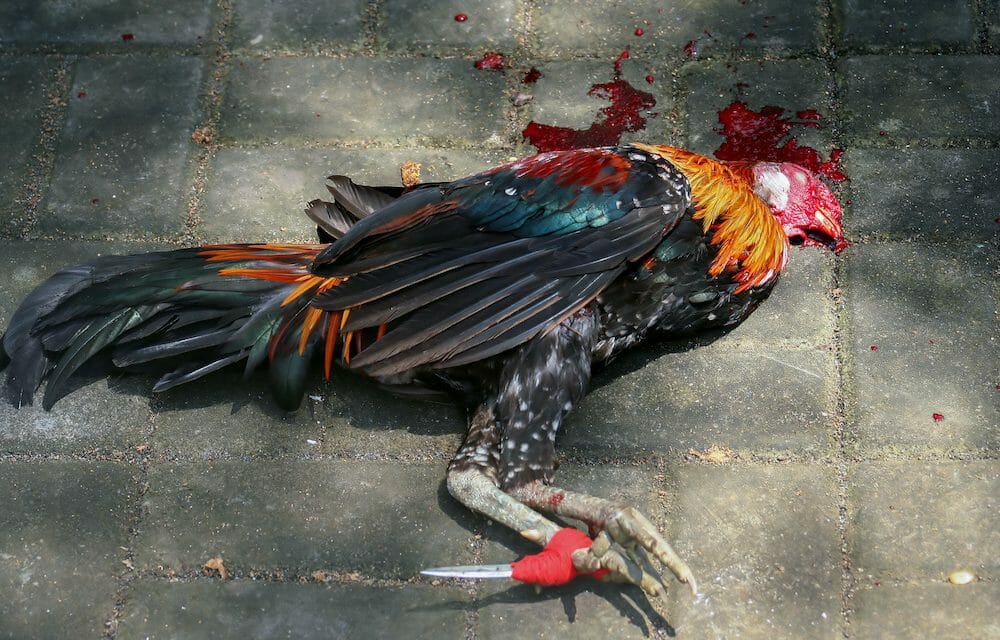
A local police officer lost his life after a razor-sharp metal spur slashed his femoral artery during an illegal cockfighting raid.He bled to death within minutes, according to the New York Times.
These spurs, known as ‘gaffs,’ are used by roosters in vicious one-on-one cockfightingdeath-matchesin the Philippines.
This gruesome tragedy highlights the inherently deadly nature of cockfighting, which forces roosters to wear dagger-like attachments and shred each other to pieces until one of them dies. If the terrified birds try to escape the enclosure, they’re shoved back into the fighting ring against their will.
Spectators place bets on the winners and watch as the birds stab and kill their opponents, gouging out eyes, breaking bones, and puncturing organs.
Cockfighting is legal in the Philippines. But certain events, including this cruel blood sport, are temporarily banned due to coronavirus-related fears.
It’s time for an end to cockfighting, which needlessly kills countless innocent birds and risks human health and safety.
Sign this petition urging the Department of the Interior and Local Government to issue a permanent, nationwide ban against cruel cockfighting events.
Report warns that supermarket chicken risk ‘catastrophic’ new pandemics
16 November 2020
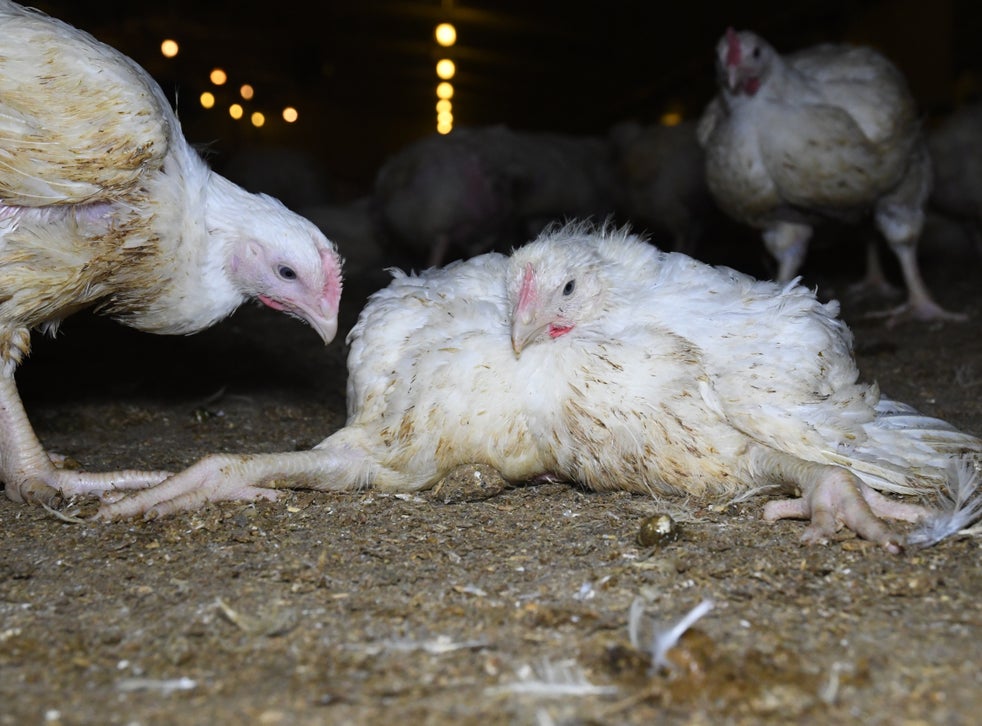
Intensively reared chicken for meat from supermarkets including Tesco, Sainsbury and the Co-op is creating an ideal environment for new pandemic viruses to emerge, a report warns.
The authors of the report warn that a new bird flu virus with “high transmissibility” would make COVID-19 appear mild claiming that supermarkets are primarily responsible for this “cruel and dangerous” system, because to keep prices low, they reportedly buy chicken from farms with overcrowded conditions that mean disease can spread easily.
They also allegedly use breeds engineered to grow unnaturally rapidly, known as “frankenchickens”, that are “practically unable to ward off infection when it strikes” because their immune systems are so weak.
Nearly a billion broiler (meat) chickens a year are reared in the UK, making it the country’s most-farmed land creature.
———————–
Cheap supermarket chicken risking ‘catastrophic’ new pandemics, report warns
Exclusive: Bird flu viruses more frequent than ever, and a highly infectious one ‘would make Covid-19 look mild’
Intensively reared chicken for meat from supermarkets including Tesco, Sainsbury and the Co-op is creating an ideal environment for new pandemic viruses to emerge, a report warns.
The “cocktail” of infections to which birds are subjected creates a near-perfect breeding ground for a disease outbreak of pandemic potential, according to the document.
ECDC = European Centre for Disease Prevention and Control
ECDC to assess risk associated with spread of SARS-CoV-2 in mink farms
16 November 2020
ECDC will assess the human implications of an extensive spread of SARS-CoV-2 in mink farms in Denmark, where by 3 November 197 farms had been affected in the country. Denmark is currently implementing strong control measures, including culling, restrictions of movement of people living in nearby areas and enhanced testing among the general population.
When the virus is introduced into a mink farm, it can spread quickly, leading to many cases among mink. Due to the large number of infections and possibly due to biological differences between mink and humans, the virus can accumulate mutations. Such variants have the possibility to spread back into the human population.
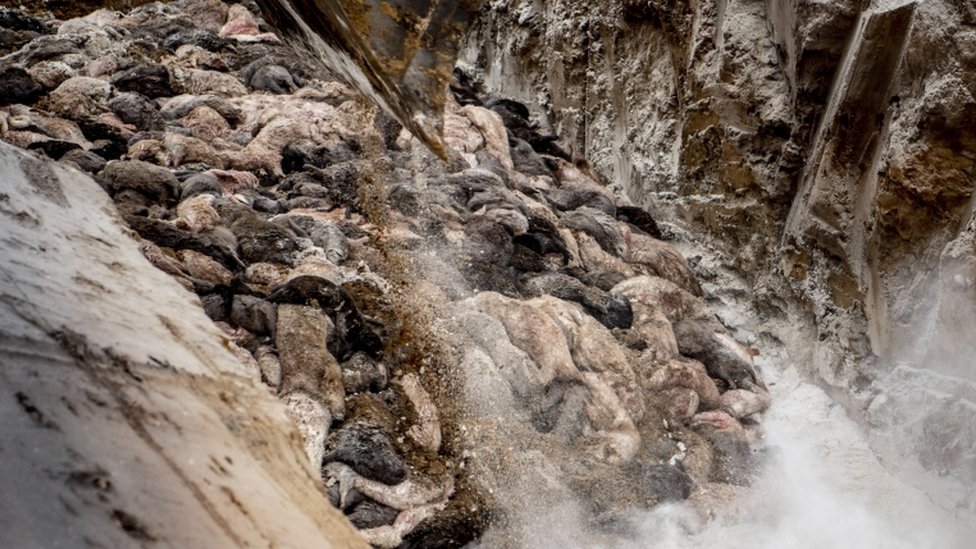
Kopenhagen Fur, the world’s largest fur auction house and owned by Danish fur breeders, has announced plans to close. This follows the news last week that Denmark announced plansto cull all its mink – as many as 17 million – after a mutated form of coronavirus that can spread to humans and threatens the efficacy of potential vaccines was found on mink factory farms.
Jesper Lauge, CEO at Kopenhagen Fur said: “the loss of the Danish mink production means that the ownership base disappears and therefore, the company’s management has decided to gradually downsize the company and make a controlled shutdown over a period of 2-3 years, “
The devastating impact of fur factory farming is now exposed as unsustainable, unprofitable and cruel. The coronavirus mink outbreaks have made news around the world. It is upsetting to see so many innocent animals killed in such high numbers and worrying to contemplate the potential threat to human health.
Fur farming is a disaster for animal welfare and a risk to human health. It is now important for governments to ban this cruelty once and for all.
A number of outrageous failings in the animal welfare of mink have been reported in Denmark over recent days, including:
A viral video showing a still alive mink surrounded by dead carcasses in a killing box. The animal, which is half gassed, is struggling to breath through an open gap in the box as workers attempt to roughly push the animal’s head back inside.
Numerous accounts report that thousands of mink bodies have been strewn across a motorway in Denmark.
Denmark’s animal welfare group, Dyrenes Beskyttelse, has reported the Danish state to the police amid accusations of cruelty.
The bombshell announcement from Kopenhagen Fur comes as the European Centre for Disease Prevention and Control said on Thursday, 12 November, that the virus mutation found in Danish mink “could potentially affect the level of overall vaccine effectiveness of vaccines under development.”
England: Respect for Animals Campaign’s Director, Mark Glover, said:
“I have devoted decades of my life to campaigning against the fur industry. The amount of animal cruelty I have seen during these years has stayed with me. The fur trade is a morally repugnant industry, relying on terrible animal suffering for a product no one really needs.
We have come a long way in the 20 years since the UK fur farming ban passed into law, which was a bitter fight.
The demise of Kopenhagen Fur is welcome but we should not forget the countless millions of suffering animals this company has profited from for around 90 years.
We now need to shut down the morally bankrupt fur industry everywhere. We won’t stop until we succeed.”
——————————————————–
Kopenhagen Fur, the world’s largest fur auction house and owned by Danish fur breeders, has announced plans to close. This follows the news last week that Denmark announced plansto cull all its mink – as many as 17 million – after a mutated form of coronavirus that can spread to humans and threatens the efficacy of potential vaccines was found on mink factory farms.
The 90-year-old company says it has enough pelts to hold auctions next year and possibly further into the future, but will start liquidating the business after that, according to a statement on its website.
Jesper Lauge, CEO at Kopenhagen Fur said: “the loss of the Danish mink production means that the ownership base disappears and therefore, the company’s management has decided to gradually downsize the company and make a controlled shutdown over a period of 2-3 years, “
The devastating impact of fur factory farming is now exposed as unsustainable, unprofitable and cruel. The coronavirus mink outbreaks have made news around the world. It is upsetting to see so many innocent animals killed in such high numbers and worrying to contemplate the potential threat to human health.
Fur farming is a disaster for animal welfare and a risk to human health. It is now important for governments to ban this cruelty once and for all.
A number of outrageous failings in the animal welfare of mink have been reported in Denmark over recent days, including:
A viral video showing a still alive mink surrounded by dead carcasses in a killing box. The animal, which is half gassed, is struggling to breath through an open gap in the box as workers attempt to roughly push the animal’s head back inside.
Numerous accounts report that thousands of mink bodies have been strewn across a motorway in Denmark.
Denmark’s animal welfare group, Dyrenes Beskyttelse, has reported the Danish state to the police amid accusations of cruelty.
The bombshell announcement from Kopenhagen Fur comes as the European Centre for Disease Prevention and Control said on Thursday, 12 November, that the virus mutation found in Danish mink “could potentially affect the level of overall vaccine effectiveness of vaccines under development.”
The UK has imposed an immediate ban on all visitors from Denmark amid concerns about the new strain.
The political fallout in Denmark has been complicated. The PM’s decision to wipe out Denmark’s entire mink population lacked a legal mandate, forcing the government to regroup and draft an emergency bill. That failed to win the three-quarters parliamentary support needed to pass, and the legislative process is now in limbo.
The government currently expects a standard bill to pass with a simple majority of more than 50%, and wants all Danish mink farming to be banned until 2022. That means breeding animals will be wiped out, meaning the scale of Denmark’s mink industry will be unrecognisable for the foreseeable future and may never recover.
Today we have heard that we have made history for mother pigs.
In June this year, SAFE partnered with our friends at the New Zealand Animal Law Association to challenge the use of cruel farrowing crates in the High Court. This was the first time in New Zealand history that such a challenge had taken place.
The High Court has ruled this morning that the minimum standards and regulations for the use of farrowing crates are unlawful.
Simply put – the High Court agrees that using farrowing crates to house mother pigs is a violation of the Animal Welfare Act.
As I write this, our hardworking legal team from the New Zealand Animal Law Association are working together with the team here at SAFE to go through the judgment in detail and plan the next steps. I will be in touch next week when we have more information to share.
The High Court has ruled that the use of farrowing crates is unlawful. This is a historic judgment for mother pigs.
From every generous donation, every petition signature, every contact with an MP, every letter to the editor and every share on social media – your support of mother pigs and your belief in justice has had a real, life-changing impact on the way we treat animals in New Zealand.
Debra Ashton Chief Executive Officer
SAFE for animals – New Zealand.
WAV Comment – Brilliant News – well done to all the team for getting justice for pigs.
This is mainly for UK supporters; but we guess international e mails are also accepted – which strengthens the case.
As our many UK supporters will know; Tesco, a major food store and supplier, have a saying that ‘Every Little Helps’.
How about that is changed to ‘Every E mail Helps’. Click on the link below and send a clear message about Amazon rain forest destruction to the new Tesco CEO Ken Murphy.
Tell him; we don’t want the beautiful Amazon forests destroyed for the production of cheap meat that is sold in your stores – simple as that !
Regards Mark
(sent to us by Liza in London – animal campaigner buddy)
Last month Tesco announced that they’re going to increase their sales of plant-based meat alternatives by 300%. [1]
But unless they also reduce the amount of industrial meat on their shelves, forests like the Amazon will continue to burn. For the first time in six years Tesco now has a new CEO, and we have a real opportunity to make sure he does the right thing.
Will you email Tesco’s new CEO, Ken Murphy and ask him to stop supporting deforestation?
Opportunities like this don’t come around very often and a new CEO could mean a fresh start. Ken Murphy has the chance to do something positive with his time in charge, but he needs to act fast.
As you’re reading this email South American forests like the Amazon continue to be destroyed to produce industrial meat, and the situation is getting worse. [2] As the UK’s biggest supermarket, Tesco is directly involved in this destruction by selling unsustainable amounts of meat, and by doing business with forest-destroying companies.
Earlier this year over 60,000 of you emailed Tesco’s former CEO, which helped lead to their announcement on plant-based meat alternatives. Now there’s a new CEO in charge, we need to keep up the pressure to make sure Tesco doesn’t stop there.
Please email Ken Murphy now and tell him personally about why we need to protect our forests.
With a new CEO in charge, this is a unique opportunity to make our voices heard. And the more of us who get in touch, the louder the message will be – Tesco should lead by example and stand up to deforestation.
I’ve drafted an email to new CEO Ken Murphy that you can send or edit. It asks him to cut ties with forest-destroying meat companies and halve the amount of meat that Tesco sells.
Adding a line at the start of the email to express why you care about deforestation will have an even bigger impact on Ken Murphy. You can also edit the subject line.