Category: Farm Animals

Greece: Petition – SIGN: Stop Chaining Animals’ Heads and Legs Together for Cruel ‘Hobbling’.

GREC0001


SIGN: Stop Chaining Animals’ Heads and Legs Together for Cruel ‘Hobbling’


Petition 2

Petition Link: https://ladyfreethinker.org/sign-stop-chaining-cows-heads-and-legs-together-for-cruel-hobbling/?utm_source=Newsletter&utm_medium=Email

PETITION TARGET: Mayor of Paros, Markos Koveos


SIGN: Stop Chaining Animals’ Heads and Legs Together for Cruel ‘Hobbling’

In the Greek Island of Paros, locals tie animals’ legs to their heads to disable them from walking in an incredibly cruel process called hobbling. The ropes and chains cut into the helpless animals’ skin, creating wounds that become painfully infected. The animals are so desperate to escape, they often break their bones trying to get free.

Hobbled donkeys, cows, and sheep are kept in areas without shelter or water, left to suffer in the baking sun or freezing cold. This often leads to an agonizing death.

Hobbling is illegal in Greece, but still prevalent. A Lady Freethinker eyewitness described seeing the shocking practice firsthand, along with further cruelty to animals in Paros.

“Dogs with heavy metal chains around their necks, burning in the sun, with no water available, nowhere to hide from the heat and sun or from bad weather. Stray cats, sick, living in garbage, being driven over often on purpose by locals,” reports the eyewitness.

The witness saw locals drowning newborn animals and poisoning stray cats, along with a general lack of animal welfare enforcement on the island.

It’s time to stop the suffering.

Sign this petition urging Mayor Koveos to enforce the law and end all hobbling, and work to drastically improve the way all animals are treated in Paros.

1.5 million votes for “end the cage age”: what’s next?


eu-flagge-zerrissen-pg


Surely most of you have signed the petition “End the Cage Age”.
For non-EU citizens and readers: This European Citizens’ Initiative aims to end the use of cages in EU agriculture by calling on the European Commission to consider new legislation in this area.

schweine kasten mit ferkel-PETA-D

With 1 million signatures alone, the European Commission would be asked to propose legislation prohibiting the use of:

• Cages for laying hens, rabbits, pullets, chickens for fattening, laying hens, quails, ducks and geese;
• farrowing crates for sows;
• Sections, if not already prohibited;
• Individual calf pens, if not already prohibited.

hühner Batterie Annie Mc n

The petition ended with a great result: instead of the one million needed, over 1.5 million people signed the European Citizens’ Initiative against livestock caging. Now the European Commission has to deal with that: what’s next?

The collected signatures are checked first. Subsequently, the citizens’ initiative will be submitted to the European Commission. The Commission must then deal with the demands to abolish cages.

In addition, the initiators of the petition will be invited to a public hearing in the European Parliament.

This does not mean, however, that the caging ban automatically comes. Although the European Citizens’ Initiative fulfills all the criteria, the European Commission has the choice: it can accept the proposals of the initiative, change them or do nothing.

The last seems to me the most likely.
Not because I am a pessimistic person or because I have seen so much bad in my long-standing fight for the rights of animals and expect nothing positive.
But, from experience.

Because the 8hours campaign of 2013, with the requirement of 1.2 million people to limit animal transports to 8 hours, never came true. The animal transports became even worse, the controls weaker, the times longer, the victims more.
Instead of realistic improvements by the EU Commission for more humane animal transports, we got animated films with instructions on how have to be transported the animals. And blood still flows from the trucks to the streets and the ships.

Tiertransport

Irresponsible, unethical, unprofessional has the EU Commission reacted.

On September 12, 2019, we read on the official website of Eurogroups for Animals:
“With the largest European petition ever for farm animal welfare ending at 23:59 last night, today is one of the most significant days for farm animals….

…With more than 1.5 million signatures so far, End the Cage Age’s success should be more than enough to persuade the European Commission to start the legislative procedure to end the use of cages for farm animals across the continent.

…“Today we have crossed the finish line in the biggest political push in farm animal welfare history. But the fight to get animals out of cages isn’t over yet,” says Reineke Hameleers. “Now it’s time for the Commission to make the changes that the citizens demand and bring us closer to the day when cages are relegated to the history books.” (https://www.eurogroupforanimals.org/more-than-a-million-people-want-to-see-the-end-of-cages-for-farmed-animals)

huhn massentierhaltung

Eurogroup and all those who render their services to the European Community for high salaries, all these must now mobilize theirselves strategically and actively so that the 1.5 million will not become bankrupt again, as they did then.

Now diplomacy, media work and commitment is announced.

If they really want to experience the day, like other 1.5 million citizens too, that “the cages are banned to the history books”, they must do everything so that the commission decides against the cages. Without compromise and consideration.
They are the ones who work closely and confidently with the commissioners, and that is why they know best that their bosses are the strongest agrarian lobyists, who not only allow painful mass animal husbandry, but demand and protect it by law.

Therefore, the question arises, what will they do if the European Commission does nothing?
In that case, we would demand of them that they give up their jobs, they leave that mendacious institution and, like us, fight on the streets for the abolition of the cages.
This is an effective and honest job.

My best regards to all, Venus

NZ: “Motherhood Led Me to Quit Dairy Farming”. But What if You Had Not Become A Mother ?

NZ


From Stacey – https://our-compass.org/2019/09/16/motherhood-led-me-to-quit-dairy-farming-forever/ 


WAV Comment – I personally am finding it difficult to accept some of what is being said by the ex dairy farmer here in relation to her change – “Mothers who gave birth during snow or storms had their babies taken immediately and didn’t even get to clean them first”. “It is not uncommon for day-old babies to have the tube incorrectly forced into their lungs and drown in colostrum within a minute or so, with colostrum pouring back out their noses. When this happens, there are many more fearful and crying babies lined up behind these, so the dead baby is thrown onto a pile of other dead ones as you don’t have time to do anything else but keep working on automatic pilot”.

So it was only when you personally had your first child you related to the mother cow having hers taken away within 24 hours ? – and what I ask, if you had gone on to not have any kids ? – would you still be a dairy farmer finding it acceptable that baby calves are torn away from their mothers almost immediately by your industry ? – am finding it really hard to accept what the ‘animal activist’ goes on about – with the tears and all that. For me, any real activist would surely have been aware (in advance) of the real horrors of the dairy industry beforehand and completely refused to get involved with it. I find it most sad that we have to wait for the birth of a human baby for this ‘activist’ to find out what the dairy industry is about. And most importantly; where would she be now if she had never become a mother ? – PS: what is husband partner doing now ? – still working at this facility stealing baby calves away from their mothers; or has he changed track also ? – we are not told in the video – I do respect her for her change of policy after the birth of her baby; but find it hard to accept that she was not educated enough at the start to know about what this industry is about; male calves being taken away within hours of birth; or shot in the head at birth when people like her partner find out that the cow has given birth to a male. Mark.


The following is Jess Strathdee’s first person account of her years spent working on a dairy farm, and what motivated her to finally leave the industry forever. 

In February 2013, my partner and I moved to live and work on a West Canterbury, New Zealand dairy farm with a 600 head herd. My partner was the second in command on the farm, and I was employed as a relief milker and calf-rearer while starting my studies with Massey University via correspondence.

When I first started milking that year, it was getting to the last months of the season, before the cows were dried off for the winter. They didn’t have a great volume of milk at that time, and the milking would generally only take an easy 2.5 to 3 hours. I remember feeling a sense of pride, solidarity and sisterhood with the cows, honoured that I was privileged to handle such a private area and process of their bodies. Except, of course, on dairy farms nothing about an animal’s body or reproductive process is respected as private or belonging to them.

…the dead baby is thrown onto a pile of other dead ones as you don’t have time to do anything else but keep working on automatic pilot.

Oh God, what I numbed myself to.


The Babies

Then calving started. I knew, logically, that cows need babies to produce milk, but I’d never really thought about the fact that those babies are almost immediately taken away from their mothers. On my first morning, I stood in the freezing pens with tiny babies who looked absolutely shattered; still wet with afterbirth, bloody umbilical cords dangling. Mothers who gave birth during snow or storms had their babies taken immediately and didn’t even get to clean them first.

The tiniest babies are tube fed, which involves a tube being shoved down their throats and into their tiny stomachs, and a litre of colostrum poured in. This is traumatizing to watch, and I can’t even imagine how it must feel. Their poor, tiny, soft mouths and throats that should just be suckling small amounts from their mothers while their systems are learning to work, must be so sore from the tubing.

It is not uncommon for day-old babies to have the tube incorrectly forced into their lungs and drown in colostrum within a minute or so, with colostrum pouring back out their noses. When this happens, there are many more fearful and crying babies lined up behind these, so the dead baby is thrown onto a pile of other dead ones as you don’t have time to do anything else but keep working on automatic pilot.

Oh God, what I numbed myself to…

Please read the rest HERE

Order a FREE vegan kit: http://www.peta.org/living/food/free-vegan-starter-kit/

Take PETA’s Cruelty-Free Shopping Guide along with you next time you head to the store! The handy guide will help you find humane products at a glance. Order a FREE copy HERE

Searching for Cruelty-Free Cosmetics, Personal-Care Products, Vegan Products, or more?
Click HERE to search.

Click HERE to find out How to Wear Vegan!

Want to do more than go vegan? Help others to do so! Click below for nominal, or no, fees to vegan literature that you can use to convince others that veganism is the only compassionate route to being an animal friend:

PETA: https://www.petaliterature.com/

Vegan Outreach: https://veganoutreach.org/order-form/


15/9 – WAV Letter to MEPs Re Romanian Sheep and Box Trailers. Nothing From Anyone – So We Write Again !

BT1


We wrote to ‘our’ reps at the EP Parliament recently, asking what the EU is doing about live Romanian sheep being exported to the Middle East in temperatures way exceeding EU Reg 1/2005 on the protection of animals in transport, and also about the use of ‘box’ trailers to carry livestock in the EU.

lyn1

Here is the link to that article; which involves a copy of our letter as well as a report associated with the box trailer issue:

https://worldanimalsvoice.com/2019/09/06/england-wav-now-write-to-europe-regarding-romanian-sheep-and-animal-carrying-box-trailers/

At the time of writing this, 15/9; we have not even had any acknowledgement to our issues from ANY of the MEPs who are allegedly representing us. So also today, we have sent yet another e mail to them all asking for a response or acknowledgement in the very least.

Or, does this show the true face of the EU ? – people allegedly representing us in Parliament who do not even bother to contact us on issues ? – for which they are paid:

https://www.europarl.europa.eu/news/en/faq/13/salaries-and-pensions

For that money, at least you would expect an acknowledgement of your letter; if nothing else.

In our letter of today we have at least asked for the basics; if these are not even met then we will be doing another post in the near future providing you, our supporters and visitors, with updated information.

Please watch in the near future.

EU: Breaking News – Petition Closed – Over 1.5 million EU Citizens want to see the end of cages for farmed animals

EU- Flagge


WAV Commentthis is a massive win, with huge numbers of EU citizens speaking out against the current systems.  The question is – will the EU listen to its own citizens, or will it continue to bow to the meat mafia lobby ? – this is a deciding point for the EU and its Commissioners to now show their true hand.  Citizens or lobbyists ! – a failure by the EU to take note of what EU citizens have requested will be catastrophic for them in the future – they must act now.


EU: Over 1.5 million people want to see the end of cages for farmed animals.


Image result for intensive caged animals eu

The End the Cage Age European Citizens’ Initiative (ECI) has closed with over 1.5 million signatures asking the EU to put an end to the confinement of farmed animals.

With the largest European petition ever for farm animal welfare ending at 23:59 last night, today is one of the most significant days for farm animals that the world has ever seen. At the time of writing, more than 1,500,000 people have signed, with the final total still being counted as paper petitions continue to pour in from the public. 

Over 300 million pigs, hens, rabbits, ducks, quails and calves across the EU are still reared in cage systems that are designed to cram in the highest number of animals possible for the sake of maximising production. But such systems deny sentient creatures the most basic of freedoms, such as the space to move; and science and even practice have shown that cages are outdated and obsolete.  

Image result for intensive caged animals eu

The End The Cage Age European Citizens’ Initiative was launched in September 2018 by Compassion in World Farming in partnership with Eurogroup for Animals and over 170 other animal welfare and environmental organisations across the EU – the largest ever coalition in the name of farm animal welfare. 

To hit the 1 million signature target – the official number needed for a successful ECI – the campaign held events throughout the EU, collaborated with influential MEPs and celebrities, launched undercover investigations into the caged farming of calves, rabbits and sows and unveiled a new digital campaigning platform that allowed the public to build their own signature collection pages. These actions and activities helped to unite a continent against cruel cages. 

“Of all the terrible ways we control animals, the cage is one of the most primitive and barbaric,” says Reineke Hameleers, Director at Eurogroup for Animals. “With this tremendous backing, the key decision makers EU Commission and Council have to understand just how important this matter is to EU citizens, and start the ball rolling towards this seismic shift in our food and farming systems.”

Image result for intensive caged animals eu

Few ECIs ever reach the required one million signatures, so today’s count represents a monumental step on the path towards sparing animals the enormous suffering they experience now in barren, overcrowded cages, and even towards ending factory farming. Within three months of receiving the signatures today, EU Commission representatives must meet the organisers, adopt a formal response spelling out what action it will propose in response to the citizens’ initiative, if any, and the reasons for doing so – or not doing so. 

Image result for intensive caged animals eu


Because this is an official EU initiative, each signature goes through a verification process – which can make or break the ECI. A total count of signatures may include up to 20% of invalid data, such as duplicates, incorrect ID numbers or dates of birth, the wrong resident status or even illegible handwriting, so a buffer of at least 300,000 signatures was needed. 

With more than 1.5 million signatures so far, End the Cage Age’s success should be more than enough to persuade the European Commission to start the legislative procedure to end the use of cages for farm animals across the continent.

Image result for intensive caged animals eu

“Today we have crossed the finish line in the biggest political push in farm animal welfare history. But the fight to get animals out of cages isn’t over yet,” says Reineke Hameleers. “Now it’s time for the Commission to make the changes that the citizens demand and bring us closer to the day when cages are relegated to the history books.”

Australia: Live Exports – News From Lyn, Animals Australia.

australia

WAV Comment – see our other recent post on this issue:

https://worldanimalsvoice.com/2019/09/11/australia-live-export-footage-shows-australian-cattle-dragged-by-ropes-before-slaughter-in-Indonesia/ 


Dear Mark,

It’s been weeks since our Investigators returned home from their deployment for the Festival of Sacrifice, and I just wanted to drop you a quick line to once again convey how grateful I am to you.

I am now able to speak to you about what we found in Indonesia as this investigation was made public through the media this week.

Because of your support, we have again been able to document and expose the brutal treatment and slaughter of Australian cattle in Indonesia, and lodge a legal complaint with the Department of Agriculture.

A still from live export footage of cattle slaughtered in Indonesia

I won’t go into detail within this email, because I know that many of you prefer to be spared. But if you would like to read about what our Investigations Unit documented, you can do so in this media article, published yesterday.

It’s been eight years since I stood in a slaughterhouse in Indonesia and watched, with abject horror, the treatment that Australia’s live export industry had knowingly been supplying Australian animals to. I know for many of you, the images of one terrified animal who stood trembling as he watched his friends butchered around him, remain with you to this day.

We will never forget 'Tommy'.
‘Tommy’, the gentle Australian steer who we saw trembling in an Indonesian slaughterhouse in Indonesia, 2011.

What ‘Tommy’ endured — along with so many others — epitomised in the most tragic of ways, the callousness of Australia’s live export trade. The willingness of exporters to supply animals to brutal treatment was starkly exposed through that investigation, resulting in the then Gillard government implementing a new system of live export regulation.

The fact that Animals Australia has since had to police this ‘regulatory system’ in importing countries, is something that a charity should never have had to do. But I am proud that we have not shied from embracing the risks and challenges to be there for our animals, and call exporters to account. We’ve only ever been able to do this because of your support.

Once again, the critical nature of our investigative work is revealed through our recent evidence documented in Indonesia. Had we not been there, no-one would know that Australian cattle had been subjected to terrible ‘roping slaughter’ in the basement of a construction site.

Had we not been there, the exporter responsible, International Livestock Exports — recognised in the industry as the ‘cattle arm’ of the disgraced Emanuel Exports — would not now be under investigation and facing serious sanctions.

Had we not been there, the industry could have continued to operate, business as usual, as a law unto themselves.

So this is why I felt compelled to write to you today. Because had it not been for your caring and your generous support of our Investigations Unit, our team could not have been in Indonesia.

That such cruelty continues reveals exactly why live export, in its entirety, should end. Every piece of evidence we gather, whether in Indonesia, Kuwait, Vietnam or Egypt, continues to build that case.

There’s a reason why nearly a decade later, we still think about Tommy. For many people, coming face to face with him was the first insight they’d ever had into the fear and distress of animals raised and killed for food — the first time they were able to witness their desire not to be harmed.

Thank you for entrusting us with your faith and support and allowing us to dedicate every single moment to them. Thank you so much for your kind and generous heart.

Because of you, we can dedicate every day to Tommy and friends, and creating the kinder world that they so need and deserve.

In gratitude,

Lyn White AM
Animals Australia


https://secure.animalsaustralia.org/take_action/live-export-shipboard-cruelty/?gclid=EAIaIQobChMI-r3uheXN5AIVibTtCh1mGgLHEAAYASAAEgJZKPD_BwE 

England: Memories – a personal experience. By Mark.

England


Memories – a personal experience.

everybody[1]

Many years back; 20 or more; the live animal export trade from the UK via English ports such as Dover, was at its peak. I used to travel down to Dover and other ports several times a week and do (undercover) monitoring of the (live animal export) trade. There were several of us at Dover and we all got together to wait for the livestock truck carrying ship(s) to arrive at the harbour late in the evening. They were special ships which had to be chartered because we had made some massive wins in getting the normal ferry companies to stop taking live animals to the continent. Animal transporters were banned from normal passenger ferries – people did not want to share their holiday crossing experience with animals going to their deaths; so those same people spoke out and the ferry companies buckled. That was a big win; but the trade did not stop entirely. The industry was forced to charter its own ships to take the trucks; along with the financial overheads that came with it.

The special (livestock transporter) boats usually arrived late in the evening; like 11pm or midnight. From our vantage points on the cliffs, we watched them arrive a few miles off the harbour at a section of the English Channel which is known as ‘The Downs’. From there they had to get a pilot to bring their ship into the harbour; that was fine with us – ship charter; paying for a pilot etc; all extra costs to the industry involved with live animals.

I took these following photos many years ago – some time on the odd occasion when the livestock ships had no choice but to dock during the daytime.  In both you can clearly see the livestock transporters.  This operation was normally undertaken under the cover of darkness in the middle of the night – away from the eyes of the public.

D45

D46

So late at night we (campaigners) congregated in a region up on the famous Dover White Cliffs which overlooked the harbour; at a place known as ‘Langdon’. We watched the ship come into the harbour under pilot control until it berthed at the far end (left pier) of the harbour. You can see the kind of view we had from the cliffs in this video:

On the left hand side of this video you can see the Eastern arm at which the ship photos above were taken.

At night, with all the lights in the harbour, it was impressive to say the least. A sort of ‘Close Encounters’ situation. Once the ship had docked on its usual left hand pier; we then had to hang around and wait for the rear doors on the ship to open and the ramp be lowered. Then was the first real signs of the nights trade for us – how many empty livestock trucks were going to discharge from the ship and make their way up to the local lairages to collect the animals; which had been specially brought down to these farms ready for export. Usually, most nights, we counted somewhere between 6 and 9; sometimes more, sometimes less.

One of the local farms (or ‘lairages’) where the animals were kept ready for export was also operating a business on the side as a caravan park. So, what do you do in such situations ? – you buy a caravan and place it in the farm caravan park; right next to the old pathway which the trucks used to get down to the animals sheds. With people there having a great nights caravanning !; and the use of mobile phones and a kettle for a cup of tea ; we could keep each other informed exactly of the trucks, their registration numbers; haulier, and type of animals they were carrying. Observers literally within a few feet of the transporters as they arrived empty, and left loaded with animals. It was a well organised arrangement; livestock trucks monitored from the minute they arrived at the harbour on the ship; all the way up to collect the animals at the lairage; and then still monitored at all times on the to their return to the harbour; where they were always greeted by a ‘reception group’ even at 2 or 3 in the early hours of the morning; who had been informed who exactly was on their way down. We never let up; they were monitored and tracked from the moment they arrived until the moment they left. Our system was good; very good.

Eventually, and to get a good view of the loading of the trucks onto the ship, we returned from our reception duties at the docks to Langdon up on the cliffs. Up there it was wild, dark and bleak; with the forever Dover cold wind blowing in off the English Channel. We kicked around; talked, drank hot tea and waited for all the trucks to load back onto the ship ready to head over to France and god knows where else. Sometimes the odd ‘lady of the night’ would appear and offer her services to some of the blokes. They were never taken up as we were decent folk and there was much more important things to do !

The whole exercise from unloading the empties off the ship, to driving up to the lairages, loading, and then getting back to the harbour to load the full animal transporters that had come back from the lairage usually took about 3-4 hours. It was always in the darkest of dark times of the night; the trade did not want to be seen by the general public – but they were; we watched their every move; and we always followed up with reports and publicity on what was happening in those ‘dark hours’.

Once all the full livestock trucks had loaded back onto the same ship that they arrived on; we sat and watched as the rear ramp and doors closed up; the signal that the ship was ready to leave the harbour once again with all the innocents on their final trip to god knows where.

Watching the loaded ship sail out of the harbour destined for France with what, 6, 8, 10 animal transporters loaded was always a difficult time for me personally. We had done everything we wanted to do each night; gathered the information and let the industry know that even at that time we were around; but for me also, we had failed the animals by allowing them to sail away to their deaths. Saving and stopping all the trucks was impossible; we knew it; but witnessing the situation always made you feel like you had let the animals down by not saving them. I was quite a big ‘U2’ fan at the time; and I always sat in my car up on the cliffs and played ‘Exit’ from the ‘Joshua Tree’ album – the haunting Bass and a time of real despair; as I watched the ship sail out of the harbour with its cargo of death. The music; the experience yet again; everything seemed to come together at that moment in time.

‘Exit’


Music has a real power – often to be the right track at the right time to hold memories –‘Exit’ was right for the betrayal of animals that I witnessed so regularly at those cold, dark; upsetting nights at the docks. Even now; 20+ years later, that track (Exit) always takes me back to those cold and windy nights up on the cliffs watching the livestock carrier departing for France. That track always brings back that situation to me of being there and witnessing the suffering for a few pennies more. Sometimes I would stay on longer and watch – from high on the cliffs you could watch the ship sail across most of the Channel almost until it had arrived in Calais; what, some 23 miles away. Sad times, bad times, but in the end we stopped it completely at Dover. It felt good to be of the crew that did that !

Regards Mark


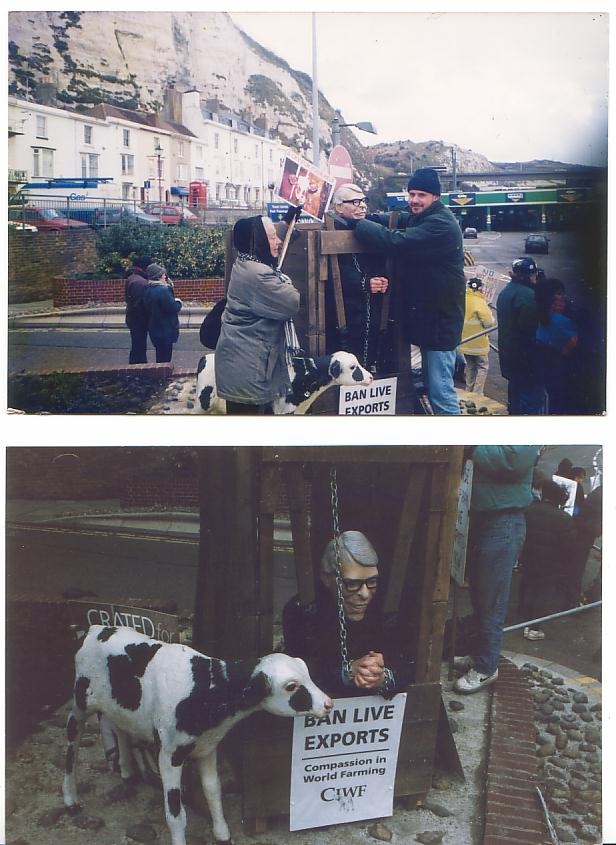
In the UK people have always detested the live animal export trade.  Part of our national way towards being an animal welfare nation I guess.  Here are a few scenes from around Dover in the past of what good, decent folk will do to stop animal abuse with the animal exports:


For Jill – never forgotten:

JILL


USA: Cassie and California – First State to Ban Fur. A Message.

usa-flaggen-bleistift-jpg


A message from Cassie – fur activist – great person !!

Hi Mark,

The California fur ban just passed its final vote in the full Senate! Now, all we need is for the governor to sign the bill and California will officially become the first state in the US to ban the sale of fur. I wonder who’s going to be next? And the fur industry is wondering the same thing. They can see the writing on the wall and they know that the momentum from this victory can lead to the end of the cruel fur trade around the whole world. Let’s make sure we don’t let them down.

Share this victory video to show the world the power of the grassroots (and the fur industry’s ridiculous responses when confronted with the truth) 

DxE is showing the world the secrets that animal abusing companies want to keep hidden, and it’s leading to concrete change. We need your help to capitalize on this momentum and continue exposing the truth to create change. Right now, each new monthly donor – at any amount – is getting DxE a $100 match. If you or anyone you know can become a member, now is a perfect time!

Thank you,

Cassie


FUR

you did it 2


EU: Suffering of calves on 1700km road journey to Israel.

zerissene EU-Flagge am Stock


Suffering of calves on 1700km road journey to Israel

Calves being transported from Lithuania to Israel have been found in extremely overcrowded conditions on the trucks, lying in a thick layer of manure and suffering from heat and extreme thirst. 

These conditions – suffered on a journey of two weeks for a distance of 1700km – caused the death of some animals, but also made others so exhausted that they had to be dragged by their legs from the trucks. 

The investigation by Animal Welfare Foundation (AWF) and Israel Against Live Shipments (IALS) trailed the calves along their journey and called Road Traffic Inspection in Poland when they spotted evidence of suffering on the trucks. Official veterinarians were called and found multiple violations of Regulation (EC) No. 1/2005, which states that animals shall not be transported in a way likely to cause injury or undue suffering.

“This was the most tragic sight I have seen in all my years working as an investigator in animal transportation,” says Maria Boada-Saña, investigator and project manager of AWF. “It is incomprehensible how official veterinarians in Lithuania approved these transports.” 

Polish officials immediately decided to unload the suffering animals and started administrative proceedings against the Polish transport company Konrad. However, after a 24-hour-long rest at a stable, the animals were carried in three trucks instead of two to Slovenia, where investigators from IALS found terribly weak and exhausted calves upon arrival at Koper. 

From here, the transport continued by sea, and the animals were loaded onto the livestock vessel Holstein Express, destination Israel. The calves spend four days at sea without any authority to assess their welfare, or ensure they are treated in compliance with EU legislation. 

“Our experience shows that sick animals are usually left untreated, and their dead bodies are regularly dumped into the Mediterranean Sea,” says Yaron Lapidot, spokesperson of IALS. “Investigators have repeatedly found European cattle and calves washing up dead on the beaches of Israel, having been thrown overboard from livestock vessels.” 

After arrival in Haifa, the journey of these animals is not over yet. The calves are loaded onto small trucks in which the temperature can exceed 37°C and carried on to quarantine stables where they are kept for a month before being sent to fattening farms. 

“By removing the live import tax in 2014, the Israeli government sealed the fate of hundreds of thousands of animals going through hell on the journey to Israel. Ever since then, promises by our agriculture minister to reduce the numbers have not materialized and essentially the public continues to subsidise the imports,” says Yaron Lapidot. “This year we expect that Israel will import about 850k live animals, an increase of 400% since 2014.” 


The two organisations have sent a film highlighting the suffering of these animals to EU Commissioner Andriukaitis, and are calling on the European Commission to stop the long-distance transport of live farm animals to Israel and other Third Countries. 

“AWF and IALS are the latest of many organisations which are constantly revealing serious welfare problems in the long-distance transport of animals,” says Reineke Hameleers, director of Eurogroup for Animals. “The suffering of animals on such journeys is inevitable, and the European Union must stop this cruel and archaic practice.”

Image result for cartoon eu joke

Australia: Live export footage shows Australian cattle dragged by ropes before slaughter in Indonesia.

australiapg

A still from live export footage of cattle slaughtered in Indonesia

Live export footage shows Australian cattle dragged by ropes before slaughter in Indonesia

Exclusive: An investigation is under way after cattle were allegedly sold illegally outside supply chain

The Department of Agriculture is investigating a live export company after it received footage showing Australian cattle being pulled to the ground with ropes and slaughtered without being stunned in a carpark underneath an Indonesian mosque.

International Livestock Exports has suspended all supply to one of its Indonesian abattoirs over the breach, which was reported to the department by Animals Australia.

ILE identified itself as the exporter after the department shared the footage it received from Animals Australia with all relevant exporters, in an attempt to identify the cattle.

The footage, seen by Guardian Australia, shows about a dozen cattle in an underground carpark near the grand mosque in Medan City in North Sumatra. They were killed as part of Eid al-Adha last month and a complaint was lodged with the department on 13 August.

Four of the cattle were identified as Australian. The footage shows them being pulled to the ground by ropes around their legs and rope halters, then being dragged by their tails. The slaughter happened in full view, and sometimes within metres, of other cattle.

Ear tags had been removed but a combination of ear notches and brands identified them as cattle produced on a station in the Northern Territory and shipped to Indonesia by ILE.

The slaughter was reported to the department as a breach of the Exporter Supply Chain Assurance System (Escas), which was introduced after a 2011 Four Corners investigation. Exporters dealing in Australian animals can sell only into an approved supply chain

Read more


A director of ILE, Mike Stanton, told Guardian Australia the cattle had been illegally sold outside the supply chain from a facility in Indonesia, and ILE had suspended the facility it believed was responsible. “We did that as soon as we were able to work out where the leak has been,” he said.

The department told Guardian Australia it did not comment on investigations that were still in progress.

Legislation to appoint an independent inspector general for live exports passed the Senate on Tuesday.

Stanton said there were 140 facilities in Indonesia approved as part of ILE’s supply chain. “If you’re exporting a lot of cattle there’s going to be issues along the line,” he said. “We do our best. “I know a lot of people think we don’t, but it’s bloody hard.”

He said the treatment of the cattle shown in the footage, particularly the long minutes taken to drag them to the ground, was “awful”.

“We are in the business of selling animals for slaughter but we want it done in an appropriate manner,” he said.

ILE shares an office in West Perth with Emanuel Exports, the company responsible for the 2017 voyage of the Awassi Express in which 2,400 sheep died of heat stress.

An investigation by the department into allegations Animals Australia paid for the footage from the Awassi found no evidence to suggest the footage was manufactured or illegally obtained.

ILE was issued a show-cause notice in October because of its association with Emanuel and another sister company, EMRS Rural Exports, which both had their export licences cancelled. ILE handles 70% of live cattle exports from Broome.

The Australian Live Export Council chief executive, Mark Harvey-Sutton, said the slaughter was “unacceptable” but had to be put in context of the industry’s broader track record.

“Let’s not forget that exporters are also very proactive in this space and often actions are undertaken by exporters ahead of what the regulator looks to do, and that was the case this time,” he said.

Harvey-Sutton said Australian exporters had “very good systems in place” and the council worked “very closely” with both producers and exporters to keep them informed in cases of Escas non-compliance.

There have been 172 complaints of non-compliance since Escas was established in 2012 – 70 by Animals Australia.

Its strategy director, Lyn White, said: “It is deeply concerning that Australian cattle have once again been subjected to roping slaughter in Indonesia, and that the only reason this has become known is because of the efforts of a charity.

“Escas was established to prevent such horrific treatment. The fact that it can still occur speaks to the ever-present risks of exporting animals and losing control of their welfare.”

White said Escas breaches should result in the automatic suspension of an export licence.

A review conducted by Guardian Australia of the first five years of reports found only three cases in which punitive action was taken against exporters.

Self-reported breaches by exporters are not publicly listed and investigated if they are made and rectified within a set timeline.

The chief executive of the Northern Territory Cattlemen’s Association, Ashley Manicaros, said the slaughter involved just four of the 400,000 cattle exported from Darwin to Indonesia each year.

Manicaros said exporters should be given more credit for the work they had done to reform after the crackdown in the live sheep trade.

“Those operators that don’t meet those standards will be the ones that have to get to the standard if they want to remain in business,” he said.

https://www.theguardian.com/australia-news/2019/sep/11/live-exports-footage-australian-cattle-dragged-ropes-slaughter-indonesia