Category: Farm Animals

“On the 21st of April, Easter Sunday, two stables with thousands of pigs have gone up in flames in Klein-Wanzleben, district in Saxony (Germanx) The cause of the fire in the pig farm is still unclear. It was also unclear whether the animals burned or suffocated on the gases. The smoke column was temporarily seen from 20 kilometers away.

The buildings are in full bloom, said Enrico Grube from the police station Börde. In the total of nine pig farms, it is estimated that between 45 000 and 75 000 pigs are housed – more exact figures are not available.”
This is the press release, and it was the same to read in all newspapers. More time and space have not been wasted on this tragic accident.
How many pigs are housed in a fattening system, we learn when, for example, a fire breaks out.
According to police, between 45,000 and 74,000 animals are housed in the stables.
The plant consists of a total of nine stable buildings.
Around 2000 piglets could not be saved, they were burned alive.
Fattening pigs, gilts, sows and piglets are kept.

It was only last year that 109 of 180 piglets died in an animal transport in the region because the transporter was overloaded.
Did you know that the small piglets from different countries are being carted to Germany? More than 16 million pigs are imported from abroad each year to Germany.
56.6 million pigs are slaughtered in Germany, because Germany is one of the largest meat exporters in the world.
 Many pigs do not make it to the slaughterhouse, they already die before. Can you imagine that? between 45,000 and 74,000 animals on a pig farm? And in addition in such a fattening plant with 60,000 pigs a fire broke out, in which 2000 piglets died!!!
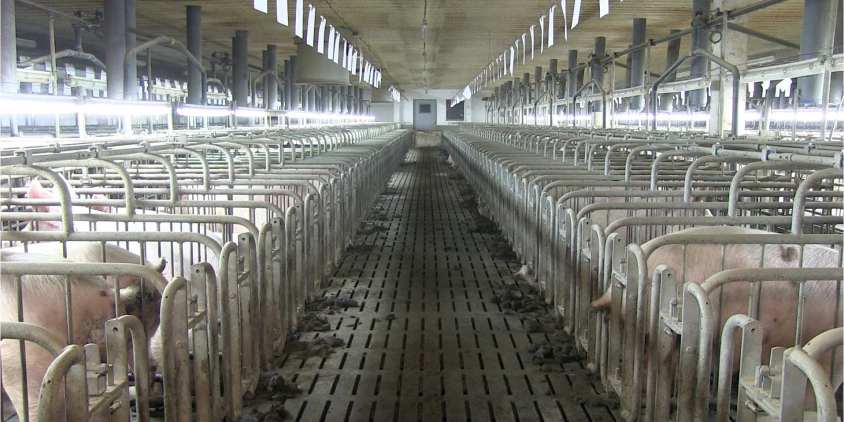
Do you still remember Adrianus Straathof? He ran six in Saxony-Anhalt alone pig breeding farms.
After heavy criticism on the basis of the conditions in Gladau (Saxony) determined 2013 the public prosecutor’s office. Straathof has been in the criticism of the conditions in the piglet factory Gladau for some time. The Dutchman was convicted of forced and fined € 2.1 million. Did he ever pay?
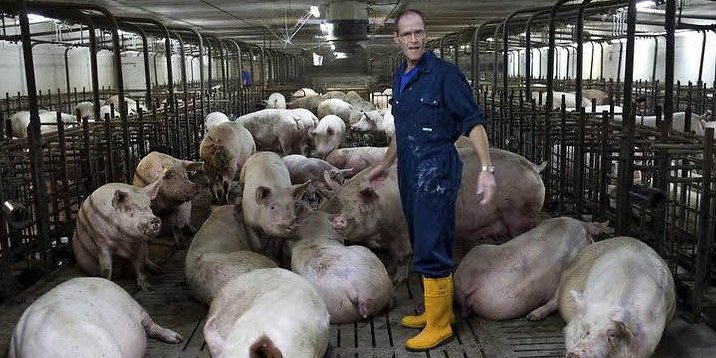
End of 2014 then the message: Animal husbandry ban for pig Baron Straathof! In addition: If the case becomes final, this could be the turn in factory farming.
But there was no turning point in mass animal husbandry, as you can see from the current case in the pig farm in Saxony that 45,000 to 74,000 pigs are still kept.
Saxony-Anhalt seems to be a “pig country”, where Easter Sunday broke out in a pig farm in Klein Wanzleben a fire and 2000 piglets had to give their lives.
The animal rights organization ARIWA, through undercover investigations in 2015 and in the same place, found that there were serious, unavoidable animal welfare violations in the local farms. The animals there suffer in a way that we humans can hardly imagine. (we are still talking about the same farm!!)
As in other documented cases, the sows are fixed motionless for weeks in such small crates that they can not even stretch out their legs when lying down. Shelter stalls do not provide drinking water for the thirsty animals.
Boars are illegally locked in physical cages. At some crates, faeces and urine can not run off, so that these clean sows must smear with their own excrement.
A gilts hall is lit neon-bright around the clock – a method used by people for torture. As in so many other installations, the regulatory offenses are piling up in such a way that they result in crimes against the Animal Welfare Act. These could be easily punished with a withdrawal of animal husbandry or even with imprisonment.
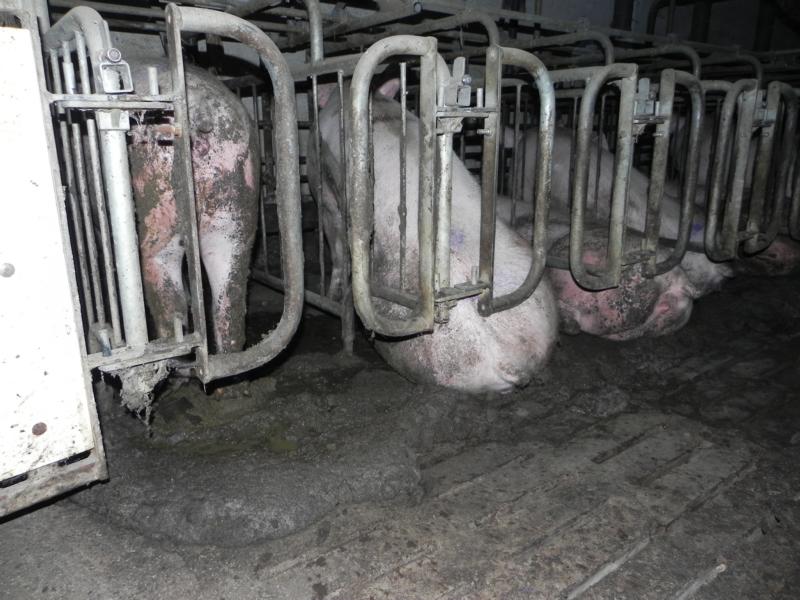
In addition, the plant also illustrates the countless quite legal animal cruelty in German livestock farming.
An example: gilts, which are not yet old enough for an economically worthy insemination, can be fixed completely legally in box stalls indefinitely, without possibility to move. Because the animal protection ordinance prescribes that sows may be in the crate stall for a maximum of 28 days after insemination.
For inseminated sows but the regulation does not regulate this point. This applies to gilts as well as sick sows or those who do not get pregnant in the crate despite insemination or lose their fetuses within the first four weeks.
All these sensitive animals may be locked indefinitely in the crate stall at the pet owner’s discretion. The pictures from the plant show a large hall full of gilts, which have been fixed motionless for months in this way. Here it is confirmed that loopholes of animal owners are exploited as soon as there is an economic interest behind it. Even if it means unbelievable suffering for the animals. Which, how we know, no one interested in the slaughterhouse.
The question that arises: is Adrianus Straathof still active? On January 16, 2015, there was a change in the management of the District Court Potsdam :
Managing Director of GLAVA GmbH: Heidrun Spengler-Knappe · No longer Managing Director: Adrianus Gerardus Maria Straathof!
And if we continue our research, we will return to the pig baron Straathof, who has been active in Hungary since 2018, near the border with Croatia and Serbia.
https://netzfrauen.org/2019/04/22/schweinemast/
My comment: The terrible pictures in video with the illegal housing conditions for the animals come from the fattening farm which at that time belonged to the pig-baron Straathof.
Whether today the same plant, where 2000 lives were burned alive, still belongs to this criminal, we do not know.
And it’s not easy to find out.
Because this corrupt system operates hand in hand with the meat mafia and with all those who are actually the pillar of this system. Animal abusers, environmental criminals, meat and hunting mafia all of these are well protected by the system.
Was not it, that the lawsuit against the lab-torturer Logothetis from the laboratory in Tübingen was annulled?
Was not it, that the murderer of Lioness Cecil, Parker, never stood trial?
Was not it, that Dog Hucher’s mafia boss in Romania, Barbulescu, did – and does still – his criminal business with EU funds?
We all, and especially the animals are at the mercy of these criminals.
My best regards, Venus
If anyone heard the animals screaming – it would run down anyone’s back icy cold …


| Newsletter 26/4/19.
New Call for Action
|


This and more actions – click on the following:

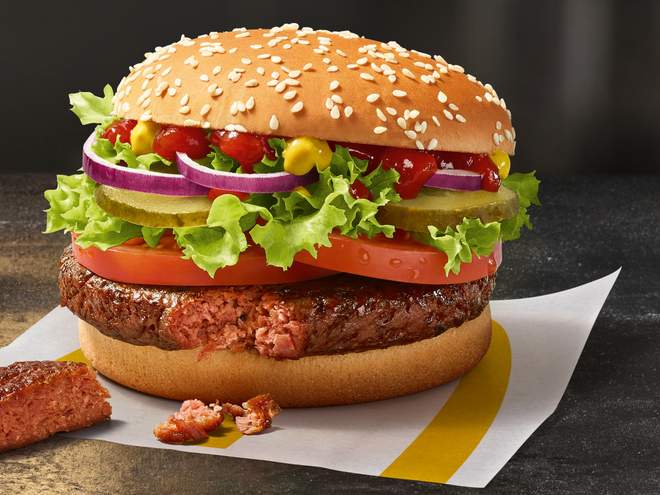
WAV Comment – ‘McDonald’s Germany states that the burger has a “meaty taste”, despite containing no trace of animal by-products’. As someone who eats vegan because of my ethical concerns for animal welfare; why then do I want a Vegan burger that has a ‘meaty taste’ ? – it is an alternative to meat, so why try and link it to meat ? – I dont want to suffer a ‘meaty taste’.
Under EU regulations, I guess it will soon have to be called a ‘Vegan disc’, rather than a vegan burger. The EU specialise in wasting time on things like this; yet allow animal abusing transporters to get away with abuses scott free ! – Mark.
McDonald’s has announced the launch of a new vegan burger on its menu in Germany.
This will mark the first time the German franchise of the fast food chain has offered a vegan burger to its customers.
The Big Vegan TS burger consists of a patty made from soy and wheat.
It is served in a classic sesame seed bun, and contains salad, tomato, pickles and red onion.
McDonald’s Germany states that the burger has a “meaty taste”, despite containing no trace of animal by-products.
“Improving for us means that we are brave enough to try new ways,” says Philipp Wachholz, company spokesman for McDonald’s Germany.
The Big Vegan TS burger will be available in all participating McDonald’s branches across the country from Monday 29 April.
It will replace the Veggieburger TS on the main menu and the McMenu, which provides customers with the option to combine food items for special prices.
According to market research company Skopos, as of 2016, there were 1.3 million people following plant-based diets in Germany.
This equates to around 0.016 per cent of the country’s population.
The release of the vegan burger at McDonald’s Germany isn’t the first time the fast food restaurant has made plant-based options available to its customers.
Earlier this year, McDonald’s announced the launch of its first vegan-friendly Happy Meal in the UK, which the company created in partnership with the Vegetarian Society.

Following on from the terrible news today about the death of Eco Warrior Polly Higgins https://worldanimalsvoice.com/2019/04/25/eco-warrior-polly-higgins-has-died/ – I want to share a tribute to a personal friend and fellow live export campaigner.
Read the tribute from CIWF, London:
https://www.ciwf.org.uk/news/2019/04/john-callaghan-a-leader-in-the-fight-for-animal-welfare
We are deeply saddened to share the tragic news that our friend and former staff member, John Callaghan has passed away.
John served throughout much of the 1990s as our Education Director and produced some excellent educational books on farm animal welfare. But, like all our senior staff, he played a major campaigning role during the mid-nineties when the live animal export protests were at their height.
Shoreham became a key export location when exports were banned at Dover and John became known as ‘Mr Shoreham’. He was regularly down at the dockside, leading the protests with energy and passion. One of our major supporters wrote to us recently saying:
“John was the loveliest person and an inspiration to me and many others. It was his wonderful self-deprecating humour that drew us in to the whole animal welfare world when we met him at Shoreham all those years ago.”
A wonderful communicator, he shared his expertise and love of animal welfare both via the media and by inspiring many people to support the fight for a better life for animals.
After a stint working for World Animal Protection, John returned to us in early 2007 as Director of Programmes and Deputy CEO and we welcomed back his commitment and experience. He left in 2010 and moved back to Somerset to be near to his family.
Those of us who worked with him will always remember his dedication, his gentle heart and wonderful humour.
—————————————————–
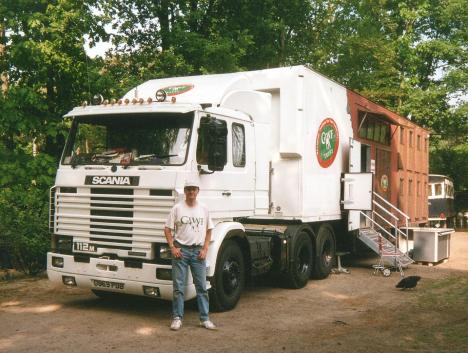
I (Mark) had the immense pleasure of knowing John for many years. I did some work with him in the Netherlands in the mid 90’s when we took the CIWF exhibition truck all over the NL on the issue of intensive farming and live calf exports. As British calves were being exported to the NL at the time; we took some time out of our schedule to ‘sniff around’ and find out a little more about places they were being sent to.
John often used to hitch a ride in my car which I had taken to the Netherlands as part of the job. We shared many hours on the road; laughing, talking and generally trying to have a good time in work that we both knew the live animal export business caused immense suffering to – innocent, sentient beings.
As the CIWF tribute above says, I will always remember John as the most kind, humorous guy you could ever wish to meet – his dedication to animal welfare was 110%.
As Venus says with her post on Polly Higgins;
Why do the good, useful and hopeful people go out of the life so early?
And the assholes, the torturers, the criminals live long and have so much time to destroy life and nature?
This is an injustice that we experience more often and that offends us deeply.
True, very true. John also went far too early. I knew his son (John Jnr) also; and my condolences go out to him at this sad time.
RIP John- and thank you for all you did to improve the lives of all animals.
Regards Mark.
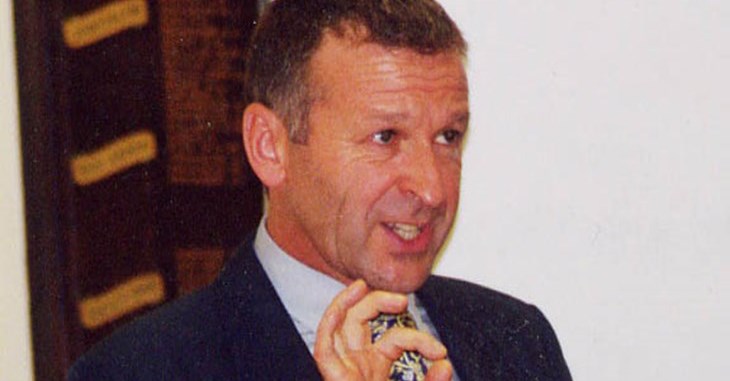
Here is a photo of John (man in the middle) I took many years ago at the EU in Brussels – a live export demo of all things – veal calves and veal crates !
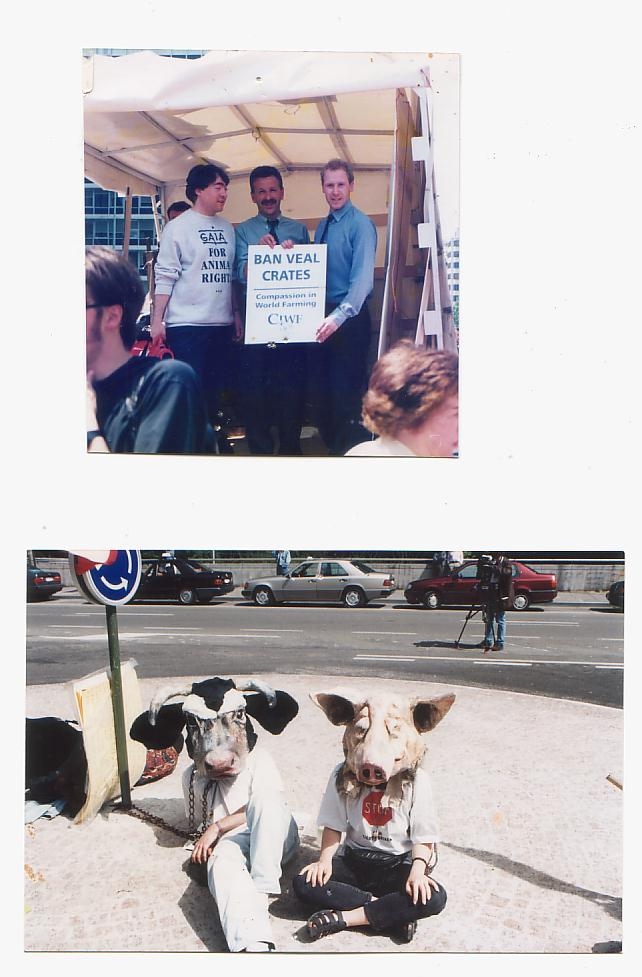
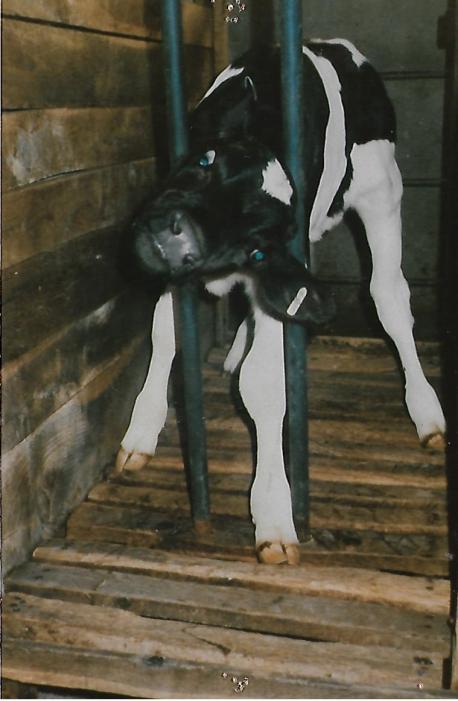
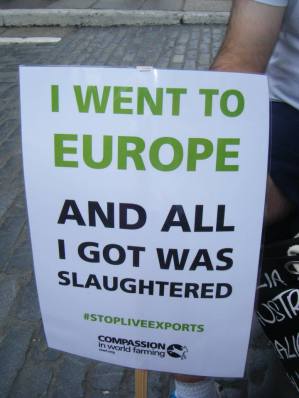
… and (below); me in the Netherlands with the CIWF Tour Truck covering all aspects of intensive farming. Note free range chickens !

SIGN: Justice for Helpless Chicks Dumped Like Trash Because they ‘Didn’t Sell At Easter’

Image Credit: Pxhere
Petition link:
SIGN: Justice for Helpless Chicks Dumped Like Trash Because they ‘Didn’t Sell At Easter’
PETITION TARGET: Cambridgeshire Police and Lincolnshire Police
Tossed like disposable trash, more than 160 helpless chicks were dumped on the roadside to die in the English counties of Cambridgeshire and Lincolnshire.
Sixty of the chicks were already dead by the time anyone found them. These baby birds never had a chance.
“They had no access to nearby food or water or shelter from predators and had they not been found, then sadly the rest would have perished as well,” said RSPCA inspector Justin Stubbs, describing the appalling scenario.
The chicks were abandoned in two separate incidents that appear to be connected, according to RSPCA spokesperson Amy Okelford, who believes the animals may have been for sale as pets and were discarded when they failed to sell in time for Easter.
It is never OK to simply throw out a living, breathing creature because they are not “profitable.”
Sign this petition urging police to do everything in their power to track down and prosecute the individual(s) behind these cruel acts.
Anyone with information about this case is urged to contact the RSPCA.

Scientists at the University of Osnabrück (Germany) are currently working on the question of what influence artificial light sources have on the well-being of chickens in so-called livestock farming. They are sure: the wrong lighting has a strong impact on the health of the animals, who perceive the light quite differently than we humans. The unnatural bulbs they have been exposed to their entire lives are disrupting their natural rhythm and leading to stress, disease and behavioral problems.
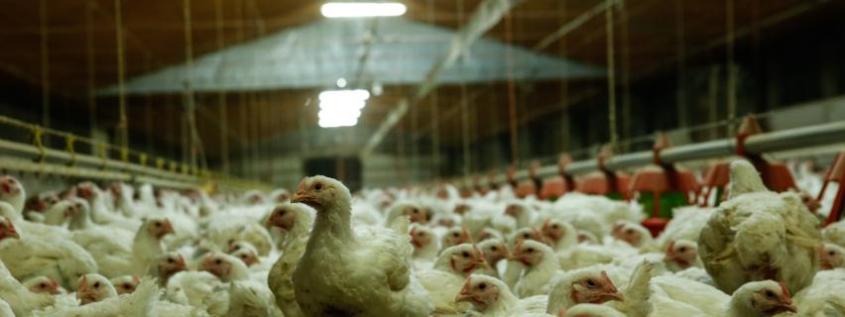
Light plays a significant role in the natural rhythm of a chicken’s life. It naturally influences regulated processes, such as eating behavior, laying activity, moulting and the dynamics between active awake and passive rest periods. In the stables, however, completely different lighting conditions prevail, as those to which a chicken is naturally adapted. What we humans experience as white, flicker-free light, for example, is similar to chickens, like the effects of a wild disco lighting that flickers in different frequencies and shines in bright colors.
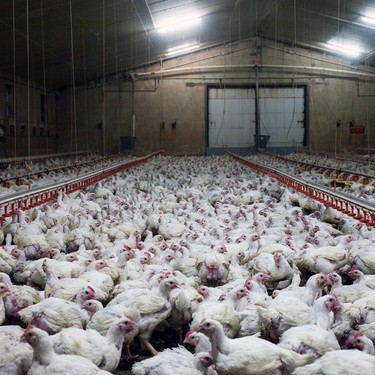
Light plays a significant role in the natural rhythm of a chicken’s life. It naturally influences regulated processes, such as eating behavior, laying activity, moulting and the dynamics between active awake and passive rest periods. In the stables, however, completely different lighting conditions prevail, as those to which a chicken is naturally adapted. What we humans experience as white, flicker-free light, for example, is similar to chickens, like the effects of a wild disco lighting that flickers in different frequencies and shines in bright colors.
Visual perception: chickens look different than humans
Due to the different structure of the organs of vision, chickens have a different visual perception than humans. Their environment is therefore very different for them than it is for the human eye of the norm. After all, chickens actually see better than we do: instead of three, they have five so-called cone types and thus perceive a broader color spectrum. Her eyes are also designed for the ultraviolet range of light. For example, objects that simply look like black to humans can appear to them in many bright colors.
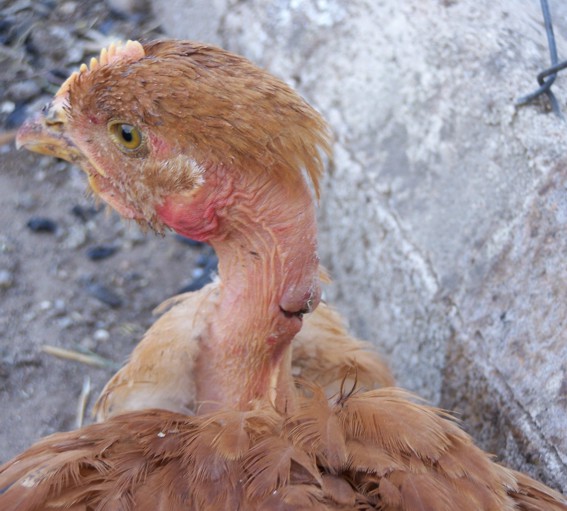
Also, the number of different images that can process the eye of the chicken in a second, significantly affects his perception: While there are only 20 to 60 images per second in humans, the chickens’ vision becomes about 160 images per second registered. This has the consequence that the animals, for example, in an AC powered light bulb can detect the annealing of the wire, although this simply shines evenly for people.
In terms of brightness, the eyes of a chicken are up to ten times more sensitive than ours. As the light sources in the stables seem brighter for them, the chickens are blinded by them. On the other hand, the insulated lighting there does not correspond to the darkness that chickens need during their rest periods.
This photosensitivity may also provide an explanation for the hitherto unanswered question of why many free-range laying hens often prefer to stay in the barn instead of spending time in supposed freedom.
Disturbing environment as a cause of unnatural behavior
Since the artificial lighting in the stables does not emit UV light and shine brighter than is necessary for the chick’s eyesight, the animals perceive a visual distortion of the reality of their surroundings.
The unpleasant lighting conditions, according to the scientists, are likely to affect the negative moods of the animals and can lead to aggressive behavior such as feather pecking or self-mutilation.
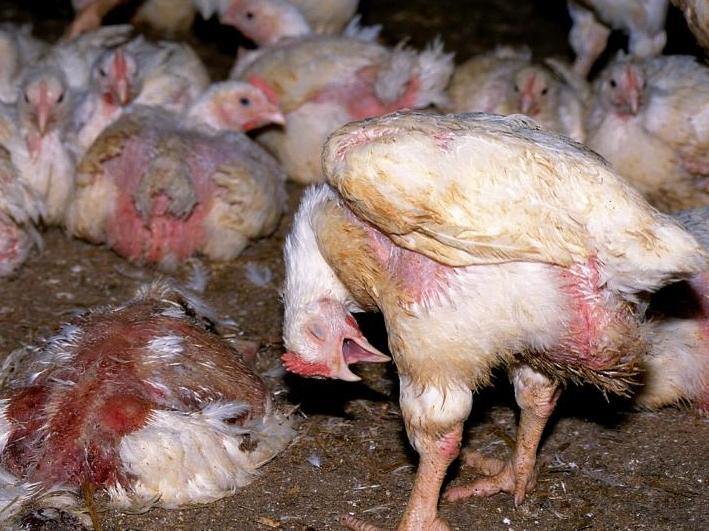
In addition to other factors such as high population density, stinking stable climate or lack of employment opportunities, false light can be responsible for many behavioral problems, illnesses and deaths. Worse is the fact that in most laying hens the beaks are cut to prevent cannibalism. This is done in a very painful way.
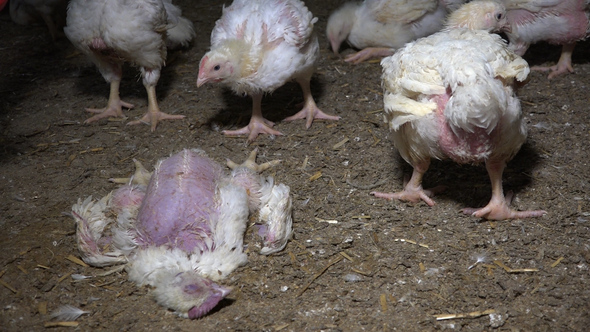
Necessary change of perspective
In order to reduce the suffering of chickens in industrial livestock, research, companies and livestock owners must work together to adapt the standards in the stables to the biological conditions and the natural habitat of the chickens. The example of false lighting in the chicken breeding and fattening systems raises the question to what extent other animals in “livestock husbandry” – in addition to the obviously tormenting conditions – suffer from stress factors that are imperceptible to humans. Because all stables and livestock farms are constructed from a human perspective, mostly without knowing the individual perception and the specific needs of each animal species.
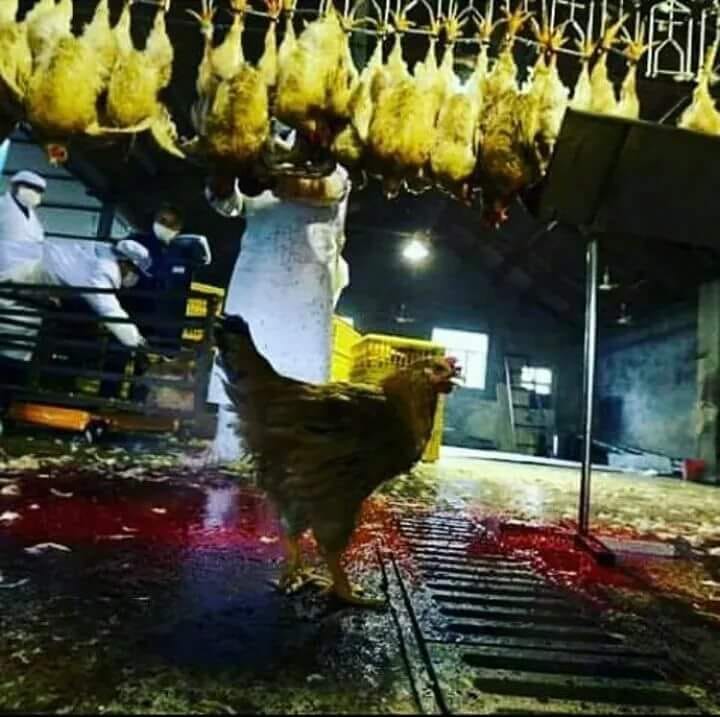
Every animal deserves to live in freedom and in a species-appropriate environment. By choosing herbal alternatives, we can eliminate the exploitation and suffering of animals. Day after day!
My comment: In the video we can see how live the so-called “organic” chickens in Germany. The video was shot undercover by the organization “animal friends” in 2012. For those who think: yes, but it is old … since then, nothing has changed.
The Farm Mafia is not at all interested in the welfare of the animals, the corrupt politicians who earn from the suffering of the animals, even less so.
The meat eaters who are cheated by both- the meat mafia and the politicians- because they pay dearly for organic meat, although it is not- are not interested too. Not for the suffering of the animals, not for the fraud of a corrupt system. And so, all those involved in this daily murder and deception can continue to work together because they share a common goal: to live on animals!
In Germany, 51.9 million chickens are currently kept for the purpose of egg production. In dirty and full stables.
Ovarian infections, peritonitis, parasitic infestation, sternum curvatures and breastbone fractures, consequences of cannibalism, viruses, bacteria – a painful, silent and often slow death is the result also in the so-called organic husbandry systems. There is never any medical help for injured and sick animals – the animals suffer and die mostly in the middle of the stable area.
Man has decided that animals are a matter, and under this fascist conviction, the daily murder of animals takes place with such sadistic coldness and cynical indifference that only a human animal can possess.
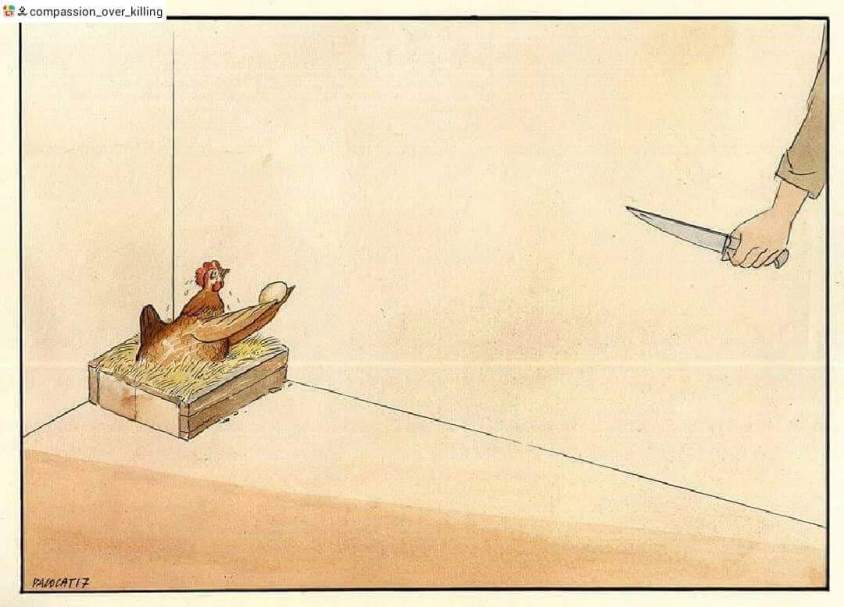
My best regards to all, Venus

The Environmental Integrity Project reviewed EPA records for 98 large U.S. slaughterhouses and found that three-quarters of them discharged toxic waste directly into nearby streams and rivers, violating pollution control permits.
The EPA records show that 250,000 gallons per day were dumped into waterways from January 2016 through June 2018 and that 74 of the 98 slaughterhouses had exceeded their permit limits for nitrogen, fecal bacteria, and other pollutants.
Additionally, more than half the slaughterhouses had five violations, and a third had at least 10 violations. Some of these slaughterhouses are dumping as much nitrogen pollution as small cities!
Eric Schaeffer, executive director of the Environmental Integrity Project, said in a statement:
State environmental agencies need to start cracking down on and penalizing these flagrant violations of the federal Clean Water Act. And EPA needs to step in and set stronger national water pollution standards for meat processing plants.
The records also rank the worst polluters in the U.S. by total nitrogen released and name the JBS pork processing plant in Beardstown, Illinois, as the most polluting slaughterhouse in the U.S. last year. The slaughterhouse released an average 1,849 pounds of nitrogen a day into a nearby stream leading to the Illinois River. According to the EPA, that’s equivalent to the nitrogen in raw sewage from a city of 79,000 people.
The meat industry has a record of egregious water pollution. In fact, animal excrement and other agricultural runoff from large-scale farms have polluted nearly one-third of rivers in the U.S.
In addition to destroying waterways, toxins from factory farms contaminate our drinking water. A report from Environmental Working Group found that systems supplying drinking water to millions of Americans contain dangerously high levels of nitrates, which have been linked to increased risk of certain cancers.
But factory farms don’t just devastate the environment and compromise our health—they cause immense suffering for billions of animals.
Pigs, cows, chickens, and other farmed animals face unthinkable horrors: cruel caged confinement; brutal mutilations; and bloody, merciless deaths.
Don’t believe us? Just watch this recent Mercy For Animals undercover investigation at a JBS pig factory farm that exposed workers kicking and punching animals in their faces, ripping out the testicles of baby pigs without any pain relief, and violently smashing baby pigs headfirst against the ground to kill them.
The single best thing we can do to protect animals, ourselves, and the planet from the cruel and destructive factory farming industry is to eliminate our consumption of meat and other animal products altogether.
Order your FREE Vegetarian Starter Guide today. And check out our Pinterest page for thousands of plant-based recipe ideas!
https://mercyforanimals.org/epa-records-show-three-quarters-of-us-slaughterh

Unbelievable: The power of the agricultural lobby!! – they want to end the European animal welfare initiative ‘End The Cage Age’!
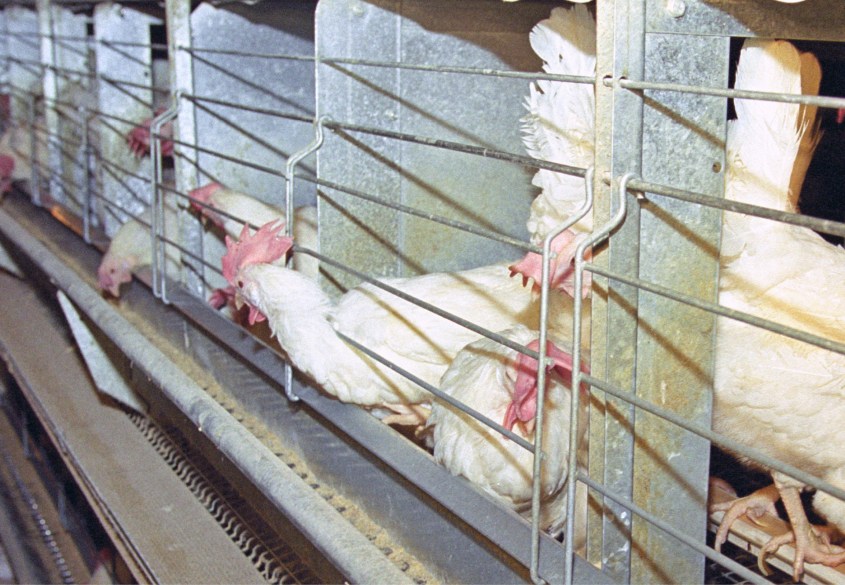
https://help.four-paws.org/de-DE/kaefighaltung-ist-ein-albtraum
What happens when people in Europe want to end the terrible animal torment in the stables?
The big agro-industry starts an attack. Only just a horrible meat scandal shocked Europe, so “rotten meat” from Poland was also processed in school kitchens and restaurants.
However, such news quickly disappears from the media, as does the meat scandal from Brazil, which shook the whole world (The world had 2017, a new rotten meat scandal. This time it is kuked meat from Brazil. For years, spoiled beef should have been partially treated with carcinogenic substances and resold).
The agricultural lobby is powerful, and in order to keep meat consumed, the EU has boosted meat consumption with 15 million euros.
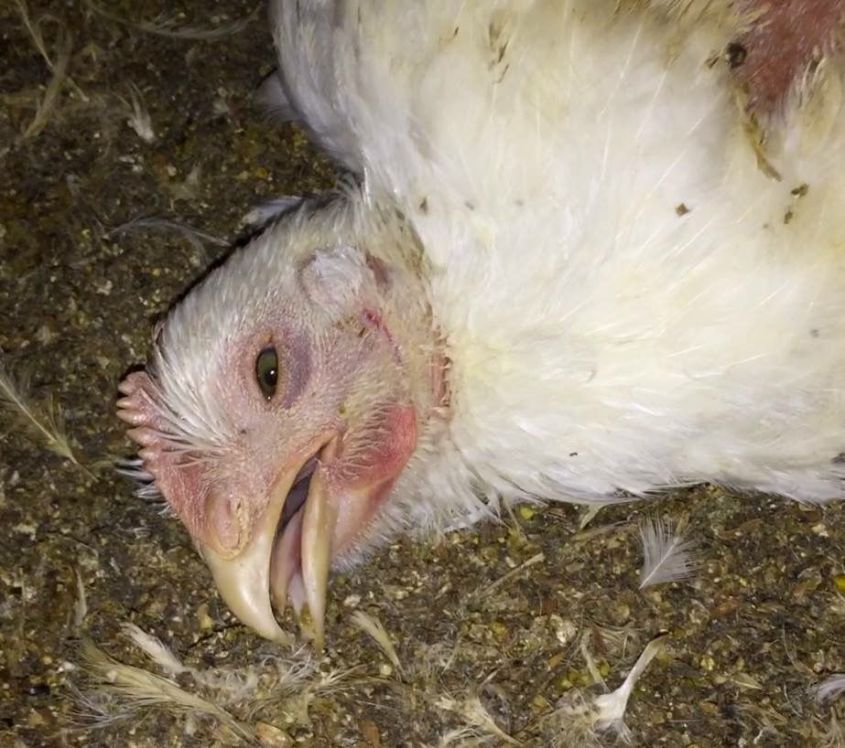
More than 300 million animals in European agriculture suffer from cages. The European Union is the second largest meat producer worldwide! Not only that animal rights activists are no longer allowed to draw attention to the cruel conditions on farms, now the agricultural lobby is launching a counter campaign against a European citizens’ initiative calling for more animal welfare in the stables. Incredible, is not it? More and more outrages of mass animal husbandry are being exposed, but consumers are not supposed to know this, as are the many meat scandals.

“We do not need a self-proclaimed stable police to control animal welfare”! “
No! these words do not come from China, where the government criticized animal welfare organizations that drew attention to the terrible situations with terrible images from the slaughterhouses for dogs, but these words come from the Federal Minister of Agriculture, Germany, Julia Klöckner.

Only pictures of animal rights activists or undercover researchers, show that, where apparently many people have looked away. Whether farmers, veterinarians or the traders all of them benefit from animal suffering. These are pictures that you do not even get to see in a horror movie.
The European Union is the second largest meat producer worldwide! Instead of less meat, more is produced worldwide in 2017, about 324.8 million tons of meat.
Millions of tons of meat are produced here and exported abroad. Factory farming leaves behind terrible consequences in this country, which are supported by taxpayers’ money. Meat from Germany – in demand worldwide – while cheap meat from other countries is imported – more crazy it can not be!
The meat business is booming!
The meat industry is making all sorts of efforts to grow, as the Tönnies example shows, although a message from the meat industry in May 2017 confirmed that demand for pork in Germany and the EU is shrinking.
Why slaughter more pigs then? The meat industry also has an answer to this: exports to third countries increased by 35 percent for pork and over 20 percent for slaughter by-products. The main reason for this is a strong increase in deliveries to China and, to a lesser extent, to other countries, especially Asian ones.
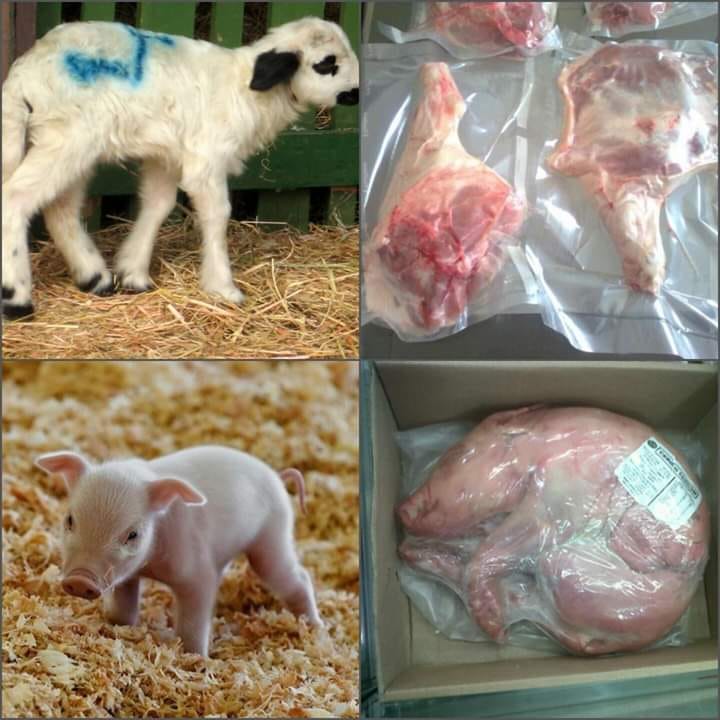
EU Agriculture Commissioner Hogan promised farm animal owners to help open up new export markets and pointed to market voyages to Vietnam and Indonesia. In early November 2016, he visited Turkey, pointing to further trips to West Africa, Canada, Iran and the Persian Gulf in the first half of 2017.
More criminal is not possible: eggs from Ukraine and Argentina, poultry from Brazil and Thailand. Germany imports eggs to the Ukraine and they sell the eggs to Indonesia. Beef from Argentina, Paraguay and also from the USA, while China prefers meat “Made in Germany”. What is not consumed here then goes to Africa.
So Germany exports meat to China, but gets meat from Thailand. While in Latin America more and more rainforests and savannas are being burned to feed the animals in Germany for the intensive cultivation of soybean for animal feed, we also receive meat from Brazil and Argentina.
But we do not participate! We need 1 million valid signatures to ask the European Commission to end this unworthy treatment of farmed animals.
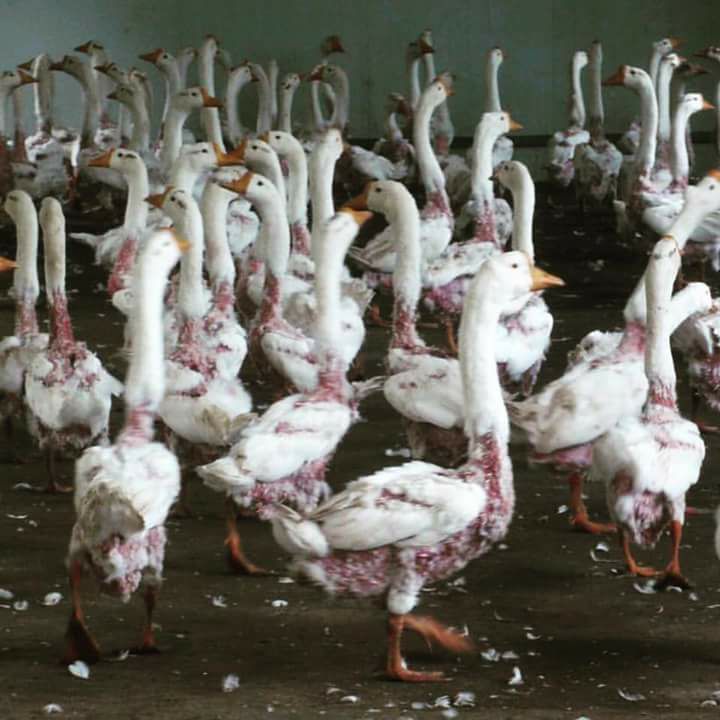
Please sign the petition (if not done yet): https://help.four-paws.org/de-DE/kaefighaltung-ist-ein-albtraum
This Video below is an undercover footage from year 2018 in a Polish farm shows workers smashing baby chicks on metal to kill them. However, these practices are not just a “specialty” from Poland, almost everywhere in Europe the Farma mafia uses these killing methods.
https://netzfrauen.org/2019/02/05/agrarlobby-2
My comment: It is fact that supply and demand no longer regulate the price, it is produced in hell and what we do not want goes abroad. The farmers pollute the landscape and soil the groundwater. Citizens should regulate this with their money. And that’s with help of the subsidies.
Therefore: instead of subventions penalties for animal cruelty, extermination of birds and bees, environmental and water poisoning are urgently required.
After such a report, one thinks spontaneously of the victims of the Easter.
We celebrate Easter, because everything started with a betrayal – that’s what the church means! The Father sent his son down to earth to save the people … and he was betrayed … we all certainly know the story!
We betray the animals every day, but these days the most, and many even with a clear conscience, because they call it tradition.
We call it mass murder and do something against this collective madness. We leave all the animals whether pigs, cattle, poultry, rabbits, lambs …. in their peace and sign the petition against the cage attitude.
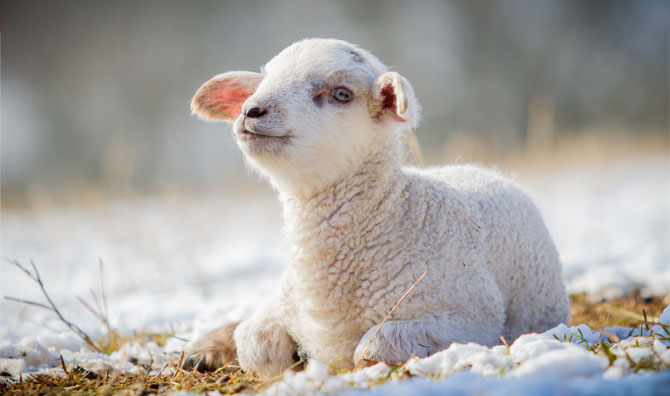
Happy Easter to all, wishes Venus

We are supposed to have EU so called ‘Politicians’ to address such problems as these. This May EU citizens are expected to vote for new Members of the European Parliament (MEP’s). The animals in these photos have no voice; except via us, and if they do not get support from EU politicians, people that ARE supposed to be addressing and approving animal welfare in the EU; then one has to ask if anyone is worthy of your vote in May. When, and only when they address such issues as this, will they be worth even considering.
Wonder why the UK wants to get out of Europe ?
Over one billion rabbits are slaughtered annually for meat worldwide; around 50% of these are produced in China. Rabbits are the second most farmed species in the European Union with an estimated 330 million rabbits slaughtered for meat ever year; the majority of which are produced in Italy, Spain and France (FAOSTAT, 2014).
Nearly all rabbits farmed for meat and fur are kept in small, barren cages where their natural behaviour is severely restricted. Rabbits in intensive farming systems experience very bad welfare
Good animal welfare depends on three components:
- Physical well-being
- Mental well-being
- Natural living.
In intensive rabbit farms, all three of these are compromised by confinement in barren cages, unsuitable social environments, injury and disease and through rough handling at slaughter.
Rabbits are the fourth most farmed animal in the world and most are kept in barren environments, usually in cages. In the European Union the majority are housed in tiny wire cages within large sheds containing 500 to 1000 breeding does (females) and 10 to 20 thousand rabbits reared for meat. Although farmed rabbits are domesticated, they have the behaviours and motivations of their wild counterparts, and many of these are thwarted in intensive systems.
Currently there is no species-specific legislation protecting the welfare of farmed rabbits in the EU. A few countries within the EU (Belgium, Germany and the Netherlands) have species-specific requirements for rabbit farming but they produce only a very small percentage of rabbit meat farmed in the EU.
Inadequate space and cage height
Young rabbits reared for meat (referred to as “fattening rabbits”) are typically caged in groups with 450 to 600cm² space each in the EU; this is less than the area of an ordinary A4 sheet of paper. Adult breeding does are typically housed singly, in cages that are just 60 to 65cm long, 40 to 48cm wide and 30 to 35cm high.
Cages are simply not acceptable. With barely any space, rabbits cannot adopt normal postures such as lying stretched out, sitting and standing with their ears erect (species typical “look out” posture) or rearing up to explore their surroundings. They cannot move normally or comfortably, and some don’t even have enough space to perform a single hop. This is bad for their mental well-being, and the lack of exercise can also lead to weakened bones.
Barren environment
The majority of farmed rabbits are reared in barren environments, with just a drinker and feeder and a wire mesh floor. This does not allow for natural behaviours such as digging, hiding and foraging, and leads to abnormal behaviours such as over grooming and repetitive gnawing on the bars of the cage.
In the wild rabbits spend much of their time feeding on grass and other plants, eating lots of high-fibre roughage. In contrast, most farmed rabbits are fed a pellet-only diet which is eaten in a fraction of the time. This leads to boredom and frustration.
Unsuitable social environments
Rabbits are social animals and usually live in stable groups in the wild. Serious aggression is rare once a stable hierarchy has been established.
Fattening rabbits are usually housed in pairs or groups, but they are kept in very close confinement so are unable to move away from each other. This may be particularly stressful for rabbits as they get larger and have even less space, and when they start to reach sexual maturity they can become more aggressive.
Breeding rabbits are usually kept in individual cages. This denies them opportunity for natural social behaviours, such as grooming. However, the rabbits are kept right next to each other in the cages, which also stops them from being able to move away from each other. In the wild, females keep their young in isolated nests, far away from the rest of the group, so this close proximity to other females is likely to be very stressful to them.
Singly housed rabbits show more abnormal stereotypical behaviour, such as over grooming and gnawing at the bars of their cage, than those housed in groups. Breeding rabbits can be housed successfully in groups if they are given sufficient space and adequate nesting facilities to avoid aggression problems.
Injuries and disease
The mortality rates for commercially farmed rabbits are very high. Typically, 100 – 120% of breeding does die or are culled and replaced each year, and 15 to 30% of fattening rabbits die before slaughter (which happens at 8-12 weeks old). Respiratory and intestinal diseases are the main reason for such high mortalities and cause acute pain.
Rabbit cages are made of wire and sometimes have metal sheet sides. The floor is often made entirely from bare wire, which is uncomfortable to stand on. Breeding male and females kept on bare wire often develop sores on their footpads and hocks. These sores can cause chronic pain and are a common reason for culling.
Does are commonly given hormone treatments to control their reproductive cycles and get them ready to breed at the same time. They are artificially inseminated within 11 days (on average) after giving birth to their last litter, and have been bred to produce larger litters. Their bodies are put under huge strain from this intensive reproduction cycle. It can lead to loss of body condition, metabolic diseases, and increase the risk of spinal deformities.
Slaughter
In the EU commercially slaughtered rabbits are usually electrically stunned before slaughter. Research has shown that rabbits may be frequently incorrectly stunned. Rabbits are hung individually upside down for the electrical stunning which is stressful and may cause pain and/or injury if their weight is not supported properly. This is a particular problem for larger rabbits.
There are alternatives to farming rabbits in cages, which can improve the welfare of farmed rabbits.
Higher welfare alternatives for rabbits
In some countries there are alternatives to barren-cage farming of rabbits, which can improve the welfare of farmed rabbits. However, there are still problems associated with these systems, as it is intensive production and research is ongoing.
There is national legislation setting minimum standards for rabbits in Belgium, Germany, Switzerland and the Netherlands. In these countries, barren cages are banned for fattening rabbits and breeding does. In Belgium, ‘enriched’ cages are also banned for fattening rabbits and will be banned for breeding does from 2021, and pen systems are the minimum standard.
Information provided by ‘Compassion In World Farming’ – London, England.
https://www.ciwf.org.uk/farm-animals/rabbits/rabbit-welfare/
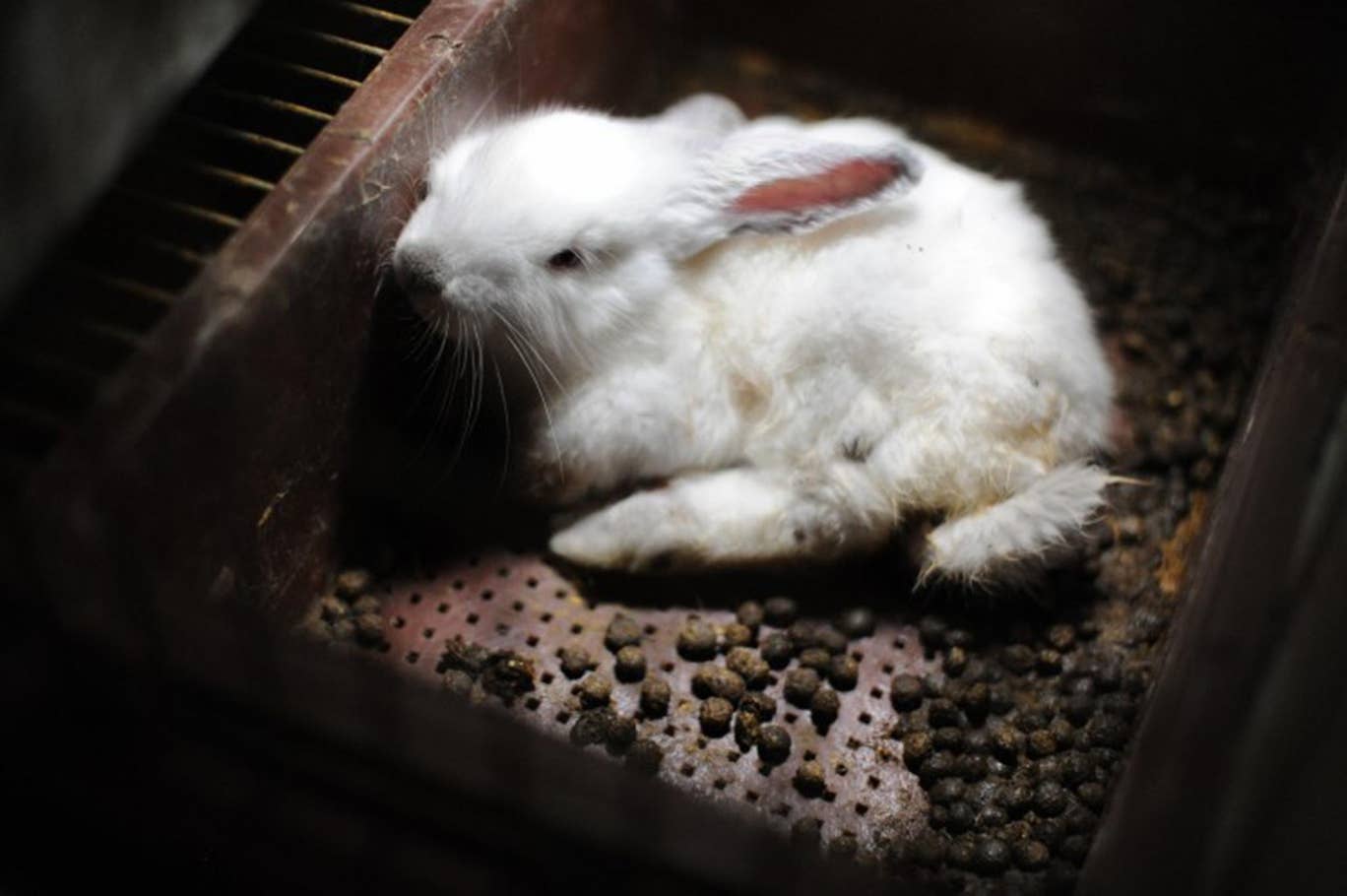
A rabbit lies at the bottom of a cage, surrounded by faeces
Spain,
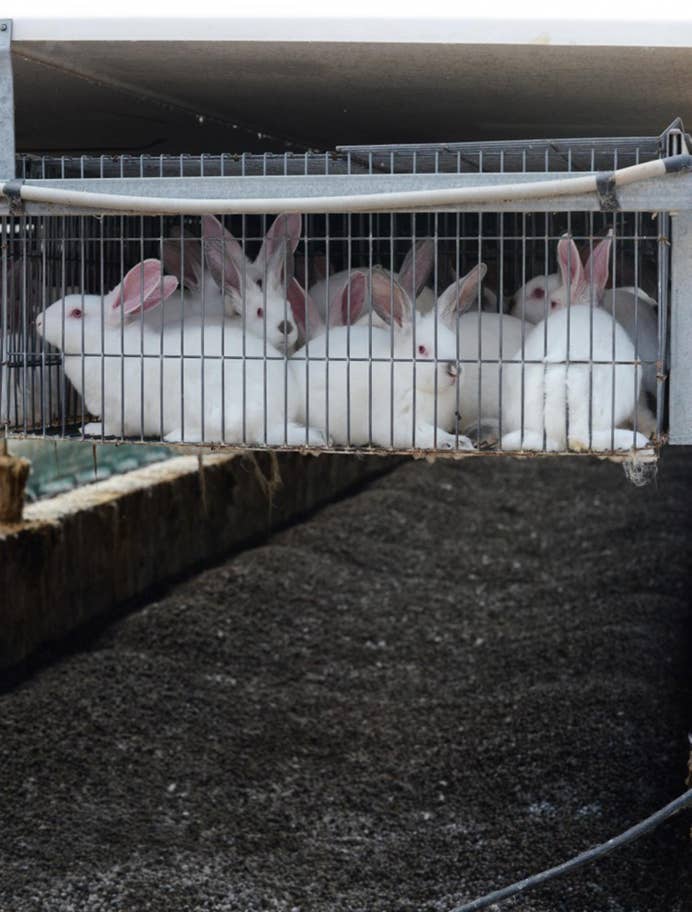
Rabbit cages hover above excrement on breeding farm
Spain,
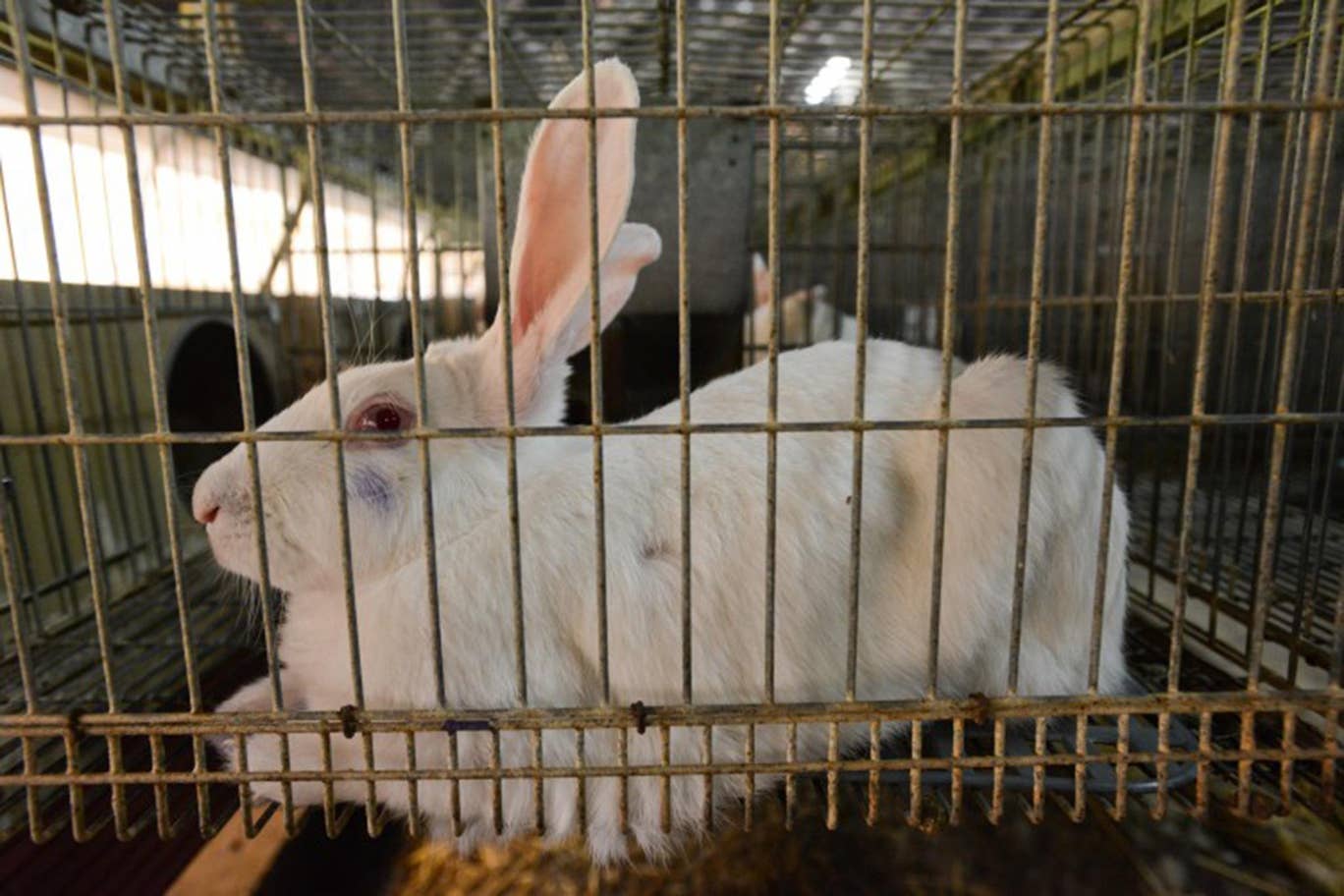
Rabbit in a breeding cage
Spain,
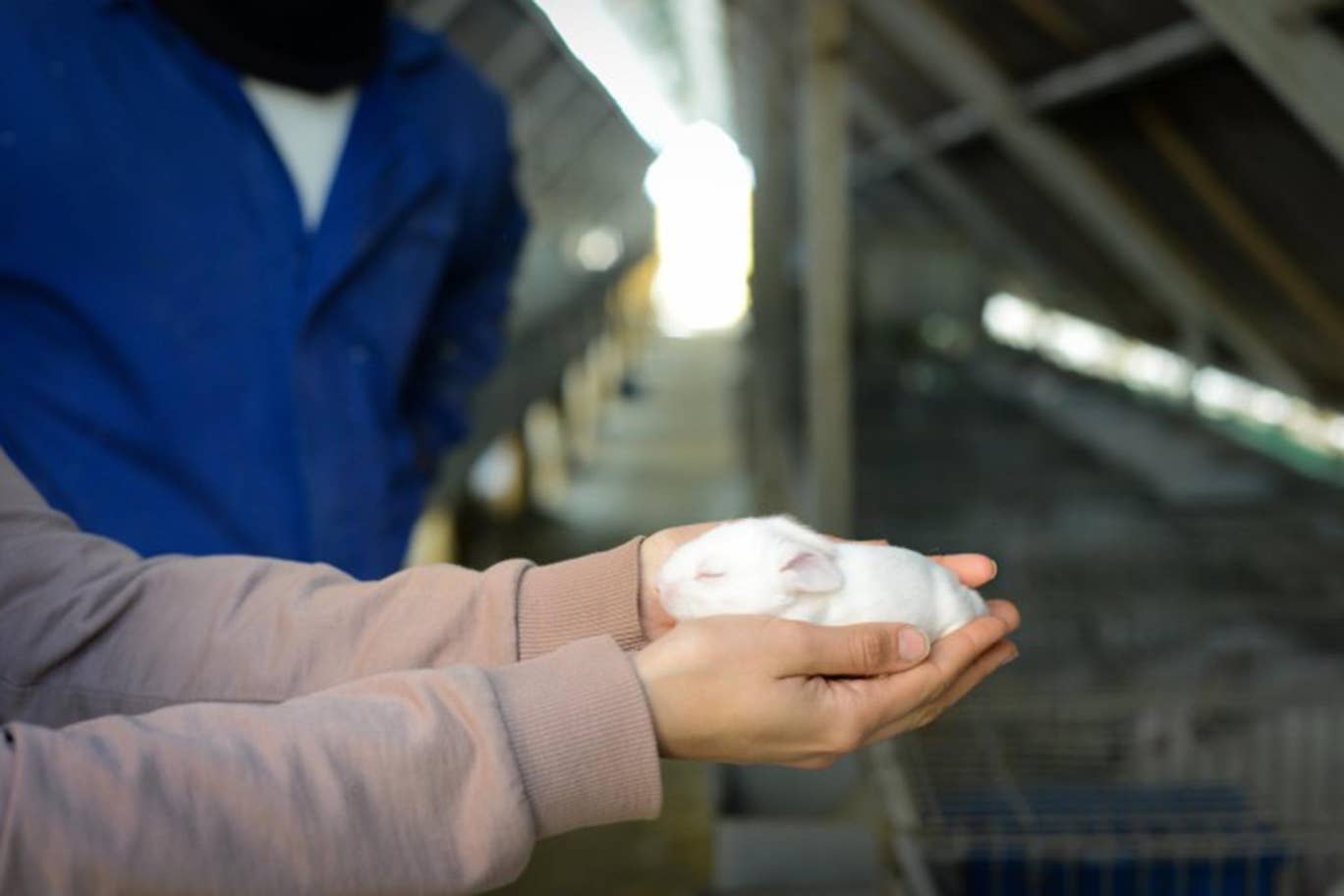
Baby rabbit born on industrial breeding farm
Spain,
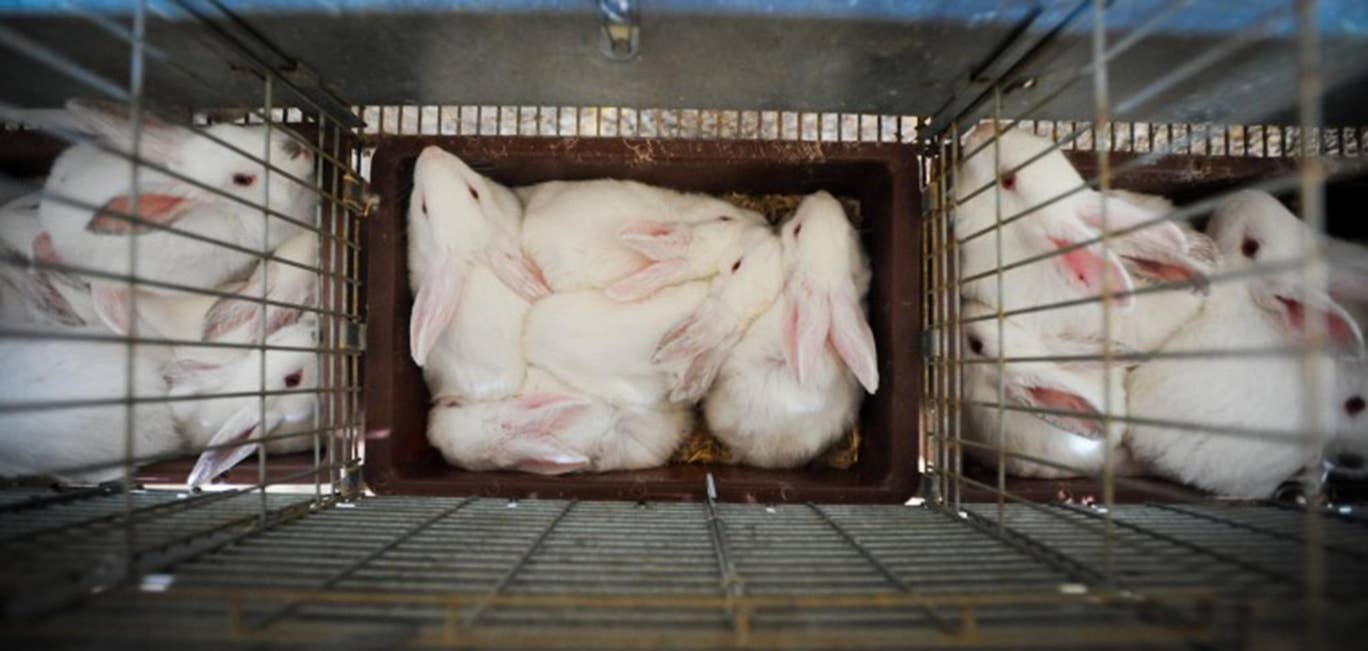
Rabbits in breeding cages
Spain,

More Rabbits in breeding cages
Spain,
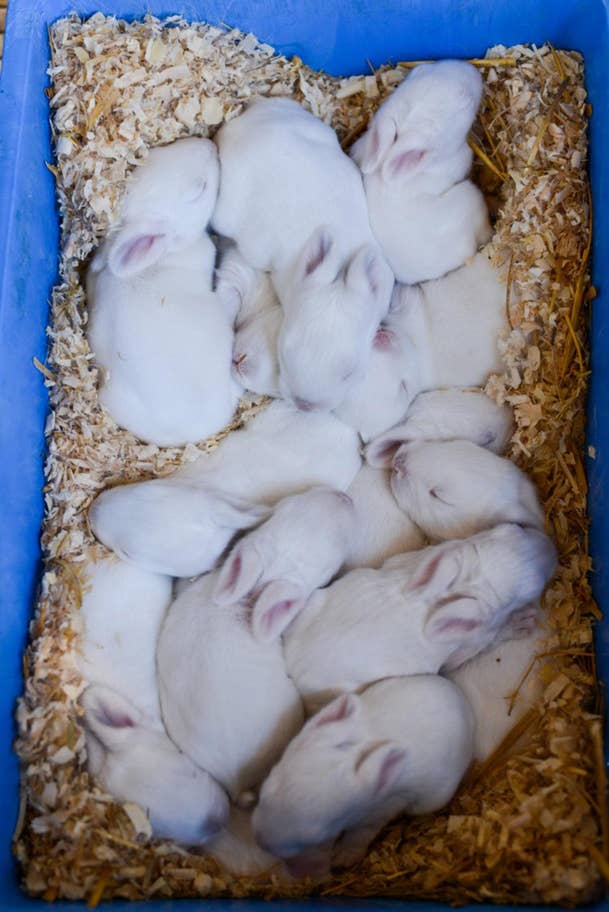
Rabbits born on an industrial breeding farm
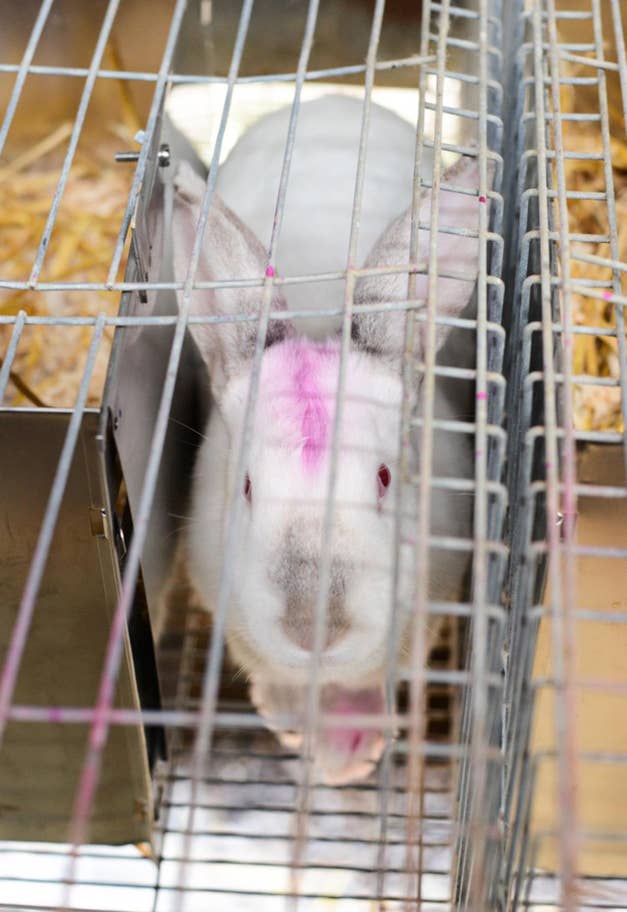
Spray painted rabbit confined in breeding cage.
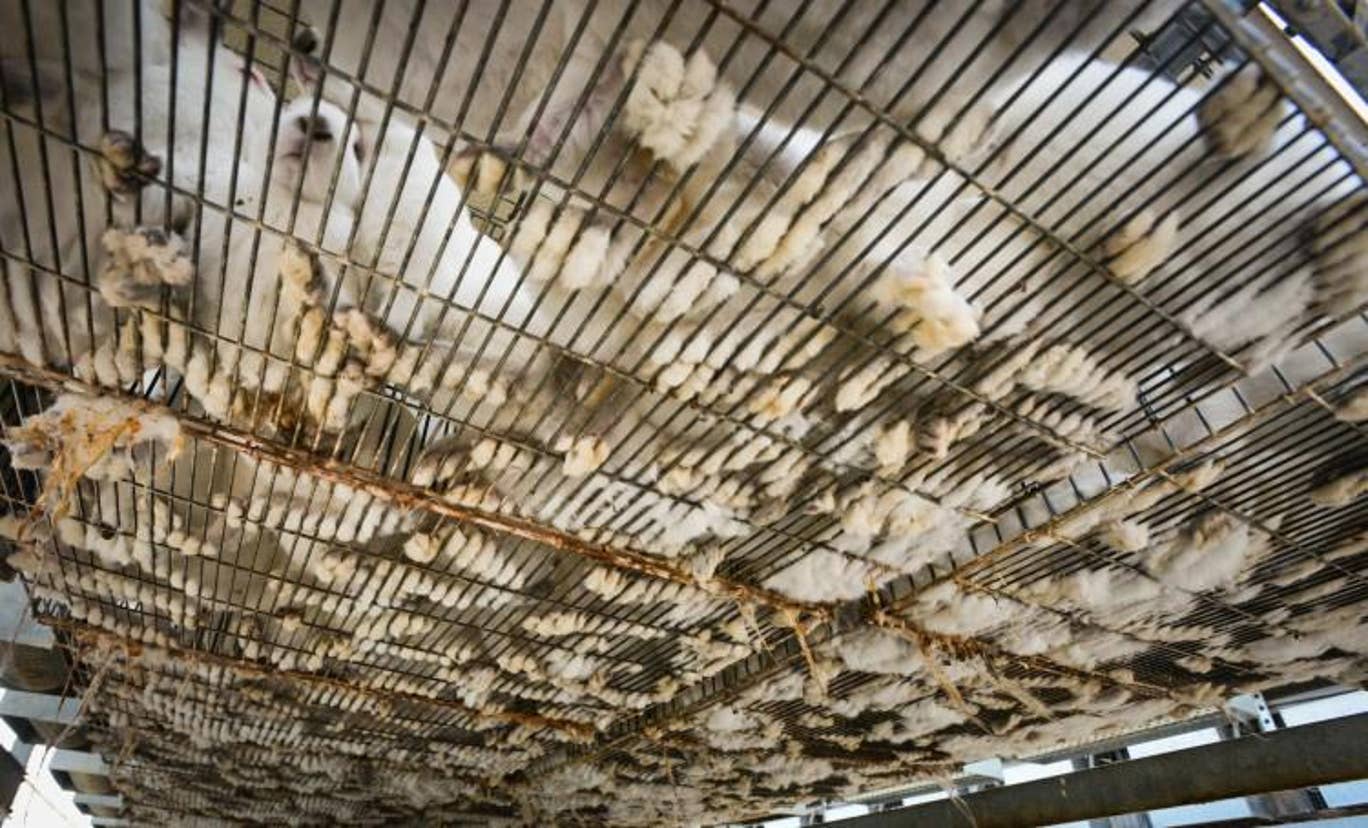
Rabbits in breeding cages.
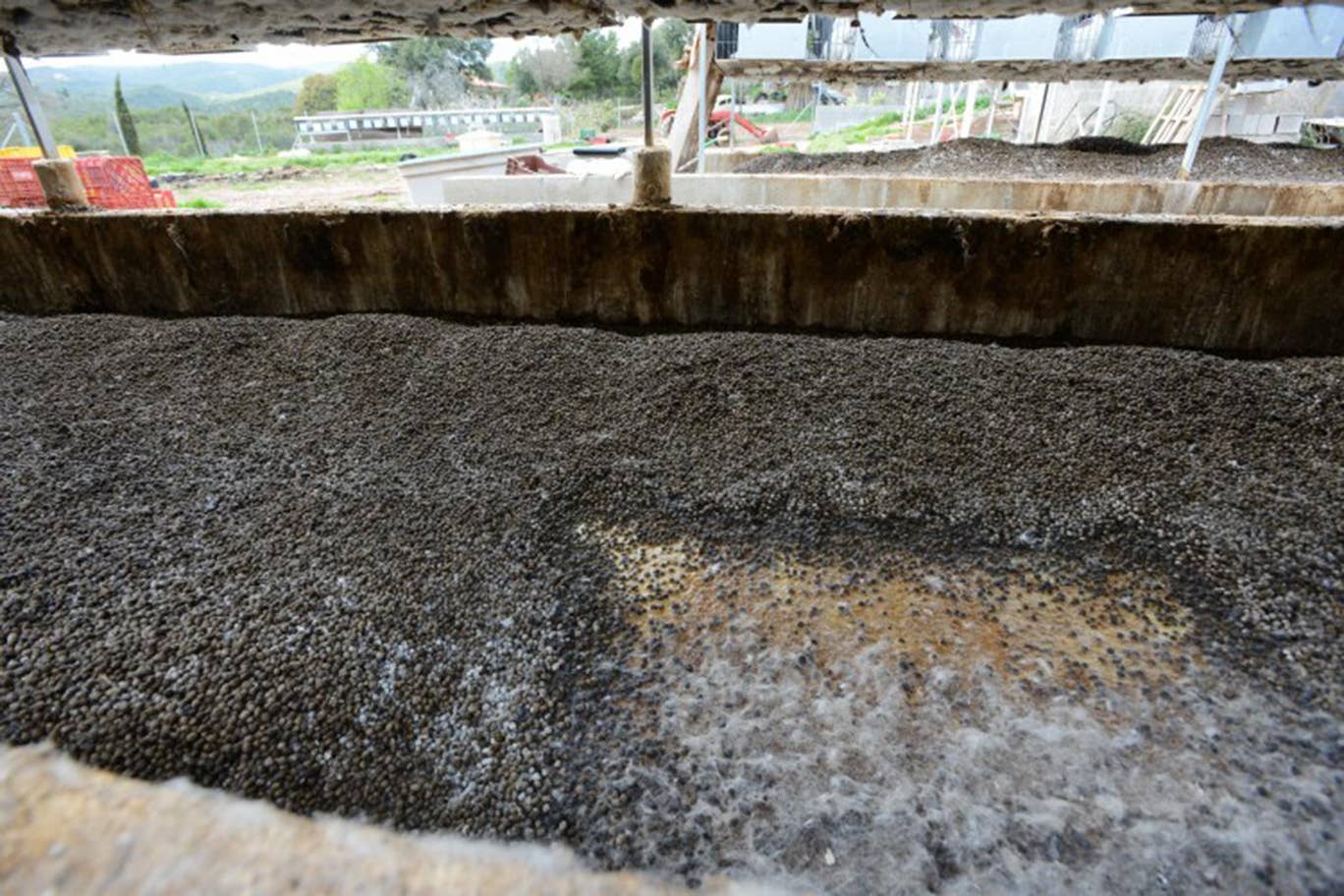
Excrement below cages on a breeding farm.
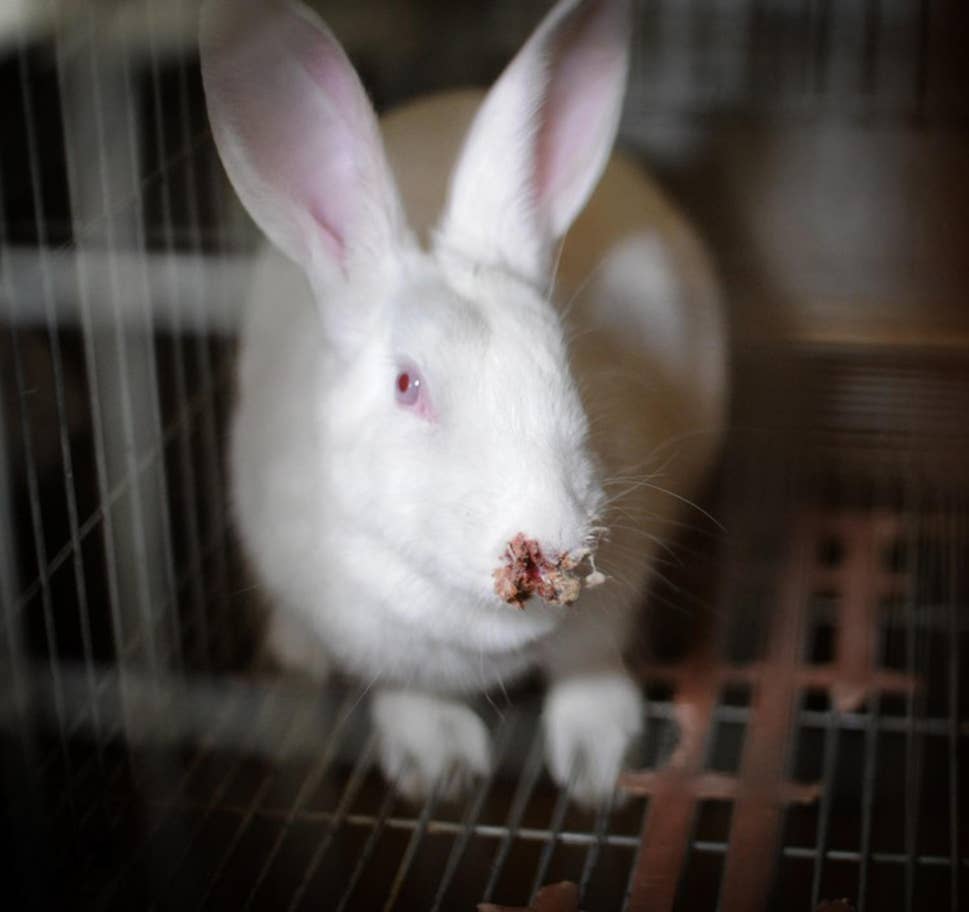
Rabbit with face injury.
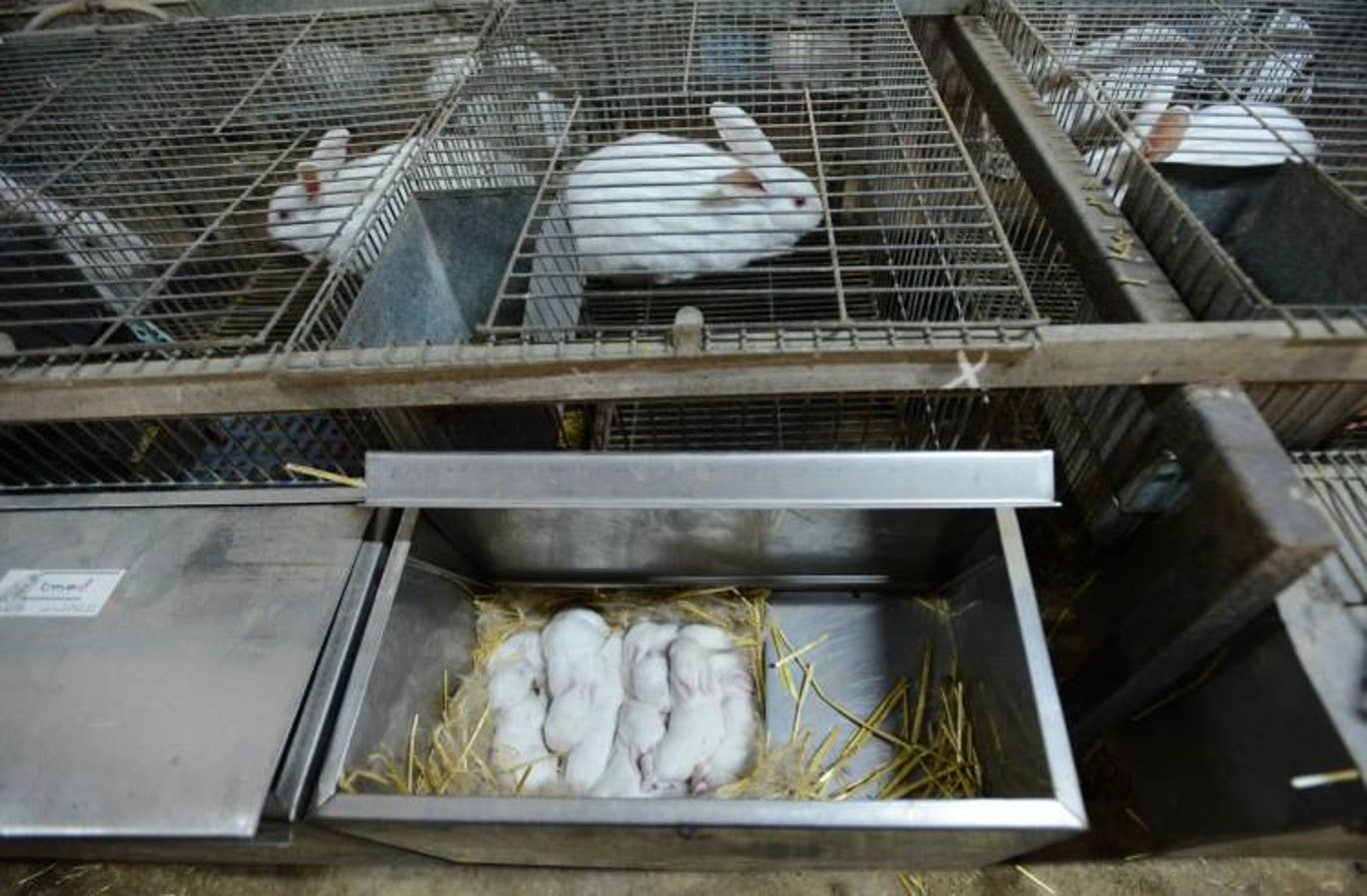
Rabbits and young in breeding cages.
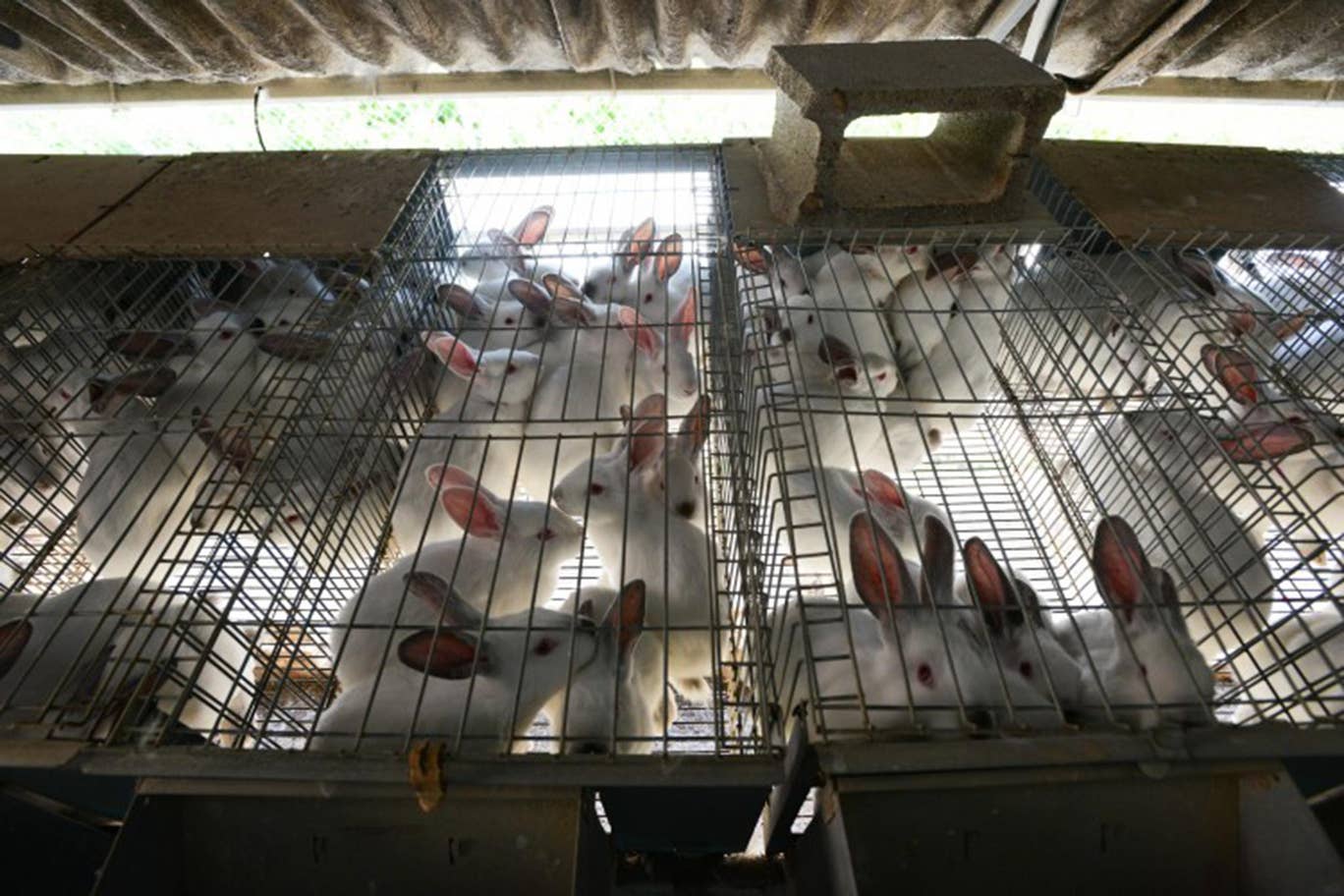
Rabbits in breeding cages.
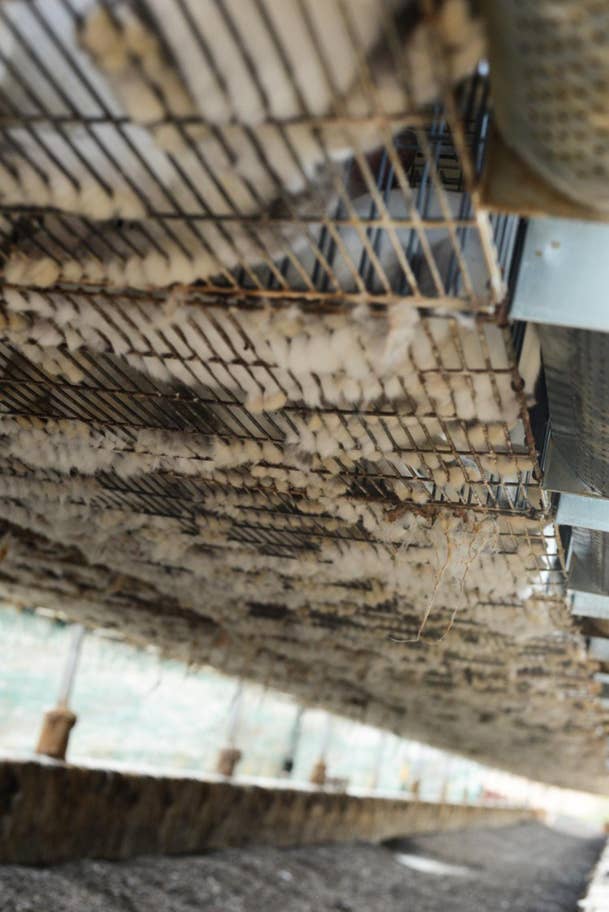
Rabbits in cages above excrement on breeding farm.
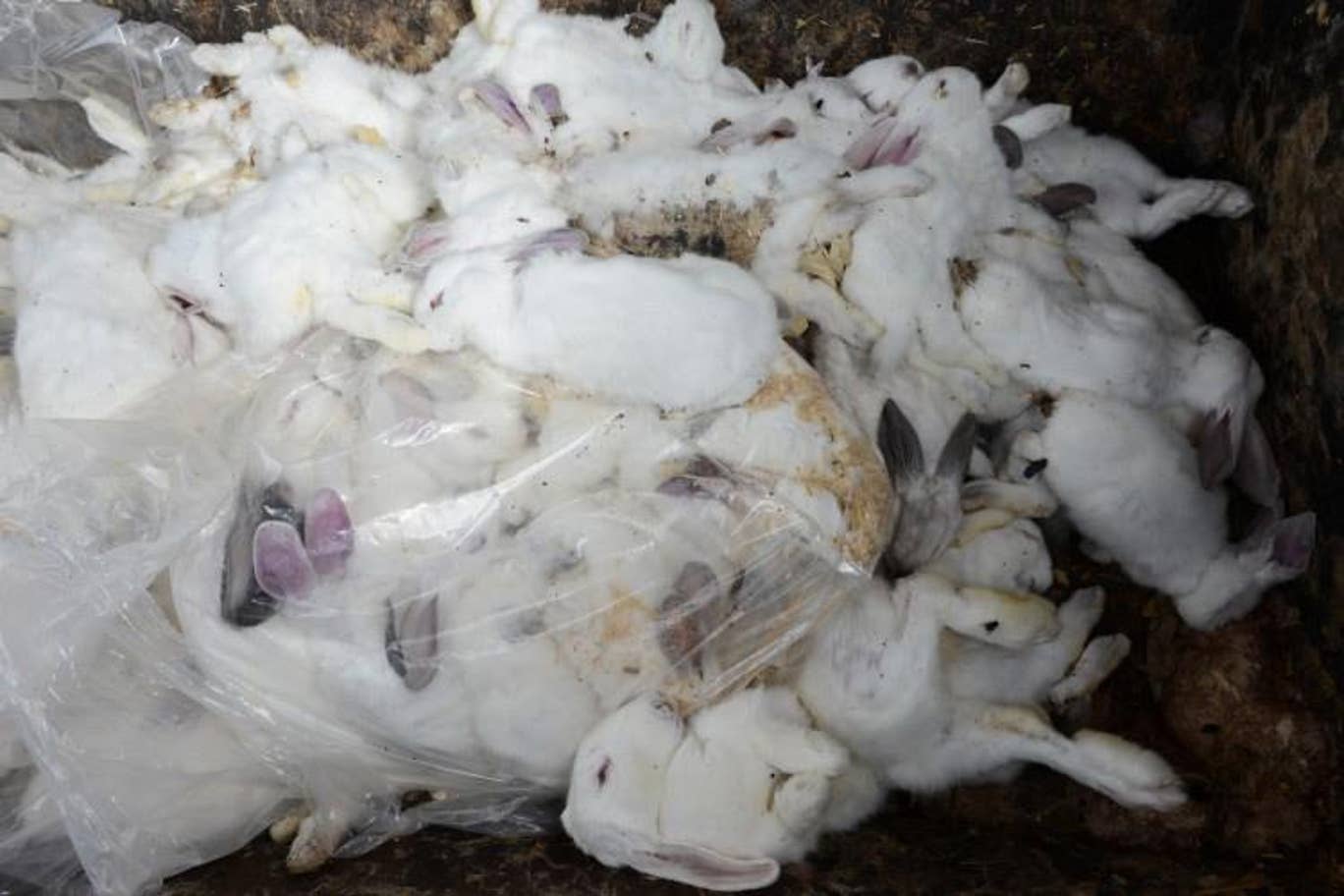
Dead rabbits in garbage bin.
Below – The ‘Masters of Europe’ – those who Enforce the Regulations !!!



Oh no — not above the rabbit excrement pile – I thought you had regulations to prevent that !