This is from Twyla – Please visit her site and view the wonderful paintings at:
https://www.twylafrancois.com/?utm_campaign=7a44b64d-f555-4b50-beeb-c1e7e6c2afb7&utm_source=so

Squashed, kicked, and disposed of alive – in Germany, 99% of all broiler chickens live on farms with more than 10,000 animals. In Germany, 30 million chickens die each year before slaughter, due to poor housing conditions!!
Not only the animals suffer terrible torments, also the human being is affected.
According to a recent report, the practices of intensive chicken production contribute to the increase in antimicrobial resistance (AMR) in bacteria that are transmissible from animals to humans, such as Campylobacter, Salmonella and E.coli.
For decades, mass animal farmers have been pumping antibiotics into the animals to make up for inhuman and disease-causing conditions. Now the bacteria fight back.
E. coli is by far the most common cause of urinary tract infection and dangerous human blood poisoning, and it can also cause meningitis. These infections can be fatal if they do not respond to antibiotics.
According to the Organization for Economic Co-operation and Development (OECD), over the next few years, antibiotic-resistant “superbugs” could kill 1.3 million people in Europe if nothing more is done to solve the problem. Researchers are already studying medieval sources in search of antibiotic-resistant germs. Farmers still want to use antibiotics, although factory farming promotes antibiotic-resistant bacteria. Criminal, right?
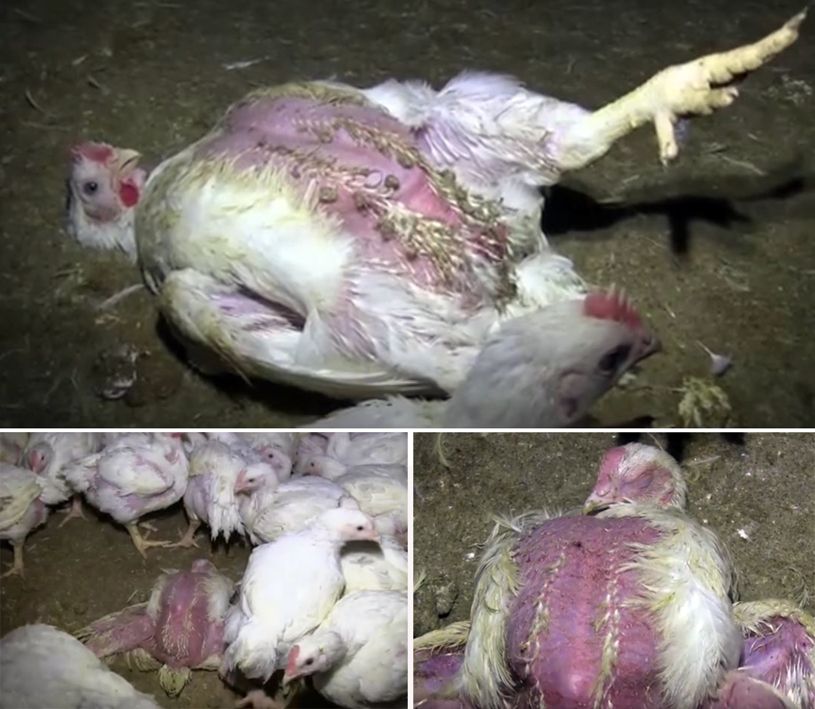
A new research shows systematic animal distress at Wiesenhof and Co. – from the first day until the day of slaughter. Bruised, kicked, taken away alive: An undercover research by Animal Equality reveals the systematic cruelty in German chicken mast farms. The documented operations supply the major groups Wiesenhof and Rothkötter. After a maximum of 42 days of life, the agony of the animals ends: in the slaughterhouse.
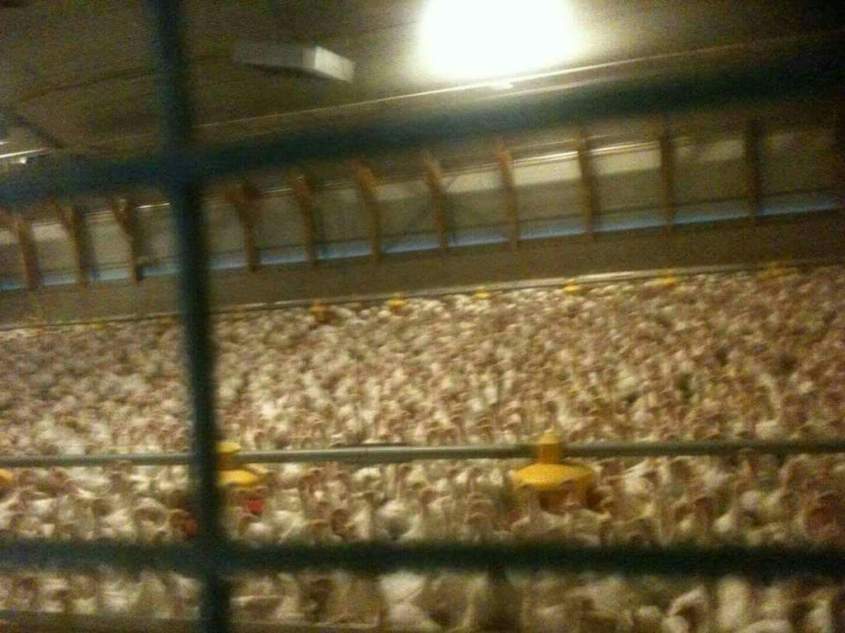
In Germany, 99% of all broiler chickens live in farms with more than 10,000 animals. There they live densely packed in huge halls.
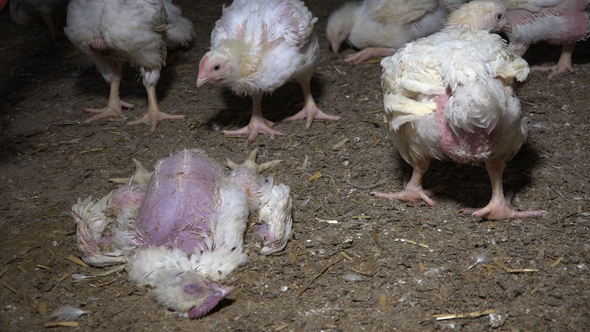
Again and again, chickens were documented that can no longer run or stand up. Often a sign of overbreeding.
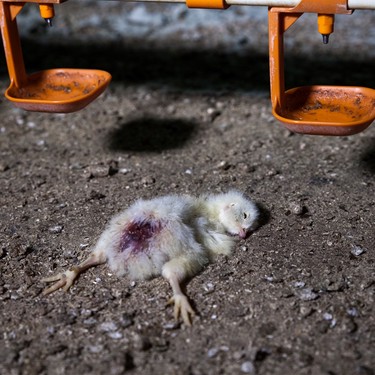
Weak and sick animals are eliminated. In the video, a worker squeezes a chick on the trough – presumably to kill it.
Chicks are systematically disposed of alive in all filmed farms. A total of ten times this has been documented.
The transport to the slaughterhouse begins with kicks and punches of the catcher squads. Animals are grabbed by the legs and thrown into the pits. It is not unusual for wings or legs to break.
In most commercial chicken farms, the chickens are given antibiotics against infection. These funds are relatively cheap and available everywhere and they provide high profits. The problems occur when the animals are kept in dirty conditions and exposed to infections and viruses.
Do you eat chicken meat?
Then there is a high risk of being infected with Campylobacter. With more than 70,000 reported illnesses in 2016 and similar high numbers in previous years, Campylobacter enteritis has become the most common bacterial notifiable disease in Germany.
According to the Robert Koch Institute, the most significant risk factor for Campylobacter infection was the consumption of chicken meat.
The EU legislation on “animal welfare” for fattening chicken does not currently guarantee “the welfare” of the farm chicken. This is evident from the implementation report of the EU Commission itself. The EU Parliament will try to pass a resolution on this issue next week to finally move things forward.
Although the problems are known, although other countries have long since reacted, although the representatives of the European Parliament and the EU states after several years, negotiations on new regulations have agreed …. the EU states have three years to the new rules implement.
Thus, the regulation does not apply until the end of 2021!!
What the regular “feeding” with antibiotics for animals and for humans – as the end of the food chain – has effects, we can count on five fingers (if we want to see the problem!)
https://netzfrauen.org/2019/01/08/chicken/
My comment: The animals get sick because of performance breeding and in the mega cases. Politicians can not say that they do not know. They know it. Consumers know it.
But the system allows (under the influence of agribusiness lobbyists) that factory farming should only meet the minimum legal requirements of animal welfare, which is anything but animal friendly.
It has to be compulsively and recklessly produced more and more… and cheaper… to generate returns. Of course, nobody is interested in the fact that it is about sentient beings, animals, and not commodities.
The animal welfare issue must be part of a general political and social rethink that does not subordinate the rights of animals to the economic interests of the dairy and meat industry.
However, this sick system can not change only by the purchasing decisions of the individual, so we must achieve this through basic power.
My best regards, Venus

Petition to Sign: Outlaw Cruel Live Animal Exports in Chile
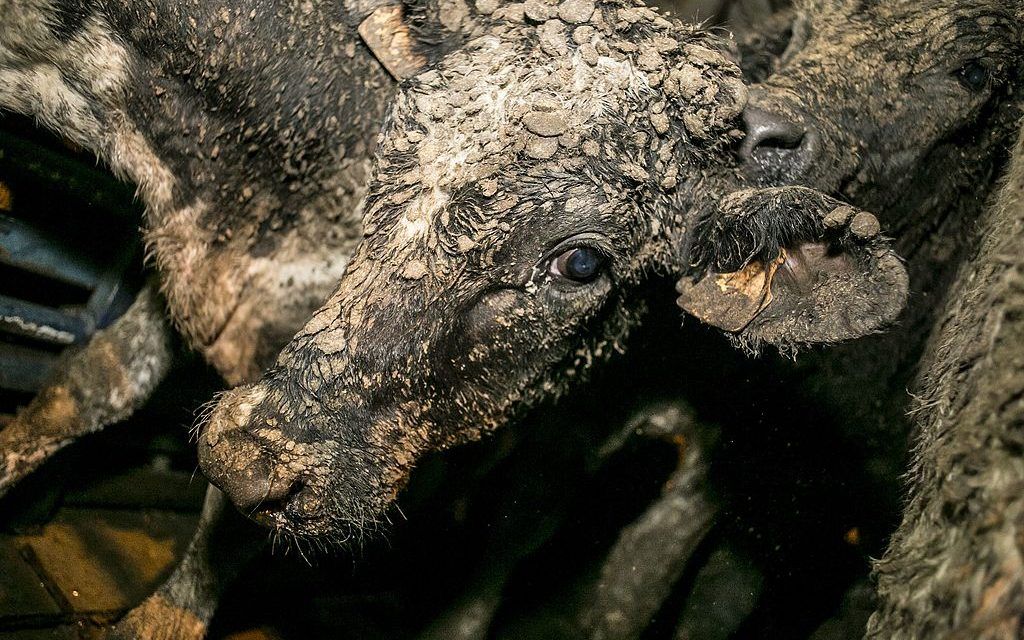
Representative image of live export conditions via Wikimedia/Shpernik088

Petition Link – https://ladyfreethinker.org/petition-support-chile-effort-end-cruel-practice-live-exports/
PETITION TARGET: Chilean Senator Guido Girardi
For animals exported from Chile to China and the Middle East, the voyage is pure torture.
Living in filth and faeces, the animals endure excruciating heat, no veterinarian care and overcrowding that crushes them to death. Sick animals may be cruelly thrown overboard into the sea while still alive and conscious.
More than 60,000 cows, pigs and other animals have endured such live export from 2014 to 2017. Those who survived were sent to countries with little to no animal welfare laws; once off the boat, they faced brutally inhumane transport and slaughter for consumption or even sacrifices.
But there is new hope. Chilean Senator Guido Girardi, along with the nonprofit organizations ProAnimal of Chile and Animals International of Australia, plan to propose a law to the National Congress of Chile banning live animal exports by sea.
Despite evidence and international public outcry, governments worldwide continue to fail to ban live exports and refuse to protect these helpless animals from the torture they endure.
But we cannot give up; the animals need us to speak up for them now more than ever.
With your signature, you can support legislation to save thousands of animals from the horrible suffering endured during live exports, and help ensure the current efforts are not made in vain.
Please sign this petition to show Senator Guido Girardi your support of ending live animal exports, and encourage him to keep up the fight until the cruel practice has ended.
Religious texts set down traditional methods of slaughter; simply using a knife to kill the animal. The right to continue using these methods is strongly contested between members of the Jewish and Muslim faiths and animal rights / welfare activists.
Opponents of the practice feel that animals should be stunned before slaughter – stunning; which is a standard industry practice worldwide – if undertaken properly, this makes animals unconscious and reduces the pain as they are cut (stuck / sticking) and bled to death. We say ‘if undertaken properly’; because there is a lot of evidence and undercover footage in existence which shows that in the ‘stun usage’ environment; many animals are not being stunned correctly or for long enough; thus regaining consciousness before their throats are cut.
However, there is no definitive scientific evidence that an animal does not feel pain whilst unconscious. Indeed, a counter argument put forward by ritual slaughter advocates is that stunning may only stop an animal from displaying pain.
While the Jews accept absolutely no stunning, some Muslims have accepted it as long as it can be shown that the animal could be returned to normal living consciousness.
EU law requires animals for the food chain to be stunned (made unconscious) prior to killing, so that death should be ‘painless’. Is any slaughter ‘painless’ we ask ?
Saying this, there are within the EU exceptions to stunning prior to slaughter for religious reasons, notably for Shechita (the Jewish method of killing animals for food – Kosher meat) and Muslim Halal. The Muslim and Jewish communities, totalling nearly 25% of the world population, have similar philosophies in this regard.
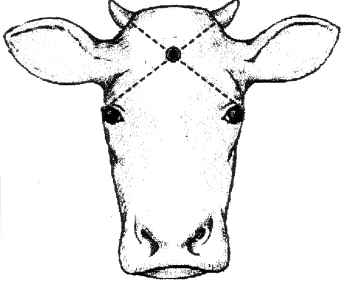
The recommended position which a captive bolt gun should be located on cattle’s head.
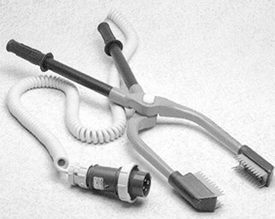
Stunning tongs deliver an electric charge. They must be positioned either side of the head to be effective.
Conventional Slaughter
Animals are generally made unconscious by stunning and then killed by cutting their main blood vessels; the carotid arteries in the neck.
Just prior to slaughter, individual animals are supposed to be separated as they are walked into a stunning box. Within seconds an operator stuns the animal. Separation is not as common as the industry would like people to think.
There are three different methods of stunning, each used for specific animals.
Captive bolt: a gun-like device delivers a concussive blow to the skull. Usually used for adult cattle and sometimes sheep and calves,
Electrical: A current is applied across a sheep’s (or sometimes cattle’s) brain allegedly rendering it senseless. Electrical stunning is undertaken using ‘tongs’ held by the slaughterman. It is essential that to produce the required result, the tongs are positioned correctly on the animals head. Again; a lot of video evidence shows that tongs are either positioned incorrectly in the first place; and / or they are not held in position for long enough time to render the animal unconscious.
There is very much a risk that some cattle, pigs and sheep may not be stunned effectively, causing them to regain consciousness before they die from blood loss during sticking Therefore, for stunning to be effective it is vital that:
the stunning equipment such as tongs are working properly – they should be regularly checked and maintained
the stunning equipment is positioned correctly on the animal’s head/head and back. In large processing facilities; this is not always correctly undertaken.
during electrical stunning, enough current is applied for a long enough period
during captive bolt stunning, the correct charge cartridge is used to fire the captive bolt
the time between stunning and sticking (cutting) is not too long to prevent an animal regaining consciousness

A sheep is electrically stunned using tongs.
Waterbath: Used for the killing of chickens. Birds are hung by their feet in metal holders (shackles) on a moving belt and their heads are supposed to be dipped into electrified water.
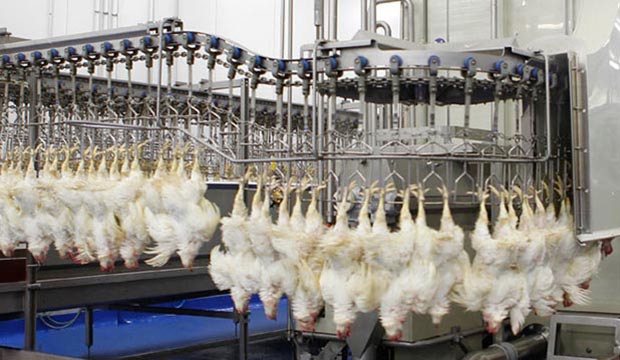
Above and Below – Chickens hanging on shackles.

The problems involved with the stunning of poultry are complex. Welfare concerns include the following:
the shackling of live birds – which is painful.
Waterbathing can result in some birds raising their heads and subsequently missing the water bath stunner.
Can result in the birds receiving painful pre-stun shocks as they enter the stunner.
Can result in an insufficient electrical current flowing through the bird’s body to ensure the bird is unconscious (effectively stunned).
Can be designed so birds passing through an automatic neck cutter only receive a single cut to the neck, which reduces the rate of blood loss.
Can result in birds accidentally missing the automatic neck cutter. If these birds are not noticed by the slaughter person, they may still be alive when entering the scalding tank – a tank of boiling water that helps to loosen the feathers prior to plucking.
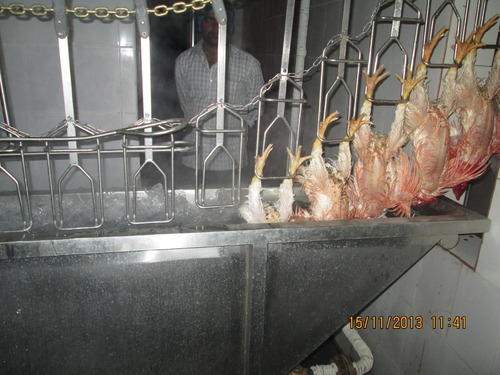
Chickens going through the scalding tank.

Above and below – A pig still alive within the scalding tank.
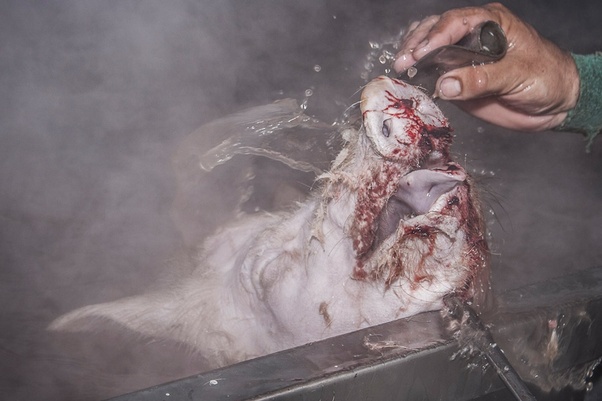
Gas: carbon dioxide or other inert gases are used, mainly for poultry; but also for pigs.
Stunning with CO2 gas is in our opinion terrible, but it offers some benefits over electric stunning including the ability to stun animals in groups, with minimal restraint, less handling, and therefore potentially less stress before stunning. There is also less reliance on the skills of the people operating the equipment.
However, recent studies have revealed a number of welfare issues with CO2 stunning. These include:
the gas is very unpleasant for pigs (who are highly aversive animals)
there is variability between individual pigs’ responses to CO2
pigs are not rendered unconscious immediately
high concentrations of CO2 gas can cause significant pain and distress to pigs when inhaled (by causing acute respiratory distress)
Studies of pigs’ behaviour have found that most pigs will avoid high concentrations of CO2 gas if possible, and that almost 90% of pigs preferred to go without water for 72 hours than experience exposure to CO2 gas.
Further research is urgently needed to develop stunning systems which retain the benefits of CO2 stunning while minimising the disadvantages. Evidence suggests that potential alternatives to be investigated may include:
non-aversive (not unpleasant and do not cause pain) gas mixtures such as argon, nitrogen, or nitrous oxide
a combination of argon with CO2
anaesthesia with non-aversive gases, followed by killing by CO2 or electrical methods
genetic selection for pigs which do not find CO2 to be painful.
The RSPCA (in the UK) recommends that stunning/killing pigs with high concentrations of CO2 should be phased out quickly, and replaced with a more humane alternative. The development of more humane gas mixtures and suitable equipment should be urgently prioritised.

Pigs being killed by the use of CO2.
Bleeding out comes from having at least both carotid arteries in the animal’s neck severed (“sticking”) to ensure maximum blood loss.
Cutting actions required
In poultry and sheep the throat is cut behind the jaw.
The knife cut for chicken cuts muscle, trachea, oesophagus, carotid arteries, jugular veins and major nerves.
For cattle, the skin is opened at the neck through a 30cm longitudinal cut. A clean knife is then used and inserted at a 45° angle to cut the jugular and carotid blood vessels.
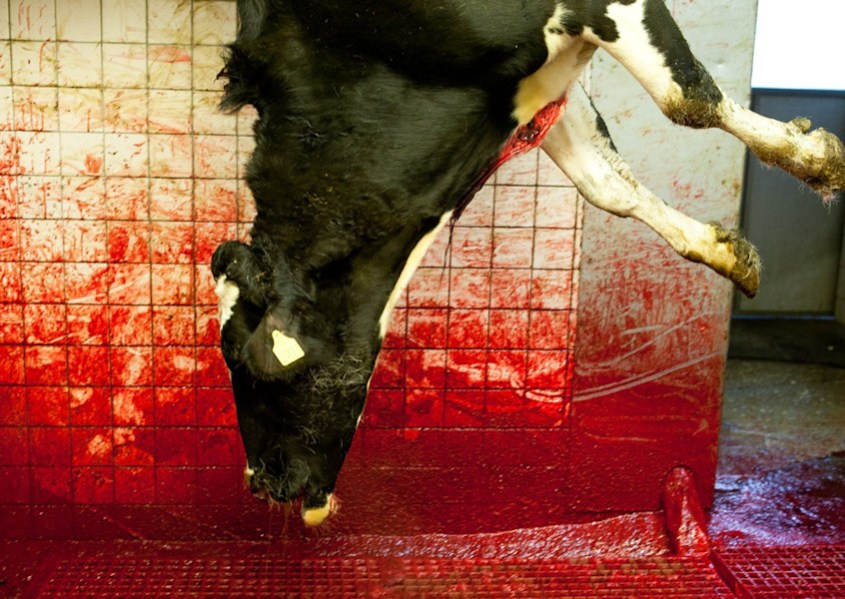
Slaughtered Cattle hung and bleeding out.
According to the ‘system’, the knife should be ‘very sharp’, without blemishes or damage and be at least double the width of the neck. It should be used in a fast, aggressive cut across the throat with the least number of strokes in order to bring about immediate and massive blood loss.
The animals are then inverted, having been shackled by a back leg – attached using a metal fastener – just after stunning (except poultry which are already inverted), to allow the blood to drain away faster.
Religious
Halal slaughter
For cattle there was no stunning in Italy and most Belgian and French slaughterhouses, unlike in Germany and the UK. Cattle were restrained upright in Italy, the UK and 80% of abattoirs in Belgium, but turned on their back in a pen in Spain. The most common stunning method was the penetrating captive bolt.
For sheep, there was no stunning in Belgian, Dutch and most of the Italian, French and Spanish abattoirs surveyed, whereas stunning was the most common practice in the UK and Germany. The animals were upright in the UK, on their sides in Belgium, France and Italy and mainly hoisted in Spain. The most common stunning method was head-only electrical stunning,
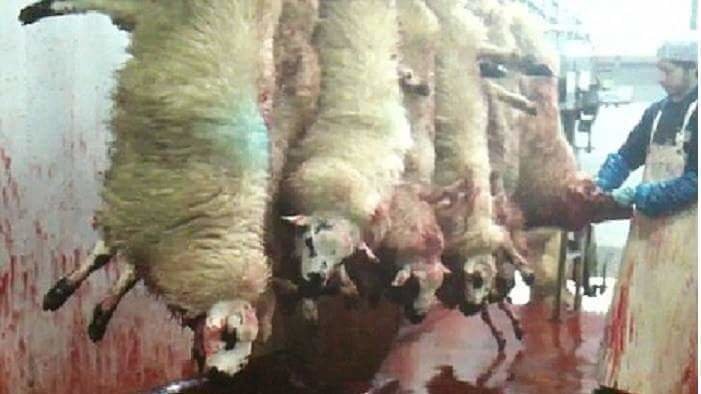
Sheep hoisted for Halal slaughter.
Poultry were not stunned in Italian abattoirs surveyed, but stunned in Germany, Spain and the UK. The stunning method used was the waterbath.
Shechita slaughter
Data from French, Italian, Spanish and UK abattoirs showed that no stunning (pre- or post-cut) was used. For cattle, slaughter was in the upright position in Italy and the UK and with animals on their backs and restrained in Spain and France. For animals such as sheep, they were turned on their sides in the UK, but hoisted in Italy.
Of importance for any slaughtering, but more so for Halal and even more for Shechita, is secure restraining. This particularly relates to the head and neck since movement results in a poor cut, slowing death, reducing meat quality and possibly retaining blood and ‘spoiling’ meat.
Religious customs
Muslim
The Qur’an sets out the rules with respect to animals and slaughter and teaches that animals should be well treated:
Restraining equipment should be comfortable for the animal, whatever ‘comfortable’ is for an animal about to die !
Invoking the name of Allah immediately before the slaughter is either compulsory or highly encouraged, although (in the UK) it is known that the name of Allah is simply continuously played via a tape during the daily process.
The cut must sever at least three of the animal’s trachea, oesophagus and the two blood vessels on either side of the throat,
Multiple acts of slaughter on one animal are allegedly prohibited, so the knife must not be lifted off the animal during the act of slaughter: a single continuous back and forth motion is required, and animals should not be shackled and hoisted before bleeding, and further actions on the carcass must wait until there are no more signs of life.
It has been claimed that the Qur’an contains nothing forbidding the consumption of stunned animals. However, there is no single authoritative body that can definitively rule as to the Muslim law on the issue of stunning before slaughter. Some Muslim authorities have approved stunning so long as the animal can regain consciousness and eat within five minutes.
Jewish
Jewish rules are set out in the Talmud and Midrash:
Shechita slaughter, necessary for orthodox Jews, always requires no pre-stunning. This reflects a need for animals to be healthy and without injury at the time of slaughter. No pre-stunning for the Shechita method has yet been accepted,
Appropriate animals must only be slaughtered by a specially trained person, and traditionally slaughter has been with the animal on its back, but an upright position has been approved.
Animal suffering
Correctly performed conventional slaughter procedures (stun then cut) results in animals rapidly becoming unconscious, and remaining so during cutting, until their death by bleeding out.
However, animals can feel stress when being prepared for slaughter, for example during restraining, and in the case of poultry there are concerns about their shackling before stunning.
In large, high-volume slaughterhouses with a focus on fast, cost-effective throughput; some personnel can be poorly trained and animal welfare regulations simply ignored, with low levels of inspection. Religious slaughter brings extra challenges to these abattoirs since it requires more attention in animal handling, specialised equipment, greater slaughtering skill and overall the process is slower.
In practice, animals may suffer pain, a slower death and stress through procedures in religious slaughter not being carried out as laid down:
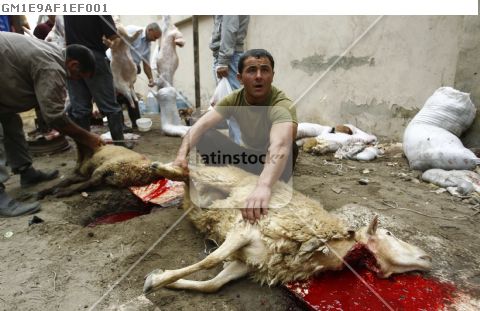
A sheep is slaughtered on the street during Muslim Eid.
Stunning procedures in ‘normal’ slaughter procedures are also not always performed correctly,
During slaughter, operator and general factory competence is very important,
A lack of experience or skill may mean that more than the required one or two movements of the arm for cutting. There have been reports of 3.2 cuts being required for Jewish and 5.2 for Halal slaughter.
Death for the animal takes longer where arteries were not correctly severed (generally reported as occurring for one out of ten animals).
Pain
The determination of the exact point; if any; when an animal becomes insensible to pain is the key animal-welfare issue. Though it is clear that animals do not lose sensitivity to pain immediately on stunning, the state of consciousness of an animal and its level of insensibility cannot be quantitatively measured.
One side argues that although science cannot provide a definitive position no-stunning slaughter is more likely to cause pain given the many nerve receptors in the neck and time taken to bleed whilst the animal is not unconscious.
However, some counter arguments put forward are that stunning:
may only paralyse an animal, preventing it from displaying pain,
Does not always work – due to operational problems, and
May be painful and the process cause stress to the animal involved.
Certainly, most people observing the process would suffer less discomfort through seeing animals first stunned.
Consciousness
A concern is that after stunning, animals regain (some) consciousness. This is particularly so for electrical stunning. Periods of less than one minute are considered desirable for “stun-to-stick”, though the UK’s Farm Animal Welfare Council considers the maximum legal interval should only be 15 seconds.
In ritual slaughter, non-stunned animals can be conscious after neck-cutting for up to 2 minutes for cattle, 20 seconds for sheep and 2.5 minutes for poultry, according to the European Food Safety Authority.
If correctly and properly performed, Shechita results in calm cattle collapsing within 10 to 15 seconds. Observation shows in 30% of cases however, that animals remain conscious for more than 30 seconds.
Alternatives
Most people would never want to witness and animal being slaughtered; yet meat eaters are seemingly happy to let someone else do the job for them behind high walls.
Fortunately, many people in the Western world especially have now decided to ditch meat for a plant based diet instead. Religious slaughter is one reason why so many people are opposed to live animal exports – all Australian sheep exported live to the Middle East are slaughtered using the Halal method. The general treatment of live animals is another.

A Major Cause of Concern – Australian sheep on a ship destined for the Middle East.
According to PETA, 198 animals are saved each year, per vegan person, but technically, none are. Animals are not saved or spared due to the amount of vegans in the world. However, less animals are “produced” to be slaughtered. So, maybe 198 animals per vegan are not produced to be killed is a very reasonable statement.
And get this: One person who goes vegan can save approximately 219,000 gallons of water a year. It takes 1,000 gallons of water to produce just one gallon of milk, and beef has an overall water footprint of roughly 4 million gallons per ton.
So, make the change to a plant based diet and do not have this terrible suffering on your conscience.
Regards Mark (WAV)



More and more cruelties from the dairy industry are revealed. It has recently become known that in the UK it is still cheaper to kill male calves than to raise them, not only in UK but also in Germany. New figures show that about 95,000 male calves are disposed of each year. But even the latest photos of the animal rights organization ARM are terrible and hard to beat when it comes to animal cruelty. Udder flaming is the name of this method. A worker burns the small hairs on the udder of the dairy cows with a flame.
The Animal Recovery Mission (ARM) posted a video of a covert investigation at Dean Foods (McArthur Dairy) in Okeechobee, Florida. The investigation revealed the cruel abuse of dairy cows. In addition to udder flaming, this shocking video from Animal Recovery Mission (ARM) shows other cruel practices that occur in dairy farms, such as: These include force-feeding, hitting sharp objects and much more.
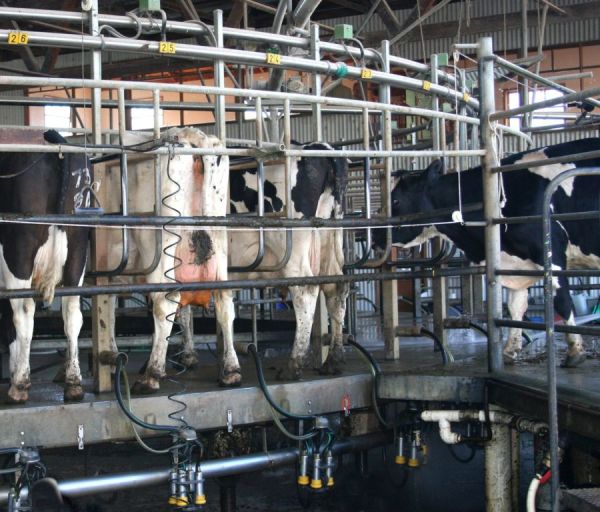
This should make milking easier. In nature, the cows’ teats are for the calves who suck on it. But if calves like the milking machines suck under constant vacuum, they would swallow themselves.
But the fact that today in industrial agriculture milked with such a high vacuum (because it has to go fast) is not enough. The criminal operators of dairy farms have also practiced this sadistic torture of the “udder flaming”! The poor cows, it should not only be very painful, also cows are afraid of fire. We first thought it would be a fake, but it is indeed a cruel practice in many dairy farms.
It is now the third dairy farm in Florida that was reported for animal cruelty.
Male calves of highly bred dairy cows do not get fat and are thus hardly suitable as meat, so the male calves are “disposed of”
The number of male calves killed right after birth is rising again in the UK, despite efforts by the dairy industry to end the practice known as “dirty secret”.
Dairy farms rely on female cows to produce milk. So, when male calves are born, they are redundant and farmers currently have few options. The dairy farmers dispose of the male calf by shooting it themselves.
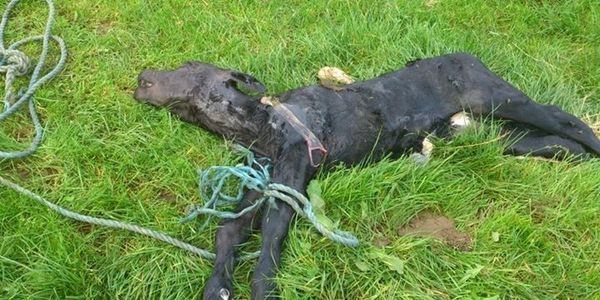
Even in Germany: Some farmers simply let weaker calves die out of sheer existential distress. A former assistant agricultural worker testifies that she has been instructed not to give the animals any more water to make them dying of thirst.
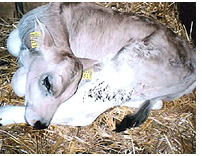
It seems to be a worldwide dreadful process to simply discard male calves, as the following Australian video shows. The meat and dairy industry kills calves that are only a few days old. These terrible discoveries are from Animal Liberation and Animal Liberation Tasmania…
In a contribution from October 2016, the Milch Mafia writes the following german report: “After two record years of the German dairy industry, the milk price is again in the foreground of the discussion.
(…) Milk has a good reputation as a healthy food!!!. But the “milk opponents” have increased. It seems some critics enjoy writing bad about food. One gets the impression that this creates a business model. In the past, nuclear power was the favorite enemy of certain political currents, today it has become the food industry. ”
The dairy and meat mafia is worried about the decline in demand for milk
The fact that animal rights activists are not welcome because they reveal such cruelty, also shows the statement of the new German Federal Agriculture Minister Julia Klöckner. “We do not need a self-proclaimed stable police to control the welfare of the animals.” Therefore: The German politics want to criminalize animal rights activists!
Already very stupid that the milk opponents are compared with the nuclear power opponents. Only recently, the Federal Court ruled that the distribution of unauthorized film footage from organic chicken coops was not illegal.
So cruel animal cruelty will continue to be uncovered and there are still foreign animal welfare organizations that show, with which criminal methods animals are tortured to produce milk and meat and who are these torture factories.
https://netzfrauen.org/2018/09/21/dairy/
This time I want to make my comment short:

Best regards to all, Venus
At the end of the video a small child is crying and is shocked by the animation.
Its young mother turns the stroller in the opposite direction and tries to keep her crying child away from the “cruel” reality.
Reality?
In reality they have been in trucks for days!
There is no place to lie. Those who become tired and lie down risk becoming depressed by their fellow sufferers. During the entire transport they are not supplied, drinking nipples are not accessible and this is not provided. This is not possible with the number of animals.
They are transported for hours or days with unknown animals, receive neither food nor water, they are exposed to heat and cold, unknown persons and a strange environment.
They suffer from exhaustion, pain, injuries and have to endure noise, vibration and odor (ammonia, exhaust fumes, gasoline).
Dear mother,
Now, and as early as possible teach your child that ethic never stops with living beings who can feel. A living being that has the ability to feel subjective, to suffer, to rejoice, or to be sad, is a free being that has a value system and the right to life.
Like your crying child.
My best regards, Venus
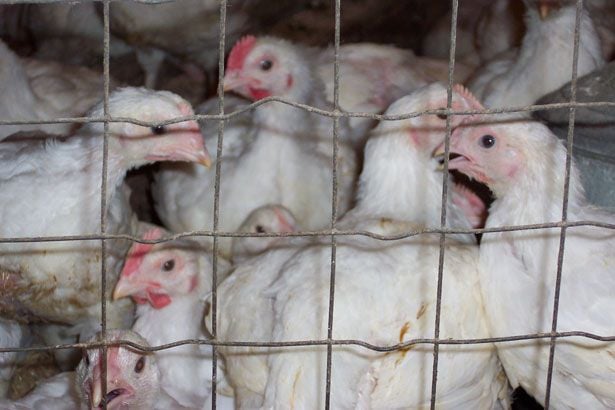
Image Credit: Public Domain Pictures – Kim Newberg
Posted by Carly Day | January 19, 2019
World Animal Protection (WAP) has released a shocking report showing that some of the world’s biggest fast-food giants are failing to address the extreme suffering of chickens raised for their meat in factory farms.
The report, entitled The Pecking Order 2018, is the first such study to look into the issue of the welfare of chickens destined for the dinner table.
Nine of the world’s most well-known fast-food producers were included in the assessment (Burger King, Domino’s Pizza Group, Domino’s Inc, KFC, McDonald’s, Nando’s Pizza Hut, Starbucks, Subway), which looked at company policies regarding chicken welfare, any targets and objectives documented by the companies, and the transparency of reporting progress.
Shockingly, these international powerhouse companies, who make enormous profits from killing hundreds of millions of chickens each year, are doing very little to ensure the animals in their supply chain receive even minimal welfare standards at factory farms or slaughterhouses.
None of the companies rated higher than “Poor” on WAP’s assessment scale. Not a single one has a worldwide policy for improving chicken welfare; in fact, only three even show an interest in the issue — Burger King, Starbucks, and Subway — however, they only focus on limited regions or countries.
McDonald’s, KFC, Pizza Hut, and Nandos were rated as “Very Poor,” while Domino’s Inc and Dominos PLC failed altogether.
“It is deeply disappointing that not one company that relies on chickens for profits received a grade above poor for animal welfare,” said Alesia Soltanpanah, executive director of WAP US. “Of the ten billion animals raised and killed for food every year in the United States, 90 percent are chickens, and these companies have the ability to have a major impact on the living conditions of these animals.”
With such massive exploitation of animals for consumption, these companies have tremendous power to change the lives of these birds for the better. WAP is asking them to avoid sourcing caged chickens and give the animals a more natural and stimulating environment in which to display natural behaviors.
They also urge companies to use birds that have a healthier growth rate. As farmers adapt to meet increased demands, they select breeds that grow too quickly and suffer from numerous health issues as a result, including pain and lameness, as well as strain on the heart and lungs.
“The findings of the inaugural Pecking Order report leave much room for improvement,” continued Soltanpanah. “The companies ranked, including seven US-based brands, have a responsibility to consumers and the animals in their care to give these chickens a better life.”
In the meantime, we consumers have the power to stop the suffering by leaving chicken off of our plates and choosing cruelty free, plant-based foods, instead.



WAV Comment
There are some Trumped up narcissists who survive only on the amount of money they have and by ensuring that everybody calls them ‘Mr President’. These are the same folk who are supposed to run a nation and keep people in employment paid a monthly, living wage. On the other side of the coin, there are many folk who are not financially rich; but who do hold that special trait of being ‘compassionate’ people; trying to help other living. sentient beings. In the following videos you will witness actions from such people. In our opinion; these folk are the real ‘heroes’ of any nation; they do not seek self glorification from the media; instead they just get on doing what they do best – in this case saving desperate animals in need of help; providing care for their survival. We salute them; not the jumped up egomaniacs living in their ‘fake’ world that says they think everything they do is correct whilst everything others do is wrong.
Welcome here to the world of compassionate, normal; sensible people:
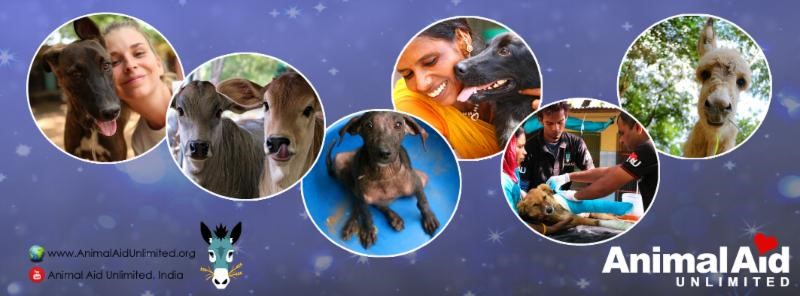
Last week we welcomed special dignitaries to visit our shelter and to honour some of Animal Aid’s most active community volunteers. The special guests included the previous Rajasthan Home Minister and now Rajasthan Opposition Leader, Gulab Chand Kataria; an MLA and senior police officer and local business leader.
We were greatly assisted by Dr Jinendra Shastri, a political leader in Udaipur, who helped organise the event and ensured that the media covered activities of Animal Aid throughout the week, including a special feature about two of our most stellar volunteers, Anca Gheorghe from Austria and Ayala Melki, from Israel. We loved the publicity, the awareness raised about street animals’ problems, and the opportunity to celebrate Udaipur residents who have helped save so many lives
Harrowing rescues all with happy endings, 10 unbelievable close calls will bring you from “Oh No!” to “Yesssss!” within the same breath.
When all hope is lost, with your help, we’re there.
We got a call for a dog who had been hit by a bike and was unable to walk. He had somehow dragged himself to the side of the road but was unable to stand or to walk. He was so happy to see his rescuers that he wagged his tail despite the pain of his injuries. We brought the dear boy back to Animal Aid’s hospital and began his treatment and 6 weeks of bed rest.
His mother cow was frantic. She paced back and forth at the edge of an open well in heart-breaking agony because her calf had fallen in. We could barely distinguish his face looking up from the floating garbage as, exhausted and ice cold, he took his last breaths. Our rescue team arrived just in time. Watch a beautiful mother get her most desperate wish fulfilled.
He cowered under a porch, weakened with agony after what must have been weeks of maddening itching from mange. His scab-encrusted body was also attacked by maggots that had entered the skin which he had scratched open in desperate confusion. Too ravaged by the mange parasites to eat, this precious dog was in the final stages of his life. But watch what happened next.
Celebrate the Care-givers:
Bhagat Singh

7 years ago Udaipur animals got a new guardian angel with rescue team leader Bhagat Singh. As a our ambulance driver, Bhagat has led his team in literally thousands of life-saving missions, guiding rescuers down winding lanes, calamitous construction sites, busy freeways and into the back rooms of private houses–wherever animals hide in pain, or are stopped in their tracks by urgent health problems. Bhagat cheerfully tackles near-impossible distances and every hour makes critical judgments about which animals need to be treated as the highest rescue priorities. Bhagat Singh has set the highest standard for life-saving rescues.

