A comprehensive review of research studies on diets and cardiovascular health made perfectly clear how amazing a healthy vegan diet can be. The scientists came to these conclusions about what a wholesome plant-based diet can do for your heart:
Reduce the risk of heart disease by 40 per cent
Reduce the risk of death from cardiovascular disease by 40 percent
Fully or partially remove harmful plaques from blocked arteries in up to 91 per cent of patients
Reduce the risk of high blood pressure by 34 percent
Reduce blood cholesterol from high to normal levels
Help achieve or maintain a healthy weight
Reduce the risk of type 2 diabetes
The authors conclude that plant-based diets should be promoted through dietary guidelines and recommendations because they can not only prevent but also reverse atherosclerosis, heart disease and associated health issues.
Click here to read the Viva health January 2019 articles:
Rescued sun bear Aurora recovers from health check and makes herself at home
Just a few weeks on from her rescue, Aurora is in good health and busy exploring the largest space she has ever known.
For sun bear Aurora, the new year has brought with it an entirely new and wonderful life.
Having spent 15 years in a tiny, barren cage as an exotic pet, Aurora was freed by rescuers in December and brought 1,500 kilometres to sanctuary.
In the weeks since, this gentle sun bear has experienced more kindness and enjoyed more natural behaviour than in all the years since she was poached from the wild as a cub.
She has moved to an indoor den to complete her 45-day quarantine period and her new space is packed with enrichment and climbing structures.
Animals Asia Vietnam Bear and Vet Team Director Heidi Quine said:
“For a bear whose every waking moment has been entirely bereft of stimulation for over a decade, Aurora’s new surroundings must feel palatial. Sun bears love to climb and for the first time in her life, this is something Aurora is free to do. She’s experienced huge changes over the last few weeks, but she is a brave soul and is already very trusting of her new carers.”
Aurora has also received a thorough examination by vets who believe she has a small gallstone and suffers from arthritis. Thankfully, neither condition requires surgery or medication currently and will be monitored closely as future treatment will likely be required.
Another area of concern during her rescue was the state of Aurora’s teeth. Having been fed an unsuitable diet for years, there was a large build-up of tartar which unchecked would cause serious disease and pain. Thankfully, the nutritious and crunchy vegetables and fruit Aurora now enjoys as part of her daily diet have already massively improved her condition.
Heidi said:
“When Aurora got back to her den after the health check she used the straw to build herself a huge comfy nest, just as a sun bear would in the wild. These are exactly the kind of natural behaviours Aurora has been denied all her life, and to see her simply begin to be a bear again fills us with the greatest joy.”
During the remainder of her 45-day quarantine period, Aurora will continue to build her strength, while her carers will work to earn her trust. After quarantine is complete, it is hoped Aurora will be integrated with some of the other eleven sun bears at the sanctuary and will be free to enjoy a large outdoor enclosure.
Not directly associated with AA; but please look at this video relating to Vietnamese bile bears and the daily suffering they endure to milk them for bile:
Rome: Involuntary activists of the Italian animal welfare organization Essere Animali managed to document the sad life of the Italian dairy cows. The two committed animal rights activists filmed the entire life cycle of the dairy cows, from insemination to the treatment of calves and the milking of cows. What they saw was scary!
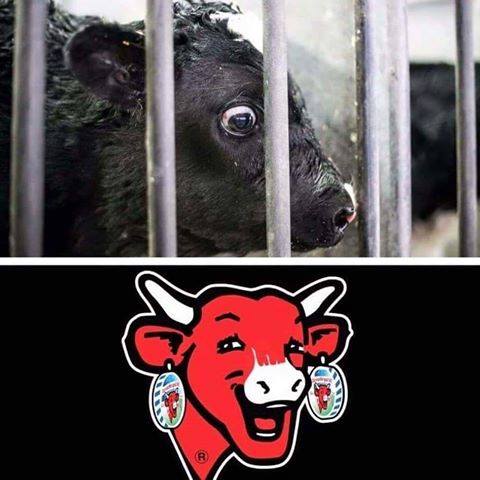
When milk and dairy products are advertised on Italian television, happy cows grazing on a green meadow in a beautiful landscape are almost always shown. The reality is a completely different one. Of the more than 2,200,000 dairy cows in Italy, the very few ever see green grass. The vast majority of them must be crammed together in confined spaces in dark stables their miserable existence as a dairy cow, until they – when the milk yield decreases – after a few years “cleared away”.
The video starts with insemination. To guarantee a constant milk production and to be able to “produce” a calf annually, the cows are inseminated regularly. As a result, the pregnant cows can be milked twice a day and 300 days a year.
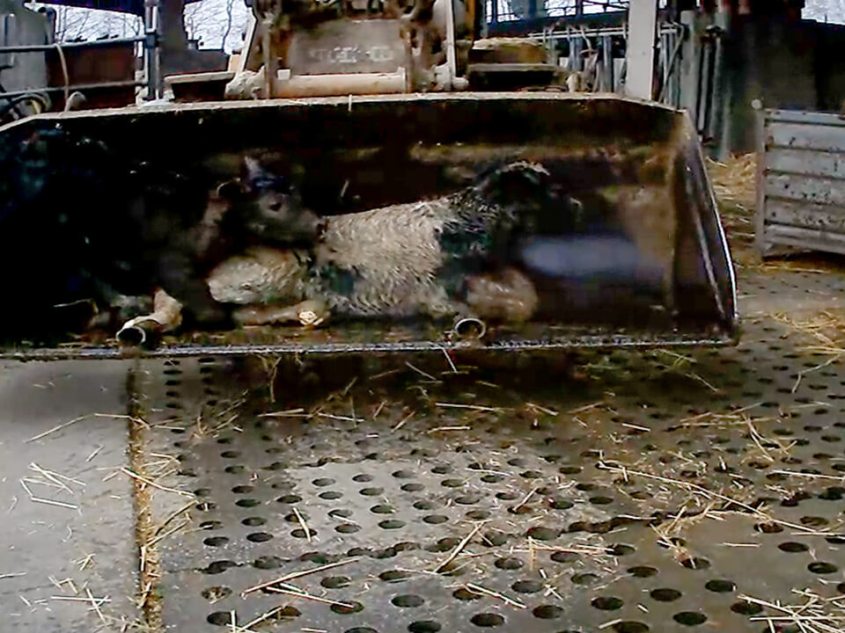
The hidden cameras also show the separation of freshly born calves from their mothers. A cow desperately calls for her calf. The calf is brutally separated from her mother and taken away with an excavator. Then they tie a rope to his leg and put it in a tight box for several weeks. If it is a male calf, it is fed with a low-iron diet to obtain a light meat and brought to the butcher after six months. Overall, male calves are regarded as a by-product of intensive dairy farming and are therefore less valuable than dairy cows. The video shows several painfully dying and dead calves. But if it is a female calf, it becomes a dairy cow.
In order to avoid injuries, the calves are burned the roots of the horns. Although this extremely painful procedure, according to law, may only be performed by a veterinarian and under anesthesia, this practice was used by simple staff and without anesthesia in the stable screened by animal rights activists. In addition, the activists were able to document many cases of violence against the animals. The cows were kicked, pushed and even beaten with iron bars. Breeding of dairy cows designed for maximum milk production – a dairy cow of the Holstein cattle breed today gives up to 28 liters of milk, in 1985 it was only 17 liters – is increasingly affecting the welfare of the animals.
More and more often, the animals suffer injuries to the claws or slip on the wet concrete floor of the stables, breaking their tendons and legs. By law, injured and suffering cows may not be repealed,but would have to be killed immediately, but the employees often let the animals suffer for days before the “mercy shot” for lack of time.
Although the dairy cows could live up to 20 years, they are “exchanged” after four to five years of life as a result of slowly declining milk yield and handed over to butchers and meat processing companies.
Given the sad fate of the dairy cows as well as the brutal and sometimes illegal behavior of the employees, there is not much left of the image of happy cows, who are happy to give milk, and who are carefully cared for by the advertising.
Animal welfare organization hopes that consumers will reconsider their consumption of milk and dairy products produced under such dire conditions.
My comment: The meat consumer likes to “stun” himself.
We do not learn to feel anything anymore. Even after such documentation which- fortunately! – has been shown by public service broadcasters in recent years, we develop mechanisms such as rejection, oppression or even apathy.
We can not say more: how do the animals that give us milk live? Where are they?
We read and experience how animals live today: in huge factory farms, under torture, psychic stress, suffering until they are transported to the slaughterhouse. In a way, we know the truth quite well!
But the most effective way to evade this reality is to deny it. That’s why we tell ourselves that such pictures are just the exception, we buy organic milk from happy cows and organic meat from meadows cows.
And so we tell ourselves, there is no problem, so we do not have to make any thoughts and we are not responsible for our consumption, that is, for our actions.
And that’s why, we no longer see the cow, which is transported by crane, on our plate!
‘Radical Islam has won’: Belgium outlaws Muslim and Jewish animal slaughtering practices àhttps://on.rt.com/9ltk
The ban brings Belgium in line with European Union regulations that require animals to be stunned, so they can’t feel pain, before slaughter. However, Jewish and Muslim religious laws require that animals are conscious when they are killed.
The new law applies to the country’s Flanders region and a similar ruling will come into force in the Wallonia region in August, meaning the religious slaughtering practices will be outlawed across the country.
The resolution to ban ritual slaughter passed the Flanders parliament unanimously in 2017.
Belgium’s Flanders region has banned Jewish and Muslim forms of ritual animal slaughter, sparking a firestorm of criticism from religious groups, who see the measure as thinly veiled xenophobia.
Approximately 500,000 Muslims and over 30,000 Jews live in the small European country, which has a population of 11.3 million. Leaders of both communities have railed against the new law and are challenging it in Belgium’s Constitutional Court.
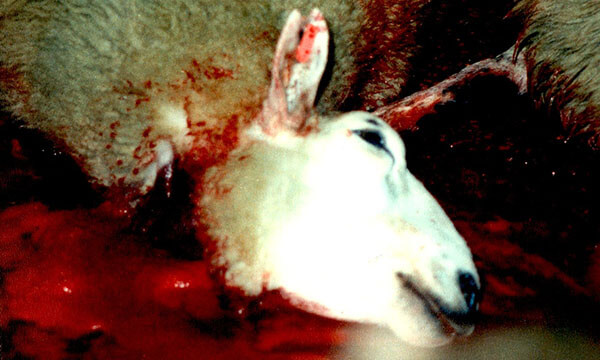
Kosher and Halal methods of slaughter involve the animal being killed with a single cut to the neck which severs critical blood vessels. Advocates claim the animal loses consciousness in seconds and it doesn’t suffer during the process.
Flanders – and Belgium’s Francophone region, Wallonia, later this year – join Denmark,Sweden, and Slovenia on the list of European nations that have outlawed all forms of ritual slaughter.
Rule of law or attack on religious freedom? Belgian ritual animal slaughter ban DEBATE à https://on.rt.com/9lw0
Rabbi Pinchas Goldschmidt, the president of the Conference of European Rabbis, said the ban is proof that “radical Islam has won.”
“We are in the midst of an attack on the freedom of religion. The European capital has, with its laws and lack of tolerance for minorities, proven that radical Islam has won,” he said, as cited by Israel National News.
“We managed to block many [similar pieces] of legislation in other countries in Europe and attempts to pass bills in the European Parliament and initiatives in the the EU’s agencies.”
However, that stance was dismissed by animal rights activists.Ann De Greef, director of Global Action in the Interest of Animals, said that in Belgium “the law is above religion.”
“They want to keep living in the Middle Ages and continue to slaughter without stunning – as the technique didn’t yet exist back then – without having to answer to the law,” she said to the New York Times.“Well, I’m sorry, in Belgium the law is above religion and that will stay like that.”
My comment: Of course it’s an archaic, a barbaric method of slaughtering, the shafts. And I’m sure: progressive, enlightened Muslims and Jews would be against it.
Brussels has decided correctly.
But such good decisions need to be extended.
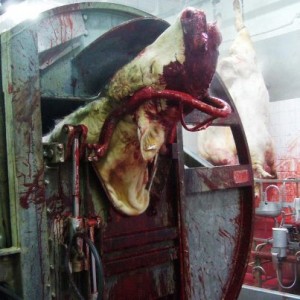
Also in the European area, in the slaughterhouses, methods are practiced, which are often worse than the shafts. The last undercover investigations of the organization SOKO (Germany) proved it.
It is therefore urgent that Brussels requires video surveillance of all slaughterhouses by law.
Because only then can good decisions be controlled in practice.
Above – Chinchilla -the only animal farmed for fur in Serbia.
The new ban now saves about 12,000 / 13,000 animals each year.
After ten years of lobbying, Serbia’s long-awaited ban on fur farms finally went into effect on January 1st, 2019, and will save the lives of an estimated 12,000 chinchillas every year.
When it passed, the 2009 Animal Welfare Act included a decade-long transitional period, allowing fur farmers time to phase out their business and find a more sustainable income. But the wait is now finally over for these suffering animals.
Anti-fur organizations such as the Fur Free Alliance have been hard at work during that period, as pro-fur advocates fought to get the ban reversed.
In 2018, with the deadline drawing closer, fur trade groups stepped up their efforts, pressuring the Serbian government to extend the transition period or abandon the ban completely.
Thanks to the relentless work of the Fur Free Alliance and Serbian organization Freedom for Animals, the law stayed in place.
“For 15 years now, Freedom for Animals has advocated for a fur-free Serbia by advancing and supporting legislation to abolish this brutal exploitation of animals,” said Snezana Milovanovic, director of Freedom for Animals. “With the enforcement of the 2009 Animal Welfare Act, that makes it illegal to keep, reproduce, import, export and kill animals only for the production of fur, a great victory is finally achieved. Not only is this ban important for animals kept for fur production in Serbia, but also for the whole South East European region, and it signifies a major step forward for animal rights worldwide.”
The only species farmed for their fur in Serbia, chinchillas are endangered and protected in their natural habitats within South America. These adorable rodents are highly social, often living in colonies of up to 100 individuals. They are monogamous, mobile, shy and nocturnal.
These natural behaviors lie in stark contrast to their tortured lives in fur farms. Crammed into tiny cages barely big enough to move around in, they are forced to be active in the daytime.
Research has shown that chinchillas are prone to serious health and behavioral issues when kept in these horrific conditions. From stereotypic behaviors to self-mutilation, the intense stress of their enforced imprisonment is clear.
Serbia’s ban now puts them on a par with arounda dozen other countries that have put an end to fur farming, including Norway, Belgium, and Luxembourg.
WAV Comment – I must be one of those consumers that the FDA thinks ‘does not understand’ the difference between milk from a cow and milk from a nut. What’s more; the following video makes it all the more difficult to understand – this man seems to be milking Almond nuts ! – and I thought you only milked cows; unlike many humans though; I do know that a cow has to be in calf in order to produce milk; that she is constantly artificially impregnated to achieve this; and any males she produces are either shot at birth or sent off at a very young age to be housed in crate type systems – causing immense distress for the (mother) cow and also for the calf.
Milking Almond nuts for Almond milk must be very specialized; but as the video shows, there are some who are prepared to do it. As the FDA says; people really must be informed more about this whole system. Enjoy the video; and try hard not to laugh too much !
Court Dismisses Lawsuit That Would Have Outlawed Labelling Almond Milk as ‘Milk”
The United States Court of Appeals for the Ninth Circuit has dismissed a court case claiming that Blue Diamond’s almond milk is deceptively mislabeled and confusing for consumers.
This decision backs up a ruling by the United States District Court for the Central District of California, which dismissed the case made by Cynthia Painter in May 2017.
The plaintiff insisted that Blue Diamond’s almond milk should be labeled as “imitation milk,” in a weak argument that alleges consumers are not smart enough to distinguish between dairy-based and plant-based milk.
The complainant alleged that the company “deceptively markets its almond beverages as nutritionally equivalent or superior to dairy milk when, in fact, almond beverages are nutritionally inferior to dairy milk.”
Thankfully, the courts did not buy into this argument, acknowledging that consumers are aware of the products they purchase and putting a quick end to this ridiculous case.
This case is seen as a desperate attempt by the dairy industry to stifle the growing demand for plant-based alternatives. The court docket itself states that while sales of almond milk increased by around 40% between 2013-2014, dairy milk sales declined.
Rather than attribute this demand to a growing ethical and moral consumer drive, they claim that it’s because consumers think almond milk is the same thing as cow’s milk.
The memorandum released by the court of appeals concisely debunks the argument, stating:
“Painter’s complaint does not plausibly allege that a reasonable consumer would be deceived into believing that Blue Diamond’s almond milk products are nutritionally equivalent to dairy milk based on their package labels and advertising. The district court correctly concluded that “[n]o reasonable consumer could be misled by [Blue Diamond’s] unambiguous labeling or factually accurate nutritional statements.”
Although it’s reassuring to see the courts take a stand against such claims, plant-based dairy alternatives are still under the spotlight of the Food and Drug Administration (FDA).
In September 2018, the FDA issued a notice inviting public comment on “Use of the Names of Dairy Foods in the Labeling of Plant-Based Products,” targeting things like vegan cheese, milk, and yogurt. The agency state that they are concerned that consumers may not understand the nutritional differences between dairy and non-dairy milks.
Maine Fair Trade Lobster—the “largest lobster processing facility in the state”—is under fire after PETA obtained an eyewitness video showing workers dismembering conscious lobsters by tearing off their claws, puncturing their shells, and ripping their heads off.
Despite being torn limb from limb, the animals often don’t immediately die. Scientists have conclusively determined that lobsters, like humans and all other animals, feel pain. But lobsters don’t enter a state of shock when injured, so they feel every moment of their slow, painful death. Disremembering fully conscious lobsters doesn’t kill them instantaneously and causes them pain and suffering, and this kind of mutilation and torture is prohibited by Maine law.
Business as Usual
This horrific practice is evidently standard operating procedure for Maine Fair Trade Lobster and is common in the Maine lobster industry. PETA obtained video footage showing that fully conscious animals were torn apart at the now defunct Sea Hag Seafood processing plant in 2012 and again at the Linda Bean’s Maine Lobster processing plant in 2013. Some lobsters were mutilated and left to die in garbage bins.
PETA has filed a complaint with police in Gouldsboro, Maine, where Maine Fair Trade Lobster is located, and an investigation is underway.
The company is a subsidiary of East Coast Seafood Group. Please urge grocery store chains Costco and Giant Eagle to reconsider selling lobsters who were torn apart while conscious.
My comment: The deliberate transformation of a living being into a bundle of suffering and dumb despair is a crime – what else should be a crime? The Animal Holocaust remains the most massive and longest-running murder campaign of all time. And it makes veganism the most important aspect of animal rights.




 The video starts with insemination. To guarantee a constant milk production and to be able to “produce” a calf annually, the cows are inseminated regularly. As a result, the pregnant cows can be milked twice a day and 300 days a year.