New book reveals factory farming a threat to humanity as big as climate change
18 August 2022
Compassion In World Farming (CWF)
Taking its title from a chilling warning made by the United Nations that the world’s soils could be gone within a lifetime, “Sixty Harvests Left” uncovers how the food industry threatens our world.
Author Philip Lymbery is the President of Eurogroup for Animals and Chief Executive of Compassion in World Farming.
Sixty Harvests Left takes us behind closed doors and into the boardrooms of industrial agriculture, investigating the dark side of food production. It confronts ‘Big Ag’, whose mega-farms, chemicals and animal cages are sweeping the countryside and jeopardising the very air we breathe, the water we drink, the food we eat and the nature we treasure. It spotlights the pioneers who are battling to bring landscapes back to life, in a world where wildlife, hens, pigs and people thrive by protecting the very thing that our civilisation is built on: soil.
At the heart of sustainable change lies a recognition that all life on our planet is interconnected, and that our future depends on treating it with compassion and respect. In so doing, we can protect the world’s wildlife and soils as if our life depends on it – because it does. The life expectancy of farmland soils would change from just sixty harvests left to one of infinite sustainability, while regenerative, agroecological farming can help end cruelty to animals, save wildlife, stabilise the climate and safeguard the planet for future generations. And to me, that seems like a future worth having.
Philip Lymbery
Combining insightful analysis, storytelling and research, award-winning author Philip Lymbery demonstrates why food and future harvests matter more than ever, and shows us how we can restore our planet for a nature-friendly future.
In this beautifully written book Philip Lymbery describes how intensive agriculture harms the environment and inflicts suffering on sentient animals. But after visiting with and talking to those on the front line – scientists, farmers and food providers, he is able to show that there are sustainable alternatives. And that they are working. There is indeed hope for the future of our planet, and each one of us can play a part. I urge you to read ‘Sixty Harvests Left’.
Dr. Jane Goodall, DBE, Founder of the Jane Goodall Institute
Regards Mark
WAV Comment: Phil and I have known each other for about 40 years; in earlier days we both became very involved with campaigning at Dover, Kent, England; against the live export of lve animals. Phil is now the CEO of CIWF, which you can visit at:
Whilst there are currently no operational fur farms or foie gras production in the country, this move will help to prevent these farming methods that disregard animal welfare from being practised in the future.
The Ministry for Agriculture, Fisheries and Animal Rights published a new legal notice, LN 187 2022, amending the Regulations on the Protection of Animals kept for reasons related to Agriculture.
This legal notice adds regulations regarding the prohibition of the forced feeding of birds and the prohibition of raising animals for fur in Malta.
Though such practices are not the norm in Malta, it is still crucial to prohibit them to ensure the protection of these animals.
Ministry for Agriculture, Fisheries and Animal Rights, Malta
Malta now joins 12 other EU countries that have prohibited fur farming.
Whilst this is a great step forward, there is currently no ban on the placement of farmed fur products on the market in Malta.
Eurogroup for Animals is calling for a ban on fur farming and farmed fur products across the European.
Many of you know that live animal transport (exports) are one of our main issues.
Here are some stories and links, and videos, from ‘Animal Equality’. There is a lot to take on, and so at the end I have given a link for you to complete the reading.
The top right ‘wire globe’ (in the link) allows you to convert translation into several languages if you desire.
Regards Mark
.
What are we doing to stop the transport of live animals?
The transport of live animals is one of the topics on which our team of researchers has focused the most in the last 10 years of research.
After a miserable life on a farm, every animal destined for human consumption ends up in the slaughterhouse.
But first, he is forced to endure another intolerable injustice: the transport phase.
A suffering that can last for days, weeks, months: an absurd journey towards death.
How many times have you traveled next to a truck from which you could glimpse, through small slits, animals crowded inside?
If you’ve ever encountered their eyes, you know what it means to see a living being suffer and not be able to do anything to ease their pain.
Because that is our job, what we have been doing tirelessly for more than 15 years around the world: we fight to end the suffering of animals raised for food.
To combat the transport of live animals, we are moving on several fronts: research is not enough, we need a precise strategy and that the institutions perceive us as authorised partners.
Here’s what we’re doing to counter the transport of live animals:
We have filed a complaint with the Directorate-General for Health of Agricultural Production;
We have filed a complaint that “is valid for an entire country”;
We have denounced and sanctioned non-compliant carriers whenever possible;
We have conducted 10 investigations in 10 years;
Thanks to our research work and political pressure, the Committee of Inquiry into the Transport of Live Animals (ANIT) was set up in the European Parliament;
We are working with ENPA and the Ministry of Health to increase roadside inspections.
THE LAWSUIT FOR IRREGULARITIES IN THE TRANSPORT OF LAMBS TO SAUDI ARABIA
Thanks to the images obtained during the shipment of lambs in the Port of Cartagena bound for Saudi Arabia that revealed acts of mistreatment, we were able to file a lawsuit with the General Directorate of Health of Agricultural Production.
The workers resorted to violence to force the lambs to move.
These practices are in breach of the European Union Regulation on the protection of animals during transport.
In addition to this demand, we also initiated a petition addressed to the European Commission and the Ministry of Agriculture, Food and Fisheries demanding the end of long-distance transport that has already been signed by more than 46,000 people.
THE COMPLAINT AGAINST SPAIN
THE CASE OF DRIFTING BOATS
The case that has led us tothe decision to file a complaint with the European Commission against Spain is the one that affects the ships Elbeik and Karim Allah, which left the Spanish ports of Tarragona and Cartagena, respectively, in the spring of 2021.
On board these ships were hundreds of thousands of animals, specifically 895 cattle in the Karim Allah and 1789 calves in the Elbeik. The animals were to be sold in Tripoli (Libya), but once they were denied disembarkation due to an alleged animal disease, the boats were leftadrift and remained so for more than two months.
During these very long weeks, the animals traveled locked in pens in chilling hygienic conditions, going back and forth from one country to another, without the possibility of being unloaded in a port or even being able to rest or feed.
TheSpanish authorities – which would be responsible for enforcing EC Regulation 1/2005 regulating the protection of live animals during transport – did not take any measures to put an immediate end to the extreme suffering of animals on board.
All this despite the fact that the authorities were aware of the situation.
Already on February 18, 2021, when the karim Allah ship was near the port of Cagliari, Animal Equality – in collaboration with ENPA and the Foundation for Animal Welfare – sent a petition to the Italian Ministry of Health requesting an immediate inspection of the ship and livestock on board.
Following our request, the Ministry had scheduled an official inspection, but the ship left Italian territorial waters before it could be done.
In addition to this report, Animal Equality, again in collaboration with ENPA, sent two petitions to the Spanish Ministry of Agriculture requesting urgent action to safeguard the health of animals still alive in karim Allah.
However, the Spanish Ministry did not react with the speed required by the case and did not immediately force the animals to be docked and unloaded, despite the fact that EC Regulation 1/2005 considers that it is a perfectly legitimate measure in case of infringement.
This decision came much later: the Karim Allah was forced to dock in the port of Cartagena after weeks of travel and the Elbeik, also in the same port, after three months of its departure.
In both cases, all the surviving animals were sacrificed, while others, in both the Karim Allah and the Elbeik, died on board. Some animals were also torn to pieces and thrown into the sea, according to the sources.
The condition of the animals was terrible: the cattle were injured, hungry, in obvious pain and dehydrated; some were in a state of stupor, unable to open their eyes or respond to stimuli.
Equally shocking were the conditions of the boats: the pens were overcrowded, in sanitary conditions so extremely inadequate that the animals could not even lie down; the pens were built with iron pipes with rusty and broken areas; the drinking troughs were closed and fodder and straw were totally absent, with numerous rodents present on the decks.
THE COMPLAINT
Animal Equality, in collaboration with ENPA, filed a complaint with the European Commission against Spain, pointing out the incorrect procedures and omissions carried out by the authorities of the ports of Tarragona and Cartagena, which should have controlled compliance with the minimum standards of protection of animals on board the ships Elbeik and Karim Allah.
We have asked the European Commission for an audit on the correct application of the Regulation on the protection of animal welfare during transport by the Spanish authorities and the possible opening of a procedure for infringement of European legislation.
In addition to bringing these testimonies to light, we have done much more:
We protest against the Spanish and port authorities, even filing a complaint with the European authorities against Spain for incorrect procedures and omissions on the part of the port authorities, which should have monitored compliance with the minimum animal protection standards. These practices are widely in breach of the EU regulation on the protection of animals during transport, which explicitly prohibits excessively long journeys without adequate veterinary care, food and water;
We have also submitted a petition to the European Parliament, asking MEPs to take the measures they deem appropriate to ensure compliance with EU legislation on the protection of animals during transport, with particular reference to their export by sea from Spain, and other affected Member States, to third countries.
UPDATE: THE COMMISSION HAS RESPONDED TO US!
A year has passed since our complaint against Spain to the European Commission and the sending of the petition to the European Parliament, which followed the case of the ships Elbeik and Karim Allah, left adrift for months by the omissions and incorrect procedures applied by the competent authorities.
A news that has confirmed, for the umpteenth time, the serious violations that the Spanish authorities continue to commit of European legislation on the welfare of live animals transported.
The Commission has finally responded to the comments we included in the petition to the European Parliament, specifying some measures it has taken or intends to take.
The European Commission has informed us that:
It will carry out 4 new audits, i.e. in-depth assessments, during 2022, including one in Spain;
The Commission has carried out audits in the Member States responsible for the authorisations granted to the Elbeik and Karim Allah vessels, namely Romania and Croatia, in order to clarify possible shortcomings related to the approval of the two vessels. What is clear from these findings is that these two vessels are not currently authorised to transport live animals;
The Commission is developing rules to step up official controls on cattle ships and at exit points from EU ports.
The Commission also gave us important news about Spain’s intentions:
“Spain has submitted to the Commission a series of corrective measures, including its protocol on the protection of animals during the export of livestock by ship, its new national legislation on the welfare of animals during transport and its working agreement with the General Directorate of the Merchant Marine of the Ministry of Transport to help the competent authority to carry out official controls for the granting of authorisations to ships.”
We are sincerely pleased that our request has been accepted and that Parliament has asked the Commission for explanations: although on this occasion the demands of animals have been taken into account, our work does not end there.
In fact, we have requested a copy of this document to know the deadlines and to be able to verify that these actions are really executed by Spain.
PENALTIES FOR NON-COMPLIANT CARRIERS
The work of denouncing that we have carried out over the years has been crucial not only in paving the way for inspections by the authorities and obtaining sanctions, but also in supporting political and media pressure, in denouncing those responsible for animal offences and – very importantly – also in calling on the European Parliament to shed light on infringements of transport legislation.
With our latest investigation at the Slovenian border to document animals destined for Italian slaughterhouses, we managed to denounce and fine two transporters.
After constant surveillance to intercept suspicious vehicles, our investigation team discovered a truck from Hungary, chased it and quickly reported it to the traffic police.
And the following irregularities were found:
The drinking fountain system did not work and lost water, but not only that, the system was prepared for pigs and not for sheep;
The temperature control system inside the vehicle was damaged;
The space for the lambs was insufficient: the animals could not even stand;
The carrier was sanctioned for the first two points with a total fine of more than 3000 euros.
In addition to those “officially” recognized by veterinarians called by the police, there were many other problems:
There were animals of different species and ages in the same transport;
The vehicle had metal parts and internal obstacles, a possible risk to the animals transported;
The lambs were in an obvious state of stress.
We have a duty to show and document everything, even what escapes inspection and what is not taken into account by the authorities, because every detail represents real suffering for these animals.
More than half of all antibiotics sold and used in the United States do not go to treating people. Instead, they go to animal agriculture — where overuse of these drugs is now contributing to a huge upsurge in antibiotic-resistant superbugs.
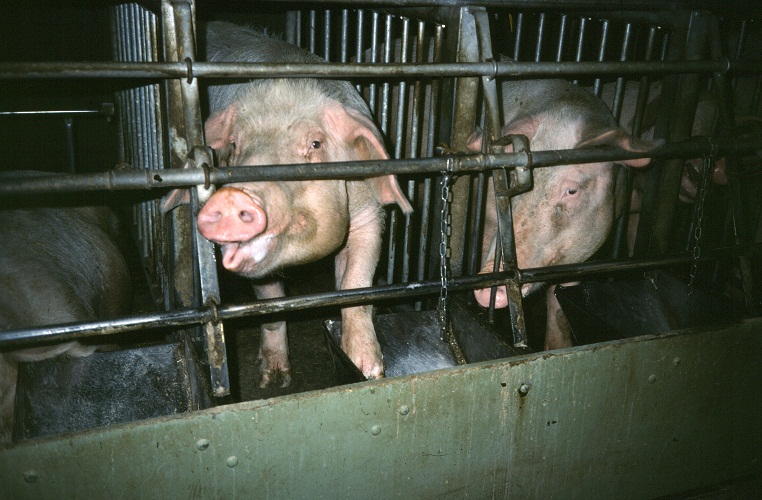
Factory farmers regularly dole out antibiotics in livestock’s water and food supplies, as part of a general mission to prevent infections and death among their pig, foul, cow, and other animal populations. Preventing infections is a huge concern, because factory farmers lock these animals in filthy, feces-covered, overcrowded conditions where diseases can easily run rampant. While corporate farmers could solve this problem by improving facility conditions, they’d rather continue to pack animals as tight as possible to keep profits high. So instead they pump the animals full of antibiotics. This has already had disastrous consequences for human health.
The more our bodies and bacteria get used to the presence of antibiotics, the more those bacteria evolve and mutate to fight off our antibiotic medical treatments. And that means we have fewer and fewer ways to protect ourselves when we get sick. As a result, the number and intensity of superbugs in humans is exploding. MRSA, CRE, candida auris, strep, and others are plaguing more and more people — even young, healthy patients. During the COVID-19 pandemic, this superbug explosion has become even more dire. And these patients aren’t just becoming incredibly sick. Many of them are dying as these overused medicines become less and less effective.
The U.S. Food and Drug Administration (FDA) has tried to help reduce antibiotic use in agriculture, but with limited success. That’s partially because it hasn’t set many hard, enforceable rules. Recently, it began requiring farmers to work with veterinarians to administer certain antibiotics that it deems “medically important” for human use. But as long as a vet is willing to sign off on the treatment, there’s not much enforcement in place to stop misuse.
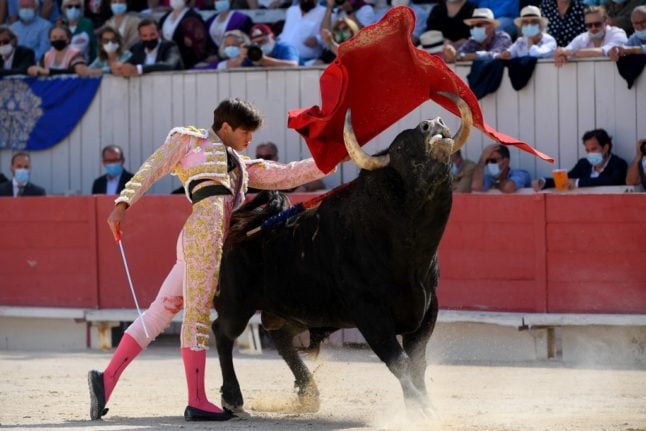
French matador El Rafi performs a muleta pass on a fighting bull in the arena of Arles, southern France, on June 6, 2021 (Photo by Nicolas TUCAT / AFP)
‘Immoral and archaic’: Animal rights activists eye bill to ban bullfighting in France
As thousands of bullfighting aficionados gather across southern France for traditional summer ferias, opponents of the practice are reviving their fight for an outright ban, confident that public opinion is finally on their side.
“I think the majority of French people share the view that bullfights are immoral, a spectacle that no longer has its place in the 21st century,” said Aymeric Caron, a popular former TV journalist and animal rights activist who was recently elected to parliament as part of the hard-left France Unbowed party.
For years, critics have sought a final legal blow against what they call a cruel and archaic ritual, but none of the draft bills presented have ever been approved for debate by National Assembly lawmakers.
French courts have also routinely rejected lawsuits lodged by animal rights activists, most recently in July 2021 in Nimes, home to one of France’s most famous bullfighting events.
But Caron, based in Paris, told AFP that the time was ripe for a new proposal given growing concerns about animal welfare, with a draft bill to be submitted this week.
“I do indeed hope this bill will be debated in parliament in November… it would be a first,” he said.
The prospect seems all the more likely after France Unbowed won dozens of new seats in recent elections, helping to strip President Emmanuel Macron of his centrist majority in parliament.
The goal is to modify an animal welfare law that allows exceptions for bullfights — as well as cock fighting — when it can be shown that they are “uninterrupted local traditions.”
Such exceptions are granted to cities including Bayonne and the mediaeval jewel of Mont-de-Marsan in southwest France near Spain, where the practice has its origins, and along the Mediterranean coast including Arles, Beziers and Nimes.
‘Respecting the animal’
For Caron, “it’s not a French tradition, it’s a Spanish custom that was imported to France in the 19th century to please the wife of Napoleon III, who was from Andalusia,” the countess Eugenie de Montijo.
That argument is unlikely to convince the jostling crowds who packed the streets of Bayonne for the bullfighting feria that ended Sunday, a sea of fans clad all in white except for bright red bandanas or sashes.
“The people who want to ban it don’t understand it. Bullfighting is a drama that brings you closer to death… You’re afraid, but that’s a part of life,” said Jean-Luc Ambert, who came with friends from the central Auvergne region.
Like many other fans, his friend Francoise insisted that bullfighting is an art as much as a sport, where “a man puts his life on the line, while respecting the animal.”
“We’re not trying to convert anyone — I just want the people against it to leave us alone,” she told AFP.
The guest star of the Bayonne feria, Spanish matador Alejandro Talavante, did indeed find an appreciative audience, with the crowd demanding the award of the bull’s ear for his performance.
It’s a conflict that echoes the widening rift in France between rural dwellers steeped in deep agriculture traditions, and Parisians and other urban residents accused of trampling on the country’s cultural heritage — often derided as “the Taliban of Paristan.”
Widespread support?
Andre Viard, president of the national bullfighting association, shrugged off the threat of a ban.
“This comes up in every parliamentary session,” Viard told AFP of Caron’s efforts to find allies for the France Unbowed initiative.
“We tell the other parties: Why do you want to be associated with a bill that attacks a cultural freedom protected by the Constitution, and territorial identity?”
The debate echoes similar opposition in other countries with bullfighting histories, including Spain and Portugal as well as Mexico, Colombia and Venezuela.
In June, a judge in Mexico City ordered an indefinite suspension of bullfighting in the capital’s historic bullring, the largest in the world.
Caron is banking on support from across the political spectrum, including top members of Macron’s party such as the head of his parliamentary group Aurore Berge, who was among 36 lawmakers who called for a bullfighting ban last year.
An Ifop poll earlier this year found that 77 percent of respondents approved of a ban, up from 50 percent in 2007.
“More and more people are concerned about animal suffering, including in bullfights,” Claire Starozinski of the Anti-Bullfighting Alliance told AFP, adding that many people don’t realise that the bulls are actually killed.
“I know there are MPs from other parties who will support me, and have said so,” Caron said — though he admitted that more mainstream lawmakers such as Berge might be reluctant to join his leftish campaign.
“Is she going to remain true to her convictions, or make a political calculation that prevents her from supporting me? That’s what will be at stake in the talks over the coming weeks and months.”
A New York animal sanctuary boss was arrested after she allegedly refused to return some missing cows to their owner.
Tracy Murphy of Asha’s Farm Sanctuary could face up to seven years in prison if convicted after a missing steer and heifer escaped from a nearby farm and ended up on her property.
New York State Police say that troopers visited the sanctuary in Niagara County, New York, on July 25 to retrieve the animals and return them to the farm.
But when they arrived at the sanctuary, Ms Murphy allegedly would not return them to the farmer.
So troopers with a search warrant seized the animals and returned them to the owner of McKee Farms,Scott Gregson, and took Ms Murphy into custody.
The 59-year-old appeared in court shackled and pleaded not guilty to third-degree grand larceny charge. She was then freed from Niagara County Jail.
“I don’t know how they got over there,” said Mr Gregson.
“My fence was secure, the electric was on, and the gates were all closed and there were no hoof prints or droppings so I don’t know how they got over there.”
He says that he initially called Ms Murphy and made arrangements to visit her and collect the animals. But he says when she refused to comply he called the State Police.
“All I wanted was for me to get my cattle back. Obviously, I made a complaint with the state police and they are pressing charges against her. I guess it’s up to the courts at this point,” he added.
Before her arrest, Ms Murphy had offered to pay for the animals and keep them at the sanctuary.
“Where do you think a Sanctuary would release the animals back to slaughter when they found their way here,” Murphy told WKBW. “We’re willing to waive any bordering, and we’re willing to give them top dollar for these animals.”
The incident has attracted the attention of Hollywood star Joaquin Phoenix, a vocal animal rights activist, who told The Independent that he hoped Ms Murphy would be treated fairly and praised her “kindness.”
“There was an opportunity here to show compassion and mercy. To allow these peaceful creatures to remain without fear or anticipation of harm for the rest of their lives,” he said in a statement.
“What this merciful opportunity was met with was such a shame. I applaud Tracy for standing her ground in the name of animal liberation.
“To so harshly punish a woman who was simply showing kindness to two individuals who had wandered onto her property is astounding.”
I liberated a wasp this morning. It was in the bird bath and would not have survived had it not been fished out of the water.
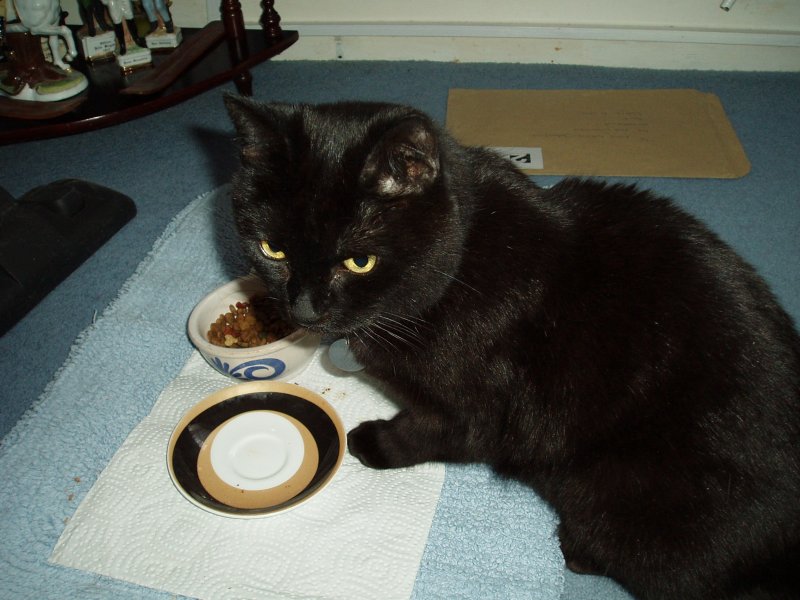
This afternoon (4/8/22), and it has kind of broken me at the moment; I have had to have my prettiest star, Sally the cat, put to sleep. She was 22 years old, which makes her around 110+ in human years (if we have to do a comparison). She was my one shining light on many depressing days and dark corners, and believe me, there are many now days. She wanted nothing but affection, love and (plenty of) food, which she enjoyed a great deal; simply giving back love and enjoyment, entertainment, in return. She had love and affection, and comforting voices right up to the very end, the moment she passed. Most animals in the current ‘systems’ do not experience this.
What about all the millions of animals that are reared to be blasted by shooting parties ‘enjoying’ a day out ?.
What about all the animals who are live crammed into transport trucks or death ships as they are hauled all over the globe for a few pennies more ? – Live Transport – World Animals Voice.
What about all the animals in the labs that are abused and injected with god knows what; having their skulls sliced off in the name of something which has gone on for decades and yet, never really brings anything in the way of medical advancement or progress ?.
What about the badgers who are being culled by the tens of thousands in the UK to simply win votes from the farming community ? – Search Results for “badger culling” – World Animals Voice. What about the Krebbs report which said that culling badgers was unnecessary ?.
What about the dogs and horses that are bred to be raced against each other so that humas can win a tenner on a bet ?.
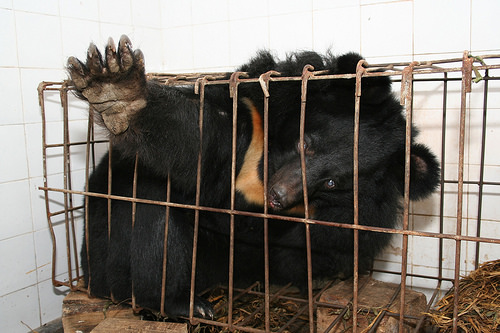
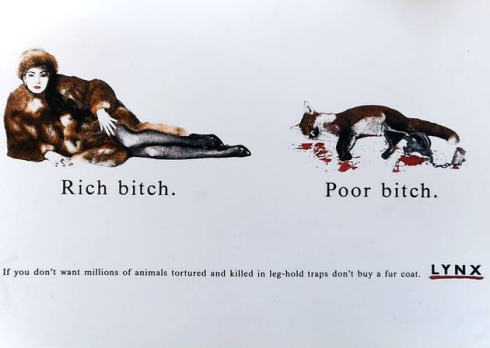
What about the dogs held in Korean cages for their meat; what about the animals who are farmed (the poor bitches)and skinned alive for their fur to adorn the body of some fur hag who is sometimes known as a rich bitch ? – Search Results for “fur” – World Animals Voice
Lots of ‘what abouts’; and by no doubt I have missed many other subjects who deserve just as much.
Yup; all issues constantly and thankfully getting a lot of campaign attention by the mob that goes under the umbrella of animal rights. If that pigeonholes you as part of the mob, then am glad, no very glad, to have been part of the mob for 45+ years.
Sally was fortunate; she had a loving environment. Many animals as shown above suffer nothing but abuse from the moment of birth through to the moment of death. They never experience a kind hand, only abusive ones.
For Sally:
Remember when you were young? You shone like the sun Shine on, you crazy diamond
Nobody knows where you are How near or how far Shine on, you crazy diamond
Pile on many more layers And I’ll be joining you there Shine on, you crazy diamond
Then we’ll bask in the shadow Of yesterday’s triumph
Shine On You Crazy Diamond
Pink Floyd
You will be my rest and peace child I moved up to take a place, near you The prettiest star One day though it might as well be someday You and I will rise up all the way All because of what you are The prettiest star One day though it might as well be someday You and I will rise up all the way All because of what you are The prettiest star
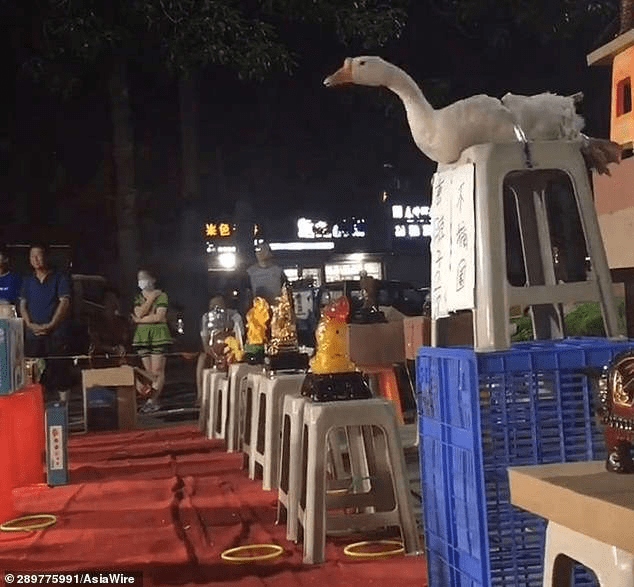
A fairground game in which people aim to throw hoops around the neck of a goose tied down to a stool has been condemned by animal rights campaigners.
Bizarre footage from the funfair in Yantai in eastern China‘s Shandong province shows a white goose strapped down to a stool precariously balanced on plastic crates.
Punters are encouraged to throw plastic hoops at the helpless bird, with prizes on offer should they manage to get one of the hoops its neck.
The footage recorded at the funfair last month shows fairgoers launching ring after ring at the animal, which ducks and moves its head frantically to avoid being hit by the oncoming objects.
Elisa Allen, a programme director at the animal welfare organisation People for the Ethical Treatment of Animals (PETA) strongly condemned the incident.
‘These videos of fairgoers throwing objects at helpless geese show that, regrettably, there are still people who see animals as commodities whose fears and feelings are of no consequence.’
She added: ‘Geese are intelligent, sensitive birds who deserve to be respected as individuals, not as the sum of their body parts or as amusement.
‘PETA Asia is pushing for stronger animal welfare legislation in China while working to change public attitudes towards our fellow animals.
‘We remind everyone that the best way to help animals is by never eating or wearing them and always speaking out whenever you see them being abused.’
Viva! is the UK’s leading vegan campaigning charity, specialising in undercover investigations and high-profile animal campaigns. Founded in 1994 by Juliet Gellatley, we have spent almost 30 years creating a kinder, more sustainable world for humans and animals alike.
Diet is linked to the diseases that kill most people in the affluent West – ‘degenerative’ diseases. Researchers at Viva! Health keep up to date with the latest science to show you why a varied vegan diet cuts your disease risk, and can improve your health.
And let’s not forget our magnificent Vegan Recipe Club which has hundreds of healthy, delicious and colourful recipes, helping people go and stay vegan.
Please, consider joining Viva! today so we can continue educating the public about the benefits of living vegan.
If you can, please give £5 or more a month and become a Viva! Friend. You’ll receive Viva!life magazine PLUS an exclusive I’m a Viva! Friend mug, keyring, sticker pen and bookmark.
You’ll also receive some handy guides, wallcharts, and a free Films For Change 60 day trial where you can enjoy any film on their site – including an expansive collection of vegan documentaries!

















 World Animals Voice
