Category: Farm Animals

England: Ex Environmental Minister (Defra) Paid Over £100,000 To Act As Lobbyist For Meat Processing Company.

WAV Comment:

Owen Paterson always did what he could to allow the continuation of live animal exports from the UK.  He was a big opponent character to us, the anti export protesters, when we campaigned for an end to live animal exports around the ports of Southern England.

Paterson was the government environment secretary between 2012 and 2014, a time when live animal exports were being fought hard against by animal welfare campaigners.

Although not relating to live exports, it does show the influence that major political people can have in the ‘lobbying’ corner, especially, as in just one case here, Paterson was being paid around £100,000 to act as a consultant for Randox, to seek contracts.

This was exposed by the brilliant ‘Guardian’ in the past:

https://www.theguardian.com/politics/2019/apr/07/mp-owen-paterson-lobbied-government-for-firm-he-worked-for

Now that all these issues have come to the front, including the issue of how much he was paid as a ‘lobbyist’; his contacts via government and Defra, for whom he was the top person, (Environment Minister between 2012 and 2014), we can now see why the common man protester at the docks was fighting such a battle.  If he (Paterson) was paid big sums of money in the past to lobby for the meat industry, then it has possibly been happening in the past relating to other organisations.

We hope there will be further investigations and revelations regarding exactly what Paterson did for the meat industry which resulted in him getting such big financial rewards.

Regards Mark

—————————————————————-

Ex-Tory minister ‘should be suspended’ for lobbying on behalf of two companies

26/10/21

A former Conservative minister should be suspended from the Commons for lobbying on behalf of two companies, a standards body has ruled.

Owen Paterson was found to have “repeatedly used his privileged position” to benefit Randox, a clinical diagnostics company, and Lynn’s Country Foods, a meat processor and distributor.

The MP, who was environment secretary from 2012 to 2014, was a paid consultant for Randox from 2015 and for Lynn’s Country Foods from 2016. The allegations relate to his conduct between October 2016 and February 2020.

Following a two-year investigation, the Parliamentary Commissioner for Standards said he had breached the rule prohibiting paid advocacy by making multiple approaches to government departments and ministers for the two companies.

She recommended he be suspended from the Commons for a month. This will have to be voted on by MPs and usually occurs within five days.

Advertisement

Mr Paterson was found to have breached the rules on lobbying on behalf of Randox by making three approaches to the Food Standards Agency (FSA) about the testing of antibiotics in milk in 2016 and 2017 and approaching ministers at the Department for International Development four times about its blood testing technology in those years.

On behalf of Lynn’s Country Foods, Mr Paterson breached the rules by making seven approaches to the FSA in 2017 and 2018 and failed to declare his interest as a paid consultant to the FSA in four emails between 2016 and 2018.

He was also found to have breached the rules on using parliamentary facilities by using his parliamentary office 16 times for business meetings with clients between 2016 and 2020, and sending two letters relating to his business interests on House of Commons headed notepaper.

The MP acknowledged he should not have used the headed notepaper and apologised but maintained he had not breached the code of conduct in any other respect.

https://news.sky.com/story/ex-tory-minister-should-be-suspended-for-lobbying-on-behalf-of-two-companies-12444841

… and from ‘The Guardian’, London:

MP Owen Paterson faces suspension for breaking lobbying rules

Ex-minister could be suspended from Commons for 30 days for working as a consultant with two firms

The Tory MP Owen Paterson faces a 30-day suspension from the House of Commons for an “egregious” breach of lobbying rules, raising the possibility he could lose his seat if enough constituents trigger a byelection.

The former cabinet minister was found to have breached paid advocacy rules, two years after the Guardian published documents revealing how the former environment secretary helped lobby for two firms he was paid to advise – Randox and Lynn’s Country Foods.

Paterson claimed the investigation by Kathryn Stone, the parliamentary standards commissioner, did “not comply with natural justice” and had played a “major role” in the death of his wife, Rose, who took her own life in June 2020.

Stone’s investigation, which was launched in October 2019, found Paterson had worked as a consultant to Randox, a clinical diagnostics company, since August 2015, and Lynn’s Country Foods, a processor and distributor of meat products, since December 2016.

She said he made three approaches to the Food Standards Agency relating to Randox and the testing of antibiotics in milk; seven approaches to the same agency relating to Lynn’s Country Foods; and four approaches to ministers at the Department for International Development relating to Randox and blood testing technology.

Following her investigation, the standards committee – which contains MPs from different political parties, including several Conservatives – launched its own investigation, and the results of both were published on Tuesday.

The committee revealed Paterson had failed to declare his interest and used his parliamentary office on at least 16 occasions for business meetings with his clients between October 2016 and February 2020, and sent two letters relating to his business interests on taxpayer-funded Commons-headed notepaper.

Paterson was also found to have committed “an egregious case of paid advocacy”, “repeatedly used his privileged position to benefit two companies for whom he was a paid consultant”, and brought the Commons into disrepute. It said: “No previous case of paid advocacy has seen so many breaches or such a clear pattern of behaviour in failing to separate private and public interests.”

The committee recommended Paterson be suspended from the Commons for 30 sitting days.

Under a law introduced in the wake of the MPs’ expenses scandal, any MP suspended for more than 10 days can face a trigger ballot where their constituents decide whether to force a byelection by supporting a recall petition. Ten per cent of the electors in Paterson’s seat would need to support the petition for a byelection to be called.

Paterson, who is also a former Northern Ireland secretary and prominent Brexit campaigner, claimed the investigation was biased and “offends against the basic standard of procedural fairness that no one should be found guilty until they have had a chance to be heard and to present their evidence including their witnesses”.

He said Stone did not speak to him to get his side of the story until after she had “made up her mind” and did not seek oral evidence from 17 witnesses who wanted to testify in his support. “I am not guilty and a fair process would exonerate me,” he added.

Last summer, Paterson’s wife of 40 years killed herself. “We will never know definitively what drove her to suicide, but the manner in which this investigation was conducted undoubtedly played a major role,” he said in a statement responding to the commissioner and committee’s ruling.

“Rose would ask me despairingly every weekend about the progress of the inquiry, convinced that the investigation would go to any lengths to somehow find me in the wrong. The longer the investigation went on and the more the questions went further and further from the original accusations, the more her anxiety increased.

“She felt beleaguered as I was bound by confidentiality and could not discuss this inquiry with anyone else. She became convinced that the investigation would destroy my reputation and force me to resign my North Shropshire seat that I have now served for 24 years.”

However, the standards committee said there was no evidence Stone had shown any evidence of bias and called it “completely unacceptable” for Paterson to have made “unsubstantiated, serious, and personal allegations” against the work of his scrutineers.

Questions were raised about Paterson’s business dealings in April 2019, when the Guardian revealed he was being paid nearly £100,000 by Randox to act as a consultant, while helping lobby the government to seek contracts for the same multinational firm.


26/10 Breaking: London, England: Animal Rebellion Activists Scale Defra Building As Part of COP26 Protest Demanding an End to Subsidies for Meat and Dairy Farming.

26/10/21 Breaking:

London, England.

Defra is the (UK) government ministry that is responsible for Environment, Food and Rural Affairs.

Activists from Animal Rebellion unfurl a banner after scaling the outside of the Department for Environment, Food and Rural Affairs (Defra) in Westminster, central London, calling for the Government to invest in a plant-based future at the upcoming Cop26 conference in Glasgow. Picture date: Tuesday October 26, 2021.
Activists from Animal Rebellion unfurl a banner after scaling the outside of the Department for Environment, Food and Rural Affairs (Defra) in Westminster, central London. (PA)

Animal Rebellion activists scale Defra building in London as part of COP26 protest

Animal rights activists have scaled a government building in central London and say they plan to stay there “indefinitely”.

Demonstrators from Animal Rebellion – which is affiliated to Extinction Rebellion – have climbed up the Defra building as part of a protest ahead of the upcoming COP26 summit.

The group says it is demanding an end to subsidies for meat and dairy farming in a protest against climate change. Police and firefighters are at the scene in Westminster.

Read more: Everything you need to know about COP26

They plan to stay in place until prime minister Boris Johnson pledges to urge all world leaders to also end such subsidies when they attend the COP26 summit next week.

The group tweeted an image of its members on the side of the Department for Environment, Food and Rural Affairs building on Tuesday (26/10)  morning.

Activists from Animal Rebellion unfurl a banner after scaling the outside of the Department for Environment, Food and Rural Affairs (Defra) in Westminster, central London, calling for the Government to invest in a plant-based future at the upcoming Cop26 conference in Glasgow. Picture date: Tuesday October 26, 2021.
Activists from Animal Rebellion unfurl a banner after scaling the outside of the Department for Environment, Food and Rural Affairs (Defra) in Westminster, central London. (PA)

The picture shows four people in orange hard hats and hi-vis jackets using ladders, ropes and harnesses to scale the building.

Animal Rebellion spokesman Nathan McGovern said: “Our protesters climbed the building in the early hours of this morning to send a clear message that we want an end to support for animal agriculture which is killing our planet.

“The four, who are around 10 to 20 metres high, have unveiled a banner saying ‘COP26: Invest in a plant-based future’.

“We will see what the situation with the police is, but the plan is to stay in place indefinitely and this will remain a peaceful protest.”

The group tweeted: “Animal Rebellion protestors have scaled Defra, demanding government support for a plant-based food system at COP26. 

Animal rights activists have scaled a government building in central London and say they plan to stay there “indefinitely”.

Demonstrators from Animal Rebellion – which is affiliated to Extinction Rebellion – have climbed up the Defra building as part of a protest ahead of the upcoming COP26 summit.

The group says it is demanding an end to subsidies for meat and dairy farming in a protest against climate change. Police and firefighters are at the scene in Westminster.

Read more: Everything you need to know about COP26

They plan to stay in place until prime minister Boris Johnson pledges to urge all world leaders to also end such subsidies when they attend the COP26 summit next week.

More to come as we get it;

Regards Mark

Australia wants to shoot down 200 kangaroos for no reason

A group of kangaroos in Victoria, Australia, who are trapped on private property are in imminent danger of being killed under a permit that was issued by the government.

Urge Victoria’s environment minister to investigate this issue and ensure a non-lethal alternative will be pursued to protect these native animals from being needlessly killed.

These kangaroos entered the private property through holes in an exclusion fence that were repeatedly created by vandals that have since been repaired. There may now be as many as 200 kangaroos who have been living trapped on approximately 172 acres, and can’t leave or return to an adjacent wildlife reserve.

Instead of seeking a solution that would allow the kangaroos to live, and be relocated elsewhere, the Department of Environment Land Water and Planning (DELWP) has issued the property manager an Authority to Control Wildlife permit for them to be killed.

Kangaroos are protected in Victoria under the Wildlife Act 1975, but the system in place is failing them, and many other protected wild animals, by allowing them to be killed at the behest of property owners who want them gone.

Given the many threats wild animals already face that are now being exacerbated by the climate crisis, including Australia’s bushfires, the government should prioritize protecting them from being killed simply because it’s convenient and instead ensure that they are truly protected.

Send our letter to Lily D’Ambrosio, the Minister for Energy, Environment, and Climate Change, urging her to investigate this matter and pursue non-lethal alternatives by filling out the form on this page.

Sign and share the petition:

 https://www.idausa.org/campaign/wild-animals-and-habitats/latest-news/kangaroos-victoria/

And I mean…More than 1.5 million kangaroos are killed annually in Australia. It is the largest land slaughter in the world – and one of the most brutal.

Kangaroos have been native to Australia for millions of years.
Today they are seen as competitors by ranchers and agriculture and are brutally hunted

Well over 100,000 kangaroos are legally shot every month in Australia.
“Shooter”s hired by slaughterhouses and farmers shoot the animals at night and deliver them to specialized slaughterhouses that process up to 4,000 kangaroos a day.

The animals are industrially cannibalized to produce dog food, meat and leather, which Australia exports around the world.
All kangaroo products come from wild animals in the wild, not from breeding.

Germany is the third largest importer of kangaroo meat and leather. The meat and leather of the hunted kangaroos are exported in large quantities.
In a global comparison, 19 percent of the meat was delivered to Germany;

The national animal kangaroo is proudly advertised in Australia by brands, sports clubs and souvenir sellers.
Behind the scenes, however, millions of adult animals are being killed in mostly brutal ways.

In addition, there are around 800,000 young animals every year who have no chance of survival without their mother and are accepted as collateral damage from the hunt.
Many of them have their heads smashed into cars.

Opponents of the industry are a vocal minority. Animal welfare organizations, celebrities and a growing number of scientists describe the culls as inhuman, unsustainable and unnecessary.

We mean it the same way! An execution is never a human option.
And not only we, but actually everyone knows that humane treatment of nature and animals is an indispensable prerequisite for a civilized society.

My best regards to all, Venus

UK: Chicken farms breaking law millions of times a day, say animal rights groups.

Chicken farms breaking law millions of times a day, say animal rights groups

Animal advocacy groups are urging the UK Government to enforce laws that prohibit chickens from being carried by the legs, which they say leads to pain and distress before slaughter.

Chicken farms breaking law millions of times a day, say animal rights groups (newfoodmagazine.com)

Today a joint letter signed by 14 animal protection charities has been sent to Zac Goldsmith, UK Minister for the Department for Environment, Food and Rural Affairs (Defra) calling on the Government to properly enforce regulations designed to protect chickens at the time of slaughter.

Handling chickens by the legs is illegal under The Welfare of Animals (Transport) (England) Order 2006, which transposes Council Regulation (EC) No 1/2005 from the EU. However, despite this it is referenced as a possible way of handling in the official Government Codes of Practice, which farmers use to guide their operations. Consequently, the signatories say catching chickens by their legs is standard industry practice in the UK.

“At an already distressing and often painful time for these chickens, they are grabbed by their legs and flung upside down, with producers often carrying six chickens per hand,” said Pru Elliott, Senior Campaigner at The Humane League UK.   

“Chickens don’t have a diaphragm like us, so being carried upside down causes their internal organs to crush their lungs, and on top of that intensively reared chickens have very fragile legs and joints. Carrying them like this is causing huge amounts of suffering and the Government isn’t doing anything to stop it.”

According to The Humane League, 3.1 million chickens are transported to slaughter every day in the UK. Animal protection groups claim all commercial-sized farms practice catching chickens by the legs, which they say means the law is being broken millions of times a day.

The legislation states that animals should not be lifted or dragged by the head, ears, horns, legs, tail or fleece, or handled in such a way as to cause them unnecessary pain or suffering. A recent case in The Netherlands ruled that the Dutch authorities must investigate companies handling chickens by the legs after accepting that it is prohibited under the same law that applies to the UK.

“This legislation was created to protect animals and minimise any stress caused during a very stressful activity. The fact that the law is being broken so widely is unacceptable. The Government guidance is currently encouraging unlawful activity,” said Edie Bowles, solicitor at Advocates for Animals.

Companies elsewhere in Europe have started to adopt a progressive catching method developed by Dutch animal charity Eyes On Animals known as the Upright Catching Method. Rather than being caught and carried by the legs, chickens are caught one-by-one with both hands placed around the body, holding the wings closed, and the chickens are carried to and placed in the transport crate while upright.

“The Upright Catching Method is common sense. It’s how the public would want and expect animals to be handled, and how anyone with a pet chicken would pick them up. It’s not complicated, but it is voluntary so it’s a question of how committed companies are to the wellbeing of the animals and it will stay that way unless the Government starts to enforce the law.” said Nicola Glen, UK Inspector for Eyes on Animals.

“For other animals the law is enforced, and if we do see cases of animals such as pigs and sheep carried by the legs people are outraged, but it’s not the same for chickens.”

Regards Mark

England: All’s Wool That Ends Wool. Dorset and Wiltshire Fire and Rescue Service Save Herd of 26 Sheep From Flooded Field.

BNPS.co.uk (01202 558833) Pic: DWFRS/BNPS All's wool that ends wool. Pictured: Firefighters with the rescued sheep. This is the heartwarming moment 26 sheep were rescued by firefighters using a boat from a flooded field. The livestock found themselves submerged when torrential rain hit the south of England earlier this week. Fire crews from Sturminster Newton and Blandford, assisted by a Devon and Somerset Fire Rescue animal rescue officer, waded towards the sheep at the waterlogged site near the River Stour in North Dorset. The animals were all carefully placed into the vessel and brought to dry land.
BNPS.co.uk (01202 558833) Pic: CaralineFelthamDart/BNPS All's wool that ends wool. Pictured: The sheep stranded in the flooded field. This is the heartwarming moment 26 sheep were rescued by firefighters using a boat from a flooded field. The livestock found themselves submerged when torrential rain hit the south of England earlier this week. Fire crews from Sturminster Newton and Blandford, assisted by a Devon and Somerset Fire Rescue animal rescue officer, waded towards the sheep at the waterlogged site near the River Stour in North Dorset. The animals were all carefully placed into the vessel and brought to dry land.

Herd of 26 sheep rowed to safety after field floods in downpours

More than two dozen sheep had a narrow escape thanks to firefighters when their meadow flooded in Dorset.

The herd of 26 were strapped into a boat and rowed to shore after torrential rain turned their field in the hamlet of Fiddleford into a lake.

Living up to the ‘rescue’ side of their mission, the Dorset and Wiltshire fire and rescue service crew were called to the waterlogged site near the River Stour.

The service sent its wading team out in a long inflatable boat and they brought the animals to dry land.

They tweeted: ‘All’s wool that ends wool. How many sheep can you fit in a boat?

‘A question the wading team from Sturminster Newton and Blanford fire stations found out this week!

‘With assistance from a Devon and Somerset fire service animal rescue officer, 26 sheep were rescued from a flooded field using a boat.’

A picture shows at least nine sheep safely secured in the boat surrounded by four members of the fire crew looking delighted with the outcome.

The livestock enjoyed a more serene ride to safety than others caught in a past downpour have done.

Farmer Faye Russell sprung into action in February last year with her lamb and sheep caught up in Storm Dennis.

She put a rope around her waist and leapt into her Derbyshire field which had turned into a ‘fierce’ river.

‘Metro’ London

Well done to Devon and Somerset fire service animal rescue;

Regards Mark

How is silk made? From animal suffering!

Silk caterpillars are killed by scalding them alive in boiling water!
To make the fine fabric, the still pupated silkworms are boiled.
1.6 trillion silkworms are killed in the clothing industry every year.

Find out everything about the cruel production of silk and what animal-friendly alternatives there are!

How is silk made?

Silk is an animal fiber that mainly consists of proteins.
The material is made in small glands in the mouth of the silk moth.
The caterpillar wraps itself in it and forms a protective cocoon around its body.
It then pupates and turns into a butterfly.

In order for the silk to be used economically, the silkworm was domesticated in China over 5,000 years ago.
This gave rise to the mulberry moth with the name Bombyx mori. It was bred for high performance, feeds mainly on mulberry leaves and is not able to survive in nature because it is extremely sensitive to changes in its environment such as temperature fluctuations.
In order to be able to better control the animals, their ability to fly was also bred away.
In addition to the mulberry moth, other types of butterflies such as the Japanese oak silk moth are used, but their cocoons only make up a small part of the silk traded worldwide.

Are silkworms killed?

Glands in the silk moth’s mouth produce the popular silk.

The animal wraps itself in this and so wraps itself in its cocoon. Normally, after its metamorphosis, the butterfly would bite through the cocoon and hatch. In the case of the silk spinners, however, this does not happen.

The spun larvae are killed with hot water, hot air or in the microwave before hatching. The cocoons are then placed in a hot water bath so that the glue that holds the silk threads together is released. The thread can then be unwound and is ready for further processing. In the helpless attempt to escape death, the animals are visibly writhing in their cocoons.

Continue reading “How is silk made? From animal suffering!”

The myth of UK farming

Posted 6 days ago by Charlotte Regan in the “Animals in farming” blog

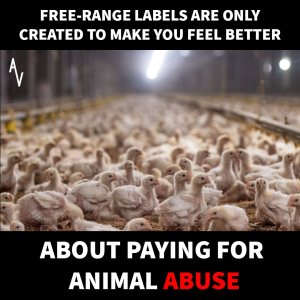
Over 70% of farm animals in the UK are raised on factory farms.

Tell the world
From a very early age, in books and through songs, we are presented with a very idyllic image of farming – spacious green fields, fresh air, bright red tractors, and happy animals roaming free.
When we get older, food branding and advertising continue this narrative, using images and descriptive language which reinforce these traditional perceptions of farming.

Factory farming UK
But, sadly, this is not the truth of much of modern farming in the UK.

The drive for cheap meat has industrialised our farming system to the point that many farms are unrecognisable in comparison to those we have been repeatedly conditioned to think of.
The brutal fact is that, today, over 70% of farm animals in the UK are raised on factory farms.

Where the vast majority of chickens and pigs raised for meat spend their entire lives indoors, with no green fields to explore.

Even dairy cows are increasingly kept indoors for the whole year.
Where animals are not free to roam or even free to engage in their natural behaviours.

Pigs are kept trapped together in claustrophobic pens. Mother sows are prevented from turning around in restrictive farrowing systems, used to prevent the mother pig accidentally squashing her young.

Thousands of broiler chickens must constantly compete with one another for even an A4 sized area of space.

Where there is no fresh air, only huge ventilation fans fixed to the walls, constantly spinning in an effort to disperse the heat, smell and waste gas of so many animals trapped together.
Where chicken farmers must wear biosecurity suits to protect against the spread of diseases and waste.

Why are we not shown these truths in adverts, on packaging or food labels? Because the reality of factory farming is utterly abhorrent to most people.
Britain is often touted as having some of ‘the best animal welfare standards in the world’.

Continue reading “The myth of UK farming”

USA: Petition Now Launched Asking For Turkey Abusing Employees To Be Sacked From Their Jobs, Please Support By Signing – Thank You.

Petition Link:

Fire Workers Accused of Stomping on Live Turkeys – Animal Petitions

In relation to our very recent post about workers at Plainville Farms clearly being shown on video violently abusing Turkeys, see the video footage at:

Turkey Abusers – Stomped, Punched, and Left to Die Is Not ‘Humane’—Tell Wegmans and Harris Teeter Now! – World Animals Voice

There is now a petition asking for all the employees accused of stomping on live turkeys to be suspended from employment.

Petition wording is:

Target: Mark Schiller, CEO of Hain Celestial Group and Plainville Farm President Tom Donovan

Goal: Fire workers accused of kicking, torturing striking, and stomping on live turkeys.

A video published by PETA has reportedly shown vulgar, sadistic treatment of turkeys at a production site in New Oxford, Pennsylvania for Plainville Farms. In the video, workers are apparently shown kicking, torturing striking, and stomping on live turkeys, who are left on the floor to die after being tortured. Workers apparently grab the turkeys by the wings, a delicate spot, and fling them at each other playfully. This seriously twisted behavior must be punished if proven true.

Plainville Farms provides food for markets such as Whole Foods, Publix, and Harris Teeter. On their website, they declare that the alleged actions go against the company’s morals. They claim that the workers will be held accountable, but it is vital we make certain the company follows through. If these accusations are true, then labeling these products as “humanely-raised” is simply not true.

New protocols should be demanded to limit scenarios like this from happening. Acknowledgement is not enough- demand these workers and supervisors are fired if found responsible and that new regulations are implemented that actually guarantee humane treatment of these turkeys in the future.

PETITION LETTER:

Dear Mark Schiller and Tom Donovan,

As you may be aware, recent footage of turkey farms by employees at your companies were released. If reports are true, employees entertained themselves by torturing animals. While it is important to acknowledge any wrongdoing, you must also ensure there are consequences for the workers accused of this abuse. Firing supervisors and workers who allegedly allowed this treatment to happen is an important first step. You should not advertise your products as “humanely-raised” or “cruelty-free” if this is not the case either. Your retailers at Publix, Harris Teeter, and Whole Foods should also be formally informed about this incident.

Please ensure investigations against these locations are followed through and the proper consequences are met. While this video reportedly showing the violence at your turkey farms may demonstrate a single scenario, it is your responsibility to look into all your farms at differing locations. Enact protocols that ensure cruelty does not occur. Consumers and non-consumers alike will be awaiting direct action from your companies.

Sincerely,

[Your Name Here]

Petition Link:

Fire Workers Accused of Stomping on Live Turkeys – Animal Petitions

Please take action and sign;

Regards Mark

Danish Government Makes Progress ?, Whilst UK (COP26) Government Cops Out On Imposing A Meat Tax and Promoting Plant Based Diets.

WAV Comment:

The Danish government are no friends of ours. 

Mass mink murderers; mass murderers of marine mammals in the Faroe islands; take a look:

Search Results for “denmark mink” – World Animals Voice

Search Results for “faroe islands” – World Animals Voice

Also, never having even been polite enough to respond to our letter to the Danish ambassador in London re the mass mink murders:

Denmark: Still No Response From The Danes Regarding Our Letter of 12/11/20. That’s Life – Or Death, If You Are Danish Mink ! – World Animals Voice

And as of today, 22/10/21 we still have never had any response back.

Now we hear (and welcome) the following; ? something for the British government to take note on – see below for more;

Regards Mark

Denmark announces 1 billion kroner for plant-based foods in historic climate agreement

The Danish government has announced over 1.25 billion kroner (€168 million) in funding to advance plant-based foods, as part of an unprecedented climate agreement for food and agriculture.

The Danish government has announced over 1.25 billion kroner (€168 million) in funding to advance plant-based foods, as part of an unprecedented climate agreement for food and agriculture. This funding is the largest investment in plant-based research and development by any EU country to date. 

The agreement, endorsed by all major parties in the Parliament, acknowledges that plant-based foods must be a “central element in the green transition” and commits the government to creating a national action plan for plant-based food with clear targets for production and sales.

Research by Oxford University shows that the world cannot meet its climate targets without shifting away from conventional animal agriculture. Moving to plant-based meat could reduce climate emissions by up to 90% compared with farming animals.

Under the new agreement, Denmark will create a Fund for Plant-based Food Products, providing 675 million Danish kroner (€90 million) over nine years to support product development and promotion. 

For farmers, a five-year Plant-based Eco-scheme will pay 580 million Danish kroner (€78 million) in bonuses to those who grow plant-based protein crops for human consumption. 

An existing EU-funded scheme, which provides funding for “environmental technology”, will be expanded to include processing equipment for plant-based foods.

The government will also devise a strategy for “green proteins” for animals and humans, backed by 260 million Danish kroner (€35 million) over five years. This funding is likely to support fermentation-made proteins and cultivated meat (grown from cells), as well as animal feed.

Rune-Christoffer Dragsdahl, secretary general of the Vegetarian Society of Denmark, said: “It is groundbreaking that we will have a national action plan for plant-based foods with specific objectives, and that Denmark will invest more than 1 billion kroner in this area. This is one of the largest amounts that any country has invested in plant-based development. 

“This agricultural agreement will create thousands of jobs in the plant-based sector. If more funds are set aside later as part of the ongoing negotiations over research investment, we could see tens of thousands of new jobs.”

Acacia Smith, policy manager at the Good Food Institute Europe, said: “With this announcement, Denmark has recognised the huge potential of sustainable proteins to drive down agricultural emissions, and established itself as Europe’s biggest public investor in plant-based innovation. 

“As they prepare for COP26, governments around the world should be factoring plant-based and cultivated meat into their climate plans. If they are serious about meeting the Paris Agreement and building strong, green economies, they must follow Denmark’s lead and invest in bringing sustainable proteins to consumers’ plates.” 

Denmark announces 1 billion kroner for plant-based foods in historic climate agreement – GFI Europe

Meanwhile; in the UK; where COP26 is being held and so very promoted by the UK government; it seems like some information was released (spilled out) when it should not have been – read on::

Plan that suggested meat tax to help people go vegan swiftly deleted

A meat tax should be brought in to tackle climate change and help people move towards a vegan diet, experts have told the Government.

A model for increasing the price of ‘high-carbon foods’ was drawn up for ministers exploring ways to combat rising global temperatures.

The paper was seen by The Telegraph when it was published by mistake on Wednesday morning before it was removed soon after.

The plan was drawn up by the Business department’s Behavioural Insights Unit, known as the ‘nudge unit’.

The recommendations included giving shoppers vegan recipes when they buy new pots and pans and offering students cooking classes that avoid high-carbon foods.

Other solutions included increasing the ‘relative availability’ of plant-based food and providing children with ‘sustainable defaults’ in schools.

But the Government has insisted it has no plans to carry any of these suggestions out, saying the document is an ‘academic research paper, not government policy’.

‘We have no plans whatsoever to dictate consumer behaviour in this way,’ a spokesperson said.

Researchers went on to say that Brits’ hearts and minds could be better won over if the action was directed at farmers instead of consumers.

This ‘bold policy’ would impose a carbon tax on producers of red meat – beef, lamb and mutton.

But experts worry this would just welcome competition from producers which export into the UK that would not be subject to the same environmentally friendly or welfare laws as British farmers.

Indeed, Conservative MP for Thirsk and Malton Kevin Hollinrake said: ‘Most livestock farmers, most hill farmers are break-even at best.

‘You start putting taxes on them, and they are out of business…It will not only hit farming, it will devastate communities.’

The Government stressed a meat or dairy tax was not part of its Net Zero strategy – a goal for the UK to cut carbon emissions to net-zero by 2050 which was set out on Wednesday.

Boris Johnson plans to do this with other consumer-directed measures, including phasing out petrol and diesel cars and replacing boilers with low-carbon electric heat pumps.

The Treasury has warned this could cost the UK £37 billion a year but business secretary Kwasi Kwarteng told Times Radio: ‘The cost of inaction actually could be greater than actually doing things’.

‘Metro’ – London.

Paper calling for meat tax to help people go vegan swiftly deleted | Metro News

I have one thing to say to both the UK, and the Danish murdering governments

Regards Mark