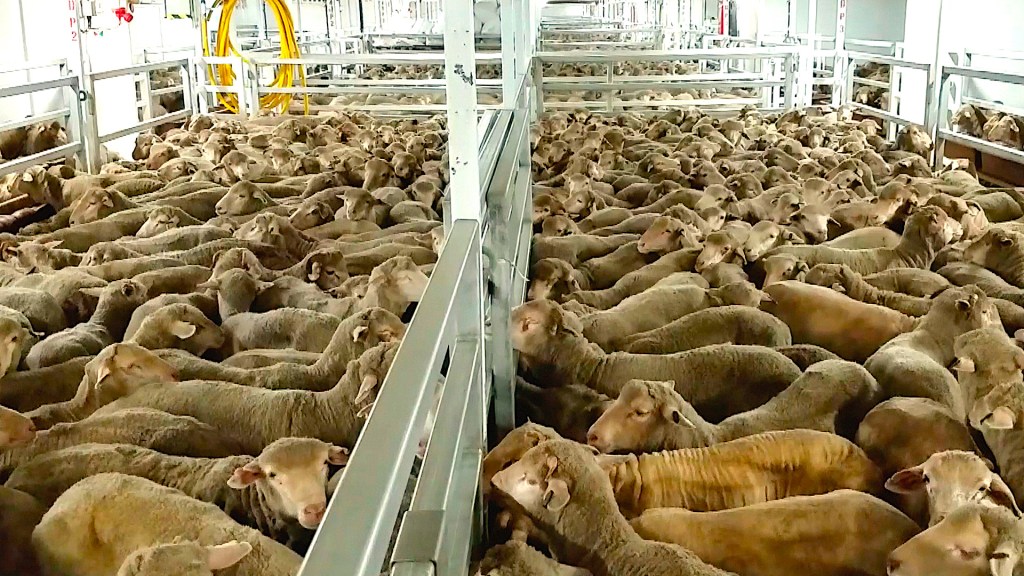
TheAwassi Expresssailed from Australia’s winter to the Middle Eastern summer in the lead up to the annual Muslim festival of sacrifice. But something went “wrong”. Approximately 2,400 sheep didn’t make it to port.
They died of heat stress, some trapped in a bog of excrement, and someone on board filmed it.
This hell for the animals continues to this day.
One mass murder chases the next.
Decaying animals that lie in the ship for days and weeks, and not even a responsible person who would have to be released for violating the law, cruel conditions in mobile coffins with exotic names such as “Al Shuwaikh,” “Karim Allah”, “Elbeik”… the list could go on and on and everyone is horrified for a few days, everyone calls for more “animal welfare” and “respect for animal laws” but – as always – nothing changes.
And we can be sure that what we learn through videos is only a small part of what is really happening, and most importantly, we can be sure that such crimes happen much more often than we know.
And every time we write petitions to politicians, ministers, commissions, that means to bodies that treat their grandmother’s old console better and more carefully than do with animals.
Hypocrisy, ignorance, indifference to cruelty, mass murders, violations of protective laws and agreements – these are the main characteristics of everyone who benefits from animal corpses
Rights and dignity are reserved exclusively for humans and are often completely denied to non-human animals.
The machinery draws its energy from the large power stations of business, press, religion, and politics, but the energy itself is extracted in the deep, dark pits of human stupidity.
We don’t have to wait for politicians or laws.
We can always start to create real animal welfare by denying the animal profiteers our money.
Where there is no demand, there is no production and where there is no production, there are no “failures” and not even “unfortunate individual cases”.
WAV Comment – from our animal friends at OIPA in Milan, Italy. You can send a letter as per the draft at the end of this post, or modify it to say what you want. E mail addresses are also given. Thanks.
A MASS CULLING OF STRAYS IN PAKISTAN: 25,000 DOGS EXPECTED TO BE KILLED IN THE NEXT FEW WEEKS. OIPA INTERNATIONAL WRITES TO THE PRIME MINISTER
The list of countries that brutally and cruelly kill street dogs and cats rather than using ethical methods to keep under control strays’ population is getting longer day after day.
The Pakistani government has been recently planning to cull 25,000 stray dogs within the next 60 days. The mass killing has started in the tehsils of Lodhran, Kehror Pakka and Dunyapur under the special directive of Commissioner Javed Akhtar Mahmood.
Many people across the world might not know it, but this is not a method recently introduced in the country. More than 50,000 dogs die every year on the streets of Pakistan and it is the government itself to order the mass killing and poisoning of the animals in almost every city of the country. They are shot or poisoned and then their dead bodies are collected by municipal workers, loaded and piled onto trucks for disposal. Karachi and Lahore have the highest rate of dog killings each year with over 20,000 dogs killed in these two cities alone. For smaller cities, the average rate per year is between 3,000 and 6,000 dogs
Citizens still believe this cruel and inhumane method is the only solution and many take part in the killings by hanging or poisoning stray dogs on the streets.
As affirmed by Sonia Saher, who runs a sanctuary for rescued street dogs in Pakistan called Stray Animals Safety and Control Authority Pakistan (SASCAP) : “The government of Pakistan has no animal protection laws, no law on criminal offenses against animal abusers and an open policy of killing stray dogs on an annual basis.”
Pakistan being a signatory member of the World Organization on Animal Health (OIE) should ensure the five basic freedoms for animals
Freedom from hunger, thirst and malnutrition by ready access to fresh water and food
Freedom from fear and distress by ensuring conditions and treatment which avoid mental suffering.
Freedom from discomfort by providing an appropriate environment including shelter and a comfortable resting area
Freedom from pain, injury and disease by prevention or rapid diagnosis and treatment
Freedom to express normal behaviour by providing sufficient space, proper facilities, and company of the animal’s own kind
We have decided to write to the Prime Minister Imran Khan and to the Minister of the Attorney General asking the following:
stop the legalized mass culling of innocent animals;
replace this inhumane practise with an ethical TNVR (trap-neuter/spay-vaccination- release) programme;
work on community awareness;
establish a cooperation with local and international NGOs that can provide expertise in stray dogs’ management.
Read the letter to the Prime Minister 👉 click here
WHAT YOU CAN DO FOR THE CULLING OF STRAY DOGS IN PAKISTAN?
You can copy or modify the text below but remember to be always polite! Our objective is to save dogs
“Dear Prime Minister Mr. Imran Khan,
I appeal to your kind attention asking to stop the legalized mass culling of stray dogs in your country. It is not acceptable that Pakistan, actively engaged in the United Nation, still uses in 2021 such a cruel and barbaric method against innocent sentient beings, involving in the killings its own citizens instead of educating the community to a pacific coexistence with animals. Please, replace this inhumane practise with an ethical TNVR (trap-neuter/spay-vaccination- release) programme, work to increase community awareness, cooperate with local and international organizations that can provide expertise in stray dogs’ management, build shelters properly managed in order to keep under control the overpopulation of stray dogs and prevent diseases such as rabies. Follow the recommendations of OIPA and other organizations. Bring a positive change for your actual and coming generations. Don’t hurt animals anymore.”
We want to turn all dairy farms into animal sanctuaries and we need your help to convince these farmers to join the movement.
We are a new plant-based drink subscription service, sourced lovingly from ex-dairy farmers.
We work with farmers to make the transition from cows’ milk to the production of plant based drinks, and at the same time convert their farmland into animal sanctuaries.
We’re offering a viable new opportunity for the farmers’ businesses to uniting with the farmers and providing them with the tools they need to move away from the dairy trade.
We will assist the ex-dairy farms to sustainably and locally source the ingredients in order to produce plant based drinks on their farms. Their land will be converted into an animal sanctuary for their cattle that are no longer being used for dairy farming.
Show your interest (no payment, no commitment) in buying fresh plant-based drinks from them and let us do the rest.
From the Facebook page of the Austrian animal rights activist Martin Balluch
“Incomprehensible!
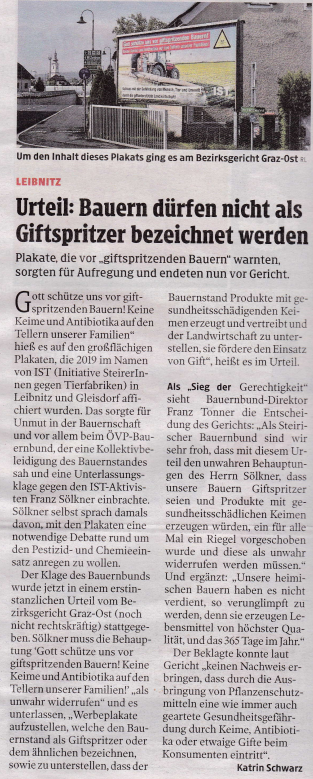
A “citizens ‘initiative against animal factories” has put up a poster that reads:
“God protect us from poisonous farmers! No germs and antibiotics on our families’ plates.
Content of the poster: “God protect us from poisonous farmers! No germs and antibiotics on our families’ plates “!
A criticism of pesticides without specifically addressing anyone.
The farmers’ union felt addressed and sued for revocation and omission, although the union is not even mentioned.
As a result, a judge whose husband works in a company that is 100% owned by Raiffeisen * Markt actually ruled that:
– the farmers’ union was meant and therefore may complain – it is a statement of facts and not an opinion – these facts are incorrect.
Therefore, the citizens ‘initiativemust revoke the statement as untrue, publish the revocation in the “Kleine Zeitung” (small Newspaper) and on a poster for a fee, and pay the farmers’ union money(!!!)
It is hard to believe what kind of judges there are. We had it very often in animal welfare.
It is to be hoped that this disgrace will be reversed in the instance.”
* Raiffeisen: is the brand or name part of more than 330,000 companies that deal with agricultural products in the upstream and downstream sectors as well as general financial services worldwide.
And I mean…The farmers’ association, which is of course known to play the victim, said: “Our local farmers don’t deserve to be denigrated like that, because they produce high-quality food 356 days a year“ !!!
Since when have environmental polluters been portrayed as victims?
The farmers think it is completely okay to put pigs in cages for 4 months in which they cannot turn around, mothers take their children away, kill excess piglets and when they have exploited cows enough, they let them kill the last moneyclose.And that is subsidized!
If I am not an animal abuser, then I do not use them for my economic interests either.
Animal breeding alone is torture because the animals are bred for maximum performance and have physical problems (especially with poultry).
Where’s the animal owner’s love in this business?
And now there is something else: How much groundwater is contaminated by the liquid manure? We afford the luxury of destroying our environment so that we can worship our daily flesh. And thus give the animals a torturous life.
I think it would be very fair if the farmer paid for the removal of the nitrates from the water; after all, he caused it.
A vile and despicable judgment, the lobby at its worst.
Over Half Of Brits To Buy Vegan Easter Treats This Year, Says Survey
The top plant-based alternatives that people will be seeking out to replace are dairy chocolate, meat, and cheese
More than half of Brits will buy vegan Easter treats this year, according to a new survey.
The 1,000-person poll was conducted by Mexicana Vegan, the plant-based alternative to the UK’s number once spicy cheese.
It found that 54.8 percent of respondents are ‘likely to buy vegan alternative products to traditional Easter food this year’.
The top plant-based alternatives that people will be seeking out to replace are dairy chocolate (48.4 percent), meat (36.4 percent), and cheese (32.3 percent).Moreover, 22.6 percent of people polled are planning to cook vegan alternatives to the usual Easter Sunday dishes this year. A whopping 47.2 percent cited the desire to be ‘healthier’ as the main reason for going vegan this Easter.
‘We’ve seen demand soar’
Lisa Harrison is the Senior Brand Manager for Mexicana Vegan. In a statement sent to PBN, she said: “So much of our Easter traditions focus on food, whether it’s gifting Easter eggs to friends or family, or indulging ourselves over the long Easter weekend; the highlight being Easter Sunday lunch.
“And with lockdown measures being lifted from 29 March to allow outdoor gatherings of either six people or 2 households, people will be planning their Easter food experiences and what they will be giving to friends and family this Easter.
“It’s great to see that people are strongly considering going vegan this Easter. We’ve seen the demand for our plant-based cheezes soar over lockdown as people seek out healthier alternatives and the need to pursue a healthy diet and lifestyle has never been so paramount as it has been over the last year.”
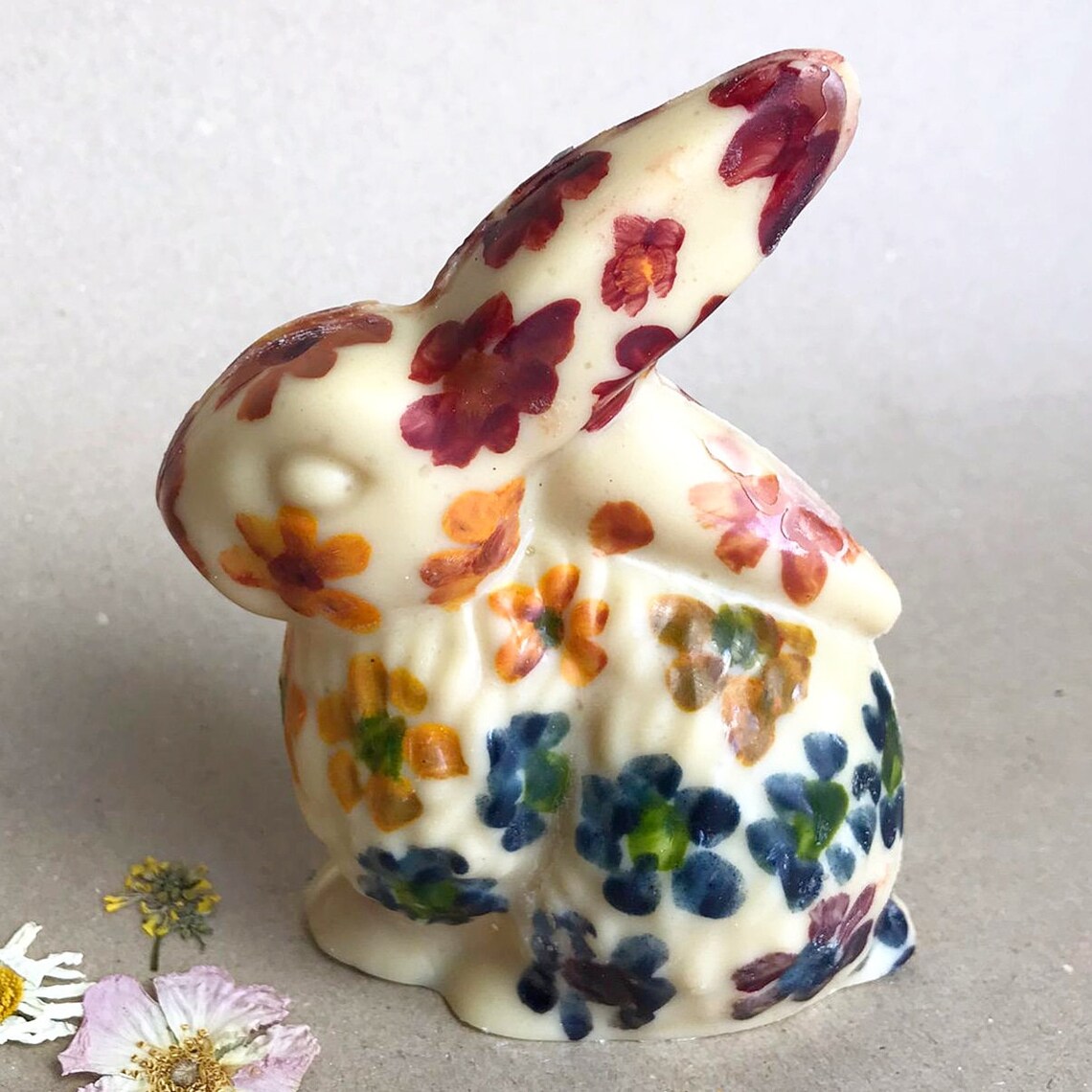
The launch features three Free From Easter Eggs: Cluckie The Chocolate Chick, Caramel Easter Egg, and White Chocolate Egg With Strawberry Pieces. All are free from gluten, wheat, and animal products.
Also on offer is the Free From Bunnies and Chickens Adventure Hunt. It includes ten vegan chocolate bunnies and chicks.
Suez Canal Situation Highlights Atrocious Animal Trade, With 200K Animals Stuck On Ships
When things go awry at sea, livestock on board ships suffer immeasurably. Animals have to stand in their own waste, for weeks on end. And if resources run out, the animals suffer dehydration and starvation; the ones who don’t survive are thrown overboard.
The atrocities these sentient beings are forced to endure are overwhelming.
Recently, a livestock ship with 1,800 head of cattle was denied port entry for THREE months! According to The Guardian, nearly 200 of the cattle died in conditions described as “hellish.”
The animals forced onboard these ships of death are already slated for death – must they suffer unnecessarily before they are slaughtered? Does anyone care for their welfare?
Your signatures and comments will be sent to the European Parliament along with our letter asking for this cruel live export transportation business to come to an end.
WAV Comment – Around August 2010 I was very involved with investigations undertaken on the very same issue which is detailed in Caroline’s article below – the export of young Irish calves to mainland EU via Cherbourg port which is in France.
Here is a link to our other site – ‘Serbian Animals Voice’, which provides an example of the overall issue and a specific investigation report relating to the work. If you just wish to read the report, then here is a direct link:
Working with other EU animal welfare organisations involved in these 5 investigations, I wrote a 125 (A4) page report which detailed all the work and its findings. This was presented (as an overall one off report) to the EU, British MP’s and MEP’s (at that time the UK was still an EU member state). As Caroline details, the ferry crossing from Ireland to Cherbourg can be long – much too long for baby calves who should be given milk from their mothers on a very regular basis.
Our work found that one targeted crossing of calves on the ferry ‘Diplomat’ lasted 23 hours.
This vessel sailed from Rosslare on 28th November 2009 at 1600hrs
The other carrier ferry which was selected to be investigated, was the ‘Celtic Link’, which sailed from Rosslare on 28th November 2009 at 1815hrs, and the actual sailing time was 17.75 hours.
Important – only the sailing times for the ferry crossings (Rosslare-Cherbourg) are given above. These times are without the additional hours taken for transporters to journey from the original point of animal loading to Rosslare harbour, and once the ferry crossing has been made, the additional hourstaken for transporters to journey to approved Control Posts in France once they had alighted the ferry at Cherbourg. So in reality; the times the calves were on truck was longer than that given above.
Once the calves finally arrived at their control post (feeding destination), they were supposed to be unloaded and rested up for many hours in accordance with EU Regulations. THIS DID NOT HAPPEN; and as you can read in the report link given above, exact arrival and leave times were recorded for several transporters carrying the calves.
Despite all this work and the long process of putting an overall report together, our evidence was simply dismissed by the EU; the trade in calves continued, as it does now, eleven years later, and I think I can safely say that all the rules are still being flouted.
This, and for many other export ‘things’ I have been involved with, is the simple reason why I have NO FAITH in anything that the EU preaches when it comes to legislation and the supposed welfare of animals. Animal welfare and the EU do not fit in the same box; we have proven it and all our evidence simply dismissed.
Does it anger me ? – yes, greatly; but it gives me even more impetus to research, investigate, and report on the issue of live animal exports. I think all the recent issues we have seen in Europe and the Suez Canal go to show what a sick and perverted bunch the politicians are who rubber stamp this mass animal abuse to happen. I promise that I will do everything in my power to expose the abuses !
Opinion: Vulnerable unweaned calves need protection in our export trade
Animal welfare campaigner Caroline Rowley outlines why she is challenging the State’s enforcement of EU law to protect farm animals exported abroad.
WE ARE CONSISTENTLY told by the State that the live export of farm animals is a highly regulated industry, with high welfare standards and care for the animals.
Yet investigations by animal welfare groups in Irish and other European countries have pointed to breaches of EU animal welfare stan
dards, as well as evidence of sickness, injury and death among cattle and calves exported to Europe and further afield.
One area of particular concern is the export of unweaned calves, thousands of which, at just 15 to 21 days, are sent on long journeys to veal farms in Europe where they are slaughtered at a few months old.
Exports have grown in recent years; largely as a result of the uncontrolled expansion of the dairy industry that is producing an increasing number of male calves that the sector has no outlet for.
Noteworthy wants to examine if we are turning a blind eye to animal welfare concerns in the live export trade. Support this project here.
A long and difficult journey
European regulations state that animals should not be transported for more than eight hours; however, there are derogations for longer journey times so long as certain conditions are met around rest and feeding times.
In this case, unweaned calves can be transported for nine hours, after which they must be allowed to rest for one hour and be given water and feed as required. The calves can then be transported for another nine hours after which they must be unloaded and fed.
In reality, however, welfare groups have documented cases where calves are in a truck at ports after nine hours and are still on the ferry after 19 hours.
The ferry journey alone is 18 hours and often trucks transporting the calves are at the port for four or five hours before departure time.
Journey logs released under FOI, for example, show the calves have been put in the trucks for around 30 hours before being unloaded and fed at the resting point in Cherbourg.
Negative impacts of the journey
There are also serious concerns about feeding of the calves. At 15 days old, calves are dependent on a liquid diet and need milk or milk replacer at least twice a day.
As there are around 300 in each truck over three levels, it is not possible to access all calves to dispense the milk. In essence, many weeks-old calves are going 24-30 hours with no feed.
Leaving unweaned calves for long periods with no feed can cause all kinds of health and welfare problems. They have little body fat in reserve and the stress of transport means they burn energy at a faster rate than they would on the farm.
They cannot regulate their body temperature effectively and calves that receive no feed during a long journey will be more susceptible to cold and heat stress.
Young, vulnerable calves do not have a fully developed immune system and the lack of feed has an adverse impact further compromising immunity.
Transport is inherently stressful and it is essential that the calves be supported during the journey by receiving adequate nutrition.
To leave them without feed for up to 30 hours will compound the stress of the journey and further compromise their immune system.
Time for Europe to take action
All transporters, including ferry companies, have been authorised to transport livestock by the Department of Agriculture with certain obligations to ensure that the transport of animals is conducted in line with the requirements under EU regulations.
Based on the evidence that we have collected, together with other organisations, we have submitted a formal complaint to the EU Commission against the Department of Agriculture for what we see as failures to take appropriate action in relation to potential breaches by ferry companies whose authorisations we argue should be revoked.
There is currently a committee of inquiry underway in the European Parliament to examine long distance transport of animals, if the regulations are fit for purpose, and how well they are being enforced. The live export of unweaned Irish calves is something that we hope is high up on the agenda.
There is something inherently wrong with a system where calves are born just to be killed, and something wrong with a society that allows it to happen.
Caroline Rowley is the director of Ethical Farming Ireland that campaigns for improved conditions for farm animals, more sustainable and ethical farming methods, and opposes live exports.
You know; with all this kind of thing every day I have to chill out for a while; and music is (amongst other things) a saviour. Sometimes I need to share some music with you as I know you get affected by it all also – you have to get away sometimes, even if for half an hour or less; so enjoy !
Due to the blockade of the Suez Canal, 200,000 animals are stuck on ships without enough water or food (Photo: Animals International)
The worst maritime animal welfare tragedy in history could, by now, be unavoidable, says Gabrile Păun, the EU director for Animals International, an NGO.
There are 16 ships taking live animals from the EU to the Persian Gulf which have been stuck for several days behind the stranded ‘Ever Given’ cargo vessel in the Suez Canal.
Even with the Ever Given now slowly moving again, the live animals inside the blistering cargo containers, which are quickly running out of feed and water, are now nearing an even more tragic end than that which awaits them in the slaughterhouses at their destination.
Even if the ships were to resume full course today, the water and food would not last until their sea journey is over.
Romania is the source for the 130,000 of the 200,000 live animals now caught in the Suez bottleneck.
Some six of the 11 ships full to the brim with the live animals from the South-Eastern European nation are in a particularly critical situation. They were supposed to reach harbours in the Persian Gulf over four days ago, but still have not left the Canal.
According to EU law, ships carrying live animals need to load 25 percent more food than planned for their trip in case of delays, but animal welfare organisations warned that this rarely happens.
Meanwhile, Păun explained to EUobserver that even with the 25 percent buffer, these ships would now run out of animal feed long before they arrive in port.
“A ship that left Romania on 16 March was scheduled to arrive in Jordan on 23 March, but instead it would now reach port on 1 April at the earliest. That is a nine-day delay. Even if the ship had the required 25 percent additional animal feed, it would only have lasted for 1.5 days”, he said.
The ‘ANSVSA’, the Romanian authority in charge of live-animal exports issued a press release two days ago saying that after reaching out to those in charge on board the ships, there is enough food and water to last a few days.
The press release added that live animal exports have been currently suspended until the situation in the Suez is dealt with.
But for Păun, those responsible for the shipment would never admit that animals are dying by the thousands on their vessels.
Meanwhile, the EU legislation does not compel an EU member state to report on animal mortality on board these ships and Romania would never release that information voluntarily because authorities know that it would lead to investigations, he added.
Romania is one of Europe’s largest live-sheep exporters and has several times been singled out by the European Commission for its bad practices regarding live-animal exports.
Last year, Romania was red-flagged by Brussels for failing to meet live-animal transport conditions after more than 14,000 sheep drowned when a cargo vessel capsized off the Black Sea coast.
A year earlier, the then EU commissioner for food safety, Vytenis Andriukaitis, urged Romania – to no avail – to stop the export of 70,000 live sheep to the Persian Gulf because temperatures inside the cargo vessel exceed 60 degrees Celsius.
Instead, Romanian authorities increased their live-animal exports, despite an investigation that showed animals exported to Gulf countries dying from the high temperatures, being unloaded violently off ships, squeezed into car trunks, and slaughtered by unskilled butchers.
Păun says the only chance now for some of the animals to make it to destination alive is for Egyptian authorities to move quickly and clear the ships trapped in the Suez.
“I am appalled that legislation did not offer Romania the power to command cargo ships to return back home. Romania should have used diplomatic pressure to resolve the issue,” he said.
“According to a ruling by the European Court of Justice, the EU member state exporting live animals to a third party country is responsible for their wellbeing until reaching destination”, he added.
For Păun, Romania should move toward exporting meat rather than live animals.
“It would cancel the unnecessary suffering of the animals and would be more economically profitable for Romania”, he said.
But even though other countries have agreed that exporting processed and refrigerated meat is far more profitable and less cruel, live animal exports remain unabated from Romania.
WAV Comment – we feel this a very important petition to support as it has huge implications throughout the EU regarding plant based dairy censorship. Please give your support, thank you – petition link below.
STOP PLANT-BASED DAIRY CENSORSHIP
Dear European Commission and EU Member States,
We want you to put a halt to plant-based dairy censorship
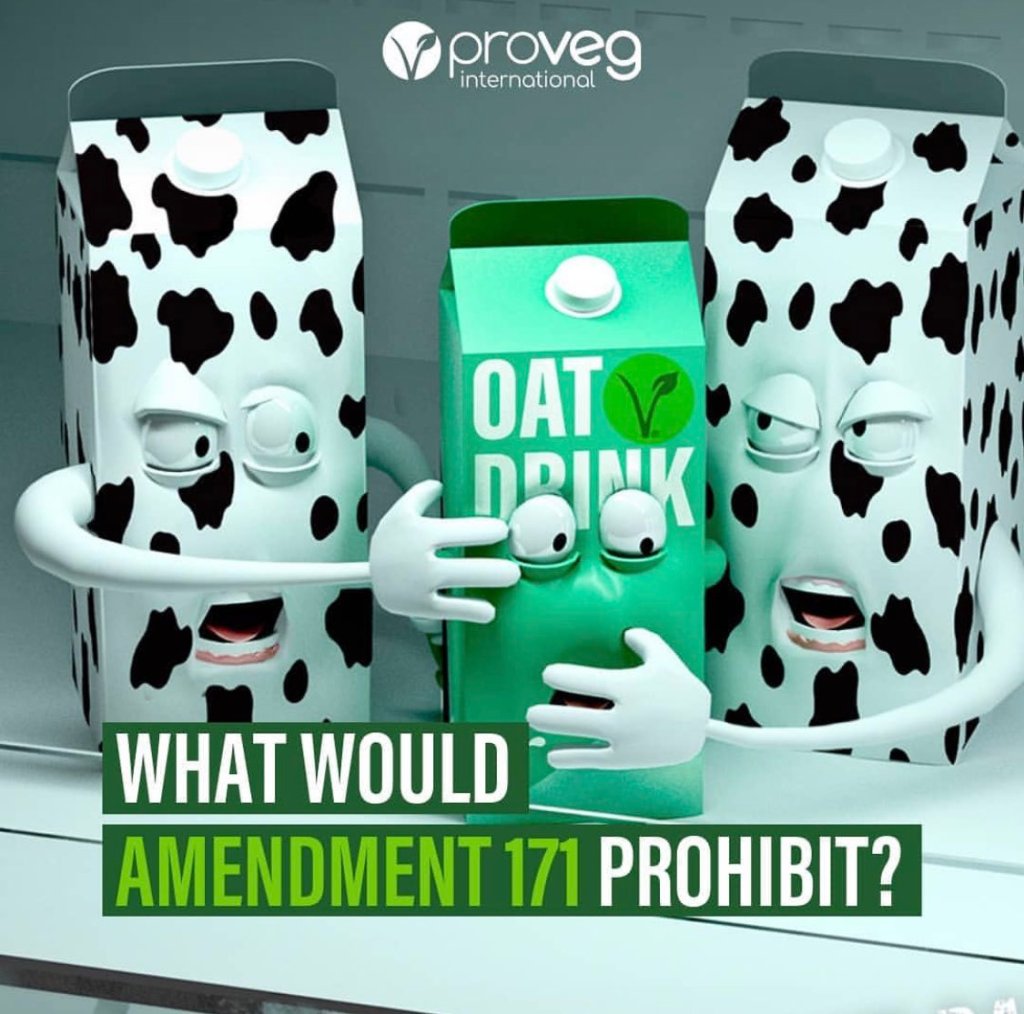
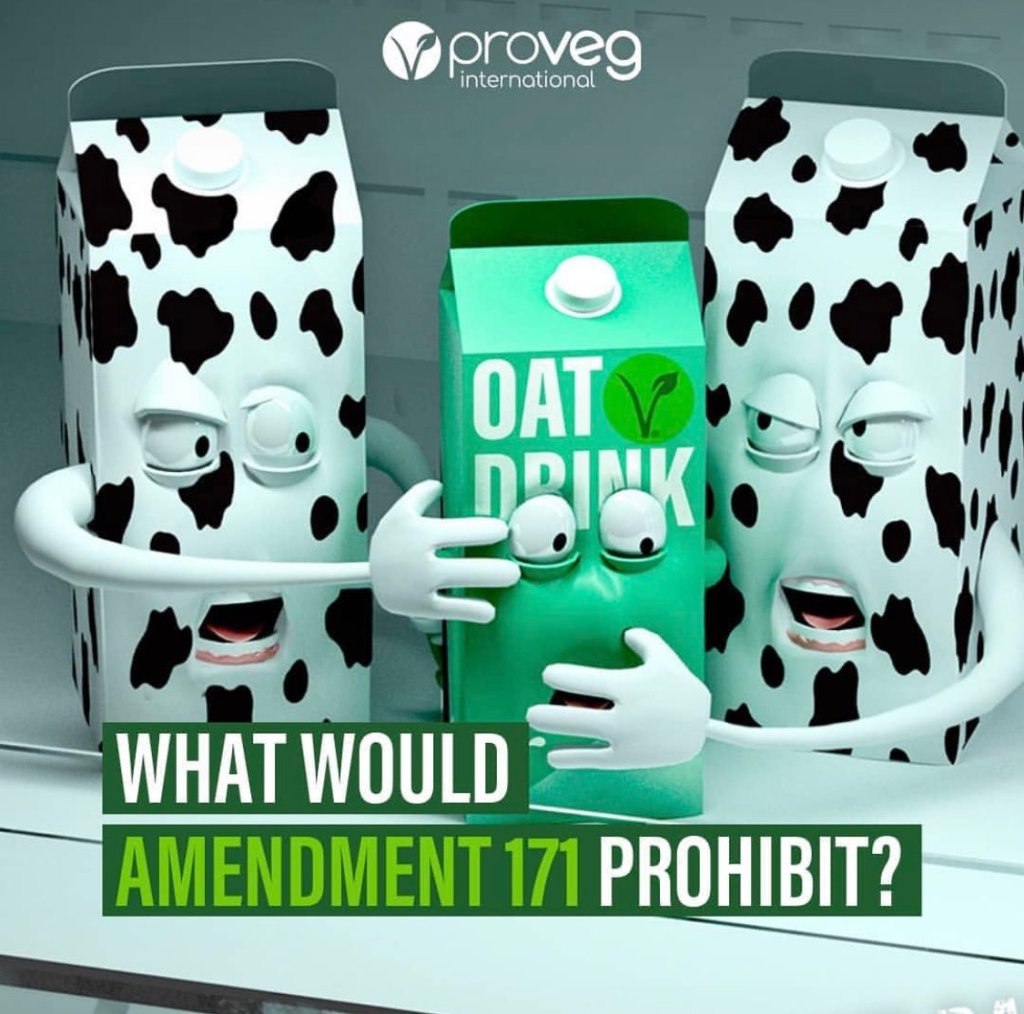
Please reject amendment 171. If adopted, it would totally counteract the consumer shift to more sustainable eating habits that’s urgently needed to fight climate change.
Dairy terms are already protected by law. Amendment 171 would go further and censor all use of dairy-related language, packaging, or imagery for plant-based foods.
Words and phrases like “contains no dairy” or “creamy texture” might be banned. The same goes for a tweet or an advert mentioning scientific data showing that a product causes, for example, “half the carbon emissions of dairy butter”. Bizarrely, the amendment could even prohibit plant-based foods from using photos of their own products on packaging.
In this way, amendment 171 would not only hide information from consumers, but also hinder innovation and the emerging sustainable food sector. Altogether, it would be a huge reversal of the work done so far to meet the EU’s own goals on public health and sustainability, as agreed under the terms of the Paris Agreement. Given the urgency of the climate crisis, it’s a highly irresponsible move.
Please add your name and tell the European Union to stop plant-based censorship.
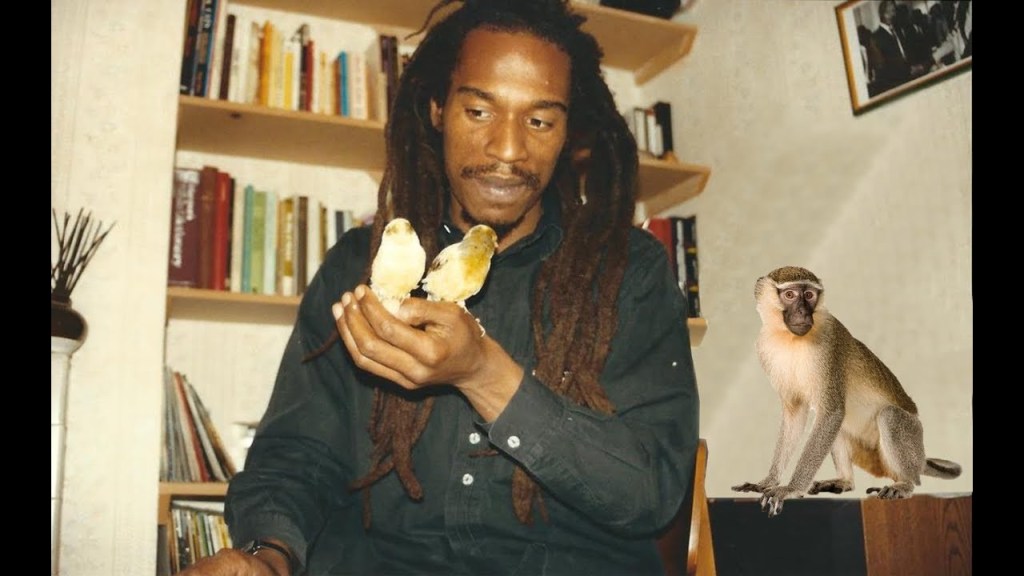
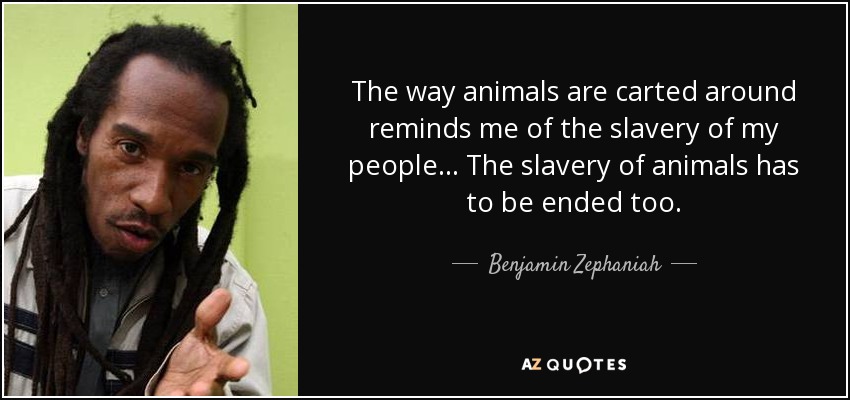
I have ‘loved’ (in a ‘blokey’ sort of way) ! Benjamin since I first saw him at a London animal rights demo decades ago. So seeing him again the BBC this morning; I thought it was time to introduce him to you. Here are a few shorts of his life and actions; a passionate animal rights advocate, he wrote the foreword to Keith Mann‘s book From Dusk ’til Dawn: An insider’s view of the growth of the Animal Liberation Movement
Dedicated – Yes;
do we want him – for sure.
Regards Mark
Benjamin Obadiah Iqbal Zephaniah (born 15 April 1958)[1] is a British writer and dub poet. He was included in The Times list of Britain’s top 50 post-war writers in 2008
Turning vegan at 13 Benjamin is pretty much a lifelong vegan. He is now 58 and as a busy performer, writer and with a passion for martial arts, he just naturally shows people what it is like being vegan and doesn’t “ram veganism down peoples throats”.
In 2004, he wrote the foreword to Keith Mann‘s book From Dusk ’til Dawn: An insider’s view of the growth of the Animal Liberation Movement, a book about the Animal Liberation Front.