A week ago, my cat Cordino had an operation, that’s why I have to leave the work on our blog aside.
In order for the wound to heal well, he has to wear a neck collar, and although he is very good-natured and cooperative, he definitely didn’t want that.
We have agreed to only wear the collar at night, and during the day it stays free and happy, but for me, this means that I have to take care of him all the time so that he does not lick the wound.
We both have to complete this task by Sunday, then Sunday is the 10th day after the operation and then the threads are extinguished by themselves and we are all redeemed.
I ask for your understanding.
Soon I’ll be fully active again on our blog.
WAV Comment – Like so many live animal transport issues which is always backed up by hard evidence; the EU ignores the same and continues to live up with the fairies on another planet. Over 8 years ago this issue was covered by NGO’s in Argentina; and the EU has not acted. What is the point of the EU we ask ?
Horsemeat imports in regular breach of EU rules
25 November 2020
Today, the Animal Welfare Foundation, supported by other NGOs, released a new documentary underlining animal welfare abuses in the production of Argentinian horsemeat. Unfortunately, as demonstrated by our report, this is not an isolated case.
The documentary, entitled “A Web of Lies”, (click on title to see video) reveals that eight years after the first investigation carried out by NGOs in Argentina, the severe abuses and neglect of horses destined for slaughter continue, despite claims that the situation has improved. The film also puts the spotlight on key shortcomings in ensuring the traceability of the horses.
Similar issues can be witnessed in several countries providing horsemeat to the EU, like Australia, Uruguay and Canada. Consumption and trade of horsemeat in the EU has overall declined between 2000 and 2015; yet, since 2017, EU imports of horsemeat from foreign countries have started to grow again, especially from Argentina.
It is thus high time for the European Commission to address the concerns around these imports.
Eurogroup for Animals launches today a report presenting an overview on animal welfare and traceability-related issues encountered in key producing countries. The report puts forward the following recommendations in order to ensure better equine protection:
All imported equine meat must comply with EU animal welfare standards at slaughter (which are currently the only applicable animal welfare requirements for imported meat).
All imported equine meat should also respect other animal welfare standards applied in EU horse meat production (e.g. related to transport, in assembly centres and in horse feedlots). This means trade agreements should contain provisions on conditional liberalisation of horse meat imports (e.g. liberalised access to the EU market would be contingent on meeting equivalent welfare standards).
Suspension of imports from countries if EU audits demonstrate a lack of enforcement of the applicable provisions of the regulation on welfare at the time of killing and traceability requirements.
Allowing for the possibility of unannounced audits.
Suspension of imports (e.g. from Mexico and Brazil) are not reversed unless the production meets the required EU animal welfare standards as confirmed by EU audits.
Working to improve equine welfare outside the EU through cooperation on animal welfare with relevant partner countries (at present Argentina, Australia and Canada), using technical assistance where required.
Greater traceability of horse meat products by introducing Country of Origin Labelling (CoOL) for fresh and frozen equine meat.
Reduced consumption of equine meat and derived products (through member organisations reaching out to retailers and consumers).
Leading Animal Protection groups join forces for animal testing bans
23 November 2020
Following calls from EU authorities for cosmetics ingredients to be tested on animals, Europe’s leading animal protection groups have sent a joint statement to MEPs urging them to uphold the groundbreaking cosmetics testing and marketing bans.
Even though the testing of cosmetics ingredients on animals is banned under the EU Cosmetics Regulation, the European Chemicals Agency (ECHA) and the European Commission (EC) argued that even ingredients used exclusively in cosmetics may still be tested on animals under the REACH regulation (Registration, Evaluation, Authorisation and Restriction of Chemicals) if there is a possibility of workforce exposure during the manufacturing process. For cosmetics ingredients also used in other types of products, tests on animals may, they say, be required regardless of any potential for workforce exposure.
It is imperative that the purpose of the Cosmetics Regulation – that cosmetics products are safely brought to market using only non-animal data – be met without compromising the bans. For ingredients marketed under the Cosmetics Regulation that have a history of safe use by consumers and of controlled handling on the factory floor, robust protection of both workers and consumers is already enabled through a variety of non-animal assessment methods and the careful application of exposure assessments. When regulators decide that a new ingredient cannot be brought safely to market without animal testing, its introduction should be delayed until additional non-animal test methods are available.
The recent administrative decisions are not the end of the road for the cosmetics testing and marketing bans. We maintain that new safety assessment data for cosmetics substances imported into, manufactured or sold within the EU may only rely on non-animal assessment methods. The wishes of citizens and legislators are clear: ECHA and the European Commission must be held accountable and compelled to uphold the terms of the EU cosmetics animal test and marketing bans as originally intended.
As animal protection organisations, we call for the European Parliament and the European Commission to ensure that the following mandates are urgently carried out:
• The EU bans on animal testing for cosmetics and the marketing of ingredients tested on animals must be fully upheld and implemented as intended by the legislators.
• EU test requirements – including requirements set out in REACH – must not undermine the bans but instead must apply a substance-tailored approach to ensure consumers, workers, and the environment are protected without further tests on animals.
• The European Commission must devise a robust testing strategy for cosmetics ingredients using only available non-animal assessment strategies so that the implementation of the Chemicals Strategy for Sustainability reflects the overwhelming support for strengthening – rather than weakening – the protection of animals in Europe.
The joint statement and list of signatories can be seen here.
20,000,000 waterbirds dead. 400,000 tonnes of lead. The poisoning continues despite legal obligation to phase out lead shot in wetlands 20 years ago, when the 2000 African Eurasian Waterbird Agreement deadline passed. This week MEPs have the opportunity to ban lead with a workable proposal that benefits people, animals & nature and help banning lead gunshots.
The health of European citizens, biodiversity and the environment is at stake as a result of the use of toxic lead gunshot. The Commission is seeking to repair this through a ban on the use of lead gunshot in wetlands.
A very small proportion of EU citizens release 1000s of tonnes of toxic lead gunshot into the environment year on year. This is despite excellent non-toxic alternative gunshot types being available which are comparably priced and in common usage in many Member States.
The price of the toxic pollution is currently being borne by:
One million waterbirds poisoned to death annually, millions more suffering;
People exposed to lead gunshot in their food – of particular importance to children and pregnant women due to impacts of lead on the developing brain;
Soils contaminated and then poisoned for future agricultural use.
Wetlands International, together with Conservation without Borders, Eurogroup for Animals, European Association of Zoo and Wildlife Veterinarians, Humane Society International, International Fund for Animal Welfare, Migratory Birds for People and WWT urge you to end this old-fashioned polluting habit and support the proposal from the Commission to ban use of lead gunshot in wetlands as a significant step to a toxic-free future.
WAV Comment: Just shows; even with all the evidence; how bloody useless the EU is.
Live export from Europe to third countries is booming despite tragedies
23 November 2020
Animals International
Press Release
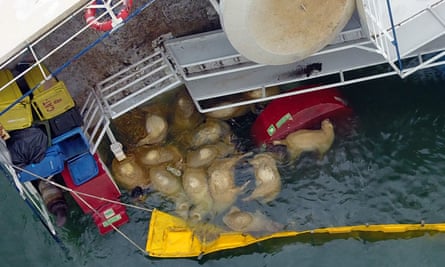
1 year after the live export vessel MV Queen Hind capsised killing thousands of sheep no one is held responsible. Eurogroup for Animals and Animals International, its member organisation in Romania, today remember the thousands of sheep who endured the most horrible death a year ago in the Romanian harbour of Midia.
For immediate release: Brussels, Bucharest 24 November 2020
The tragic anniversary is the opportunity to remind the lack of action by the Romanian Government and the EU Commission which led this barbaric trade to continue, with over 4 millions cattle, sheep and goats being shipped in despicable conditions to countries where animal welfare doesn’t meet the European standards.
Romania alone experienced a major raise in live animal exports since the Queen Hind capsised, with more than 2 million animals leaving the country by sea to reach North Africa and the Middle East, a journey that may take up to three weeks.
While Romanian authorities insist that the density was 10% less than usual, the company hired to take the ship out of the water found secret decks with extra animals that were not part of the official vessel documents. The Romanian Government has not published their conclusions on the incident’s investigation.
The Queen Hind was overloaded, and animals were sentenced to an unavoidable death caused by greed and corruption. The Romanian Government has made no step forward to end live export and has also failed to progress in its commitment to work towards phasing out the trade.
Commented Gabriel Paun, EU Director of Animals International.
Temperatures in the Gulf may reach 50 degrees Celsius in the shade. Despite evidence of Romanian sheep suffering extreme heat stress, in July the Romanian Parliament passed a new law allowing live exports to take place when temperatures rise above 35 degrees Celsius. Even with the added requirements to shear animals and reduce stocking density by 10%, thisnew law breaches the EU transport Regulation that clearly demands Member States to freeze exports if temperatures soar above 35 degrees.
This bill was debated after the Queen Hind tragedy and was initially aiming to improve the welfare of exported animals by freezing exports during summer, as Australia has done, and having a veterinarian on board all ships. But interference by foreign animal trading companies in the Parliamentary debates saw the bill watered down in a form that breaches the current EU Regulation.
The audits carried out by the EC in European harbours indicate major deficiencies, especially in Romania which dedicates more than half of their maritime fleet to export of EU animals to third countries. The Commission concluded that these authorisations were granted superficially and that the fleet endangered animals and crew.
Moreover, within the Farm to Fork strategy the EC intends to revise the EU animal transport regulation and the EP created the Committee of Inquiry on the protection of animals during transport (ANIT).
Thanks to the ANIT Committee we believe that MEPs will have all the evidence they need to investigate how Member States apply the current Transport regulation and finally stop live transport in favor of meat and carcasses trade.
Commented Reineke Hameleers, CEO, Eurogroup for Animals.
Animals International and Eurogroup for Animals call on the EU Commission to start an infringement procedure against the Romanian Government for continuously failing to comply with the EU animal transport regulation.
In the aftermath of the incident Eurogroup for Animals members Animals International and Four Paws were both involved in the rescue operations.
ENDS
Above – The ‘do nothing EU Commissioner Andriukaitis
Below – the ‘animal welfare’ ignorant Romania Minister Petre Deae
Just as polar bear cubs are about to be born and begin denning with their mothers, Trump is rushing to hold a fire sale of the Arctic National Wildlife Refuge.
He invited oil and gas companies to identify which areas of the refuge’s coastal plain they’d like to drill, then proposed to toss out rules on offshore drilling. New cubs could one day see oil rigs from their dens.
This pristine landscape is not his to sell, so we’re in court to stop him.
Trump and his greedy friends know time’s running out for them to plunder public lands for personal gain, which is why they’re moving fast to auction off leases to drill in the refuge.
Those leases will make it harder to keep this treasured landscape from turning into an oilfield.
We can’t let them get away with this last-minute money grab.
We’re in court to block more than 1.5 million acres of Alaska’s Arctic National Wildlife Refuge from being opened to oil and gas drilling.
And we have a separate lawsuit in the works to stop Trump’s plan to open more than 18 million acres of the western Arctic.
Drilling in these areas will cause oil spills and greenhouse gas emissions already threatening polar bears with extinction. It will also decimate important caribou habitat, including areas where they raise their calves.
It’s obscene that after one of the worst seasons of wildfires and hurricanes in history, the administration’s priority is to worsen the climate crisis by giving handouts to Big Oil.
We can’t let the administration get away with ruining the Arctic refuge on its way out the door.
EU and US block plans to protect world’s fastest shark
The population of shortfin mako, mainly caught as bycatch but also prized by sports fishermen, is facing an alarming decline
The mako shark population could take five decades to recover even if fishing were to stop immediately. Photograph: Nature Picture Library/Alamy
Conservationists accused the EU and the US at negotiations of Atlantic fishing nations this week of blocking urgently needed plans to protect the world’s fastest shark species.
The strength and speed of the shortfin mako, which can swim up to 43mph, makes it a target for sports fishermen, particularly in the US, while its highly prized meat and fins have led to the shark being overfished globally – and dangerously so in the north Atlantic.
The population could take five decades to recover even if fishing were to stop immediately, according to scientists at the International Commission for the Conservation of Atlantic Tunas (ICCAT), a fisheries management organisation.
Last year, international governments voted to regulate trade in the endangered species, under the Convention on International Trade in Endangered Species, after the EU co-sponsored a proposal.
But there was no outright ban, and this week Britain – in its first official act as an independent member of ICCAT – backed a proposal by Canada for such a ban. The UK said it was extremely disappointed that no agreement had been reached in 2019.
The EU and the US, however, refused to back the ban, saying it would not in itself stop mako mortality as bycatch. Each suggested separate proposals that would allow boats to continue to land mako in certain circumstances. Given the lack of consensus, the ICCAT committee chairman said he had no choice but to postpone any decision on mako catches until 2021.
“North Atlantic mako depletion remains among the world’s most pressing shark conservation crises, yet the EU and US put short-term fishing interests above all else and ruined a golden opportunity for agreeing a clear and simple remedy,” said Ali Hood, director of conservation for the Shark Trust.
Grantly Galland, an officer for the Pew Charitable Trusts’ fisheries team, said the delay in adopting a ban would speed the decline of a species already at dangerously low population levels.
“The only real advice from scientists to ICCAT is to have a no-retention policy. Another year of catching at the current level will leave the population in the north Atlantic in even worse shape,” Galland said.
Scientists warned last year that the important predator was declining faster than previously thought. They recommended annual landings of mako in the north Atlantic be reduced from 3,000 tonnes to 300, to allow the population to recover.
Ian Campbell, associate director of policy for Project Aware, a non-profit working with sports divers in ocean protection, said: “It has been heartbreaking to watch the US devolve from a global shark conservation leader to a primary obstacle to international, science-based protections for endangered makos.” He urged the incoming Joe Biden and Kamala Harris administration to “restore US commitment to science and the precautionary approach”, particularly for vulnerable marine life.
Doctors Tell U.K Government Going Vegan Can Reduce Severity Of COVID-19
‘Going vegan is one of the simplest, cheapest things Britons can do to slash the risk of becoming seriously ill with COVID-19′
Agroup of clinical experts has told the U.K government going vegan can reduce the severity of COVID-19.
15 top doctors have written an open letter to the government. It advises that a plant-based diet is an effective way of fighting health issues such as obesity, T2 diabetes, and heart disease. These are all major risk factors for COVID-19.
The letter has been signed by experts such as Emanuel Goldman, Dr. Shireen Kassham, and Professor Richard Kock.
‘Obesity crisis’
“The Government is set to ban junk food adverts before 9 pm and end buy-one-get-one-free promotions,” the letter reads.
“These are positive steps. But, the Government’s health strategy roundly fails to mention possibly the single biggest thing as Britons we can do to tackle the obesity crisis.
“Going vegan is one of the simplest, cheapest things Britons can do to slash the risk of becoming seriously ill with COVID-19. Now more than ever before it’s time to embrace the benefits of a plant-based diet before it’s too late.”
The campaign will see billboards across the country ‘making clear the stark health benefits of a plant-based diet.’.
Juliet Gellatley is the director of Viva!. In a statement sent to PBN, she said: “Today some of Britain and America’s top clinicians are delivering a very clear message.
“A healthy vegan diet can help you lose weight, reverse Type 2 diabetes and protect heart health, reducing your risk of severe Covid-19.”
Go to the Federal Register website and click on the green button – “Submit a Formal Comment” Type in your comment, using the below as a starting point
Sample CommentI urge the Small Business Administration not to finalize this rule and to instead redirect federal funding away from corporate animal agribusiness. The proliferation of corporate-controlled concentrated animal feeding operations that cruelly confine billions of animals is polluting our air and water, threatening public health, and putting rural communities at risk. The Small Business Administration should be supporting small business—not propping up corporate animal agribusiness.
Finish filling out the form and press “Submit Comment”
Background The animal agriculture industry attempts to paint itself as a collection of small family farms, but nothing could be further from the truth. Large — often multinational — corporations have overtaken animal agriculture in the United States. There is nothing small about this cruel and destructive industry, yet the Small Business Administration (SBA) is proposing a rule that will allow it to give small business loans to even larger factory farms. Unfortunately, the SBA has a history of enabling the animal agriculture industry’s exploitation of funds.
In 2018, the SBA Office of the Inspector General released a report concluding that the SBA guaranteed approximately $1.8 billion in loans to factory farms that did not actually qualify as small businesses. The Animal Legal Defense Fund has urged the SBA not to fund the corporate animal agriculture industry and is currently suing over the federal government’s decision to exempt federal funding for factory farms from environmental review under the National Environmental Policy Act. The SBA was created in 1953 “to aid, counsel, assist and protect the interests of small business concerns, to preserve free competitive enterprise and to maintain and strengthen the overall economy of our nation.” Funding the corporate owners of the animal agriculture industry with loans intended to help small businesses betrays the SBA’s mission.
This industry is neither small nor competitive—it is controlled by a handful of large, highly consolidated corporations that are destroying actual small business and siphoning wealth from rural communities. Factory farms intensively confine thousands, and even millions, of animals until they grow large enough to be trucked to slaughter. Not only do they hurt animals, factory farms threaten public health by spreading antibiotic resistant bacteria and zoonotic diseases and pollute the air and water.
These environmental effects are especially harmful in marginalized communities, where factory farms are disproportionately sited. The SBA should not be using public money to further entrench this industry at the expense of animals, the environment, and rural communities. We need your help in asking the SBA to reconsider its proposal to expand federal funding of factory farms. Follow the steps below to submit a comment to the SBA by December 1st and urge them to reject this reckless rule.
Go to the Federal Register website and click on the green button – “Submit a Formal Comment” Type in your comment, using the below as a starting point
Sample CommentI urge the Small Business Administration not to finalize this rule and to instead redirect federal funding away from corporate animal agribusiness. The proliferation of corporate-controlled concentrated animal feeding operations that cruelly confine billions of animals is polluting our air and water, threatening public health, and putting rural communities at risk. The Small Business Administration should be supporting small business—not propping up corporate animal agribusiness.
Finish filling out the form and press “Submit Comment”
Download Your FREE Vegan PDFHERE Order a FREE vegan kit HERE Download Your FREE Dairy-Free PDF HERE Take the Dairy-Free Challenge HERE Click HERE for more Dairy-FreeFish alternatives can be foundHERELearn about eggsHERE Find bacon alternativesHERE Take PETA’s Cruelty-Free Shopping Guide along with you next time you head to the store! The handy guide will help you find humane products at a glance. Order a FREE copyHERE Searching for Cruelty-Free Cosmetics, Personal-Care Products, Vegan Products, or more? Click HERE to search.Free PDF of Vegan & Cruelty-Free Products/Companies HERE Click HERE to find outHow to Wear Vegan! Want to do more than go vegan? Help others to do so! Click below for nominal, or no, fees to vegan literature that you can use to convince others that veganism is the only compassionate route to being an animal friend: PETA HERE Vegan Outreach HERE Get your FREE Activist Kit from PETA, including stickers, leaflets, and guideHERE Have questions? ClickHERE Stacey | November 23, 2020 at 7:39 am | Categories: Our Compass | URL: https://wp.me/pYypJ-9H0