ECDC = European Centre for Disease Prevention and Control
ECDC to assess risk associated with spread of SARS-CoV-2 in mink farms
16 November 2020
ECDC will assess the human implications of an extensive spread of SARS-CoV-2 in mink farms in Denmark, where by 3 November 197 farms had been affected in the country. Denmark is currently implementing strong control measures, including culling, restrictions of movement of people living in nearby areas and enhanced testing among the general population.
When the virus is introduced into a mink farm, it can spread quickly, leading to many cases among mink. Due to the large number of infections and possibly due to biological differences between mink and humans, the virus can accumulate mutations. Such variants have the possibility to spread back into the human population.
Finding unity and bringing people with diverse opinions togetheris the need of the hour in our politically complicated world. But for most everyone reading this newsletter, we all share a sense of oneness. Animals keep bringing us together. Whether or not we’re vegan; whether we voted for this one or that one; whatever our colour, country or culture; we each love animals and hate to imagine any of them suffering. No single one of us has made Animal Aid the sparkling fountain of rescues it has grown to be. We’ve done it together, and from all corners of the world, speaking dozens of different languages, wearing sarees, sarongs, or skirts; wearing blue jeans or suits, we’re pooling our resources to help the beautiful beings all around us, flying a common flag.
Hiding, delirious and desperately wounded, watch the rescue of KC (the King of Cuteness).
We never know what to expect when a wounded dog is hiding in a sewer drain, but when they do that it’s never a good sign. Desperately wounded animals seek relief in the dark hidden places, but with wounds as serious as KC’s, the pain won’t go away.
KC’s wound was filled with maggots. He threw his head around wildly, almost delirious with pain.When our rescue team arrived, he tried to get away, but, exhausted, he could only take a few steps. Once we removed the maggots, cleaned and snuggly bandaged his head, we found KC to be absolutely kingly in his cuteness, so loving that even before he took his first bite of food after the sedation wore off, he gave us one of those big-nose camera kisses.
So that’s what KC stands for. King of Cuteness, and you’ll see why here.
Your love can reach deep and lift high. Please donate.
Adopt fabulous, fun-loving Foxy!
Beautiful Foxy is the biggest sweetie-pie you could meet! Playful and petite, she captures the hearts of all who meet her with her gentle nature and enthusiasm for life.
Foxy has a rare disorder that has fused her jaws closed. She can open her jaw just enough to eat semi liquid food that must be specially prepared for her, and biting is not possible for her. A young dog, Foxy sadly had a difficult start on the streets, struggling to find food she could eat and unable to defend herself. She has some scarring on her back which makes us think she might have been mistreated – in spite of this,she is incredibly trusting and loves to snuggle up to people.
Foxy is currently being fostered with another dog who she’s great friends with, and together they love to play and go on walks, where she will lay in any puddle she can find! Due to her difficult past, Foxy gets very attached to her humans and can become anxious if she is left alone, so she needs a home where someone is around most of the day. And that person will be as lucky as Foxy, who spreads cheer and love all day long.
Suffering silently, little Chauncy needed urgent help.
Getting worse at a very fast rate, this poor little donkey’s wound, filled with maggots, would soon kill him. During monsoon season, many donkeys are let loose by their owners to forage for grass, but their owners may not see them for weeks at a time. Luckily, a passing driver saw the gaping wound and called us to the rescue. We found a very deep hole filled with maggots – but we also found one of the most modest, sweet and loveable Beings we’ve ever met. We called him Chauncy, because it sounded formal and adorable, like him.
Someone suffering in silence can heal with a song in their heart. Please donate.
The Senate Committee on Culture and Sports has rejected this Thursday a motion of the Popular Party asking the Government to promote actions to promote bullfighting and recognize it as a “sign of identity of Spain.”
“Treating animals like this, cannot be part of our culture, nor receive public money”
The motion was rejected this Thursday with the vote against by all the groups of the Senate Committee on Culture and Sports, except for the Popular Party and Vox (right-wing populist party), who voted in favor.
The Popular Party (PP) defended in its text that “bullfighting is a set of activities that are directly connected with the exercise of fundamental rights and public freedoms protected by the Constitution, such as those of thought and expression, production and literary and artistic creation, scientific and technical “, something that has been criticized by the rest of the groups, except Vox (right-wing populist party)
During the defense of the motion, the PP senator María de las Mercedes Cantalapiedra assured that Bullfighting is “the most important mass spectacle in this country after football”, to which the senator of “Esquerra Republicana” Bernat Picornellhas replied that..
«The bullfighting festivities are not the second show in this country, but the tenth, behind football, cinema, monuments and sites, museums, concerts of contemporary music and classical music, exhibitions, theater and art galleries. So let’s say things by name and don’t make things up.“
In addition, he has defended that “killing an animal is not a culture in the 21st century” and added that bullfighting “has fewer followers every day.”
Picornell also recalled that a few days ago the European Parliament asked to withdraw the aid associated with the breeding of fighting bulls.
The PSOE (Social Democratic Party) senator Miguel Ángel Vázquezhas reproached the “popular” [the conservative Popular Party] for bringing to the Upper House “a bull already fought” with the intention of “rivaling the extreme right in the field of identity”, and he has described as “authentic nonsense” to link the defense of bullfighting to fundamental rights, although he has recognized that bullfighting is “an ingrained tradition.”
Finally, he has finished explaining that they would vote against because the position of the PSOE in the face of bullfighting is that of “neither promoting nor prohibiting.” (!!!)
Along the same lines, the senator of “Adelante” Andalucía María Pilar Gonzálezhas confirmed that her group would vote against it, claiming that “We deny the strategic, historical and cultural value of bullfighting.”
In addition, the senator of “Junts Per Catalunya” Assumpció Castellví has assured that “The bull suffers pain, under no circumstances can it be said that the animal does not suffer”, he stressed.
The only one who has aligned himself with the PP’s motion has been the Vox ((right-wing populist party) senator Jacobo González-Robatto who has defined Bullfighting as an “essential part of Spanish cultural heritage” and has lamented that it has been a sector “very punished by the pandemic” and by “the management” of the Government.
“For you bullfighting is violence and Otegui [a Basque politician] a man of peace, we are going badly,” he added.
And I mean…The Spaniards should be proud of the committee’s refusal to recognize this primitive and bloody spectacle as a “sign of Spanish identity”.
Not all Spaniards are lacking in empathy and education like the corrupt garden gnomes of PP, Vox, and PSOE.
The majority reject bullfighting, only a bunch of idiots still believes in bullfighting, and they are proud of this primitive culture of prehistoric men.
Bullfights and celebrations with bulls or other animals have nothing to do with culture or art!
We are very close, not least thanks to Corona, to ban this barbaric industry once and for all.
Is the climate crisis pushing the world towards a ‘point of no return’?
A new study claims we may have already reached a hypothetical ‘point of no return’, but other researchers say this is ‘at odds’ with what we know about climate science. Daisy Dunne examines the arguments
It’s a question with no simple answer. Even if humans quit polluting the world overnight, scientists say it would take many decades for the Earth’s climate to reach a new equilibrium. This is largely linked to how heat is stored in the world’s oceans, which can, in turn, have an influence on air temperatures.
Matters might be complicated further by potential “tipping points” in nature that might be triggered by global warming.
For example, rising temperatures are causing permafrost, frozen ground found in high northern latitudes that stores vast amounts of carbon, to thaw out. This thawing causes more carbon to be released into the atmosphere, which, in turn, is adding to rising temperatures. There is a worry that such positive “feedback loops” could ultimately lead to rapid heating, and limiting global warming is important for avoiding such feedbacks.
A new study, published today in the journal Scientific Reports, makes the bold claim that, hypothetically speaking, we could “already [be] past a point of no return for global warming”.
Using a simplistic mathematical model, it simulates what would happen in a hypothetical world where greenhouse gas emissions were stopped in 2020. It finds that, in the simulations, the world continues to heat up for hundreds of years as a result of positive feedback loops such as permafrost thaw.
However, leading climate scientists from across the UK and beyond have urged people to take the results of the new study with extreme caution.
Prof Richard Betts MBE, chair of climate impacts of the University of Exeter and the Met Office, told The Independent: “Having talked to various colleagues, we don’t think there’s any credibility in the model.
“Feedbacks are important. The possibility of eventually becoming committed to long-term climate change is important. But there is no real evidence that this has already happened.”
Because the model used in the new study is simplistic, it does not well simulate important climate feedback loops, Prof Betts explains.
In addition to permafrost thaw, the melting of Arctic sea ice is also an important potential feedback. Warming of the world’s oceans and atmosphere is causing the ice to melt at an astonishing rate. Bright white ice reflects away sunlight, and, once it disappears, the exposed dark ocean begins to absorb more sunlight, heating the ocean further – leading to further ice melting.
Though this feedback is important to take into consideration, the model used in the new study does not well simulate how it works, says Prof Betts.
The results also stand in contradiction with the findings of the upcoming assessment report from the Intergovernmental Panel on Climate Change (IPCC), an independent group made up of the world’s leading climate scientists.
“The results presented in the paper are interesting but are really at odds with the science community’s understanding of how the climate is changing,” says Prof James Renwick, head of the school of geography, environment and earth sciences at the Victoria University of Wellington.
“The latest round of climate model simulations show that if greenhouse gas emissions were to stop immediately, there is likely to be very little further increase in temperatures and no sign of warming resuming in future.”
The models used by the IPCC are more advanced and better able to simulate the behaviour of the Earth’s feedback loops, says Prof Mark Maslin, a climate scientist at University College London.
“These results do need to be confirmed by more complex climate models used in the IPCC reports, because these results come from one model which has not undergone the rigorous cross checking and testing that is usual for climate models,” he says.
In their paper, the authors note the simplicity of their model by saying that they “encourage other model builders to explore our discovery in their [bigger] models, and report on their findings”.
It is important to understand that it is not too late to take actions to address the climate crisis, says Prof Betts: “I really wouldn’t want people to take [the research paper] seriously and start getting worried that the climate catastrophe is now unavoidable.”
Claims that the world is “doomed” to suffer extremely high levels of warming can be detrimental to global efforts to tackle the climate crisis, explains Leo Barasi, author of the Climate Majority.
“Claims the world is irreversibly doomed to runaway warming, and no amount of emission cuts can help us, can always find an audience, just like claims that climate change is nothing to worry about,” he told The Independent.
“But these assertions usually rest on outlying studies or data that’s been taken out of context and ignore all the opposing evidence.
“Telling the world that we’re doomed, when that’s not backed up by the evidence, is irresponsible and unlikely to motivate the urgent action that can still prevent disastrous warming.”
PETITION TARGET: Cambodian Ambassador to the United States Chum Sounry
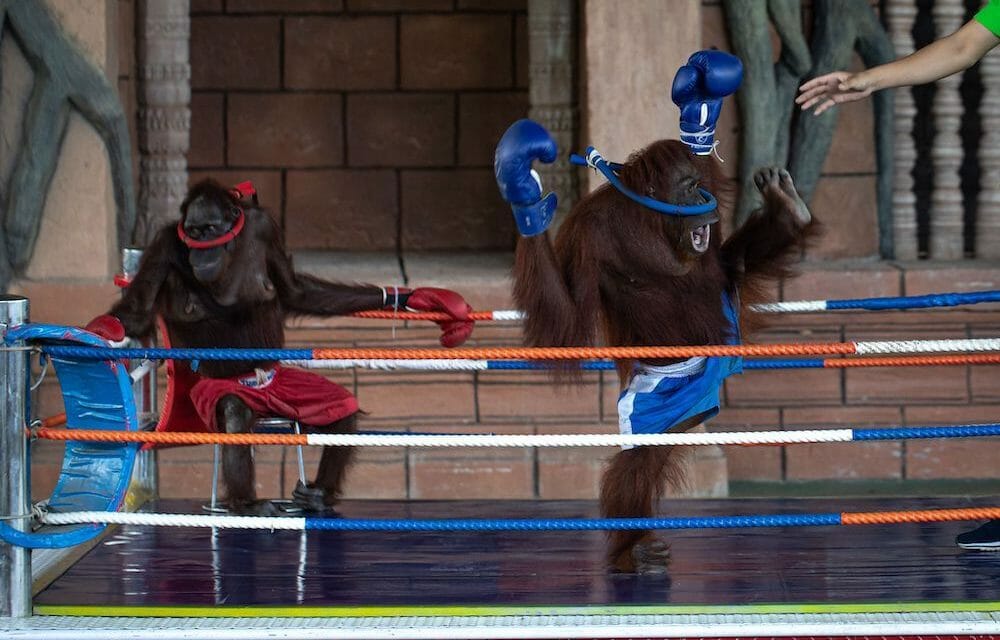
The Phnom Penh Safari zoo in Cambodia showcases disturbing orangutan boxing matches, forcing innocent apes to fight each other in a boxing ring. The animals are also made to ride bikes, hula-hoop, and wear degrading outfits, as shown in numerous TripAdvisor photos.
Orangutans aren’t the only animals abused at this zoo: tigers jump through flaming hoops and cower in fear of trainers’ electric prods; crocodiles are hit with sticks and have their mouths taped shut for selfie opportunities; and elephants are controlled with bullhooks.
The animals appear neglected, too. The tigers are declawed and extremely thin, according toEARS Asia. And the drinking water is filthy, according to aKhmer Times article that has since been deleted.
Animals do not exist for human amusement. They deserve natural habitats and loving caretakers, not cruel zoos where they’re forced to perform for park-goers.
The abuse must stop. Sign this petition urging Cambodian Ambassador to the United States Chum Sounry to call for an end to all cruel animal performances at the zoo and push for a thorough investigation into the animals’ treatment.
Please support the campaign – sign the petition at:
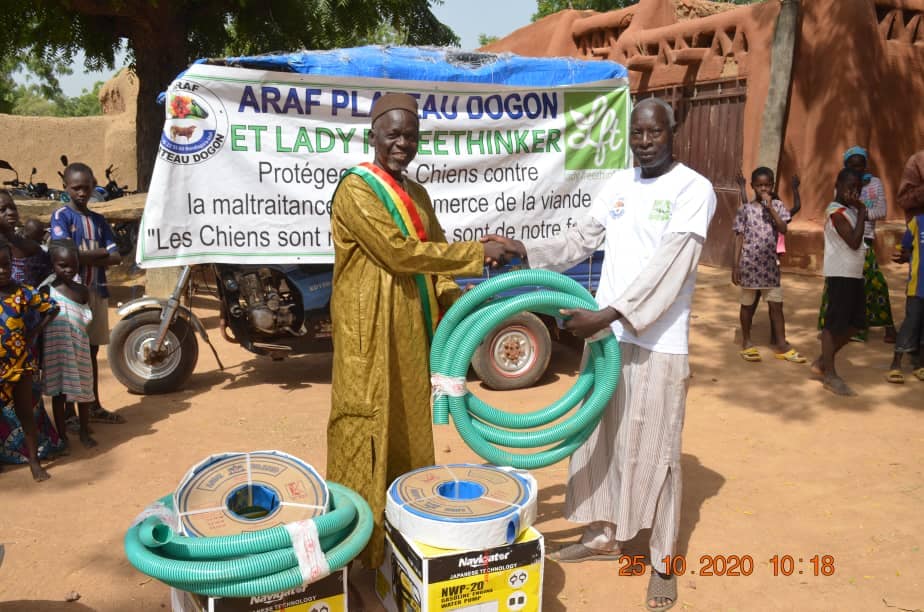
With funding from Lady Freethinker (LFT), local partner and nonprofit ARAF-Plateau Dogon gifted 20 former dog meat traders life-changing farming equipment to start their new livelihoods growing crops. These are the first of 37 more dog meat dealers transitioning to a cruelty-free means of sustenance.
This transformation was officially marked and celebrated in a ceremony chaired by the Sébougou mayor. The celebration included local village chiefs and other officials, according to ARAF-Plateau Dogon.
The switch will save thousands of lives, as former dog meat sellers in Mali give up the trade and turn to plant farming for their livelihoods. The former traders are now speaking out against selling and eating dogs, too.
“Lady Freethinker applauds the courage and determination of these former dog meat traders for turning to a more compassionate livelihood,” said LFT President Nina Jackel.
LFT funding is going toward a quarter of a hectare of land for each farmer. It also helps provide supplies to grow the crops, which will include tubers, vegetables, and small fruit trees with short cycles.
Most dog meat sellers are eager to give up the trade and only take part to feed their families. By growing crops, they’ll have a sustainable means of income. The initiative benefits the entire community, where some people live on less than $1 per day and urgently need resources.
This is part of a larger effort between LFT and ARAF-Plateau Dogon to help raise awareness of animal cruelty in the Ségou region of Mali, where more than 300 dogs are killed each day for meat.
Dogs are rounded up from villages — either taken off the street or sold by guardians who no longer want them — forced to walk for days without food or water, bludgeoned with sticks, and roasted over a fire.
In addition to encouraging dog meat traders to give up the trade, activists are traveling to villages to raise awareness of the campaign and encourage humane treatment of dogs.
The dog meat trade has grown in recent years there, with Mali’s growing population and lack of adequate food sources (partly due to climate change-related effects), according to ARAF-Plateau Dogon.
Lady Freethinker is proud to be a part of this initiative and take this big step toward ending the dog meat trade in Mali.
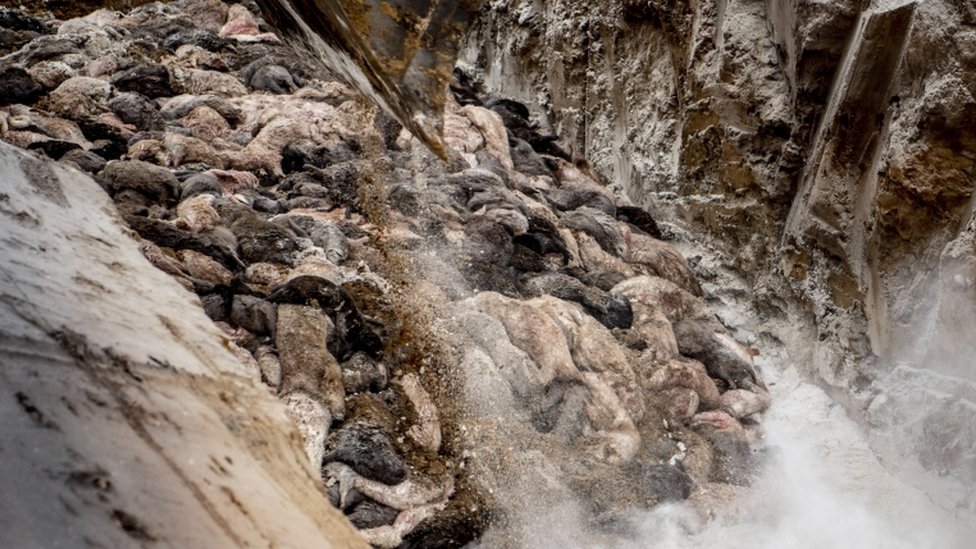
Kopenhagen Fur, the world’s largest fur auction house and owned by Danish fur breeders, has announced plans to close. This follows the news last week that Denmark announced plansto cull all its mink – as many as 17 million – after a mutated form of coronavirus that can spread to humans and threatens the efficacy of potential vaccines was found on mink factory farms.
Jesper Lauge, CEO at Kopenhagen Fur said: “the loss of the Danish mink production means that the ownership base disappears and therefore, the company’s management has decided to gradually downsize the company and make a controlled shutdown over a period of 2-3 years, “
The devastating impact of fur factory farming is now exposed as unsustainable, unprofitable and cruel. The coronavirus mink outbreaks have made news around the world. It is upsetting to see so many innocent animals killed in such high numbers and worrying to contemplate the potential threat to human health.
Fur farming is a disaster for animal welfare and a risk to human health. It is now important for governments to ban this cruelty once and for all.
A number of outrageous failings in the animal welfare of mink have been reported in Denmark over recent days, including:
A viral video showing a still alive mink surrounded by dead carcasses in a killing box. The animal, which is half gassed, is struggling to breath through an open gap in the box as workers attempt to roughly push the animal’s head back inside.
Numerous accounts report that thousands of mink bodies have been strewn across a motorway in Denmark.
Denmark’s animal welfare group, Dyrenes Beskyttelse, has reported the Danish state to the police amid accusations of cruelty.
The bombshell announcement from Kopenhagen Fur comes as the European Centre for Disease Prevention and Control said on Thursday, 12 November, that the virus mutation found in Danish mink “could potentially affect the level of overall vaccine effectiveness of vaccines under development.”
England: Respect for Animals Campaign’s Director, Mark Glover, said:
“I have devoted decades of my life to campaigning against the fur industry. The amount of animal cruelty I have seen during these years has stayed with me. The fur trade is a morally repugnant industry, relying on terrible animal suffering for a product no one really needs.
We have come a long way in the 20 years since the UK fur farming ban passed into law, which was a bitter fight.
The demise of Kopenhagen Fur is welcome but we should not forget the countless millions of suffering animals this company has profited from for around 90 years.
We now need to shut down the morally bankrupt fur industry everywhere. We won’t stop until we succeed.”
——————————————————–
Kopenhagen Fur, the world’s largest fur auction house and owned by Danish fur breeders, has announced plans to close. This follows the news last week that Denmark announced plansto cull all its mink – as many as 17 million – after a mutated form of coronavirus that can spread to humans and threatens the efficacy of potential vaccines was found on mink factory farms.
The 90-year-old company says it has enough pelts to hold auctions next year and possibly further into the future, but will start liquidating the business after that, according to a statement on its website.
Jesper Lauge, CEO at Kopenhagen Fur said: “the loss of the Danish mink production means that the ownership base disappears and therefore, the company’s management has decided to gradually downsize the company and make a controlled shutdown over a period of 2-3 years, “
The devastating impact of fur factory farming is now exposed as unsustainable, unprofitable and cruel. The coronavirus mink outbreaks have made news around the world. It is upsetting to see so many innocent animals killed in such high numbers and worrying to contemplate the potential threat to human health.
Fur farming is a disaster for animal welfare and a risk to human health. It is now important for governments to ban this cruelty once and for all.
A number of outrageous failings in the animal welfare of mink have been reported in Denmark over recent days, including:
A viral video showing a still alive mink surrounded by dead carcasses in a killing box. The animal, which is half gassed, is struggling to breath through an open gap in the box as workers attempt to roughly push the animal’s head back inside.
Numerous accounts report that thousands of mink bodies have been strewn across a motorway in Denmark.
Denmark’s animal welfare group, Dyrenes Beskyttelse, has reported the Danish state to the police amid accusations of cruelty.
The bombshell announcement from Kopenhagen Fur comes as the European Centre for Disease Prevention and Control said on Thursday, 12 November, that the virus mutation found in Danish mink “could potentially affect the level of overall vaccine effectiveness of vaccines under development.”
The UK has imposed an immediate ban on all visitors from Denmark amid concerns about the new strain.
The political fallout in Denmark has been complicated. The PM’s decision to wipe out Denmark’s entire mink population lacked a legal mandate, forcing the government to regroup and draft an emergency bill. That failed to win the three-quarters parliamentary support needed to pass, and the legislative process is now in limbo.
The government currently expects a standard bill to pass with a simple majority of more than 50%, and wants all Danish mink farming to be banned until 2022. That means breeding animals will be wiped out, meaning the scale of Denmark’s mink industry will be unrecognisable for the foreseeable future and may never recover.