WAV Comment (Mark) – After more than 30 years of personally campaigning against this disgusting, barbaric trade; the news today (12/5/21) is finally looking good. “MINISTERS have published an action plan on animal welfare, looking at how to use Britain’s freedom outside the EU to increase standards”. Freedom outside of the EU; this legislation shows what can be done by individual nations when they do not have to bow to do nothing fools in Brussels.
I am checking and re checking everywhere to get confirmation; but as you can see below it looks positive.
I will write more on this as more detail is obtained.
Regards Mark
George Eustice, the environment secretary, said: “We are a nation of animal lovers and were the first country in the world to pass animal welfare laws.
Our action plan for animal welfare will deliver on our manifesto commitment to ban the export of live animal exports for slaughter and fattening, prohibit keeping primates as pets, and bring in new laws to tackle puppy smuggling.
As an independent nation, we are now able to go further than ever to build on our excellent track record.”
It can be a little confusing to non Brits, but the United Kingdom is literally what it says, ‘United Kingdoms’; formed by the (kingdom) nations of England, Wales, Scotland and Northern Ireland. Each has its own government; Read more at https://en.wikipedia.org/wiki/Government_of_the_United_Kingdom
United Kingdon.
WAV Comment – there is a lot of talk going around that the UK Ministry Defra will aim to get legislation for a ban on live animal exports intorduced by the end of this year. They are currently going through all the submissions submitted to them; including a large proposal by ourselves. The UK government promised that once the UK had left the EU, it would be able to introduce legislation to ban all live animal exports, which it was unable to do as an EU member state. The consultation (now being reviewed by government) is part of that objective; and we are hopeful for good news in the coming months.
The State Opening Of Parliament – Good news for the environment and animals.
The StateOpening of Parliament is an event which formally marks the beginning of a session of the Parliament of the United Kingdom. It includes a speech from the throne known as the Queen’s Speech (or the King’s Speech if the UK has a male monrch).
It takes place in the House of Lords chamber on the first day of a new session, which is usually in May or June, and traditionally in November, but can occur at any time of year depending on the timing of General Elections and parliamentary session start dates.
It takes place in front of both Houses of Parliament. The monarch, wearing the Imperial State Crown, reads a speech that has been prepared by his or her government outlining its plans for that parliamentary year.
Basically, it outlines the major legislation that the government intends to introduce into UK law in the coming Parliamentary session.
This next session is going to see some positive legislation for both animals and the environment being passed into law, including:
Environment Bill
Another confirmed commitment is to new, legally binding environmental targets in the form of the much-delayed Environment Bill, which was was first launched in July 2018. The Government said it will pass the legislation in the run-up to the international Cop26 climate change summit in Glasgow at the end of year.
Animal Sentience Bill
The Queen’s Speech will also ensure animals with a backbone will have a legal right to feel happiness and suffering. According to the Sunday Telegraph, an Animal Sentience Bill will enshrine in law that animals are aware of their feelings and emotions in order to make the UK a world leader in animal welfare.
Animals Abroad Bill
A new Animals Abroad bill is also expected to ban imports of hunting trophies, while a Kept Animals bill will ban families from keeping primates as pets.
Here is a further review of some other issues not related to animals or the environment:
Thanks as always to Stacey at ‘Our Compass’ for sending this info to us.
WAV Comment – (Mark): As and English activist that has campaigned against the calf trade and dairy industry for the last 30+ years; I find this video very disturbing. It is a complete and utter insult to all of us who have worked so very hard over the years to get this kind of thing stopped. Cruelty goes on, no matter where you are on the planet; and what you do to effectively try to stop it.
Please watch the video – the UK prides itself (quite rightly) on being a nation that prides itself on the way it treats and cares for animals. This video shows the dark side, the other side of the UK pride for animal welfare. It gets to me hard; as it will get to you hard; mere babies cruelly separated from their mothers just hours after birth; the despearate calls from both sides for the want to be together.
There is one simple way to avoid the situations you see in the video; and that is to completely ditch all dairy products and instead go plant based; it is so very easy nowdays.
We have fought over the years in the past; we fight now, and we will forever fight in the future until abuses like those shown here are confined to history books, and we have to explain to youngsters in future why we allowed such abuses to take place in the ‘recent past’.
Regards Mark
Source Expired: Dairy Still KillsWhy do some promote cow’s milk and cheese as “humane”? Consuming animals as well as their “products” is never a victimless activity regardless of how humans define it, those anthropomorphized tv demonstrations of happy cows and cows going to school are delusional deflections from the reality of hell they experience: all exploited animals die, most after brief lives of pain, torment, bodily control, and mutilation.
If you agree that such incalculable suffering and violent death of infants “from other countries” is horrific, you should read about how many infants are violently, fearfully butchered in the US yearly, page 6, and also note that the US, just as one example, exports animals and animal “products” globally.
USDA: 2019 Commercial calf slaughter totaled 587,000 head
Mind you, that number includes calves and not the mothers or the chickens or the lambs or the pigs or the fish: globally and yearly, trillions of unwilling animals are butchered.
If you consume animals or the secretions of animals and refuse to watch the violence and cruelty required for you because you find it “too distressing”, can you imagine having to actually experience it? Would you promote “humane euthanasia” of your cats or dogs in a slaughterhouse?
This really isn’t difficult: next time you make a choice, choose the one that doesn’t require such violence and misery, reaching for plant-based milks or plant-based cheeses or plant-based foods in general takes no additional effort. Nobody selects cows’ milk because it’s “naturally healthy”, that’s just the spin to validate your money subsidizing suffering. Cow’s milk is fortified with those “naturally healthy” benefits – ie, those vitamins are artificially added to it after it is stolen from the infants who it is “naturally” intended for – and the USDA includes soy milk as a healthy dairy food.
It’s bizarre that people pretend that drinking another species’ breastmilk, beyond infancy, and with teeth, causing preventable death to infants and mothers, is “healthy” or “natural”. SL
A staggering 65,000 male calves under a month old were killed in slaughterhouses in 2020 in the UK, more than the number shot on farms.
Latest figures show that 60,000 male dairy calves were killed on British farms – a part of the industry which often faces public criticism. With assurance schemes, supermarkets and dairy companies prohibiting the “routine euthanasia of healthy calves” – the shooting of calves on farms – what will be the fate of these previously killed waste products? Is this another ‘kinder option’ that the industry has created following on from the mass integration of the dairy and beef industries?
Red Tractor, Arla and Müller, plus many supermarkets including Tesco, Waitrose and Morrisons all have varying policies attempting to prevent this killing. But there are loopholes and calves will not always be protected. Some of these policies only protect calves for up to eight weeks old and others do not prevent calves being sold on at markets. Therefore, the fate of many of these calves is to enter the integrated calf rearing and fattening system, where they will be killed from 12 months old for their flesh. But thousands will still be unsuitable and unprofitable.
Oaklands Livestock Centre
‘Slaughter calves’ are bought by dealers from dairies and markets. Dealers are accountable for over half of all calves entering slaughterhouses.
We filmed calves being picked up from dairy farms, supplying Sainsbury’s via milk processor, Müller, by Oaklands Livestock Centre, owned by renowned calf dealer Derek Whittall.
Whittall buys and sells calves at Halls Shrewsbury Auction, as well as buying calves at Barbers Market in Market Drayton.
Whittall’s facility, Oaklands Livestock Centre, is in Shropshire. It is a busy hub for calves passing through. Centres like these are an integral part of the UK calf trade and aid the exploitation of calves. This site is also home to one of Blade Farming’s collection centres. Arla and Sainsbury’s have partnered with beef processor ABP through its Blade Farming operation. This aids the integration of the dairy and beef industries through rearing calves. Son of Oaklands’ Director, Josh Whittall, has been in charge of transport for some Blade Farming calves.
Some of the calves who arrive at Oaklands are destined to enter the integrated rearing system, and eventually be killed for their flesh. Many others will head straight to the slaughterhouse.
Arriving at the centre, calves were mercilessly unloaded. They were kicked and pushed down trailer ramps. Others were dragged up by their tails and ears.
We caught on camera the physical and verbal abuse of these vulnerable babies.
Gates were slammed on the calves, trapping their delicate legs. Plastic bags were waved around to scare the already distressed babies.
The violent culture of abuse amongst workers towards calves at Oaklands was normalised, condoned and seemed to be expected.
These incidents are highly distressing to watch, and not only do they breach transport and welfare legislation, they demonstrate a total lack of compassion and cause unnecessary pain, fear and suffering to the individual animals.
Molly Vasanthakumar Bachelor of Veterinary Medicine and Surgery MRCVS
Naturally, calves drink from their mothers throughout the day and under legislation, those who are less than four weeks old must be fed two or more times in 24 hours. We filmed multiple groups of calves going without feeds for as long as 21 hours and others were fed only once in 29 hours. This was a regular occurrence during our filming.
Unweaned calves had no access to water.
Young calves paced and cried out. Being separated from their mothers and having milk restricted is highly distressing and dangerous for calves. When they were finally fed, they were often shown no patience. Some were thrown and hit and one was kicked in the face for not taking to the drinkers fast enough.
Some calves were loaded up and were left on a trailer for almost three hours. This is another clear breach of guidelines.
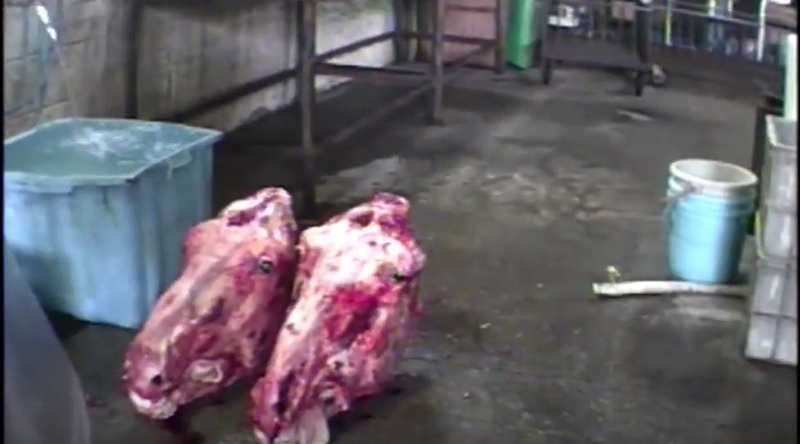
Oaklands takes many calves directly to slaughter. This is the heartbreaking, lesser-known part of the calf trade. Oaklands workers took calves to G. & G.B. Hewitt slaughterhouse in Chester, which they used to kill calves. Other agents including Livestock Supplies Ltd were caught on camera also taking calves there, taking almost 30 calves in February alone.
Calves are sent to the same slaughterhouses that kill larger animals such as sheep and adult cows. Their small frames are reflected in how tiny they look inside the walkways and holding pens.
We saw calves who were mercilessly stunned with a bolt gun before being strung up by their back legs and having their throats slit open to be ‘bled out’. The workers, desensitised to this horrific violence, took no hesitation in taking the lives of the calves. Curious and vulnerable babies were reduced to a mere profit-making product, hanging upside down and bleeding onto the slaughterhouse floor.
Their flesh will be sold for human consumption and their skin for leather.
Their captive bolt gun failed to stun a calf FOUR TIMES
There is no legislation covering the time between stunning and bleeding out but the Humane Slaughter Association (HSA) states that “if it is possible to stick [cut the throat] within 15 seconds, then this should be the case”. We caught calves being left for over 40 seconds after stunning.
Could this cruel fate inside the slaughterhouse increase now that policies have been introduced to prohibit the killing of male calves on farms? Will we see slaughter figures increase? Ending the shooting of calves on farm will not end the killing inside slaughterhouses.
Whether they are killed at 10 days old or enter the “integrated rearing and fattening system” …
Take PETA’s Cruelty-Free Shopping Guide along with you next time you head to the store! The handy guide will help you find humane products at a glance. Order a FREE copyHERE
Searching for Cruelty-Free Cosmetics, Personal-Care Products, Vegan Products, or more? Click HERE to search.
Free PDF of Vegan & Cruelty-Free Products/Companies HERE
Want to do more than go vegan? Help others to do so! Click below for nominal, or no, fees to vegan literature that you can use to convince others that veganism is the only compassionate route to being an animal friend:
WAV Comment – we need to help SAFE (NZ) to get an immediate ban from the NZ government on the export of live animals. Please take action and send your mail as per the link below – it only takes a minute or two, but will make a huge difference – Thanks.
Regards Mark
Ban on live export by sea announced!
On 14 April 2021, Minister of Agriculture Damien O’Connor announced a ban on the export of live animals by sea. The trade will be phased out over the next two years.
Please email the Prime Minister and Minister of Agriculture to thank themfor banning live export by sea and to demand that this ban be implemented immediately.
Take Action
Two years is too long – Demand an immediate ban on live export
This email will be sent directly to Rt Hon Prime Minister Jacinda Ardern, Minister of Agriculture Hon Damien O’Connor, and Associate Minister of Agriculture (Animal Welfare) Hon Meka Whaitiri. You will also receive a copy for your records. Emails are public information ‒ if you would like any of your information withheld, please state this in your email.
This month, the New Zealand Government announced a ban on all livestock export by sea. More than 57,000 of you directly pleaded with our Prime Minister and Minister for Agriculture, asking them both for a ban on cruel live export – and our voices were heard.While this is a historic step forward, we are concerned about the tens of thousands of animals that will continue to suffer for the next two years during phase-out, as well as the animals that continue to be exported by air.
The Minister for Agriculture has said he could end this trade now and he’s chosen not to.
This isn’t good enough for animals, and it’s not good enough for us as campaigners.
EU’s farmed animal welfare rules need ‘serious and extensive review’
The European approach to animal welfare has recently been the subject of a renewed debate. The pandemic has stressed the importance of a strong and sustainable food system and highlighted the links between our health, ecosystems, supply chains, and consumption patterns. Notably the one with farmed animals.
COVID-19 and climate change have alerted us of the need for a systematic change in the treatment of animals, says Inês Ajuda, farmed animals programme leader at Eurogroup for Animals.
Polls across the block confirm our interest in the well-being of farmed animals.
“The welfare of farmed animals is a shared concern for Europeans and it is part of our shared identity to ensure that farmed animals have a life worth living,” says Olga Kikou, head of the charity Compassion in World Farming.
But animal welfare rules have not just come to the forefront during the pandemic and have been a hot topic for decades.
In the European Union, discussions started in the 80s, which led to the adoption of a series of directives to protect farm animals. But they are often criticised for being too vague.
The directives and recommendations advise on matters such as space, balanced diets, environment, and limitation of harmful procedures. But animal welfare laws vary across Europe with northern states generally more strict.
Globally, the animal welfare acquis should ensure they have good physical health, mental wellbeing, and the ability to carry out natural behaviour. But the current rules can be problematic.
“As current things stand, it is easy to have a vague interpretation of what the general farming directive means, and this can lead to serious problems for animal welfare,” says Ajuda.
Some companies do not comply with the directions, but what’s more important is that even when they do adhere, many irregularities occur because laws are so outdated.
For example, “there is no legislation requiring particular space or housing conditions for fish, or for transporters to provide for their welfare.”
Ajuda says science has considerably advanced since the rules were first established, so the “Animal Welfare acquis needs a serious and extensive review.”
The opportunity for change appears to be in the works
The European Green Deal has come to set core policy initiatives to make Europe climate neutral in 2050. A healthier and more sustainable EU food system is a cornerstone of this deal, and a special programme has been designed to achieve it, Farm to Fork.
The initiative has set an ambitious target for the European agriculture industry, which animal farming is considered an integral part of.
Good animal welfare standards have been shown to help reduce the dependence on excessive veterinary medication, which is also one of the key goals of the Farm to Fork strategy.
The extensive use of antibiotics is a concern because of the potential development of antibiotic resistance, which could compromise animal and human health.
When an animal is suffering from stress because it is, for example in a cage, like a mother pig that can’t properly interact with her piglets because she can’t turn around or reach them, “it usually leads to an impact on the immune system, which then leads to susceptibility, making them more prone to disease, and this means more antibiotic use,” says Ajuda, who is also a veterinarian.
The Farm to Fork strategy is calling for a review of the EU’s animal welfare legislation, which brings many promises to change current standards and ensure that the welfare of farmed animals is substantially improved.
“Phasing out cages is indeed one of the most pressing issues that require the EU’s attention. Another key issue the EU needs to tackle is the transport of live animals and their exports to third countries,” says Olga Kikou.
Like us at WAV, Ethical Farming Ireland is into live animal transport – live exports; in a big way.
Below at the end of this post is a link to their site, which features many interesting articles for you to have a look at, and see the reality of very young calves being exported live from Ireland – something we have been personally very involved with in the past.
Check out all our investigation work at About Us. | Serbian Animals Voice (SAV) – scroll down until you see the young calf pictures (as above); and you can read one of the investigation reports we produced (one of five) and which were presented to the EU in report form.
Here is the direct link to the aforementioned report if you wish to avoid visiting SAV; although we suggest a look as the site also covers many other campaign actions from the past:
Undercover investigation report link as presented to the EU (1 of 5 investigations):
The Intergroup on the Welfare and Conservation of Animals is calling to replace live export with a trade in meat, carcasses and genetic material
16 April 2021
In view of the announced revision of the Council Regulation (EC) No 1/2005 (Transport Regulation), Members of the European Parliament (MEPs) joined forces and set up the Animal Transport Working Group within the Intergroup on the Welfare and Conservation of Animals.
There is a growing concern around the sustainability of live transport from animal health and welfare, environmental, societal and economic perspectives.
Taking stock of all the violations to the current animal transport legal framework, as well as the evidence about the unfitness of such a system, MEPs decided to publish a Manifesto to outline the main changes that should be translated into law.
Among others, the MEPs are calling for:
Trading meat, carcasses and genetic material instead of live animals, with non-EU countries Setting up species specific journey times for the intra-EU trade, within a maximum journey time of 8 hours for adult mammals
Introducing species-specific requirements for the commercial movements of fish and invertebrates, laboratory animals, equidae, cats and dogs
Effective monitoring and enforcing mechanism to foster legal compliance
The Manifesto follows up on the recommendations made by Eurogroup for Animals in its White Paper on the revision of the Transport Regulation, published in January 2021.
Tell Atlas Air to Stop Shipping Horses From Canada to Japan to Be Slaughtered
It seems almost too preposterous to be true: Every year, more than 6,000 live horses in Canada are packed into transport crates and sent on harrowing flights halfway around the world to be slaughtered in Japan.
PETA’s video investigation reveals what happens in Japan to horses who are no longer wanted.
PETA went inside Japan’s largest horse slaughterhouse and captured footage of the horrifying final minutes of a horse formerly used for racing. PETA’s eyewitnesses watched as he was doused with water before being moved onto the kill floor. The terrified horse panicked, slipping out of his halter and escaping, only to be caught—and killed—minutes later.
Now, a recent exposé by Canada’s Global News shows that live horses are crammed into wooden shipping crates before being loaded onto cargo planes destined for Japan. Horses are often deprived of food and water and packed so tightly that they’re unable to stand naturally for the duration of the 16- to 18-hour flight. Numerous horses have died during landing accidents or “due to a combination of a substantial delay, the large size of the horses, and significant stress levels in the animals.” One horse, on a flight out of Calgary, was discovered dead and upside down in a crate.
The Canadian Food Inspection Agency (CFIA) is supposed to ensure that horses are segregated based on height and compatibility. But Dr. Maureen Harper, a former veterinarian with the CFIA, revealed a different reality: “They’re being shipped unsegregated. I was just horrified. They’re basically stuffing them in like a can of sardines.” She further explained that it’s impossible for any veterinarian to separate the horses adequately, stating, “The CFIA is knowingly not enforcing their own regulations. No veterinarian, on the ground, on the spot, can decide which horse is compatible with which horse at the time of loading. There’s no way.”
Some of these horses may come from the U.S. In 2012, PETA eyewitnesses followed a trailer from a meat buyer’s property in Iowa to a slaughterhouse in Québec and observed that the 33 horses onboard endured this 36-hour ordeal in subfreezing conditions and were never given food, water, or a chance to unload.
Your voice is needed today. Join us in urging Atlas Air, Inc., a New York-based company, to stop shipping horses to Japan, where they’ll be slaughtered.
14/4/21 – WAV Comment: We have some great news to share with you all today, and that is that New Zealand ‘s government has announced that they will END ALL live exports by sea; including the export of mother cows from the dairy industry. I personally want to thank everyone who supported our efforts to get the NZ government to stop this abusive business – now you have achieved that; Success !
Regards Mark
From Animals Australia:
This is an incredible win for animals. New Zealand’s government has just announced that they will end all live animal exports by sea, including the export of mother cows from the dairy industry. When I heard this breaking news, I immediately thought of you.
It’s because of you all taking action to contact New Zealand’s decision-makers that they have heard that animals deserve so much better. And it’s thanks to people like you — including the tireless advocates at SAFE For Animals NZ — that hundreds of thousands of cows and their unborn calves will be spared the terror of the live export industry.
New Zealand hasn’t exported live animals for ‘meat’ for many years, since the Cormo Express disaster in 2003. But a legal loophole meant that hundreds of thousands of vulnerable pregnant dairy cows could still be exported — condemning them to lives of deprivation and suffering in destination countries and subjecting them to the unavoidable risks of sea transport. These dangers made global headlines last year with the tragic sinking of the Gulf Livestock 1, which saw thousands of dairy cows and 41 human crew members perish at sea.
As NZ Agriculture Minister Damien O’Connor said in his announcement of this decision this morning, “The fact is, once animals leave New Zealand by sea we have very limited ability to ensure their wellbeing before they reach their destination … that is an unacceptable risk to New Zealand’s reputation. We must stay ahead of the curve in a world where animal welfare is under increasing scrutiny.”This is the inherent risk of live export for any animal, from any country. And it’s why we will continue as fervently as ever to convince our government and others around the world to replicate the NZ decision and prioritise the wellbeing of animals over commercial interests.
Thanks to this courageous and compassionate leadership, New Zealand’s legacy for animals has again set a precedent for the rest of the world to live up to.
The New Zealand government would not have made this decision had they not recognised that human consciousness is shifting. That old traditions that have seen cattle and sheep as food and commodities are being replaced by a deep understanding of their sentience and the desire from an ever-growing collective of people to also protect them from harm.
Thank you for being one of those leaders, Mark, and for being one of the key people propelling this shift in human thinking.
Today is a good day. Thank you for caring so deeply, for your commitment to living and being the change and for helping to inspire the NZ government to reach this historic decision.
The country, which currently sends around 3 million live farmed animals every year on horrific voyages around the world to be used as “breeding stock”, will phase out the industry over the next two years, the government announced on Wednesday.
Of course, we wish the ban was immediate, but it’s nice to have a confirmed end date to this ghastly business which tosses animals about on rough seas, sees them trampled by their shipmates, suffocated by their own faeces, and dying of dehydration, starvation, and illness.
The New Zealand government has made a historic and compassionate move.
Now, all eyes are on Australia to follow suit.
Please join us in calling on Agriculture Minister David Littleproud to end this disgusting, dangerous trade at last:
TAKE ACTION – demand the Australian government do the same:
And finally from SAFE in New Zealand, who have worked so hard to get this victory:
Kia ora Mark
We did it! Together we have once again made history for animals.
This morning the New Zealand Government announced a ban on all livestock export by sea.This is a huge win for animals and sets an international precedent for other countries to follow.
It is your tireless commitment to animals that has made our decision-makers take positive action to uphold the spirit of the Animal Welfare Act.
You took action for animals, and it mattered. More than 57,000 people directly pleaded with our Prime Minister and Minister for Agriculture, asking them both for a ban on cruel live export. They have heard your voice.
Thank you.
Thank the government for taking this action by clicking on:
We’re hopeful that today’s decision to ban livestock export by sea is the beginning of more positive change for animals in New Zealand. While this is a historic step forward, we are concerned about the tens of thousands of animals that will continue to suffer for the next two years during phase-out, as well as the animals that continue to be exported by air.
SAFE will continue to call for an immediate ban on all live animal export, and we need your help.
Today’s victory for animals is yours.
You were with us in 2019 when an ABC News exposé revealed the shocking reality that faced New Zealand cows exported to Sri Lanka.
More than 30,000 caring New Zealanders signed SAFE’s petition demanding government accountability and forcing an official review of cruel live export.
For more than a year we waited together for the Government review to be released. In September last year we watched in horror as the Gulf Livestock 1 disaster unfolded, and appalling footage from the ship came to light. Our Government was silent as 5,867 cows and 41 crew members, including two New Zealanders lost their lives.
You refused to remain silent. We know you will continue to take action for animals until our Government announces a complete and immediate ban on all live export.
Your voice and actions have made a difference again today. We know you’ll stand with us as we continue to be a voice for all animals and demand an immediate ban on all live export.
Photos obtained by Animals International and from whistleblowers, indicate several breaches of EU laws. In one of the photos, it appears clearly that the vessel was overloaded, and animals were crammed not only in their pens but also on corridors that must be kept clear at all times, except during loading and unloading operations.
What the Suez Canal crisis meant for animals and for EU Regulations
9 April 2021
Animals International
16 vessels transporting live animals from the EU to the Middle East were affected by the Suez crisis on 23-29th March causing delays that were deadly for thousands of sheep, mainly from Romania but also from Spain.
Bucharest, April 12th, 2021 – Animals International claims that the Suez blockade caused extremely high mortality among animals and exposed weaknesses of EU laws.
According to Animals International’s sources involved in this crisis, the mortality was between 180 and 1,100 on each vessel. But the mortality declared by the Romanian authorities was just not higher than 0,22% among the 105,727 sheep and 1,613 cattle aboard 7 of the 11 ships.
We seek to clarify this gigantic reporting difference by talking to those who transported the animals. We learnt that Dragon had the highest mortality with over 1,100 dead animals. The answer to the difference seems simple. Thousands of dead sheep have been thrown overboard in the Red Sea before reaching their destination. The 0,22% refers to the animals who continued to die from the throwing point to the harbor of destination.
Gabriel Paun, EU Director of Animals International
Photos obtained by Animals International and from whistleblowers, indicate several breaches of EU laws. In one of the photos, it appears clearly that the vessel was overloaded, and animals were crammed not only in their pens but also on corridors that must be kept clear at all times, except during loading and unloading operations. Furthermore, the surviving animals were loaded for further transport in the Middle East onto trucks that are substandard according to the EU laws.
“EU Court of Justice rulings are clear. EU laws must be respected beyond its borders until the destination which is considered the place where the animals will stay for at least 48 hours. Upon arrival, the animals were unloaded from ships onto trucks and immediately transported further. These trucks were not protecting animals from injuries and the burning sun, they were crammed over each other”, added Paun.
Last but definitely not least, the Suez crisis indicates just another scenario never foreseen by the EU Commission and the Member States where there were no contingency plans for this situation. They had no legal means to order the vessels to return to the port of origin. The only reason that mortality was not closer to 100% is that the blockade ended after 6 days and not later. None of the vessels have decided to return to the port of origin and any extra day awaiting was equivalent to thousands of new deaths. “The Suez crisis exposes further weaknesses of EU animal welfare laws that must be subject to revision by the EU Commission and object to the ongoing EU Parliament inquiry on the transport of live animals”, concluded Paun.
Ultimately, all exported animals to the Middle East were killed while fully conscious by untrained and unequipped workers in breach of EU Slaughter Regulation 1099/2009.















 World Animals Voice