USPCA calls on public to challenge election candidates on animal welfare issues
21 April 2022
USPCA
Ahead of the upcoming election, Northern Ireland animal welfare charity, the USPCA, has launched its ‘Act for Animals’ campaign which calls on the public to challenge their prospective political representatives on their views regarding animal welfare legislation.
The campaign highlights four areas of animal welfare which are in need of urgent address including greater enforcement and regulation of the puppy trade, the introduction of a banned offenders register, the impending indiscriminate badger cull, and the introduction of a ban on hunting wild mammals with dogs.
The outgoing Assembly voted against introducing a ban on hunting wild mammals with dogs, did not afford time to consider a private members bill which would have enhanced the regulations around the cruel puppy trade and the DAERA Minister announced a cull of badgers – a protected species. Our incoming Assembly needs to do better, and we all now have the opportunity to use our vote to enhance animal welfare in Northern Ireland.
Brendan Mullan, USPCA Chief Executive
The USPCA are asking the public to challenge election candidates to commit to:
Better enforcement and regulation of the puppy trade
Voting against an indiscriminate badger cull
Supporting a ban on hunting wild mammals with dogs
Supporting the introduction of a banned offenders register
A recent Lucidtalk poll commissioned by the Northern Ireland Companion Animal Welfare Group (NICAWG) reinforces this with 83% of respondents agreeing that there needs to be improvement in the enforcement of current animal welfare law in Northern Ireland.
Animals play an essential role in our community and natural environment, enhancing our quality of life – but at the same time, can be taken for granted or worse still, abused. As a compassionate society, we must recognise our duty to protect all animals – be that our much-loved companion animals or our native wildlife. The public has demonstrated time and time again, their appetite to see real change in animal welfare here in Northern Ireland. We thank our supporters for rallying behind our campaigning work and look forward to their continued support in the months ahead. We all play an important role in shaping Northern Ireland’s political landscape for the next five years – we hope Northern Ireland has a future in which animals are afforded the protections they deserve.
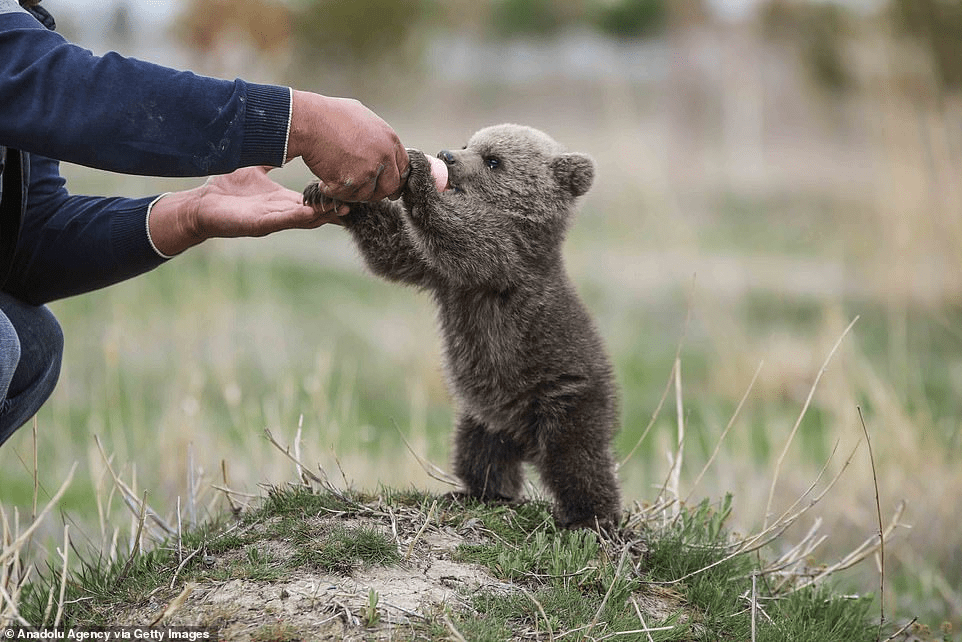
Feeding time: Baby bear ‘Hakvan’ is pictured feeding from a milk bottle by an officer at a rehabilition center in Van, Turkey
Thirstier than the average bear! Adorable orphan cub guzzles milk from a bottle at Turkish rescue centre after he was found wandering alone in the wilderness without his mother
Bear cub ‘Hakvan’ was found wandering the wilderness without his mother near the Turkish border with Iraq
Photos show a rescue centre finding the baby bear and nursing him back to health with a small milk bottle
Turkish rescue workers brought the cub to Van for treatment, feeding Hakvan while under supervision
An adorable bear cub was found lost in the wilderness without his mother by a Turkish rescue centre in Hakkari, a nearby province on the Turkish border with Iraq.
The baby bear, called ‘Hakvan’, is pictured guzzling from a milk bottle after his rescue. Photos show him being nursed back to health after his solo adventure.
‘We will apply a special rehabilitation process for him but he will be a longtime guest here,’ Aslan said. It is not clear at what point the rescue centre will attempt to reintroduce Harkvan back into the wild
After being separated from its mother in Hakkari, Turkish rescue workers brought the bear cub to Van for treatment, feeding Hakvan every three hours and keeping him under supervision.
War exposes many truths, the brutal and the valiant. The war in Ukraine is powerfully and painfully magnifying the interconnectedness of human and animal lives, and, mercifully, our unrelenting commitment to acting with love, even in the face of lethal danger.
Domesticated animals are affected by almost every human decision and those involving violence most of all, whether they’re hidden in factory farms or captured by the lenses of photographers and broadcast globally.
An animal keeper comforts an anxious elephant at the Kiev Zoo in Kyiv, Ukraine, as a large convoy of Russian tanks and other vehicles threatened the capital. (AP Photo/Emilio Morenatti)
In Ukraine, they are exhibiting feelings of intense fear, pain and confusion. They apparently don’t understand why their worlds are being turned upside down.
A woman named Alisa fled Kyiv on foot with her mother, sister, children and two dogs — including an elderly German Shepherd named Pulya — and shared her experience with The Guardian.
“My dog is 12 and a half and she struggled to walk and fell down every kilometre or so and couldn’t stand up again. I stopped cars and asked for help but everyone refused; they advised us to leave the dogs. But our dogs are part of our family. My dog has experienced all the happy and sad moments with us. Mum’s dog is all she has left of her former life. So my husband, at times, carried our dog on his shoulders.”
Alisa’s husband carrying Pulya, their 12-and-a-half-year-old dog, to the border with Poland.
My own family includes rescued German Shepherds, and the images of this 80-pound, grey-muzzled dog being carried to Poland so she would survive gripped my heart. We would do the same for our dogs. We won’t have to, and for that we are deeply grateful. But no one should have to.
Horses are similarly let loose when natural disasters, like forest forest, tear through landscapes. We can anticipate and prepare for some emergencies. Others, like sudden invasions, we cannot as easily plan for — but we can respond in kind.
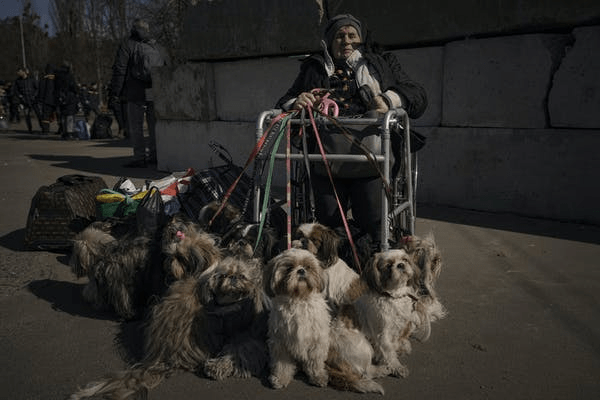
Antonina, 84, sits in a wheelchair after being evacuated along with her 12 dogs from Irpin, at a triage point in Kyiv, Ukraine, on March 11, 2022. (AP Photo/Vadim Ghirda)
The real extent of the damage remains to be seen, but the effects will be wide-reaching. As farms and shelters run out of food, water and workers, or lose electricity, untold numbers of animals will suffer and die, quickly or very slowly.
We are all connected, within and across borders, within and across species. Ukrainians who remain and are defending the lives of others demonstrate profound bravery that resides deep in the human spirit.
Anastasiia Yalanskaya, a 26-year-old woman who refused to leave Kyiv, was killed while delivering food to an animal shelter that had been without food for three days. Another animal advocate, Natasha Derkach, was killed as she worked to save animals in Dnipro, a city under siege from heavy shelling.
There are many more victims. Ukrainians are losing their lives defending animals.
A week before the Russian invasion began on Feb. 24, 2022, I was contacted by a colleague to assist a Ukrainian city hoping to create the country’s first animal cruelty unit. My colleague later received a powerful message from an animal advocate inside Ukraine who was afraid they might never speak again.
This war has laid bare the violence of abusive men who terrorize people and animals. It has demonstrated what losing your freedom really looks like.
But the dedication Ukrainian people have shown to animals reveals that even in the most dangerous times, the human capacity for cruelty is rivalled only by our ability to be courageous and compassionate. We can be more than simply human. We can be truly humane.
See the many photographs associated with this article by clicking on:
Animal rights activists marched on Sunday April 10, 2022 in Havana. Photo: Pedro Sosa Tabio.
“The majority of us here are independent protectors and we seek to raise people’s awareness about looking after animals.”
By Pedro Sosa Tabio
HAVANA TIMES – On Sunday 10th April, Dog Day in Cuba, dozens of people met outside the entrance to Havana’s Colon Cemetery to go on a pilgrimage to Jeannette Ryder’s grave, a US philanthropist living on the island who dedicated herself to looking after plants, children and especially animals.
“The majority of us here are independent protectors and we seek to pay tribute to Jeannette Ryder’s great work, to our own work and to raise people’s awareness about looking after animals,” Gilda Arencibia, an animal rights advocate for many years, said. “We have a lot of love for animals, especially the animals in our country, who have always been unprotected and abused.”
A few days ago, a cat was thrown into the ring during a show at the Rancho Boyeros Fairground, so people could chase it, lasso and beat it. Photos went viral on social media. As did the animal rights community’s outrage. Days later, it was reported that the people responsible were fined 1500 and 3000 Cuban pesos.
“The solutions they give us are fictitious, a simulation. As far as I understand, Decree-Law (No.31/2021 of Animal Protection) doesn’t do absolutely anything to protect animals and animal rights advocates, who are unprotected. There is no law that protects us,” animal rights activist Saily Maria Garcia said.
The cat in the ring incident was the main reason for animal rights advocates meeting at Colon Cemetery, holding signs against animal abuse and wearing orange clothes, the color of this cause.
The idea to march isn’t new, but there were different efforts to quell it this year.
A grave’s symbolism
Jeannette Ryder’s grave displays a statue of the lady’s body lying down with a dog laying at her feet. Rinti was her pet and the story goes that when she passed away, her dog laid in front of her grave and also perished, refusing to eat and drink.
This grave is a symbol for animal rights advocates, which is why it is the final destination for the pilgrimage. They gather around the grave. They fill the edges with different kinds of flowers and cover the grave with a Cuban flag.
They walk past Maria, who receives applause from the whole crowd. Maria is a short and wrinkled old woman, with white hair. They ask her how long she’s been working with animals. Maria remembers being in the cemetery for years, when she was called to look after a dog that had been bitten by rats. Then, there was another dog with scabies. Somebody from the crowd corrects her: her work dates back a lot further, she’s been looking after animals for many years and is one of the founders of today’s animal protection movement in Cuba. Maria nods and says she has photos of that dog’s face full of scabies. She’s only interested in talking about the dog, about how much the dog needed her help.
There are lots of people like Maria taking part in the short pilgrimage, who dedicate themselves to looking after animals, treating them, rescuing them from precarious conditions, looking for families to adopt them…
“Patricia, who isn’t here today, was summoned to a police station yesterday, even though she hadn’t committed a crime, has never had run-ins with the Law, has always given her body and soul to animals and nobody has ever knocked on her door to give her a plate of food,” animal rights activist Freddie Filo tells the crowd. “It’s sad that she isn’t here on a day like this. She is always with us here. She also founded this.”
Behind the group, on the other side of the passageway that separates one block of graves from the next, several State Security agents dressed as civilians supervised the march. The pilgrimage is a new reason for them to deploy their well-known popular “control” tactics.
Animal rights advocates gathered at Jeannette Ryder’s grave. Photo: Pedro Sosa Tabio.
23rd and F Streets
The call for the Cuban pilgrimage for Dog Day was spread on social media with a poster. The poster had a photo of a puppy and encouraged people to meet on April 10th, at 10 AM, in the park on 23rd and F Streets, at the beginning of the normal route to the cemetery.
Days before the scheduled date, some animal rights activists: Patricia Gonzalez, Aylin Sardiña and Betty Batista Romero, were summoned by the police to prevent them from taking part in the event.
“Second Lieutenant Camila and another official showed up at my door around 10:30 PM, to ask me what I’d be doing tomorrow. I would like to take part in the pilgrimage and raise my voice against animal abuse (…), but sadly, I’ve been threatened with charges of sedition if I decide to go. She made this very clear in the subpoena she gave me the day before yesterday, but she believed she needed to warn me again,” Batista Romero wrote on his Facebook page.
On Sunday April 10th, at about 9 AM, there were around four people wearing orange clothes and with their chihuahuas in the park on 23rd and F Streets.
Approximately five minutes later, a stout and grey-haired man, wearing trousers and a checked shirt, told them they’d have to leave. They requested an explanation and he explained that the pilgrimage hadn’t been banned, but that it could only take place within the cemetery’s bounds. The small group agreed to leave.
Susana Bisbe confirmed this on her social media when she informed animal rights advocates that State Security wouldn’t let them begin the march in the park on 23rd and F Streets and that they all had to head to the cemetery.
Hours before the pilgrimage, the Government announced the call for an animal protection fair in different Havana municipalities, on social media. The coincidence with the date and time of the march made some activists suspicious of this government initiative.
What are they scared of?
The first pilgrimage in Cuba for Dog Day was in 1994, from Jeannette Ryder’s grave to G Street in Vedado. However, the 2019 pilgrimage was the most important when hundreds of people took part in a march authorized – and not summoned – by the capital’s government, from Parque Quijote, on 23rd and J Streets, to the cemetery.
In addition to having had a greater turnout than this year, slogans against animal abuse were shouted along the whole way and the police were even present, cutting off streets busy with traffic so that the crowd could pass by.
However, the government’s negative response to similar initiatives in other provinces, suggests that the “authorization” in 2019, could have been a mistake.
What lessons does the animal rights march on April 7th teach Cubans?
The march on April 7th taught many lessons that can be used by those who believe you can legitimately fight for your rights in Cuba or by those who want to expose inconsistencies in Socialist Rule of Law.
Even though the right to protest is recognized in Article 56 of the Constitution, very few initiatives called independently of the Government have been authorized. Others were repressed by police authorities or criminalized when they did finally take place.
On May 11th 2019, Cuba’s LGBTI community held its own march against homophobia and transphobia, after the traditional conga normally held this time of year was canceled. During the peaceful parade, many participants were repressed and arrested by the police, who tried to stop the protest.
On November 27th 2020, a great military operation cut off streets surrounding the Ministry of Culture, where approximately 300 young people held a sit-in to protest the repression members of the San Isidro Movement had suffered. Even though there weren’t any clashes between repressive forces and protestors, the peaceful protest and its leaders were demonized by state-controlled media. Then, some of the participants were interrogated, harassed, and threatened by State Security.
Over a thousand people were sanctioned or sentenced to prison for up to 20 years because of the July 11th and 12th 2021 protests, charged with theft, public disorder, incitement, contempt and sedition.
In October 2021, the Cuban Government denied authorization for a “Peaceful Protest for Change”, arguing that “the reasons for the protest held no legitimacy.” Days later, its main organizers – who created the Archipielago platform – were victims of police harassment and threats, interrogations, slander campaigns in the media and hate crimes.
Against such a backdrop, the Government seems to be intent on stopping spontaneous or programmed protests in Cuban society. However, the pilgrimage against animal abuse took place, even if it was regulated and policed.
One of the reasons for the animal rights advocates’ march was the abuse of a cat during a rodeo show in Boyeros. Photo: Pedro Sosa Tabio.
Many told Belfast Live they are delighted for them, and hope they find an elephant sanctuary where they can “roam freely and enjoy the company of other elephants” while others said they’ll be sad to see them go.
“I hope they find a retirement home where they can live out a comfortable life,” one person commented.
Another added: “Hopefully, they’ll send them to the Tennessee Elephant Sanctuary where they can live out their lives wandering the hills of Tennessee, swimming in a lake and just being elephants.”
“Sad but happy to see the elephants go,” said a third.
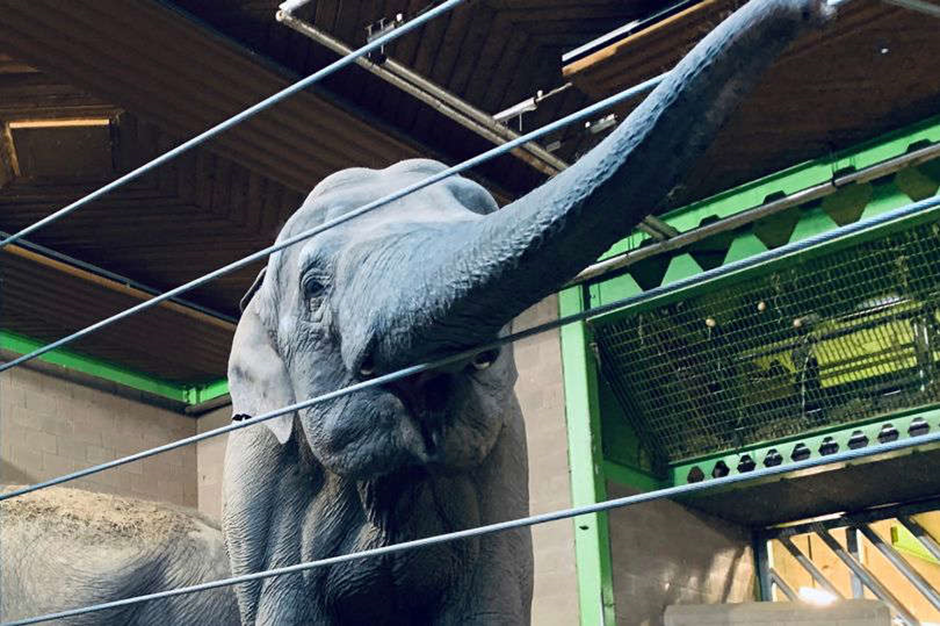
The size of the elephant enclosure in Belfast was also a recurring theme, with one person telling us “the elephants were the ones that confirmed my decision to never go back – they looked broken”.
“A zoo only serves its purpose if the animals are suitable for the space they are in and not to mention climate and resources to look after them well,” another comment read.
While another said in their opinion “the area they are kept in is far too small, no pool for them to bathe, and very little interaction with other animals. They are an intelligent animal, its cruel keeping them in a shoe box confinement”.
Others praised the zoo for rescuing Yhetto and Dhunja and stopping them from “being abused”.
A zoo supporter said: “Do people not understand these animals where abused most of their lives and due to the trauma they suffered it will always cause them to sway and shuffle… Why not let the poor girls live the rest of their lives at our zoo!”
“Those that work there are passionate about animal welfare – I trust their decisions are in the best interest of the animals,” added another.
“I just hope wherever they are moved to has a larger enclosure for them and more enrichment. It is so depressing seeing them at Belfast zoo. Yes, it is a sanctuary compared to where they were before, but still totally inadequate.”
A Belfast City Council spokesperson said they meet all animal welfare standards and have provided the highest level of care for Yhetto and Dhunja who they took in as “the zoo has provided a sanctuary for older non-breeding female elephants in recent years”.
“The very difficult decision has been made to phase out elephants from the zoo’s future animal collection plan,” they added.
“Dhunja and Yhetto will be transferred together to another zoo in future, and we are working closely with the European Association of Zoos and Aquaria to identify the best possible new home for them.”
An Arizona man is facing animal cruelty charges after police found he had shoved 183 animals into a freezer, including some that reportedly were still alive.
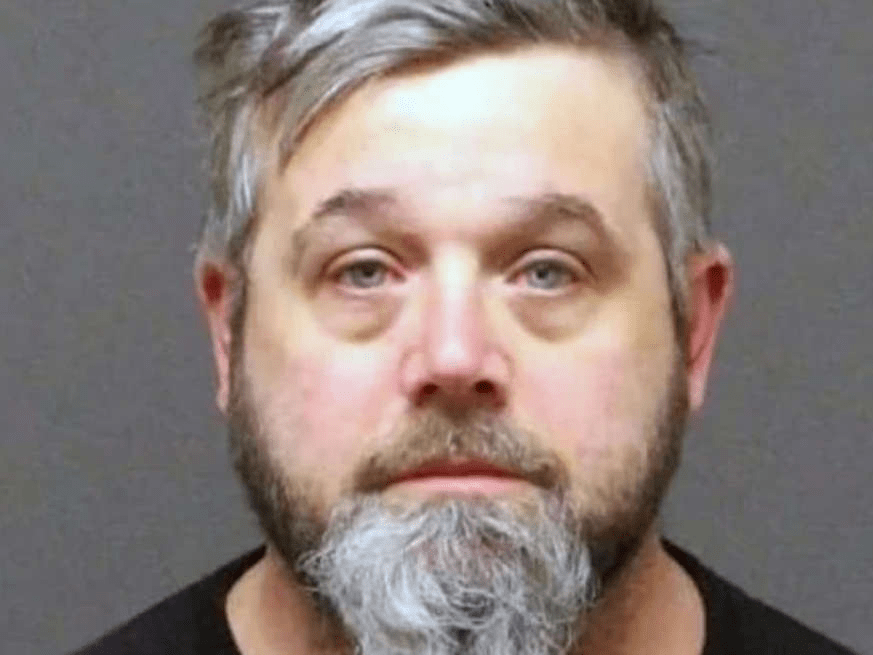
Michael Patrick Turland, 43, allegedly filled the cooler with dead dogs, rabbits, birds, lizards, turtles, mice and other animals, according to The Associated Press.
Mohave County deputies found the animals on 3 April during an animal welfare check. A woman called the sheriff’s office and complained that she had lent Mr Turland her snakes so that he could breed them, and that he never gave them back. She told them the man then disappeared, and several months later that she received a call from the owner of the property where Mr Turland had been renting. The owner found the freezer full of animals and alerted the original snake owner.
The woman who owned the snake then called the deputies to make the animal welfare check.
The sheriff’s office said the animals were kept in a “large-sized chest freezer” and noted that the positioning of the creatures suggested that some were likely alive when they entered the freezer.
Mr Turland was arrested on Wednesday after deputies returned to the property. The sheriff’s office has not released a motive for the alleged crimes, but noted that its investigation is ongoing. Deputies are currently on the hunt for his wife, Brooklyn Beck, to question her further.
“When interviewed, Turland eventually admitted to placing some of the animals in the freezer when they were still alive,” the deputies said in a statement.
Ultimately, Mr Turland was charged with 94 counts of animal cruelty. He is currently being held at the Mohave County Adult Detention Facility in Kingman.
A new report shows that macaques and a number of other animals are being exploited in the tourist industry in Vietnam. Credit: Adobe Stock
Despite government intervention, more needs to be done to protect animals across Asia, the report stresses
A new investigation has uncovered abuse at several circuses and amusement parks in Vietnam.
Hong Kong-based animal rights nonprofit Animals Asia has released a new report stating that hundreds of animals are being exploited in these facilities, where they are housed in inadequate enclosures and exhibit stress-induced behaviours.
Animals were found underweight, rocking, self-harming, cowering, subjected to loud noises and bright lights, and forced to perform tricks.
The findings, published in Animals Asia’s Vietnam Circus Report, also state that endangered species—including Asiatic black bears, gibbons, Siamese crocodiles, and Asian elephants—are being kept in circuses and amusement parks, despite the fact that this is against Vietnamese law. Macaques were the most common circus animal discovered by Animals Asia.
The report also highlights illegal wildlife trafficking concerns. Between 2008 and 2019, records show that 38 bottlenose dolphins were imported into Vietnam, 33 of which were caught from the wild in Japan. During the investigation, only four facilities were found hosting dolphin circus shows. This means that several of the dolphins brought into the country previously have already died.
Vietnam isn’t alone. Around the world, a number of tourist attractions make money from abusing animals. In the US, for example, SeaWorld is under constant scrutiny regarding its treatment of orcas, dolphins, and other marine animals in its parks.
The country is also home to more than 3,000 roadside zoos. These are renowned for housing animals like tigers and chimpanzees in concrete enclosures and promoting dangerous interactions with customers.
Stopping animal exploitation in Vietnam
In Asia, thousands of animals live in zoos and parks, all with ranging standards of animal welfare.
Animals Asia acknowledges that the Vietnamese government is trying to crack down on facilities that exploit animals. Its last report on animal welfare in the country was in 2017. Since then, authorities have started to take action. But more needs to be done.
Dave Neale, the director of Animals Asia, said in a statement: “Since our last report in 2017, our public outreach campaigns, discussions with the authorities and managers of circus facilities, some of them have stopped operating, and many of them have stopped using animals in their shows. But we are still far from ending these performances for good.”
“We call upon the authorities in Vietnam to develop laws that protect animals. To give support to organisations that rescue and rehabilitate these animals, and the circus operators to diversify their business away from using animals,” Neale added.
“We appeal to the public not to support facilities that continue to abuse animals for entertainment.”
This is the heart-melting moment a tiny pup gasps for air after being pulled out of the rubble of a bombed-out home in eastern Ukraine.
Its battle-scarred 77-year-old owner was elated to be reunited with his brave best friend.
Video shows the aftermath of a Russian shell attack on homes in the village of Mikhailovka, Donetsk region.
The grandfather whose house was destroyed made a lucky escape and was able to stand, though he looked worse for wear.
Yet his thoughts immediately turned to the dog, who was missing in the wreckage.
Police quickly arrived after the shelling ended and – after hearing a timid squeal from below piles of concrete – began burrowing away at the rubble.
Below piles of broken rock, a tiny black dog covered in dust is struggling to breathe. But like his owner, it is miraculously still alive.
The dog’s master thanked Donetsk Regional Police officers for their speedy arrival and for rescuing the persistent pup.
He said: ‘Thanks to the boys for doing everything quickly and promptly here… Thanks a lot to them!’
Donetsk Regional Police confirmed the rescue and said they were more than happy to help the elderly man.
They said: ‘[He] was desperate to see his four-legged friend. Law enforcement officers did not give up hope of finding him.
‘The owner and his dog were given medical care. All is well with them.’
Local police added: ‘Russia’s war crimes have been documented. The occupier will be held accountable for every missile and projectile fired at civilians.”
Residents in the eastern Donetsk region are preparing for even more intense conflict as Russia redeploys soldiers who failed to take Kyiv to the country’s more vulnerable region.
Almost 50 days since Russia began its invasion of Ukraine, Putin’s forces have lost 19,800 men, according to the Ukrainian army.
Kyiv also claims Russia has lost 739 tanks, 1,964 armoured fighting vehicles, 358 artillery systems and 115 multiple launch rocket systems.
That is in addition to 64 destroyed anti-aircraft systems, 158 warplanes, 143 helicopters, 1,429 motor vehicles, seven vessels, 76 fuel tankers, 132 unmanned aerial vehicles, 25 special equipment units and four mobile SRBM systems.
Regards Mark
Watch the video of the rescue by clicking on this link:
The death of four horses at the Grand National has prompted calls for tougher safety measures during the race.
Solwara One was the first horse to die on Friday, before Elle Est Belle suffered a suspected heart attack on Saturday. Eclair Surf and Discorama then suffered fatal injuries during the main Grand National event.
Only 15 of the 40 horses that started the event, which has 30 fences, managed the finish the race, while 50-1 outsider Noble Yeats ended up as the winner.
Chris Luffingham, who is the director of external affairs at leading animal welfare charity the League Against Cruel Sports, believes not enough is being done to protect the horses.
‘This death toll is simply unacceptable and a blight on the horse racing industry,’ he said.
‘We need new safety measures to prioritise horse welfare and to bring about an end to this sickening spectacle.
‘We need a new independent, regulatory body which focuses purely on the welfare of the horse and ends the use of the whip and the cruelty and body count associated with the Grand National.’
The RSPCA said: ‘The death of any horse is always one too many so it is crucial that steps are taken to reduce the risk of such tragedies occurring.’
Emma Lavelle, who trained Eclair Surf, spoke about the decision to have the horse put down following his heavy fall at the third fence.
‘We were optimistic when he left the track, but during the night he just got more and more wobbly and as he got more distressed it wasn’t the right thing to do to keep going,’ said Lavelle.
‘He was in the right place for those decisions to be made and the team both at the races and at the hospital were great.
‘You kind of sit there and think of the ifs and buts and why nots, but you can’t sit and think that.
‘It’s a real gutter for everybody – his owners and the team. He was an exciting horse for the future, but what can you say?’
Meanwhile, Paul Nolan’s horse, Discorama, was pulled up during the race due to a pelvic injury and was put to sleep on welfare grounds after being assessed at Aintree’s veterinary treatment facility.
‘I’m devastated. But that is racing and you have to accept those things,’ Nolan said.
‘He gave us some great days, but all we can do is reflect on the couple of happy days and what he has done for us.
‘It is just devastating for the owners and the yard, and it it is just one of those awful things, but it is part of racing and that is what it is.
‘Unfortunately I could not attend. My father is sick at home and we had to come back from Aintree, so we are with him now.
‘He’s not good. It puts everything into perspective. We did not tell him the horse was fatally injured, [just] that he pulled muscles and was home – there are certain things you have to say to soften the blow.’
The British Horseracing Authority has made changes to improve the safety at the Grand National, including making fences more forgiving and levelling off the landing site after each fence.
‘Welfare and safety is an ever-evolving commitment and the BHA works constantly alongside our racecourses to further improve the sport’s safety record and reduce avoidable risk,’ said James Given, director of equine health and welfare at the BHA.
‘Every incident this week will be reviewed, and this information will then build on the significant evidence and evaluation that took place as part of the 2011-12 review, and in subsequent years. Should any further trends be identified that might be linked to increased risk then we are able to act on them.’












 World Animals Voice