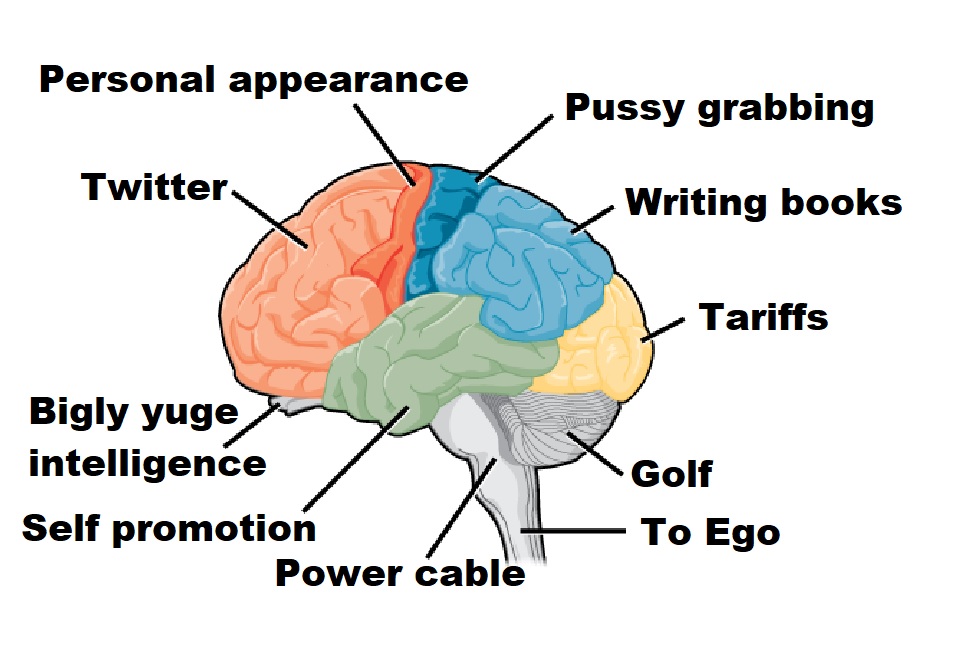
WAV Comment: So now the ex, one off President is also a Neurologist as well as a golf player. Much could be said about him and ‘brain cells’, or a lack of; but we will keep our opinions to ourselves about this.
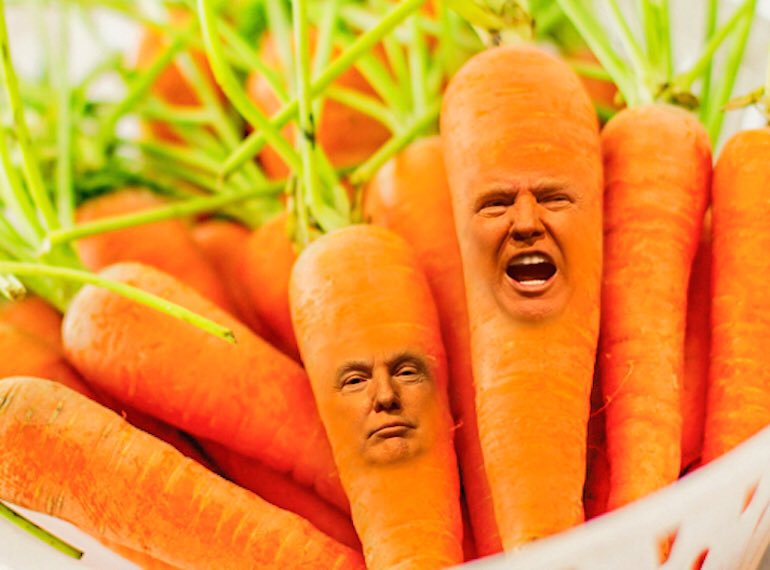
Trump – going vegan loses brain cells:
‘If I lose one brain cell, we’re f***ed’: What Trump said when Stephanie Grisham suggested he go vegan for charity because it ‘screws with body chemistry’
Former President Donald Trump apparently thinks a meat-free diet impairs a person’s cognitive function, ex-White House Press Secretary Stephanie Grisham claims in an excerpt from her new tell-all book published Friday.
He told her that switching to a vegan diet ‘messes with your body chemistry’ and feared it would make him lose ‘brain cells.’
Great American Food
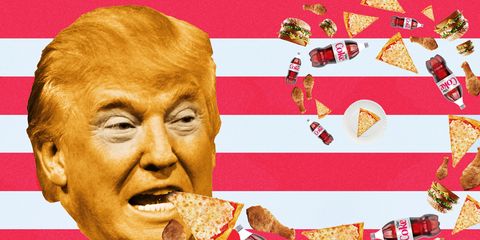
In 2019 he was widely mocked for providing the Clemson University Tigers NCAA team with ‘great American food’ to celebrate their victory – which included McDonalds, Wendy’s and Domino’s served with formal White House silverware.
He ran into trouble over his diet a short while later in 2020, during a February trip to India. Vegetarian Prime Minister Modi was planning to serve a meat-free dinner.
One White House source told CNN at the time, ‘I have never seen him eat a vegetable.’
Read it all; Dim Wit vegans may have cognitive problems with clicking on the following link; but please try:
HIDDEN: Animals in the Anthropocene is an unflinching book of photography documenting our relationship with non-human animals in the 21st century, as depicted through the lenses of 40 award-winning photojournalists.
It focuses on the invisible animals in our lives: those with whom we have a close relationship and yet fail to see. They are the animals we eat and the animals we wear. They are the animals used in research and for entertainment, as well as the animals we sacrifice in the name of tradition and religion.
The stories within its pages are revelatory and brutal.
The Anthropocene is the proposed name for the current geological epoch. In this era, human activity is the dominant influence on climate, the environment, and all life on earth. As we enter a new decade, an estimated 80 billion land animals continue to be used and consumed by humans each year. The majority of these animals are raised and killed within industrial agricultural systems. Fish and other marine life are measured by tonnes.
HIDDEN adopts an unashamedly pro-animal perspective, yet also understands the important role community leaders, educators, policy makers and activists play in determining a future relationship with animals based upon a compassionate and humane co-existence.
WAV Comment – over many decades campaigning for the rights of animals, I have seen my fair share of disturbing things. Sadly, this expose by PeTA at one of the Nippon Ham facilities in Japan is just another very disturbing investigation which has revealed the horrendous suffering of pigs.
I am providing information and links below; including video footage.
This is disgusting, the human filth that undertakes this cruelty on a daily basis cannot be classified as ‘normal’ human beings; they are the kind that dominated in prisoner camps in the past. This campaign needs your full support and actions. Please do it.
Crosspost please to as many contacts as you can;
Regards Mark
Piglets Slammed Into Concrete, Left to Die at Nippon Ham Farm in Japan
A new PETA video exposé of Japan’s leading pork producer, Nippon Ham, reveals that piglets and their mothers endure horrific abuse. While the company claims to care about human happiness and the “joy of eating,” it’s obviously not concerned about animal welfare. Pigs who are raised and killed for food don’t experience joy or anything else that would make their lives worth living.
Their lives are full of pain and suffering. See for yourself:
Very disturbing Video footage – But Must Be Watched:
Workers at Nippon Ham grab piglets by their sensitive ears and toss them around like inanimate objects.
Those who aren’t considered “profitable,” because they’re too small or sick, are thrown out like garbage.
Workers typically kill unwanted piglets by swinging them in the air and bashing their heads on the concrete floor or by injecting them in the heart with disinfectant. One piglet writhed in agony for five minutes after a worker poisoned him this way.
Another languished for an hour and finally died after a worker bashed his head against the concrete floor.
Piglets at Nippon Ham are taken away from their mothers when they’re as young as 22 days old, just as they are on most pig farms. Workers castrate them and chop their tails off without any pain relievers. A worker was caught on camera cutting into a young pig’s scrotum and yanking out his testicles with his fingers.
Suffering and Nowhere to Turn
Mother pigs, or sows, are forced to spend most of their miserable lives crammed inside metal crates that are so small they can’t even turn around. Their muscles atrophy and they’re constantly stiff and sore. They have no choice but to urinate, defecate, eat, and sleep all in the same cramped crate. Workers were even seen beating them with a heavy piece of the metal frame.
The traumatized sows had to endure the sight of their own piglets’ suffering right in front of them. Their babies squealed and thrashed violently while workers crudely castrated them or cut off their tails, and there was nothing that the mother pigs could do.
Born Into a Life of Abuse
Thousands of sows are confined and repeatedly raped via artificial insemination. They deliver litter after litter of piglets, who are always torn away from them to be raised for meat or breeding. When sows who aren’t forced to live on filthy factory farms are about to give birth, they make a nest in the dirt and cover it with soft grass and leaves. But at Nippon Ham, pregnant pigs have to stand on uncomfortable metal grates. After several years of round-the-clock imprisonment and frequent inseminations and pregnancies, they become exhausted and they’re sent to slaughter.
You Can Help Stop Cruelty to Pigs
Cruelty is pervasive in the meat industry, which treats animals as commodities rather than as living, feeling beings. There’s no need for anyone to eat ham, bacon, sausage, or any other animal-based foods—tasty vegan options are available at most restaurants, stores, and cafeterias today. It’s easier than ever to leave pigs and other animals off your plate.
Will you help pigs by refusing to buy pork and other animal-derived foods?
I watched the PETA video and it truly made me sick to my stomach. If it is within my power, I WILL NOT buy any Nippon Ham product. The people treating those poor pigs like that should be fired.
Thank you for your comment. – yes, disgusting ! – WAV
We reported on the then President elect, Mr Moon; back in 2017. You can see some of our articles that were published at the time on ‘Serbian Animals Voice’.
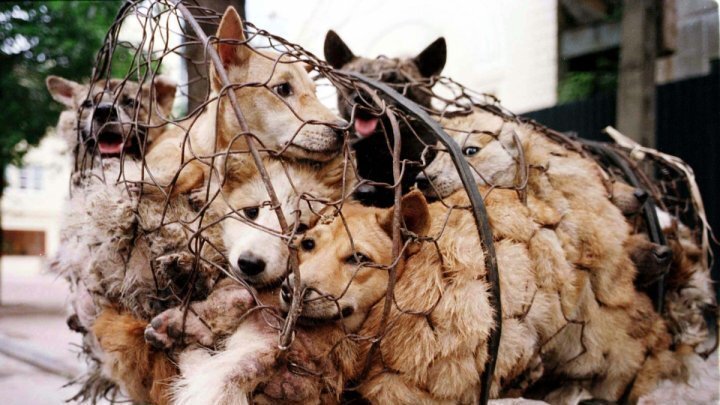
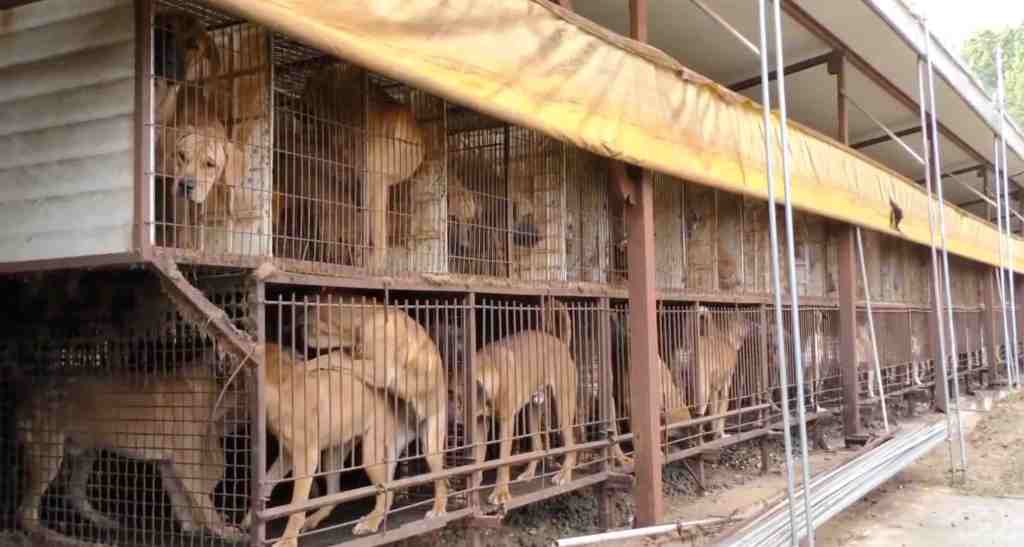
So where are we now ? – surprisingly, 2022 sees the election of a new President to South Korea; and suddenly, the dog farm / dog meat trade rears its head yet again. Mr. Moon, the man who was elected as President with so many promises for the dog meat trade back in 2017 is NOT allowed to run again for President under the South Korean constitution.
We remember, and publish here, pictures of the then to be President Moon informing us all that the dog meat trade was going to be a priority issue. We remember all the promises of things going to be done, and the pictures of Mr Moon cuddling up to dogs; who he alleged he was going to protect.
Well, to be basic, Moon has not really done much at all in his presidency. Now we are rolling along to new elections in March 2022. The issue of the dog meat trade is suddenly rearing its campaign head again.
We hope that the next elected president will do a great deal better than Mr. Moon; who we see as being all puff and no wind when it came down to reality. We greatly hope that the coming months will see legislation introduced which will put an end to South Korean dog meat farms for once and for all. We, and many other welfare groups will never let this abhorrent issue die; an issue which could have been resolved years ago had the president lived up to his promises of doing something about the trade.
For the first time in a long time we are hearing rumblings of changes in the dog meat trade. We welcome this, but based on past election promises, we are taking nothing for granted; we have been duped with false hopes and promises before.
Lets see what the next few months actually bring !
Regards Mark
President Moon kisses a dog – and gives election promises that were never kept.
Under the South Korean constitution, the president is restricted to a single five-year term in office, meaning the incumbent president Moon Jae-in is ineligible to run for a second term.
The 2022 election will determine the office of the President of the Republic of Korea. It is expected to be held by 9 March 2022.
S.Korea’s Moon hints at dog meat ban amid debate over animal rights
SEOUL, Sept 27 (Reuters) – South Korea’s President Moon Jae-in said on Monday there might be a need to prohibit dog meat consumption amid debate over the controversial practice and growing awareness of animal rights.
While no longer as common as before, dog meat is eaten mainly by older people and is served in some restaurants and can be bought at specific markets.
Moon made the remarks after being briefed by Prime Minister Kim Boo-kyum on efforts to improve the handling of abandoned animals and a mandatory registration system for dogs. read more
“After the briefing, he said time has come to carefully consider imposing a dog meat ban,” Moon’s spokeswoman Park Kyung-mee said in a statement.
It was the first time that Moon raised a ban, which is likely to give fresh momentum to debate over whether to curtail the practice.
To boost their popularity, several presidential hopefuls have pledged to ban dog meat in recent weeks, especially as dogs have become popular as pets and advocacy groups have urged South Korea to close down restaurants and markets selling dog meat.
Lee Jae-myung, governor of the country’s most populous province of Gyeonggi and a leading presidential contender from Moon’s party, has vowed to push for a ban through social consensus.
But Yoon Seok-youl, an opposition frontrunner, has said it was a matter of people’s personal choice.
A poll commissioned by animal welfare group Aware released this month said 78% of respondents believed the production and sale of dog and cat meat should be prohibited and 49% supported a consumption ban.
But, another survey by polling firm Realmeter found people were divided over whether the government should ban eating dog meat, though 59% supported legal restrictions on dog slaughter for human consumption.
Dog meat sellers have insisted on the right to their occupation, saying their livelihoods are at risk.
Reporting by Hyonhee Shin; Editing by Christian Schmollinger
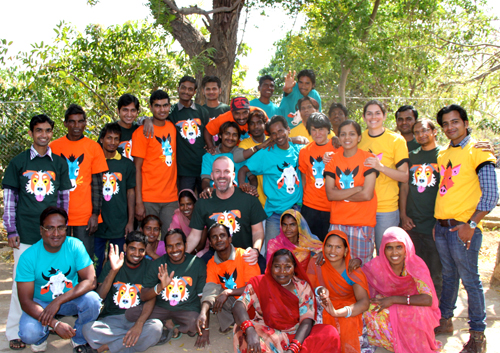
The expression “rain or shine” gets a whole new meaning in the intense weather of Rajasthan. We’re experiencing a late monsoon, and we want to take a moment to thank our incredibly cheerful, often drenched, staff. Our kennels and animal treatment areas are protected, but because we have nearly year-round sun and extreme heat most areas are outside and do get muddy when it rains. The smiling faces we see, with rain sometimes soaking right through their rain gear, not only boosts the spirits of the other staff, but it affects the animals too with the loving encouragement they need. Thank you for appreciating our tenderhearted and stalwart crew.
Elvis’s sadness lifted as he healed,and then he started singing!
Precious Elvis, a teenaged puppy, screamed in pain when his rescuers tried to lift him.
His feet had been run over by a vehicle, andone paw was crushed. His toes were splayed and swollen to twice their normal size. Standing was too excruciating to bear. Had he been an older dog with more brittle bones, Elvis might have been facing an amputation, but since puppy’s bones heal much faster than adults we decided it was worth trying to save his legs. We treated his wounds and wrapped his intensely painful feet in thick bandages, which we changed every day. The little guy was one of the most careful young patients we’ve ever had. He seemed determined to cause no fuss. But he was so inward we wondered if he was depressed. Then, when he’d progressed a bit on his healing journey, well, this boy burst out in song.
A wild piglet was seriously hurt with multiple puncture wounds from an animal attack. Even hours after her wounds were cleaned and bandaged, this young sweetheart trembled with fear. She would need incredible bravery, but snuggled deep into her blanket for the feeling of the comfort she had known sleeping with her siblings against her mother’s big body. Now she was all alone. Though she ate well, she was facing a long recovery, and she may have been significantly depressed. But someone very special was waiting for her, though none of us would have guessed.
Just one week after her admission, we rescued another little piglet with similar puncture wounds–a little boy piglet full of his own noisy squeals and twirls. As we treated his wound, we told him he was in for a beautiful surprise. As soon as we had secured his bandages, we delighted in introducing him to his new friend. Though they were a few weeks different in age, pigs are such social and emotional beings that no questions were asked! They bonded within minutes. We felt we could see their healing accelerate from the sheer joy in each other’s comfort and…play! Meet Luke and Leia, tumble-bunnies in action.
Mauled by a leopard,but Beesie’s love of life won!
We can only imagine that the leopard was interrupted, though no one saw the attack–maybe Beesie fought back too hard.
He was in utter shock for hours after the attack to his throat and chest. Residents from a nearby village hurried him to our hospital. Saving his life seemed an almost impossible task. But his strength was phenomenal, and the jaws of the leopard had closed on him just millimeters short of killing him. His astonished eyes stayed wide as adrenalin ran through his body long after arriving in our hospital.
A great amount of flesh had been simply taken, and there was insufficient skin remaining to stitch closed the wounds. We kept them clean and snuggly bandaged, and changed them every day for 2 months. To our amazement, this dignified boy completely healed. Meet Beesie today!
This sweet little baby was injured so seriously she couldn’t move or even really cry out in pain. Her mother and siblings seemed to sense something was wrong, and when our rescuers arrived, they were completely cooperative as they reached down and lifted up the limp little bundle.
When we cleaned her wound and bandaged her up, she started feeling much better and we were delighted to find she had a good appetite and was “all heart” when it came to healing. Within just 10 days her strength was completely restored and she could be reunited with her family again. We were so delighted by her great recovery.
How the cruel death of a little stray dog led to riots in 1900s Britain
Novelist campaigns for statue of terrier experimented on by scientists to regain its place in a London park
An animal in peril can inflame British public opinion like nothing else. Nearly 120 years ago, the fate of one small brown dog caused rioting in the streets of London, to say nothing of the protest marches to Trafalgar Square and questions asked in parliament.
Now the astonishing, little-known story – involving anti-vivisectionist campaigners, an eminent doctor, a legal battle and a controversial memorial statue in a park – is the subject of a new book and of a fresh campaign to honour the lowly terrier at the heart of it all.
An “affair” that made headlines and provoked disorder, but has since been forgotten, the Brown Dog story is a tale that has “obsessed” the imagination of first-time novelist Paula S Owen ever since she heard it.
“The book and the campaign really are a dream come true for me after all this time,” Owen said this weekend before the publication of Little Brown Dog, her fictionalised account of historic events. “I’ve been obsessed with this story for so long, it’s fantastic to know it has been told.”
The extraordinary row began with the public vivisection of a stray dog carried out in 1903 by Dr William Bayliss, a renowned physiologist who was also instrumental in the discovery of hormones. Operating alongside his brother-in-law, Professor Ernest Starling, Bayliss demonstrated the procedure to medical students at University College London, including a duo of undercover Swedish feminists and animal rights campaigners, Leisa Schartau and Louise Lind-af-Hageby. The operation, the women declared in their diary, was cruel and unnecessary, and the dog, which had been previously experimented on, had not been properly anaesthetised.
Months later, the campaigners recruited the help of a barrister Stephen Coleridge, a descendant of the Romantic poet Samuel Taylor Coleridge and secretary of the National Anti-Vivisection Society. He spoke out in public against Bayliss, prompting, first, an action for slander, and then one for libel, once the accusations of cruelty had been repeated in print.
The case quickly became a cause célèbre, discussed across the country, and when Coleridge eventually lost the case, Britain’s animal lovers were enraged. A fundraising drive resulted in the erection of a statue in Latchmere recreation ground in Battersea, south London, to commemorate the life of the stray dog. But, as Owen explains in a note at the end of her novel, in the 1900s the nation was not prepared to let a deceased dog lie.
The issue, she recounts, “became a lightning rod for continuing disturbances, riots, and rallies across London.
[The statue] was subjected to repeated attacks by outraged medical students. And was defended by the equally outraged working-class locals of Battersea, plus a cast list of feminists, suffragists and suffragettes, trade unionists, radical liberals and anarchists. The situation became a national talking point and was debated in parliament. The statue was protected, at great expense, day and night, by the police.”
Eventually the council acted, taking down the statue covertly at night. It has never been seen since.
In 1985, a bronze statue by Nicola Hicks, which commemorates the dog and the lost memorial, was unveiled in nearby Battersea Park. But on Sunday Owen is to visit the spot in Latchmere recreation ground where the original statue once stood to launch her campaign for a new monument to the terrier. She will put up a carefully re-created lightweight model.
“It’s incredible that the team who helped me have made something so realistic and 3D from a grainy old picture,” she said.
Owen, who is Welsh but lives in south London, has worked as a climate change campaigner and environmentalist. Her factual book about the Brent Spar controversy of 1995, when Greenpeace fought Shell’s plan to sink a decommissioned North Sea oil storage and loading platform in the Atlantic, is being adapted for a television series. And she sees a clear link between the animal protection story at the heart of her novel and her environmental work.
“This isn’t simply the tragic tale of one stray dog, appallingly treated and abused in a less enlightened age,” she has written. “Nor is the hysteria, violence and bewildering behaviour directed at a lump of stone and metal – so feared by authorities it drove them to steal and destroy it – the main focus of the novel.
“It’s more complicated than that. The whole sorry episode is an echo, a mirror, reflecting the endless injustices and evil carried out by humans on other species throughout history.”
Her novel is being published by Honno Press, a supporter of Welsh women’s writing for 35 years, and Owen said it keeps very close to the facts. “I have stayed true to events but I have changed the key characters a little. My surgeon is Bayling and my heroines are now British ≠ one upper class and one a working-class young woman from Wales.”
On Wednesday, when Owen launches her book and the new statue campaign, it will be the 115th anniversary of the day the original Brown Dog statue was unveiled to gathered celebrities, including Irish playwright George Bernard Shaw.
In the spirit of the words of Lena, Owen’s fictional heroine, who argues “our humanity is defined by how we treat, respect and nurture other species, not just our own kind”, the author now says she hopes her book will ask: “Can we say, hand on heart, we are any more ‘humane’ today than we were one hundred years ago?” This article was amended on 16 September 2021 to include reference to the 1985 memorial by Nicola Hicks that stands in Battersea Park.
Animal Liberation Queensland VimeoEven as a vegan for many years, I had not heard of this horror until recently. That this is an accepted method of “animal husbandry” is wretched, that it is concealed as “animal husbandry” is vile.
It has been relentlessly and successfully proven that if a human can devise a form of torturous confinement, causing abject pain and maximum suffering, apathetically and indifferently, and then provide the most harrowing and terrifying death, it has been achieved on animals.
If you participate in animal exploitation in any form (consumption, products, entertainment, clothing, etc.), you contribute to this hell that humans inflict on sentient creatures – like humans, cats, and dogs – effortlessly, willingly, and without condemnation.
“Welfare” laws are 100% meaningless to the victims who suffer for them, there is no part of “welfare” that includes suffering and violence, which occurs in ALL animal exploitation; even the most “cared-for” animal is used and then killed. Using terms like “welfare” and “humane” and “husbandry” to define exploitation requiring bodily control, intrusion, violation, and violent death (yes, killing any unwilling being is inherently violent absent suffering, defense) means those human-manufactured, self-soothing terms are for HUMANS and not the victims of them. If you care, you don’t exploit. SL
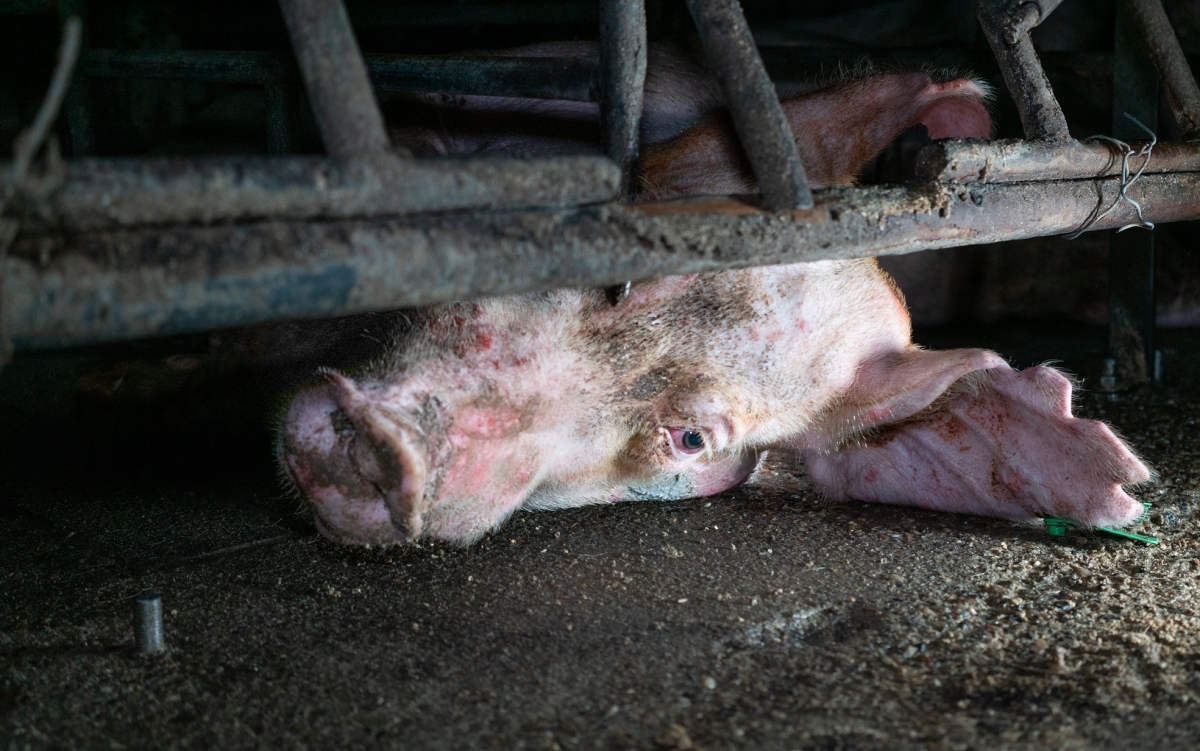
Footage released in January shows filthy conditions, violent abuse by workers, untreated wounds, and one boar left to slowly die over several days.
Authorities have failed to prosecute and boars continue to suffer in this facility every day.
This is the reality for animals that live within this broken system, but thanks to you, more and more people are becoming aware and turning away from animal agriculture.
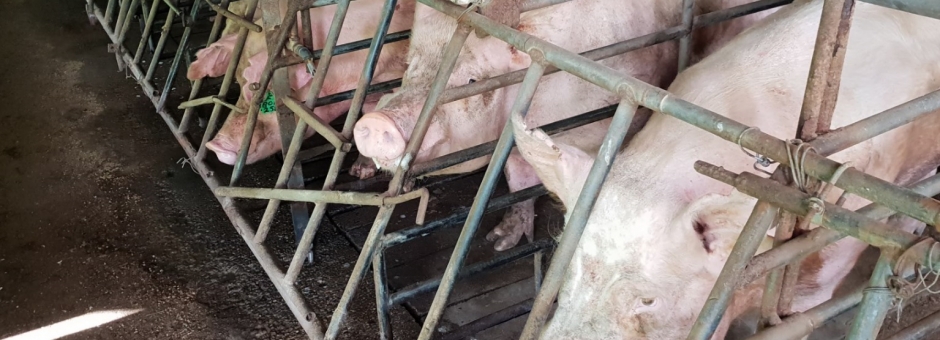
You’ve heard of sow stalls, but did you know about boar stalls?
In an unseen facet of pig farming, boars are kept in small stalls all their lives, only being released for a brief time for semen collection a couple of times a week.
Semen collection farms are a relatively unknown facet of the industry. At this facility, at least 20 boars are kept in tiny stalls – most are equivalent to sow stalls – with no room to turn around, and barely enough room to even lie down. They have no enrichment, they are left with untreated injuries, fed only the minimum food required to keep them alive and “useful”, and are routinely abused. The only time the boars leave their tiny, filthy stall is for semen collection.
When we received the footage our immediate concern was around the strong possibility of another boar suffering a similar fate to Boe from untreated illness and dying a slow painful death. We immediately informed the authorities with a complaint to RSPCA Qld and passed on the video footage. RSPCA Qld acted quickly and arranged a team of inspectors and vets from both RSPCA Qld and Biosecurity Qld to conduct a surprise inspection.
We understand at least one boar was euthanised that day. After that, the rest of the investigation was handed over to Biosecurity Qld. In Queensland, a Memorandum of Understanding exists in which all farmed animal issues are referred to Biosecurity Qld, which is part of the Queensland Department of Agriculture.
On receiving no further updates from Biosecurity Qld, and realising authorities were not taking this seriously, we released the footage through two videos.
First, on 6 March, Animal Liberation Queensland & Animal Liberation (NSW) released Boe’s story. The public reacted and shared Boe’s story resulting in more than 630,000 views on Facebook.
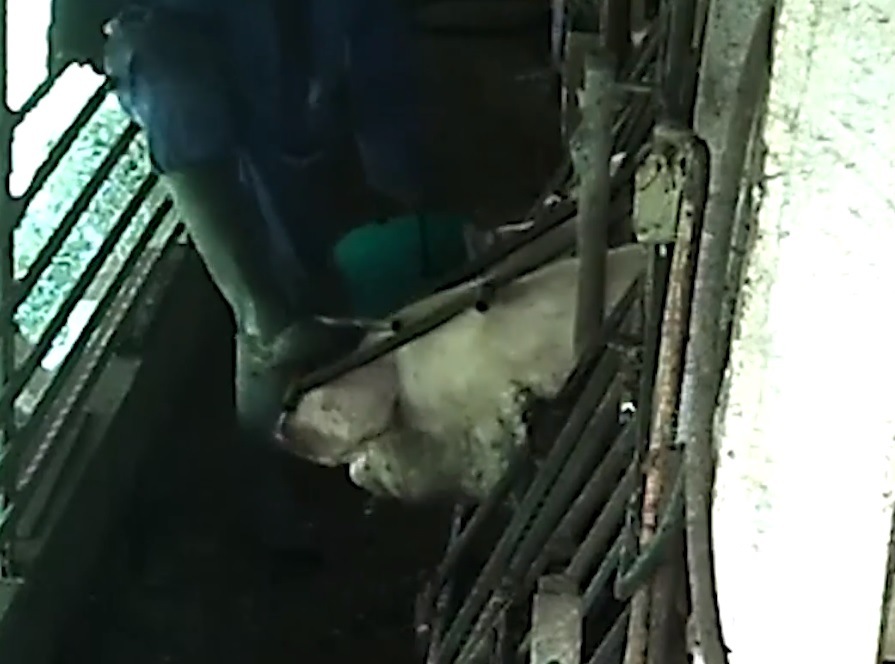
On 11 March we released the second video documenting further abuse and filthy conditions. Faeces and infestations were found throughout the facility. Video footage shows the worker kicking the boars, stomping and smashing metal bars against a boar’s head.
After numerous follow-ups with the Department, we learned that several “direction orders” were given to the owner to rectify issues they had found in their inspection. Biosecurity Queensland has confirmed that they have been back multiple times since the initial inspection and they are satisfied that all direction orders are being adhered to. In other words, it seems they will not be taking further action and have given this place the tick of approval. In practice, very little has changed for the boars that may spend the rest of their lives in these barren rusty metal cells. From the information we have, the direction orders related to the untreated wounds, and the maintenance or uncleanliness of the facility. There is nothing that will give any sense of relief to these boars and nothing that will stop others from meeting a similar fate to Boe.
Despite numerous requests for further information authorities would “not comment on the outcome of any investigations”. We can, unfortunately, conclude that no charges have been laid – despite numerous animal cruelty abuses outlined above that were documented by investigators, as well as issues during the inspection by authorities. If these boars were dogs, the owner and workers would now be facing court.
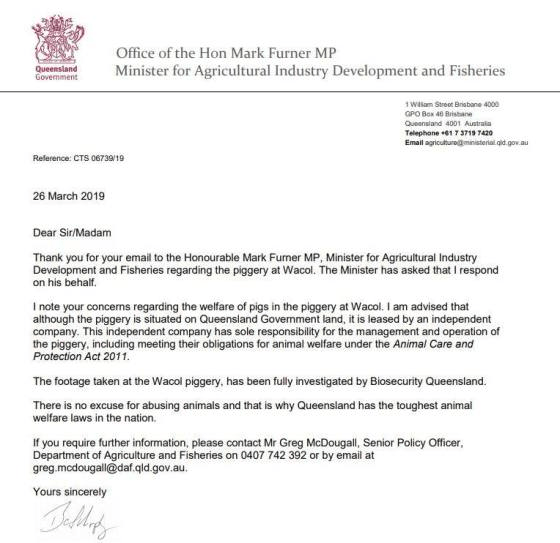
More than 3000 people sent emails of concern to the Minister for Agriculture. A couple of weeks later his office sent out a generic reply showing very little concern:.
Above: Minister’s office response to public concerns regarding lack of action taken by the Department.
Above: Injuries were left untreated.
We have also raised several conflicts of interests. Firstly, the land on which the Wacol pigs are incarcerated is leased from the Department of Agriculture – the very Department that is responsible for upholding animal welfare laws – is also taking money from this facility. The Minister failed to see any conflict here.
Secondly, this issue reminds us of the conflict of interest that exists for all animal agriculture. The Department of Agriculture in each state is responsible for growth and economic sustainability of the industry, but at the same time has the responsibility to enforce the Animal Care and Protection Act – and to police the very businesses it seeks to promote and grow. Both the Premier and Minister continue to ignore this very clear conflict of interest.
We are grateful to the investigators who took great risks to bring this cruelty to light. This is a thankless task, being confronted first hand with this cruelty. We greatly appreciate the thousands of you who complained to the Minister, made phone calls, and shared the video footage.
Sadly, this is the reality of millions of animals used and abused around the country every day. It is no wonder we see cruelty like this when the system is set up to fail these animals. As long as we have a society that supports, embraces and even celebrates animal agriculture, scenes like this will continue to be commonplace.
Know that this hasn’t all been for nothing. Hundreds of thousands of people have had their eyes opened to the reality of animal agriculture. For countless people, this was the final straw, and they have committed to going vegan. For others, this may be the start of their journey.
We can all help through our daily choices. By choosing vegan alternatives and never buying meat, dairy, eggs and other animal products, we take away the demand. Speak to your friends and family. Keep sharing footage and stories on social media. Keep writing and calling the Ministers, and speak to your local MP. Volunteer with or donate to animal advocacy groups.
Pressure on industry and government is growing every day, and every day the public is becoming more and more informed. Sadly, these industries of cruelty will not close down overnight, but with your help their days are numbered. We will keep fighting, and we will achieve animal liberation.
Take PETA’s Cruelty-Free Shopping Guide along with you next time you head to the store! The handy guide will help you find humane products at a glance. Order a FREE copyHERE
Searching for Cruelty-Free Cosmetics, Personal-Care Products, Vegan Products, or more? Click HERE to search.
Free PDF of Vegan & Cruelty-Free Products/Companies HERE
Want to do more than go vegan? Help others to do so! Click below for nominal, or no, fees to vegan literature that you can use to convince others that veganism is the only compassionate route to being an animal friend:
Over 1 billion fish are being raised on fish farms in the EU at any one time. These are undomesticated species quite new to being captive in production systems, which are often highly intensive and are themselves new technologies undergoing development.
EU aquaculture and animal welfare policies are pursuing fish welfare objectives, while a new regime governing EU financial support to fisheries and aquaculture has weakened the links between EU investment and EU policy objectives.
National aquaculture strategies and the implementation of EU financial support mechanisms need a smooth and coordinated implementation by Member States for subsidies to operate in support of policy initiatives and realise improvements in fish welfare.
When compared to terrestrial farm animals, scientists, producers, policy makers and animal advocates alike were late to understanding fishes’ needs and applying animal welfare approaches to fish in aquaculture. Some milestones were:
2005 the Council of Europe adopted guidelines for fish welfare during farming
2008 EFSA scientific opinion on fish sentience
2009 EFSA scientific opinion on welfare during husbandry and slaughter
2009 The OIE adopted standards for fish welfare during transport and at slaughter
2020 EU Platform on Animal Welfare adopts fish welfare guidelines
With the many EU and external research projects in the intervening years, we now have a wealth of knowledge for practical implementation. Initiatives from sectororganisations, thirdpartycertifiers, and policymakers seek to apply knowledge to provide a better life and death for farmed fish, improve product quality and resource efficiency, and better meet consumers’ expectations.
In May 2021 the European Commission published its newaquaculture strategy until 2030 which includes fish welfare priorities including developing best practice codes and guidelines, setting validated indicators, providing training, and supporting a transition to lower-trophic species.
The Farm to Fork Strategy previously committed the EU’s aquaculture policy to being a part of its animal welfare initiatives, and in August 2021 the inception impact assessment of the revision of all EU farm animal welfare legislation included specific options for fish welfare.
The European Maritime, Fisheries and Aquaculture Fund (EMFAF) 2021 – 2027 regulation seeks to simplify Member States’ administration and programming. One approach to simplification is to only reference high level Union priorities such as sustainable economies and communities, and to maintain weaker links between national and EU aquaculture policies.Opening up the fund for investments to meet legal obligations has also weakened the incentive to invest it now in policy areas marked as important next priorities.This is where the link between the spending of EU funds and the delivery of EU policy is weakened.
Maintained from the previous regulation is the requirement that financial support is consistent with Member States’ own multiannual national strategic plans, and those plans must themselves use the EU’s aquaculture strategy as their basis. However there is no real requirement that national priorities contribute to specific EU objectives, or even that Member States update their national plans now. Then the EU’s aquaculture strategy is referenced as a more complete set of policy priorities, but there is less impetus for Member States to direct financial support for the delivery of EU policy priorities.
Aquaculture is not an area of exclusive EU competence and Member States operate national policies and licensing regimes specific to their varied geographical and market contexts. Member States should take the fish welfare objectives from the EU’s aquaculture strategy as priorities in their national strategies in support of the moves to advance animal welfare in aquaculture.
The Commission funds aquaculture research and facilitates Member States’ coordination of aquaculture policies, and it needs to do more to provide substance and cohesion for its aquaculture priorities. It needs to look beyond the small portion of the EMFAF that it controls directly and to activate mechanisms in other policy areas including animal welfare.
Animal welfare policy could consolidate knowledge into implementable indicators and guidelines through a dedicated Animal Welfare Reference Centre. The Commission could mandate EFSA to provide the necessary knowledge, since its last opinion on fish welfare was more than ten years ago.
The alternative path is that intensive aquaculture systems continue to evolve without accounting for the needs of the animals. Aquaculture takes the production and reputational losses that are seen with intensive terrestrial agriculture systems, and the fish continue to suffer unnecessarily.
The EU has identified the right fish welfare policy priorities, and they are aligned with voluntary measures being taken widely in the market. The new EU financial support regime (EMFAF) has weakened the explicit links between EU financial support and specific EU aquaculture policy objectives, but Member States can take up the common EU priorities and the Commission should use other mechanisms to provide the necessary resources and cohesion.
Op-ed by Douglas Waley, Fish Welfare Programme Leader at Eurogroup for Animals
In the same month the U.S. Senate recognized August as National Catfish Month, Animal Equality, an international animal protection organization that has conducted hundreds of investigations into slaughterhouses and industrial farms, released disturbing footage of an undercover investigation at Simmons Farm Raised Catfish. Simmons, in Yazoo City, Mississippi, is one of the largest USDA-inspected catfish slaughterhouses in the U.S. and a supplier for Cracker Barrel and Captain D’s restaurant chains, as well as Kroger, Save A Lot, and Piggly Wiggly grocery stores.
Video footage revealed catfish piled on overcrowded conveyor belts slowly suffocating as workers take lengthy breaks, fish returning to consciousness after electrical stunning and beheaded while fully awake, and undersized, deformed, or parasite-scarred fish languishing in bins without water for hours before being ground alive and turned into feed for growing catfish. A turtle, bycatch from the netting process that removes the farmed fish from ponds, was tossed onto a conveyor belt loaded with severed fish heads and tried to escape being shredded alive.
The month-long investigation further revealed that these were not isolated incidents, according to Animal Equality’s Director of Investigations Sean Thomas, but that catfish, turtles, and other bycatch fish were routinely left to suffer out of water before being killed.
Pressing for Criminal Animal Cruelty Charges
Animal Equality presented evidence to the Yazoo County Sheriff’s Office and County Prosecutor alleging that Simmons had violated Mississippi law against animal cruelty, which does not exclude fish from legal consideration, according to Kathy Hessler, Director of the Animal Law Clinic at Lewis and Clark School. Hessler further stated in a memo that “scientific research indicates that fish and turtles can suffer and feel pain, and that animals who live in water, fish, in particular, suffer when taken out of water.” Thomas points out that catfish are “robust” fish and can survive for prolonged periods out of water, making their slow suffocation even more excruciating.
The slaughter process itself also causes pain and suffering. The catfish pass through an electrical stunning device intended to incapacitate them prior to decapitation. The fish are heaped on top of each other, and the stunning relies on the current being carried from fish to fish through their crowded bodies. However, videos of the slaughter line show catfish flopping, gasping, and moving their fins after stunning, and many appear to be fully conscious when beheaded and may even maintain consciousness for some time after decapitation.
In one haunting scene, the severed head of a catfish gasps slowly as the conveyor belt passes. Studies in other species of fish have shown that respiration and gasping can persist for up to eight hours after decapitation, and research in rats suggests that brain death does not occur for a least a minute after decapitation—raising questions about how much suffering these conscious catfish endure, and for how long. To that point, Thomas cites a 2020 study showing that catfish are resilient to electrical stunning and most immediately regained consciousness.
The organization has also reached out to companies that purchase catfish from Simmons, and Kroger has initiated an independent investigation into the allegations. Animal Equality also filed consumer complaints with Alabama, Georgia, Louisiana, Mississippi, and Tennessee state attorneys general, stating that Simmons’s claim of “swiftly processing” catfish constitutes unfair or deceptive trade practices. In response, Simmons removed the claim from its website that the fish are processed “within 30 minutes.”
A Unique Opportunity to Demand Federal Oversight
While catfish are not excluded from local animal cruelty laws, they are excluded from the Humane Methods of Livestock Slaughter Act, originally passed in 1958 and the only federal legislation overseeing animal welfare during slaughter. This act requires the “proper treatment and humane handling” of all animals slaughtered in USDA-inspected facilities but omits chickens and fish. According to Hessler, “fish and aquatic animals have no legal protections during transportation to, or within, the slaughter process. Methods of slaughtering fish and other aquatic animals can be quite gruesome, painful to the animals involved, and take significant periods of time.” In 2021, over 193,000 tons of catfish (measured in live weight) have already passed through slaughterhouses, with no oversight for their humane handling or welfare.
However, catfish do hold the unusual status of being the only fish species inspected by the USDA, the federal organization responsible for enforcing the Humane Slaughter Act. This unique regulatory situation was implemented in 2016 to undercut foreign competitors to the U.S.’s home-grown catfish industry. Producers hoped that adding USDA certification to their products would give them an edge in the market. In the states of Mississippi, Alabama, and Arkansas, which collectively use 53,200 acres of water surface for catfish farming, catfish production is frequently marketed as “sustainable, traditional family farms” rather than as an industry bringing in significant sales, to the tune of 371 million dollars in 2020.
Despite catfish’s special status, USDA inspectors don’t assess live fish in slaughterhouses. As Thomas explains, “it’s just for the sanitary conditions under which the fish are packaged. So, if a piece of that fish fell on the floor they would inspect it, but they’re not going over to the other side and watching where the live animals come in and seeing if stunning is occurring or anything like that.” Thomas points out that this sends a potent message to the industry “where the USDA doesn’t recognize them [the catfish] as animals deserving of even the most basic protections.”
But, because USDA inspectors are already present in these facilities, Animal Equality sees this as an opportunity to press for federal oversight of catfish being slaughtered. And as Hessler states, the legislative framework is already present, and “these animals now vastly outnumber their mammal counterparts in the slaughter process, and scientific evidence has clearly shown that they can feel pain and suffer. It is therefore incumbent on us to protect them from unnecessary suffering during the slaughter process.”
To this end, Animal Equality is petitioning Congress to include fish in the Humane Slaughter Act. Thomas admits that this is only a first step in humane oversight for farmed fish, but it would be a crucial move toward recognizing their capacity for pain and suffering and their need for federal protections.
Simmons Farm Raised Catfish and The Catfish Institute could not be reached for comment.